
Mobile Shelving Maintenance and Service Intervals
How to keep a high-density mobile shelving system moving smoothly for decades: daily habits, rail and carriage cleaning, quarterly inspections, the annual professional service visit, and what each warning sign is telling you.

Monthly
Typical rail cleaning interval in normal environments
Weekly
Interval recommended in dusty or high-traffic rooms
Annual
Professional inspection recommended by system manufacturers
0
Loads that should ever sit on the rail
Mobile shelving fails slowly, and always for the same reasons
A well-installed compact storage system is a simple machine: steel carriages riding on wheels and bearings along a level rail, moved by a handle or a drive. Nothing about it is fragile. What breaks it is accumulation — grit in the rail, a wheel out of alignment, a load pushed too far forward, a safety lock nobody has tested since installation. None of those cause a failure on the day they appear. They cause one two years later, when a carriage starts to drag, then binds, then stops with the aisle closed.
That is good news for anyone responsible for a room full of high-density mobile shelving: nearly every service call these systems generate is preventable with habits that cost minutes, not budget. This page sets out what to do every day, every month, every quarter and every year, what the early warning signs mean, and where the line falls between in-house housekeeping and work that belongs to a trained technician.
These intervals are planning guidance drawn from published manufacturer maintenance recommendations for mobile shelving. Your system came with its own operation and maintenance documentation; where the two differ, follow the manufacturer’s instructions for your equipment, and never perform an adjustment the documentation reserves for a technician.
The maintenance schedule at a glance
Four intervals, each with a small number of tasks. Almost everything in the first two columns is done by the people who already use the room.


Every use: the three habits that prevent most damage
Clear the aisle before closing it. Every carriage closing is a controlled collision with whatever is in the way. Manufacturers build in safety features precisely because people and objects end up in aisles, but the habit of looking before moving is what keeps those features from ever being tested. Where multiple people share a room, aisle-holding or locking hardware exists to keep an occupied aisle open; train people to use it rather than trusting that nobody else will move the range.
Keep the rail clear. Boxes, pallets, carts, tape, banding and packaging debris all end up on rails in busy rooms. A carriage that rolls over debris carries it into the wheel path, where it becomes the flat spot or the alignment problem you pay to fix later.
Push loads back on the shelf. Material overhanging the shelf face gets crushed when the aisle closes, and repeated impacts loosen shelf clips and end panels. It also shifts weight forward on the carriage, which is the opposite of what you want on a moving assembly.
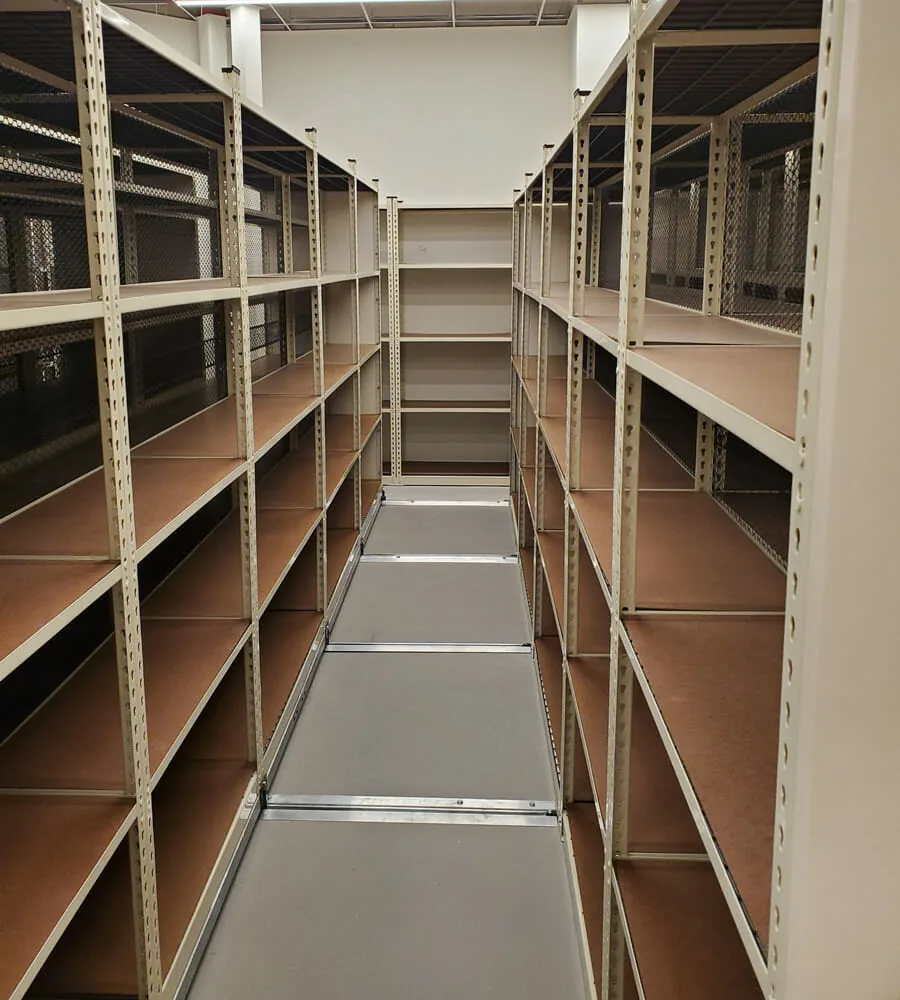
Weekly to monthly: cleaning the rail and listening to the system
Rails are the wear surface of the whole system, and dust is the main enemy. Manufacturer guidance for mobile shelving is consistent on the method: remove dust and debris from the track with a soft brush or a vacuum, and avoid harsh chemicals or water-based cleaners, because moisture in the rail leads to corrosion over time. Monthly cleaning suits most environments; weekly is more appropriate in warehouses, stockrooms and other dusty or high-traffic spaces.
While you are there, use the system deliberately and pay attention. A healthy carriage moves smoothly and quietly with even effort from one end of its travel to the other. Anything else — grinding, ticking, a spot where effort rises, a carriage that closes unevenly at one end — is information. Note it, and have it looked at before it becomes the reason a range is out of service.
Check the aisle locks the same way. Engage one, try to move the range, and confirm it holds. On powered systems, confirm that the safety devices stop carriage motion as documented, and that staff know the recovery procedure when one activates.
What not to do to a rail
Do not lubricate rails or wheels unless the manufacturer’s documentation for your system specifically calls for it. Oil and grease collect the dust you just removed and turn a clean rail into a grinding compound. Do not flood a rail with water-based cleaner, and do not use solvents on painted or powder-coated surfaces.

Quarterly: a real inspection walk
Once a quarter, walk the system with a checklist instead of a broom. Ten minutes per range is enough, and the point is to catch drift before it becomes damage.
- Wheels and bearings rotate freely, with no grinding, resistance or flat spots audible as the carriage travels.
- Drive handles turn smoothly and engage the carriage evenly, with no play at the hub and no slipping under load.
- Drive shafts, chains or belts — where the design uses them — are intact, correctly tensioned and free of visible wear.
- Carriages run square to the rail and close evenly along their whole length, with no gap that opens at one end.
- Anti-tip provisions, end stops and guide systems are present, secure and undamaged.
- Aisle locks and safety devices engage and release as documented, on every carriage and not just the ones in daily use.
- Shelf clips, beams and decks are seated, with no loose or missing hardware and no visibly deflected shelves.
- End panels and fasteners are tight, and nothing rattles or shifts when the range is moved.
- The rail is clean, unbent, still level along its run, and its anchors and any grout are sound.
- The floor around the rail is intact, with no cracking, settlement or new deflection under load.
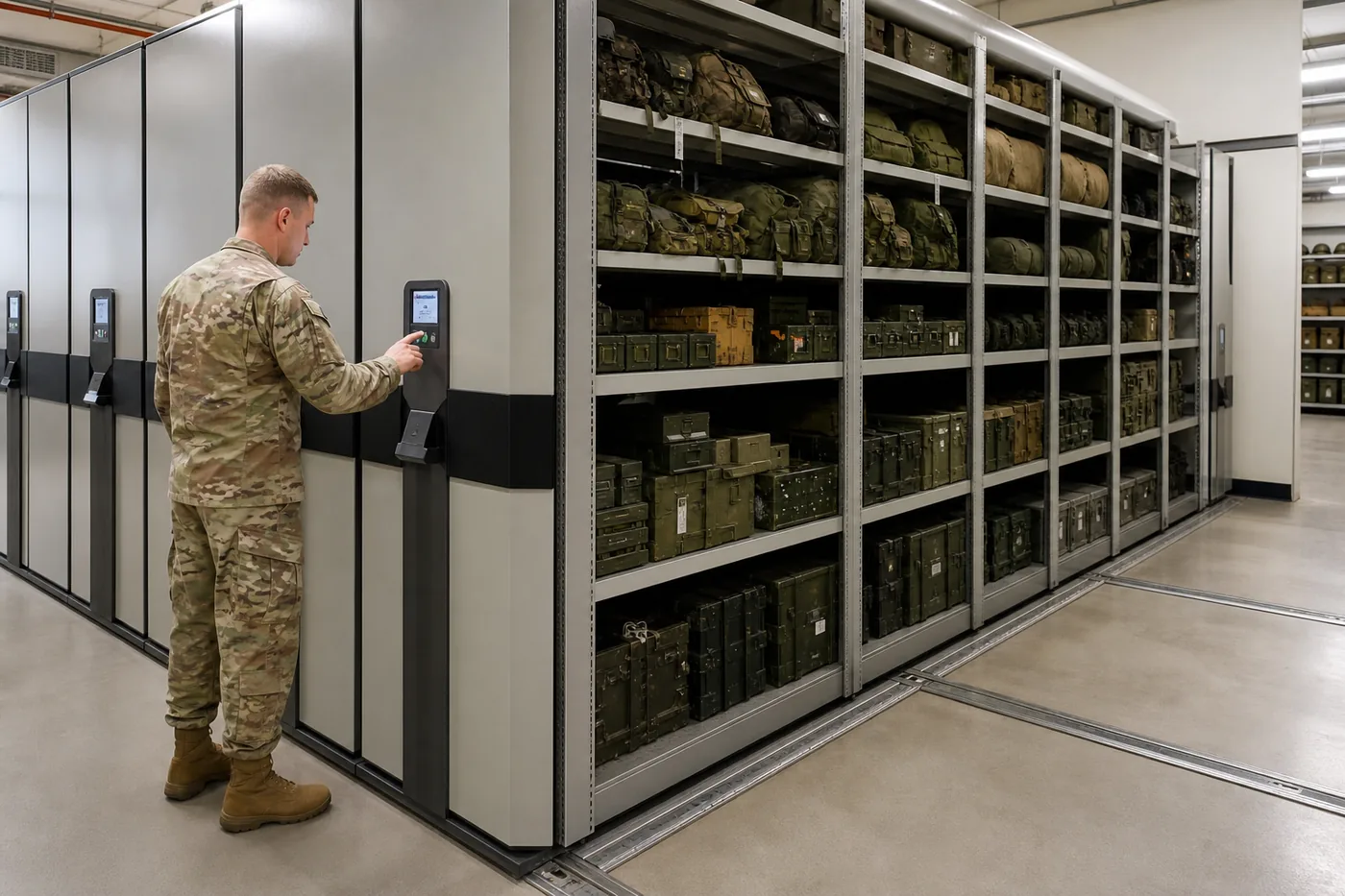
Annually: the professional service visit
Manufacturers of these systems recommend scheduling a preventive maintenance visit by trained technicians at least once a year. That visit exists to do the things a facilities team should not: check and correct the alignment of tracks and carriages, inspect and adjust safety locks and anti-tip mechanisms, examine mechanical components for wear, and verify load distribution and structural integrity.
Two additional items belong on the annual agenda in this region. First, confirm that the anchorage is intact and that nothing has been modified in a way that compromises it — seismic bracing is a code requirement in most jurisdictions here, as covered on our page on seismic anchoring and bracing. Second, verify that loading has not drifted beyond what the floor was confirmed to carry. Rooms fill up, box weights change, and federal records storage facility rules require that a posted floor load limit not be exceeded; the same discipline is worth applying anywhere. See floor load requirements for what that means in practice.
Keep the reports. A file of annual inspection records is what turns a warranty conversation, a budget request or a facility condition assessment from an argument into a document.
Troubleshooting: what the symptom usually means
Most reported problems fall into a short list. Use this to triage before you call — and to describe the problem accurately when you do.
| Symptom | Common causes | What to do first |
|---|---|---|
| Carriage suddenly harder to move | Debris in the rail, an obstruction under a carriage, a load shifted forward, a wheel out of alignment | Stop using it. Clear and inspect the rail and the wheel path; if effort is still high, call a technician rather than forcing it |
| Grinding or scraping noise | Grit in the wheel path, a worn bearing, a carriage running out of square | Clean the rail, then have the wheels and alignment inspected if the noise persists |
| Carriage closes unevenly, gap at one end | Alignment drift, uneven floor or rail, damaged guide system, uneven loading along the range | Do not correct it by pushing harder. This is an alignment item for a technician |
| Drive handle spins or slips | Worn or loose drive components, a hub or shaft connection that has come loose | Take the range out of service and have the drive train inspected |
| Aisle lock will not hold | Worn or misadjusted locking hardware, debris in the mechanism | Treat as a safety item. Take the range out of service until it holds reliably |
| Powered system stops mid-travel | A safety device has activated, an obstruction is present, or a control or power fault | Follow the documented recovery procedure; confirm staff know the manual override for power outages |
| Rust or corrosion at the rail | Moisture from cleaning, a housekeeping process using water, or a building envelope issue | Change the cleaning method to dry brushing or vacuuming and investigate the moisture source |
| New floor cracking near the rail | Loading beyond what the slab was confirmed to carry, or a substrate problem | Stop adding load and get a structural opinion. This is not a shelving repair |
Need a mobile shelving system serviced or inspected?
We install and service high-density mobile shelving across Utah and the Mountain West, including systems we did not originally supply. Tell us the symptom and we will tell you what it usually takes to fix.
Set the system up to be maintainable
Maintenance gets much easier when three things are decided before installation, which is why they belong in the specification and submittal package rather than in a conversation after handover.
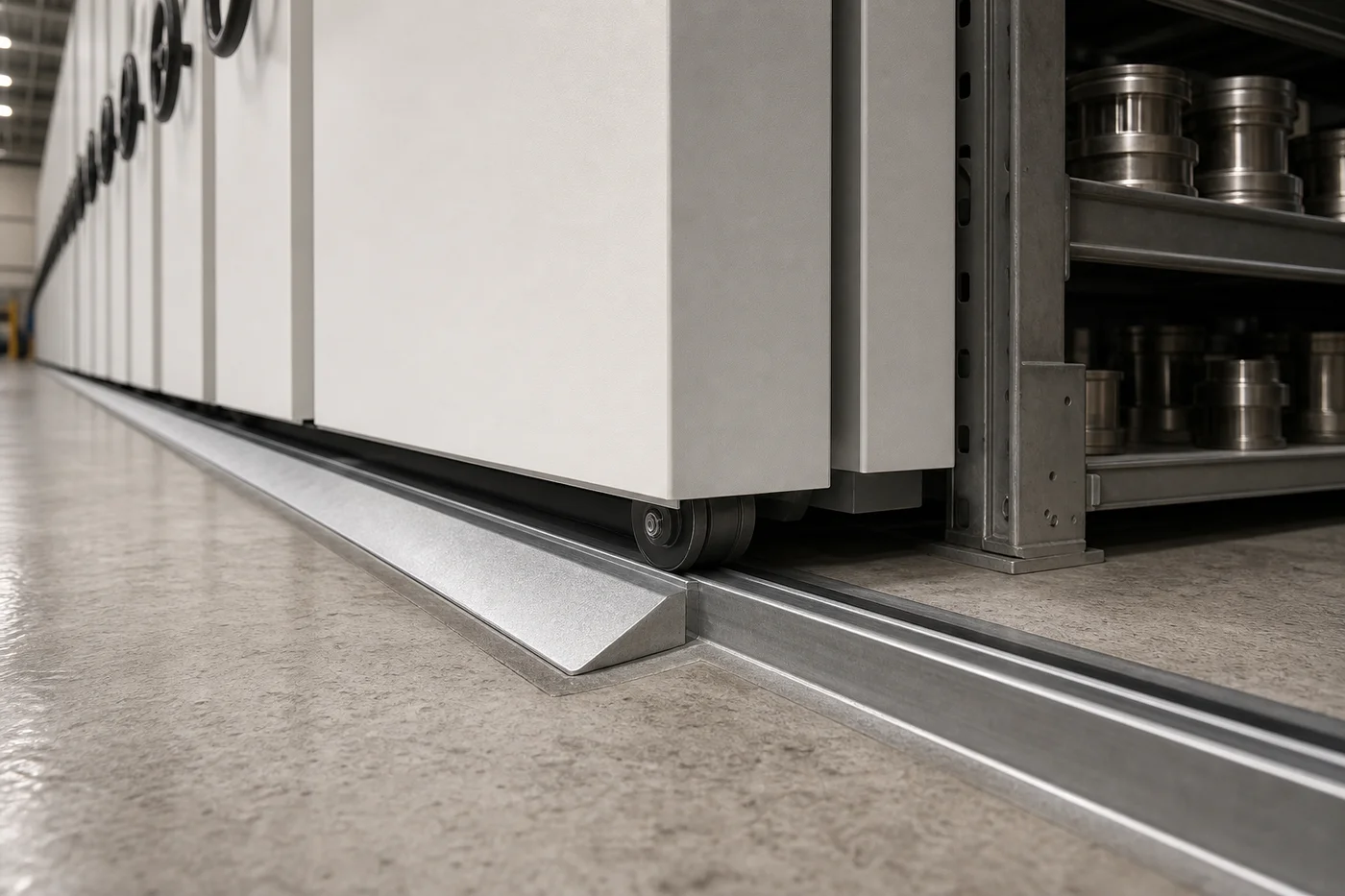
Rail type. Recessed rail set flush with the floor eliminates the ramp, which removes a trip hazard and makes ordinary floor cleaning reach the rail. Surface rail with ramps is perfectly serviceable but collects more debris at the ramp edges and needs more attention there.
Drive type suited to the load. A manual system asked to move ranges beyond its comfortable effort is a system that gets forced, and forcing is what damages alignment. Our comparison of manual, mechanical-assist and powered drives covers how to size that decision.
Documentation and training at closeout. Require operation and maintenance data, warranty documents and hands-on training in the submittal requirements. A room where people know how to hold an aisle open, what not to leave on the rail, and who to call generates dramatically fewer service events.
Get a free quote
Tell us what you are storing, the room size and your timeline. A project specialist will follow up with layout options and pricing. Prefer to talk? Call (800) 326-4403.
How often should mobile shelving rails be cleaned?
How often does a mobile shelving system need professional service?
Should mobile shelving rails or wheels be lubricated?
A carriage suddenly got harder to move. What should we do?
Who can perform mobile shelving maintenance in-house?
What maintenance does a powered mobile shelving system need that a manual one does not?
How long should a mobile shelving system last?
Does maintenance affect seismic compliance?
Keep Your High-Density Shelving Moving
Service, inspection, alignment, parts and relocation for mobile shelving systems across Utah and the Mountain West — including systems installed by someone else.