
Museum Records and File Storage Mobile Shelving Case Study: Salt Lake City, Utah
How the Natural History Museum of Utah added a closed-door, side-by-side high-density filing system to hold letter-size records in a small back-of-house room.

Customer
Natural History Museum of Utah
Location
301 Wakara Way, Salt Lake City, UT 84108
Product
Side-by-side high-density shelving, seven shelf levels, hinged doors, back panels, letter dividers
Application
Museum records and letter-size file storage
About the project
This project supplied a closed-door, side-by-side high-density filing system for records and letter-size file storage at the Natural History Museum of Utah (301 Wakara Way, Salt Lake City, UT 84108). It was purchased on the State of Utah cooperative contract, which is how most Utah public institutions buy storage equipment without running a separate bid.
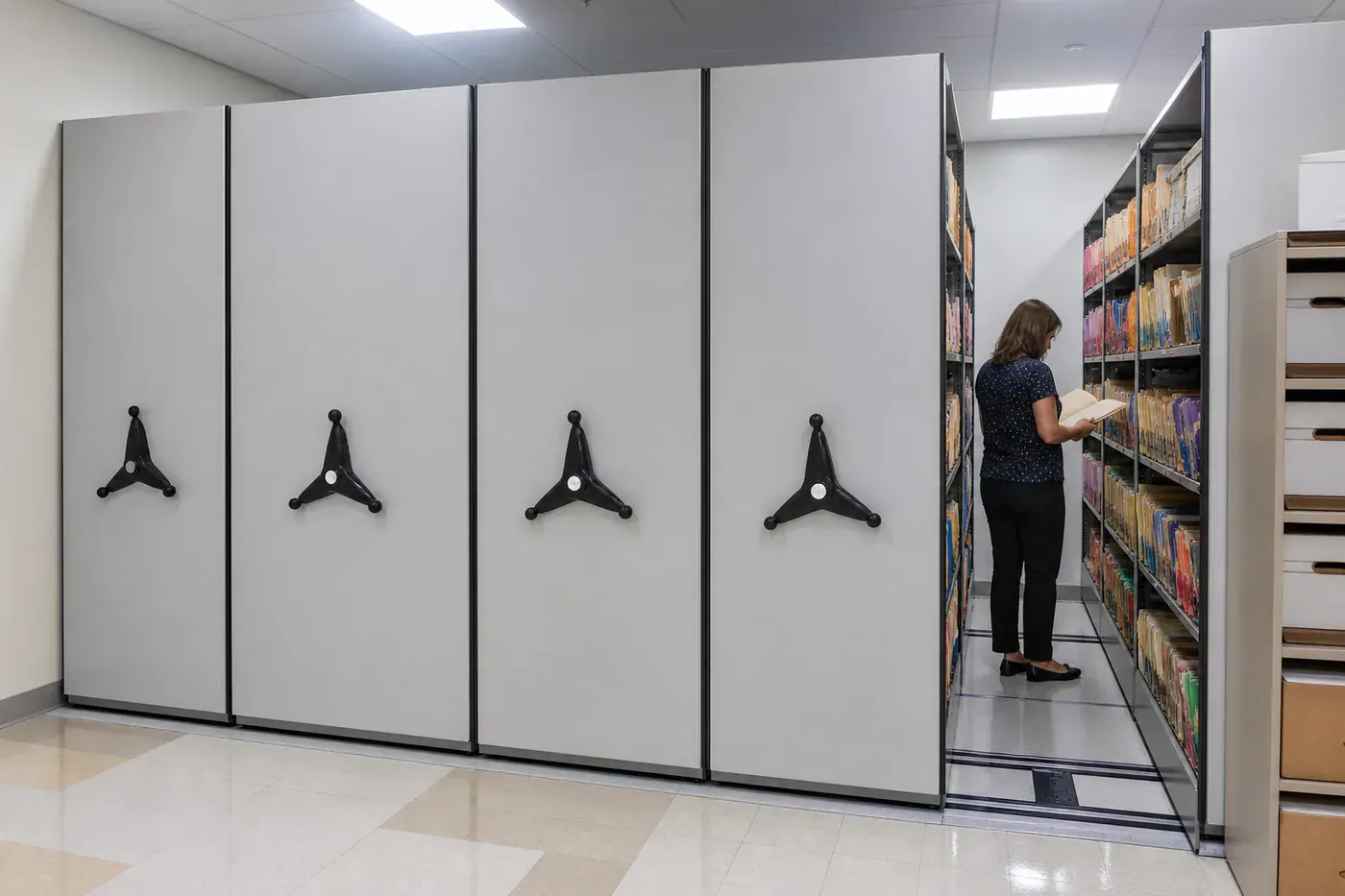
Material Handling USA supplied and installed the system as a compact mobile shelving solution built to an approved drawing, with seven shelf levels, hinged doors and solid back panels on every section, and two dividers per shelf. Freight, inside delivery, installation and packaging removal were included, on an approximately four week schedule.
Project scope at a glance
The situation
A museum’s storage problem is not only artifacts. Every collection carries paper with it: accession and catalog records, condition reports, loan and exhibition paperwork, donor and provenance files, permits and research correspondence. That material is referenced for decades and cannot be discarded when a cabinet fills.
Back-of-house rooms in a museum are also the first space to get squeezed. Collections growth, exhibit fabrication and lab space all compete for the same square footage, so a records room usually has to hold more each year inside the same four walls.
Lateral file cabinets are the least efficient answer available: each one spends floor area on drawer clearance it can never store in. Static open shelving is better, but every range still needs its own permanent aisle. High-density shelving removes those fixed aisles and converts them into filing inches.
What Material Handling USA supplied
The system was built with our partner Aurora Storage, one of the manufacturers we use for high-density mobile shelving.
We supplied a side-by-side high-density shelving system built to an approved drawing, with seven shelf levels per section, hinged doors and solid back panels on all sections, and two dividers per shelf, plus freight, inside delivery, installation and packaging removal.
The configuration follows the material. Letter-size folders are uniform and shallow, so a shallow-depth section with many closely spaced levels holds far more linear filing inches than a deep shelf would, and dividers keep each level browsable instead of letting folders slump.
Because the room was small, a side-by-side arrangement made more sense than a full rail-mounted range system: sections move laterally in front of one another, so the whole run needs only one section’s worth of open space rather than a wide moving aisle.
Why doors and back panels on a records system
Doors are not standard on filing shelving, and this project specified them on every section. In a museum back-of-house room they do three useful things: they keep airborne dust off paper that is meant to last, they keep the run looking finished in a room that visitors or donors occasionally pass through, and they add a simple layer of control over who casually browses records.
Solid back panels do the quiet structural work. Without them, folders pushed too far slide out the back of a shelf into the next range. With them, every section has a defined back wall, which also stiffens the section and keeps the door alignment true over years of use.
Side-by-side systems vs full mobile aisle systems
| Side-by-side high-density | Rail-mounted mobile ranges | |
|---|---|---|
| Best room size | Small rooms and single wall runs | Dedicated records or collections rooms |
| Floor work | Minimal; sections track in place | Floor rail with a twin ramp or a sub-floor |
| Open space needed | About one section of lateral travel | One shared moving aisle |
| Typical capacity gain | Roughly a third to a half more filing in the same wall run | Commonly close to double the capacity of static shelving |
| Good fit for | Records and file storage against a wall | Large records, supply and collections rooms |
What the museum gained
Museum and archive storage across Utah
Material Handling USA is based in Salt Lake City and installs museum, archive and records storage across Utah, from institutional collections rooms on the Wasatch Front to small-town museums in the southern part of the state. Utah public institutions can buy on state cooperative contract, which keeps a project like this to a drawing, an approval and an install date.
Utah collections also have to be planned for earthquakes: the 2020 Magna quake knocked artifacts from shelves at the state history archive. Our guide to planning earthquake-ready mobile shelving in Utah explains anchorage, shelf restraints and review for museum and records rooms.
Related pages: our mobile shelving in Utah overview, the museum and archival collections storage guide, our Blanding, Utah museum collections case study, the Oxford, North Carolina museum and archives case study, and Utah museum shelving.
Call (801) 328-8788 to plan a museum records or collections room.
Frequently asked questions
What does a museum store on high-density filing shelving?
What is a side-by-side high-density system?
Why seven shelf levels?
Do shelf dividers matter for file storage?
Can doors be added to filing shelving?
How long does a system like this take?
Can Utah museums and agencies buy on state contract?
Planning a museum records or collections room?
Send us the room footprint and what you need to file, and we will lay out a high-density system that fits it, including delivery and installation. Utah installs from our Salt Lake City base.