
Planning Earthquake-Ready Mobile Shelving in Utah
A Wasatch Front planning guide for records officers, collections managers and facility teams: what Utah’s hazard and codes mean for a high-density storage room, and what to settle before you buy.

Wasatch Front odds
43% chance of a M6.75+ earthquake in 50 years (UGS/USGS 2016 forecast)
Code in force
Utah State Construction Code based on the 2024 IBC, effective July 1, 2026
State buildings
DFCM requires a nonstructural seismic restraint checklist and submittal
Who it is for
Records officers, archivists, collections managers, facilities and design teams
Why seismic planning is part of every Utah mobile shelving project
High-density mobile shelving puts a lot of weight into a small footprint. Carriages loaded with record boxes, bound volumes, collections objects or parts can weigh several tons per range, stand well over head height and move on rails across the floor. Along the Wasatch Front, where most of Utah’s population, public records and museum collections sit within a few miles of an active fault, that combination makes earthquake design a planning question from day one rather than a detail for the installer.
This guide supports our Utah mobile shelving page and focuses on what is specific to Utah: the state’s earthquake forecast, what the 2020 Magna earthquake did to real collections, which code path applies to your building, how state-owned projects are reviewed by the Division of Facilities Construction and Management (DFCM), and how to plan the room so both the system and its contents come through a quake. For the engineering arithmetic behind anchorage (design force, importance factor and seismic design category), see our national guide to mobile shelving seismic anchoring requirements.
Nothing here replaces the building official or the design professional responsible for your project. It is meant to help owners ask the right questions early, when changes are cheap.
Utah’s earthquake picture in plain numbers
In 2016 the Working Group on Utah Earthquake Probabilities, convened by the Utah Geological Survey and the U.S. Geological Survey, published the first detailed forecast for the Wasatch Front region. Over the next 50 years it estimated:
- a 43 percent chance of at least one magnitude 6.75 or larger earthquake,
- a 57 percent chance of at least one magnitude 6.0 or larger, and
- a 93 percent chance of at least one magnitude 5.0 or larger.
The USGS notes that large earthquakes on the central segments of the Wasatch fault have recurred roughly every 900 to 1,300 years on average, and that the Salt Lake City segment’s most recent large event was roughly 1,200 to 1,600 years ago. In practical terms, a storage system bought today will very likely feel at least a moderate earthquake during its service life, and could face a much larger one.
That is why structural engineers treat most Wasatch Front building sites as high-seismic sites. The Structural Engineers Association of Utah has pointed out that essentially all code-regulated projects along the Wasatch Front should have a project geotechnical report before seismic design begins, because soft valley soils can amplify shaking.

What the 2020 Magna earthquake taught Utah collections
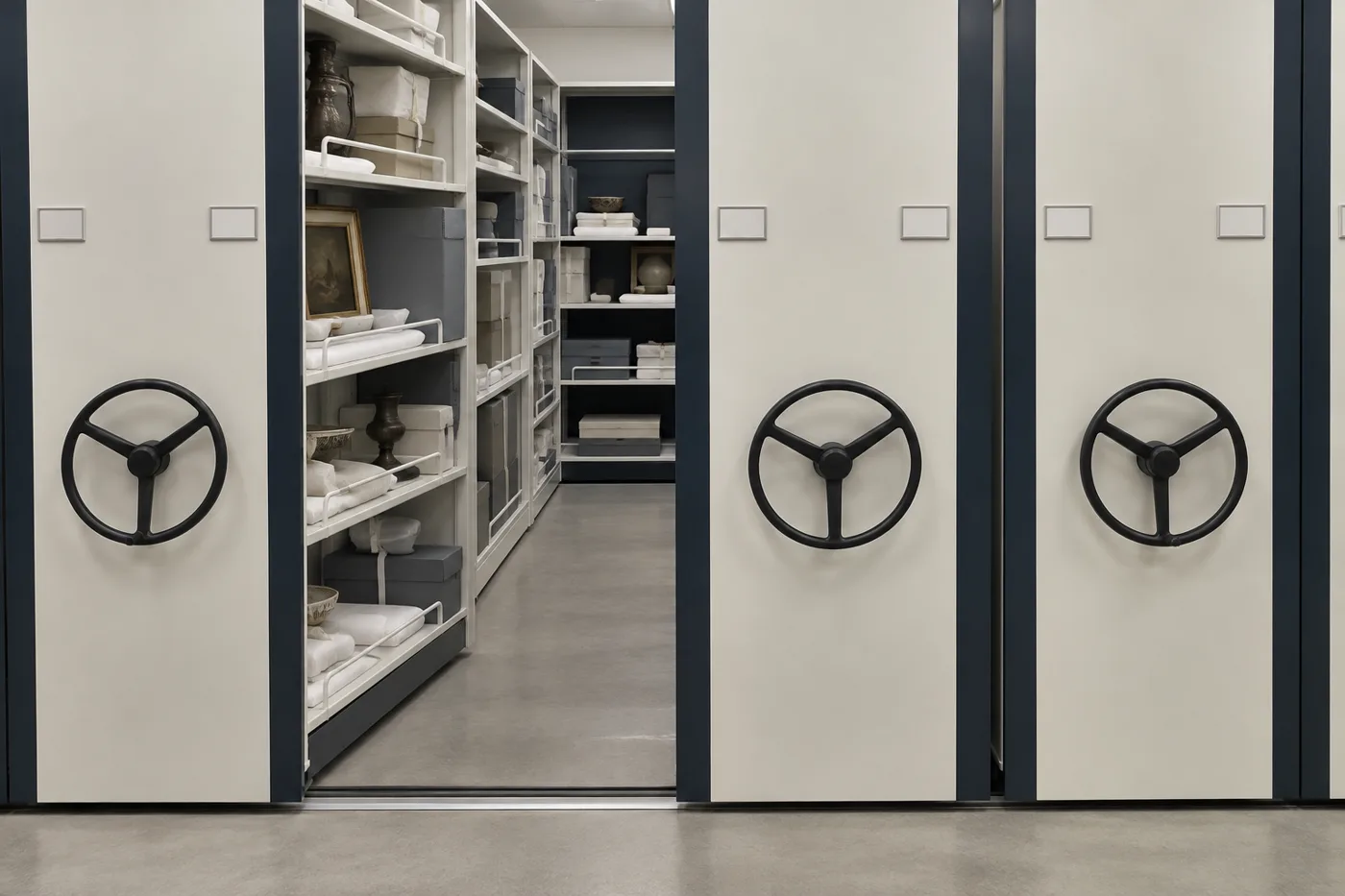
At 7:09 a.m. on March 18, 2020, a magnitude 5.7 earthquake struck with its epicenter north of Magna. More than 30,000 people reported feeling it, and more than 2,500 aftershocks followed, including two magnitude 4.6 events the same day. By Wasatch Front standards it was a moderate quake, yet it exposed weak points in how Utah stored irreplaceable material:
- State history archives. Part of the Utah State Historical Society’s collection was stored in the basement of the Rio Grande Depot. KSL reported that some artifacts were knocked off walls and shelves, and the building’s damage accelerated the move of the collection to other state facilities; the research center did not reopen until early 2023.
- The state art collection. A state spokesperson described the racks holding paintings as having “dominoed.” The Utah Division of Arts & Museums later reported close to 900 works were on that racking and roughly one in four needed frame repair or a new frame, although nothing was a total loss. Shelving holding three-dimensional objects came through undamaged, and the replacement racking was approved by seismic engineers before installation.
- Public libraries. Photos from the Magna branch library showed books thrown from shelves and fallen ceiling tiles.
The lesson for anyone planning a records room or collections store is that the storage furniture and its contents are where much of the loss happens. DFCM’s own guidance notes that nonstructural damage has historically accounted for 25 to 50 percent of the damage observed in recent U.S. earthquakes, and that even small earthquakes can make nonstructural components a life-safety hazard. A well-anchored, well-loaded mobile system addresses both halves of that problem: the structure of the shelving and what sits on it.
Which rules apply to your Utah building
Utah adopts one construction code statewide through the State Construction and Fire Codes Act (Utah Code Title 15A). The 2021 International Building Code took effect in Utah on July 1, 2023, and the 2026 General Session updated the State Construction Code to the 2024 editions, effective July 1, 2026. IBC Section 1613.1 sends the seismic design of nonstructural components permanently attached to a structure to ASCE 7, the national loads standard (the 2022 edition under the 2024 IBC). ASCE 7’s table of architectural components specifically lists permanent floor-supported storage cabinets and library shelving or book stacks more than 6 feet tall, including their contents.
Who reviews the work depends on the building:
| Building | Who reviews it | What that usually means for mobile shelving |
|---|---|---|
| Private offices, clinics, warehouses, law firms | Local building official (city or county) | Anchorage designed to the State Construction Code; local design criteria may apply (Salt Lake City, for example, publishes default site-class rules when no geotechnical report exists) |
| State-owned buildings and agencies | DFCM | A Nonstructural Component Checklist on the plans; seismic restraint details with the construction documents or as a deferred submittal; a project-specific design by a registered design professional, or manufacturer certification of seismic qualification |
| Public school districts | District and the Utah State Board of Education’s construction and facility safety program | School projects follow the State Construction Code; confirm the district’s submittal and inspection process early |
| Hospitals, fire stations, emergency operations centers | Local building official, plus any healthcare licensing review | These are Risk Category IV buildings, where some components carry a higher importance factor; ask the engineer early |
DFCM’s guidelines, current as of its July 2026 revision and written to the 2024 IBC and ASCE 7-22, are worth reading even for private projects because they show what a thorough owner review looks like. They apply to newly constructed buildings, additions and all new or replaced components in existing buildings; they accept products tested and listed under ICC Evaluation Service or IAPMO programs when installed per the listing; they allow manufacturer certification based on engineered analysis, shake-table testing such as ICC-ES AC156, or experience data; and they require a Statement of Special Inspections under IBC Chapter 17. They also make clear that a general reference to a design manual is not a substitute for project-specific documentation.
The ASCE 7 exemptions DFCM summarizes mostly cover components in buildings assigned to Seismic Design Category B or lower and certain small mechanical and electrical items. They rarely help a tall, loaded mobile shelving system in a typical Wasatch Front building, so plan on anchorage being designed rather than assumed.
What gets anchored and checked in a mobile system
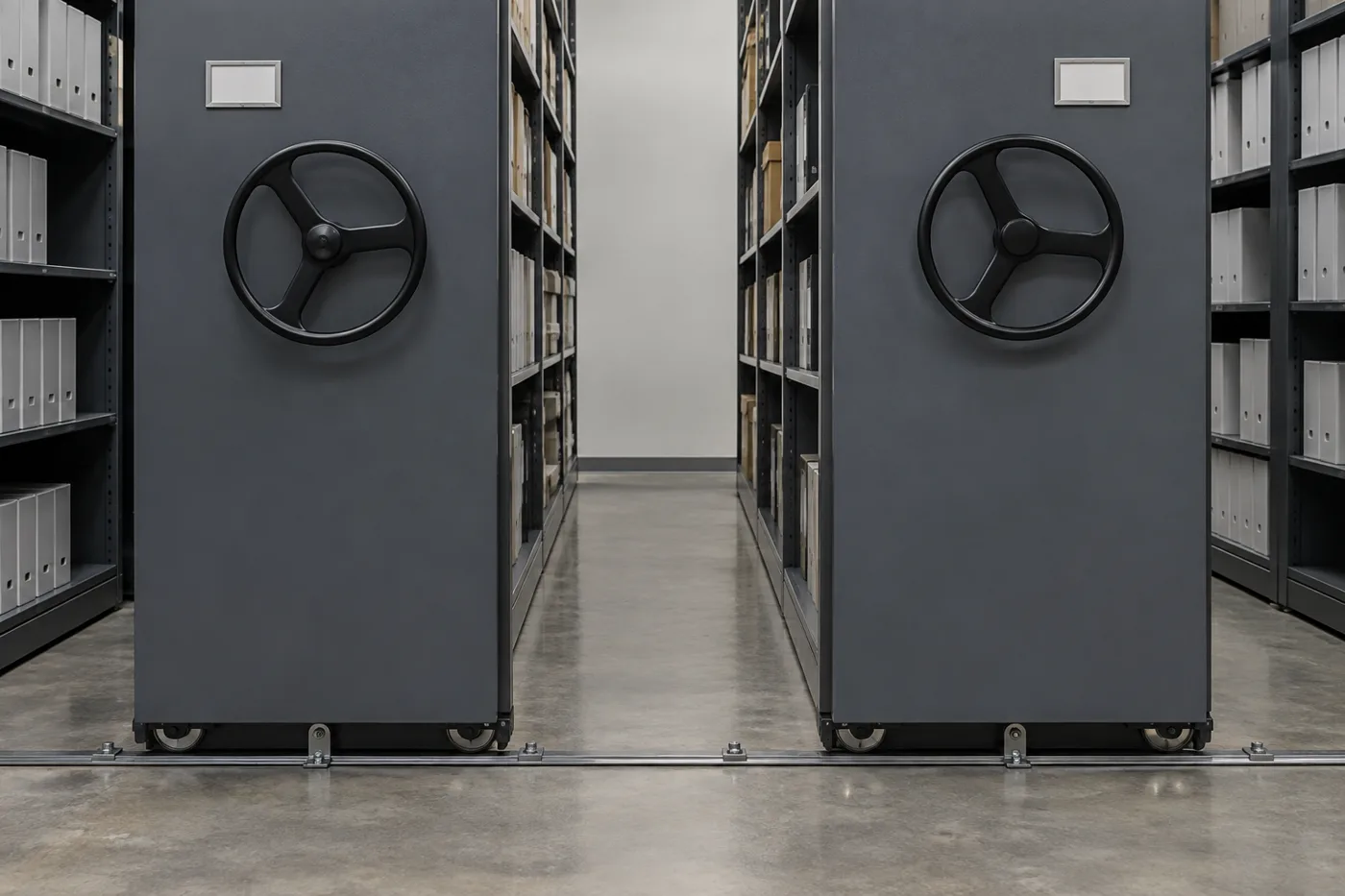
A mobile system has more load paths than a static shelf, because the shelving rides on carriages and the carriages ride on rails. A seismic design typically addresses each link in that chain:
- Rails to the slab. Rails are anchored to the concrete at designed spacing, with anchors suited to the slab thickness and concrete strength.
- Carriages to rails. Anti-tip hardware at the carriage base engages the rail so a loaded carriage cannot rock off or overturn.
- Shelving to carriages. Uprights are fastened to the carriage deck so the shelving and carriage act as one unit.
- Stationary end ranges. Fixed ranges at the ends of the block are anchored, and some designs add overhead ties where walls or structure allow.
The slab is the part owners most often overlook. Anchors need enough concrete depth and strength, and existing Utah buildings range from new post-tensioned slabs to decades-old floors of unknown thickness. Coring or drawings that confirm the slab should come before layout, not after. Our pages on floor load requirements and recessed versus surface-mounted rail cover the related decisions.
Keep the contents on the shelves

Anchoring keeps the shelving standing. It does not stop boxes, ledgers or artifacts from sliding off. Magna showed that contents are where much of the loss and clean-up happens, so plan them deliberately:
- Shelf front restraints. Restraint bars or raised shelf lips across the front of each shelf keep boxes from walking off during shaking.
- Lidded containers. Loose files and small objects in lidded record boxes stay together even if a box shifts.
- Heavy low, light high. Bound volumes, full file boxes and dense items belong on the lower levels; this also lowers the loaded system’s center of gravity.
- No storage above the top shelf. Items stacked on top of carriages are the first to fall and can block aisles.
- Padding and ties for collections. Museums commonly pad shelves and secure fragile objects individually so they cannot strike each other.
Load placement is also part of the engineer’s assumptions. If the design assumes an evenly loaded system and the room ends up with every heavy box on the top two shelves, the real system no longer matches the calculation. Our guides to shelf depth and level spacing and load ratings help turn that into a written loading plan staff can follow.
After a quake: inspection before anyone opens an aisle
Magna’s aftershock sequence, with two magnitude 4.6 events within hours of the main shock, is a reminder that the first day after an earthquake is not the time to walk into a narrow aisle between heavy carriages. A simple written procedure helps:
Build this into your emergency plan alongside the records-protection steps in our guide to mobile shelving and vital records disaster preparedness, and keep routine service on schedule so small problems do not become earthquake problems; see maintenance and service intervals.
Seismic questions by Utah facility type
The basic approach is the same everywhere, but different Utah facilities raise different questions. We have supplied mobile shelving to many of these settings across the state:
How an earthquake-ready Utah project gets specified
A seismic mobile shelving project in Utah usually follows the same sequence. Starting it early avoids the most expensive surprise, which is discovering at permit time that the slab or the layout does not work:
For the documents most reviewers expect, see our specification and submittal checklist, and for installation steps, how mobile shelving is installed. Existing systems that are being moved or reused need the same check; see relocating and reusing mobile shelving.
Common mistakes on Utah seismic projects
- Choosing a layout before anyone has confirmed the slab.
- Assuming a moderate quake like Magna is the design case for the Wasatch Front.
- Treating anchorage as the installer’s problem instead of part of the submittal.
- Forgetting the contents: no shelf restraints, heavy boxes up high, storage on top of carriages.
- Reusing an old system in a new building without re-checking anchorage for current code.
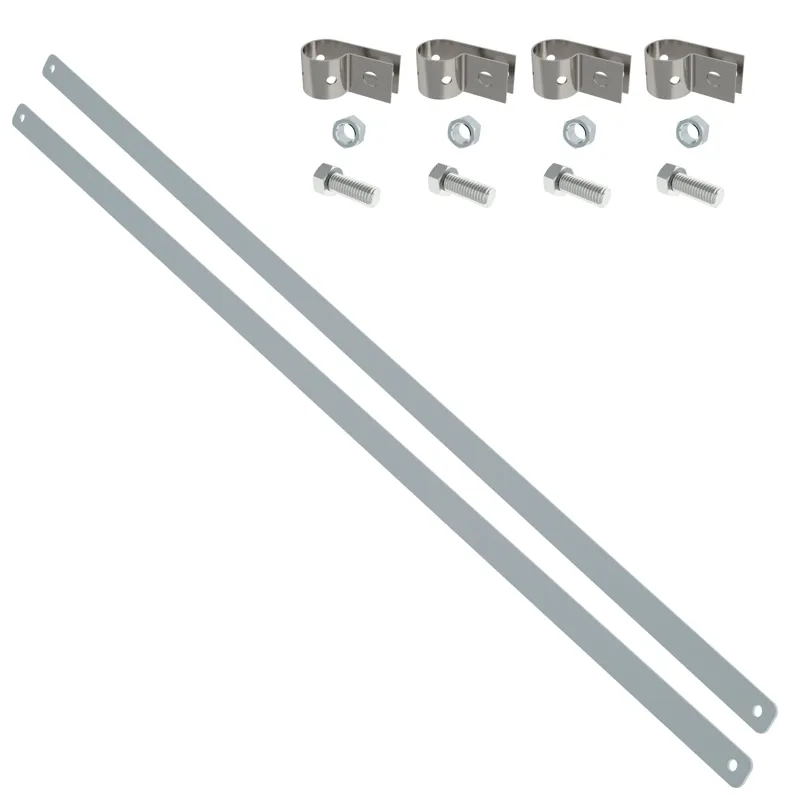
Shop Seismic Shelving Bracing and Lidded Record Boxes Online
Sway-brace kits for static wire shelving and lidded file storage boxes that keep records contained on the shelf. Engineered mobile systems are designed and quoted per project.


Get a free quote
Tell us what you are storing, the room size and your timeline. A project specialist will follow up with layout options and pricing. Prefer to talk? Call (800) 326-4403.
Frequently asked questions
Does mobile shelving have to be seismically anchored in Utah?
Which building code edition applies in Utah right now?
What does DFCM require for state-owned buildings?
Was the 2020 Magna earthquake the kind of quake Utah designs for?
How do we keep boxes from falling off mobile shelving in an earthquake?
Can we move our existing mobile shelving into a new Utah building?
Planning an earthquake-ready storage room in Utah?
Send us your room dimensions, what you plan to store, and anything you know about the slab and the building. We will prepare a layout drawing and flag the seismic, floor and submittal questions to settle with your engineer or building official. Call (801) 328-8788 to start.