
Mobile Shelving Weight Capacity and Load Ratings
A shelf rating and a carriage rating are not the same number, and neither one is the floor load. Here is what each figure on a mobile shelving spec sheet actually means and how to read it correctly.
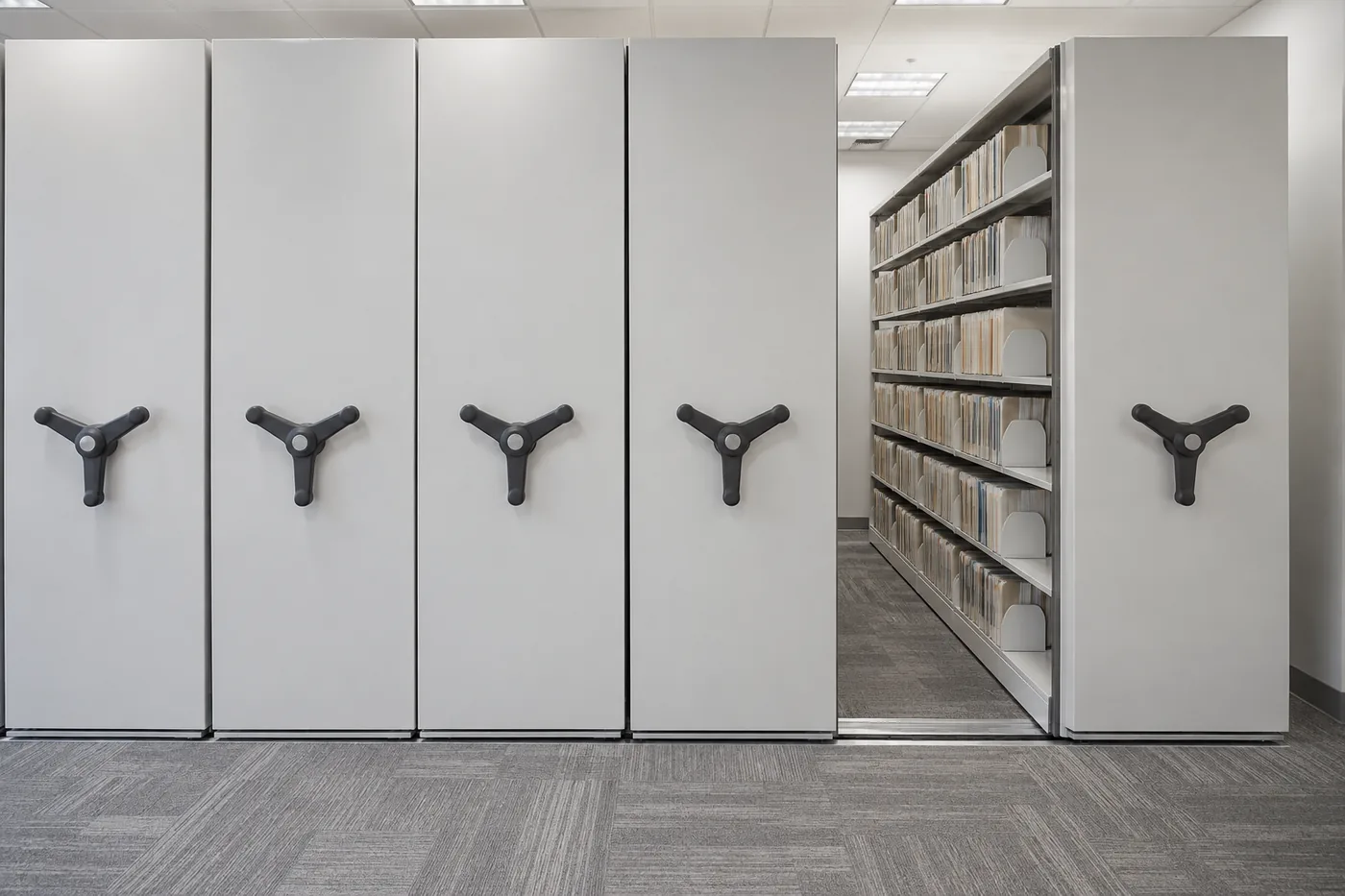
2 ratings
Per-shelf capacity and total carriage capacity are different numbers
UDL basis
Published shelf ratings assume weight spread evenly, not stacked in one spot
Deck matters
Solid steel and wire mesh decks carry differently even at the same size
Not the floor
Shelf/carriage rating is separate from the slab load requirement underneath
A shelf rating and a carriage rating answer different questions
Every mobile shelving quote and spec sheet carries weight numbers, and buyers often assume there is one number that answers “how much can this hold.” There are at least two, and they answer different questions:
- Per-shelf (or per-bin) capacity. How much a single shelf level can carry, almost always stated on a uniformly distributed load basis.
- Per-carriage (total) capacity. How much the entire moving structure — every shelf level on that carriage, added together — can carry while still traveling on its wheels and rail without excess force or damage.
- Drive mechanism capacity. A separate, related number on manual and mechanical-assist systems: how much total weight the handle, handwheel or chain drive is geared to move and hold without drifting.
- Floor (structural) load. Not a shelving number at all — the total weight the slab underneath has to carry once the fully-loaded system is in place. Covered on its own in the floor load requirements guide.
A system can be entirely within its per-shelf rating on every level and still be over its carriage total, if enough heavily-loaded levels are stacked on one carriage. The reverse is also true: a carriage well under its total rating can still have one overloaded shelf if weight is not distributed sensibly between levels.

Uniformly distributed vs. concentrated loads
Published shelf ratings are stated on a uniformly distributed load (UDL) basis — the tested assumption that weight is spread evenly across the whole shelf surface. That assumption matters more than buyers usually expect:
What a UDL rating assumes
An even sheet of weight across the entire shelf, edge to edge and front to back. Ordinary filing, uniform totes, cartons of similar size and stock that fills most of the shelf footprint all behave close to a UDL in practice.
What breaks the assumption
A single heavy item in one corner, a piece of equipment resting on a few small feet, a stack of dense material pushed to the back of the shelf and left empty in front — all of these are concentrated (point) loads. A shelf rated for a generous UDL can be locally overstressed by a concentrated load that is nowhere near that total number, especially on a wire deck where the load is carried by the grid rather than a continuous surface.
Manufacturers that also test and publish a concentrated-load figure state it as a separate number from the UDL rating. If a spec sheet only shows one number, assume it is the UDL rating and ask directly about concentrated loads before storing anything point-heavy — test equipment, dense parts, or archival boxes packed with metal contents are the cases we see most often.
How deck material changes the number
The shelf deck itself — solid steel, welded wire mesh, or a polymer/composite panel — is not interchangeable at the same published gauge and shelf size. Wire decks carry load through a grid of welded wires rather than a continuous plate, which changes how the same nominal weight behaves on the shelf:
| Deck type | How it carries load | Where it is chosen |
|---|---|---|
| Solid steel | Continuous surface, load spread across the whole panel; least sensitive to small concentrated loads | General filing, cartons, uniform stock, and anywhere spill containment or a closed surface is wanted |
| Welded wire mesh | Load carried by the wire grid; visibility and airflow through the deck, but more sensitive to a small heavy item landing between wires or at one point | Fire-code-driven open-shelf designs, parts storage where visibility matters, and rooms needing ventilation |
| Polymer / composite | Varies by product; typically rated lighter-duty than steel and chosen for corrosion resistance rather than raw capacity | Cold storage, wash-down environments, chemical exposure |
The wire versus solid shelf decks guide compares the two in more detail on ventilation, fire-code implications and cleanability; the point for capacity purposes is that a shelf rating is never a property of “steel shelving” in the abstract — it is specific to the deck type, gauge and depth actually tested.

Carriage totals and the drive mechanism
The carriage total is not simply a bigger version of the shelf rating — it is a separate structural and mechanical question:
This is also why adding shelf levels to an existing carriage, or converting light shelving to a denser storage medium later, is a question for the manufacturer rather than a field modification — see the modular expansion design guide for planning a system that can grow without exceeding the original carriage and drive ratings.
Shelf rating vs. floor load — two different engineering questions
The single most common confusion we see in a mobile shelving spec review is treating the shelf/carriage rating and the floor load requirement as the same thing. They are not:
| Shelf / carriage rating | Floor load requirement | |
|---|---|---|
| What it measures | What one shelf, and the whole carriage, can carry | What the slab underneath the entire installed, fully-loaded system has to support |
| Who states it | The shelving manufacturer’s product engineering | A structural engineer, based on the building’s actual slab and the system’s total installed weight |
| What it’s used for | Confirming you can safely store what you plan to store on each level | Confirming the existing building can safely carry the finished system at all |
| Where it’s covered | This page | The floor load requirements guide |
Read both before you sign
A quote that only states shelf capacity has answered half the question. Ask for the carriage total and, on an existing building, confirm the floor load has been checked against the structure — not assumed.

Reading a manufacturer’s spec sheet without guessing
Bin shelving placed on mobile carriages is covered by the current edition of the structural shelving standard for industrial steel bin shelving, which states capacities on a uniformly distributed load basis — a useful common reference point, since it means a rating stated “per ANSI MH28.1” or an equivalent reference is describing the same kind of test every other manufacturer using that standard ran. When a spec sheet gives you a number, confirm four things before comparing it to another quote:
- Is it per shelf, per bin opening, or per bay (a group of shelves between uprights)? These are not interchangeable.
- Is it stated as a UDL, and does the sheet separately note a concentrated-load allowance?
- Is the carriage total shown separately from the per-shelf number, or do you have to calculate it yourself by adding up every level?
- Does the quoted deck type (solid, wire, gauge) match what the rating applies to, or is the rating for a different deck option than what’s being priced?
What overloading actually does
Exceeding a rated capacity rarely fails dramatically and immediately. What actually happens, roughly in order of how much it is exceeded:
- Excess operating force. A manual or mechanical-assist carriage becomes noticeably harder to start and stop — the drive was sized to the rated total, and pushing past it shows up first as force at the handle.
- Shelf deflection. A shelf loaded well past its rating can bow or sag, which on a mobile system can bind against the level above or below as the carriage travels.
- Accelerated wear. Wheels, bearings and rail take the extra load on every pass, shortening service life well before anything visibly breaks.
- Structural damage. In a sustained or severe overload, shelf or carriage frame damage — the case that actually requires repair or replacement rather than maintenance.
Overload is also a stability question, not just a structural one — see the safety features and design guide for how load discipline connects to anti-tip provisions on tall or heavily loaded ranges, particularly in seismic regions covered in the seismic anchoring guide.

Specifying capacity correctly
Write weight requirements into the specification the same way the specification and submittal checklist handles every other performance requirement — as a number the manufacturer has to design to and submit calculations against, not a line item left to their judgment:
- State the actual heaviest realistic contents per shelf, including growth room, not just today’s inventory.
- Ask for both the per-shelf UDL rating and the carriage total in the submittal, and confirm they were calculated for the deck type actually being quoted.
- Flag any concentrated or point-heavy items (equipment, dense parts, metal-content boxes) explicitly and ask for a concentrated-load figure, not just a UDL number.
- On any existing building, require a floor load calculation as a submittal item — see the floor load requirements guide — rather than assuming the shelf rating covers it.
- For systems planned to grow, size today’s carriage and drive to the load you’ll actually reach, not just the load you’re starting with; see the modular expansion design guide.
Not sure your planned contents fit the rating?
Tell us what you’re storing, roughly how it’s packaged, and how full a shelf typically runs. We’ll match it against real manufacturer shelf and carriage ratings before you spec anything.
Design & price it online: Metro High-Density Shelving Configurator
Configure Top-Track and qwikTRAK high-density shelving banks in our free Metro High-Density Shelving configurator — build the layout, see a full bill of materials and save or send the quote in minutes. Need a different Metro product? Browse all 17 tools in the Metro configurator hub.
Shop Track-Mounted Shelving Components Online
Buy select items directly from our online store, or request a quote for volume, custom sizes and freight-rated orders.


Get a free quote
Tell us what you are storing, the room size and your timeline. A project specialist will follow up with layout options and pricing. Prefer to talk? Call (800) 326-4403.
Frequently asked questions
What is a mobile shelving weight capacity rating?
What is the difference between a uniformly distributed load and a point load?
Does the shelf deck material change the weight rating?
Is the shelf rating the same as the floor load requirement?
How is total system capacity calculated?
What happens if a shelf or carriage is overloaded?
Do different mobile shelving manufacturers rate capacity the same way?
Get your mobile shelving weight capacity confirmed before you order
Send us what you’re storing, how it’s packaged and how the room is used. We’ll size the shelf and carriage capacity, the drive mechanism and, if needed, coordinate the floor load check before anything ships.