
Moving or Reusing an Existing Mobile Shelving System
Relocating a high-density system is not the same job as installing one. This is what can be reused, what almost never can, and the sequence that keeps a move from turning into a replacement.

Rail
The component least likely to be reusable
2 floors
The old one and the new one are both scopes of work
Empty first
Contents always leave before the equipment
Survey
The step that decides whether the move is worth doing
A relocation is not an installation in reverse
Organizations relocate high-density storage for ordinary reasons: a lease ends, a department consolidates, a building is refurbished, a records room moves to a different floor, or a system is bought second-hand from an agency that no longer needs it. The instinct is to treat it as a moving job. It is closer to a dismantling job followed by a fresh installation with used parts — and pricing it as the former is how these projects go wrong.
The reason sits in how the equipment works. A high-density mobile shelving system is not free-standing furniture. The carriages roll on rail that was set out, levelled and anchored to a specific floor, and the whole assembly was commissioned against that floor’s flatness. Move the carriages to a different room and none of that survives. Everything above the rail may well be reusable; the interface between the equipment and the building has to be created again from scratch.
This page covers how to judge whether a move is worthwhile, what typically transfers, the order the work has to happen in, and where the costs hide. It applies equally to relocating your own system and to evaluating a used system someone is offering you.

Five gates that decide feasibility
Answer these before anything is dismantled. Each one can move cost out of the moving budget and into a replacement line, and it is far cheaper to discover that while the system is still standing.
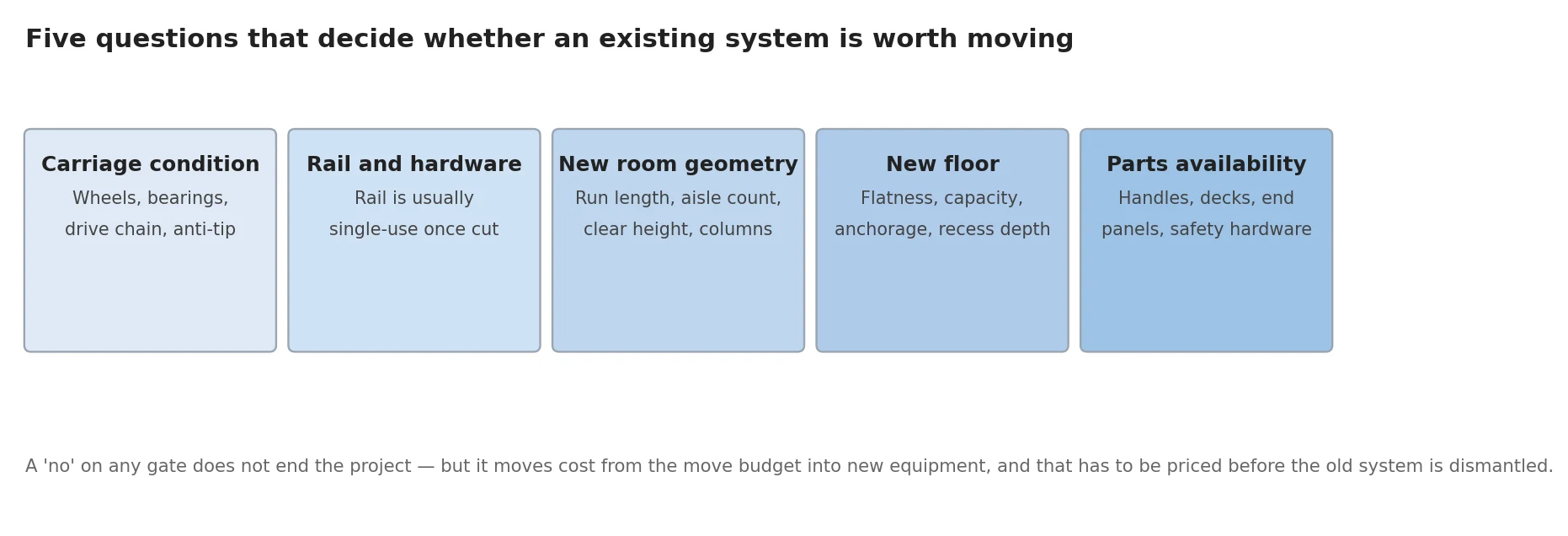
- Carriage condition. Wheels, bearings, drive mechanism, chains, anti-tip devices and safety hardware. A system that has been serviced on a regular interval usually moves well; one that already binds or drifts will not improve by being taken apart.
- Rail and floor hardware. Rail sections, anchors and levelling shims are the components most often written off. Rail cut and set out for one room rarely matches another, and anchors are typically single-use.
- New room geometry. Range length, aisle count, clear height, column positions, door swings and egress paths. A system built for a long, narrow room may simply not configure into a square one.
- New floor. Flatness, levelness, structural capacity, and whether the design will be surface-mounted or recessed. The floor decides how much preparation the destination needs.
- Parts availability. Handles, decks, end panels, shelf hardware and safety components get damaged during dismantling. Confirm that replacements are still obtainable for the system in question before committing.
Get the survey in writing
A relocation quote based on a photograph is a guess. Ask for a written survey of the existing system, the existing floor and the destination floor, identifying what is being reused and what is being replaced. That document is what protects the budget later.
What usually reuses well — and what usually does not
| Component | Typical outcome | Why |
|---|---|---|
| Shelving uprights, decks and dividers | Usually reusable | Ordinary steel components; the usual losses are damage in handling and mismatched replacements |
| Carriages | Usually reusable if serviced | The most valuable part of the system; condition of wheels, bearings and drive determines it |
| Drive handles and mechanisms | Often reusable | Wear items, but replaceable individually if the system line is still supported |
| Rail, anchors and levelling shims | Usually replaced | Cut and levelled for a specific floor; anchors are generally single-use |
| End panels and finishes | Mixed | Cosmetic damage is common in transit and panels are frequently sized to the original run length |
| Safety hardware and labels | Replace as needed | Anti-tip and aisle-safety components should never be reinstalled in doubtful condition |
| Infill flooring or ramps | Replaced | Belongs to the old room, not the equipment |
The rail is the item that surprises people most. Whether the original was recessed into the slab or surface-mounted with an infill floor changes both the removal work and what the new room needs; our recessed versus surface-mounted rail page explains the difference and its consequences. Assume the destination needs new rail unless a competent survey says otherwise.

The sequence, and why the order is not negotiable
Most of the damage done to relocated systems happens because steps were taken out of order — typically dismantling before labelling, or lifting carriages while ranges are still loaded.
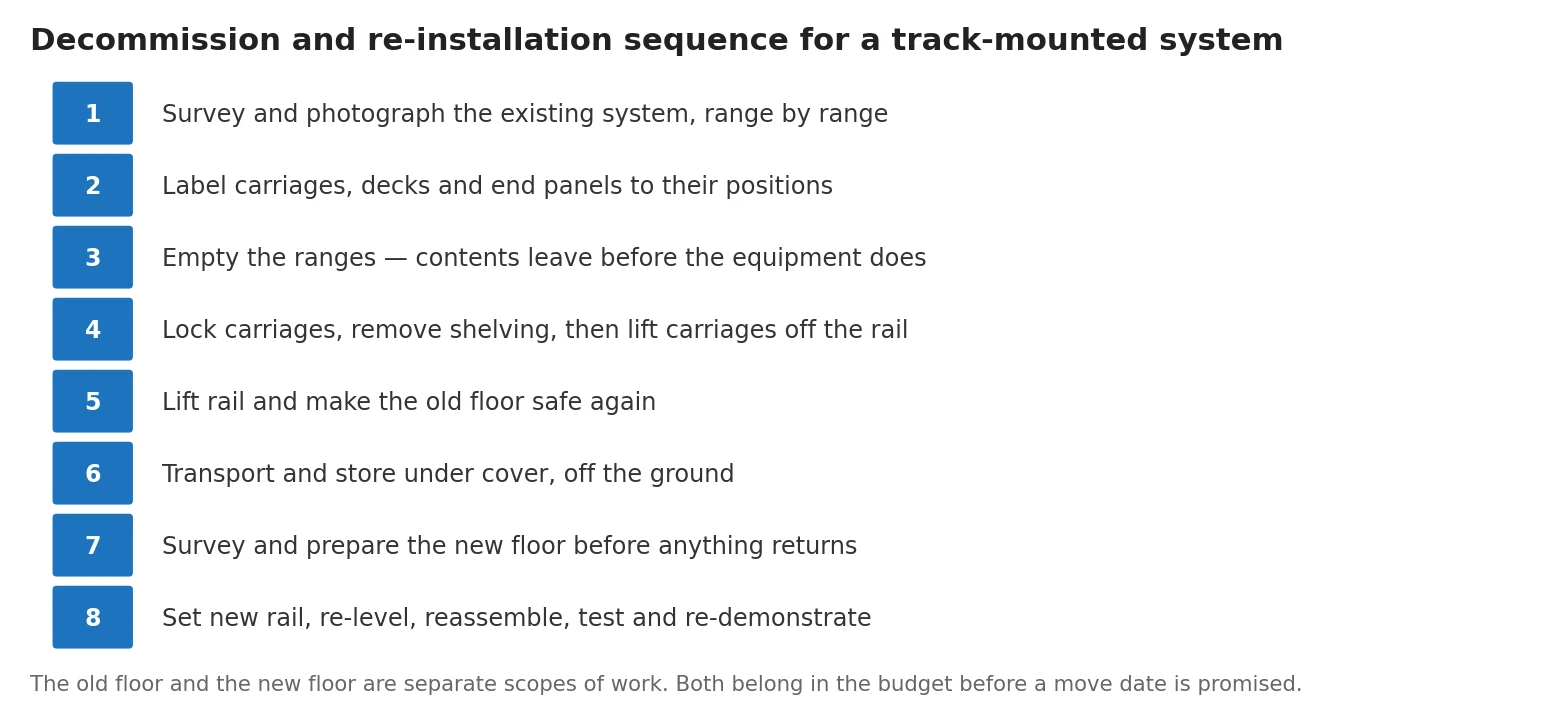
Survey and record. Photograph the system range by range and record the configuration: run lengths, aisle count, shelf depths, level spacing, drive type and any non-standard components. That record is the shop drawing for reassembly, and it is also the evidence for anything found damaged on arrival.
Label to position. Carriages, decks, end panels and hardware are not interchangeable in practice even when they look identical, because they have worn into their positions. Labelling is tedious and it saves days later.
Empty the ranges. Contents always leave before the equipment does. This is the part that dominates the schedule in a records room or library, and it is the part organizations most often underestimate; plan boxes, carts, staging space and staff time as a separate work package.
Dismantle in reverse. Shelving and decks come off, then the carriages come off the rail, then the rail is lifted. Rail removal is where the old floor gets damaged, so agree in advance who is making the old floor safe and to what standard.
Prepare the destination first. A floor survey, structural review and any levelling or infill work should be finished before equipment arrives on site. Reinstallation then follows the same readiness gates as any new system — our installation process page covers those in detail, and they apply in full to a reused system.
Commission properly. A relocated system needs the same testing, adjustment and demonstration as a new one: aisles opening and closing under load, safety devices proven, anti-tip verified, and staff shown how to operate it. Do not accept a handover that skips this because the equipment is not new.
Two floors, two scopes of work
Every relocation involves two building scopes that are easy to leave out of a budget.
The floor you are leaving. Removing rail leaves anchor holes, adhesive residue, recess channels or a raised infill floor to take up. If the space is being handed back under a lease, making good is usually a contractual obligation with a standard attached. Establish who owns it before the move starts.
The floor you are arriving at. A relocated system imposes exactly the same demands as a new one. The structural capacity of the destination must be reviewed for the concentrated load of a compacted collection — covered on our floor load requirements page — and the anchorage and bracing must satisfy the seismic requirements of the local code, covered on our seismic anchoring page. Flatness and levelness decide how much shimming or levelling the rail will need.
If the destination is an occupied building where work has to happen around staff, the phasing techniques on our retrofit into an existing building page apply directly.

Storage between buildings
Moves rarely line up perfectly, and equipment often waits somewhere in between. That interval is where avoidable damage happens.
- Store under cover and off the ground. Painted steel that sits on a damp slab or outdoors will show corrosion at the contact points, and carriages with wet bearings do not roll properly afterwards.
- Keep components together by range and keep the labelling intact. Mixed pallets of unlabelled parts are the most common reason a reinstallation takes twice the estimated time.
- Protect drive mechanisms and handles separately. They are the most easily bent components and the most disruptive to replace.
- Keep the survey record with the equipment. Whoever reassembles it may not be whoever took it apart.
- Plan the storage duration honestly. A three-week gap is a logistics detail; a six-month gap is a storage cost that belongs in the comparison against buying new.
Move it, or replace it?
There is a point at which relocation stops making financial sense. It is usually reached when the sum of dismantling, transport, new rail, floor preparation, replacement parts and reinstallation approaches the cost of new equipment that is correctly configured for the new room. Because the new-equipment option also resets the service life and comes with a warranty, the break-even is nearer than people expect.
Relocation tends to be worth it when the system is relatively young and well maintained, the destination room has a similar geometry, the destination floor is in good condition, and the collection is not changing. It tends not to be worth it when the system is already at the end of a long service life, the configuration does not suit the new room, the drive type no longer matches how the collection is used, or parts are no longer available.
Two related questions are worth asking at the same time. Is the current drive type still right for how the material is used now? And is the current shelf depth and level spacing still right for what is being stored? A move is the cheapest moment to change either, because the system is already apart.
Whichever way it goes, keep the maintenance record with the equipment; our maintenance and service intervals page covers what should have been happening, and a gap in that record is itself an input to the decision. If the outcome is new equipment, our cost and budget drivers and specification and submittal checklist pages cover the next step.
Related Boxes & Packaging Supplies
These are boxes and packaging supplies, not shelving, mobile carriages, or storage-system equipment. See each product page for current price and ordering details.




Get a free quote
Tell us what you are storing, the room size and your timeline. A project specialist will follow up with layout options and pricing. Prefer to talk? Call (800) 326-4403.
Frequently asked questions
Can mobile shelving be moved to another building?
Can we reuse the existing rail?
Do we have to empty the shelving before it is moved?
Is buying a used mobile shelving system a good idea?
Who repairs the floor we are leaving?
Does a relocated system need to be commissioned again?
Moving a mobile shelving system?
Send us photos of the existing system and dimensions of the destination room, and we will tell you plainly what can be reused and what should be replaced.