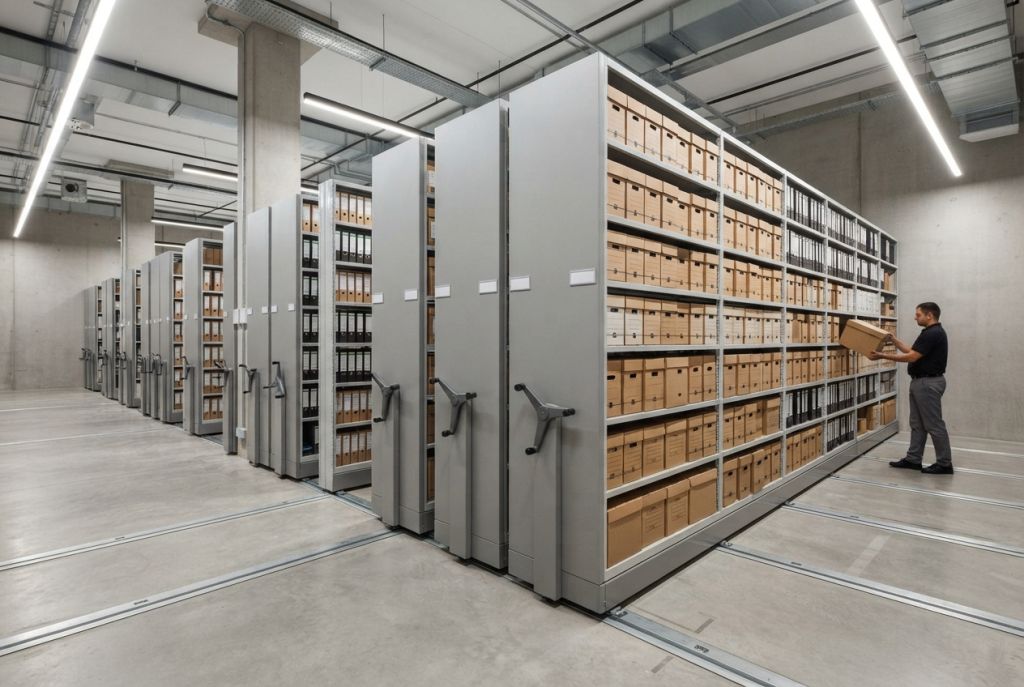
Space gets tight gradually, then all at once. One department adds more records. Another keeps old files longer for compliance. A secure room becomes overflow storage. Before long, staff are walking around cabinets, retrieval takes too long, and the floor plan starts working against the operation.
That's where high density file storage systems make a real difference. They're not just shelving on tracks. They're a way to reclaim usable square footage, improve access, and delay the need for expansion. For buyers comparing options, the key issue usually isn't whether storage is needed. It's whether the current layout wastes too much of the building to justify keeping it.
Is Your Storage Space Working Against You?
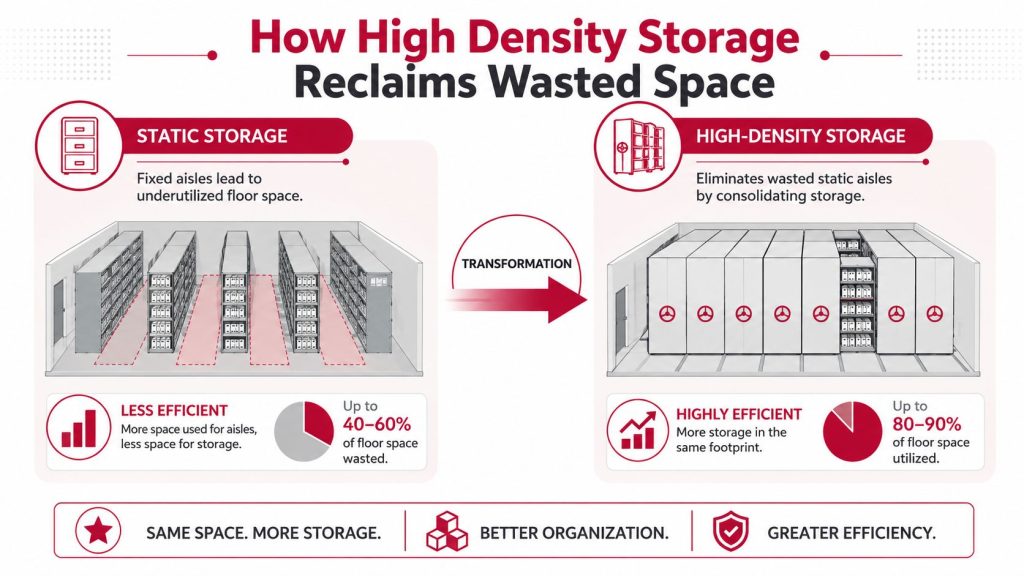
A common layout problem looks simple on paper. Rows of static shelving or filing cabinets seem organized enough at first. But each row needs its own access aisle, and those aisles consume space whether someone is using them or not. In practice, that means a large part of the room is reserved for empty walking paths.

For facility managers, that waste shows up in several ways. Files spill into adjacent rooms. Teams split collections across departments. Secure records get stored farther from the people who need them. The building hasn't gotten smaller, but the usable storage area has.
The real cost of a static layout
Static shelving often creates a hidden trade-off. You get simple access, but you give up a large amount of floor area just to maintain fixed aisles. That can be acceptable in low-volume environments. It becomes expensive in clinics, evidence rooms, archives, laboratories, and administrative offices with constant growth.
According to Patterson Pope's high-density storage systems guide, high-density file storage systems, particularly mobile shelving configurations, deliver a 50% reduction in required floor space compared to traditional static shelving, effectively doubling storage capacity within the same footprint.
That's why these systems are often treated as a facility upgrade rather than a furniture purchase. The value isn't only in storing more. It's in recovering a room that was being used inefficiently.
Practical rule: If your storage room feels full but the building still has expensive floor area tied up in fixed aisles, the problem is usually layout efficiency, not lack of shelving.
Where buyers usually feel the pressure first
The first warning signs are operational, not architectural:
- Slow retrieval: Staff spend too much time walking, searching, or navigating crowded aisles.
- Space spillover: File storage starts taking over office, lab, or support space.
- Poor adaptability: New records arrive, but the room has no easy path for controlled growth.
- Security strain: Sensitive files end up in less suitable locations because the dedicated area is full.
When those issues stack up, high density file storage systems move from a nice-to-have to a planning priority.
How High Density Storage Reclaims Wasted Space
The easiest way to understand the concept is to think about movable library stacks. Instead of keeping an aisle between every shelf row, the system keeps only one aisle open where it's needed. The shelves move. The access point stays intentional.
The basic mechanism
High density mobile shelving uses carriages mounted on floor-anchored tracks. The shelving units roll laterally so staff can open an aisle only at the row they need. Instead of maintaining many permanent aisles, the room functions with one movable aisle.
That design change is what creates the space savings. According to Wolter's mobile shelving overview, high-density mobile shelving systems eliminate 70–80% of fixed aisles required by traditional static shelving, which typically needs 1.2–1.5 meters between rows for access, thereby delivering the same storage capacity as static systems in half the floor space.
Why this matters in real facilities
This isn't only about density. It changes how a room performs.
A static room is built around empty space firstandstorage second. A mobile room flips that logic. It allocates most of the footprint to active storage and creates access only when someone needs it. That's why these systems fit so well in secure, space-limited environments.
In tight facilities, the most valuable square footage is often the area you're currently giving away to aisles no one is using.
What works and what doesn't
Some rooms are strong candidates right away. Others need more planning.
| Layout condition | What tends to work | What tends to fail |
|---|---|---|
| Growing file volume in a fixed room | Mobile shelving with planned access zones | Adding more static cabinets until circulation breaks down |
| Secure records or controlled access files | Single-aisle layouts with managed access | Open room layouts with scattered cabinets |
| Archived or moderate-turn file collections | Dense storage with organized labeling | Treating every file as if it needs constant open access |
| Irregular workflows | Custom layout with user analysis | Buying a standard footprint without studying traffic patterns |
The lesson is simple. High density storage works when the room is designed around actual use, not assumptions.
Comparing High Density File Storage System Types
Not every high density system fits the same workflow. Buyers usually sort options by how the shelves move, how often files are accessed, and how much control they want over retrieval speed and user interaction.
High Density System Comparison
| System Type | Storage Density | Footprint | Access Speed | Relative Cost | Best For |
|---|---|---|---|---|---|
| Manual mobile shelving | High | Compact | Moderate | Lower | Offices, records rooms, archive areas |
| Mechanically assisted mobile shelving | High | Compact | Moderate to fast | Mid-range | Heavier loads, frequent daily use |
| Motorized mobile shelving | High | Compact | Fast | Higher | Secure records, evidence, high-turnover storage |
| Static high-capacity shelving | Moderate | Larger | Immediate | Lower to mid-range | Rooms where every aisle must stay open |
Manual mobile shelving
Manual systems are the practical choice for many file rooms. Staff move the carriage by hand, usually with a wheel or handle mechanism. These systems fit operations that want high density without the added complexity of powered controls.
They work well when file access is steady but not constant. For law offices, school administration, HR records, and archive storage, a manual system often delivers the needed density with a straightforward operating model.
Mechanically assisted systems
Mechanically assisted units sit between manual and motorized options. They're useful when loads are heavier or users need smoother movement with less effort. In environments with dense folders, archive boxes, or mixed file media, assisted motion can improve day-to-day usability.
This category is often a good fit when a room needs high capacity but the buyer wants to avoid overbuilding the system.
Motorized mobile shelving
Motorized systems make the most sense when speed, control, and repeatable access matter. According to HD Space Saving, motorized high-density shelving systems can reduce total filing or storage area by up to 50%, with control systems enabling single-aisle access with ≤30-second response time, ensuring rapid retrieval in high-turnover environments.
That matters in evidence storage, server cages, records departments, and other settings where staff need quick access without giving up density. Motorized systems also tend to support more controlled access workflows.
Static high-capacity shelving
Static shelving still has a place. If every aisle must remain open at all times, or if the file collection is small enough that density isn't the primary issue, a well-designed static system may be the better choice. The mistake is assuming static is always cheaper in the long run. If it forces you into more leased space, renovation, or operational clutter, the lower initial price can become expensive.
A practical way to choose
Use these questions to narrow the field:
- How often are files retrieved: Daily active use may justify assisted or motorized movement.
- How heavy is the storage load: Dense file folders, boxes, and specialty records may call for more heavy-duty carriage support.
- Who needs access: A few trained users can work well with mobile aisles. Large groups with simultaneous access may need a different layout strategy.
- How sensitive are the contents: Security and controlled access can influence system type and room configuration.
If your project includes both paper records and digital infrastructure planning, it also helps to understand how file retention, server environments, and storage workflows intersect. This overview of NAS drive meaning for business gives useful context for teams balancing physical records with networked storage planning.
For a broader look at mobile shelving layouts and product considerations, review this guide to mobile shelving.
Buyer note: The right system is the one that matches access behavior. A premium system in the wrong workflow underperforms just as quickly as a basic system in the wrong room.
Strategic Planning for Your High Density System
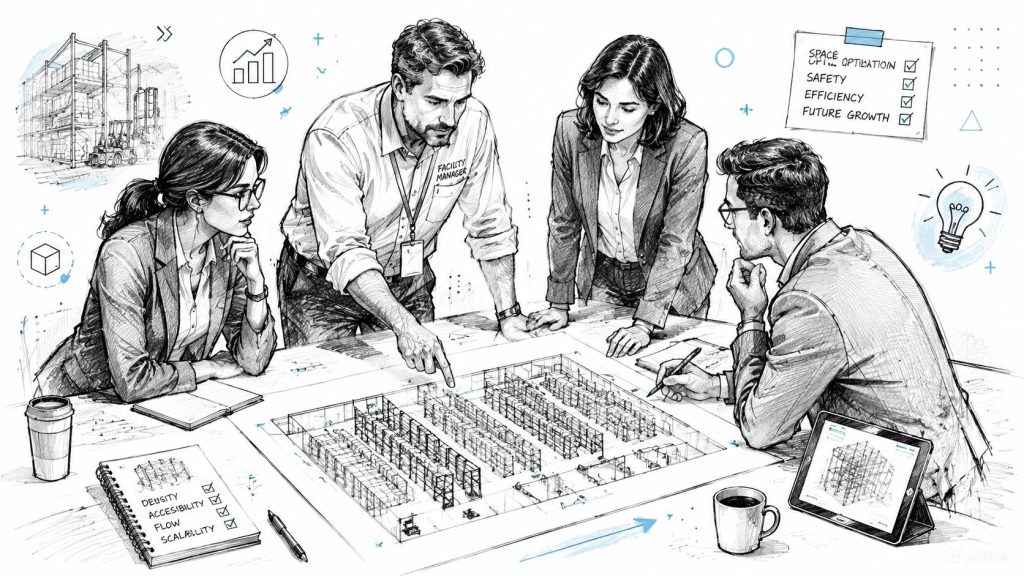
The most successful projects start with data, not catalog pages. Before choosing rails, controls, or shelf sizes, you need a clear picture of what is being stored, how often it moves, who accesses it, and how the room must function over time.
Start with inventory behavior
Storage planning gets better when buyers separate active files from low-touch material. Some records need frequent retrieval. Others are retained mainly for compliance. Mixing those categories into one undifferentiated room usually leads to a poor layout.
According to UNEX's implementation guide, successful system deployment requires precise analysis of how often each SKU moves and how much space it currently occupies to determine which items qualify for high-density storage, ensuring gains in accuracy, throughput, and labor efficiency.
Even in file-heavy environments, the principle holds. Measure movement. Measure volume. Then assign the right storage mode.
Review the physical conditions early
A good plan also accounts for the room itself. Buyers should confirm:
- Floor conditions: Rails, carriage loads, and overall building support need review before final layout approval.
- Access patterns: One movable aisle works well when traffic is managed logically.
- Security needs: Evidence, medical records, HR files, and controlled archives may need restricted access strategies.
- Future growth: A room that fits today but leaves no expansion path becomes a redesign project later.
What a strong planning process looks like
A sound project usually follows this sequence:
- Needs assessment based on file volume, access frequency, and room limitations.
- Layout development to test aisle placement, shelf configuration, and traffic flow.
- Structural and operational review to confirm fit with the facility.
- Specification and budgeting based on the final use case, not a generic package.
- Installation coordination with realistic lead times and room preparation.
Material Handling USA supports this kind of project planning with product sourcing, consultative layouts, and design input for storage rooms, secure areas, and operational spaces. For buyers, that matters because a well-planned system tends to perform better from day one.
Good storage planning removes guesswork before equipment is ordered. That's where many projects either save time or lose it.
Common planning mistakes
Several issues show up repeatedly in underperforming installations:
- Buying for shelf count alone: More shelves don't help if the aisle logic is poor.
- Ignoring user behavior: The people retrieving files determine whether the layout works.
- Skipping growth planning: Storage systems should accommodate operational change, not freeze the room in its current state.
- Treating installation as plug-and-play: Mobile systems need coordinated planning, not furniture-level assumptions.
Calculating the Real ROI of High Density Storage
The ROI discussion should start with avoided space costs. If a system helps you keep storage within the current footprint, you may avoid expansion, renovation, or the continued loss of productive floor area. That's often the largest financial benefit, even before labor savings enter the picture.
There's also the durability side of the equation. According to K-Log's buying guide for high-density file shelving, high-density file shelving is specifically engineered for professional office and clinic settings, featuring strong frames and reinforced shelves capable of supporting large quantities of heavy file folders without structural failure. Buyers aren't just paying for density. They're paying for a system built to handle sustained file loads.
Where the return usually comes from
A practical ROI review should include:
- Recovered floor area: Space can be reassigned to staff, operations, or additional storage.
- Deferred building changes: Expanding later is often better than expanding now.
- Faster retrieval: Better organization supports cleaner workflows.
- Better planning visibility: Teams can standardize storage instead of reacting room by room.
Why timing matters
Demand cycles, installation scheduling, and internal approval timelines can stretch a project longer than expected. Buyers who start earlier usually have more freedom to compare layouts, evaluate options, and schedule installation with less disruption.
If you're building the financial case, it helps to compare density projects with other space-saving strategies. This vertical storage cost and pricing guide is a useful reference point for evaluating storage investment decisions across different system types.
The strongest ROI case usually comes from combining space recovery with workflow improvement, not from equipment price alone.
Your High Density System Decision Checklist
Choosing among high density file storage systems gets easier when the decision is tied to operational needs instead of product labels.

Use this checklist before requesting pricing
- Define the contents: List file types, folder sizes, box storage, security needs, and load expectations.
- Map access behavior: Identify who needs files, how often they retrieve them, and whether multiple users need simultaneous access.
- Confirm room constraints: Review dimensions, door swings, obstructions, and circulation requirements.
- Plan for growth: Leave room in the design for future records, policy changes, or department expansion.
- Set the purchase objective: Decide whether the main driver is capacity, workflow, security, or floor space recovery.
- Review supplier support: Ask whether layouts, design guidance, and quote support are included before you buy.
For warehouses, labs, clinics, and secure records rooms, those questions prevent expensive mismatches. They also make quote comparisons more meaningful because you're evaluating a defined solution rather than a rough equipment guess.
Installation, Maintenance, and Long Term Care
Installation should be treated like a managed facility project. That means site review, floor preparation, delivery coordination, assembly, alignment, and final operating checks. When buyers plan those steps early, installation tends to go much more smoothly and with less disruption to staff.
Maintenance is usually straightforward, but it shouldn't be ignored. Tracks need to stay clear. Moving parts should be inspected on schedule. Shelving loads should match the intended use. For powered systems, controls should be checked as part of routine facility maintenance.
Long-term ownership habits that help
- Train users early: Proper operation reduces wear and prevents misuse.
- Keep access rules simple: Clear aisle and loading procedures improve consistency.
- Review layout fit over time: Storage demands change. The room should be checked before it becomes strained again.
For a deeper overview of ownership considerations, this mobile shelving buyer's guide is a helpful next step.
Frequently Asked Questions
Are high density file storage systems only for archives?
No. They're used in active records rooms, healthcare settings, administrative offices, evidence storage, laboratories, and other environments where space and controlled access matter.
Are mobile systems hard for staff to use?
Not when the layout matches the workflow and users receive basic training. Problems usually come from poor planning, not from the concept itself.
Do I need a motorized system?
Not always. Manual and assisted systems work well in many file rooms. Motorized options make more sense when retrieval speed, heavier loads, or controlled access are higher priorities.
Can these systems support heavy file folders?
Yes, provided the shelving is specified correctly for the application and load. File storage systems are built for professional settings where folders and records can be substantial.
What should I measure before asking for a quote?
Room dimensions, file types, approximate volume, access frequency, security needs, and any site constraints such as doors, columns, or floor conditions.
Is installation disruptive?
It can be, but a planned installation reduces disruption. Scheduling, room prep, and phased transitions help keep operations moving.
Can a system be planned for future growth?
Yes. That's one of the smartest reasons to start early. A layout that anticipates future demand is usually more cost-effective than redesigning the room later.
How do I know if my facility is a good candidate?
If your current storage area feels crowded, fixed aisles consume too much floor space, or files are spreading into nearby rooms, you're likely a strong candidate for review.
Maximize Your Facility's Potential Today
High density file storage systems solve a space problem, but the bigger value is operational. The right system helps you use the room you already have more effectively, keeps files accessible, supports security, and gives your facility a better path for growth. The difference between a good result and a frustrating one usually comes down to planning, layout accuracy, and choosing the system that matches how your team works.
If your storage rooms are getting tighter, it's worth reviewing options before those constraints affect staffing, workflow, or expansion timing. Better planning usually leads to smoother installs, clearer budgets, and fewer compromises.
Material Handling USA can help you evaluate high density file storage systems with practical layout support, competitive pricing, fast shipping and delivery, free layouts and designs with no obligation, and free quotes. To discuss your project, Contact Us for a consultation, Request a Quote, or Call 800-326-4403. You can also email Sales@MH-USA.com to start planning the right storage solution.
Related Resources
- Security Cages — Explore our complete product line and request a free quote
- Mobile Shelving Systems — Explore our complete product line and request a free quote
- Industrial Mezzanines — Explore our complete product line and request a free quote
Related planning resources: Datum mobile filing systems.