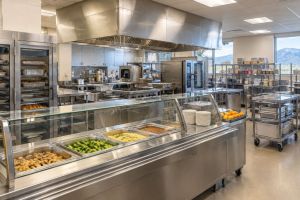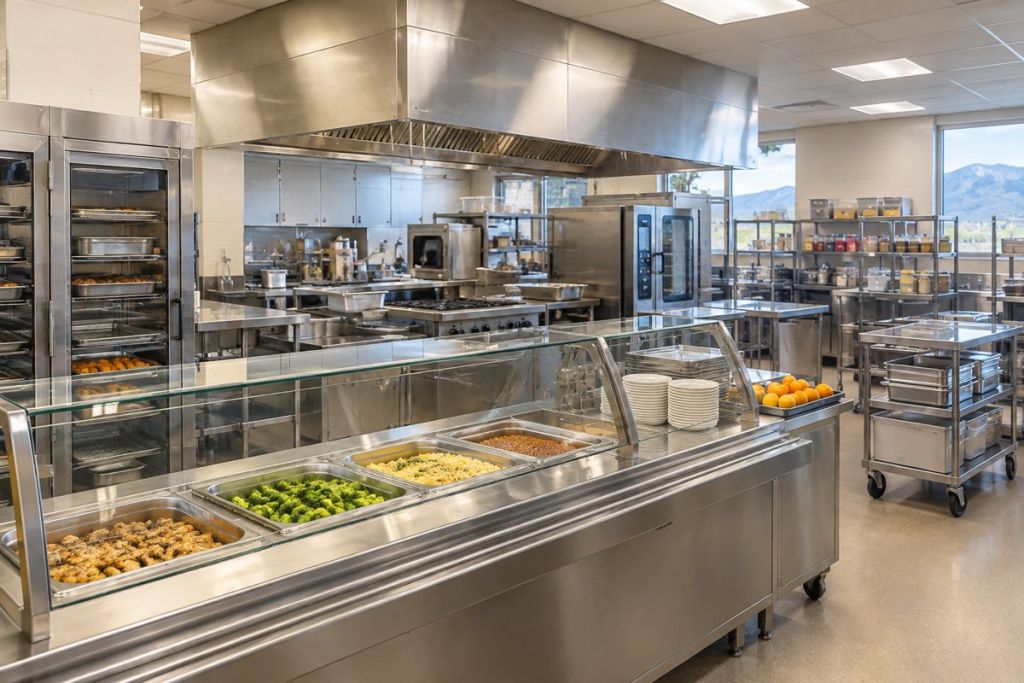
If you're specifying school cafeteria kitchen equipment Utah districts will rely on every school day, start with labor, approvals, and your serving window, not a catalog. A line that looks strong on paper fails fast if carts can't move, pans can't hold temperature, or a grease appliance sits outside the hood. This guide matches configurations to Utah school workflows so you can request a quote that reflects the actual job.
What Utah School Kitchens Must Handle
95% of Utah school districts needed at least one piece of equipment to serve nutritious meals more effectively, compared with 88% nationwide, in the Utah school foodservice assessment. The estimated median requirement was $23,000 per school, and the aggregate statewide need reached $40.2 million. That's the planning context for nutrition directors, maintenance leads, and procurement staff across the state.
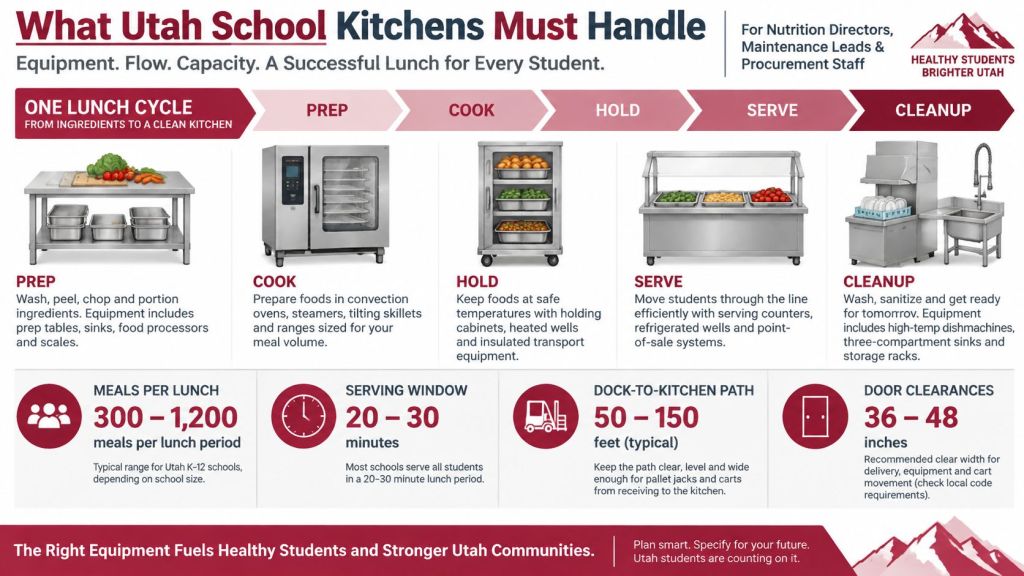
Walk one lunch cycle and the gaps become clear. Cold storage holds raw and ready food. Cooks prep, portion, and finish a set menu under time pressure. Hot and cold holding carries pans through the full serving window. Carts move food to classrooms or satellite points, then warewashing resets trays and pans before the next period.
Where the Shortages Cluster
The same assessment found 50% of Utah districts needed serving-portion utensils, 47% needed hot-holding cabinets, 46% needed scales, 43% needed utility carts, and 42% needed knife-and-cutting-board sets. It also found 49% needed kitchen-infrastructure changes in at least one school, while only 35% had at least some budget available for upgrades.
A missing cart, scale, or holding cabinet can slow service as much as a missing oven.
Don't treat small tools as afterthoughts. Portion control, safe holding, and transport decide whether a cooked batch reaches students on time. Review your site needs against practical food service material handling solutions and the Utah focused commercial kitchen equipment hub before you lock a list.
Kitchen Line Options for District Workflows
Pick the row that matches your menu and staff first. Don't start with the largest oven.
| Configuration | Best Utah fit | Main trade-off | Core equipment |
|---|---|---|---|
| Scratch production line | High schools and central kitchens with trained cooks | Highest hood, utility, and training demand | Combi or convection ovens, steamer, kettle or skillet, walk-in cooler |
| Heat and serve line | Elementary schools with short staff | Limited scratch menu | Convection oven, hot holding cabinet, pass-through, reach-in refrigerator |
| Satellite receiving kitchen | Sites fed from a central kitchen | Service stops if transport or the central kitchen fails | Receiving cooler, hot and cold holding, serving counter, dishmachine |
| Shared small kitchen | Older or small buildings with one work zone | Crowded clearances and shared utilities | One oven, reach-in refrigeration, door-type or undercounter dishwasher, mobile carts |
| Cold storage and holding package | Any site limited by temperature rather than cooking | Does not add batch capacity by itself | Walk-in or reach-in cooler and freezer, hot holding, scales, carts |
Scratch Production and Heat and Serve
A scratch production line fits high schools and central kitchens that cook from raw ingredients. Combi or convection ovens, a steamer, a kettle or tilting skillet, and walk-in storage give you menu range. You pay for that range with longer hoods, higher utility load, more training, and more cleaning steps.
A heat and serve line fits elementary sites with few cooks. One right-sized convection oven, reliable holding, a pass-through, and reach-in refrigeration keep the workflow simple. You can run it with a small team and short training time. You can't stretch it into a full scratch menu without adding labor and prep capacity.
Size heated holding cabinets to your pan count and serving window, not to leftover floor space. Holding that runs short forces cooks to rush batches or reheat food.
Satellite, Shared, and Holding-Led Setups
A satellite receiving kitchen depends on a central kitchen for production. Spend first on receiving refrigeration, hot and cold holding, the serving counter, and warewashing. If the truck is late or the central kitchen stops, your site has little backup, so temperature logging and spare holding space matter.
A shared small kitchen puts prep, cooking, and washing in one tight zone. Mobile carts and undercounter equipment help, but clearances get crowded fast. A cold storage and holding package fits when food waits too long at unsafe or poor quality temperatures, even though it doesn't add cooking capacity.
USDA guidance in the child nutrition dietary guidelines document links modern equipment with serving more whole foods and preparing meals from scratch. That goal only works if staff can run the line. Compare throughput, changeover time, training burden, maintenance access, utility demand, and backup cold storage before you compare purchase price.
Plain test: if labor is your limit, a smaller line that's easy to clean and change over can outperform extra cooking capacity.
How to Measure the Line and the Path In
Start with demand, then walk the building. A quote built on guessed dimensions won't survive delivery day.
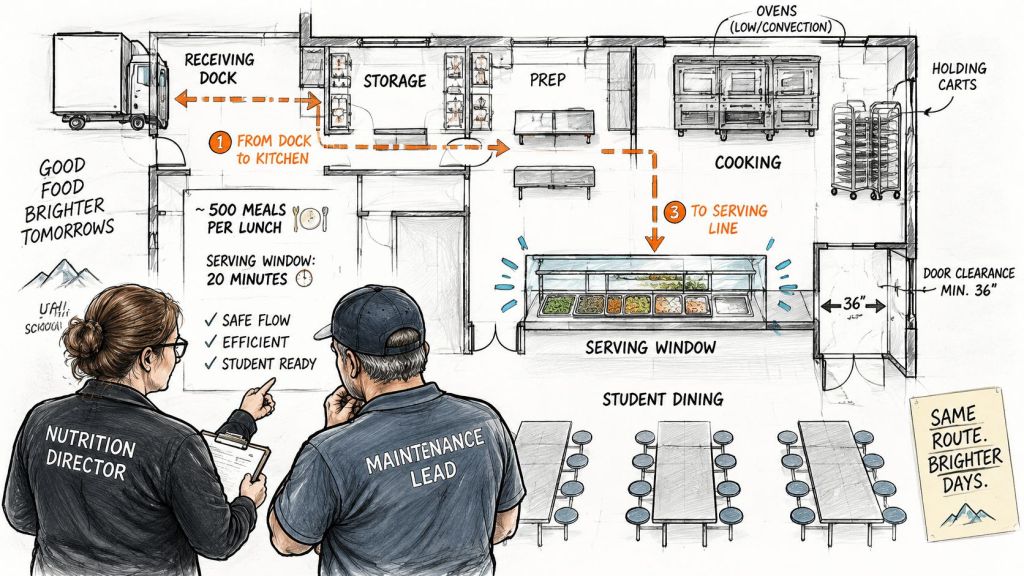
Record meals per lunch and the minutes in your serving window. Those two numbers set oven batch size, holding pan count, and serving counter length. A short window needs more holding ready at once, not just a faster oven.
Next, measure the full route from dock to kitchen. Note door width and height, corridor width, tight turns, steps, and any low pipes. Walk-in panels, tall dishwashers, and stacked ovens often fail at one narrow opening. Measure before you request pricing, not after the truck arrives.
Utilities, Hood, and Drains
Record hood length, the filter line, make-up air, and the ceiling structure above the cook line. Every grease-producing appliance must sit inside the listed hood footprint. Then list electrical voltage and phase at the panel, plus gas availability and line size. Combi ovens and steamers can exceed older circuits, so photograph panel labels.
Note floor sink locations and drain sizes for dishwashers, kettles, and steam equipment. Measure clear ceiling height to structure, since that controls walk-in tops and exhaust duct runs. Finish with serving counter linear feet, space for a point-of-service station, cart parking, and a dish return path that doesn't cross clean food flow.
| Item | What to record | Why it changes the quote |
|---|---|---|
| Meal demand | Meals per lunch and minutes in the window | Sets oven, holding, and serving length |
| Delivery path | Door and corridor width, height, and turns | Walk-in panels and dishmachines may not pass |
| Hood | Length, filters, make-up air, structure above | Grease appliances must sit under the listed hood |
| Utilities | Voltage, phase, and gas available | Combi ovens and steamers often exceed old circuits |
| Drains | Floor-sink location and drain size | Dishmachines and kettles need a proper drain |
| Ceiling | Clear height to structure | Controls walk-in tops and exhaust ducts |
| Serving line | Linear feet and point-of-service space | Sets holding cabinets and student flow |
Send the completed sheet with photos of the hood, electrical panel, and dock. Some common sizes are stocked at select manufacturers, subject to confirmation, but a measured opening still decides whether a unit can enter the building.
Utah Hood and Health Review Checks
Treat ventilation as a permitting limit, not a catalog add-on. The Utah School Construction and Facilities Resource Manual requires an institutional kitchen to have a fume-hood system, with fire protection above the equipment, behind hood filters, and within the ductwork whenever appliances generate grease-laden vapors. Covered equipment includes fryers, griddles, broilers, range tops, grills, and skillets.

Work through the design chain in order. Confirm each appliance's heat and grease output. Match it to the hood's listed duty and length. Route the exhaust duct, confirm make-up air, and check fire-suppression interlocks. Then verify ceiling structure and gas and electrical connections before procurement.
Utah guidance also specifies that activation of the extinguishing system must automatically shut off cooking equipment and electrical receptacles under the hood. Don't set a new fryer or griddle outside the existing hood footprint to gain a few inches. That shortcut creates an unprotected grease source and a redesign risk.
Health Review Is a Separate Gate
Food-service facility plans go to the local health department for evaluation and approval before construction, and significant modifications can need that review too. Build your specification so a reviewer can check it without chasing paperwork.
- Capacity and load: pan count, meals served, electrical or gas load
- Site systems: drainage, ventilation, water, and temperature control
- Daily use: cleanability, sanitation features, and service access
- Support: warranty terms and who performs startup checks
Use drawing and specification files early. Our CAD, BIM, and spec resources can help your team coordinate dimensions before a submittal. For ongoing hood care concepts in other commercial settings, this overview of hood cleaning for hotel kitchens shows why access for cleaning and inspection belongs in the layout, not as a late fix.
This checklist supports coordination. It doesn't guarantee that a specific unit will pass review.
Qualified personnel still need to inspect, test, and maintain the system. Leave clear access to filters, ducts, controls, and suppression parts so that work can happen without moving the line.
Grants Lead Time and Service After Install
Sort funding before you promise an install date. In the FY2023 cycle, the National School Lunch Program Equipment Assistance Grant notice offered each participating state agency an equal allocation of $373,134, including $373,134 for the Utah State Board of Education. The program originated in 2010, and eligible purchases are generally valued above $1,000.
Utah's state education agency administers funds through competitive subgrants to eligible local education agencies, school food authorities, and schools in the National School Lunch Program. Document the operational need for each unit. Show how it supports safe food handling or efficient meal service, and separate equipment replacement from a room addition or building project.
Make Every Bid Price the Same Scope
Recent Utah solicitations show the pattern to copy. Name exact counts and types, such as gas steamers, electric steamers, and tall dishwashers. Then require spec sheets, warranty terms, delivery, lift-gate unloading, startup, and calibration in writing. A low unit price that leaves those items out isn't comparable.
| Bid item | What to write in the bid | Why it matters |
|---|---|---|
| Exact counts | Named quantities by type, such as gas steamers, electric steamers, and tall dishwashers | Lets every vendor price the same scope |
| Specification sheets | Model data sheets for each unit | Confirms fit against measured openings |
| Warranty | Warranty terms stated in writing | Makes later service costs comparable |
| Delivery and unloading | Freight, lift-gate service, and placement | Low unit prices can leave these out |
| Startup and calibration | Vendor startup and calibration to specification | Confirms units run to rated settings |
| Installation scope | Hood, electrical, and gas work listed separately | Shows which costs fall to the district |
Plan service life at the same time. A sound maintenance scope covers preventive maintenance, troubleshooting, repair with manufacturer-approved parts, cleaning, calibration, and safety checks. It should also state when full replacement beats another repair, subject to district approval.
Order ahead of the summer work window so hood coordination, health review, and utility fixes don't collide with startup. Some common sizes are stocked at select manufacturers, subject to confirmation. Earlier measurement and approval checks give you more install slots and fewer rushed substitutions.
Which Setup Fits Each School
Use this verdict table after you've measured the site. Check the condition in the last column before you add equipment.
| School type | First equipment priority | Condition before adding more |
|---|---|---|
| Elementary site with one or two cooks | Holding, pass-through, carts, and a right-sized oven | Kettle added only when staffing supports scratch cooking |
| Middle school adding scratch items | One flexible oven or steamer | Hood and staff can support the added load |
| High school or central kitchen | Scratch production line | Enrollment, scratch menu, and trained labor all exist |
| Receiving school | Cold holding, hot holding, and a reliable dish return | Transport and central kitchen schedule are steady |
An elementary site with one or two cooks should protect service first. Holding, a pass-through, carts, and a right-sized oven move a simple menu on time. A kettle can wait until staffing supports scratch work, extra cleaning, and recipe training.
A middle school adding scratch items should add one flexible oven or steamer at a time. Confirm the hood, utilities, and crew can support it during a normal lunch, not just on a light menu day. If changeover and cleaning already run long, fix workflow before you add batch capacity.
A high school or central kitchen can justify a scratch line when enrollment, the menu, and trained labor exist together. A receiving school should spend first on cold holding, hot holding, and a dish return that doesn't back up. Those items keep service moving when production happens elsewhere.
Flag Approvals in the Quote Request
The USBE Child Nutrition Programs pre-approved equipment list requires state agency approval before procuring equipment that is shared with a program outside the Child Nutrition Programs, costs $25,000 or more per unit, or isn't included on the pre-approved list. Items on the list costing less than $25,000 per unit generally don't require that approval, but you still document program use and procurement compliance.
Write the chosen configuration, measured openings, and every approval flag into your quote request. I would price staffing fit before oven size, every time.
Common Questions Before You Request a Quote
When Does a Utah Purchase Need State Agency Approval
Approval is required when equipment is shared with a program outside the Child Nutrition Programs, costs $25,000 or more per unit, or isn't on the state pre-approved list. Listed items under that threshold generally don't need approval, but districts still document program use and procurement compliance.
Does Every New Oven Need a New Hood
No. Hood needs are driven by grease-producing appliances such as fryers, griddles, broilers, range tops, grills, and skillets. Confirm the appliance output against the existing hood's listed duty and footprint first.
Can a Grant Pay for a Building Addition
No. Equipment grants support necessary equipment, while building construction is a separate purchase. Delivery and installation can fit the project budget when the grant rules for that cycle allow them.
Is the Lowest Bid the Best Bid
Only when every bid lists the same scope. Compare spec sheets, warranty, freight, lift-gate service, placement, startup, and calibration before you compare unit prices.
Does a Larger Combi Oven Always Help
No. When labor is the limit, a smaller line that's easy to clean and change over can serve meals more reliably. Extra capacity doesn't help if staff can't prep, load, and wash up in the window.
How Early Should a District Start
Start before the summer work window. Early ordering leaves time for measurements, hood coordination, health review, approval flags, and utility corrections without pushing startup into the school year.
Who Reviews Kitchen Plans
Food-service plans go to the local health department before construction. Significant kitchen changes can need that review too, so submit drawings and equipment data early.
Does a Checklist Guarantee Code Approval
No. A checklist helps your team coordinate appliances, hood duty, interlocks, and service access. It doesn't guarantee that a specific unit or layout will pass review.
Request a Layout Review and Quote
Build your quote packet in four lines. Name the configuration. List meals per lunch and the minutes in your serving window. Attach delivery path, hood, utility, drain, and ceiling measurements. Flag any unit at $25,000 or more, any shared use, and any grease appliance planned under the hood.
Moving that packet forward before the summer install window gives you time for drawings, health review, and utility checks. Waiting can push a needed replacement into another school year, with another year of slow holding, cart shortages, or repair calls. Some common sizes are stocked at select manufacturers, subject to confirmation, so early measurement also helps you avoid selecting a unit that can't pass your doors.
Material Handling USA is headquartered in Salt Lake City, UT and serves customers nationwide. Local service areas include Salt Lake City, Provo, Ogden, Park City, St. George, Logan, Lehi, and Orem. For larger facility projects, we coordinate measurement, drawings, specification, delivery, and installation so your project has a single point of contact.
For school cafeteria kitchen equipment Utah districts can specify with confidence, start with a free layout and free quote with no obligation. Contact Us for a free design or layout consultation, use Request a Quote through the Utah commercial kitchen equipment hub, call (800) 326-4403, or email Sales@MH-USA.com. Competitive pricing, fast shipping and delivery options, and quality materials start with accurate site data.
Send us your meal counts, serving window, and site measurements, and we'll help you match a cafeteria configuration to your staff, hood, and approval path. Visit Material Handling USA to request your free layout review and quote for your Utah district.