
Home | Storeganizer | Order-Picking Efficiency
How to Improve Order-Picking Efficiency by Rebuilding the Pick Face
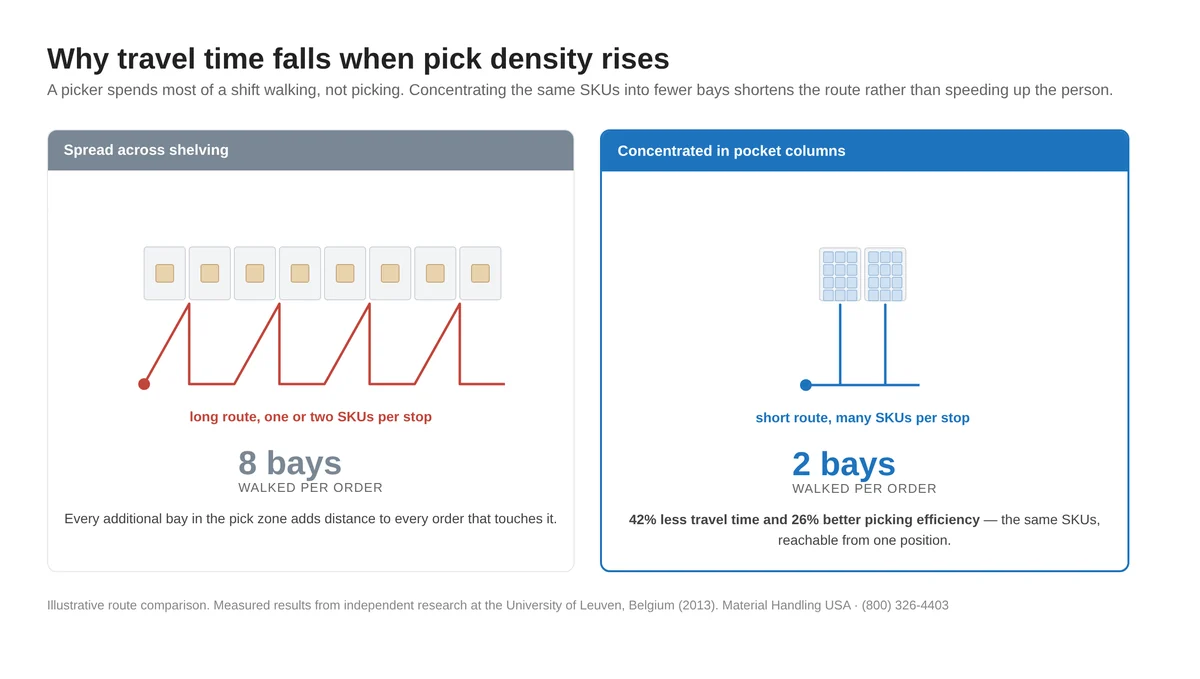
Walking is the largest consumer of a picker’s shift, and it responds to layout rather than to effort. Storeganizer concentrates up to 396 pick locations into a single rack bay — measured at 42% less travel time and 26% better picking efficiency against conventional rack and shelf.

Picking productivity is a layout problem before it is a labour problem

When lines per hour are disappointing, the first instinct is usually to look at people: more training, better incentives, tighter supervision. It rarely moves the number much, because the largest single consumer of a picker’s shift is not effort — it is walking. If the SKUs on a typical order are spread across 400 feet of half-empty shelving, no amount of motivation compresses that distance.
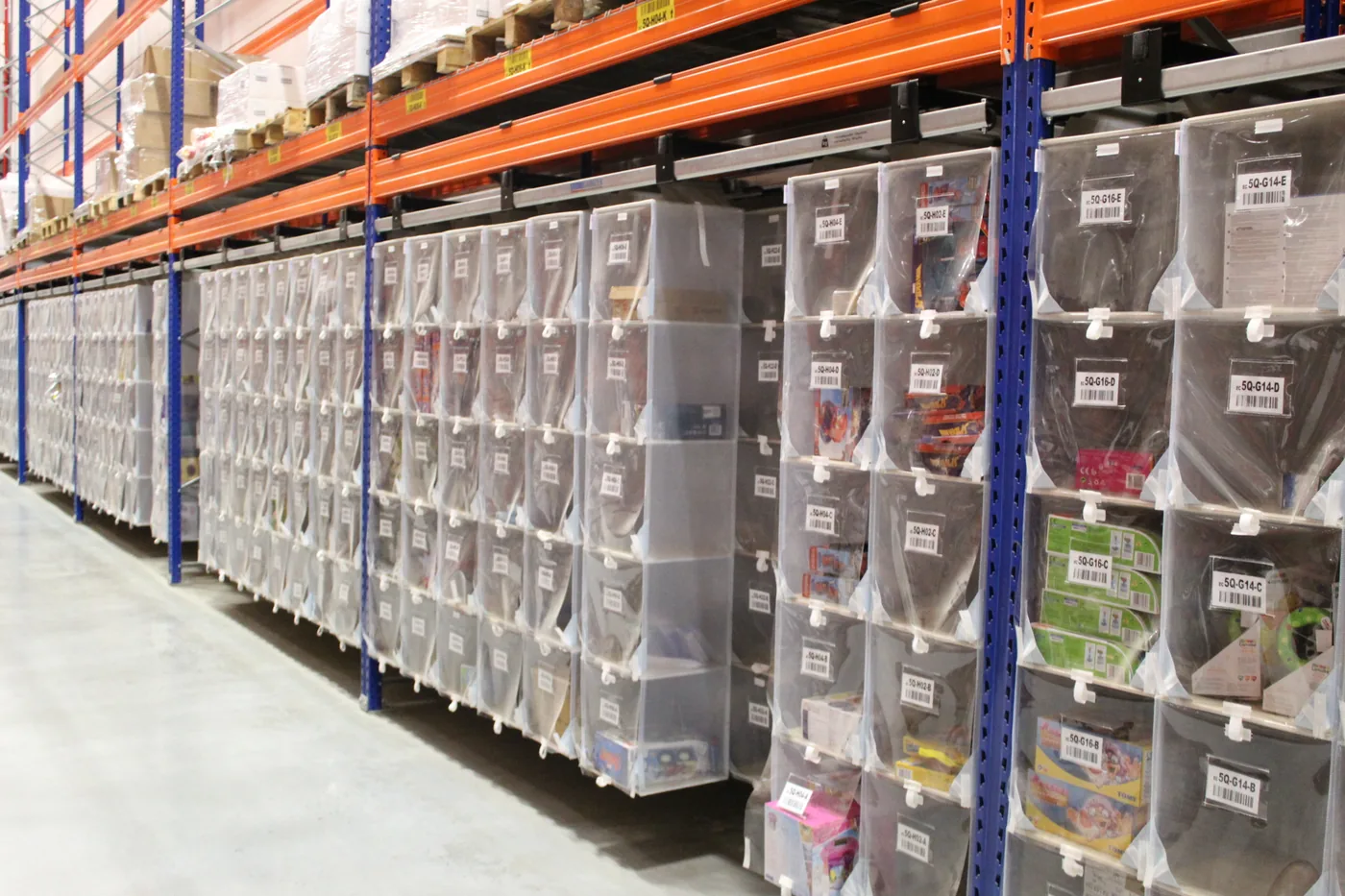
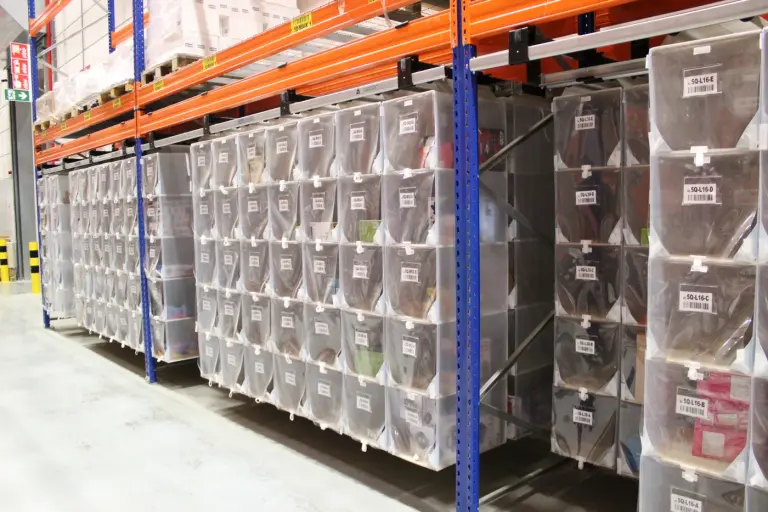
The fix is to bring the SKUs closer together. That is precisely what a Storeganizer pick face does: vertical columns of right-sized textile pockets, hung in existing pallet rack up to four rows deep, concentrating between 28 and 396 discrete pick locations into a single bay. Independent research at the University of Leuven measured a 42% reduction in travel time and a 26% gain in picking efficiency compared with conventional rack and shelf.
The five levers that actually move lines per hour
Reported before-and-after figures
| Operation | Before | After |
|---|---|---|
| Luxury-goods distribution centre, Dubai region | 25-30 lines picked per hour from static shelving | 60-80 lines per hour; overall operational efficiency up about 30%; two fewer full-time staff needed |
| Technology distributor, UK national DC | Baseline of about 75 lines per hour in the converted zone | About 90 lines per hour and rising; roughly 10 seconds faster per pick; 40% more SKUs hit per unit of travel |
| Independent University of Leuven research | Conventional rack and shelf | 42% less travel time, 26% better picking efficiency, 40% more usable space |
Figures as reported by the named operations and the cited research. Your result depends on how inefficient the current pick face is and how well the new one is slotted.
See how dense your pick face could be
Enter your bay height and pocket size in the free Storeganizer Configurator and it returns pick locations per bay and for the whole project, plus a bill of materials.
Other ways we improve picking
A dense pocket face is one tool. Depending on your order profile we may recommend some of these instead of, or alongside, it:
- Carton flow rack and gravity flow racks for full-case fast movers with FIFO replenishment
- Vertical carousels and VLMs / AS-RS for goods-to-person throughput and access control
- Slotting optimization — often the highest-return change and the cheapest
- Packing station design so the gain at the face is not lost downstream
- Rack labelling and location schemes
- Full warehouse optimization and layout design
Slotting a pocket bay so the density actually pays
A dense pick face that is badly slotted is just a compact version of the same problem. Nearly all of the productivity gain reported by Storeganizer users comes from what goes where, not from the pockets themselves — so this is where we spend the design time.
Height bands
Treat the bay as three bands. The middle band, roughly between mid-thigh and shoulder height, is the golden zone: it needs no bending, no reaching and no ladder, and it should hold the SKUs that generate the most picks per day. The band below it takes the medium movers and anything heavy enough that you would rather lift it from low than from high. The top band takes the dormant tail — the parts picked a few times a year, where a step stool once a month costs nothing.
Do this once, using real pick history rather than intuition, and revisit it after three months. Velocity in most operations is far more concentrated than people expect: it is common for 15-20% of SKUs to generate 80% of the lines. Those SKUs are the only ones that really need the golden zone.
Rows deep
Pockets can hang up to four rows deep, and the front columns roll sideways by hand to expose the rows behind. Maximum density means four rows, but every roll-aside is a small movement cost. For the fastest-moving SKUs we usually specify two or three rows and take the density hit; for the dormant tail, four rows is free performance.
Labels, barcodes and the location scheme
Every pocket carries a label or barcode holder on its face. Decide the scheme before installation, not after: aisle, bay, column, row and pocket position, in the same format your WMS, ERP or CMMS already uses. Scan-verifying picks is what turns one-SKU-per-pocket from a tidiness improvement into a measurable accuracy improvement, and retro-fitting a location scheme onto a stocked face is a job nobody enjoys twice.
Replenishment
Pockets hold less per location than a shelf level, which is the trade-off for having far more locations. In practice that means replenishment frequency rises for the fastest SKUs. Two things keep it under control: put the highest-volume items in larger pockets rather than in the smallest ones that will physically hold them, and use in-pocket dividers only where two genuinely slow SKUs can share. If a SKU needs replenishing more than once a shift, it probably belongs on carton flow instead.
Explore the Storeganizer cluster
 Storeganizer hubWhat the system is, specs, options, process and results.
 Small-parts warehouse storageRight-sizing pick locations for fasteners, fittings and boxed components.
 3PL & e-commerce fulfilmentMore SKUs per square foot when the footprint cannot grow.
 Spare parts & MRO storageCritical spares findable in seconds without a parts-room expansion.
 Aerospace & defense partsTraceable, high-value small parts in a controlled parts room.
 Pallet rack space optimizationRecover the cube you already pay for before leasing more building.
 SKU slotting & rack ROIUsing SKU size, stock volume and order frequency to maximise rack-space return.
 How Storeganizer worksThe suspension system, pocket columns, four rows deep, and installing into existing rack.
 Electronics & white goodsComponent and appliance-spare ranges: pocket sizing, ESD packaging, picking accuracy.
Shop Bin Storage Systems Online
Buy select items directly from our online store, or request a quote for volume, custom sizes and freight-rated orders.


Frequently asked questions
What actually limits order-picking efficiency?
How much improvement is realistic?
Do I need a WMS to get the benefit?
Is automation a better answer?
What about pick errors?
Related Storeganizer reading
How to measure the gain in your own operation
Picking improvements are easy to claim and awkward to prove, because most warehouses do not have a clean baseline. Four measurements taken before a conversion make the after-figure defensible — and all four can be gathered in a week without new software.
What to expect, and what not to
Independent research at the University of Leuven, Belgium (2013) measured a 42% reduction in travel time and a 26% gain in order-picking efficiency against conventional rack and shelf. Those are averages across installations. Operations with a long tail of small, slow-moving SKUs stored in locations far larger than the parts tend to exceed them; operations already picking densely from well-slotted bin shelving see less.
The variable that predicts the outcome is not the system — it is how badly your current locations are sized for the items in them. That is a slotting question, and it is worth answering before a purchase decision. The slotting optimization guide covers how to profile a SKU base, and the case studies show what specific operations measured after converting.
Measure your pick face, then fix it
Tell us your current lines per hour and the size of your small-item area. We will estimate the density you could reach and what it would take to get there.