
Home | Storeganizer | Spare Parts & MRO Storage
Spare Parts and MRO Storage With a Location for Every Part
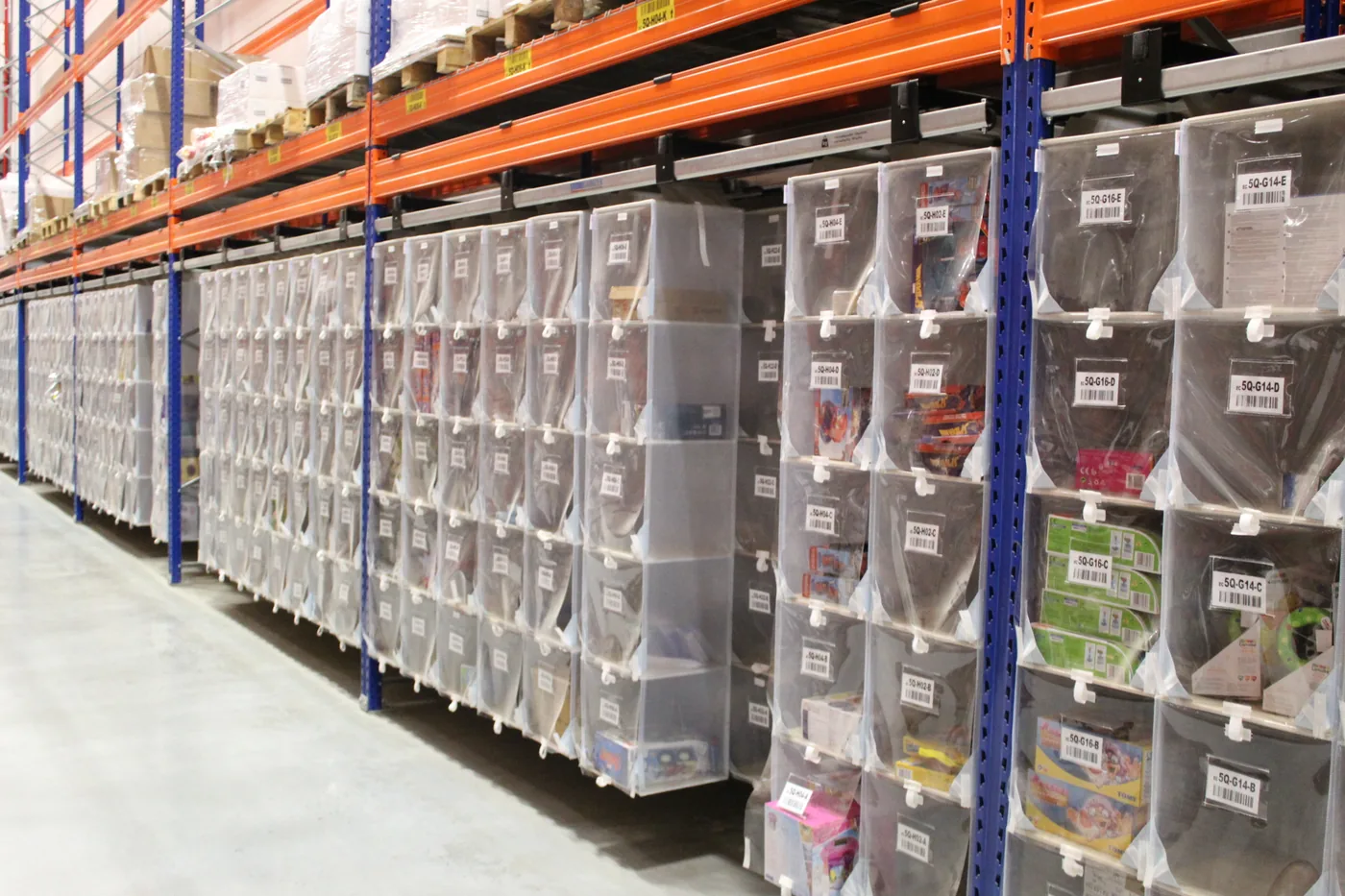
Maintenance stores do not run out of space so much as run out of findability. Storeganizer gives every spare its own labelled, right-sized pocket — up to 396 per pallet rack bay — and hands the shelving footprint back to the plant.

A spares room fails on search time, not on capacity

Maintenance stores grow by accretion. A spare arrives with a machine, goes on the nearest shelf, and is still there five years later next to three superseded versions of itself. Nothing is ever thrown out because nobody is certain it is not needed, so the room fills up, parts migrate into boxes on the floor, and the technician who needs a seal at 2am cannot find it. The cost of that is not storage — it is downtime and duplicate purchasing.
Two things fix it: a location for every part, and enough of those locations to stop parts sharing. Storeganizer delivers both cheaply, because a single pallet rack bay becomes up to 396 individually labelled pockets. The parts stop being a pile and become an addressable inventory — and the shelving footprint that comes out often gives the plant back the floor space it wanted for something else.
Which spares belong in pockets
Good candidates
- Seals, gaskets, O-rings, bearings and bushings
- Fittings, valves, connectors, sensors and switches
- Belts, hoses and boxed drive components
- Electrical spares, relays, fuses and boxed PCBs
- Fasteners and hardware kits, including bagged kits
- PPE, consumables and shop supplies
- Boxed OEM spares that arrive one or two at a time
Keep these elsewhere
- Heavy assemblies, gearboxes, motors and pumps — boltless shelving or rack
- Bar, pipe, shafting and long stock — cantilever rack
- Bulk fluids, lubricants and drums
- Controlled or high-theft items needing a locked enclosure — security cages or smart lockers
- Anything requiring calibrated, climate-sealed storage
The dormancy test
Pull a report of parts not issued in 24 months. In most stores that is 40-60% of the SKUs and a similar share of the shelf space. Those are the parts that should be compressed into small pockets high in the bay, freeing working height for the spares that actually get used.
What improves
Size your spares room in the designer
Choose the bay height you have and the pocket size your spares need. The designer returns the number of labelled locations per bay and a bill of materials you can take to a purchase requisition.
Where we install MRO configurations
MH-USA specifies spare-parts and MRO storage across manufacturing plants, utilities, mining and heavy industry, food and beverage production, data centres, transit and fleet maintenance shops, and dealer parts departments. Related pages worth a look:
Classify spares before you store them
Storage layout is downstream of a decision most stores have never formally made: which spares matter. Before a single pocket is specified, we ask maintenance and engineering to sort the catalogue three ways. It takes an afternoon and it changes the configuration completely.
By consequence of stockout
Class A spares stop a production line, a pump station or a fleet vehicle within hours. Class B degrade performance or force a workaround. Class C are convenience items. Class A parts belong in the front row at working height, ideally with a visible min level, regardless of how rarely they are issued. It is common to find genuinely line-stopping spares stored on a top shelf behind three boxes because they are only issued twice a year.
By issue frequency
Pull 24 months of issues. The result in most stores is heavily skewed: a small group of consumables and wear parts accounts for the majority of transactions, and a long tail has never been issued at all. The tail is where pocket columns pay best, because it is the tail that currently occupies the most shelf space per pick.
By physical handling
Weight, size, packaging and cleanliness decide whether a part can go in a pocket at all. Bagged and boxed parts are straightforward; bare, oily or sharp-edged items need a heavier textile grade or front covers, and heavy assemblies stay on shelving or rack. Sorting on this axis is also what stops a well-intentioned project from putting a 60 lb gearbox somewhere it does not belong.
The output is a simple matrix: high-consequence and high-frequency parts in the golden zone at the front, dormant low-consequence parts compressed into small pockets high and deep, and the physically unsuitable minority kept on parts room shelving. That matrix is what we configure the bays around, and it is what we hand over with the installation so the logic survives staff turnover.
Rebuilding a live storeroom without stopping work
The reason storerooms stay bad for years is that nobody can take them offline. A pocket-column conversion is one of the few storage changes that can genuinely be done in stages, because each bay is independent and nothing is anchored, wired or bolted into the building.
Clean before you convert
The cheapest storage is the part you no longer keep. Run a dormancy report, get engineering to sign off on superseded and obsolete spares, and dispose of them first. It is normal for this step alone to remove a fifth of the room.
Convert the dormant tail first
Start with the bays holding the parts nobody touches. Nothing urgent is at risk, the crew learns your building, and you free working-height space immediately for the parts that matter.
Stand up the new face, then migrate
Hang and label a run of bays before moving stock, so parts move once, into a location that already has a code. Migrate by part family so technicians always know where a family lives.
Re-slot by criticality and velocity
Once stock is in, move the line-stopping and fast-issuing spares into the golden zone. This is the step most projects skip, and it is where the search-time improvement actually comes from.
Decommission and reclaim
Pull the emptied shelving out and hand the floor space back. Record the before-and-after square footage: it is the number that funds the next phase.
On a typical MH-USA project a crew hangs a full run of bays in a shift. There is no drilling, welding, anchoring or electrical work, no permit drawing and no downtime for the rest of the building. If the rack you want to hang from is not there yet, we can supply and install pallet rack in the same visit.
Explore the Storeganizer cluster
 Storeganizer hubWhat the system is, specs, options, process and results.
 Small-parts warehouse storageRight-sizing pick locations for fasteners, fittings and boxed components.
 3PL & e-commerce fulfilmentMore SKUs per square foot when the footprint cannot grow.
 Aerospace & defense partsTraceable, high-value small parts in a controlled parts room.
 Pallet rack space optimizationRecover the cube you already pay for before leasing more building.
 Order-picking efficiencyCutting travel and mis-picks by rebuilding the pick face.
 Aviation & MRO partsOne part number per traceable pocket, and what belongs in cantilever instead.
 Electronics & white goodsComponent and appliance-spare ranges: pocket sizing, ESD packaging, picking accuracy.
 How Storeganizer worksThe suspension system, pocket columns, four rows deep, and installing into existing rack.
Frequently asked questions
What makes spare parts different from general warehouse stock?
Are textile pockets suitable for oily or sharp parts?
Can pockets be closed against dust and contamination?
How do we stop critical spares being buried in the back rows?
Will this integrate with our CMMS or ERP location codes?
Turn the spares room into an addressable inventory
Send us a SKU list with dimensions and issue history. We will show you which parts belong in pockets, how many bays it takes and what floor space you get back.