A purchasing manager can choose an arm length that looks right on paper, then discover that the upright, base, or floor layout can't safely support the stored material. That mistake is common because buyers often treat cantilever rack load capacity by arm length as a simple product lookup. It isn't. Arm length affects mechanical load, column demand, usable capacity, aisle clearance, and the total system you need to buy.
This guide is for warehouse managers, plant teams, and buyers storing lumber, pipe, sheet goods, steel, furniture, or other long loads. It gives you a practical order for making the decision, using published capacity guidance rather than a generic rating that may not match your actual configuration.
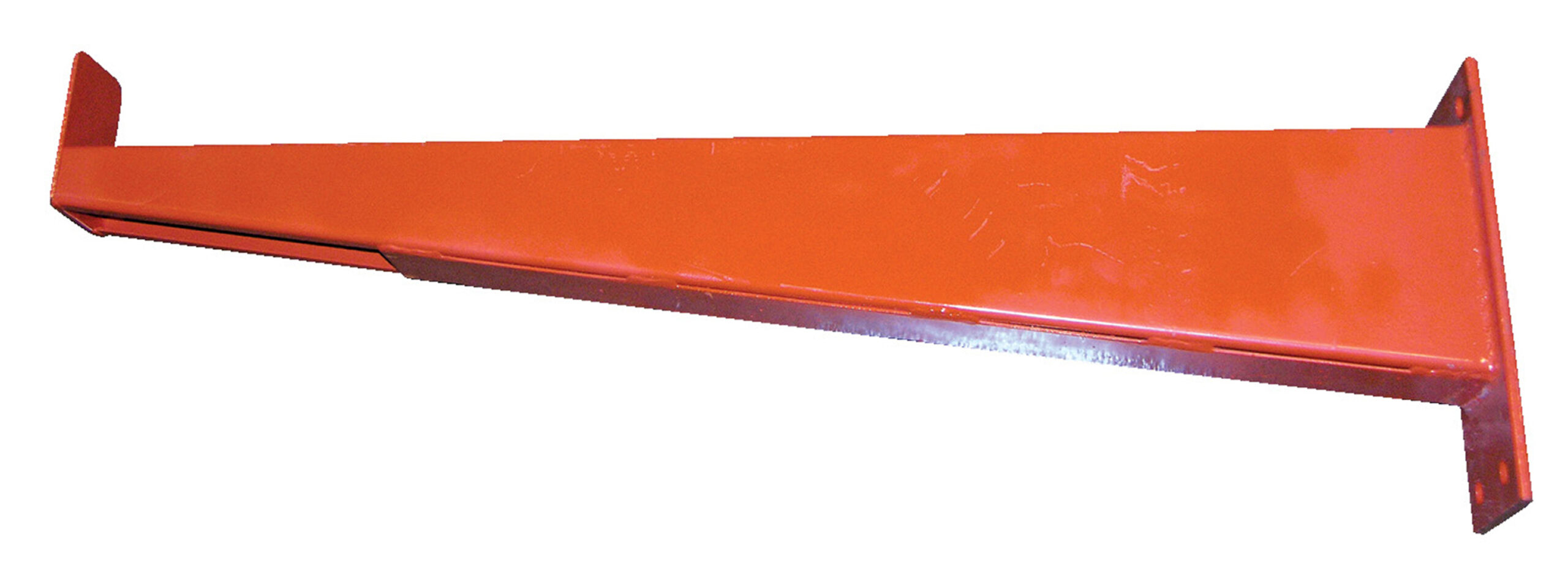
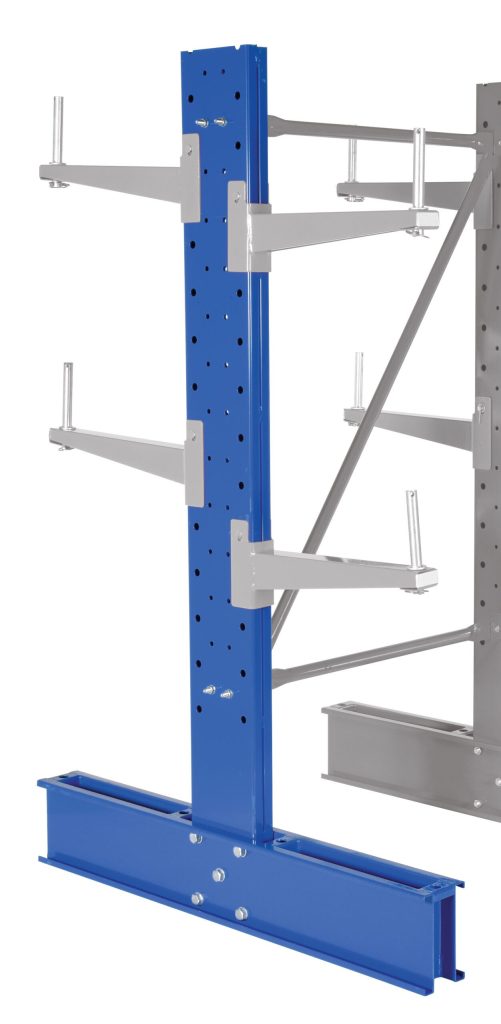
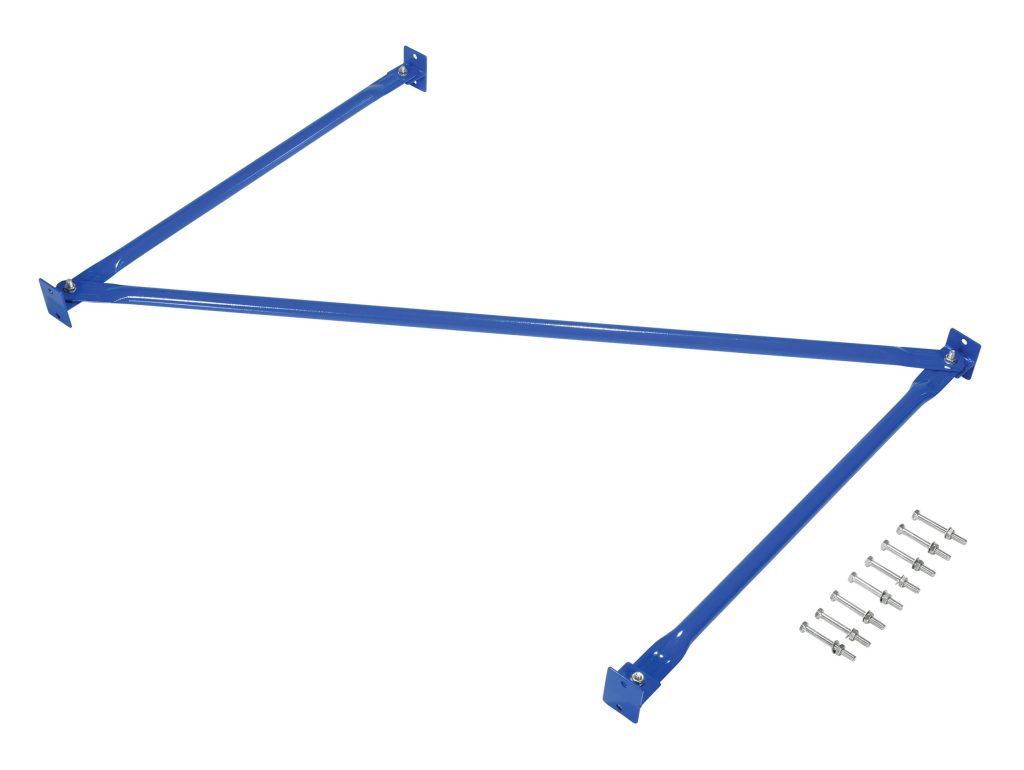
Shop Cantilever Rack Parts by Category
Compare arm lengths and duty classes side by side: each card opens a shop category with every listed size. Prices are current online prices; freight is quoted by destination and some common sizes in stock at select manufacturers, subject to confirmation. For a full layout, request a free quote or use the Cantilever Rack Configurator.
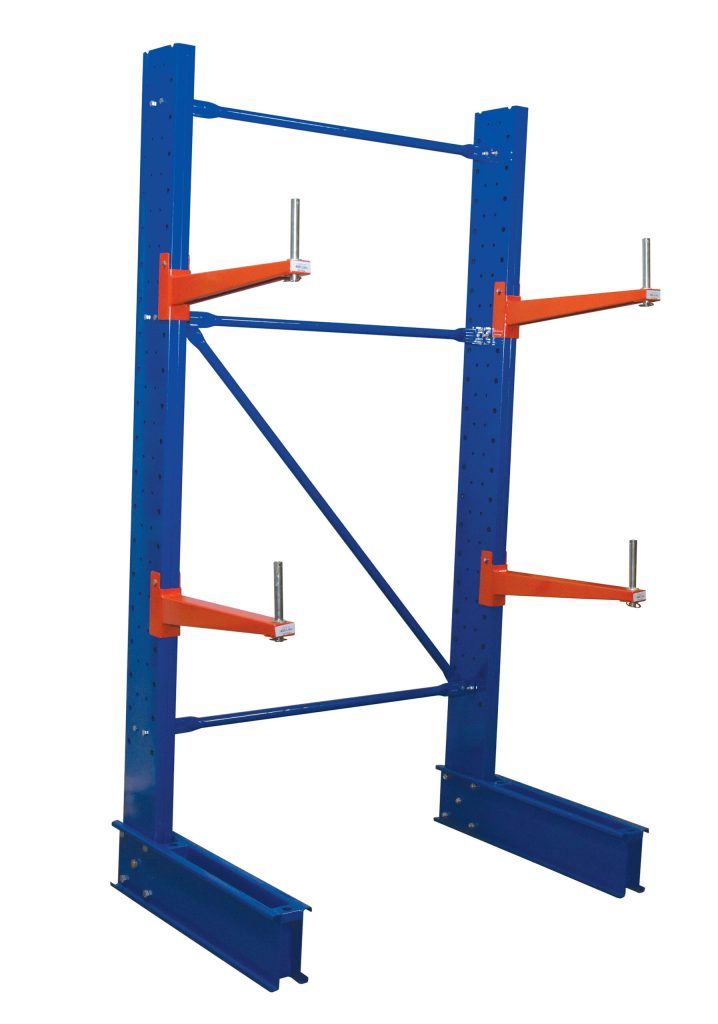
Why Arm Length Drives the Whole Cantilever Decision
A quote can look attractive until the required reach changes. A buyer may ask for long arms to store deep bundles, then learn that the column and base must handle much more load at that distance. The issue isn't only the arm itself. Longer reach can change the required upright section, base design, bracing, anchors, and aisle arrangement.
Arm length is the hidden lever in a cantilever project. It controls both capacity and cost because the rack must resist the bending force created where the load sits away from the upright. A 24-inch arm and a 48-inch arm aren't interchangeable because the stored weight stays the same. Published guidance explains that column capacity falls as arm length increases, so the rack must be checked at the exact reach you need (Cantilever Rack 101).
Start with the load footprint
The first question isn't, “How much can this rack hold?” Ask, “How deep is the material that must be supported?” The arm should match the load depth, and the load shouldn't extend beyond the arm end. A 48-inch-deep plywood bundle needs at least a 48-inch arm, while a 24-inch steel bundle calls for a 24-inch arm (cantilever rack design guidance).
That rule prevents a common buying error. Selecting a short arm to preserve capacity can leave the load unsupported. Selecting an unnecessarily long arm creates extra strain and may force a heavier, more expensive system.
Practical rule: Choose the shortest arm that fully supports the intended load depth. Then verify arm, column, base, and floor requirements together.
The rest of the decision should follow an engineering order, not a catalog chart. Confirm load depth, evaluate the heaviest load on one arm, check the total weight on each column, and validate the rack at the selected arm length.
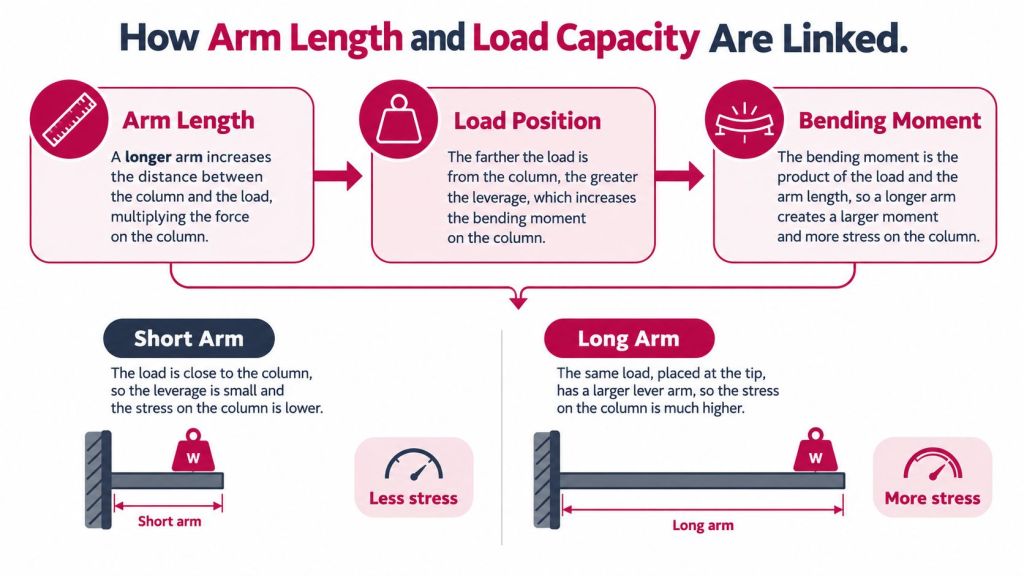
How Arm Length and Load Capacity Are Linked
A cantilever arm works like a lever fixed to the upright. As the arm gets longer, the load sits farther from the connection, so the force at that connection rises. A load near the column creates less bending demand than the same load at the arm tip.
That mechanical relationship explains why published ratings drop as arms get longer. One specification lists 1.0 m arms at up to 2,500 kg, 1.5 m arms at 1,800 kg, 2.0 m arms at 1,200 kg, and 2.4 m arms at 800 kg, depending on the stated loading conditions (Amerack cantilever rack specifications). The exact values aren't universal product ratings, but the pattern is consistent: more reach requires a more conservative capacity check.
Match arm length to load depth
The load should rest fully on the arms instead of hanging past the end. Industry guidance commonly lists cantilever arms from 12 inches to 72 inches in 6-inch increments, although available sizes depend on the manufacturer and system (Cantilever Rack Guide). To see the arm lengths and duty classes sold online, browse our cantilever rack arms, uprights and kits.
Arm capacity also depends on how many arms share the load. The required capacity is calculated as total load weight per level divided by the number of supporting arms, assuming an equal distribution (cantilever rack configuration guidance). A level carrying a load across four arms places a different demand on each arm than the same level supported by fewer arms.
Published examples show the range clearly. Medium-duty straight and incline arms from 12 to 48 inches may carry about 300 to 1,000 pounds, while heavy-duty arms from 12 to 60 inches may range from about 600 to 4,000 pounds (cantilever rack capacity examples). Use those figures as market reference points only. The manufacturer's rating for your complete rack controls the purchase decision.
For the same stored tonnage, shorter arms with more storage levels often work better than long arms with fewer levels. That arrangement can preserve capacity while using vertical space more effectively, provided the load shape, handling equipment, and clearances support it.
Capacity Ranges by Arm Length at a Glance
Arm length sets both capacity and cost. A structural steel example rates a 24-inch arm at roughly 1,200 pounds and a 48-inch by 4-inch arm at around 2,000 pounds per arm, but those figures apply only to the stated designs and loading assumptions (cantilever rack capacity guide).
Use the table as a screening tool, not a purchase specification. Published benchmarks span roughly 300 to 4,000 pounds per arm, with the rating changing by duty class, reach, and complete rack configuration. For roofing materials, compare the rack design with your actual bundles before choosing a cantilever pallet rack for roofing supplies.
| Arm Length | Light Duty | Medium Duty | Heavy Duty |
|---|---|---|---|
| 24 inches | Use the manufacturer’s light-duty rating | Often higher than longer medium-duty arms | May support dense loads when the full system is rated for them |
| 36 inches | Verify against the specific arm chart | Suitable for moderate long-load applications when properly distributed | Requires column and base review for heavy material |
| 48 inches | Capacity is more restricted by reach | Check per-arm and per-column ratings together | Published examples reach around 2,000 pounds per arm for structural designs |
| 60 inches | Confirm availability and rated use | Long reach demands a conservative capacity check | Published heavy-duty ranges can extend toward the upper benchmark only in suitable designs |
These are decision criteria, not universal ratings. Column capacity, base plate design, anchor pull-out, load distribution, and the exact manufacturer's load tag can govern before the arm rating does.
Choose the shortest arm that supports the load footprint without unsafe overhang. Then select the duty class, verify the arm rating, and check the upright at that reach. Never buy from a generic per-arm number alone.
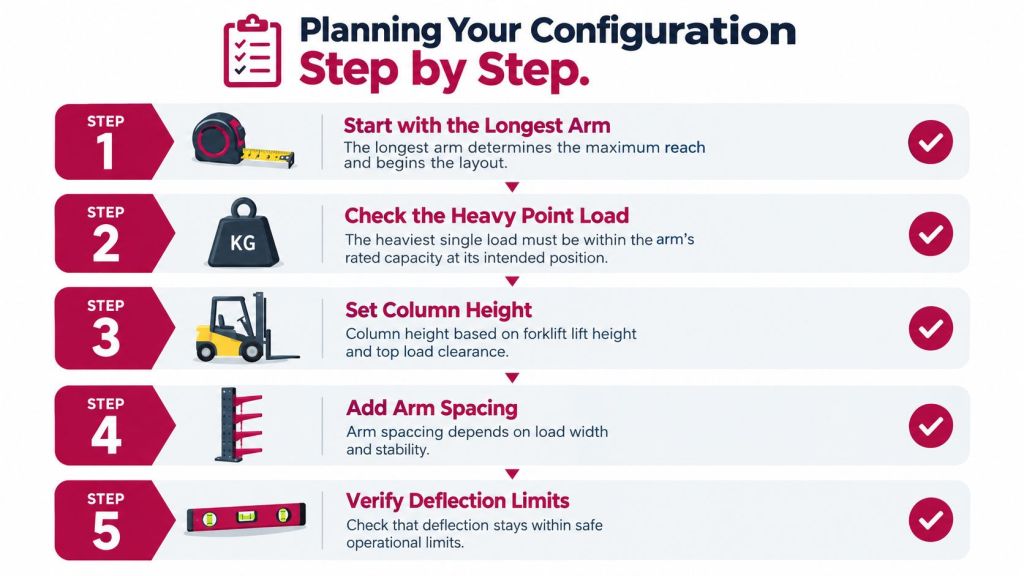
Planning Your Configuration Step by Step
A sound configuration starts with the worst combination, not the average bundle. Gather facility dimensions, load requirements, budget range, and applicable compliance requirements, including fire code, OSHA, or industry-specific rules, before requesting a final layout.
-
Start with the longest arm. Identify the deepest load and select the shortest arm that supports it without overhang. This arm sets the maximum reach and becomes the first column-capacity check.
-
Check the heaviest single load. Determine the greatest weight that one arm may carry, especially when a bundle is dense or uneven. Divide the level load by the number of supporting arms only when equal distribution is realistic.
-
Verify the total weight on each column. Add the loads carried across all levels and both sides where applicable. A rack can pass an arm check and still fail at the upright if the combined column demand is too high.
-
Set column height. Check forklift lift height, top-load clearance, ceiling obstructions, sprinklers, and future storage needs. Don't use every available inch if doing so limits safe handling or maintenance access.
-
Match the base to the layout. Confirm aisle width, forklift turning radius, load overhang rules, and the difference between single-sided and double-sided placement. The base must stabilize the rack without creating a traffic problem.
-
Set arm spacing by the tallest stored item. Average product height can hide the item that controls the vertical layout. Leave enough clearance for safe placement and removal without forcing operators to drag material across neighboring levels.
-
Review bracing and anchors. Bracing patterns may change with site conditions, including seismic requirements. Confirm the anchor type, floor condition, and required installation details before ordering.
Use a Cantilever Rack Configurator to organize these inputs and request a configuration review. See the full cantilever racking line to compare structural and roll-formed options for the configuration you land on. Distributor cut sheets should be checked against the actual combination of arm length, level loading, column height, and simultaneous bay loading, not just a single-arm rating.
Load Shape and Distribution Effects Most Buyers Miss
A rack rating often assumes a centered, evenly spread load. Warehouse material rarely behaves that neatly. Load shape and position can change the stress on an arm even when the total weight remains unchanged. Arm length sets the reach, but load placement determines how much of that reach the rack has to resist.
A short bundle placed near the upright creates less turning force than a longer bundle pushed toward the arm tip. Material extending beyond the arm adds force outside the rated support area and can make the load unstable. Treat published capacity as a limit for the stated loading condition, not a blanket approval for every product shape.

Check the actual load position
Review these conditions before accepting a published rating:
- Partial-length loads: A short or narrow bundle may place its weight on fewer support points than the layout assumes.
- Uneven bundles: One arm can carry more than its partner when material is off-center or the bundle lacks rigidity.
- Coiled stock: A coil's center of gravity can shift as operators move or uncoil it.
- Mixed-depth inventory: Products sharing one level may place weight at different distances from the upright.
- Overhanging material: Loads longer than the arm create extra force beyond the intended support zone.
Use the worst distribution operators will handle as the design case. That may require shorter arms, more support arms, a revised level arrangement, or a loading rule that keeps material closer to the upright. Do not approve a configuration based only on the ideal centered bundle shown in a brochure.
For product-specific planning, review lumber storage cantilever racking, where product length and bundle behavior can vary. Confirm the actual load position during the engineering review, then match the arm length to that condition rather than paying for reach the operation cannot safely use.
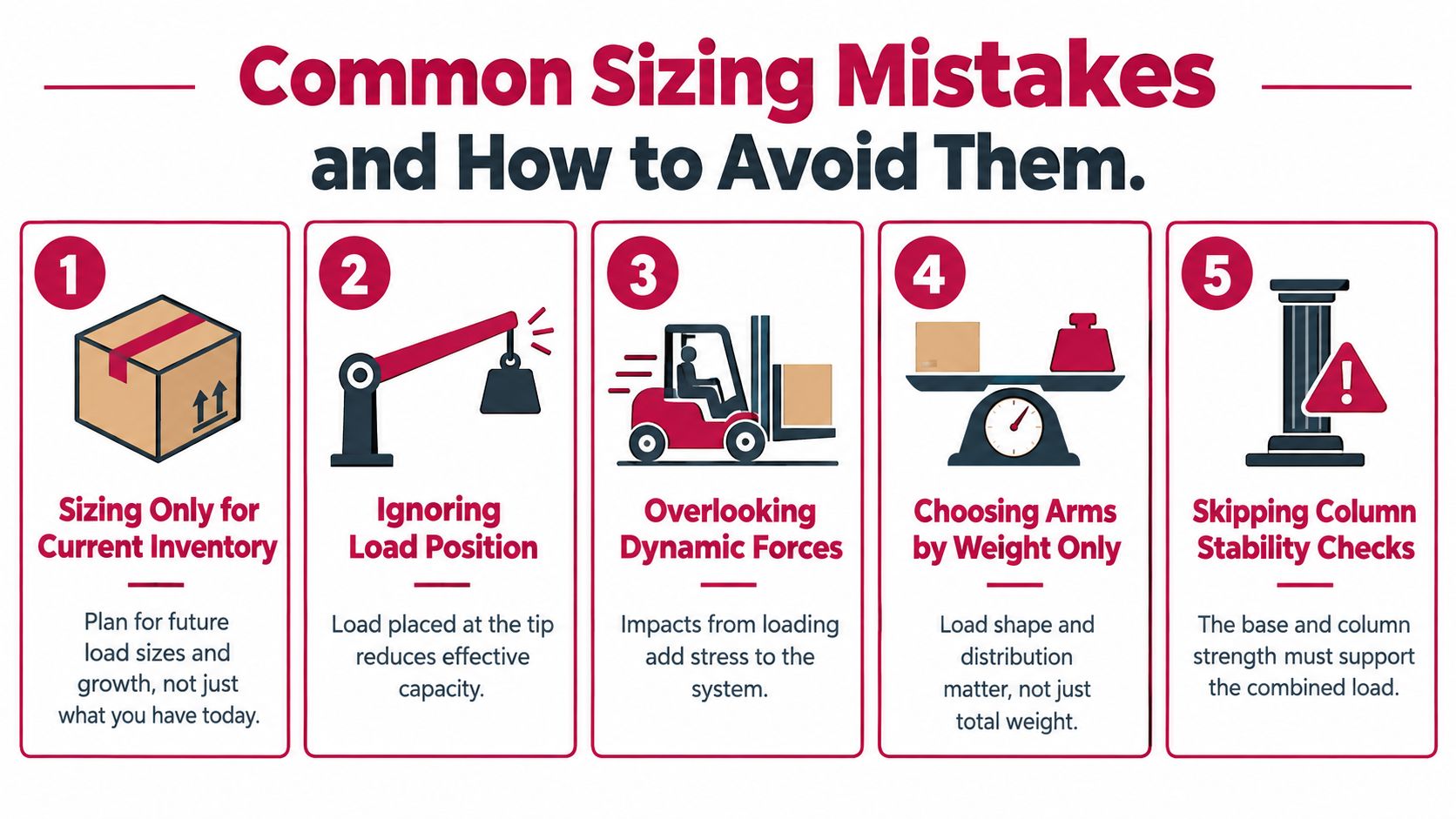
Common Sizing Mistakes and How to Avoid Them
The costly mistakes usually happen before the rack arrives. Buyers separate arm length from column capacity, approve a layout without checking the floor, or size only for today's inventory.
- Sizing only for current inventory: Leave room for future load sizes, new SKUs, and maintenance access. A layout that fits today's narrow bundles may become restrictive when deeper material arrives.
- Choosing arms that are too long: Extra reach adds mechanical force and may require a heavier upright and base. Select the shortest arm that supports the load depth.
- Underestimating point loads: Dense steel coils, bar stock, and compact bundles can place a large share of the weight on one support point. Verify the heaviest single-arm demand, not only the average level weight.
- Skipping floor and anchor checks: Taller columns and heavier loads increase the importance of floor capacity and anchor pull-out. Confirm the slab and anchoring plan before finalizing the order.
- Ignoring forklift movement: Base length and aisle layout must work with the actual forklift turning path. A rack that fits on a drawing can still obstruct loading if the operating clearance is wrong.
For a broader look at code compliance and structural sizing beyond arm length, see the cantilever rack design guide. A single review before purchase can prevent rework after delivery. Ask the supplier to confirm the complete bill of materials, load combinations, floor assumptions, clearances, and installation requirements. That review is easier before production and delivery schedules are set.
Cantilever Rack Load Capacity FAQ
Does doubling arm length cut capacity in half?
Not as a universal rule. Longer arms increase bending moment, so capacity generally falls, but the actual rating depends on the arm section, connection, column, bracing, and loading condition. Compare the manufacturer's rating at the exact length instead of applying a shortcut.
Can I use a longer arm for a shallow load?
You can, but it usually creates unnecessary reach. A shorter arm that fully supports the load often gives you a more efficient capacity and layout. Don't choose length based on future possibilities unless the rack is designed and rated for those future loads.
Does base length change the arm rating?
Base length can affect overall stability and floor layout, but it doesn't let you ignore the arm and column ratings. The complete system must resist the stored load, so have the supplier evaluate base, upright, arm, anchors, and floor together.
Can one upright use mixed arm lengths?
Mixed lengths may be possible in a designed system, but the longest arm can control the upright check. Don't assume a short arm on another level offsets the demand created by a long arm. Request a configuration review for the actual level arrangement.
What should I do if material overhangs the arm tip?
Stop treating the catalog rating as applicable without review. Overhang changes the load position and can increase the mechanical load. Reposition the load, use a longer properly rated arm, add suitable support, or obtain a revised design.
Does column height change published arm capacity?
Column height can affect overall stability and the column check, even when the arm itself hasn't changed. Confirm the upright rating at the selected height and arm arrangement rather than relying on the arm label alone.
Is a load safer if it sits closer to the column?
It can reduce force compared with the same weight at the tip, but the rack still needs to be rated for the full load and actual support pattern. Operators also need a consistent loading method so the position doesn't vary unpredictably.
What information should I send for a quote?
Provide facility dimensions, load weights, load depths, bundle shape, storage levels, forklift details, budget range, floor information, and compliance requirements. Include future inventory plans and any clearance restrictions so the layout doesn't need to be redesigned later.
Material Handling USA can provide a free layout consultation, CAD drawings, specification review, itemized quotes, and coordination around delivery and installation scheduling. Call (800) 326-4403, email Sales@MH-USA.com, or request a review before you commit to an arm length.
Material Handling USA can help you match arm length, load distribution, column capacity, anchors, and clearances in one reviewed configuration, with free layouts and quotes, quality products, competitive pricing, and fast shipping options. Visit Material Handling USA to start a design consultation, or call (800) 326-4403 to move from a capacity question to a confirmed bill of materials before planning delays affect your installation schedule.
Design It Yourself, Then Get a Quote
Use our free cantilever rack configurator to enter your load depth, weight, and column height, then send the configuration to our team for pricing. Browse the full cantilever racking line to compare structural and roll-formed options before you finalize a layout.
Related reading: