
Cantilever Lumber Rack and Lumber Storage Racking
Cantilever racking for dimensional lumber, timbers, trim and sheet goods, sized by bundle depth and weight so every unit loads straight from the aisle.
Planning a yard or shed? Try the free 3D Cantilever Rack Configurator or shop cantilever rack parts.
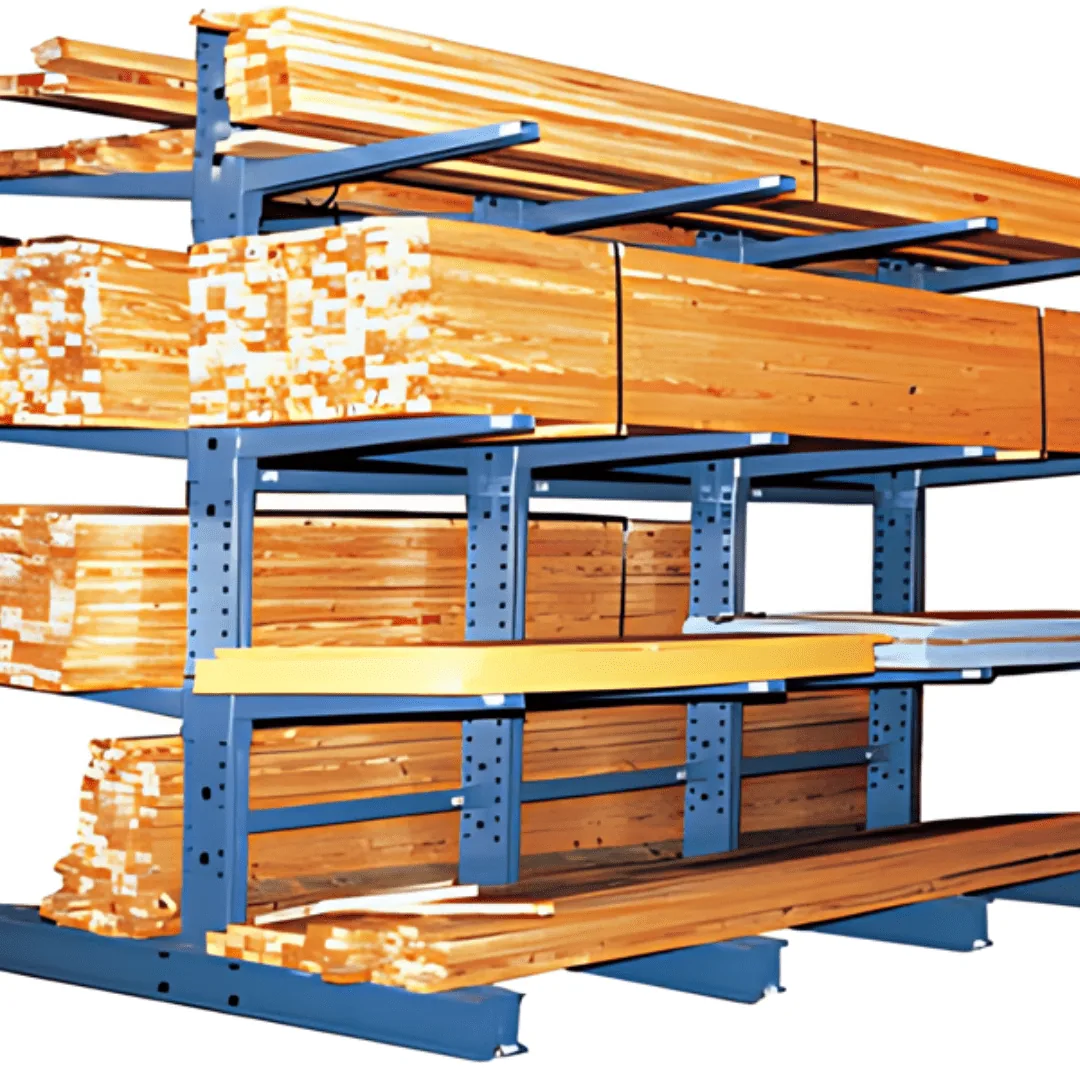
Arm = depth
Size arms to bundle depth, not length
1,865 lb
Per arm, Vestil HD straight 42 in (published)
12,800 lb
Per upright, Vestil HD 8 ft, 48 in arms (published)
Free
Lumber yard layout and quote
Shop Cantilever Lumber Rack Parts by Category
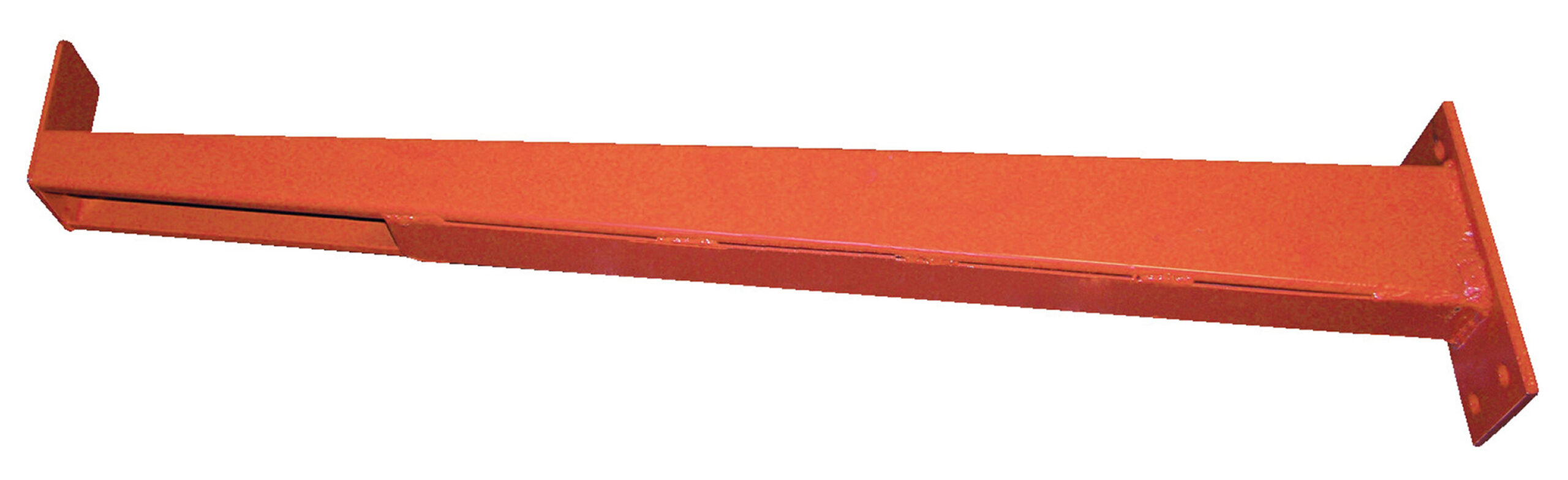
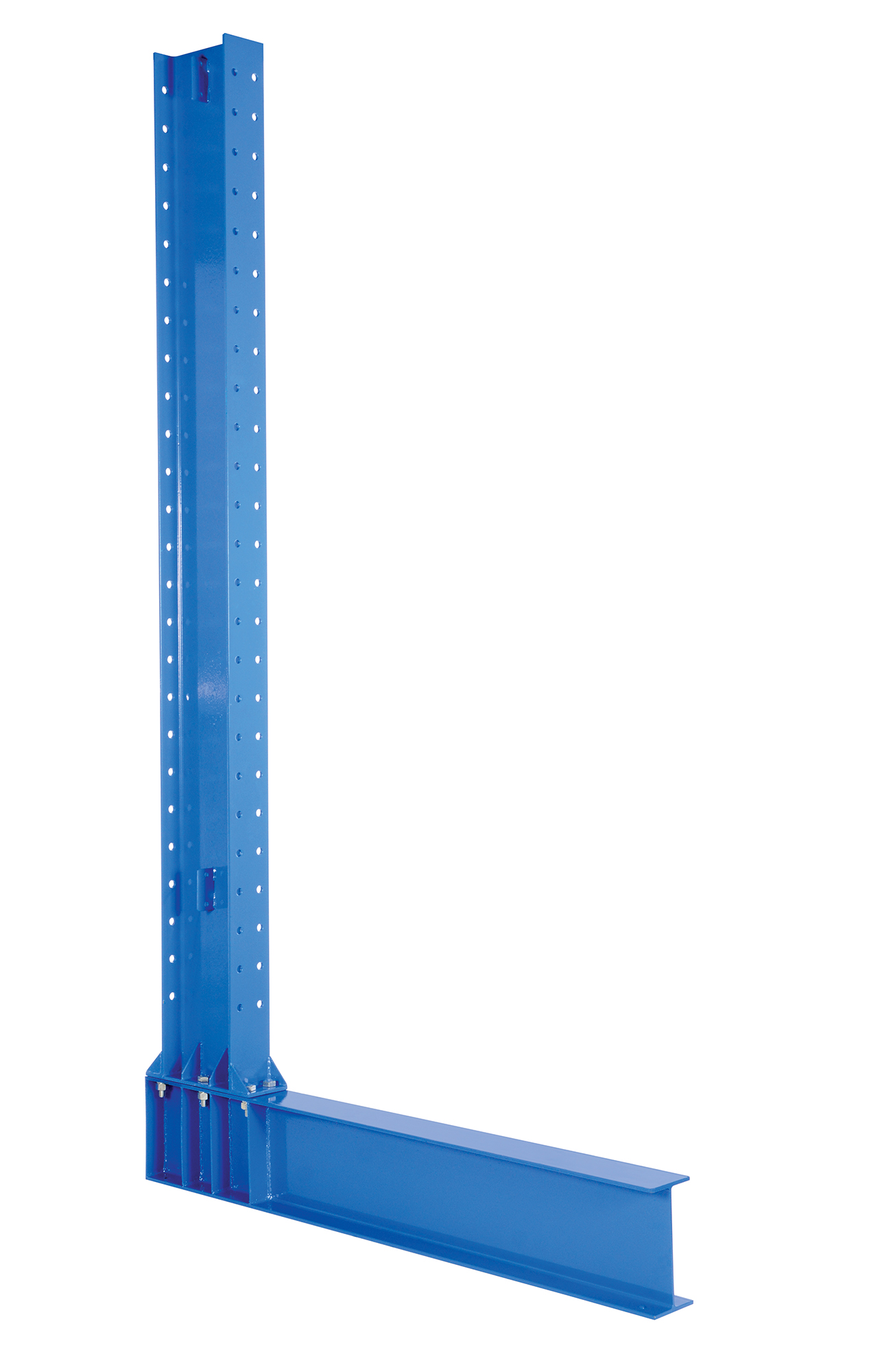
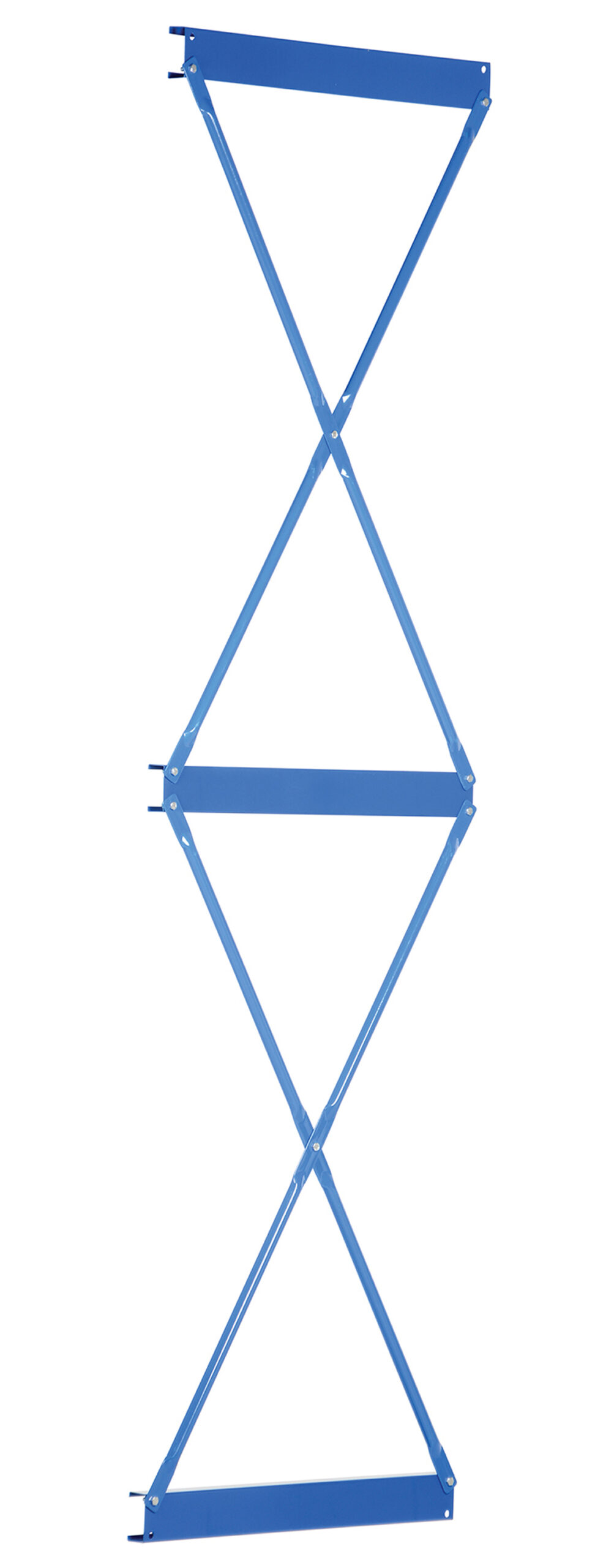
Each card opens a shop category with current online prices; the price shown is the lowest-priced in-stock item in that category. For lumber, choose straight arms as long as your bundles are deep, uprights tall enough for your levels, and brace sets that set the arm spacing your lengths need. Freight is quoted by destination; some common sizes in stock at select manufacturers, subject to confirmation.
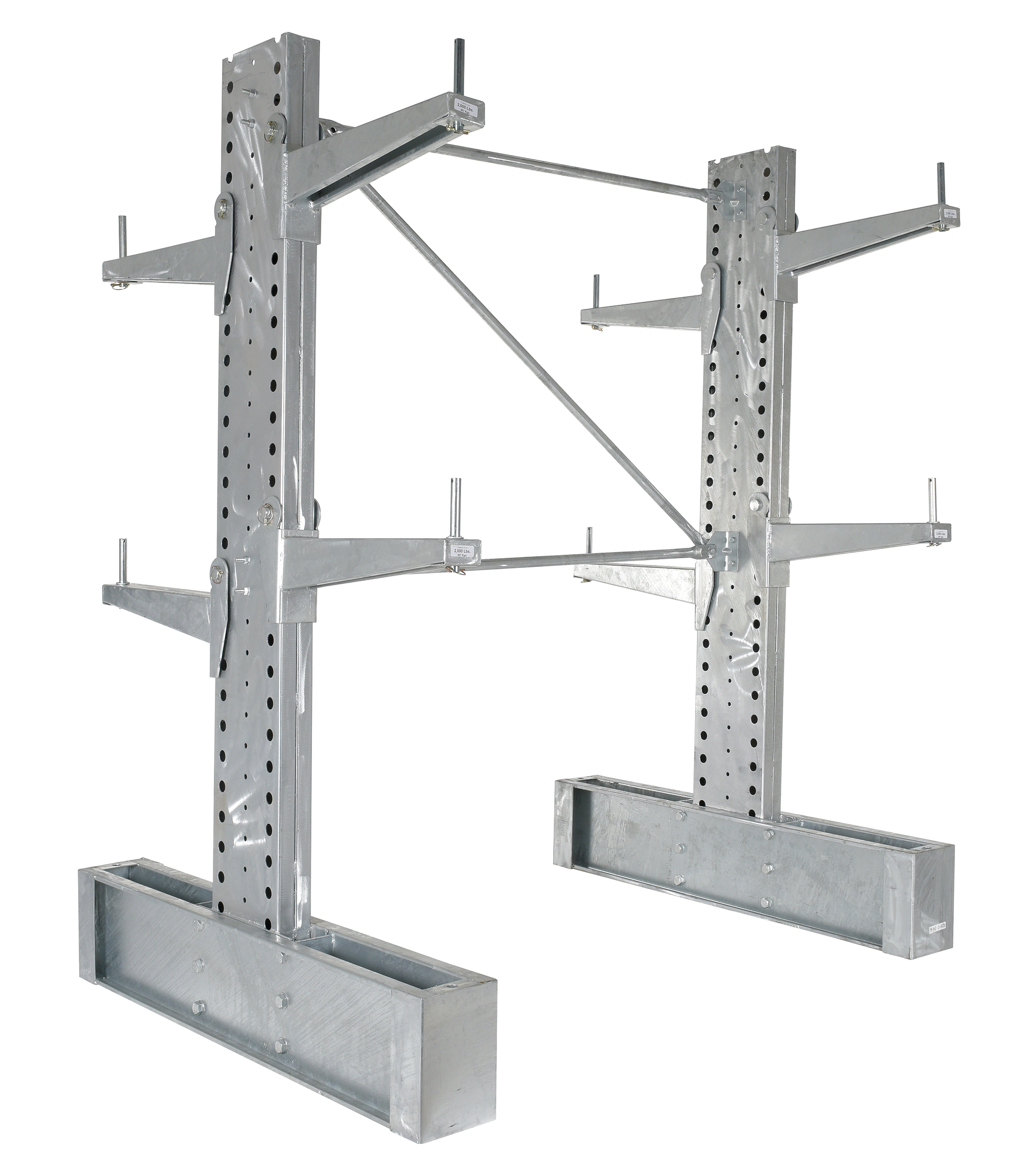
Why Lumber Yards Use Cantilever Racking
Lumber comes in 8 to 20 ft lengths and banded units that never match a 48 in pallet. On a cantilever lumber rack the bundle lies lengthwise along the row, across several arms, with no front columns to thread a forklift through. Short trim, full-length studs and long timbers can share one row, each on its own level.
Same system as our cantilever rack, set up for wood.
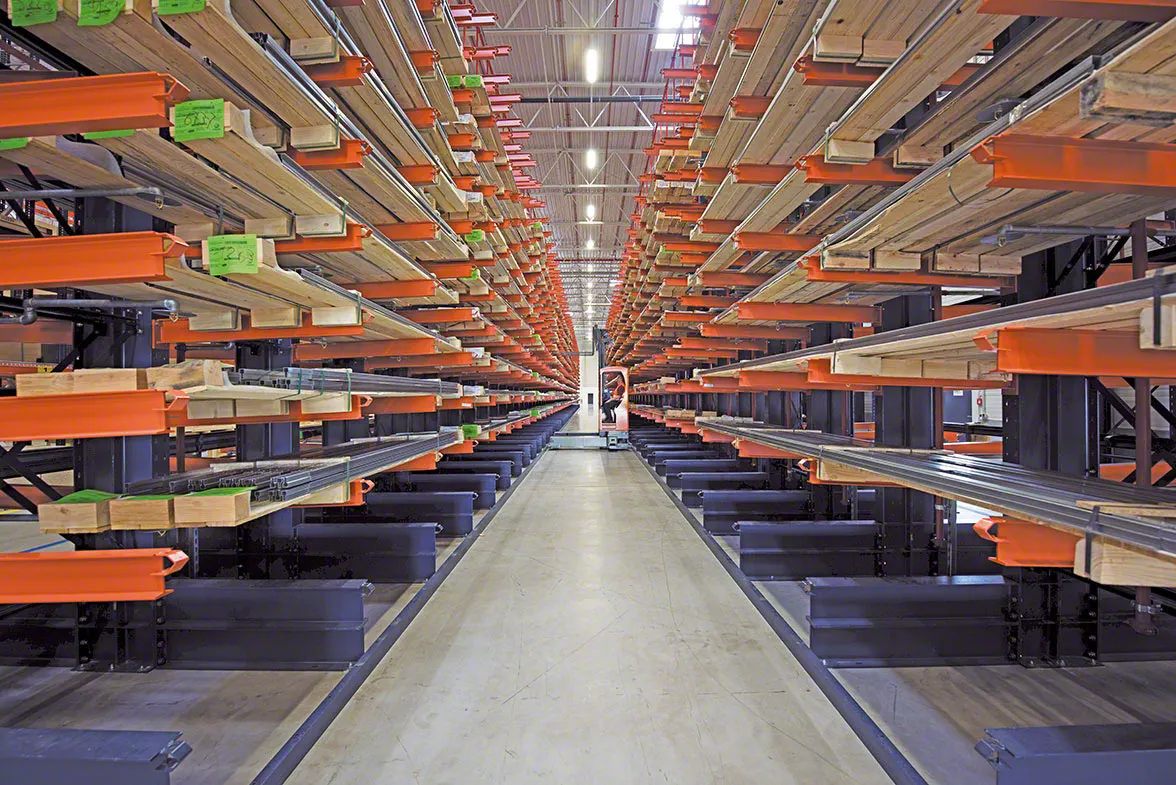
Photo: Interlake Mecalux (authorized use).
- Load from the aisle: a full unit slides straight onto the arms from a forklift or side loader.
- Off the ground and flat: arms keep lumber dry and level, which limits warping, bowing and crushed bottom boards.
- See what you have: every level is open, so stock checks and cycle counts take minutes.
- Any length per level: arm spacing supports 8 ft and 20 ft stock in the same row.
- Grows with the yard: each new bay needs one upright, one brace set and its arms.
How to Size Cantilever Arms for Lumber

Arm length equals bundle depth, the distance the unit reaches out from the column, plus a few inches. It has nothing to do with board length; length decides how many arms the unit rests on. A unit about 4 ft wide needs a 48 in arm. Never let a bundle hang past the arm tip.
Compare arm duty classes in the cantilever arm capacities by length table.
Photo: Interlake Mecalux (authorized use).
| Lumber stock | Typical bundle depth | Arm length to plan | Notes |
|---|---|---|---|
| Trim, moulding, furring strips | 12 to 24 in | 18 to 24 in arms | Light; closer arm spacing stops short pieces tipping |
| Dimensional lumber units (2×4 to 2×12) | About 42 to 48 in | 42 or 48 in arms | Most common lumber-yard arm |
| Timbers, beams, glulam | 24 to 48 in | 36 to 48 in heavy arms, or structural | Heavy per foot; check arm rating first |
| Sheet goods (plywood, OSB, MDF) | 48 in (4 ft sheet width) | 48 in arms, often with decking | See sheet goods section below |
| Engineered lumber (LVL, I-joists) | Varies by unit | Match the unit depth | Long lengths need more arms |
Lumber Weights and Arm Capacity
Weigh the heaviest unit you will store, not the average. Kiln-dried softwood framing lumber typically weighs about 26 to 36 lb per cubic foot depending on species; green or freshly treated lumber can weigh a lot more. Estimate a unit as width x height x length in feet, times the weight per cubic foot:
| Example unit (W x H x L) | Volume | At 32 lb/ft³ | Per arm on 4 arms |
|---|---|---|---|
| 4 x 2 x 8 ft | 64 ft³ | 2,048 lb | 512 lb |
| 4 x 2.5 x 12 ft | 120 ft³ | 3,840 lb | 960 lb |
| 4 x 2.5 x 16 ft | 160 ft³ | 5,120 lb | 1,280 lb |
| 4 x 3 x 20 ft (on 5 arms) | 240 ft³ | 7,680 lb | 1,536 lb |
Worked example with published ratings
A 16 ft unit about 4 ft wide and 2½ ft tall weighs roughly 5,120 lb. On four arms that is about 1,280 lb per arm, so standard and medium arms are out. Vestil rates its heavy-duty 42 in straight arm at 1,865 lb and its extra-heavy 42 in arm at 2,900 lb. Three levels of that unit put about 3,840 lb on each upright, well under the 12,800 lb Vestil publishes for its heavy single-sided 8 ft upright with 48 in arms. Taller racks and heavier units move you to 12 or 14 ft uprights or structural cantilever.
Check the whole column, not just one arm
Add every arm load on a column and stay under the upright rating for that arm length. Published ratings are uniform loads; confirm current figures on the product page or your quote.
More on why capacity falls as arms get longer: cantilever rack load capacity by arm length.
Arm and Upright Spacing by Lumber Length
Upright spacing, set by the brace set length, decides how far apart the arms are along the row. The rule of thumb: the board that hangs past the end arm should be no more than about half the arm spacing. Shorter or thinner stock needs closer arms; heavy 20 ft units need more of them.
Arm spacing is step two in our cantilever rack design guide.
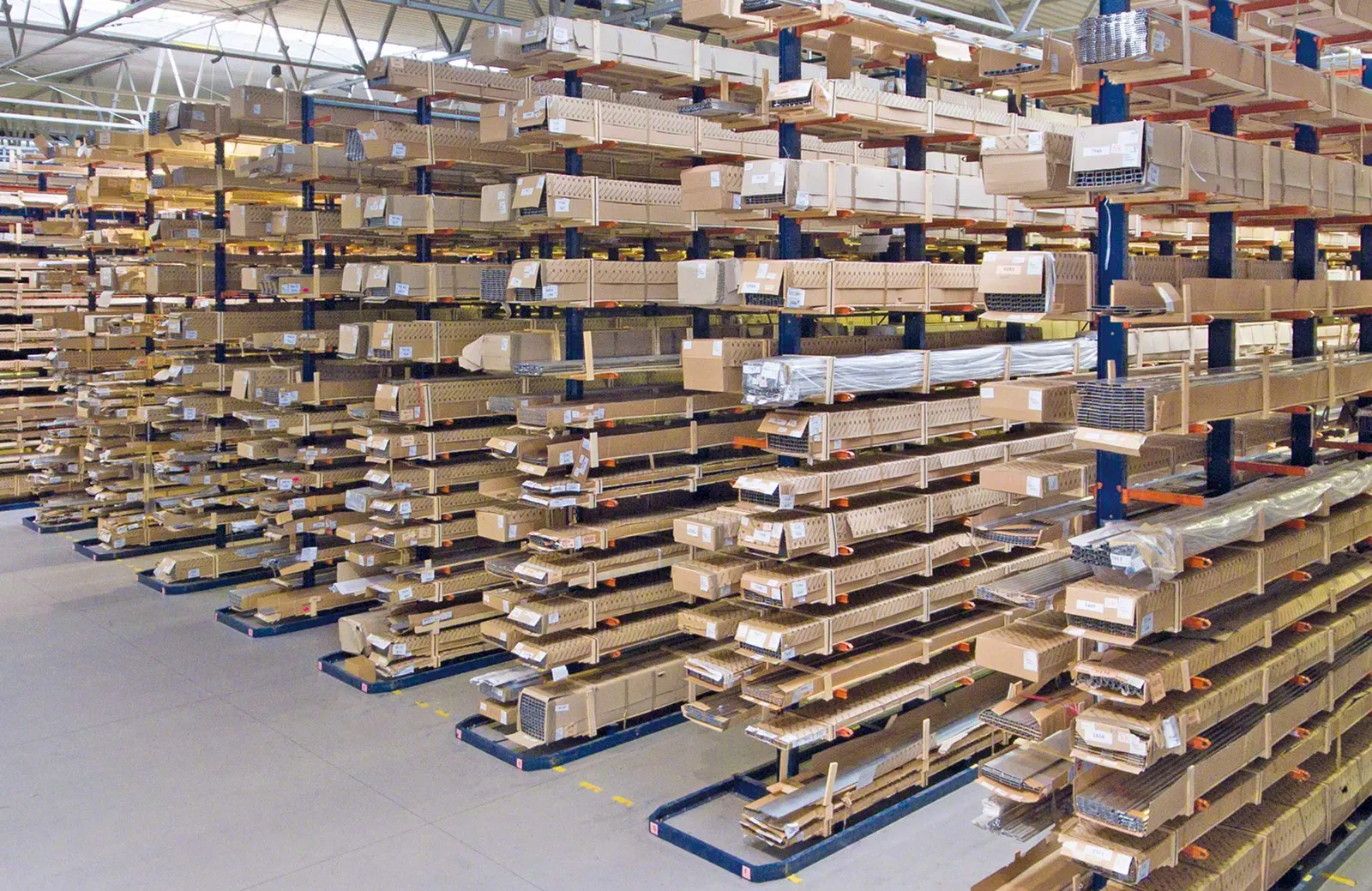
Photo: Interlake Mecalux (authorized use).
| Common length | Arms under the unit | Typical upright spacing | Overhang each end |
|---|---|---|---|
| 8 ft | 2 to 3 | About 4 ft | Up to about 2 ft |
| 10 to 12 ft | 3 | About 4 to 5 ft | About 1 to 2 ft |
| 16 ft | 4 | About 4 to 5 ft | About 1 to 2 ft |
| 20 ft | 5 | About 4 to 5 ft | About 1 to 2 ft |
These are planning figures. Thin trim and wet or treated lumber sag more, so tighten the spacing; a run that mixes 8 ft and 20 ft stock is usually laid out for the shortest common length.
Single-Sided vs Double-Sided Lumber Racks
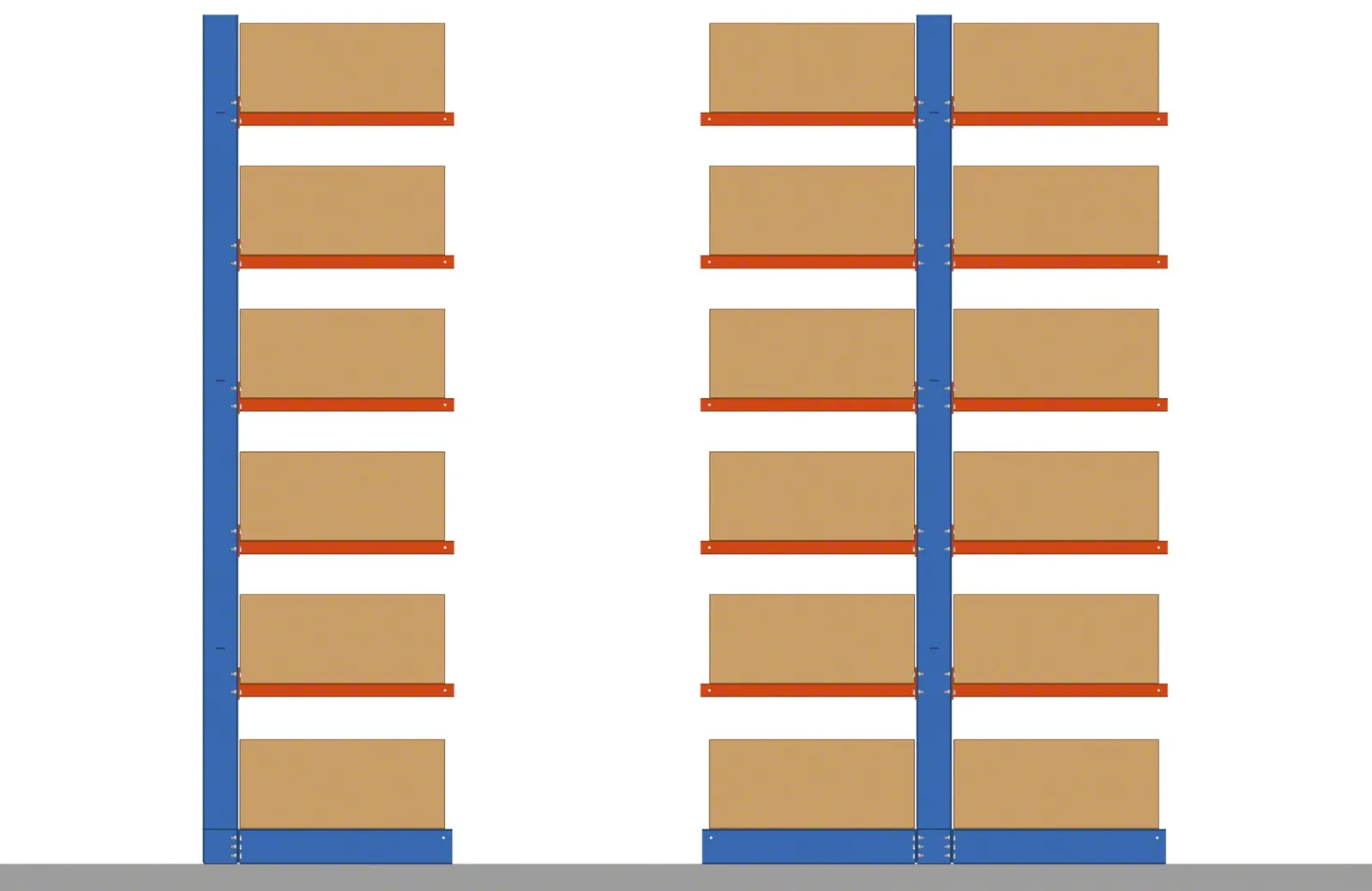

Single-sided rack runs along a wall, fence or building line and leaves one open aisle for cutting, banding and customer loading, which suits retail yards and millwork shops. Double-sided rack stands in the middle of the floor with arms on both faces and roughly double the per-upright capacity; it suits distribution yards that load from aisles on both sides.
Plywood, OSB, MDF and Other Sheet Goods
Sheets lie flat with the 8 ft edge along the row and the 4 ft edge across 48 in arms. On arms 4 ft apart an 8 ft sheet rests on three arms; thin panels and MDF still sag between them, so many yards add decking on the sheet levels and keep those levels low, within easy fork reach.
Full detail: cantilever rack for sheet goods and panels.
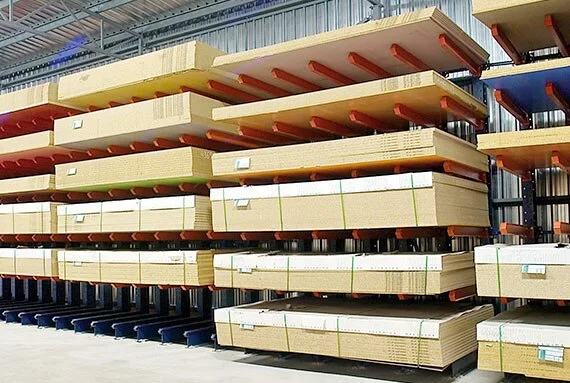
Photo: Interlake Mecalux (authorized use).
Outdoor and Covered Lumber Yards
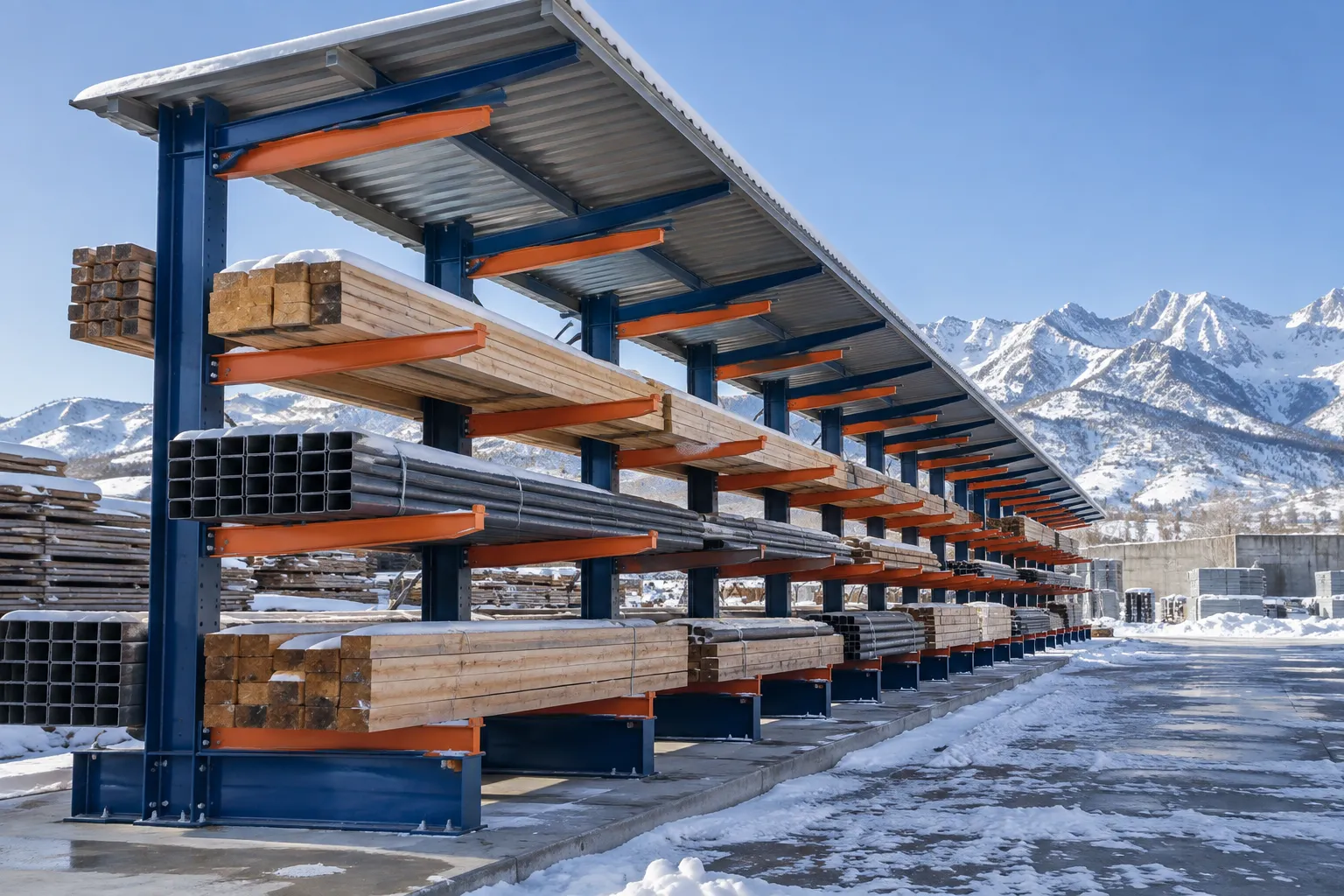
Open yards use hot-dip galvanized rack anchored to footings or a slab designed for it. A roof canopy on the rack keeps rain and sun off the top levels and helps prevent graying, checking and moisture swings. Outdoor and roofed rack must also handle wind and snow, which usually means engineering and a building permit.
Comparing options? See covered vs open cantilever rack.
- Drainage: slope the yard away from the bases so water never ponds at the anchors.
- Airflow: leave space between units for air to move, especially with green or treated lumber.
- Top-level cover: wrap or roof the top level; it takes the most sun and snow.
- Wind and snow: lightly loaded outdoor bays need anchoring and bracing for local wind; snow on loads adds weight.
Loading, Aisles and Yard Layout
A counterbalance forklift carrying a 16 ft unit crosswise needs an aisle wider than the load is long. Side loaders and four-way trucks carry lumber lengthwise and work in much narrower aisles, which is how lumber distribution centers fit more rack in the same building.
Plan the aisle with our forklift aisle width guide.
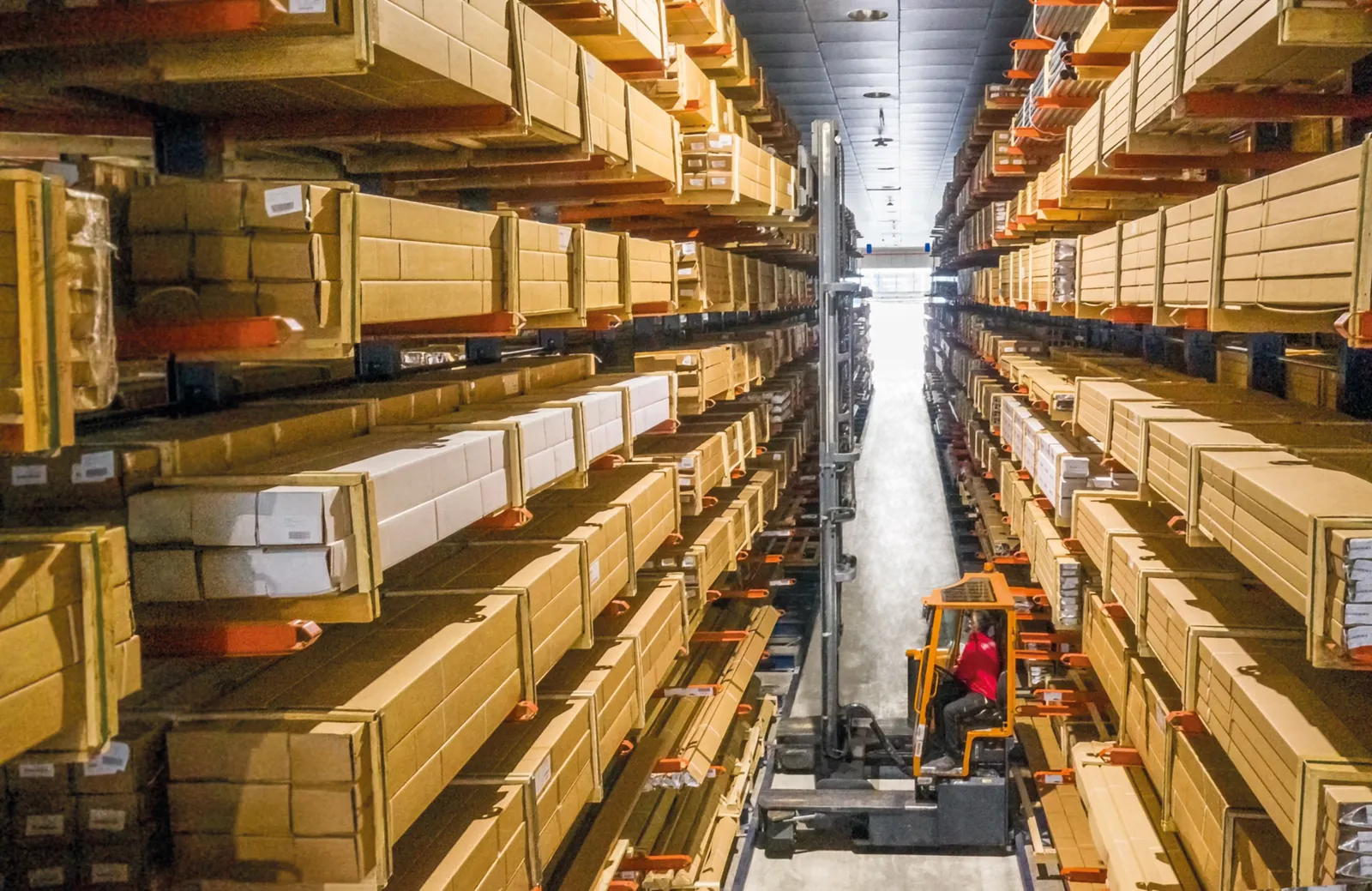
Photo: Interlake Mecalux (authorized use).
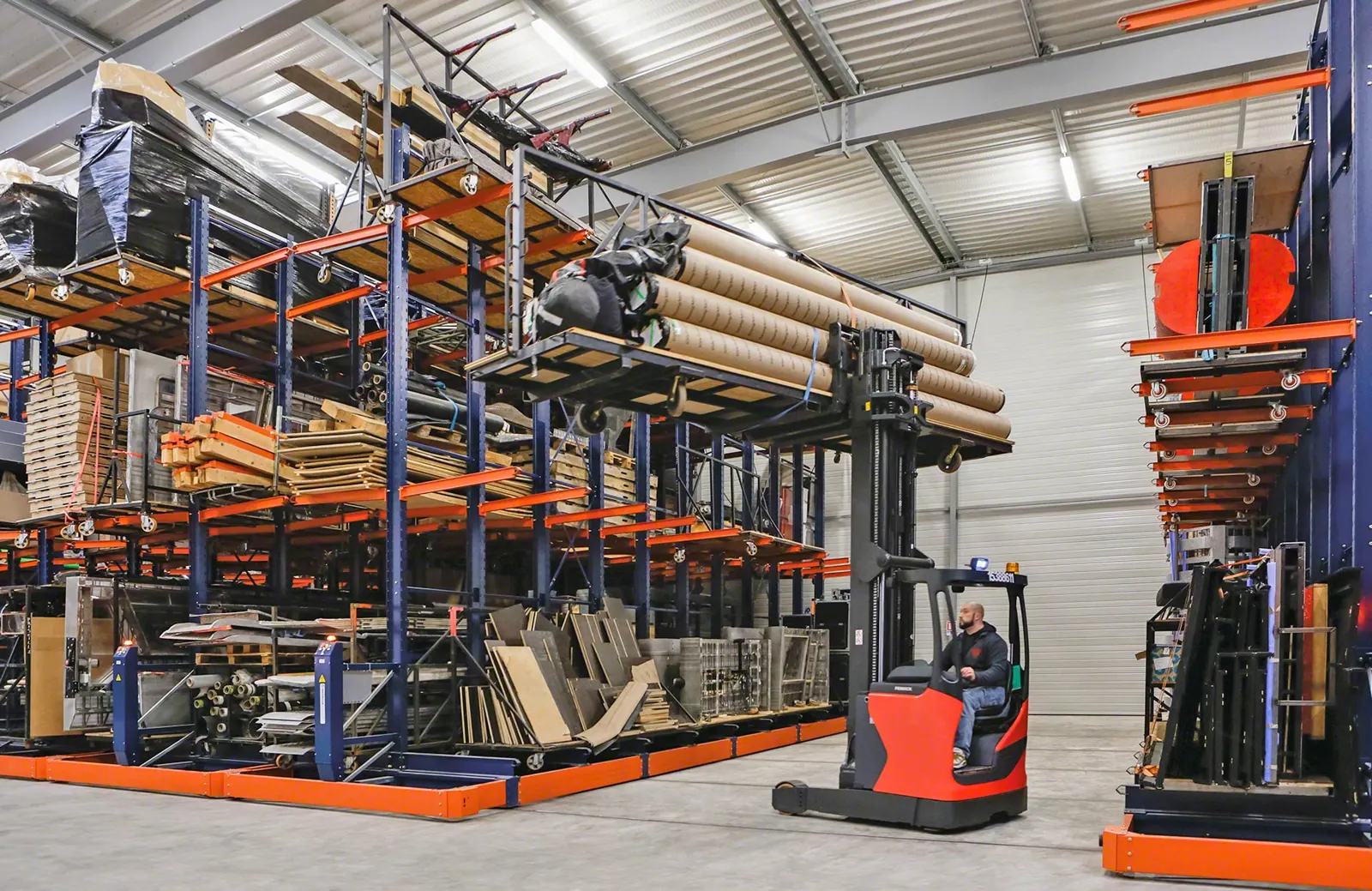
Where floor space is tight, mobile cantilever racks ride on rails and open one aisle at a time, so a building that fits three fixed rows can often hold more. They suit slow-moving stock in a covered warehouse and need a flat slab and engineering.
Photo: Interlake Mecalux (authorized use).
Lumber yard layout checklist
- Group by species and grade, then by dimension, then by length, and label every level.
- Put fast movers (studs, common 2x lumber) near the loading area and on the lowest levels.
- Keep sheet goods on low, decked levels and heavy timbers on the bottom arms or bases.
- Run single-sided rack along fences and buildings; use double-sided rows in the open yard.
- Leave turning room at row ends for long loads and a clear staging lane for order picking.
Cantilever vs Pallet Rack, Vertical Lumber Racks and Floor Stacking
| Option | Best for | Strengths | Limits |
|---|---|---|---|
| Cantilever lumber rack | Banded units, long boards, timbers, sheets | Open face, any length, rated arms, scalable | Needs aisle room; size each arm |
| Pallet rack with beams | Palletized fasteners and boxed goods | Common, low cost per position | Front columns block long loads; boards sag across beams |
| Vertical lumber rack (A-frame) | Small shops, offcuts and moulding | Small footprint, hand access | Hand loading only; ceiling limits length |
| Bunks or floor stacking | Temporary overflow | No equipment cost | Wastes height, crushes bottom units, hard to count |
| Wall-mounted lumber rack | Garages and school shops | Cheap, off the floor | Light loads only; not for forklift units |
For mixed warehouses, the cantilever vs pallet rack comparison goes deeper. Planning the inside of a store or warehouse, with sheet racks, door storage and bagged goods next to the cantilever? See our guide to indoor lumber and building materials storage racks.
Who Uses Cantilever Lumber Racks
 Lumber yards and building supplyStuds, framing lumber and sheet goods sorted for fast order picking.
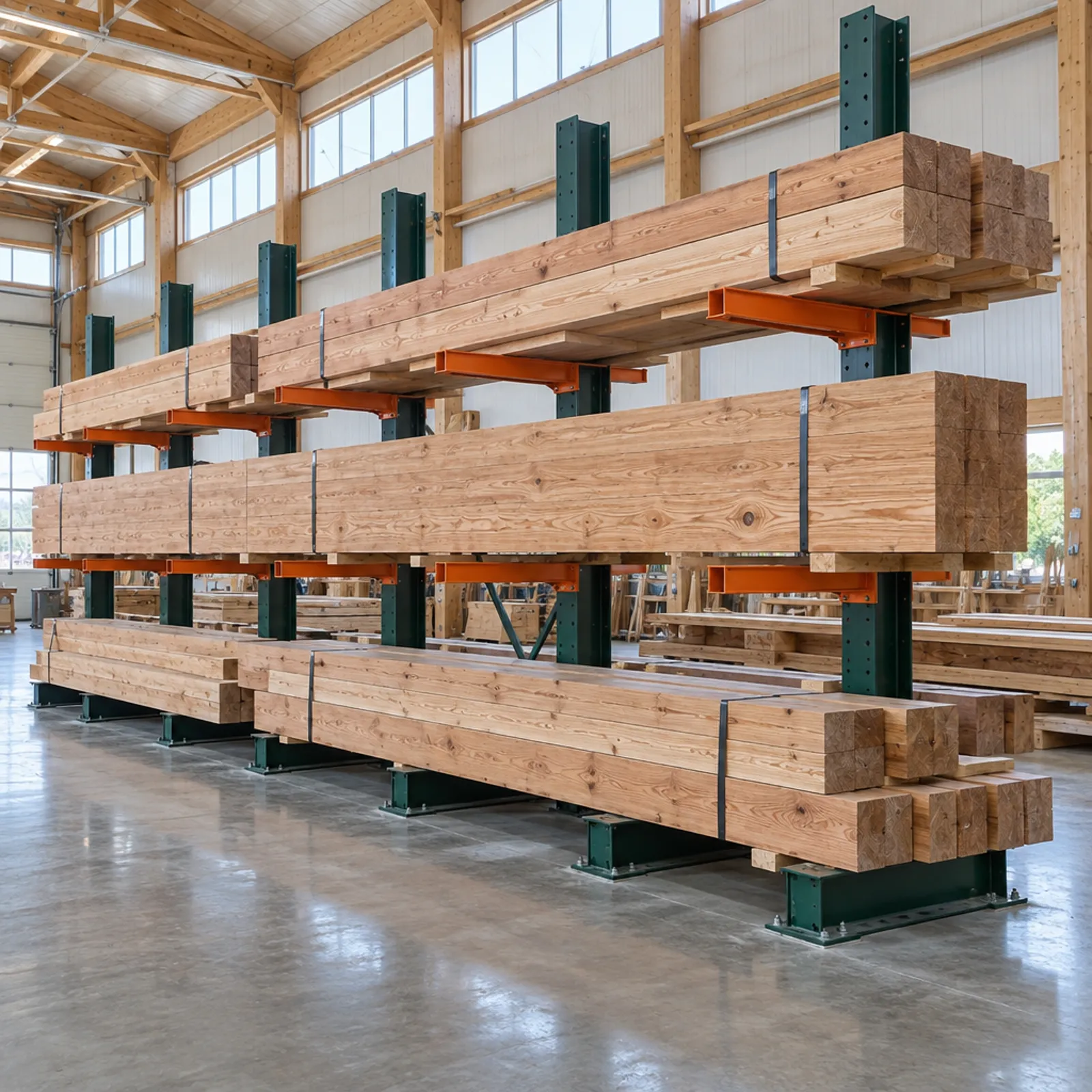 Timber framers and truss plantsHeavy timbers and long stock on heavy-duty arms.
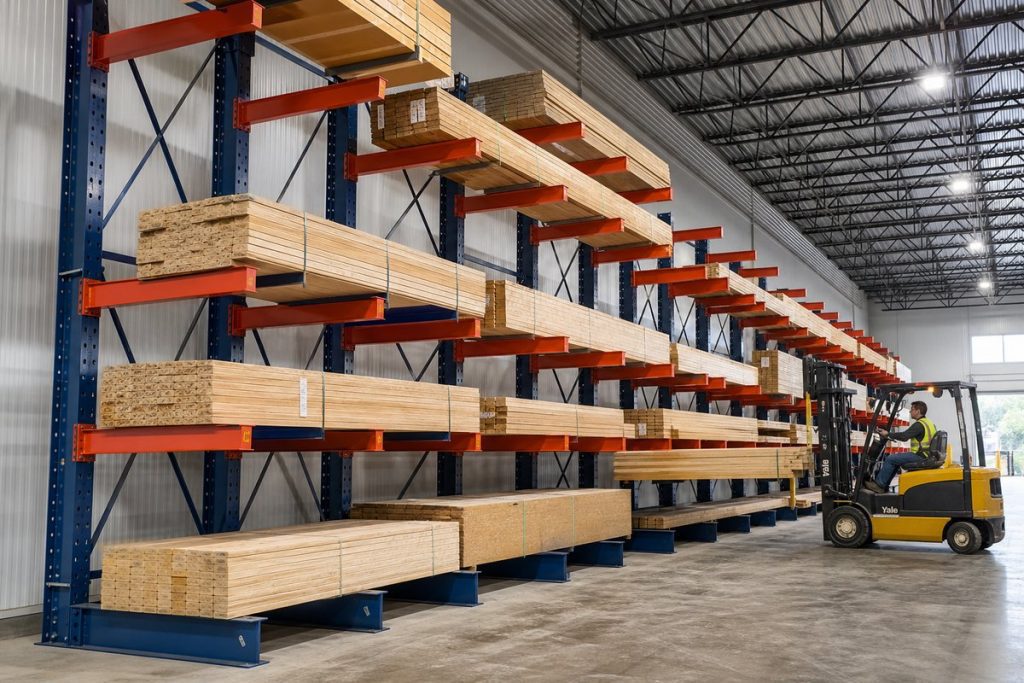 Lumber distribution warehousesDouble-sided rows loaded by forklift or side loader.
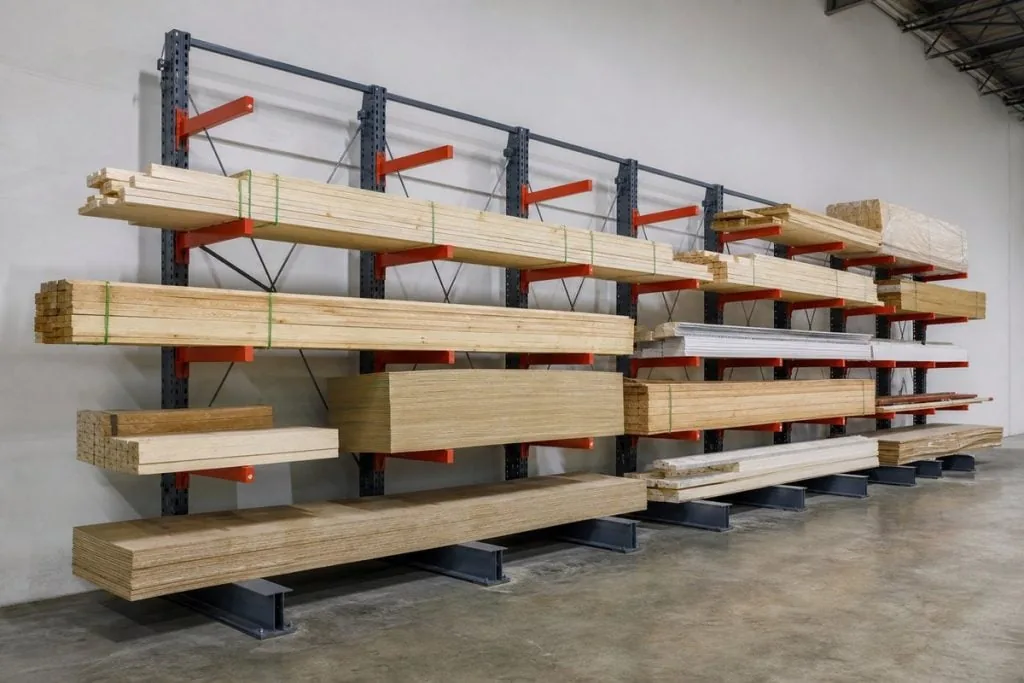 Millwork, cabinet and door shopsHardwood, trim and panels near saws and CNC routers.
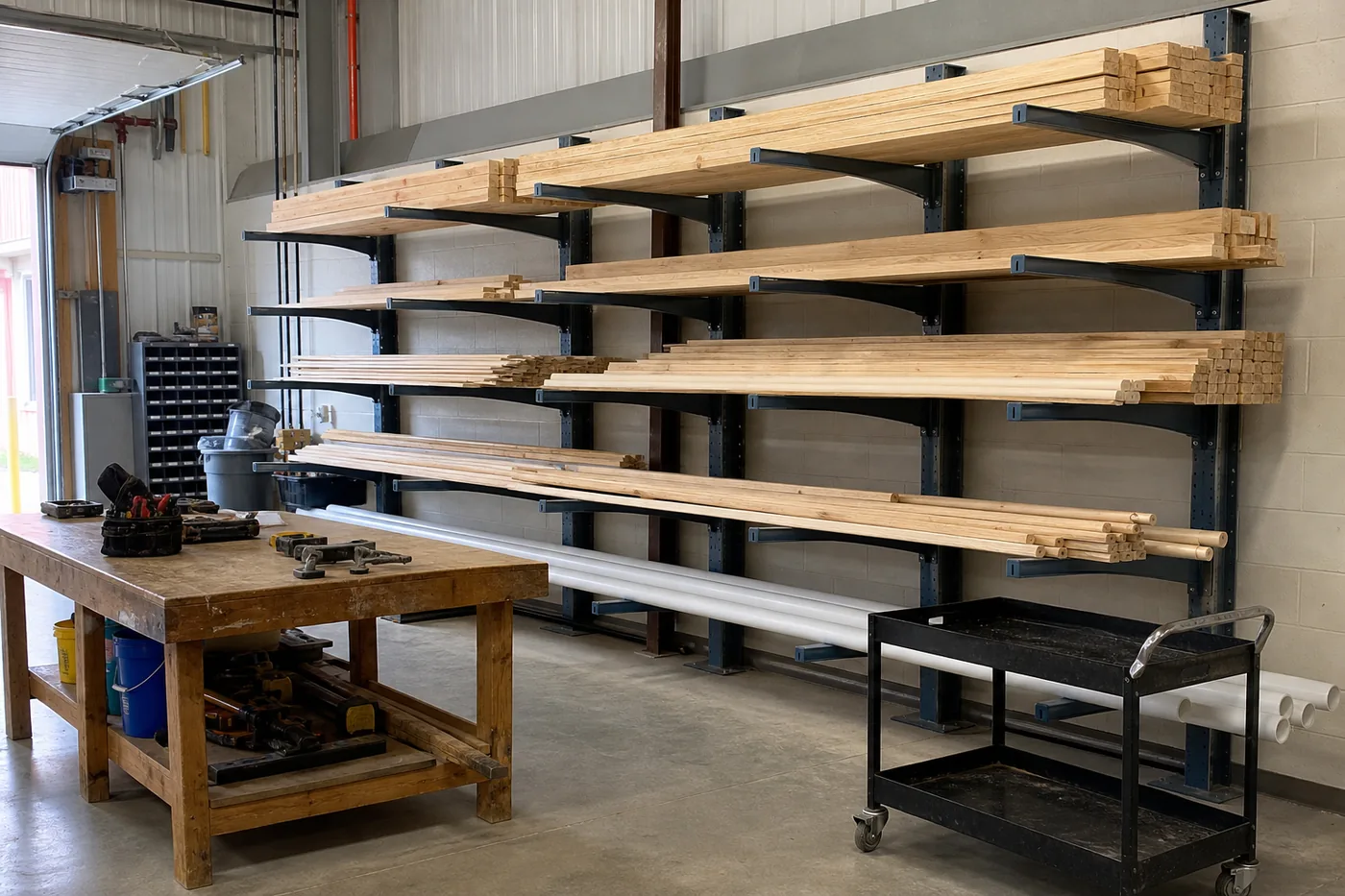 Schools and facilities shopsShop class and maintenance lumber stored safely.
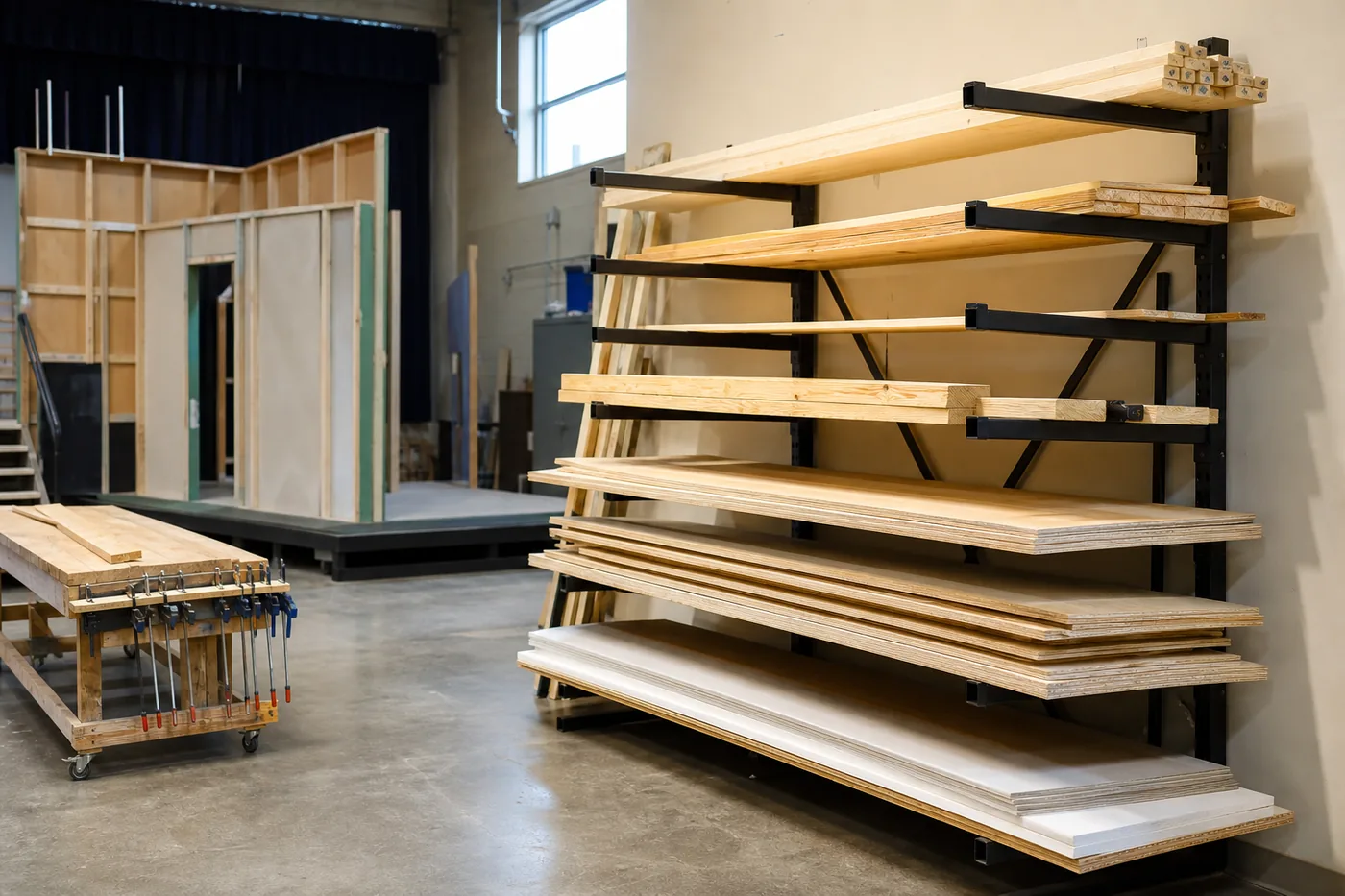 Theater and exhibit scene shopsSheet goods and framing stock for set builds.
How We Plan a Lumber Rack With You
Send your stock list
Unit sizes, lengths, species, heaviest unit and indoor, covered or open yard.
We size the arms
Arm length to bundle depth, duty class to unit weight, decking for sheets.
We size the uprights
Levels, height, single or double-sided, spacing and anchoring.
Layout and quote
Rows, aisles for your trucks, roof options, freight and installation.
Install and inspect
Anchors, load signs and a walk-through before the first unit goes up.
Safety basics
- Post arm and upright capacities on each row and keep units centered on the arms.
- Never climb arms; use the right truck and keep people clear when loading upper levels.
- Inspect for bent arms, loose arm locks and damaged bases after any impact.
- Cantilever racks are covered by ANSI MH16.3, published through the Rack Manufacturers Institute.
- Installing in Utah? See cantilever rack installation, permits and anchoring.
Thinking about used rack to save money? Used savings are usually used up at installation, because parts rarely fit well after disassembly and installer time to straighten and fit them costs more than new. Reusing rack you already own can work, and new is sometimes still cheaper after fix-up time. Call sales with pictures, or read used vs new cantilever rack.
Get a free quote
Tell us what you are storing, the room size and your timeline. A project specialist will follow up with layout options and pricing. Prefer to talk? Call (800) 326-4403.
Cantilever Lumber Rack FAQs
What arm length do I need for lumber?
How far apart should cantilever arms be for lumber?
How much does a unit of lumber weigh?
How much weight can a cantilever arm hold?
Is cantilever better than pallet rack for lumber?
Single-sided or double-sided cantilever for a lumber yard?
Can I store plywood and sheet goods on cantilever rack?
Can cantilever lumber racks go outside?
How tall can a lumber rack be?
Do I need special forklifts for cantilever lumber rack?
Do you sell cantilever lumber rack parts online?
Is used cantilever rack a good option for lumber?
Can you design and install a lumber rack for my yard?
Plan Your Lumber Storage Rack
Send your unit sizes, lengths and heaviest load, plus whether it is indoor, covered or open yard. We will size arms, uprights and spacing and quote freight and installation.