
Cantilever Rack for Sheet Goods and Panels in Utah
How to store plywood, MDF, drywall, insulation board and sheet metal on cantilever rack without sagging sheets, dented edges or overloaded arms: arm length, arm spacing, decking, weights and handling.
48 in
Typical arm for 4-ft-wide sheets
1/2 spacing
Common starting point for end overhang
~3,800 lb
A 40-sheet unit of 3/4-in MDF (approx.)
~10 lb
One 2-in insulation board (approx.)
Shop Cantilever Rack for Sheet Goods by Category
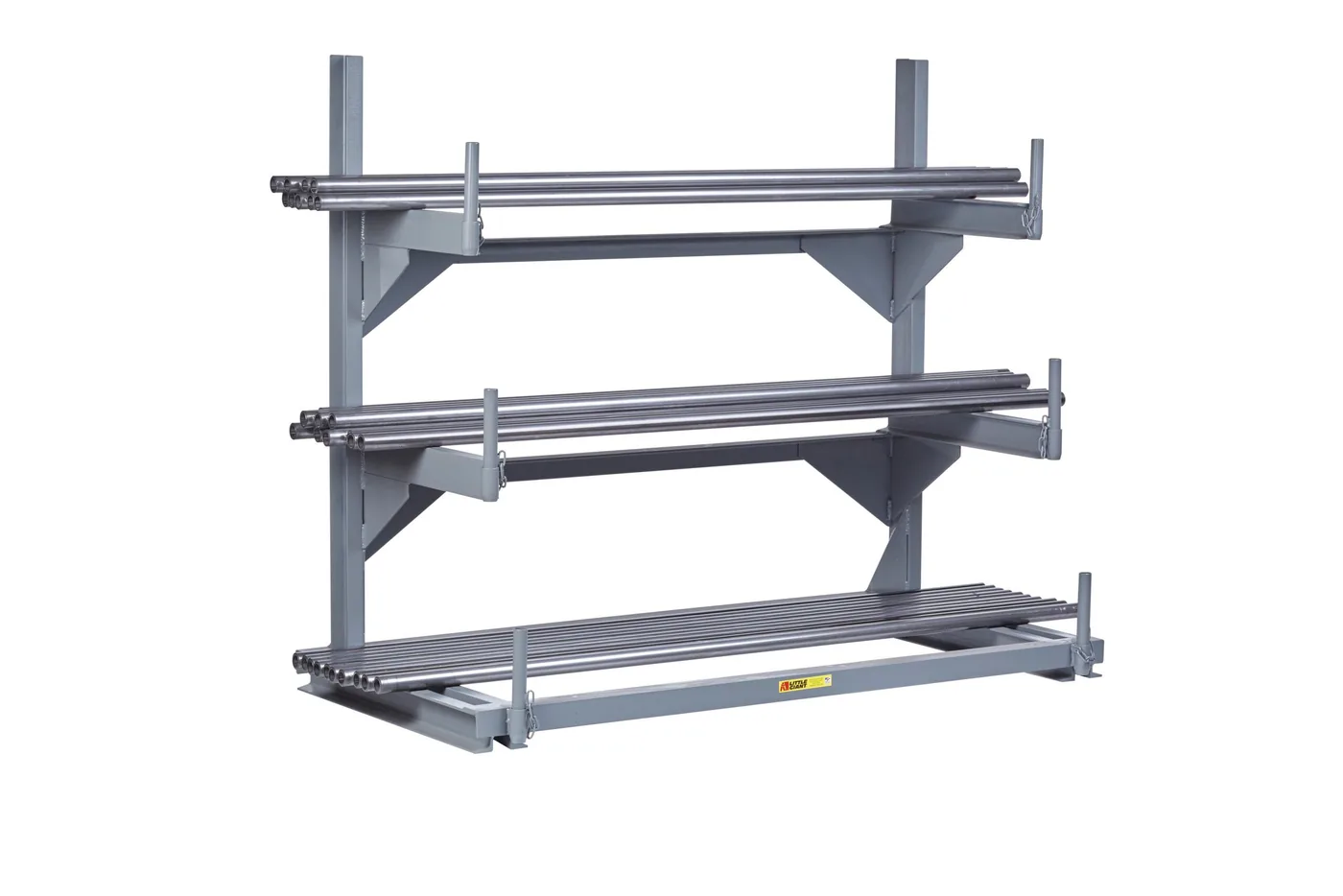
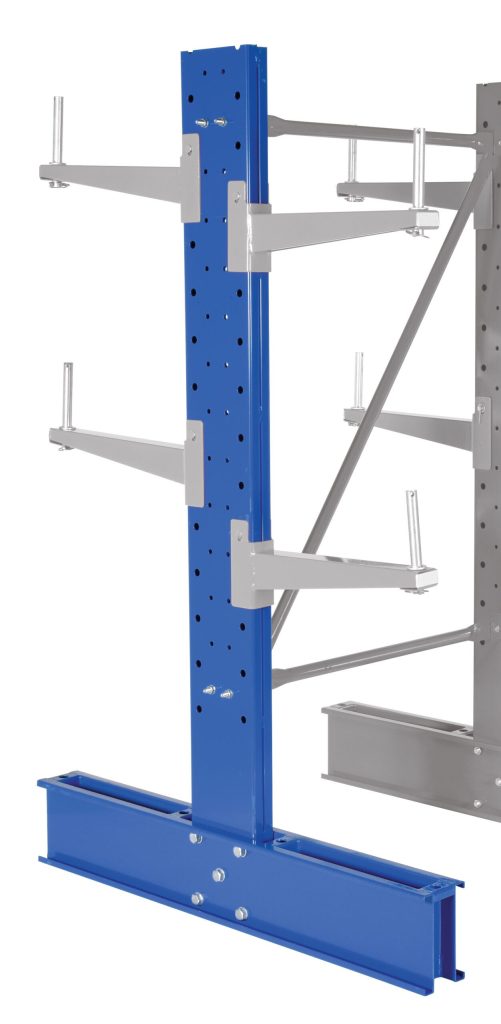
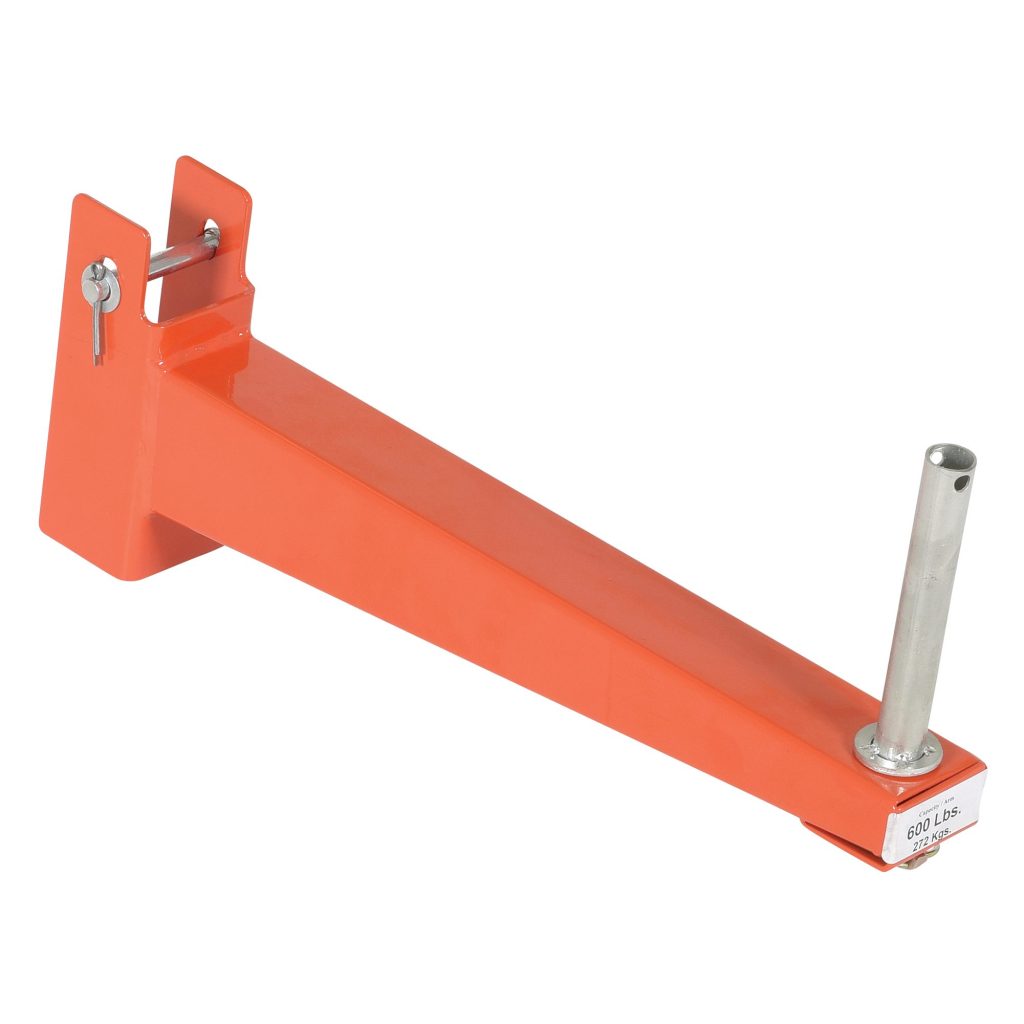
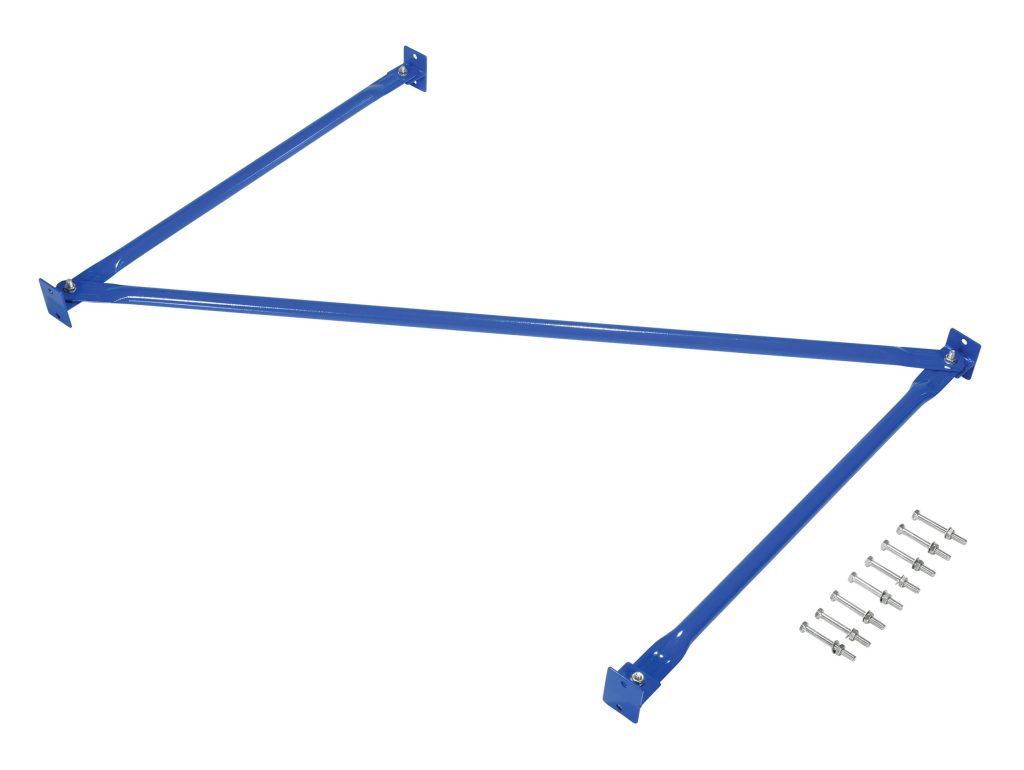
Sheet units sit flat on straight arms sized to the sheet width, with enough arms per level to stop sag. Each card opens a shop category, including Little Giant welded racks. Prices are current online prices; freight is quoted by destination and some common sizes in stock at select manufacturers, subject to confirmation. For a full layout, longer arms or freight-rated orders, request a free quote or plan it in the Cantilever Rack Configurator.
Why Sheet Goods End Up on Cantilever Rack
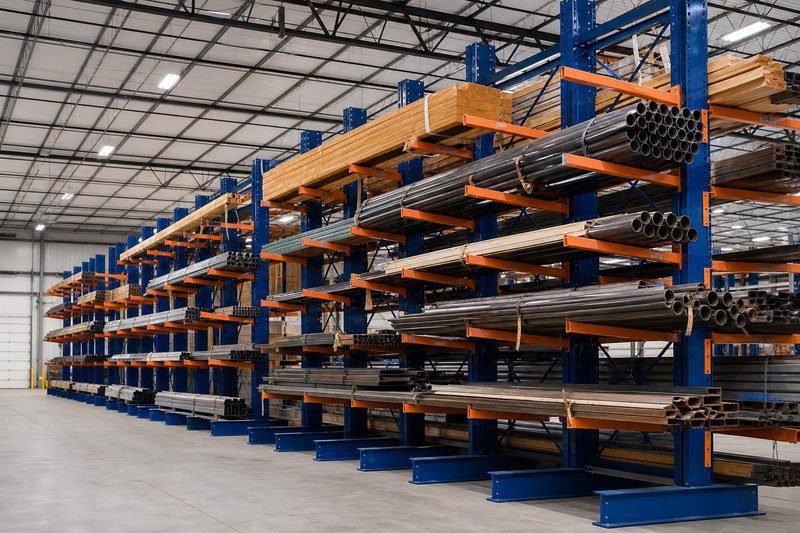
Sheet goods are awkward in a different way than pipe or lumber. A 4×8 sheet is not very long, but it is wide, flexible and easy to damage on the face and edges. A full unit is heavy, and a mixed inventory of 4×8, 4×10, 4×12 and 5×10 sheets rarely lines up with the fixed bay width of pallet rack. Cantilever rack has no front columns, so a unit of any length slides straight onto the arms, and one row can hold several sheet sizes at once.
Cabinet and millwork shops, drywall and building-supply yards, roofing distributors, sign makers and metal fabricators all run into this. For local supply, delivery and installation along the Wasatch Front, start with our Salt Lake City cantilever rack page; for arm styles, column heights and the full range, see the cantilever rack systems overview. This guide covers the details that are specific to flat, flexible stock. Uprights, straight arms, brace sets and complete kits are listed in our online cantilever rack shop.
Cantilever is not automatically the right answer, though. Small shops pulling single sheets by hand, or warehouses that only ever stock full 4×8 units, may be better served by a sheet rack or by pallet rack with decking. That comparison is further down.
Arm Length: Match the Sheet Width, Never Let It Hang Off the Tip
Sheets sit on cantilever arms with their long dimension running along the row and their width running out along the arm. That makes arm length a width question: 4-ft-wide sheets usually go on 48-in arms, and 5-ft-wide sheet metal or panels usually go on 60-in arms. Go shorter and the outer edge of the unit hangs past the arm tips, where it can tip, droop and get clipped by a passing forklift. Go much longer and you pay for capacity you cannot use and give up aisle width.
Arm length also sets the rating. Most published arm capacities assume the load is spread evenly along the arm, and a longer arm of the same section carries less. Our guide to cantilever load capacity by arm length walks through that trade-off. For sheet goods, use straight arms, not inclined arms. Inclined arms are made to keep round stock from rolling off and will make a stack of sheets slide toward the column.
| Sheet width | Typical arm | Notes |
|---|---|---|
| 4 ft (plywood, OSB, MDF, drywall, most insulation board) | 48 in | Leave a little extra if units arrive on wider dunnage |
| 5 ft (some sheet metal, panels, countertop blanks) | 60 in | Check the unit’s real depth including packaging |
| Mixed widths in one row | Size for the widest | Narrower units sit back against the column, never out at the tip |
Arm Spacing: The Number That Decides Whether Sheets Sag
This is where sheet goods differ most from pipe and bar. A thick unit of 3/4-in plywood is stiff enough to bridge a wide gap between arms. A unit of 1/4-in panels, thin sheet metal or insulation board is not: it droops between the arms and past the ends, takes a permanent bow over time, or creases where it bears on an arm edge.
A common starting point is to space the arms so each end of the unit overhangs the outer arm by about half the arm spacing. That keeps the overhang from levering the unit off the end arm and loads the arms more evenly. Column spacing is the arm spacing, so it also sets your brace size and column count.
| Sheet length | Starting layout | Overhang each end |
|---|---|---|
| 8 ft | 2 arms, 48 in apart | about 24 in |
| 10 ft | 2 arms, 60 in apart, or 3 arms 40 in apart for flexible sheets | about 30 in or 20 in |
| 12 ft | 3 arms, 48 in apart | about 24 in |
| Mixed 8 to 12 ft | Arms 48 in apart along the row | Longer units span more arms |
Treat that table as a first pass, not a rating. Stiff, heavy units can usually take the two-arm layout. Thin or soft sheets need closer arms or a continuous deck. If you store a mix, laying the row out on 48-in centers is a practical default because 8-ft and 12-ft units both land with even overhangs. Heavy plate is a different problem again, where the arms-per-level question is about weight more than flex; we covered it in our plate steel cantilever rack case study.
Whatever spacing you choose, every unit must rest on at least two arms, and the arms on each level should be at the same height so the unit bears evenly instead of rocking on one arm.
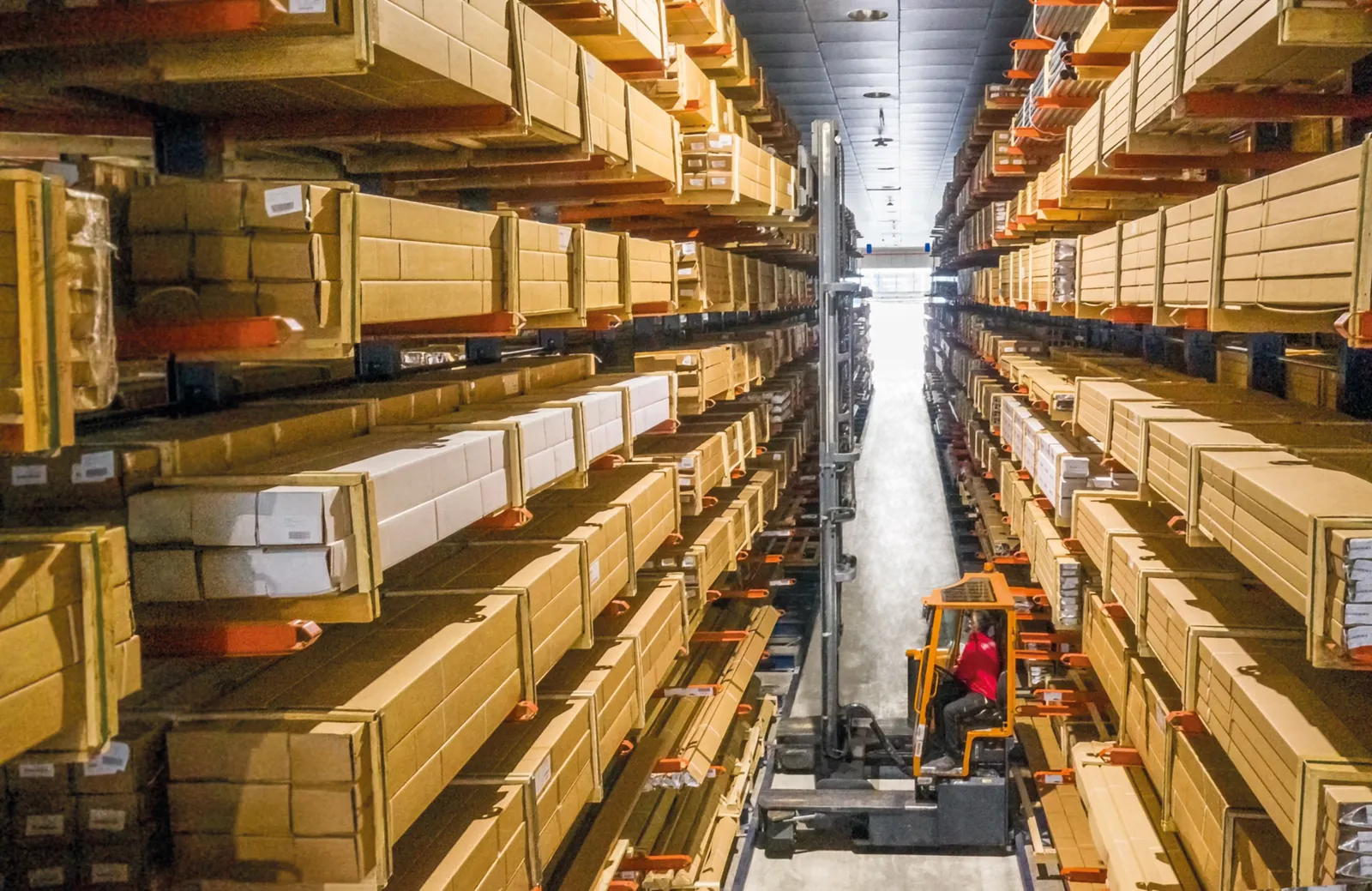
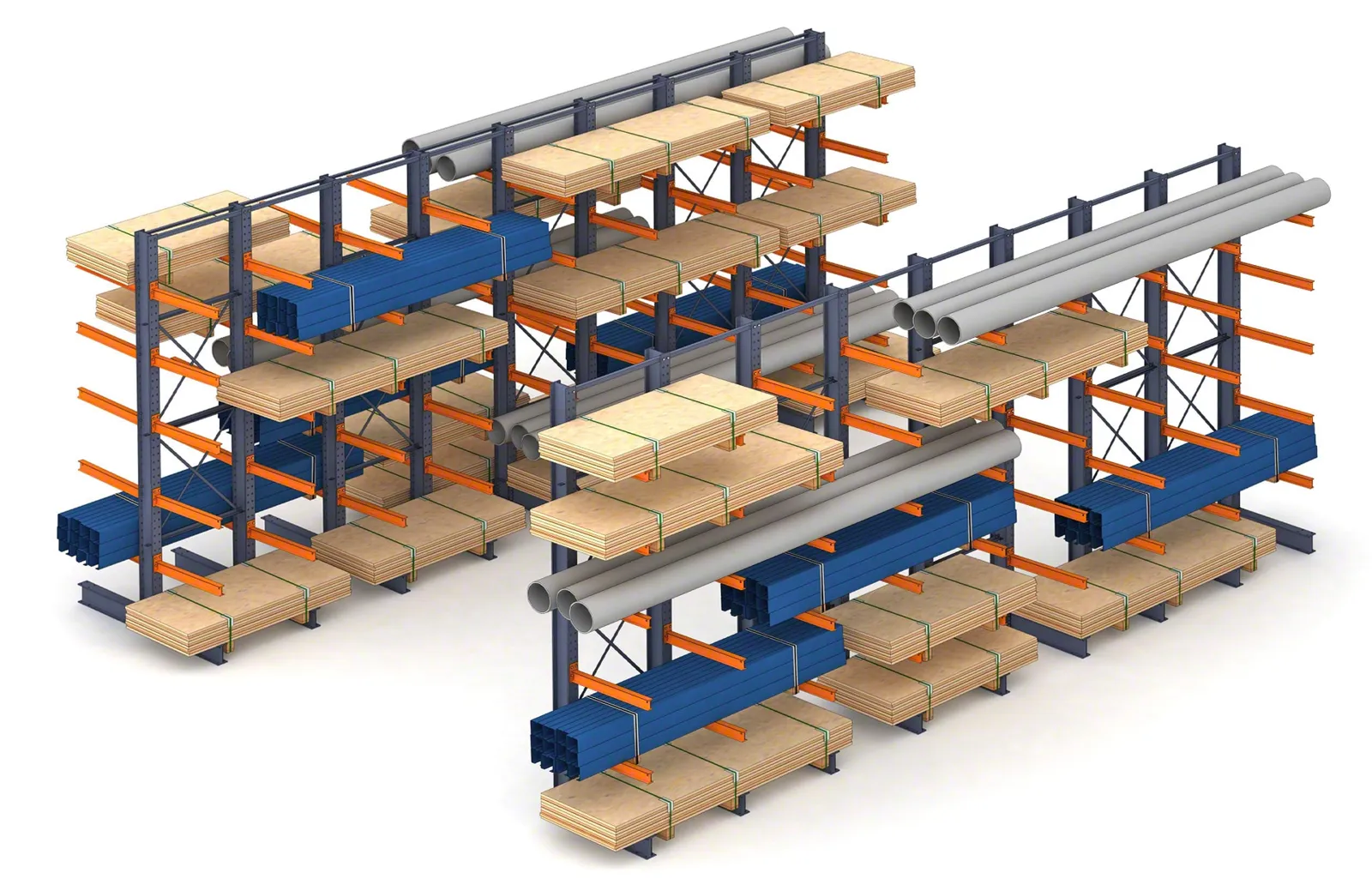
Photo: Interlake Mecalux (authorized use). Representative image, not a specific customer’s rack.
How Much a Unit Weighs, and What That Means per Arm
Sheet-goods buyers often know their sheet count but not their unit weight, and unit weight is what the arm rating has to cover. The figures below are approximate, worked out from typical material densities. Always check your supplier’s data sheet, because density varies by product and moisture content.
| Material (4×8 unless noted) | Approx. weight per sheet | Example unit | Approx. unit weight |
|---|---|---|---|
| 3/4-in softwood plywood | about 65 lb | 40 sheets | about 2,600 lb |
| 3/4-in MDF | about 95 lb | 40 sheets | about 3,800 lb |
| 1/2-in standard drywall | about 55 lb | 40 sheets | about 2,200 lb |
| 5/8-in Type X drywall, 4×12 | about 110 lb | 30 sheets | about 3,300 lb |
| 2-in polyiso insulation board | about 10 lb | a typical bundle | light, but bulky |
That first example is where light-duty racks get into trouble. A 3/4-in MDF unit can put close to 2,000 lb on each of two arms, which is beyond many light-duty arm ratings at 48 in. Structural or heavy-duty arms, or a third arm under each unit, are the usual fixes. Insulation board is the opposite case: the weight is trivial and the design is driven by sag, crushing and, outdoors, wind.
The cantilever rack standard, ANSI MH16.3, was revised in 2025, and RMI’s summary of the update notes it now sets an explicit limit on arm deflection. For a sagging sheet, a bending arm makes the problem worse, so ask for arms rated for your real unit weight rather than the lightest arm that technically holds it.
Decking on Cantilever Arms: When Sheets Need a Continuous Surface
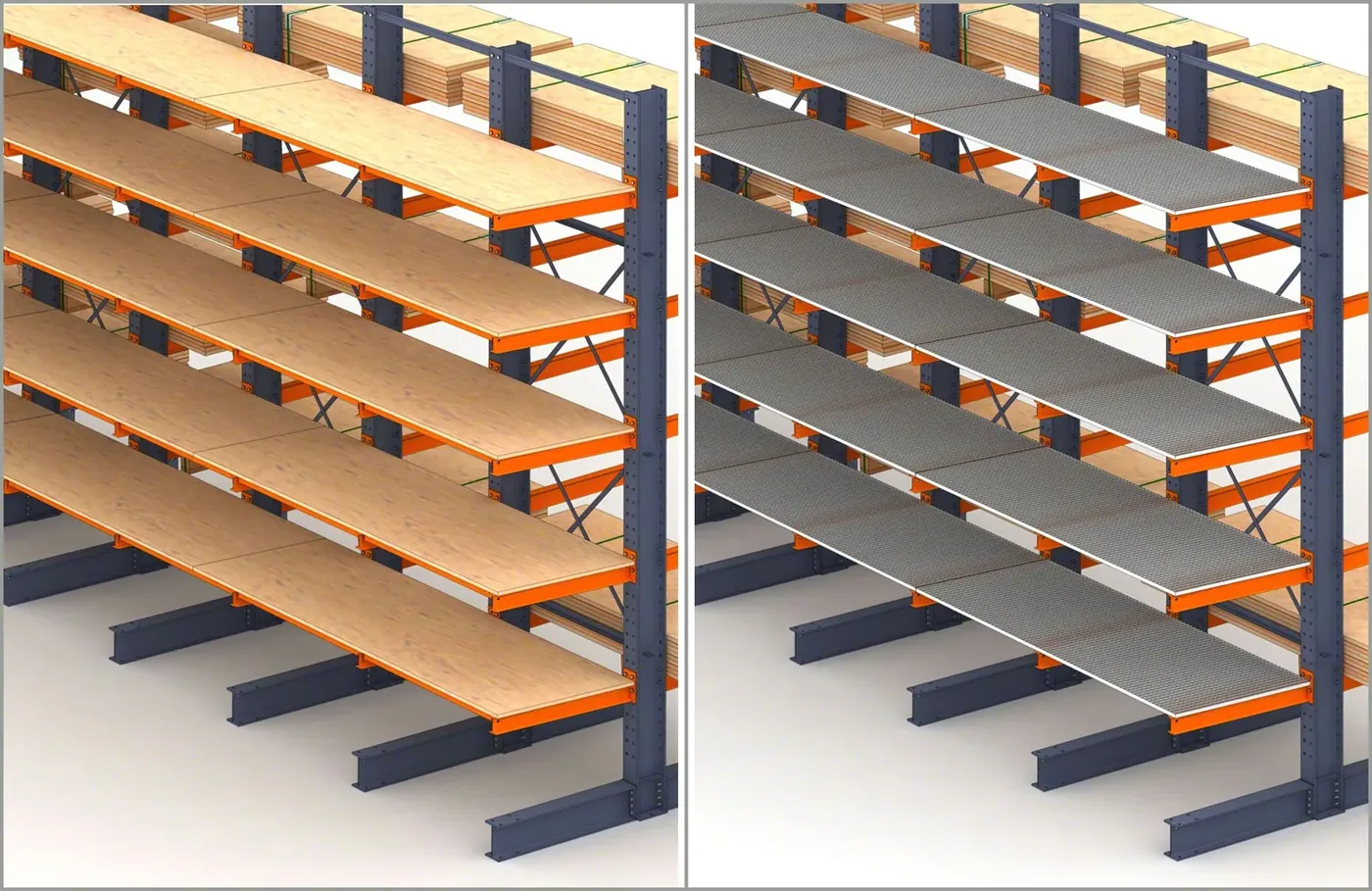
Decking turns the arms on a level into one continuous shelf. For sheet goods it solves three problems at once: thin and flexible sheets no longer sag between arms, cut-down partial sheets and offcuts have somewhere to go, and the arm edges stop denting soft faces like insulation board and finished panels.
Wood decking (plywood fastened across the arms) is common indoors and kind to finished surfaces. Steel decking, either wire mesh or perforated panels, holds up better to forklift wear and to weather, and open steel decking lets light and sprinkler water through. In a sprinklered building, check solid decking with your fire protection designer before you order it, because solid shelves can change the sprinkler design.
Image: Interlake Mecalux (authorized use). Wood decking (left) and steel decking (right) on cantilever arms.
- Decking adds its own weight to every arm, so include it in the load per level.
- The arm rating still governs. Decking spreads the load; it does not add capacity.
- Decking must be fastened to the arms so a forklift cannot push it off the back or drag it into the aisle.
- Keep a lip or stop at the front if loose partial sheets are stored on a decked level.
Decked levels also make cantilever useful for the boxed and crated items that tend to collect around a sheet-goods operation: hardware cartons, edge banding, trim bundles and short panels. Many shops deck only the top one or two levels for those items and keep the lower levels bare for full units, which keeps the forklift work at a comfortable height.
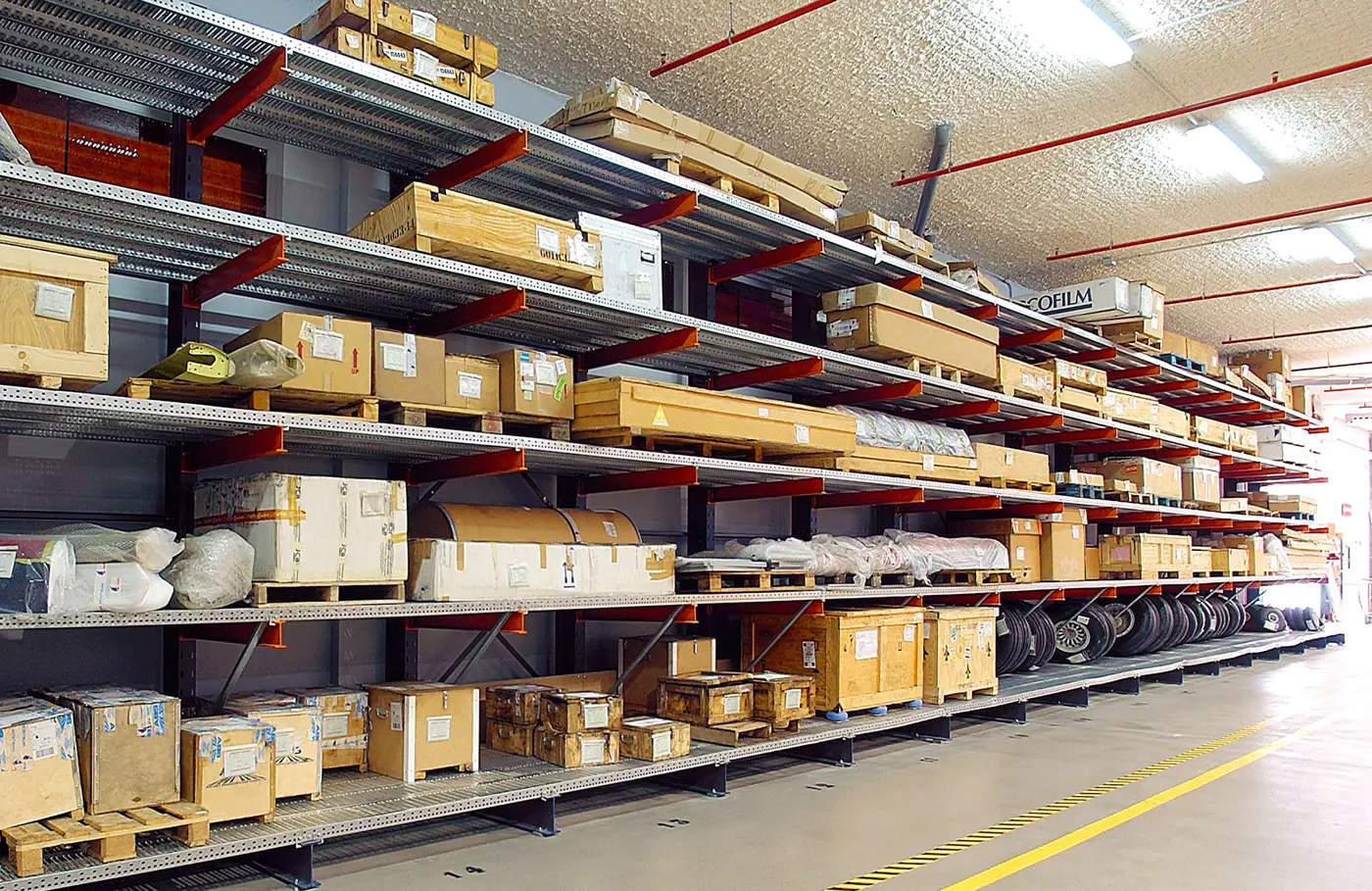
Photo: Interlake Mecalux (authorized use). Representative image, not a specific customer’s rack.
Material by Material: What Changes
| Material | Main risk on the rack | What usually works |
|---|---|---|
| Plywood and OSB | Heavy units, face damage from arm edges | 48-in straight arms, dunnage under units, heavy-duty arms for tall units |
| MDF and particleboard | Highest weight per unit, sag and swelling from moisture | Closer arm spacing or a third arm, indoor or roofed storage only |
| Drywall | Long 12-ft sheets, broken corners, moisture | 3 arms on 48-in centers for 12-ft units, indoor or roofed, keep units flat |
| Insulation board | Crushing, dented faces, wind outdoors | Decked levels, light or medium duty arms often enough, tie down top layers outside |
| Sheet metal and ACM panels | Thin sheets bow, sharp edges | Close arms or steel decking, 60-in arms for 5-ft sheets |
| Acrylic and finished panels | Scratches and bowing | Wood decking or padded arm caps, store flat on full support |
If your sheet goods share the rack with banded lumber, our cantilever racking for lumber storage page covers mixing the two on one row. Roofing distributors storing insulation board alongside long trim and coil will find the yard-side detail on our cantilever rack for roofing supplies page.
Loading and Unloading Sheet Units Safely
Most sheet-goods damage on a cantilever rack happens during handling, not storage. A few habits prevent most of it.
The Rack Manufacturers Institute’s best practices for cantilevered storage racks also stress that loads should never overhang the arm tips and that damaged arms, bases or braces need to be unloaded and assessed before use. Aisle width matters as much as the rack. A counterbalanced forklift carrying an 8-ft or 12-ft unit has to swing that length to face the rack, which takes a lot of floor. Side loaders and multidirectional trucks carry the unit parallel to the row and work in much narrower aisles. Our forklift aisle width guide covers the general sizing.
Cantilever, Sheet Rack or Pallet Rack? Picking the Right Storage
| Option | Best when | Limits |
|---|---|---|
| Cantilever rack | Mixed sheet sizes, full units moved by forklift, long sheets, outdoor yards | Needs aisle room for the load length; thin sheets need decking |
| Horizontal sheet rack (shelf style) | Small shops pulling single sheets by hand | Fixed shelf sizes and modest capacity, not for forklift units |
| Vertical sheet rack | Cut stock and partial sheets near the saw | Sheets stand on edge; not for full units or very thin stock |
| Pallet rack with wire decking | A warehouse stocking full 4×8 units and pallets in one system | Bay width is fixed, so long or mixed sheet sizes fit poorly |
Pallet rack works well when nearly every unit is a 4×8 on dunnage or a skid and the bay is sized for the 8-ft length plus handling clearance, with wire decking or pallet supports underneath. We built exactly that kind of system for a millwork shop, described in our sheet goods and plywood storage racking case study. Once 10-ft and 12-ft units show up, or the operation switches to side loaders, cantilever usually pays off. Many buildings end up with both: pallet rack for palletized goods and full 4×8 units, and cantilever for everything longer or odd-sized.
Sheet-Goods Cantilever in Utah: Moisture, Wind and Permits
Most sheet goods are moisture-sensitive. MDF and particleboard swell, drywall softens, and even exterior plywood stains and cups when it sits in snowmelt. In a Utah winter that means sheet goods belong indoors or under a roof. If you are weighing a covered yard rack, our guide to cantilever rack with a roof in Utah covers when a roof pays off, snow on the top arms and finish choices.
Wind is the outdoor issue specific to light panels. Insulation board and thin panels weigh little for their surface area, and canyon wind events along the Wasatch Front can lift and scatter unsecured top layers. Strap or weight the top of every outdoor stack, and do not leave partial bundles loose on an upper level overnight.
Along the Wasatch Front, cantilever rack also falls under seismic design and, in many cities, a building permit with engineered drawings. The sequence, from engineering and permit to anchoring and final inspection, is laid out in our cantilever rack installation guide for Utah.
What to Send Us for a Sheet-Goods Cantilever Quote
| Send us | Why |
|---|---|
| Each sheet size you stock (length x width) | Arm length and arm spacing |
| Thickness and material for each | Stiffness, which decides spacing or decking |
| Sheets per unit, or unit weight | Arm and column ratings |
| How units arrive (dunnage, skid, loose) | Vertical clearance and fork access |
| How you load (forklift type, hand picking) | Aisle width and decked levels |
| Indoor, roofed or open yard, and city | Finish, roof, wind and permit requirements |
We supply and install cantilever rack across Utah and the Mountain West, and our rack design services team can start from a simple list of what you store.
 Cantilever Rack in Salt Lake CitySupply, delivery and installation along the Wasatch Front.
 Cantilever Rack Installation in UtahPermits, anchoring, assembly order and inspection.
 Pallet Rack SystemsSelective pallet rack, beams and wire decking for palletized loads.
Sheet Goods on Cantilever Rack: FAQs
Can you store plywood and other sheet goods on cantilever rack?
How far apart should cantilever arms be for 4×8 sheets?
Do I need decking on cantilever rack for sheet goods?
Which arms should I use for sheets, straight or inclined?
How much does a unit of MDF weigh?
Is pallet rack or cantilever better for sheet goods?
Does Material Handling USA supply sheet-goods cantilever rack in Utah?
Planning Storage for Plywood, Drywall or Panels?
Send us your sheet sizes, unit weights and how you load. We will size the arms, spacing and decking, and coordinate engineering. Call 801-328-8788.