
Cantilever Pallet Rack for Roofing Supplies
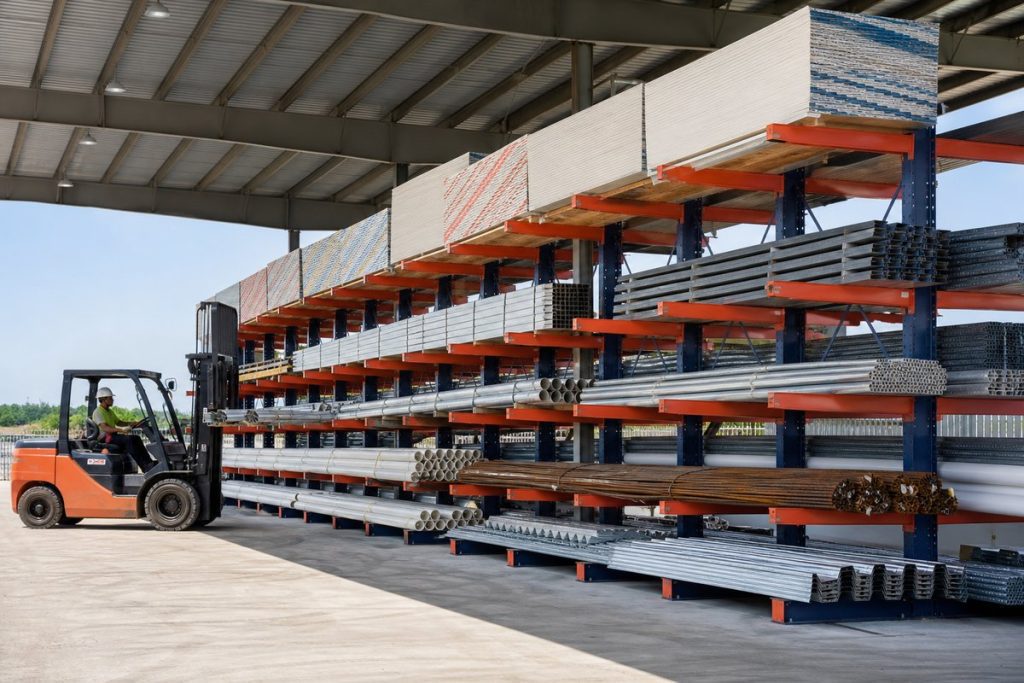
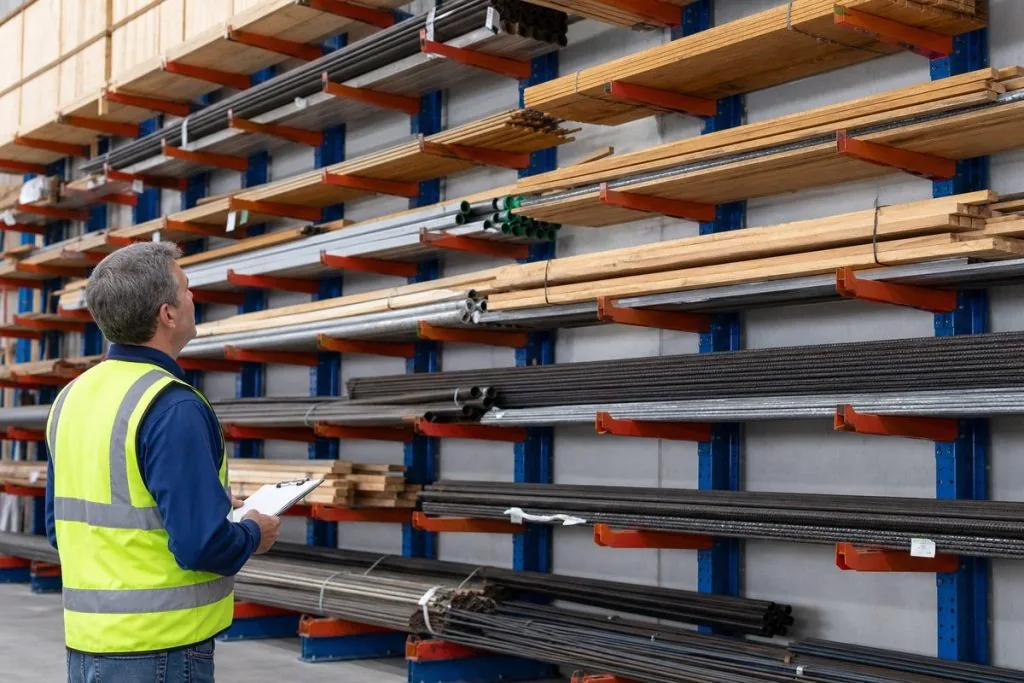
Open-front cantilever racking built for the way a roofing yard really stocks — shingle bundles, 10′ and 20′ flashing and trim, underlayment rolls, gutter coil, lumber and insulation board. Heavy-duty arms and columns sized to your loads, indoor or galvanized outdoor, designed and installed by Material Handling USA.
Heavy-duty
Arms sized to your heaviest bundles
1 or 2
Single- or double-sided runs
8′–12′
Stock column heights
3″
Arm height adjustment increment
Shop Cantilever Rack for Roofing Supplies
Roofing yards store long, heavy bundles outdoors, so galvanized sets and heavy-duty uprights are common choices. Each card opens a shop category. Prices are current online prices; freight is quoted by destination and some common sizes in stock at select manufacturers, subject to confirmation. For a full layout, longer arms or freight-rated orders, request a free quote or plan it in the Cantilever Rack Configurator.
Why Roofing Yards Outgrow Standard Pallet Rack
A roofing supply yard stocks three different problems at once. Palletized goods like shingles and adhesive are short and extremely heavy. Flashing, drip edge, trim and sheathing are long, thin and easy to bend. Underlayment, gutter coil and downspout are bulky and round, and they roll. Standard selective pallet rack answers the first problem and fights the other two: the front upright of every bay is exactly where a 20′ bundle of trim needs to go, so loaders end up angling material in, scraping finishes and giving up half the bay.
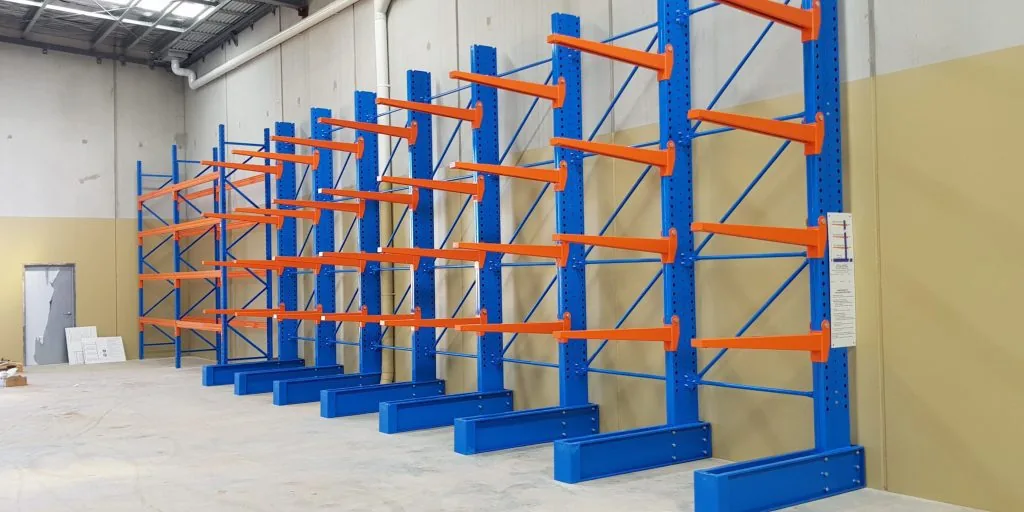
Cantilever rack removes the obstruction. Arms extend from vertical columns that sit behind the load, which leaves the entire face of the rack open. A forklift or side loader drives straight in, sets the bundle on paired arms and backs out. Nothing has to be threaded past a front post, and a single bay can hold material far longer than any beam level would allow.
That is why cantilever racking systems, not shelving and not standard rack, are what building material distributors use for long goods. If you also need conventional pallet positions for full shingle pallets, the two systems work side by side; see our pallet rack systems overview. Adding bays or replacing damaged arms, uprights or brace sets? Our cantilever rack parts guide explains how the components fit together.
What You Can Store on Cantilever Racks in a Roofing Yard
Almost everything in the yard except full, un-spread pallets of shingles. The capacities below come from the stock heavy-duty and medium-duty cantilever line we supply; the material weights are the published figures roofing manufacturers give for their own products.
 Shingles & Tile (Bundles and Broken Pallets)A full pallet of asphalt shingles runs roughly 2,520–3,400 lb (36–42 bundles at about 70–85 lb each), which is more than any single stock cantilever arm is rated to carry. The right answer is to spread each pallet or bundle stack across two or more arms — or keep full pallets on selective pallet rack and use the cantilever bays for broken bundles, tile and accessories picked by hand.
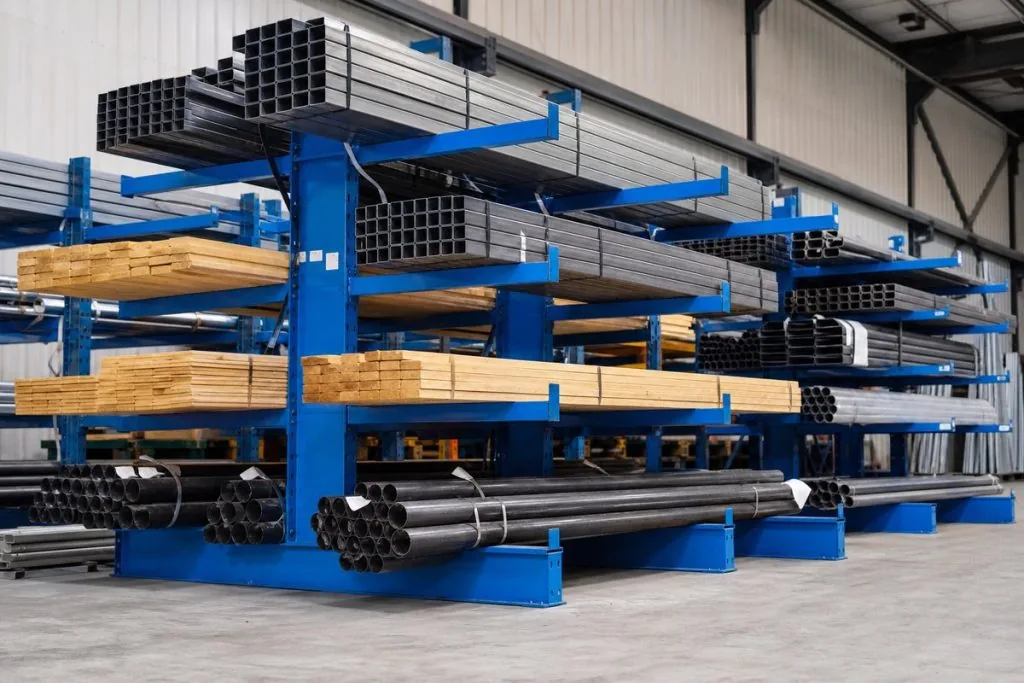
 Metal Flashing, Drip Edge & TrimLong, thin metal is the material cantilever racking exists for. Ten- and twenty-foot flashing, drip edge, valley, ridge and custom bent trim store flat and straight on paired arms with nothing to catch a bundle on the way in. Group profiles by shape and color so a loader can read the bay from the seat of the forklift.
 Underlayment & Roll GoodsSynthetic underlayment ships in 10-square rolls of roughly 23–37 lb each, with full pallets around 1,200–1,600 lb. Rolls cradle safely on inclined arms, or on straight arms fitted with end stops, so nothing walks off the front of the rack when a neighbor is pulled.
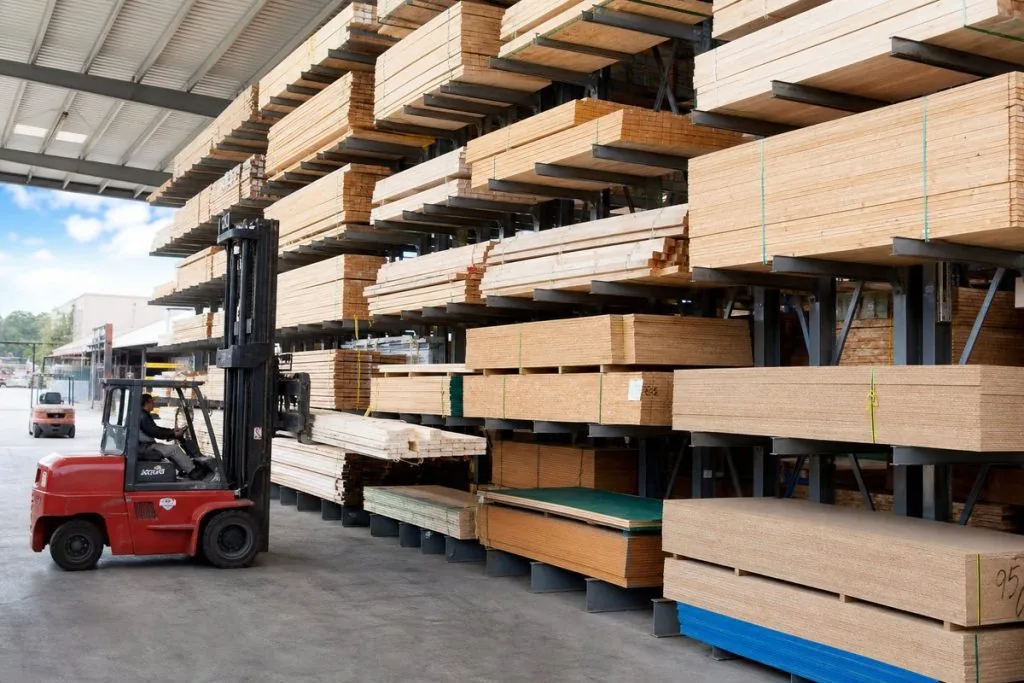 Lumber, Trusses & SheathingMost roofing yards also move dimensional lumber, fascia, sheathing and small trusses. Long arms on wide upright spacing keep 16′ and 20′ material off the ground, out of standing water and straight, which is what stops the shrink you get from crooked, mud-stained stock nobody wants to buy.
 Gutter Coil, Downspout & PipeDownspout, round pipe, gutter coil and vent stock all roll. Inclined arms, saddles or welded end stops turn an open arm into a cradle so round goods stay put. Keep the heaviest coil on the bottom arm level — it is the easiest level to reload and it lowers the center of gravity of the whole bay.
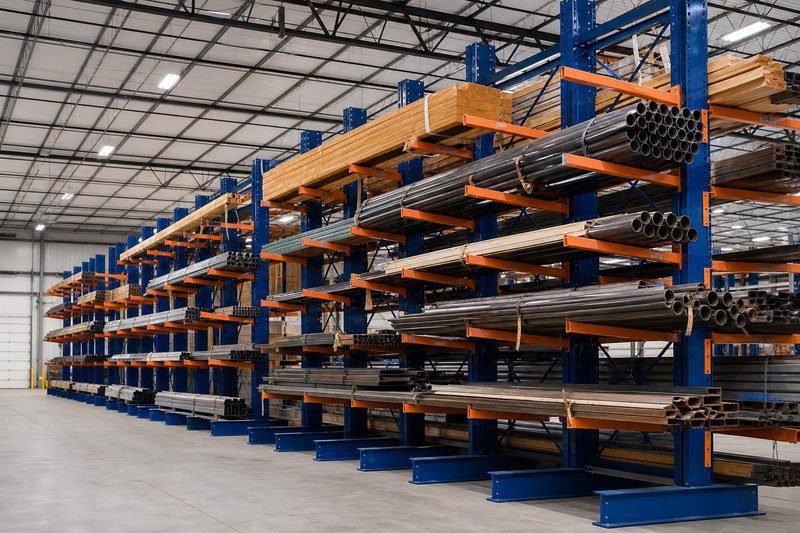 Insulation Board, Panels & AccessoriesPolyiso and insulation board, wall panel, corrugated metal panel and bagged goods sit on wire mesh or steel decking laid across the arms, turning the bay into a shelf. Decking is also how you keep small accessory cartons from falling between arms.
The load-spreading rule that keeps yards out of trouble
Cantilever arm ratings assume a uniformly distributed load along the arm. A full pallet of shingles set on a single arm can overload it even though the “rack” is rated for tens of thousands of pounds. Spread heavy palletized goods across two or more arms, keep the heaviest levels lowest, and post the arm rating on the run so loaders can see it.
Not sure which bays should be cantilever and which should be pallet rack?
Send us your top SKUs with lengths and weights and we will lay out the yard — cantilever runs for long goods, selective rack for full pallets, and the aisle widths your lift actually needs. You can also configure a cantilever run yourself in our free online configurator.
Request a Cantilever Rack Quote Open the Cantilever Rack Configurator Call (800) 326-4403
How a Cantilever Rack Is Built
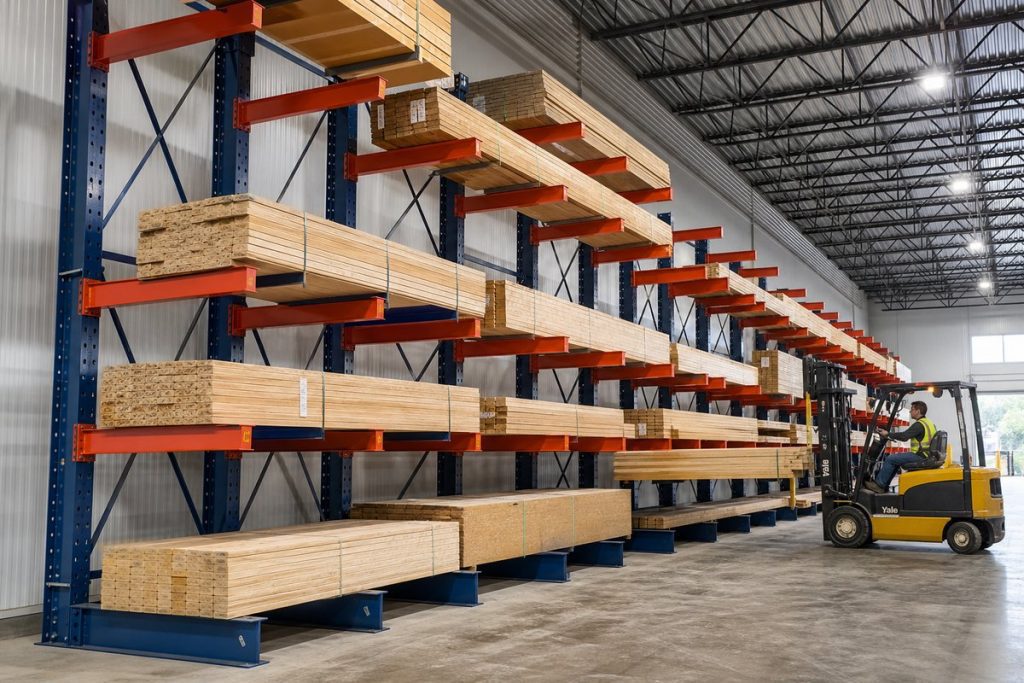
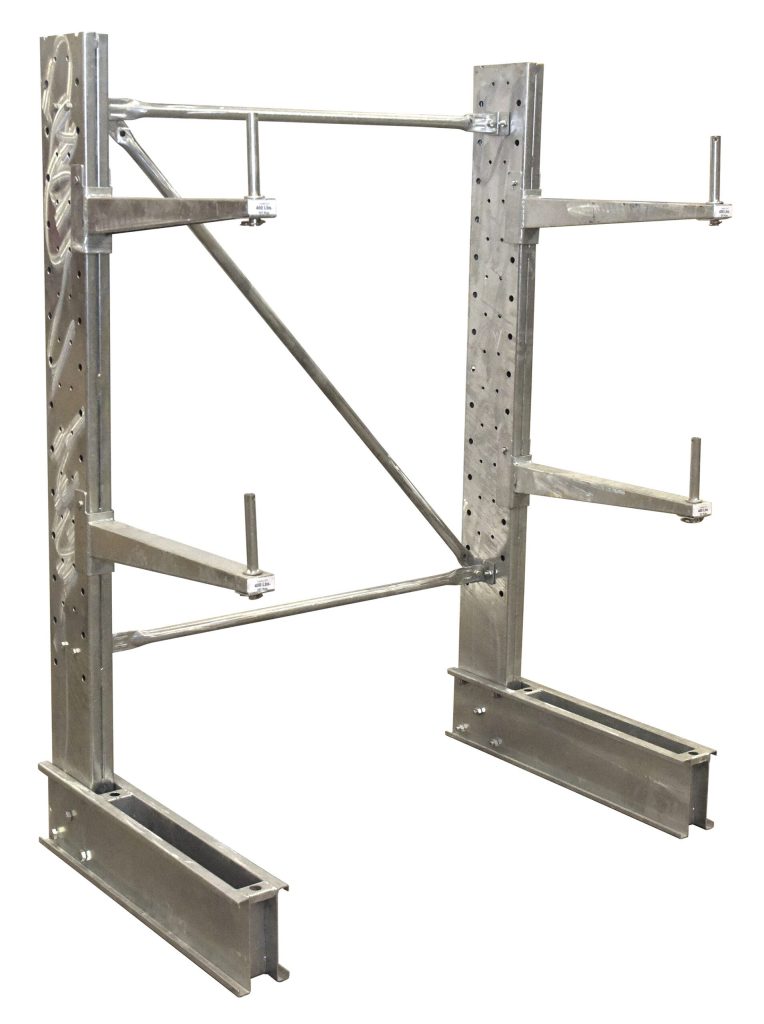
A cantilever run is four components repeated down the line. Understanding them is most of what you need to read a quote.
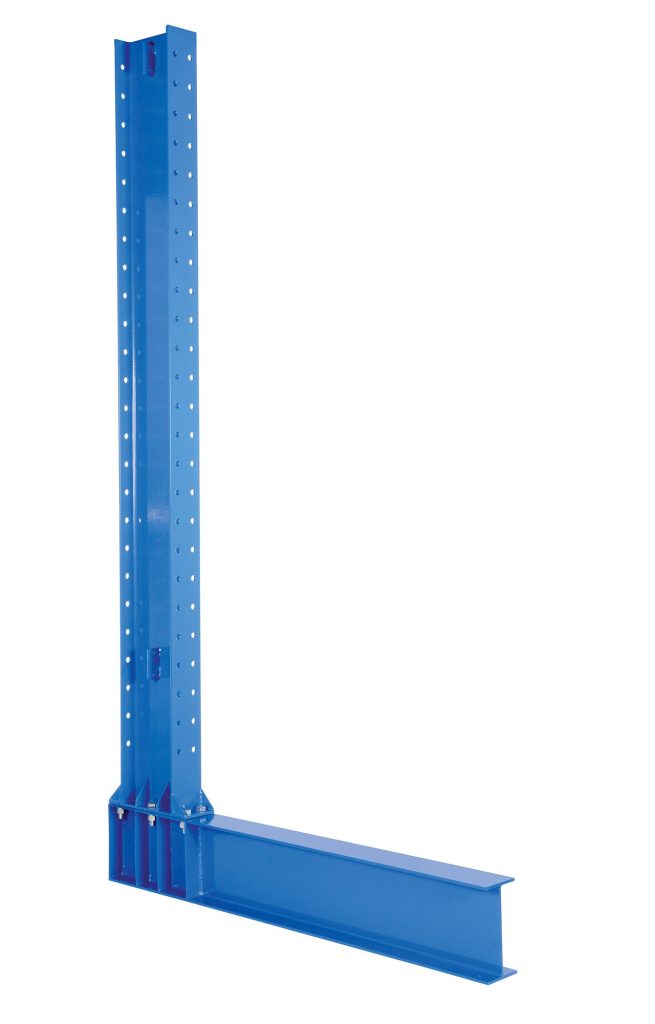
Bases are the heavy steel feet that anchor to the slab and resist the tipping moment created by loaded arms. Base length matches arm length — a 24″ arm sits on a 24″ base — which is why you cannot simply bolt longer arms onto an existing run without checking the base.
Columns (uprights) rise from the base and carry the total bay load. Stock heavy-duty columns are 8′, 10′ and 12′ tall in 14-gauge construction, punched so arms adjust in 3″ increments.
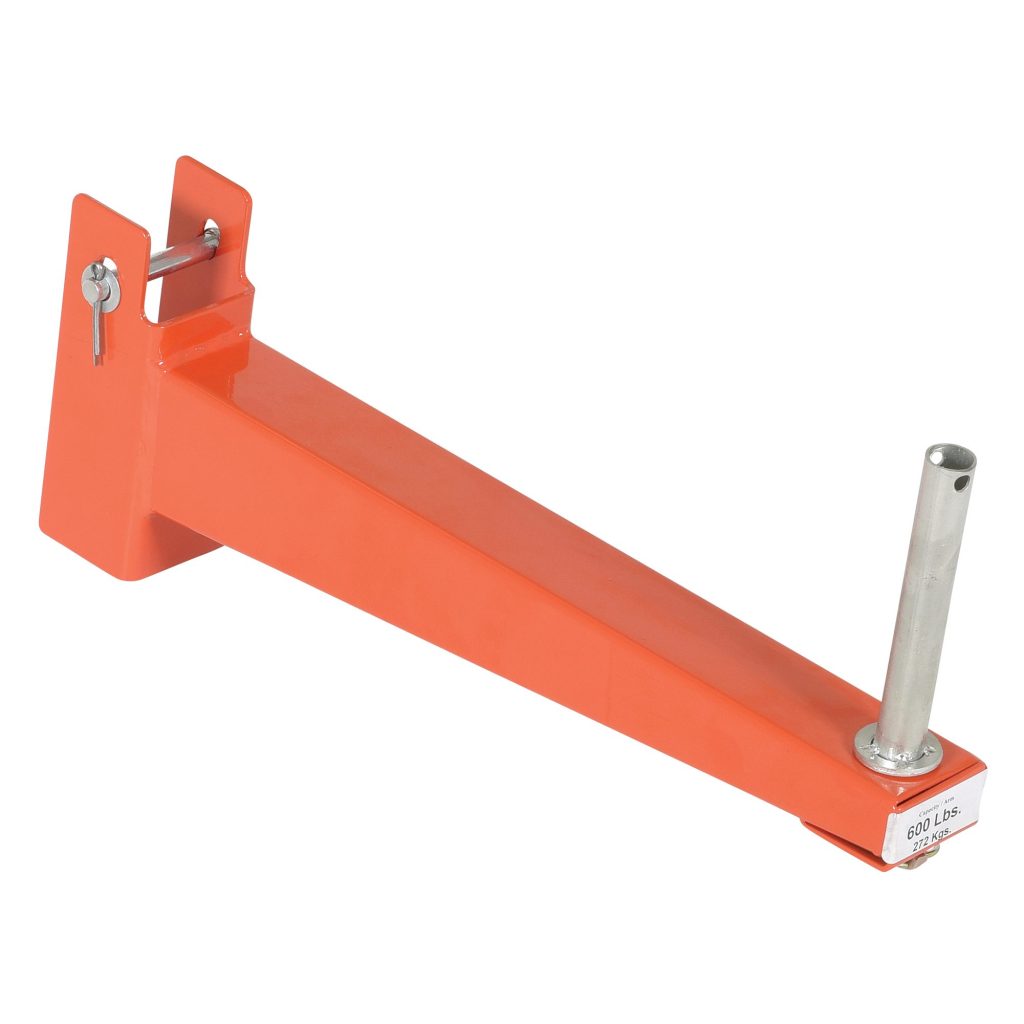
Arms bolt to the column face and carry the material. Length, angle (4° straight or 20° inclined) and duty class are the three choices that decide what a bay can hold. Bolt-on end stops are available for the heavy-duty arms.
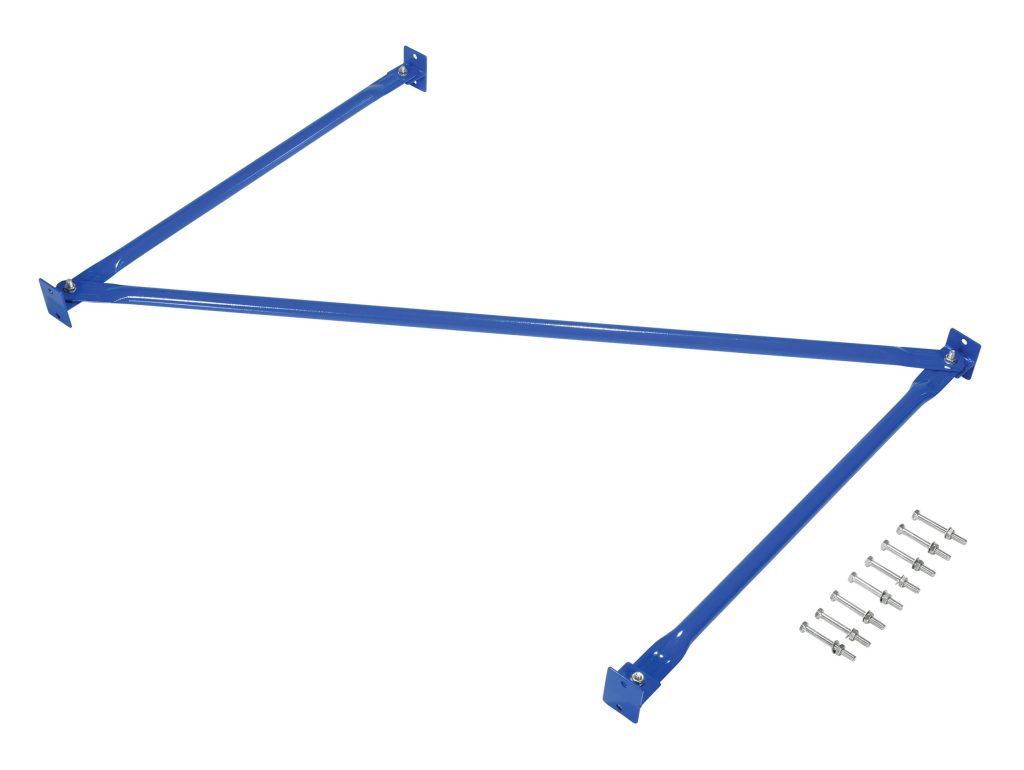
Brace sets tie adjacent columns together and set the bay width — 3′, 4′, 6′ and 8′ are the stock widths. Two bases/columns, one brace set and arms make a free-standing starter unit; each add-on unit is one more base/column, a brace set and arms.
| Component | What it does | What you specify |
|---|---|---|
| Base | Anchors the run and resists the tipping moment from loaded arms | Single-sided or double-sided; base length matches arm length |
| Column (upright) | Carries the total load of every arm level in the bay | 8′, 10′ or 12′ height; single or double sided |
| Arms | Support the material with no front obstruction | 24″, 36″ or 48″ length; 4° or 20°; regular or heavy duty |
| Brace set | Ties columns together and sets bay width | 3′, 4′, 6′ or 8′ width |
| End stops | Positive stop so round or short goods cannot slide off the arm tip | Heavy-duty arms, matched to 4° or 20° arms |
| Decking | Turns an arm level into a shelf for board, panel and cartons | Wire mesh or steel deck sized to arm spacing |
Arm Lengths, Angles and Capacities
Arm choice comes down to duty class, length and angle, matched to what each level holds. Ratings assume a uniformly distributed load on the arm and a properly anchored, plumb column, and we confirm exact capacities for your materials during design.
| Arm type | Lengths | Load class | What it is for |
|---|---|---|---|
| Heavy-duty, 20° inclined | 24″ / 36″ / 48″ | Highest — heavy bundles and rolls | Round and roll goods: coil, downspout, pipe, underlayment rolls |
| Heavy-duty, 4° straight | 36″ / 48″ | Highest — heavy flat bundles | Flat bundles: flashing, trim, lumber, sheathing, deep pallets |
| Regular-duty, 4° straight | 24″ / 36″ / 48″ | Moderate | Lighter trim, accessory bundles, hand-loaded stock |
| Medium-duty | 12″ / 18″ / 24″ | Light | Inside sales counters, cut room and shop stock, closely spaced arm levels |
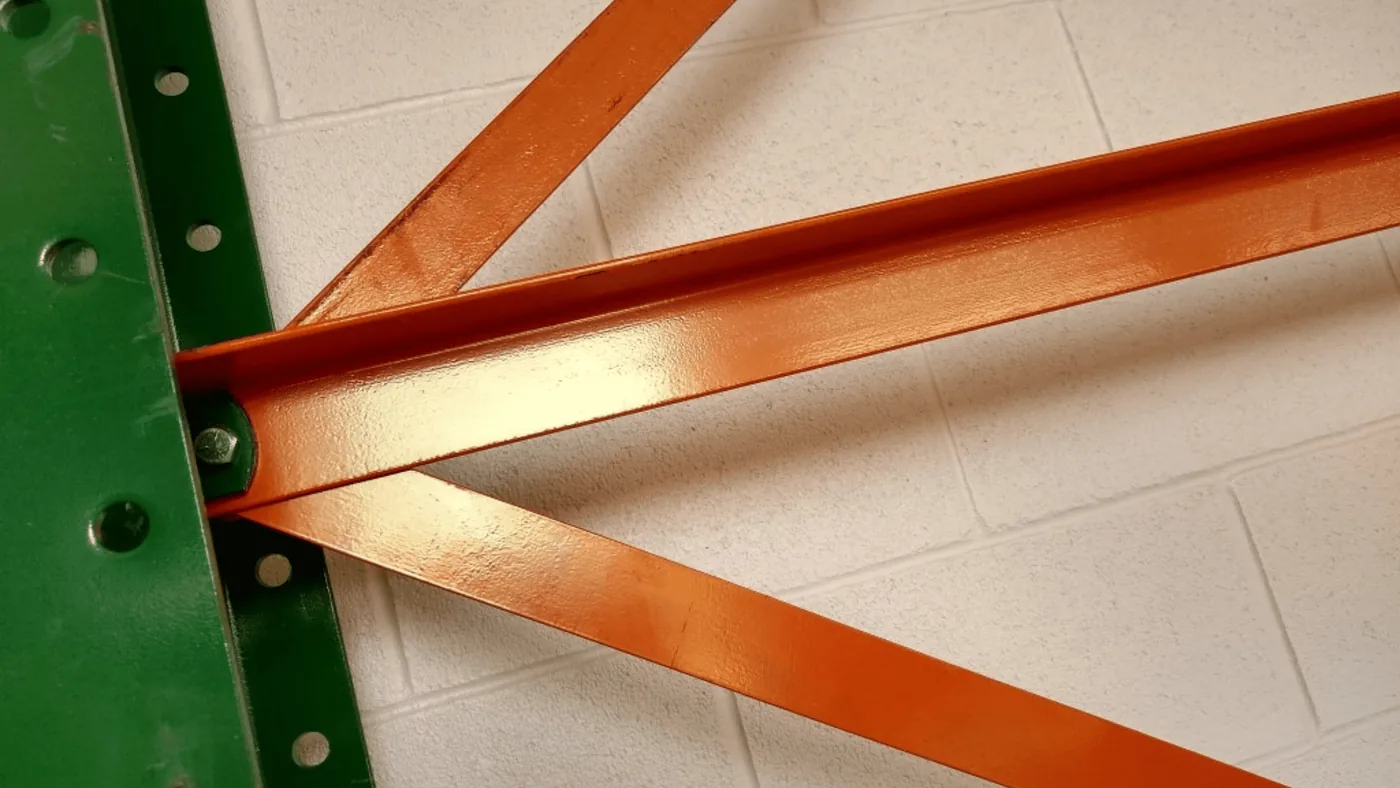 Straight 4° ArmsThe default for flat bundles — flashing, drip edge, trim, lumber, sheathing and skidded goods. A slight upward angle keeps loads settled against the column instead of creeping toward the tip. Add bolt-on end stops when a level holds short pieces.
 Inclined 20° ArmsThe choice for anything that rolls: gutter coil, downspout, pipe, vent stock and underlayment rolls. The steeper angle cradles round goods so pulling one bundle does not send the next one onto the floor. Heavy-duty inclined arms carry the heaviest roll and coil loads in the line.
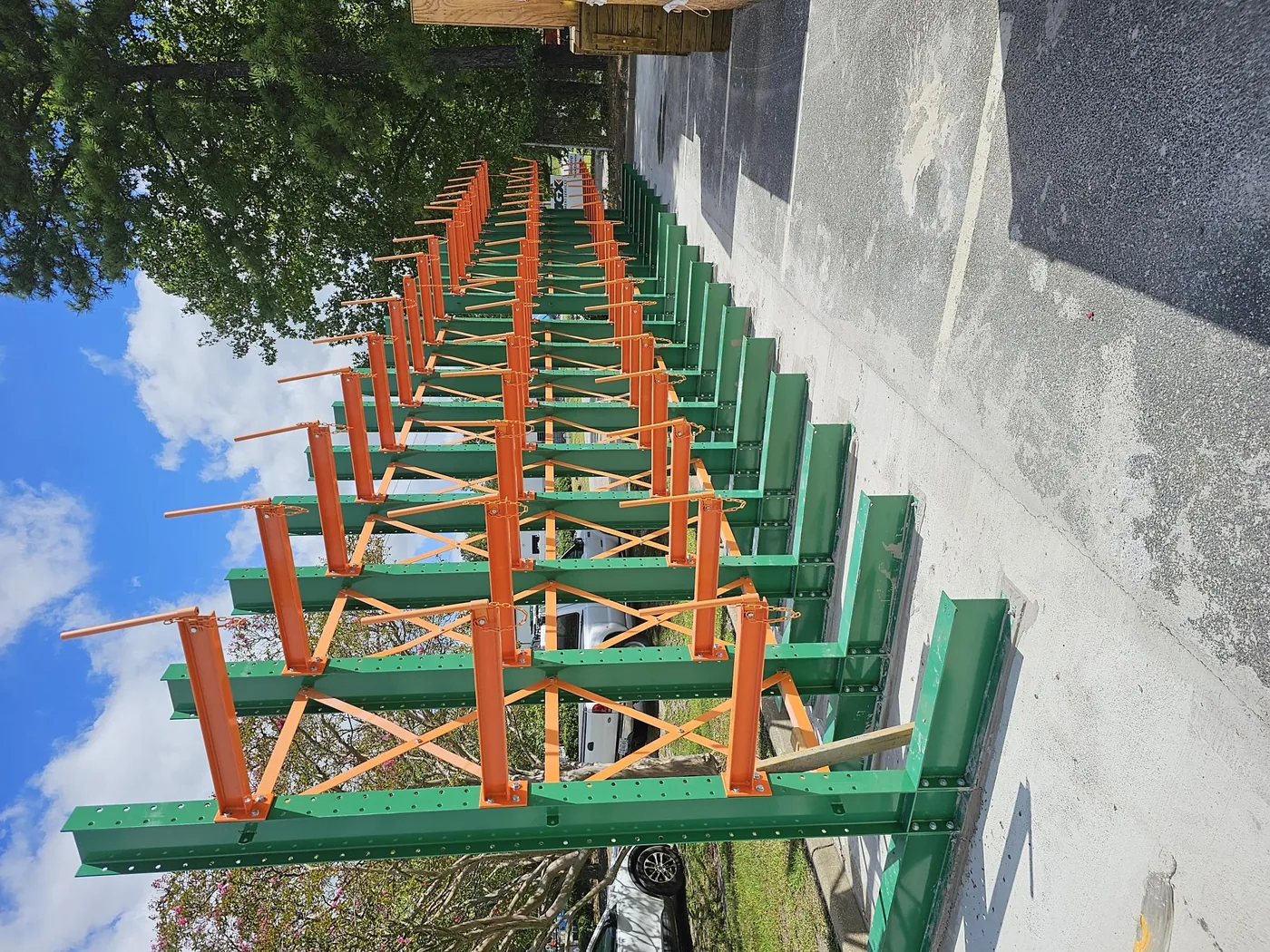 Braced Columns & Bay WidthsBrace sets tie the columns into a rigid run in 3′, 4′, 6′ and 8′ widths. Column spacing is driven by how much your material sags: rigid tube spans wide bays, while flexible trim and coil want closer support so bundles do not bow between arms.
Column Capacity — Sized to Your Roofing Load
Arm capacity limits one level. Column capacity limits the whole bay, and it drops as arms get longer because a longer arm puts more leverage on the column. We check both before deciding how many levels each bay gets, so every run is rated for what it actually holds.
| Roofing material | What drives the column load | How we size it |
|---|---|---|
| Shingle and tile pallets | Heaviest unit loads in the yard, often stacked several levels high | Heavy-duty columns and short, stout arms with capacity to spare |
| Underlayment and roll goods | Moderate weight, but many rolls per level | Inclined arms with column spacing matched to roll length |
| Coil, flashing and trim | Long, flexible bundles that sag between arms | Closer arm spacing and longer arms, with column capacity checked for the added leverage |
| Double-sided islands | Load on both faces of the same column line | Columns rated for both sides fully loaded at once |
Ratings depend on the manufacturer, column height and arm length, so we confirm the exact capacities for your layout and materials during design.
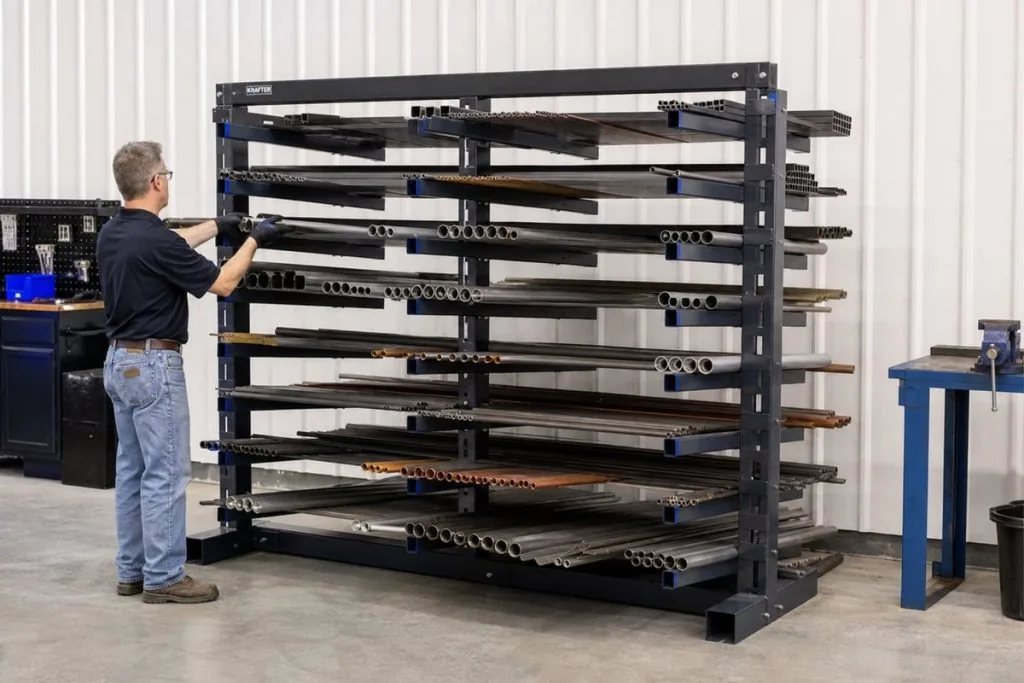
Medium-Duty Cantilever for Inside Sales and the Cut Room
Not every long item needs a 12′ heavy-duty tower. The medium-duty line is a 79″ tall unit with 12″, 18″ or 24″ arms sized for lighter hand-picked stock, adjustable in 1-1/2″ increments, with welded end stops on the angled arms and four connecting beams per section. Units assemble in minutes and are ordered as complete starter and add-on units.
Roofing yards use these behind the counter and in the cut room: sample stock, short trim, fastener and accessory bundles, and anything a person picks by hand instead of a forklift. Closer arm spacing means more levels in the same height, and hand-height picking means fewer lift moves for small orders.
Single-Sided vs. Double-Sided Cantilever Racks
One decision, made per run, that drives both your storage density and how the yard flows.
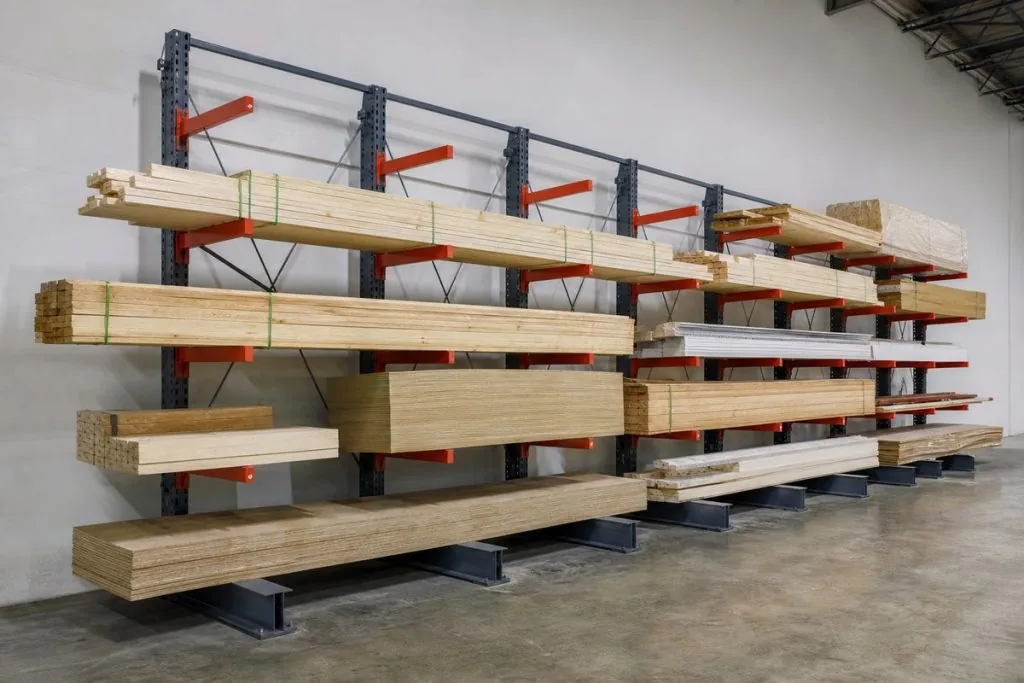 Single-Sided RunsArms on one face only, with the base extending in that direction. These go against a wall, a building face or a fence line. They protect the wall from lift damage, keep the drive lane clear and are the usual choice for flashing, trim and coil that a counter employee also needs to reach.
 Double-Sided RunsArms on both faces of one column line, doubling the pick faces off the same footprint. These sit as islands served from two aisles, with columns sized to carry full loads of shingles, underlayment and coil on both faces. Best for high-turn shingle, underlayment and lumber stock where two loaders work the same row at once.
| Consideration | Single-sided | Double-sided |
|---|---|---|
| Where it goes | Against a wall, fence line or building face | Free-standing island in the middle of the yard or warehouse |
| Arms per starter unit (medium-duty) | 4 arms on 2 columns | 8 arms on 2 columns |
| Arms per add-on unit (medium-duty) | 2 arms on 1 column | 4 arms on 1 column |
| Column capacity | Sized for one loaded face | Sized for both faces fully loaded |
| Storage per square foot of floor | Lower — one pick face | Roughly double — two pick faces off one column line |
| Best fit in a roofing yard | Perimeter runs for flashing, trim and coil where you want the wall protected | Center rows served from both aisles for high-turn shingle, lumber and underlayment stock |
Outdoor Storage, Weather and Seismic Anchoring
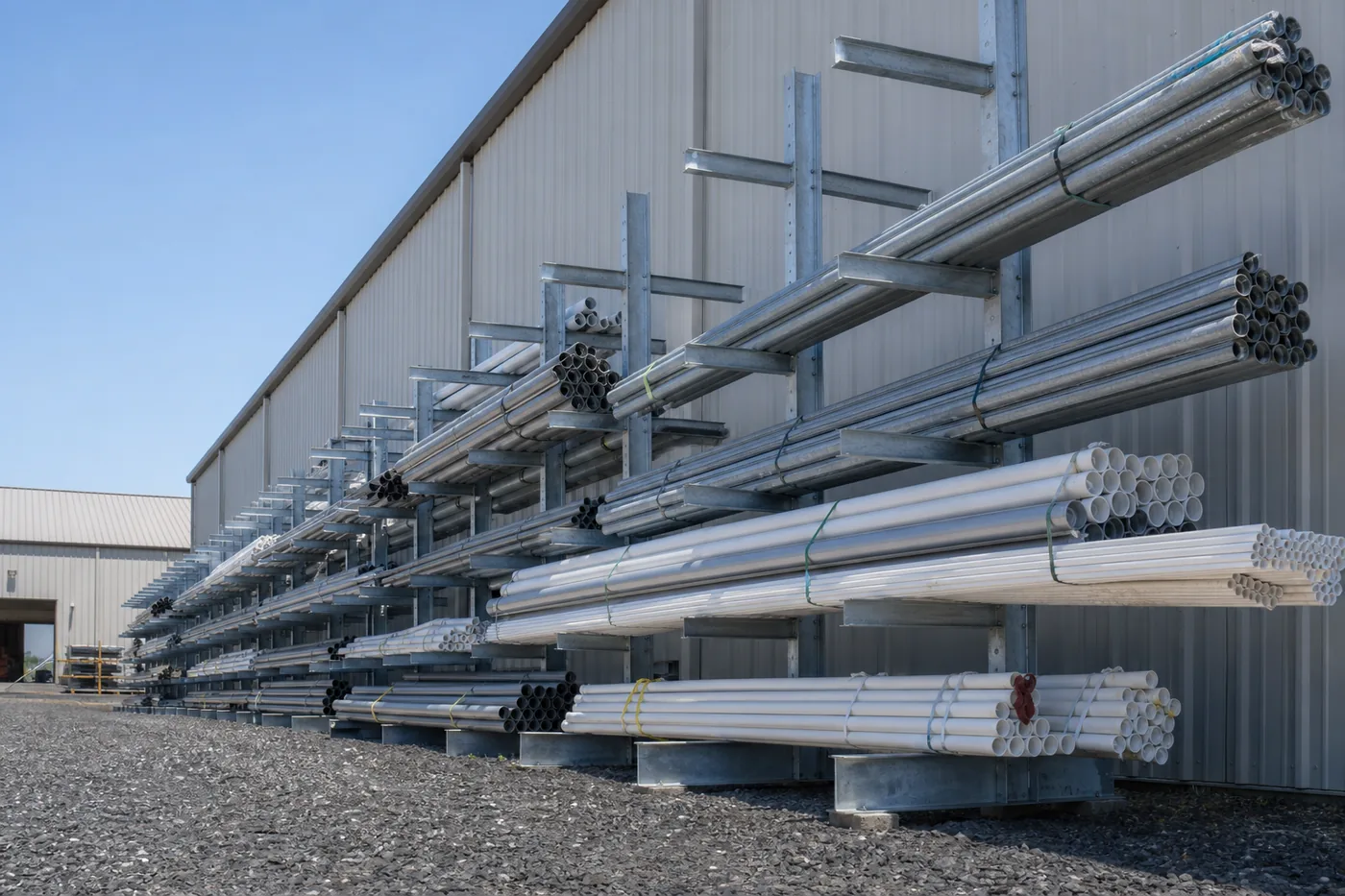
Finish and drainage come first
Most roofing yards store long material outside, and an outdoor rack is an exposed steel structure, not a warehouse fixture. Hot-dip galvanizing is the industry-standard outdoor treatment because it protects cut edges, fasteners and the inside of formed sections that paint never reaches; painted or powder-coated steel is an indoor finish and will bleed rust at the base and the bolt holes within a few seasons of Utah winters and road salt.
Second, plan drainage. Bases sit in whatever water collects, so a pad that ponds will take out an anchored base long before the arms wear out. Where a full slab is not practical, we design isolated footings under each base rather than letting a column bear on gravel.
Third, treat wind and snow as real loads. An outdoor rack loaded high with bundled material behaves like a sail and a snow shelf, and both cases have to be reviewed with your engineer of record for your site’s exposure. We will not publish a wind rating for a yard we have not looked at — anyone who does is guessing.
- Galvanized or otherwise corrosion-resistant finish for any bay exposed to weather
- A drained slab or engineered footings under every base — never bare gravel
- Wind and snow load review by your engineer of record for the actual site exposure
- Wheel stops, bollards or guarding wherever a lift turns near a column
- Bundle strapping kept intact outdoors so wind cannot lift loose sheet goods
- Load-rating plaques posted where loaders can read them from the seat

Anchors and seismic design
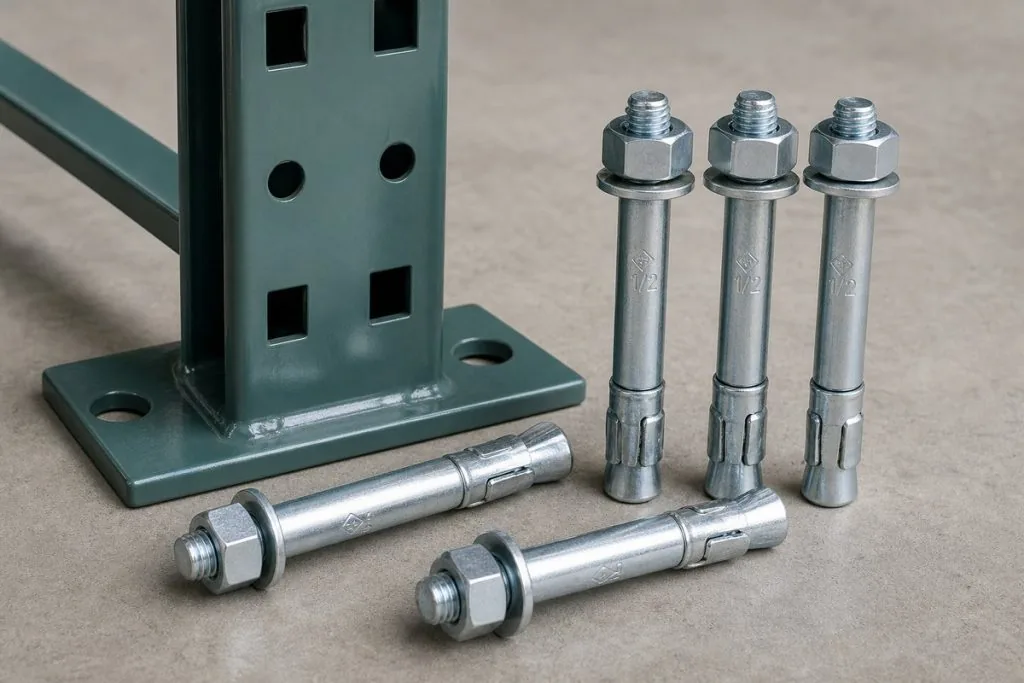
Every cantilever base is anchored — that is how the system resists the tipping moment from a loaded arm, and it is not optional on a free-standing run. Anchor type, embedment and edge distance depend on slab thickness and concrete condition, so we verify the slab before specifying hardware rather than assuming a standard wedge anchor works.
In the Intermountain West seismic design is the governing case for most storage structures. The Rack Manufacturers Institute publishes ANSI MH16.3, Design, Testing, and Utilization of Industrial Steel Cantilever Storage Racks (revised 2025), covering free-standing and top-tied cantilever racks; RMI’s cantilever best practices also cover load plaques, anchoring and damage inspection. We build to the manufacturer’s published capacities, keep the seismic base plate detail intact, and route code questions to your engineer — no supplier can promise you a permit. Our pallet rack seismic compliance guide walks through what a plan reviewer in Utah typically asks for.
How We Design a Cantilever System for Your Yard
Six steps, and the first one does most of the work.
Inventory the longest and heaviest SKUs
List every item by length, weight, width and how it is handled — forklift, boom truck or by hand. The longest item sets the upright spacing; the heaviest bundle sets the arm and column capacity. Bring us your top 20 SKUs and we can size the rack from that alone.
Choose arm length, angle and capacity
Arm length should be at least as deep as the widest bundle you store, with 24″, 36″ and 48″ the stock heavy-duty lengths. Straight 4° arms take flat bundles; 20° inclined arms and end stops hold round goods.
Set column height and arm levels
Heavy-duty columns come 8′, 10′ and 12′ tall with arms adjustable in 3″ increments (1-1/2″ on the 79″ medium-duty units). Do not pay for column height you do not need — specify extra height only when the column will act as a load stop or you plan to add levels later.
Decide single-sided or double-sided, indoor or outdoor
Perimeter runs are single-sided; center rows are double-sided and roughly double the storage over the same floor. Outdoor bays get a galvanized or coated finish, a drainage plan and a wind and snow load review.
Verify the slab, anchors and code review
Every base is anchored. We confirm slab thickness and condition, specify anchors, and route seismic and building-code questions through your engineer of record before anything ships.
Install, load-rate and train
Our crews install, plumb and anchor the run, post the load-rating plaques, and walk your loaders through the arm capacities and the load-spreading rules for palletized goods.
What to have ready before you call
The fastest quotes come from three things: a list of your longest and heaviest SKUs, a rough footprint of the space (or a photo of it), and the make and capacity of the lift that will serve the rack. With that we can usually come back with arm lengths, column heights, bay widths and a bay count without a site visit — and then confirm on site before release.
If you would rather sketch it yourself first, the free Cantilever Rack Configurator lets you set arm length, column height, bay width and single or double sided, then send the configuration straight to our team. It is the fastest way to turn “we need more room for trim” into a real bill of material.
Get a cantilever layout for your yard
Free design consultation and quote. We will size arms and columns to your material, flag anything a plan reviewer will ask about, and quote the rack and the installation together.
Case Study: Metal Man Roofing, Utah
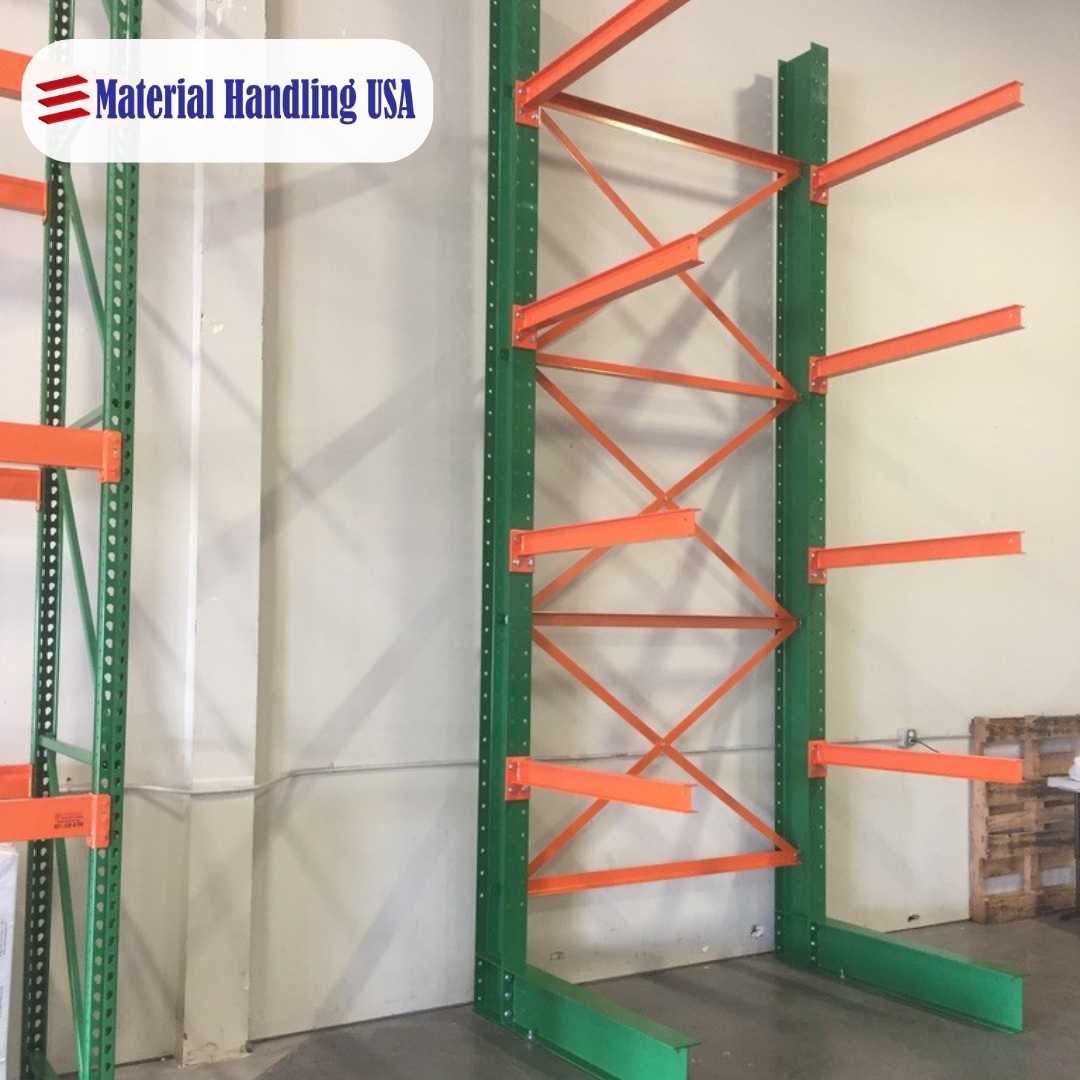
Metal Man Roofing runs three Utah locations. Their storage problem was the one we see in almost every roofing yard: long metal panel, trim and coil stacked on the ground and against walls, sorted by whoever put it there last. Loading a truck meant digging, digging meant dragging bundles across each other, and damaged panel is scrap — you cannot sell a creased piece of trim.
We designed and installed a heavy-duty cantilever system built for their material: paired arms deep enough for their widest bundles, arm levels set to their actual profile families rather than an even split, and a finish specified for the bays that see weather. Column spacing was set from their longest panel so nothing overhangs or sags between supports.
The result was the outcome cantilever racking is supposed to deliver: truck loading got noticeably faster because every bundle has one address, damage from handling dropped away because material is no longer stacked on itself, and usable storage went up in the same building — which is what let them keep more profile families in stock instead of ordering per job.
More Utah cantilever installations
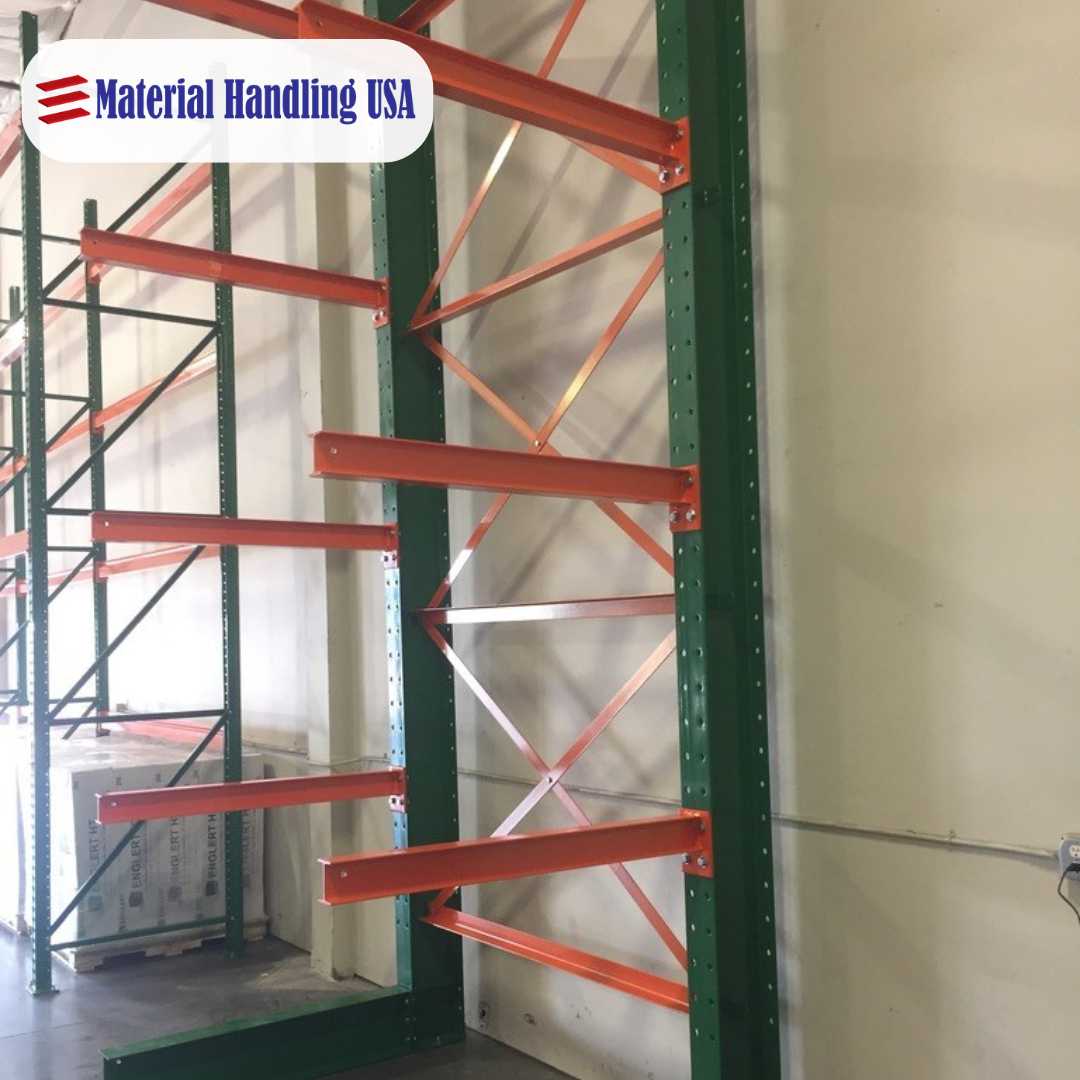
We install cantilever racking across the Intermountain West, from supply yards to schools. See the Utah high school cantilever rack project and our cantilever pallet rack in Utah overview for more examples.
Loading, Inspection and Damage Prevention
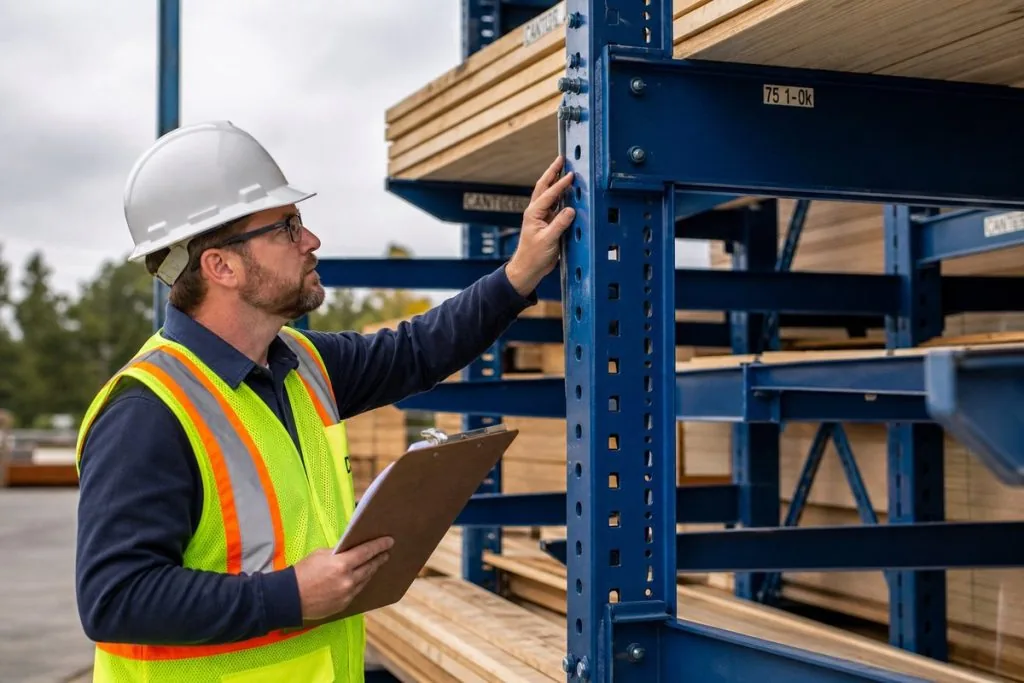
Cantilever racks fail for boring reasons: an arm loaded past its rating, a column knocked out of plumb by a lift, or an anchor that was never right. All three are inspectable, and a five-minute walk of the run once a month catches nearly all of it.
Train loaders to read the arm rating rather than the look of the rack. A bay that clearly holds “a lot” still has a per-arm limit, and a short, dense bundle like a stack of shingle squares concentrates that load in a way a full-length bundle of trim does not. When you change what a bay stores, re-check the arm.
Guard the ends of every run. The end column of an outdoor row, sitting where lifts turn, takes more impact than the rest of the system combined. Bollards or a wheel stop are far cheaper than replacing a base and re-anchoring a column.
- Post the arm and column ratings on every run and re-check them when a bay changes product
- Spread palletized goods across two or more arms — never load a pallet on one arm tip
- Load heaviest levels lowest and keep bundles pushed back against the column
- Check arms monthly for deflection, bent tips and missing or loose connecting bolts
- Check columns for plumb and bases for cracked concrete or loose anchors each quarter
- Remove damaged arms from service and replace them — never straighten and reuse
- Guard end columns and any column within a lift turning radius
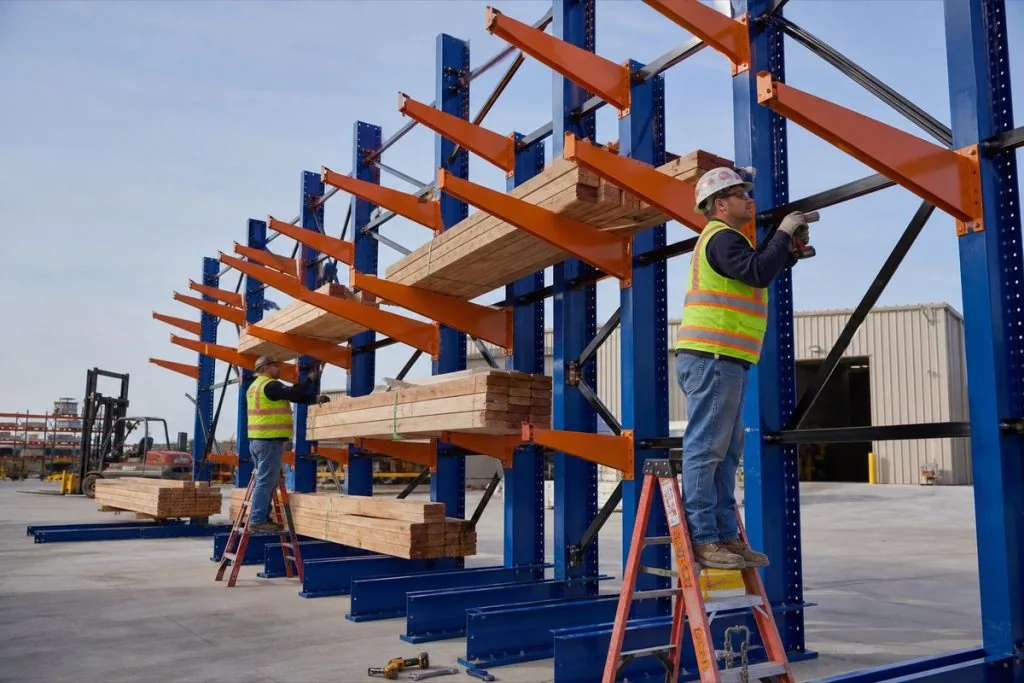
Installation is part of the capacity
A cantilever rack only reaches its published capacity if it is installed the way it was engineered: bases anchored to a verified slab, columns plumb, brace sets torqued, arms bolted through the column face and load plaques posted. Our crews install what we sell, so the same team that sized the arms sets the anchors — which is also why we can tell you up front when a slab is going to need attention before the rack arrives.
Cantilever Rack for Roofing Supplies: FAQs
Can I set a full pallet of shingles on cantilever rack arms?
What arm capacity do I need for roofing materials?
Does the total column capacity matter as well as the arm capacity?
Can cantilever racks be used outdoors in a roofing yard?
Straight arms or inclined arms — which should I order?
How tall can the rack be, and how far apart do the columns go?
Is there a design standard for cantilever racking?
Can you add to a cantilever rack we already have?
Related Products & Resources
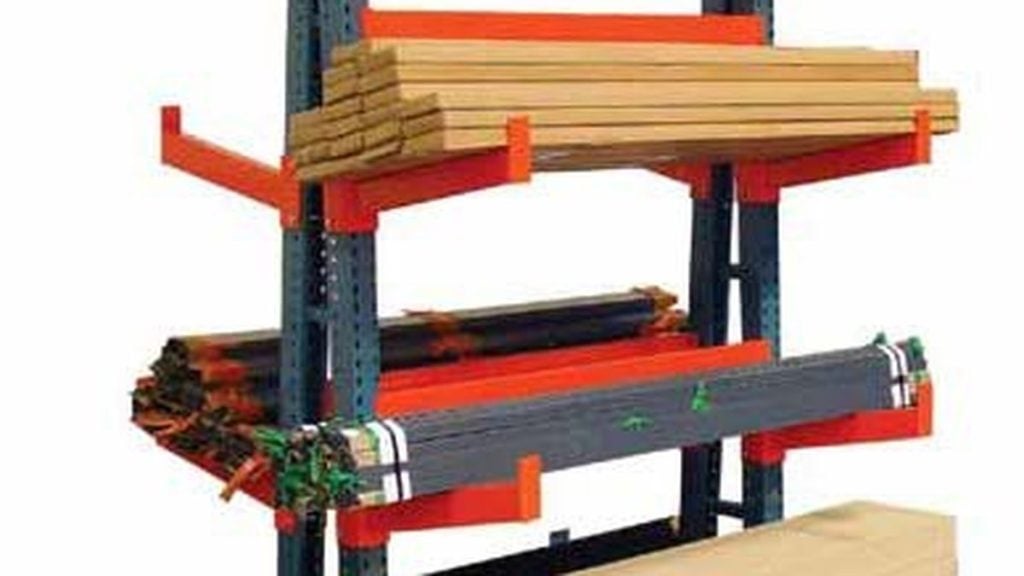 Cantilever Pallet RackingThe full cantilever line — medium and heavy duty, single and double sided, arms, bases, braces and accessories.
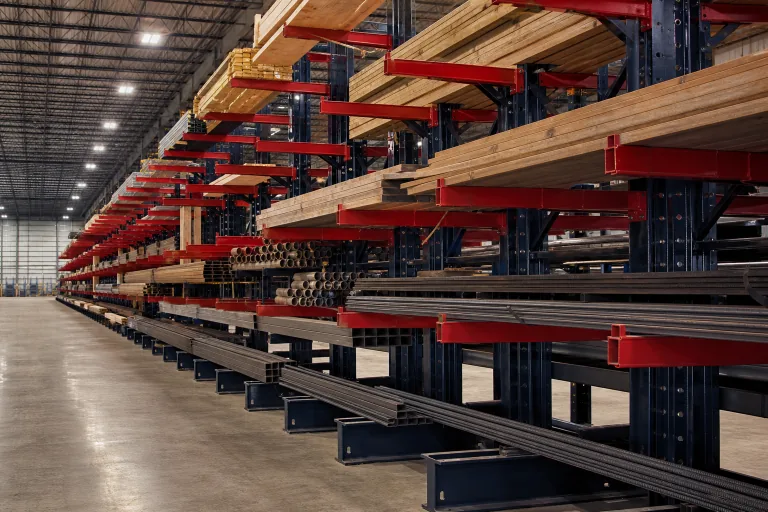 Cantilever Rack ConfiguratorFree online configurator: set arm length, column height, bay width and sides, then send the layout to our team.
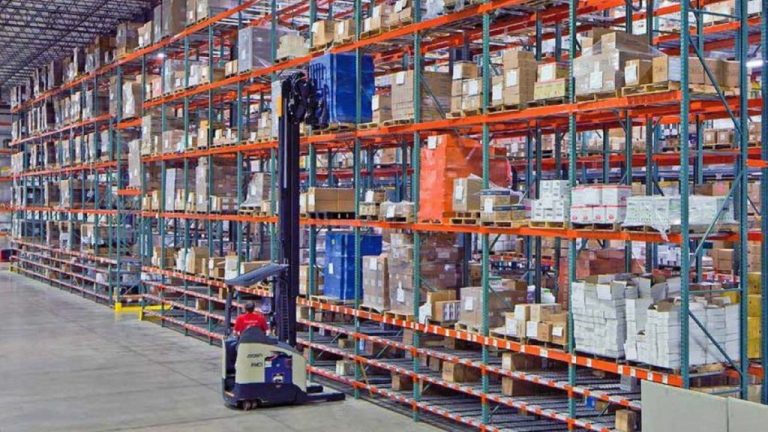 Pallet Rack SystemsSelective, drive-in, push-back and pallet flow rack for the full shingle and adhesive pallets cantilever bays should not carry.
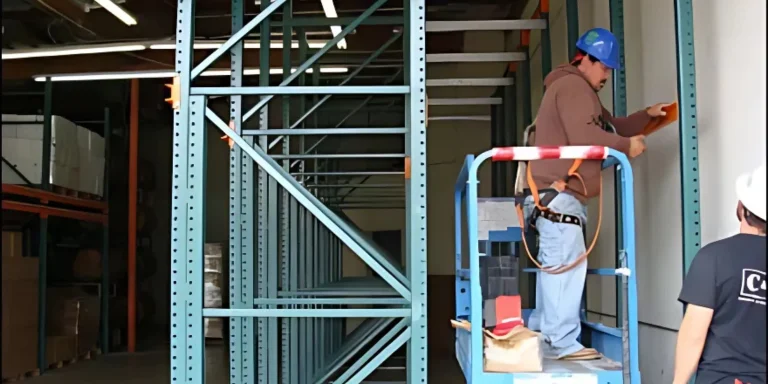 Pallet Rack Seismic ComplianceWhat plan reviewers in Utah ask for: anchors, base plates, drawings and load plaques.
 Construction Company Storage IdeasYard and warehouse storage layouts for contractors handling pipe, conduit, lumber and long material.
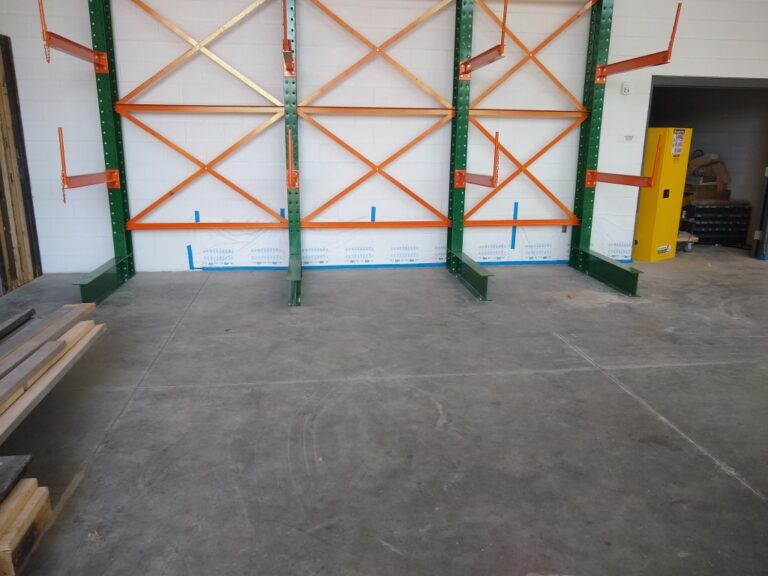 Cantilever Rack for a Utah High SchoolA smaller cantilever install for long lumber and shop stock — the same components at a different scale.
Shop Online at MaterialHandling-USA.com
Need rack accessories, decking or shipping supplies you can buy online today? Our e-commerce store stocks material handling products with published pricing.
Ready to Get Your Roofing Supplies Off the Ground?
Send us your longest and heaviest SKUs and we will size the arms, columns and bays, quote the rack and the installation together, and flag anything your plan reviewer will ask about. Free design consultation.
Ready to configure your pallet rack system?
Use our guided configurator to choose the right configuration, review your parts and submit it for checkout or a formal quote.