A Utah residence hall front desk often handles packages, mail, keys, access cards and resident questions in one spot. That works in a quiet week. It breaks down when online orders pile up during move-in, while staff are also handling lockouts, maintenance requests and parent visits.
Smart lockers for Utah universities and student housing give residents a self-service pickup point and take package handling off the front desk. The same system can also run equipment checkout and other controlled handoffs with a record of who opened which door. This guide covers what to store, how to pick a configuration, how to size a locker bank, what to check on site, and what to ask before you request a quote.
Quick answer
- Count parcels in a normal week and during move-in. Size the bank to the peak, not to the bed count.
- Most residence halls need a mixed bank of small, medium and oversized doors, plus a plan for boxes that will not fit.
- Pick an access method that matches your campus ID system: student ID tap, PIN, barcode or mobile code.
- Check egress, ADA reach range, anchoring, power and network before you order.
- Install during a low-occupancy window, such as summer, and test every door before go-live.
Why Utah Student Housing Needs a Better Package Plan
During the first week of fall semester, a residence hall team may be answering lockout calls while receiving deliveries, issuing keys and helping residents find their rooms. Every package left behind the desk adds one more task. Students come back at all hours, and staff have to search for each parcel during the busiest service windows.
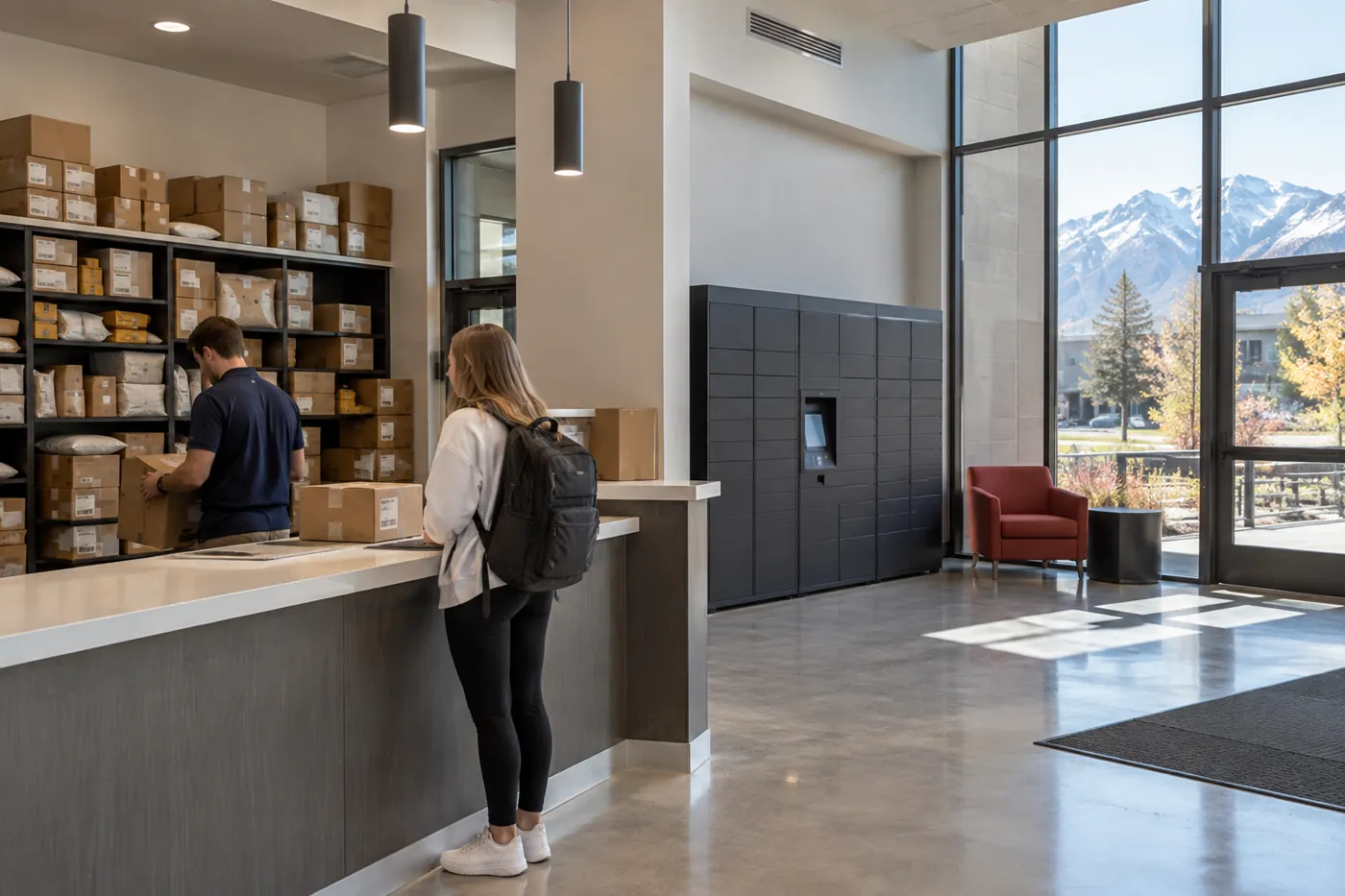
A traditional mailroom depends on staff to receive, sort, label and release every package. That makes the desk a single point of delay, and it makes pickup outside desk hours hard to offer.
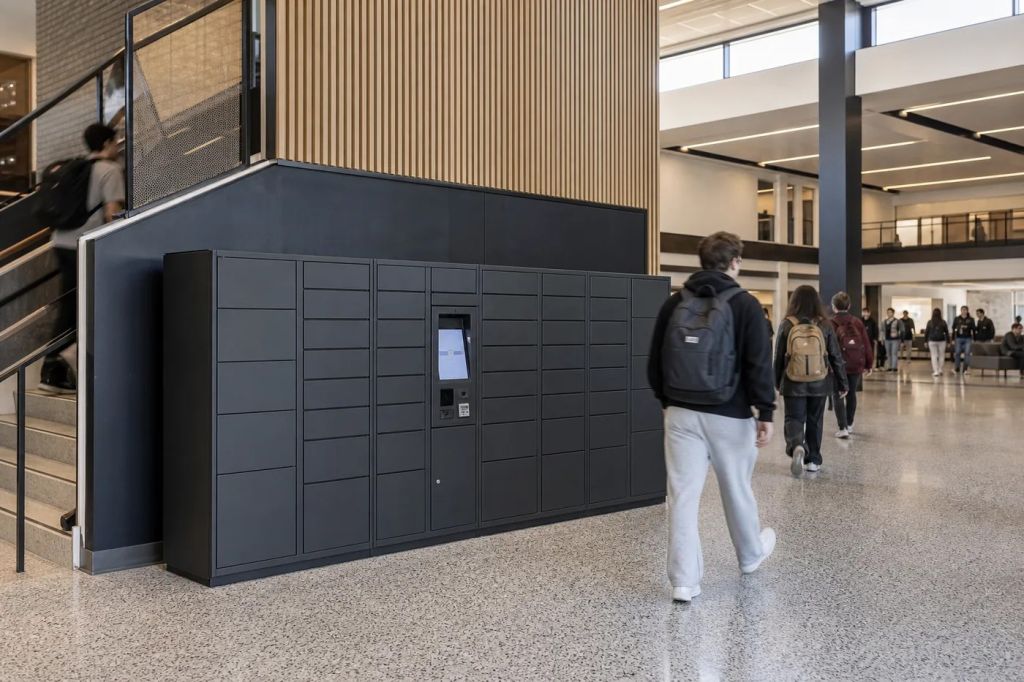
A locker bank changes the handoff. A carrier or staff member puts the parcel into an open compartment. The resident gets a notice and opens the door with a PIN, barcode, student ID or mobile code. The system records the drop-off and the pickup, and pickup no longer depends on someone being at the window. For another campus example of resident pickup resources, see the University of Florida's campus package guidance.
Shared amenities and daily convenience have shaped residence hall planning for years, as this look at dorm trends 2019 shows. Package handling is now part of the everyday resident experience, not just a back-office task.
Utah campuses are already moving this way. The University of Utah emails new residents before move-in with steps to set up their package locker account, per its pre-arrival guidance. Its newest hall, Trailhead, opened in fall 2026 as a six-story, 349,342-square-foot building for more than 1,400 students. It includes automated package lockers: the driver places a package in an open locker, and the student gets a notice and an access code, according to the University of Utah.
Practical rule: Size the locker system for the busiest week of the year, but put it where residents will use it every day.
What Utah Campus Housing Operations Need to Store
Before you pick a locker model, list everything your team receives, holds and hands out. Parcels may be the main need, but many campus operations can use controlled compartments for much more than deliveries.
Resident parcels
This means deliveries from Amazon, FedEx, UPS, USPS and other carriers. Packages run from padded envelopes to cartons that need an oversized door. The daily average is not the number that matters most. Record how many parcels arrive in a normal week, during move-in, around holiday breaks and at move-out.
Also record how long parcels sit. A parcel picked up the same day needs less storage than one held for several days. Your hold policy sets that window. University of Utah Housing, for example, accepts packages one week before a resident's move-in date, holds them for up to one week, and holds perishable packages for only 24 hours, per its desk and mail services policy. Its pre-arrival page also warns that some hall mailrooms close over the summer and that packages mailed too early go back to the sender. Rules like these shape both the size of the bank and the expiration settings in the software.
Shared equipment and supplies
Residence life teams often lend out keys, fobs, vacuums, sports gear, testing supplies and maintenance items. These need a different workflow than parcels. The user may be a resident, a resident assistant, a maintenance worker or a housing employee.
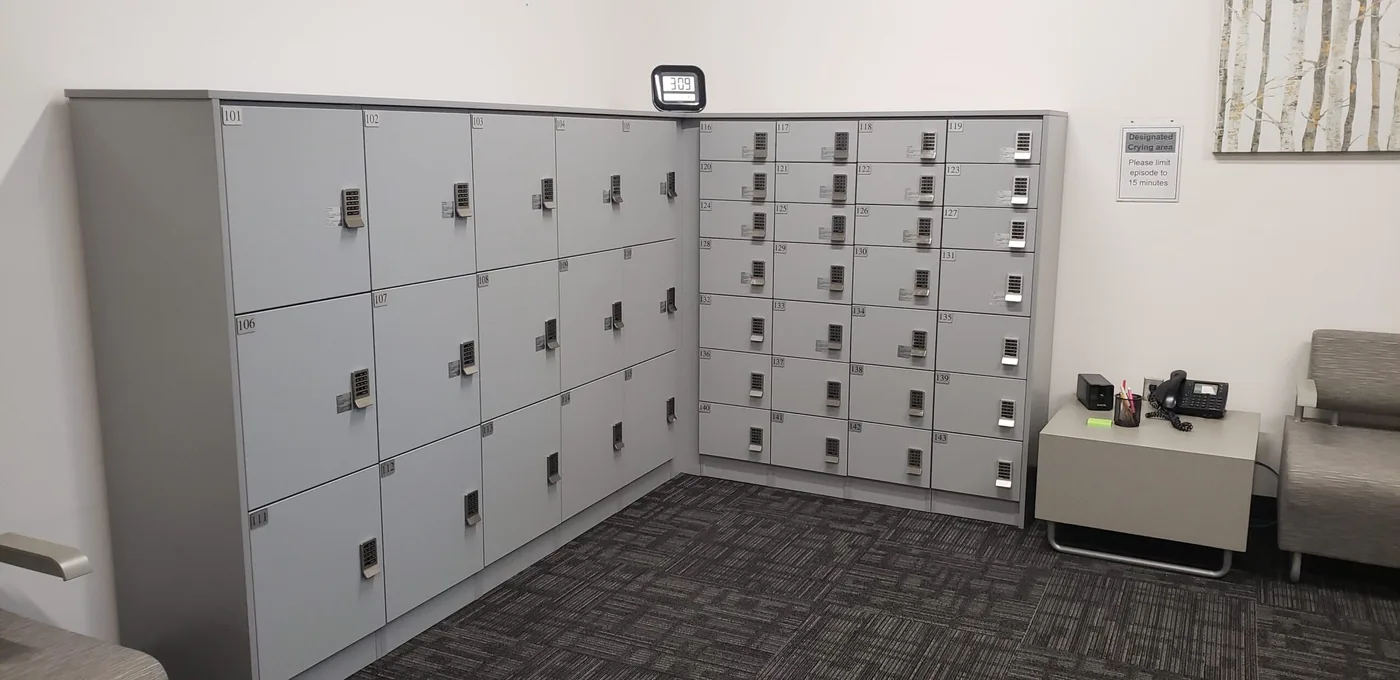
For these items, decide whether each checkout should record the borrower, the return date and the staff member who approved it. A smart asset locker can track all of that. A simple keyed or keypad locker may be enough for low-risk items that do not need a detailed audit trail. Coordinate with the team that manages door access and cameras, too. This overview of budget-friendly school entry security covers related access control ideas.
Resident access assets
This group includes replacement key cards, mailbox keys, reissued IDs and items held for students who have moved off campus. These need tighter identity checks than a normal delivery. A student ID tap, a PIN or staff approval may fit, depending on the item and campus policy.
Write the list down before you ask for a quote. Our page on touchless parcel locker systems for universities explains the difference between resident package pickup and controlled equipment access.
Planning lockers for a Utah residence hall or campus building?
See our smart lockers for Utah universities and campuses, then send us your parcel counts and floor plan for a free layout and quote. Prefer to talk it through? Call (800) 326-4403.
Smart Locker Configurations That Fit Utah Student Housing
The right configuration depends on what you store, how much wall space you have, your access rules and your staffing. A bank built only for small parcels leaves staff carrying big boxes by hand. A bank full of oversized doors wastes wall space that a busy lobby cannot spare.
Small-compartment banks
Small compartments suit padded envelopes, textbooks and small online orders. They fit tight lobbies and short corridor walls. The trade-off is flexibility. A large carton still needs counter storage or a separate oversized locker.
Access can use a PIN, barcode, mobile code, student ID tap or app. Pick the method that matches your campus identity system and what residents already use every day.
Mixed-compartment banks
A mixed bank combines small, medium and oversized doors. This is usually the most flexible choice for a residence hall because it handles varied parcel sizes without making every door large.

The trade-off is planning. The door mix has to match your real parcel data, not a catalog photo. Leave room for parcels that go uncollected, and set a process for expired codes, returns and exceptions.
Specialty compartments
Cooled or specialty doors can hold pharmacy items, lab deliveries, dining orders and other goods that must stay cold. These are more than a different door. They may need their own power, temperature checks, cleaning steps and a clear record of who handled each item.

Even basic closet organization systems follow the same rule. Plan the storage around the items and the work. Do not bend the work to fit the storage.
| Configuration | Best fit | Typical access | Footprint |
|---|---|---|---|
| Small-compartment bank | Envelopes, small parcels, textbooks | PIN, QR code, mobile code, student ID | Short wall sections or compact lobbies |
| Mixed-compartment bank | Everyday campus parcels in many carton sizes | PIN, mobile app, RFID, student ID | Wall-mounted, freestanding, L-shaped or back-to-back |
| Specialty compartment system | Temperature-sensitive or controlled deliveries | Role-based credential with staff oversight | Dedicated area with power, monitoring and service access |
| Asset or equipment locker | Loaner keys, devices, gear, supplies | Student ID or staff badge with checkout records | Near the desk, union or service point that owns the items |
For a deeper look at how these systems work, read our smart locker guide or browse smart locker systems by application.
How to Size a Locker Bank for a High-Density Residence Hall
Start with a count, not a product. Bed count alone does not tell you how many doors you need. A 600-bed hall and a 600-bed hall across town can need very different banks, depending on how often residents order, how fast they pick up and how much overflow the desk can handle. Use these steps:
- Count parcels for at least two periods. Track a normal week and the move-in period. Log arrival times, pickup times and how many items had to be handled by hand.
- Sort parcels by size. Measure or estimate each parcel as small, medium or oversized. The share in each band sets your door mix.
- Measure dwell time. Note how long parcels wait before pickup. Longer waits mean more doors for the same volume.
- Set your hold policy. Decide how long a parcel can sit before staff pull it, and what happens to perishables and returns.
- Plan the overflow. Decide where parcels go when the bank is full or a box is too big, such as an oversized locker or a shelved package room.
- Leave room to grow. Pick a spot and a cabinet layout that can take another column later if volume climbs.

Use a simple worksheet like the one below to turn your counts into a door mix. Ask the supplier to fill in the real interior dimensions for the model you are quoting, since door sizes vary by product line.
| Door size band | Typical contents | What to measure | What to ask the supplier |
|---|---|---|---|
| Small | Envelopes, phone and accessory orders, small parcels | Share of parcels in this band at peak | Interior width, height and depth for the quoted model |
| Medium | Textbooks, clothing, medium cartons | Share of parcels in this band at peak | How doors combine across columns and modules |
| Oversized | Large cartons, dorm gear, selected equipment | Count of boxes that would not fit a medium door | Largest door available and where it sits in the bank |
| Overflow | Boxes too big for any door, peak overflow | Peak overflow per day and how long it stays | Whether the software logs items held outside the bank |
Our parcel locker system sizing guide walks through the math in more detail. For overflow, a shelved package room works well beside the bank. Our mailroom and package room mobile shelving fits more parcels into the same room.
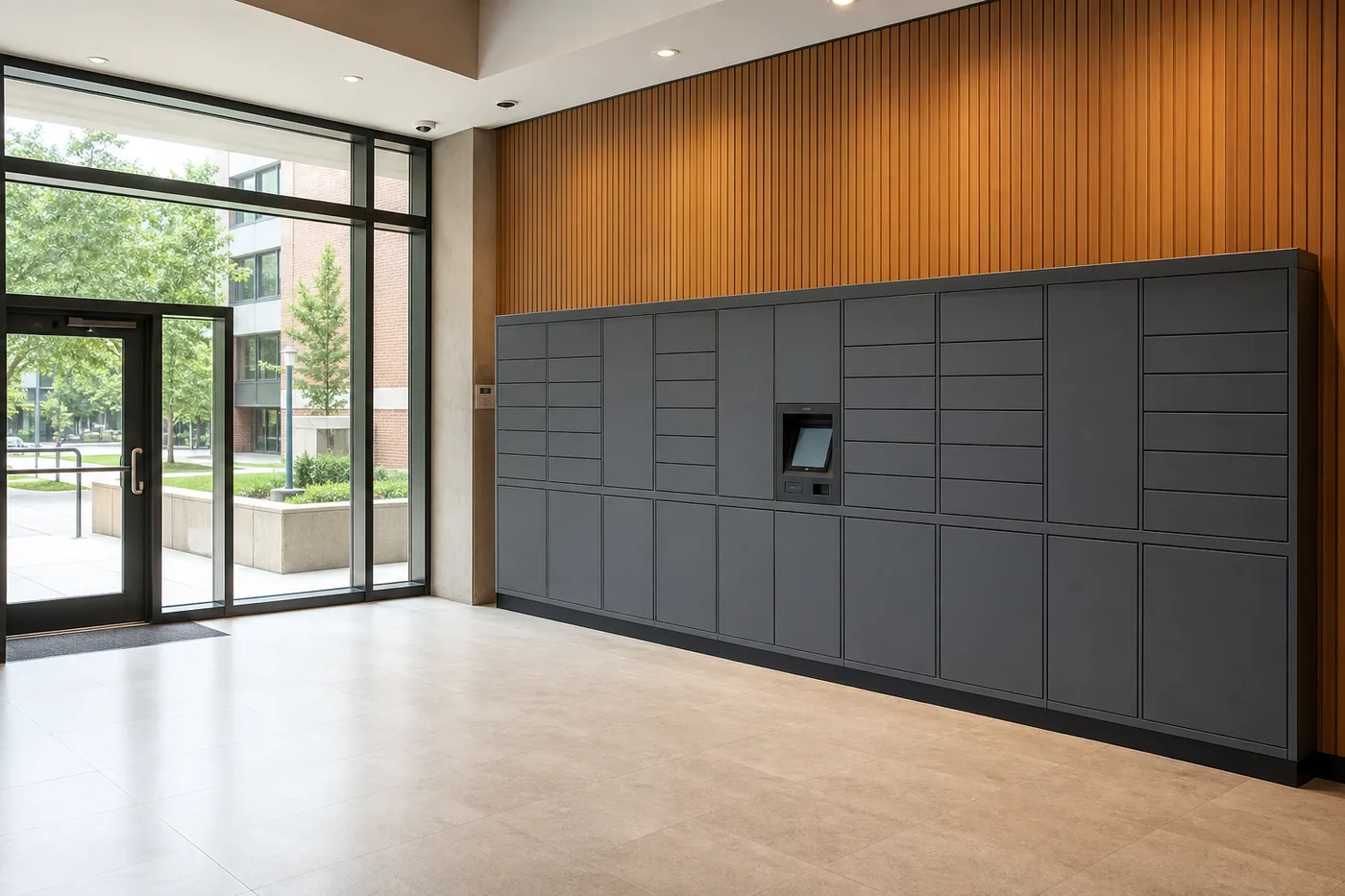
Sightlines matter too. Staff should be able to see the kiosk and the approach to the bank, without the bank sitting in a main exit path. Check clear floor space, door swings, wall conditions and whether a single-sided or back-to-back bank uses the room better. Our Salt Lake City tenant locker resource is a useful comparison for secure storage in local buildings.
Code, Accessibility and Site Checks in Utah
A locker bank can fit the wall and still cause a site problem. Review the planned spot with housing, accessibility staff, electricians and the campus fire marshal before you approve the layout.
Keep the pickup path clear. Review exit access, corridor widths, door swings and any fire-rated corridor rules. A freestanding unit is easier to move than a built-in alcove, but it still needs solid anchoring and room for service.
Accessibility takes more than one low door. Under the 2010 ADA Standards, the reach range for operable parts is no higher than 48 inches and no lower than 15 inches for an unobstructed reach, per this ADA.gov fact sheet on the 2010 Standards. Check the kiosk screen, the card reader, enough usable doors, clear floor space and the route from the entrance. Have your accessibility staff confirm how many compartments must be accessible. Our ADA lockers page covers accessible locker planning in more depth.
Site checks before purchase
- Wall and floor: Confirm whether the surface is concrete, tile, carpet or framed construction. Each one changes how the bank is anchored.
- Power and network: Verify the circuit, surge protection, outlet location and whether hardwired Ethernet or another network method meets the campus IT standard.
- Lighting: Make sure the screen, reader and door openings are easy to see without glare.
- Seismic anchoring: The Wasatch Front is earthquake country. Ask the facilities engineer how stacked or freestanding units must be anchored and braced, especially in older buildings.
- Service access: Leave room for technicians to open panels, swap parts and test the system.
- Carrier route: Walk the path a driver will take from the curb to the bank, including doors and elevators.
Do not rely on a generic floor plan. A site survey should confirm dimensions, egress, mounting surfaces, network paths and the daily routes of carriers and residents.
Software, Credentials and Campus System Integration
The cabinet is only half the system. The software sends notices, sets expiration rules, logs every door event and controls who can load or open each door. Before you compare quotes, answer three questions with campus IT:
- How will residents log in? Student ID card, mobile credential, PIN, barcode or single sign-on.
- Where does resident data come from? A housing platform, a campus ID system or a manual upload. Ask whether an API is available and who tests the connection.
- Who gets which role? Desk staff, carriers, maintenance and administrators each need different permissions.
Also ask where the software is hosted, who owns the data and how the system behaves if the network drops. Our page on smart locker software, hosting and integration lists the questions to settle before you sign.
Installation and Service for Campus Projects
Campus locker projects involve three groups. Housing operations defines the resident workflow. IT reviews identity, network and software connections. Facilities prepares the room, power, mounting surface and service route. Projects stall when one of these groups joins after the equipment is already picked.
Ask the supplier to write out the full path from quote approval to go-live. The scope should name the cabinet layout, access method, software duties, installation work, training and acceptance testing. Custom finishes, refrigerated doors, branded wraps and unusual integrations take more planning than a standard setup, so build that time into the schedule.
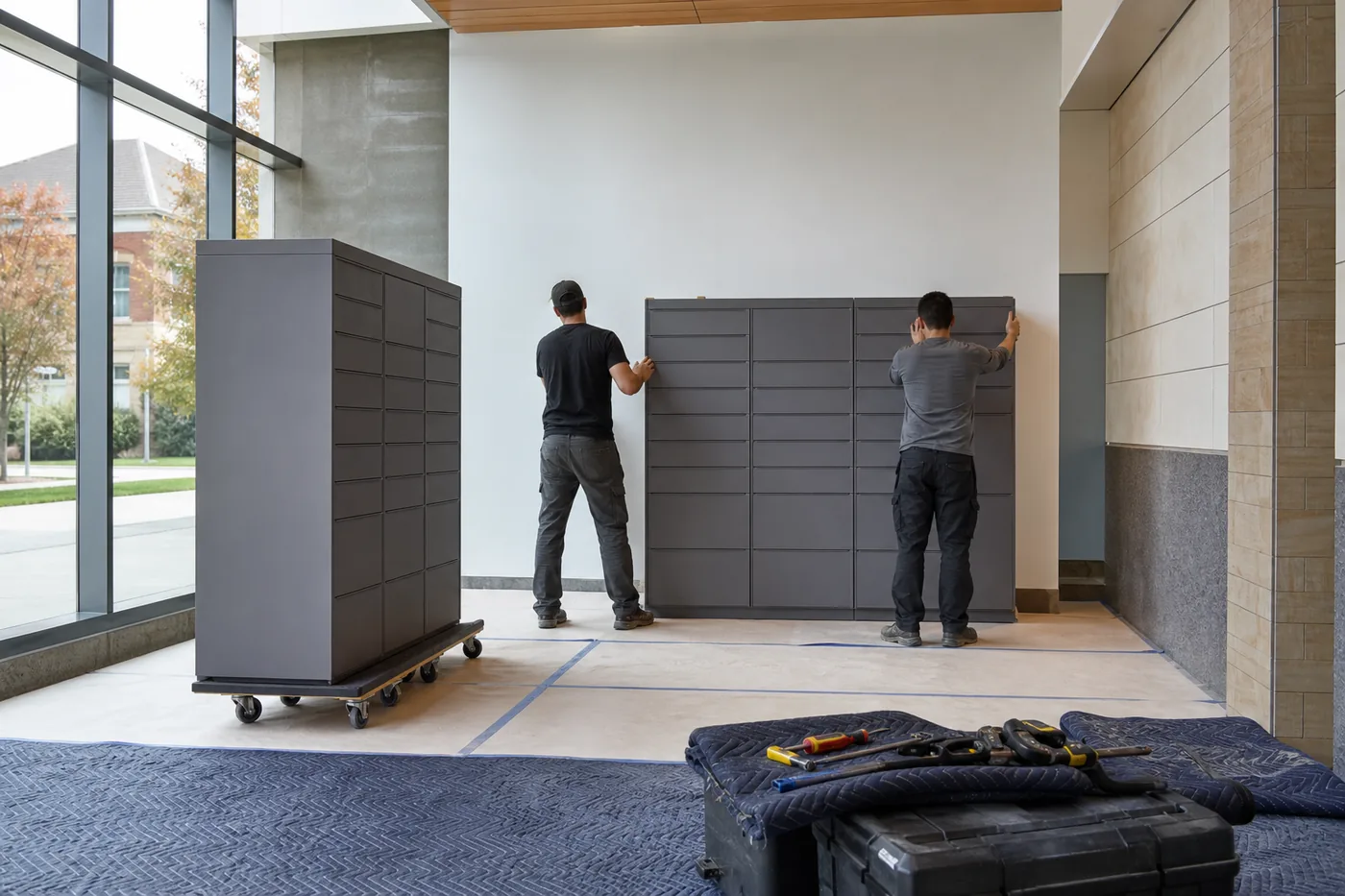
The install should start with a site survey and a check of the floor, wall, power and network. It should end with a test of every door and every way to log in. In an occupied hall, plan the work for a low-occupancy period, such as summer, when possible. One campus parcel locker buyer guide also stresses summer-break install timing. Coordinate elevator use, loading access, resident notices and temporary package handling.
Service terms deserve the same attention as the price. Ask about remote diagnostics, on-site response times, spare parts, software support and how a failed door gets taken out of service. Get clear answers on who handles a hardware problem, a network problem and a student account problem.
Ask for a written handoff plan: It should name the owner of each task, the testing steps, who gets trained and how uncollected parcels are handled.
Lead times depend on the product line, the door mix and any custom work, so ask for a written ship date with your quote. Starting the layout review early gives your campus time to compare pricing, prepare the site and avoid a rushed install right before move-in.
Matching the Right Locker Setup to Your Buyer Scenario
Different buyers need different levels of control. A high-rise residence hall may care most about parcel volume and a small lobby footprint. A student union may need equipment checkout more than package storage.
| Buyer scenario | Recommended configuration | Door mix | Access method |
|---|---|---|---|
| University residence hall with move-in surges | Mixed-compartment parcel bank | Small, medium and oversized | Student ID, PIN or mobile credential |
| Off-campus student housing tower with a small lobby | Dense small-compartment bank with some larger doors | Mostly small and medium | Mobile code or PIN |
| Traditional hall lending textbooks and equipment | Mixed bank with controlled asset compartments | Medium and oversized | Staff approval, RFID or student ID |
| Student union shared-device checkout | Asset-focused smart locker | Device-sized compartments | Role-based credential |
| Testing center or exam room | Keypad day-use lockers | Small compartments for phones and bags | Keypad or PIN |
| Small private community with one mailroom | Compact mixed-compartment system | Based on measured parcel mix | PIN or mobile code |
For a high-rise near the University of Utah, a mixed bank can cut desk traffic. It still needs a plan for boxes bigger than the largest door. A Provo or Orem property near BYU with a narrow lobby may get more from a dense wall layout than from a large freestanding unit. Off-campus buildings face many of the same choices as apartments, which we cover in our guide to smart locker systems for apartment package rooms.
A hall at Utah State or Weber State that lends equipment should not force every item into a parcel workflow. Shared devices and loaner gear need return tracking and staff permissions. When accountability matters more than convenience, look at smart lockers for total asset control.
Material Handling USA supplies locker systems and layout help for campus package pickup, equipment checkout and day-use storage across Utah. See our Utah smart lockers hub for other applications. When you compare quotes, look at the door mix, materials, software, delivery scope and service terms, not just the cabinet price.
Common Questions About Smart Lockers for Utah Student Housing
How should a residence hall size lockers for move-in surges?
Use measured arrival and pickup data from both a normal week and the busiest move-in period. Include your hold policy, the number of oversized parcels and how much overflow staff can handle by hand. A supplier should model the door mix from that data instead of using a simple per-bed rule.
Can smart lockers connect to a campus ID card or housing platform?
Many systems support student ID cards, RFID, PIN, barcode, mobile app or other credentials. Confirm whether the system you are quoting connects to your campus ID or housing platform, whether an API is available and who owns integration testing. Ask for separate roles for desk staff, maintenance, carriers and administrators.
What happens when a student does not pick up a parcel?
Set an expiration policy before launch. Staff may need to pull the parcel, contact the resident, return it to the carrier or move it to exception storage. The system should keep a record of the drop-off, each notice, the pickup and any staff action.
How should accessibility affect the design?
Review the whole route, including the kiosk, card reader, usable doors, clear floor space and the path from the entrance. The 2010 ADA Standards set a 15 to 48 inch reach range for an unobstructed reach. Do not treat accessibility as one low door. Facilities and accessibility staff should approve the final layout.
Can a locker bank go in a dorm corridor?
It depends on the corridor width, construction, egress path, fire rating, mounting method and local review. Get a site survey and talk with the campus fire marshal before placing equipment in a corridor or alcove.
What power and network connections are needed?
It depends on the locker model, the kiosk, the readers and any cooled doors. During design, confirm the circuit, where the outlets go, and whether the bank uses wired Ethernet or campus Wi-Fi. Leave room for service, too.
What service response should a campus expect?
Ask for written response times, remote diagnostic support, parts replacement steps and escalation contacts. The agreement should explain how a failed door, a kiosk outage, a credential problem and a software issue get fixed during the school year.
Should a campus buy a locker online or request a layout first?
A small standard locker may be fine to buy online once you confirm dimensions and access needs. Dense residence halls, shared mailrooms, specialty doors and integrated systems deserve a layout review first. A free design and quote can catch clearance, capacity and install problems before they turn into change orders.
Get a free locker layout for your Utah campus
We help Utah schools and student housing teams pick the right lockers, check the site and price the full job. There is no cost and no obligation.
- Smart lockers for Utah universities and campuses
- Smart locker systems by application
- Request a free quote
Call (800) 326-4403 or email Sales@MH-USA.com to start your review.