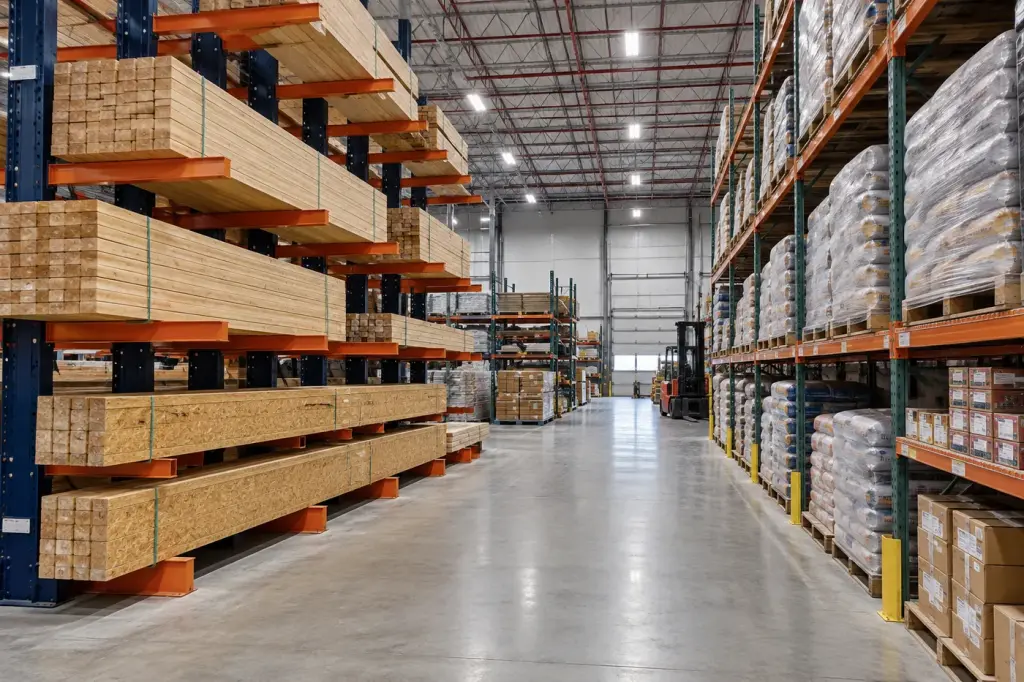
Most Utah lumber and building-material dealers run two storage worlds. The yard carries the bulk, but the warehouse and store hold what must stay dry, clean and easy to pick: kiln-dried boards, LVLs, plywood, drywall, doors, trim, bagged mix and fasteners. Indoors, every square foot is expensive and every damaged sheet comes off your margin.
This guide covers indoor lumber and building materials storage racks: which rack fits each product family, how to size aisles for forklifts and side loaders, and what the fire code and Utah’s seismic rules ask for before you install. If your question is about racks that live outside in the snow and wind, read our guide to outdoor pallet racking for Utah lumber and building supply yards instead.
Key points for indoor building-material storage
- Match the rack to the product shape: cantilever for long lengths, A-frame or vertical racks for sheets, door racks for doors, pallet rack for bags and boxes.
- Your forklift decides your aisle. Side loaders carry long loads lengthwise and work in far narrower aisles than counterbalance trucks.
- Rack storage above 12 feet usually triggers the fire code’s high-piled storage rules, including flue spaces and sprinkler clearance.
- Along the Wasatch Front, plan anchored, engineered rack and ask the city early whether it wants stamped seismic calculations.
- Go deeper with our cantilever lumber rack sizing guide.
Shop Racks for Indoor Lumber and Building Materials
Real catalog items with current online prices. Freight is quoted by destination; some common sizes in stock at select manufacturers, subject to confirmation.
 Cantilever Rack KitsStarter sets with uprights, arms and bracesFrom $894.86Pictured: Vestil 6 ft single-sided 24 in arm set ($977.31)Shop Cantilever KitsCantilever rack guide →
 Cantilever ArmsStraight and incline arms for lumber and trimFrom $36.88Pictured: Vestil heavy-duty incline arm 18 in ($40.56)Shop Cantilever ArmsSize arms for lumber →
 Sheet RacksHold plywood, drywall and panels on edge$396.78Pictured: Vestil variable height sheet rack, knock-downView Sheet RackSheet goods storage options →
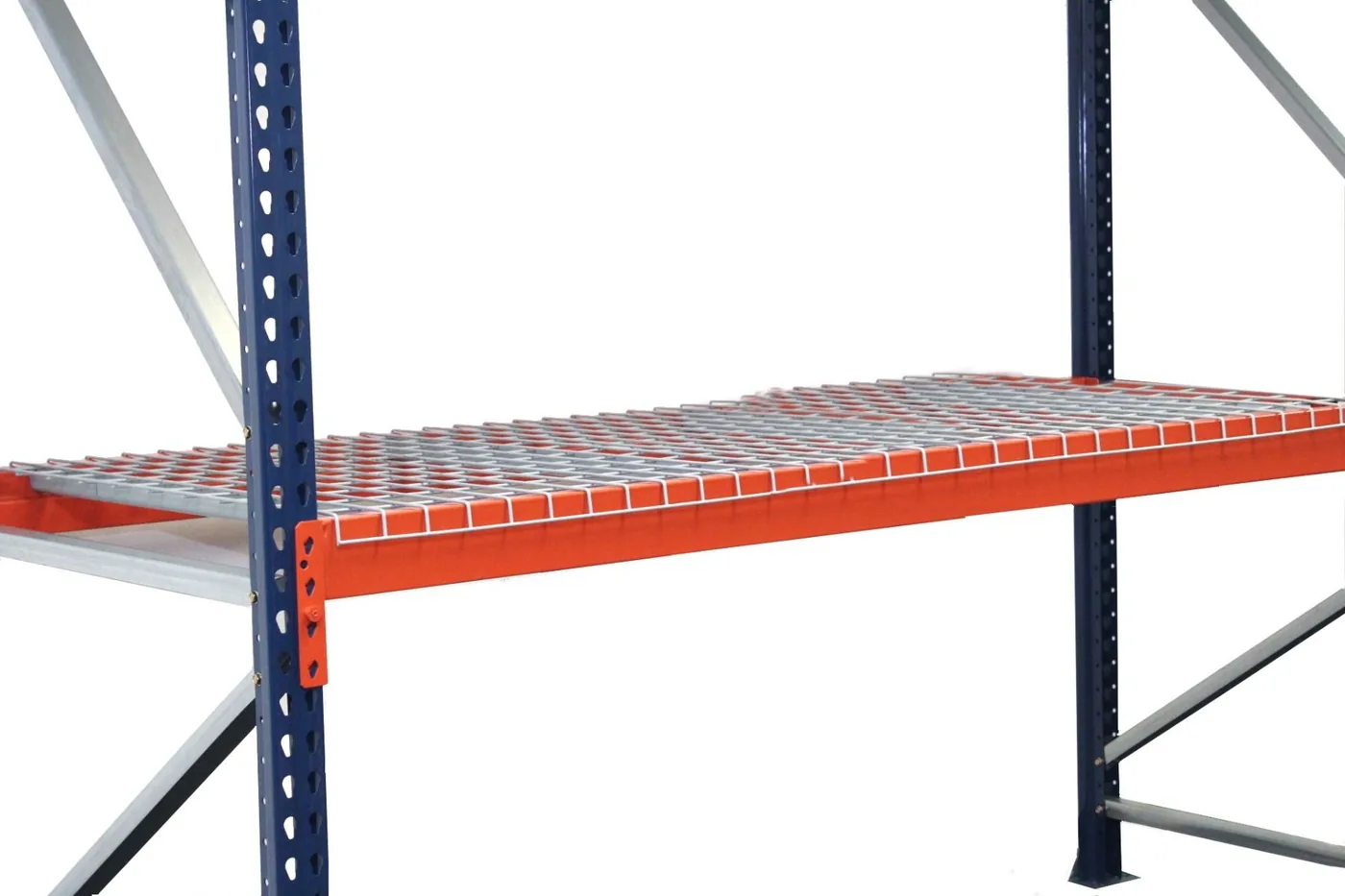 Pallet Rack with Wire DeckingFor bagged mix, boxed fasteners and palletized goodsStarter bay $658.70Pictured: Interlake starter bay with wire decking; add-on bays $541.09Shop Pallet RackPallet rack systems →
What Changes When Lumber and Building Materials Move Indoors
Indoors, weather stops being the design driver: no galvanizing, snow loads or roof canopies. Instead you work within a fixed clear height, sprinkler clearance, a slab that carries concentrated column loads, building columns that interrupt rows, and aisles shared with people and customers.
Product care changes too. You bring material inside to protect it, so the rack has to prevent handling damage: forks punching sheet faces, door edges hitting uprights and bags torn on bare beams.
| Planning factor | Indoor warehouse or store | Outdoor yard |
|---|---|---|
| Main limit on height | Clear height and sprinkler clearance | Wind, snow and stability |
| Rack finish | Standard painted steel is usually fine | Galvanized or coated steel |
| Code focus | Fire code, flue spaces, seismic anchorage | Wind, snow load, footings, seismic |
| Typical trucks | Side loaders, reach and four-way trucks, counterbalance | Rough-terrain and large counterbalance trucks |
Map Every Indoor Product Family to the Right Rack
List what sits inside: product family, length or sheet size, unit weight and how often it moves. Then give each family the storage method that fits its shape.
| Product family | Best indoor storage | Why it works |
|---|---|---|
| Dimensional lumber, boards, LVLs, I-joists | Cantilever rack with straight arms | No front columns, so any length loads from the side |
| Plywood, OSB, MDF, melamine | Flat on decked cantilever or pallet rack, or vertical sheet rack | Flat for full units, on edge for mixed picks |
| Drywall and cement board | Low flat levels or A-frame racks | Heavy, brittle edges; short lifts |
| Pre-hung and slab doors | Vertical door racks with padded dividers | Stops leaning and edge damage |
| Trim, moulding, pipe, gutters | Light cantilever arms or vertical bins | Long, light pieces that bow if poorly supported |
| Bagged mix, mortar, grout, insulation | Selective pallet rack with wire decking | Full pallet access and stock rotation |
| Fasteners, hardware, boxed goods | Pallet rack with shelving or carton flow | Small picks close to the counter |
Cantilever Arms for Long Lengths Indoors
Why cantilever owns the long-stock zone
Cantilever rack hangs arms off one row of columns, so nothing blocks the front. A 16 ft bundle of 2×6 or a 24 ft LVL slides on from the side. Indoors, single-sided runs fit along walls and double-sided rows fill the middle of the building.
Size the arm to your deepest bundle, space columns so every length stays flat, and keep the heaviest units low.
Photo: Interlake Mecalux (authorized use).

- Arm length: match it to the bundle depth, not the board length. Overhanging bundles tip; short loads on long arms waste aisle.
- Arm spacing: long boards need support at regular intervals so they do not sag or take a set. Plan columns by your shortest common length.
- Arm style: straight arms for banded units, inclined arms or end stops where loose boards could roll off.
For the full arm-capacity math, lumber weights and spacing tables, use our cantilever racking for lumber storage guide. To browse every configuration, see the cantilever rack systems hub or build a layout in the free 3D cantilever rack configurator.
Sheet Goods: A-Frame and Vertical Racks for Plywood, Drywall and Panels
A 4×8 sheet is wide, flat and easy to damage, and dealers stock many grades and thicknesses. There are two good choices, and many stores use both.
A-frame racks for drywall and contractor picks
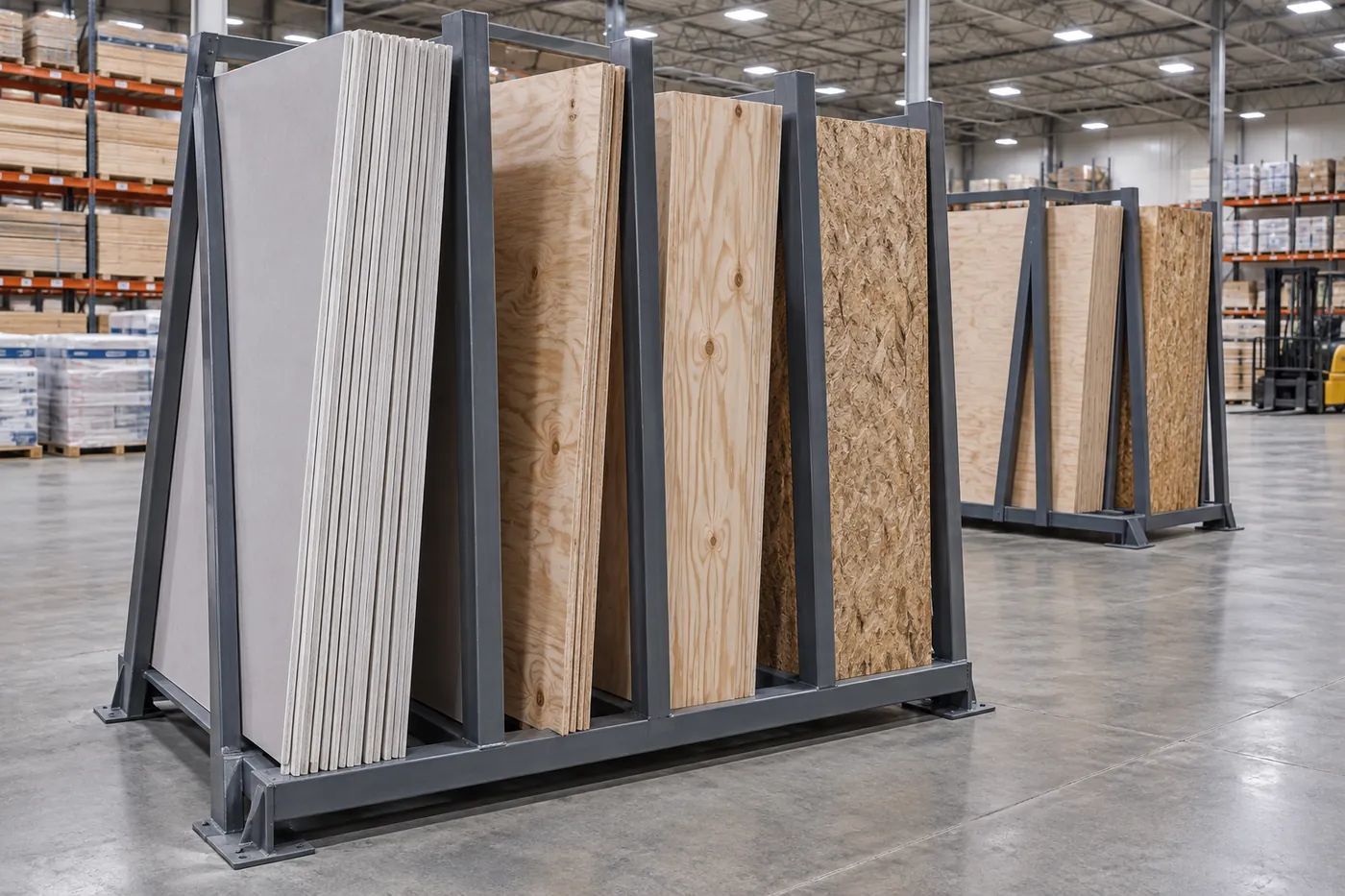
An A-frame rack leans sheets slightly on edge against a center spine, with dividers on both faces. It gives you many SKUs in a small footprint and lets staff slide out a single sheet without lifting a whole unit.
It suits drywall, cement board, plywood and OSB that sells by the sheet. Keep A-frames near the pick path and away from forklift traffic, and size the base and dividers for the weight of full stacks, which add up fast.

Vertical sheet racks and flat storage
Vertical slot racks hold panels upright in divided bays along a wall, which works well for melamine, hardwood plywood and specialty panels that move a few sheets at a time. Full units that move by the bundle are better stored flat on decked cantilever levels or pallet rack, low in the rack so forks lift them without bending the bottom sheets.
For a deeper look at flat versus vertical panel storage, see the Premier Woodworking sheet goods project and our sheet goods and panel cantilever rack page.
Sheet storage rules of thumb
- Store full units flat and fully supported; never let a sheet stack bridge a gap between two arms with no decking.
- Keep sheets off bare concrete and away from overhead doors where winter air and meltwater come in.
- Put the heaviest sheet goods, like drywall and cement board, on the lowest level or in floor-level A-frames.
Door, Trim and Moulding Storage
Keep doors upright and trim fully supported
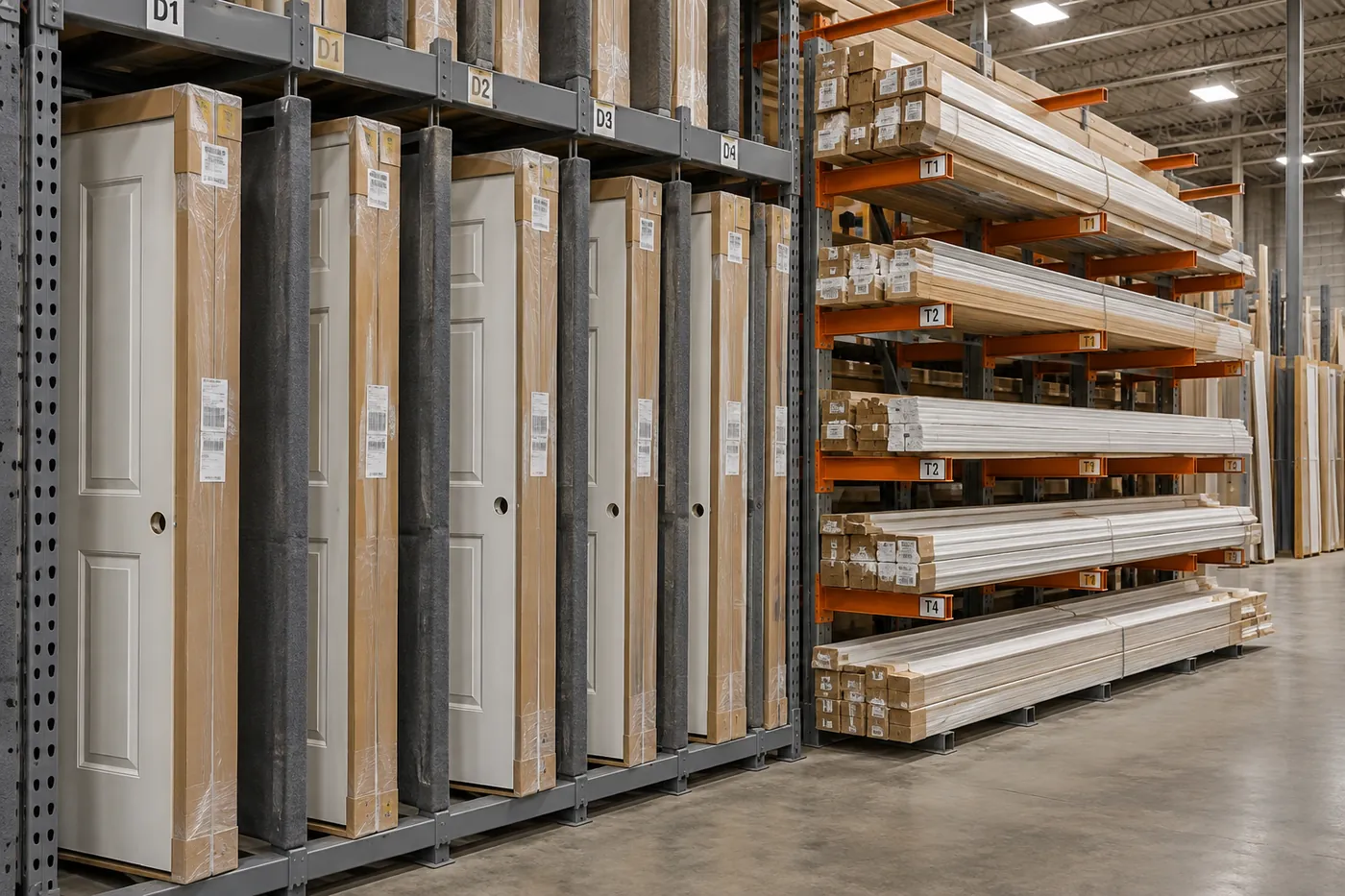
Pre-hung and slab doors are tall, heavy and finished, so they get damaged when they lean against each other or against bare steel. A vertical door rack with padded dividers holds each door, or a small stack, upright in its own slot. Store them in their packaging until they leave the building.
Trim and moulding are the opposite problem: long and light. Lengths that rest on too few points bow and twist. Light-duty cantilever arms at close spacing, or vertical bins for short lengths, keep profiles straight and visible.
- Group doors by size and swing so pickers do not unpack the wrong unit.
- Keep finished millwork away from dock doors, dust from saws and areas where forklifts turn.
Pallet Rack for Bagged and Boxed Goods
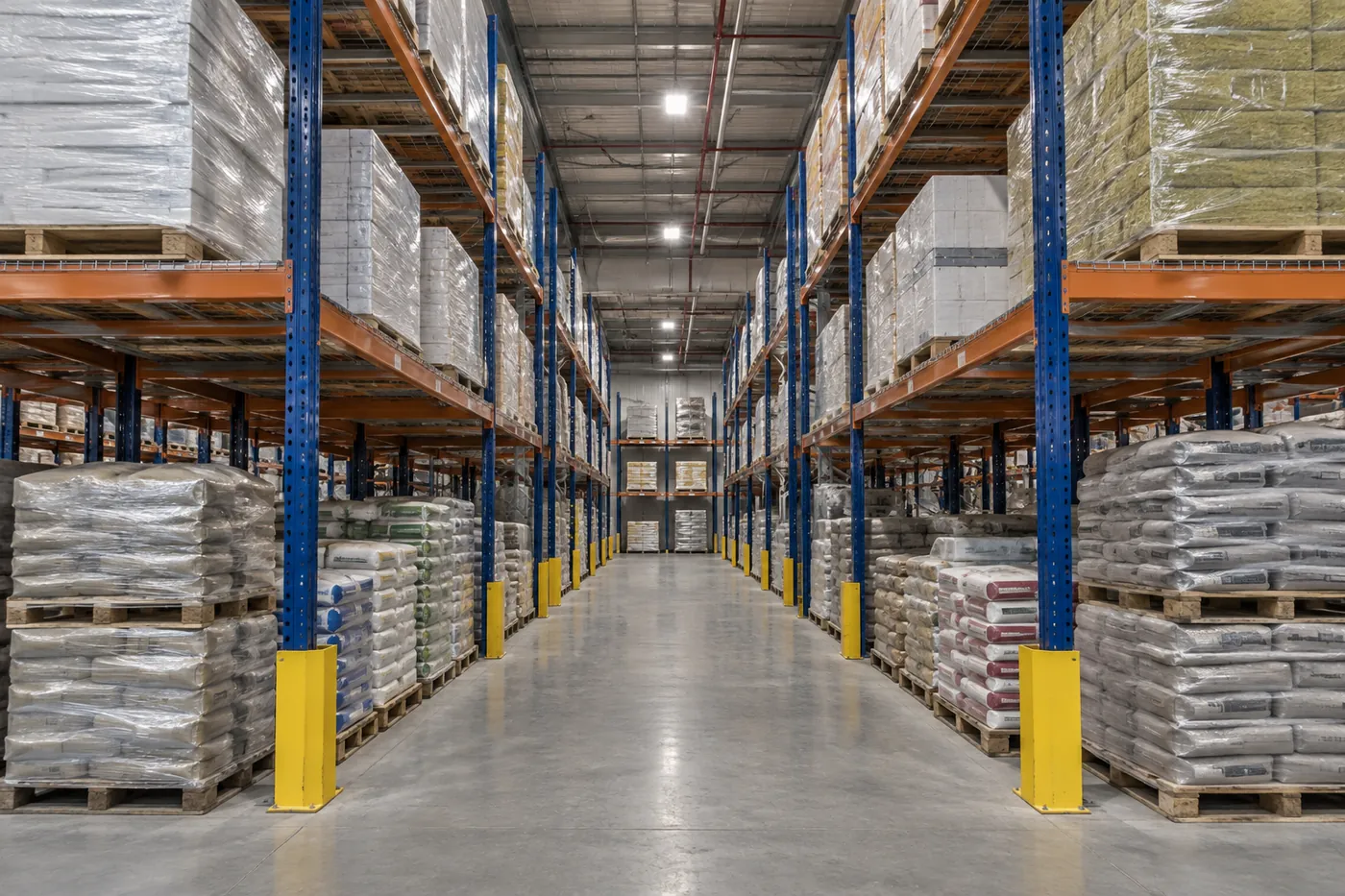
Selective rack for bags, boxes and fasteners
Bagged concrete mix, mortar, grout, stucco and insulation arrive on pallets and leave on pallets or by the bag. Selective pallet rack gives you a pallet position for every SKU with full access to each one, so you can rotate stock first in, first out and keep moisture-sensitive bags off the floor.
Use wire decking under bags so a broken pallet board does not drop product, and check beam capacity against your heaviest full pallet. Bagged goods are dense, so they usually belong on the lower levels.
Pallet rack is the wrong tool for long lengths: front columns block boards and long stock sags across beams. Our cantilever vs pallet rack comparison covers where each wins. See the bagged goods warehouse racking project and all styles on our pallet rack systems page.
Aisle Widths for Forklifts and Side Loaders
The truck sets the aisle
Aisle width drives how much rack fits in your building. A counterbalance forklift carries a long bundle crosswise, so the aisle must be wider than the load is long, plus turning room.
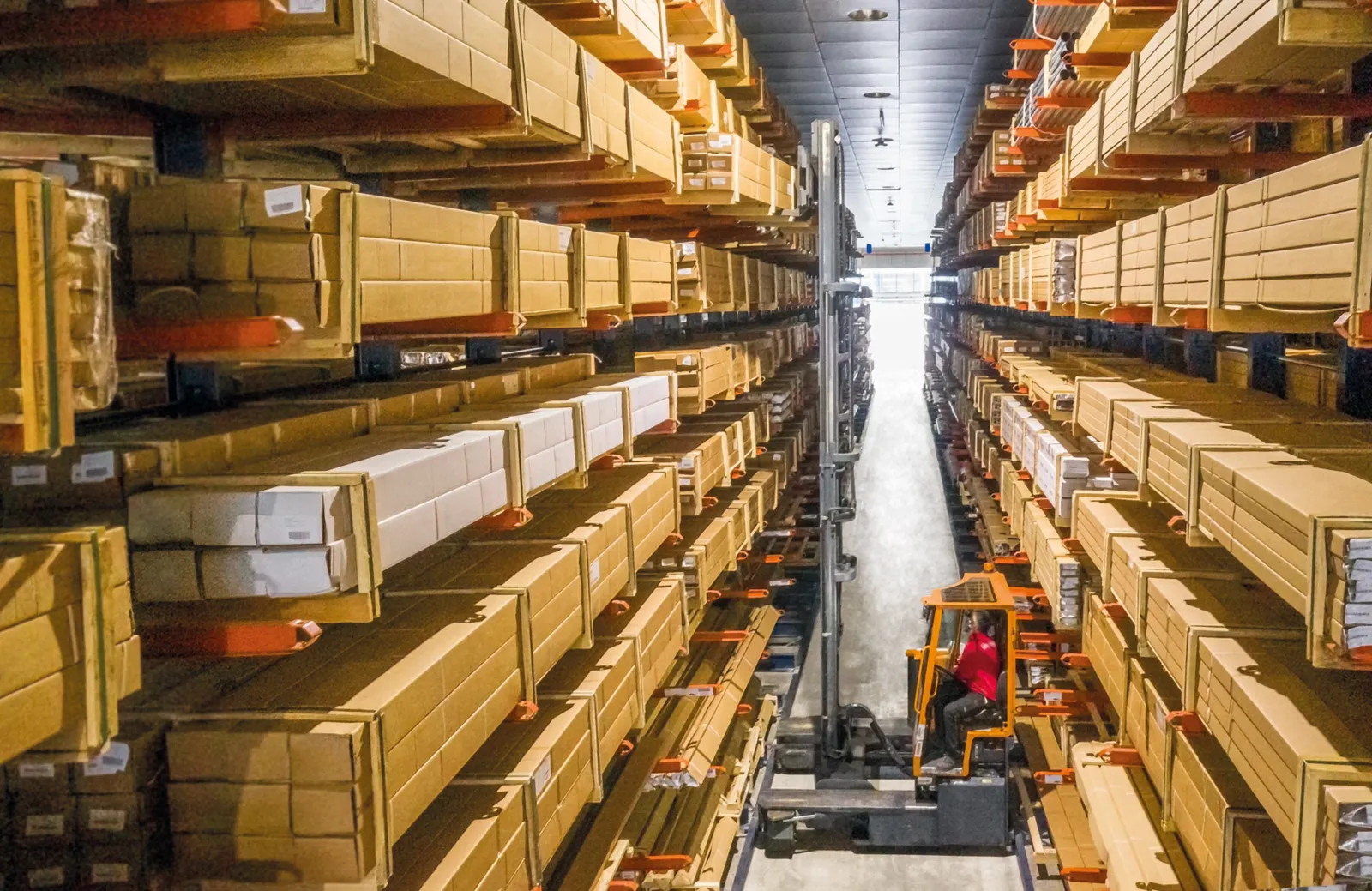
Side loaders and four-way reach trucks carry lumber lengthwise and set it on the arms from the side, so lumber distribution centers run cantilever rows with aisles not much wider than the truck and load. Check the truck spec sheet for your model.
Photo: Interlake Mecalux (authorized use).
| Truck type | How it carries long loads | Aisle impact |
|---|---|---|
| Counterbalance forklift | Crosswise, facing the rack | Widest aisles; aisle must exceed load length |
| Side loader | Lengthwise along the aisle | Narrow aisles; floor must be flat and clear |
| Four-way reach truck | Lengthwise or crosswise | Narrow aisles with flexibility for pallets too |
| Hand picking (store floor) | Single boards and sheets | Customer-safe aisles; keep heavy units low |
Leave turning room at row ends and never park pallets in a side-loader aisle. Our forklift aisle width guide walks through the measurements.
Fire Code and Flue Space Basics
Lumber, panels, doors and packaged insulation are all combustible, so an indoor lumber warehouse gets the fire marshal’s attention. Utah enforces the International Fire Code and International Building Code as adopted and amended by the state, and your local fire official has the final word. These are the points that most often change a rack plan:
Indoor fire-code checklist
- High-piled storage: combustible storage above 12 feet high (6 feet for high-hazard commodities) usually falls under the fire code’s high-piled storage chapter, which can bring permits, sprinkler design review and plan submittals.
- Sprinkler clearance: keep the top of every load at least 18 inches below sprinkler deflectors, and confirm whether your system needs more.
- Flue spaces: in high-piled pallet rack, the code generally calls for open transverse and longitudinal flue spaces so heat and water can travel up and down through the rack. Do not let back-to-back pallets or overhanging bundles close them.
- Change of use: turning a showroom or light-storage building into tall lumber storage can change sprinkler requirements. Ask before you buy rack.
Bring rack drawings and a commodity list to the fire marshal early, and see our warehouse fire safety guide.
Seismic Design and Permits in Utah
Plan for earthquakes from day one
The Wasatch Front sits on an active fault system, and many sites from Ogden to Provo land in higher seismic design categories. Rack there needs engineered base plates, anchors sized for the slab, and loads that match the design.
Many Utah cities ask for a permit and stamped seismic calculations for taller rack. Pallet rack is designed to RMI/ANSI MH16.1 and cantilever to ANSI MH16.3; ask for calculations that cite the right one.

Read more in our pallet rack seismic compliance guide, see what the city may ask for on our rack permits and engineering page, and review cantilever rack installation, permits and anchoring in Utah.
How to Plan an Indoor Lumber and Building Materials Layout
List your stock
Families, lengths, sheet sizes, unit weights, turns.
Measure the building
Clear height, sprinkler height, columns, doors, slab.
Pick your trucks
Counterbalance, side loader or four-way sets the aisles.
Zone by product
Long stock, sheets, doors, bags; fast movers nearest the counter.
Check code early
Fire marshal and building department, before ordering.
Get a layout and quote
We return a drawing, bill of materials and install plan.
Projects to compare
- Lumber yard racking systems at Wheelwright Lumber: how we plan racking for a Utah lumber and building materials supplier.
- Building products distribution racking at L&W Supply: cantilever and pallet rack for an interior building products distributor, where drywall drives the plan.
- Sheet goods and plywood storage racking at Premier Woodworking: pallet rack for a woodworking and millwork manufacturer’s sheet goods.
- Building materials yard cantilever rack at OrePac: cantilever for doors, mouldings and long bundles at a Boise building products distributor.
Indoor Lumber and Building Materials Storage FAQs
What is the best rack for storing lumber indoors?
Cantilever rack, because it has no front columns and any length loads from the side. Size the arm to your deepest bundle. Our cantilever lumber rack guide has the sizing details.
How should plywood and drywall be stored in a warehouse?
Store full units flat and fully supported on low, decked levels. Store mixed grades and single-sheet picks on edge in A-frame or vertical sheet racks, and keep heavy drywall and cement board low.
Can I use pallet rack for lumber?
Pallet rack works for palletized sheet goods, bagged mix and boxed hardware, but not for long boards: the front columns block the load and boards sag across the beams. Use cantilever for long lengths.
How wide should aisles be in a lumber warehouse?
It depends on the truck. Counterbalance forklifts carry long bundles crosswise, so the aisle must exceed the load length; side loaders and four-way trucks carry loads lengthwise in much narrower aisles. Use the truck spec sheet.
Do indoor lumber racks need flue spaces?
When combustible storage goes above about 12 feet, the fire code’s high-piled storage rules usually apply, and those can require open flue spaces in pallet rack plus at least 18 inches of clearance below sprinkler deflectors. Your local fire official decides what applies to your building.
Do I need a permit for warehouse racking in Utah?
Often, yes, for taller rack. Many Utah cities ask for a building permit and stamped seismic calculations, especially along the Wasatch Front. Ask the building department early and plan anchored, engineered rack.
What information do you need to quote an indoor lumber rack?
Your product list with lengths, sheet sizes and unit weights, the clear and sprinkler heights, column grid, forklift type and a rough floor plan. Photos help too.
Plan Your Indoor Lumber and Building Materials Storage
Send us your stock list and building dimensions. We will lay out cantilever, sheet, door and pallet rack zones and quote the whole system.