Choosing between cantilever rack and pallet rack is one of the most important storage decisions a warehouse manager or facility planner will make. Both systems are proven, reliable, and widely used across industries — but they solve fundamentally different storage problems. Selecting the wrong one wastes floor space, slows operations, and costs more than it should.
This guide breaks down the key differences between cantilever rack and pallet rack systems, covering load capacity, best applications, cost factors, and practical decision criteria. Whether you are storing palletized goods, long lumber, steel pipe, or oversized materials, this comparison will help you make the right call.
Shop Cantilever Rack by Category
Decided cantilever fits your long loads? Each card opens a shop category with current prices. Prices are current online prices; freight is quoted by destination and some common sizes in stock at select manufacturers, subject to confirmation. For a full layout, request a free quote or use the Cantilever Rack Configurator.
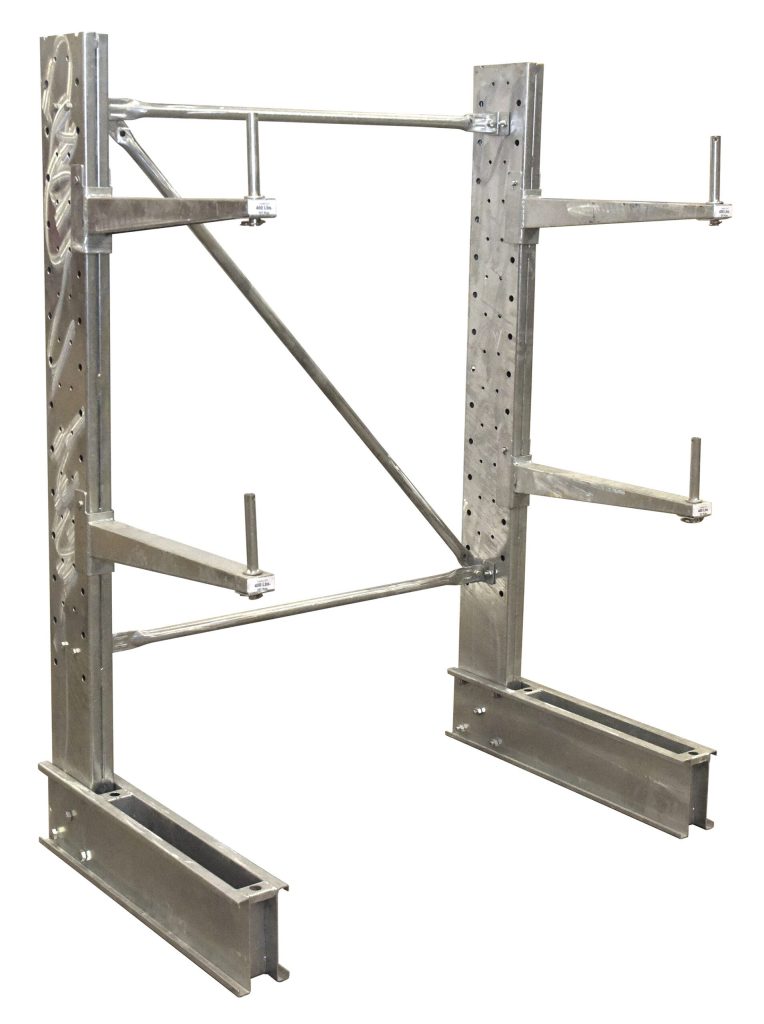
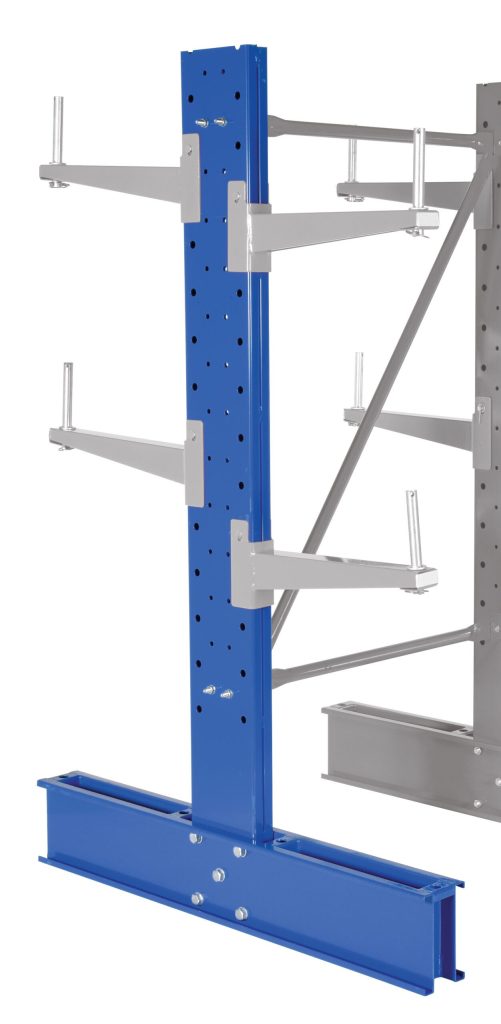
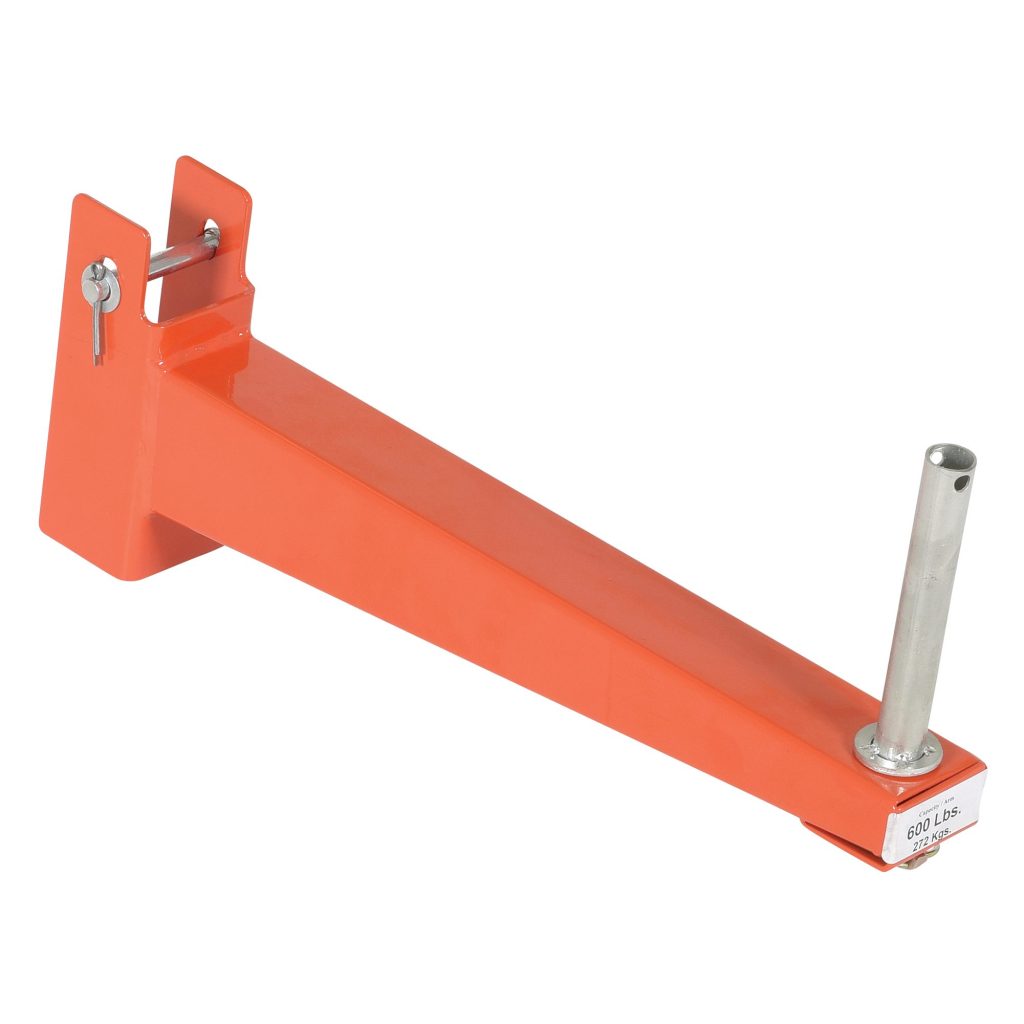
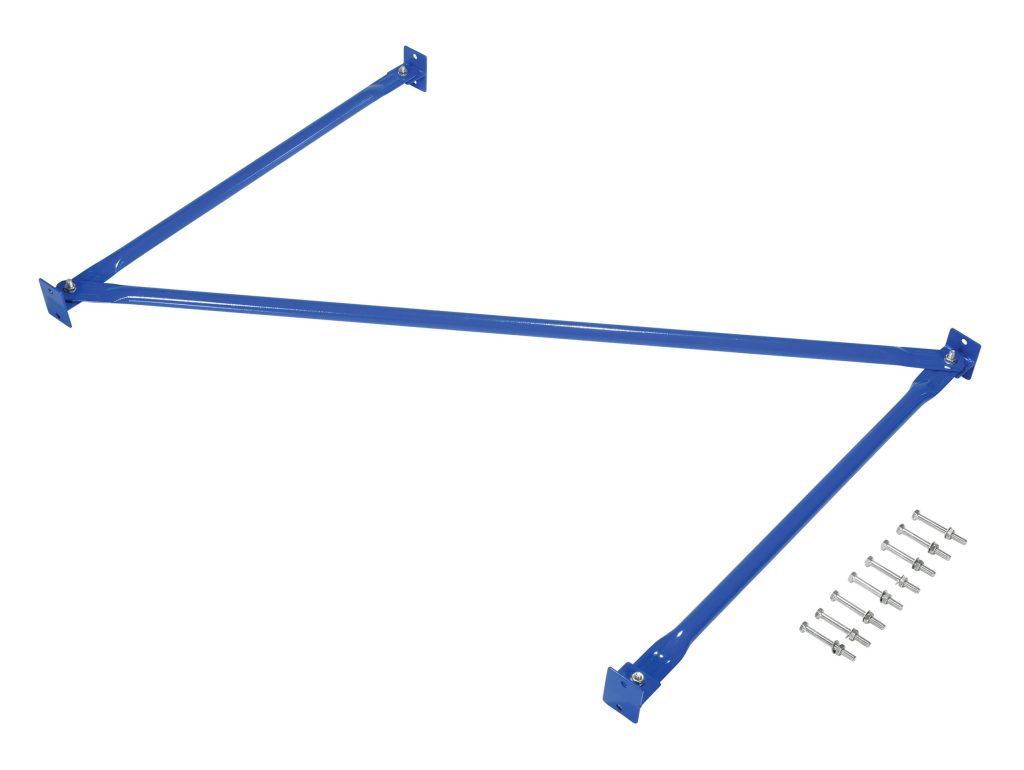
Understanding the Two Systems
What Is Pallet Rack?
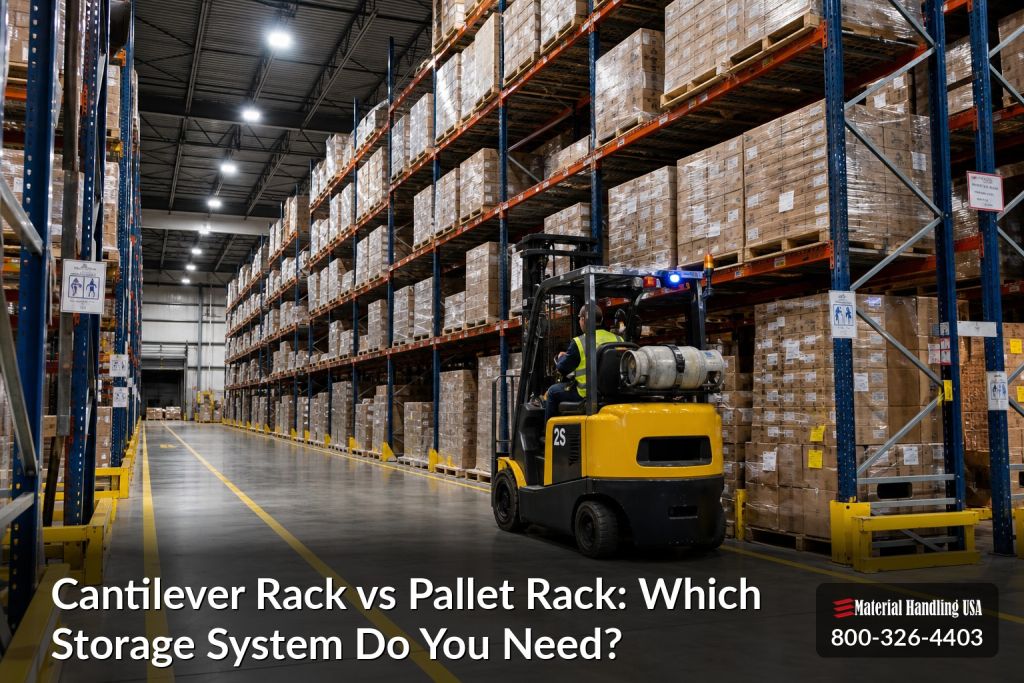
Pallet rack is the most common warehouse storage system in North America. It uses vertical uprights connected by horizontal beams to create shelf levels that hold palletized loads. Standard selective pallet rack allows forklift access to every pallet position, making it the go-to solution for warehouses that handle a wide variety of SKUs with frequent turnover.
Pallet rack comes in several configurations including selective, drive-in, push-back, pallet flow, and narrow aisle. Each variation balances storage density against accessibility. The system excels at organizing uniform, palletized loads in a structured grid pattern. Learn more about pallet rack systems.

What Is Cantilever Rack?
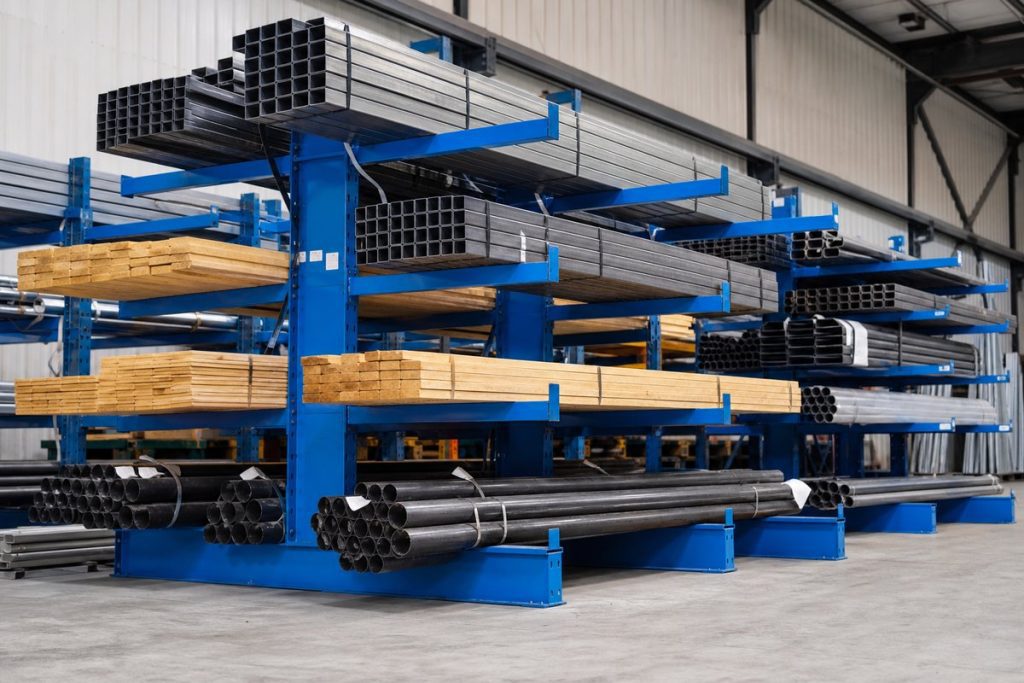
Cantilever rack uses a completely different structural approach. Instead of horizontal beams between uprights, cantilever systems feature arms that extend outward from a single vertical column. This open-face design eliminates front uprights and cross-bracing, creating unobstructed storage bays that can hold long, bulky, or irregularly shaped items.
Cantilever rack is the standard solution for lumber yards, steel service centers, pipe distributors, furniture warehouses, and any operation that stores items too long or oddly shaped for standard pallet rack bays. Explore cantilever rack options. You can also shop cantilever rack parts and kits online.
Key Differences: Cantilever Rack vs Pallet Rack
Structural Design
The fundamental difference is how loads are supported. Pallet rack creates enclosed bays with beams running between two uprights. Cantilever rack uses cantilevered arms projecting from a single column, leaving the front completely open. This structural difference determines everything else — what you can store, how you access it, and how the system performs.
| Feature | Pallet Rack | Cantilever Rack |
|---|---|---|
| Support structure | Two uprights with horizontal beams | Single column with cantilevered arms |
| Front clearance | Restricted by uprights every 8–12 ft | Fully open — no front obstructions |
| Load type | Palletized, boxed, uniform loads | Long, bulky, irregularly shaped items |
| Typical bay width | 8 ft, 9 ft, or 12 ft standard | 4 ft to 8 ft arm lengths, unlimited run |
| Height range | 8 ft to 40+ ft | 8 ft to 25+ ft |
| Weight capacity per level | 2,000 – 12,000+ lbs per beam pair | 500 – 5,000+ lbs per arm |
| Load/unload method | Forklift places pallets on beams | Forklift, crane, or manual placement on arms |
Best Applications for Each System
Pallet rack works best for:
- Palletized inventory (boxes, cartons, shrink-wrapped loads)
- Distribution centers and fulfillment warehouses
- Food and beverage storage
- Retail backstock and seasonal inventory
- Cold storage and freezer warehouses
- Any operation where loads fit standard 48×40 pallet dimensions
Cantilever rack works best for:
- Lumber, plywood, and building materials
- Steel pipe, tubing, and bar stock
- Carpet rolls and fabric bolts (carpet roll storage solutions)
- Furniture, doors, windows, and cabinetry
- PVC pipe, conduit, and electrical materials
- Sheet goods (drywall, sheet metal, plexiglass)
- Boats, kayaks, and recreational equipment
Cost Comparison
Cost is often the deciding factor, and both systems have different pricing drivers.
Pallet Rack Pricing
Standard selective pallet rack is one of the most cost-effective storage solutions available. A typical 42″ deep × 96″ wide × 120″ tall starter section with three beam levels runs between $250 and $500 depending on capacity and finish. Used pallet rack is widely available, but its lower price is usually used up at installation: parts rarely fit back together well after disassembly, and the installer time to straighten and fit them often costs more than new rack would have. A quick call to our sales team with a few pictures can help you decide. The system’s popularity means competitive pricing, fast lead times, and easy sourcing of replacement parts.
Cantilever Rack Pricing
Cantilever rack typically costs more per linear foot than pallet rack because of its structural engineering requirements. A basic single-sided cantilever section with 48″ arms runs $400–$800 or more depending on capacity. Heavy-duty structural cantilever for steel service centers or lumber yards can exceed $1,500 per section. However, for the materials it stores, there is often no practical pallet rack alternative — so the comparison becomes cantilever rack vs. floor stacking or outdoor storage, where cantilever wins on space utilization, material protection, and labor efficiency.
Total Cost of Ownership
The purchase price is only part of the equation. Consider these total cost factors:
- Labor efficiency: The right system reduces pick and put-away time significantly
- Product damage: Storing long materials in pallet rack bays causes scratches, bends, and waste
- Space utilization: Cantilever rack eliminates wasted bay space for non-standard items
- Safety: Items stored properly in the right system reduce accident risk and liability
- Flexibility: Pallet rack beam levels adjust easily; cantilever arms can be repositioned as needs change
Load Capacity Deep Dive
Both systems are engineered for heavy loads, but their capacity ratings work differently.
Pallet Rack Capacity
Pallet rack capacity is defined by two components — upright frame capacity and beam pair capacity. A standard 42″ × 144″ upright frame might carry 19,000–24,000 lbs total. Individual beam pairs are rated by their uniformly distributed load (UDL), typically ranging from 2,500 lbs to 12,000+ lbs per pair depending on beam size and span. The system’s capacity is well documented and follows RMI (Rack Manufacturers Institute) standards.
Cantilever Rack Capacity
Cantilever capacity is rated per arm and per column. Light-duty arms might handle 500–1,500 lbs each, while heavy-duty structural arms can support 3,000–5,000+ lbs per arm. The total column capacity determines how many loaded arms a single upright can support. Because cantilever arms act as individual cantilevers (not supported at both ends like beams), the engineering is more demanding — which is why structural cantilever costs more than roll-formed options.
For load capacity broken down by exact arm length, see Cantilever Rack Load Capacity by Arm Length.
Installation and Configuration
Pallet Rack Installation
Pallet rack is relatively straightforward to install. Uprights bolt to the floor using anchor bolts, beams clip into the upright slots with safety pins, and the system is ready for use. Most warehouse teams can assemble pallet rack with minimal tools. Professional installation is recommended for systems over 20 feet tall or in seismic zones.
Cantilever Rack Installation
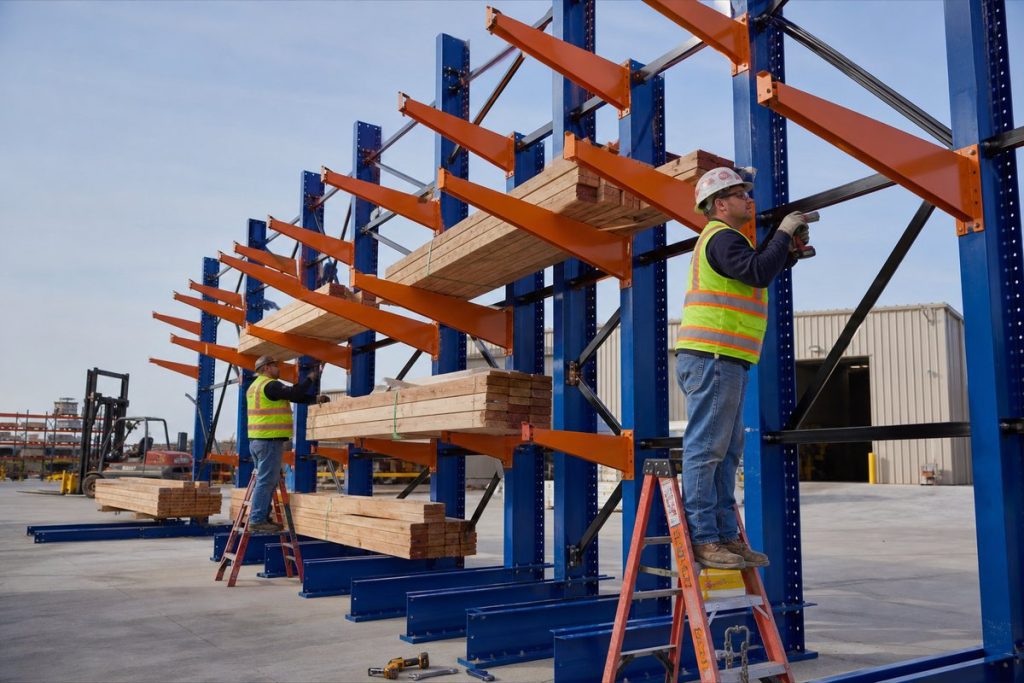
Cantilever installation requires more planning. Base plates must be leveled and anchored to the floor. Columns are bolted to bases, then braced together. Arms are pinned into column slots at the desired heights. The open-front design means cantilever racks must be properly braced and anchored — without the stabilizing effect of cross-beams, lateral forces need to be addressed through bracing and base design.
When to Use Both Systems Together
Many warehouses benefit from using both cantilever and pallet rack in the same facility. A building materials distributor, for example, might use cantilever rack for lumber, pipe, and sheet goods while running pallet rack for palletized fasteners, adhesives, and boxed inventory. A manufacturing plant might store raw steel on cantilever while keeping finished goods on pallet rack.
The key is matching each storage zone to the inventory it holds. Trying to force long materials into pallet rack bays wastes space and creates safety hazards. Trying to store individual pallets on cantilever arms is equally inefficient. MH-USA’s warehouse design services can help you plan a facility that uses both systems effectively.
Common Mistakes to Avoid
- Using pallet rack for long materials: Lumber, pipe, and bar stock do not fit safely in standard bays. Overhanging materials create aisle hazards and product damage.
- Oversizing cantilever for small loads: If your longest items are under 4 feet and palletized, pallet rack is almost always the better choice.
- Ignoring floor conditions: Both systems require level, rated concrete floors. Cantilever is especially sensitive to uneven floors because of its single-column design.
- Forgetting aisle width: Cantilever aisles need to accommodate forklift turning radius plus the length of the longest stored item. This often requires wider aisles than pallet rack.
- Not planning for growth: Both systems are modular and expandable. Buy starter and add-on sections that allow you to grow without reconfiguring the entire layout.
Making the Decision: A Simple Framework
Ask these five questions to determine which system you need:
- Are your items palletized and under 8 feet long? → Pallet rack
- Are your items longer than 8 feet or irregularly shaped? → Cantilever rack
- Do you need to access every item individually? → Selective pallet rack or cantilever
- Is storage density more important than accessibility? → Drive-in pallet rack or double-deep cantilever
- Do you store a mix of long materials and palletized goods? → Both systems in dedicated zones
For most warehouse operations, the answer becomes clear once you define your inventory profile. The biggest mistake is not choosing the wrong system — it is trying to make one system do everything.
Frequently Asked Questions
Can cantilever rack hold pallets?
Yes, cantilever rack can hold pallets by placing them across two or more arms. However, this is generally less efficient than using pallet rack because cantilever arms are wider than necessary for standard pallets, and you lose the beam-level adjustment precision that pallet rack provides. Use cantilever for pallets only when those same racks also need to store long or oversized items.
Is cantilever rack more expensive than pallet rack?
Generally yes. Cantilever rack costs 30–60% more per storage position than selective pallet rack due to heavier steel and more complex engineering. However, for long materials, cantilever is far more cost-effective than the alternatives (floor stacking, A-frame racks, or custom fixtures). The right comparison is cantilever rack vs. not having proper storage at all.
What is the maximum height for cantilever rack?
Standard cantilever rack systems reach 20–25 feet. Custom heavy-duty systems can go higher, but most applications stay under 20 feet due to forklift reach limitations and building clear heights. Pallet rack systems commonly reach 30–40+ feet in high-bay warehouses with specialized forklifts.
Can I convert pallet rack to cantilever rack?
No. The two systems use completely different structural components. Pallet rack uprights, beams, and hardware are not compatible with cantilever columns and arms. If your storage needs change, you would need to purchase new cantilever sections. Both systems hold resale value, so selling surplus pallet rack to fund cantilever is a viable strategy.
Which system is safer for warehouse operations?
Both systems are safe when properly installed, loaded within capacity, and inspected regularly. Pallet rack benefits from decades of RMI standards and widespread best practices. Cantilever rack requires more attention to arm pin security, column bracing, and load distribution. The most dangerous scenario with either system is overloading or failing to anchor the rack to the floor.
How long does installation take for each system?
A professional crew can typically install 100–150 pallet rack bays per day. Cantilever rack installation is slower, averaging 30–50 sections per day due to the more complex assembly process. Both timelines assume the floor is ready and materials are staged on-site.
Get Expert Help Choosing the Right System
Material Handling USA designs and installs both cantilever rack and pallet rack systems for warehouses, distribution centers, and industrial facilities nationwide. Our team will evaluate your inventory, measure your space, and recommend the most efficient storage layout for your operation.
Call (800) 326-4403 or request a free quote to get started.
Ready to configure your pallet rack system?
Use our guided configurator to choose the right configuration, review your parts and submit it for checkout or a formal quote.