
Warehouse Fire Safety: Flue Space, Sprinklers and Flue Guard™/Flue Keeper™
Flue space is the open channel built into every pallet rack layout so heat can rise and sprinkler water can reach a fire. Here is what it is, why blocked flue space is a real fire-code problem, and how Flue Guard™ and Flue Keeper™ keep it open without slowing down day-to-day operations.

Longitudinal & transverse
The two kinds of flue space
NFPA 13
The sprinkler code that drives flue space rules
One-person install
Flue Guard™ installation
US Patent #7,857,152
Flue Keeper™ (Original)
Plan your layout before you buy
Configure upright height, beam width, bay count, and load levels in our free 3D Pallet Rack Configurator, then get an instant bill of materials and request a quote.
What flue space is
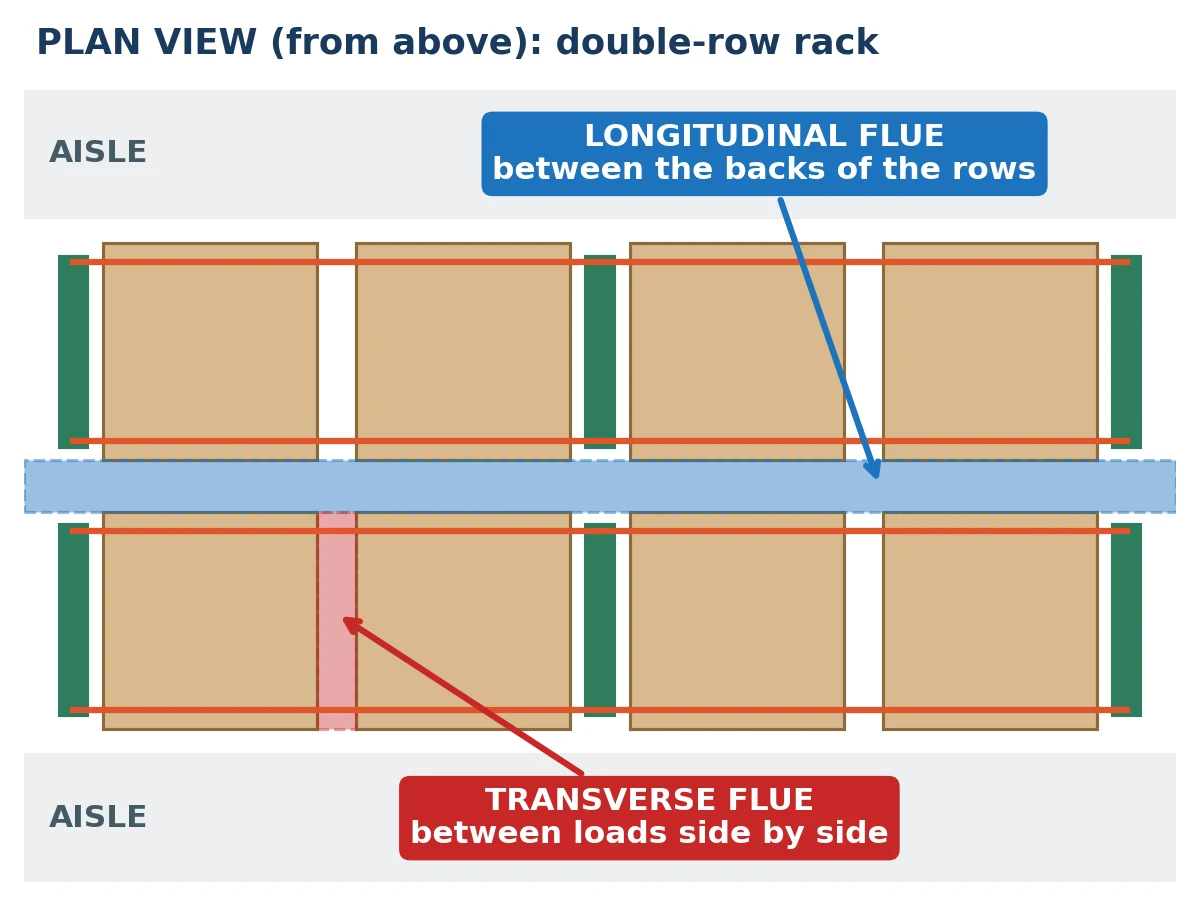
Flue space is not wasted space in a warehouse layout — it is a designed-in gap that lets heat and water move through a rack the way a fire sprinkler system expects them to. There are two kinds, and both show up on nearly every pallet rack systems layout:
| Flue space | Where it runs | What creates it |
|---|---|---|
| Longitudinal | The aisle-like gap running the length of the racking, typically between the backs of two back-to-back rows | Row spacing between back-to-back frames |
| Transverse | The gap between adjacent pallets sitting side by side on the same beam level | Loading pattern — how far apart pallets are placed on the beam |
Picture a warehouse aisle from above: pallet rack row, aisle, pallet rack row, then another gap, then the next pair of rows. That gap between back-to-back rows is longitudinal flue space. Now look at a single beam level from the front: two or three pallets sit side by side with a small gap between them. That gap is transverse flue space. Both are supposed to stay open, top to bottom, through every level of the rack.
Why flue space matters for sprinklers
Fire sprinkler design for palletized storage — the design approach behind NFPA 13, the widely adopted standard for sprinkler system installation — leans on open vertical and horizontal channels running through the rack. Two things happen in those channels during a fire:
- Heat rises through them fast enough to trigger sprinkler heads at or near the fire, instead of a head somewhere else in the building reacting late.
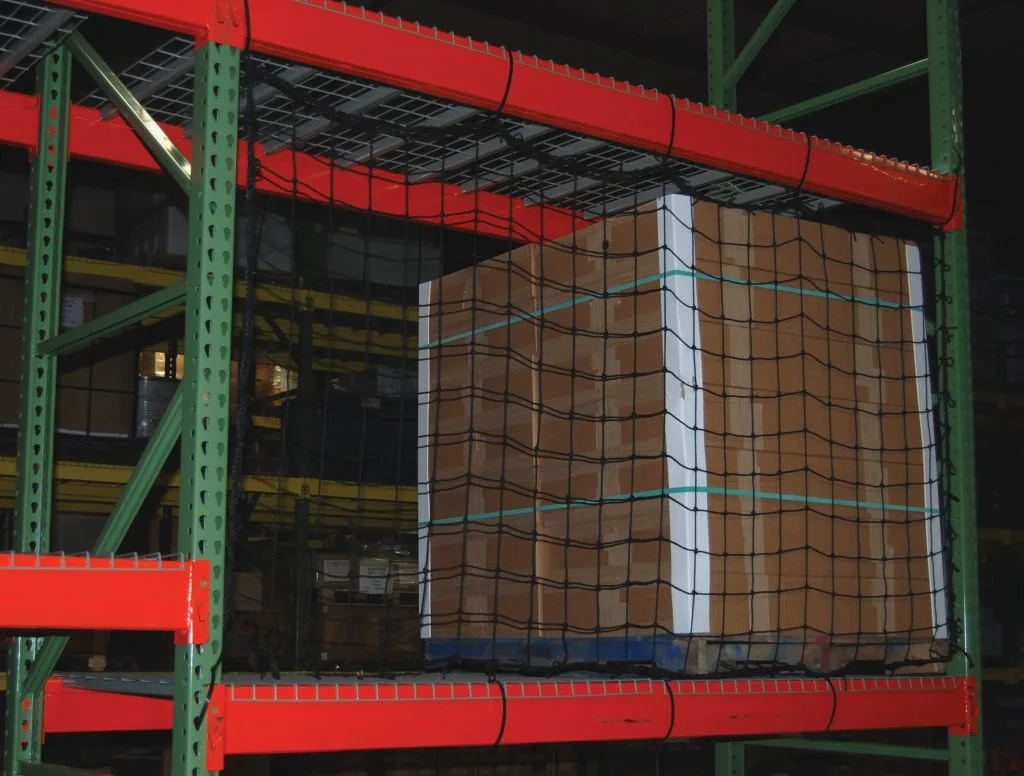
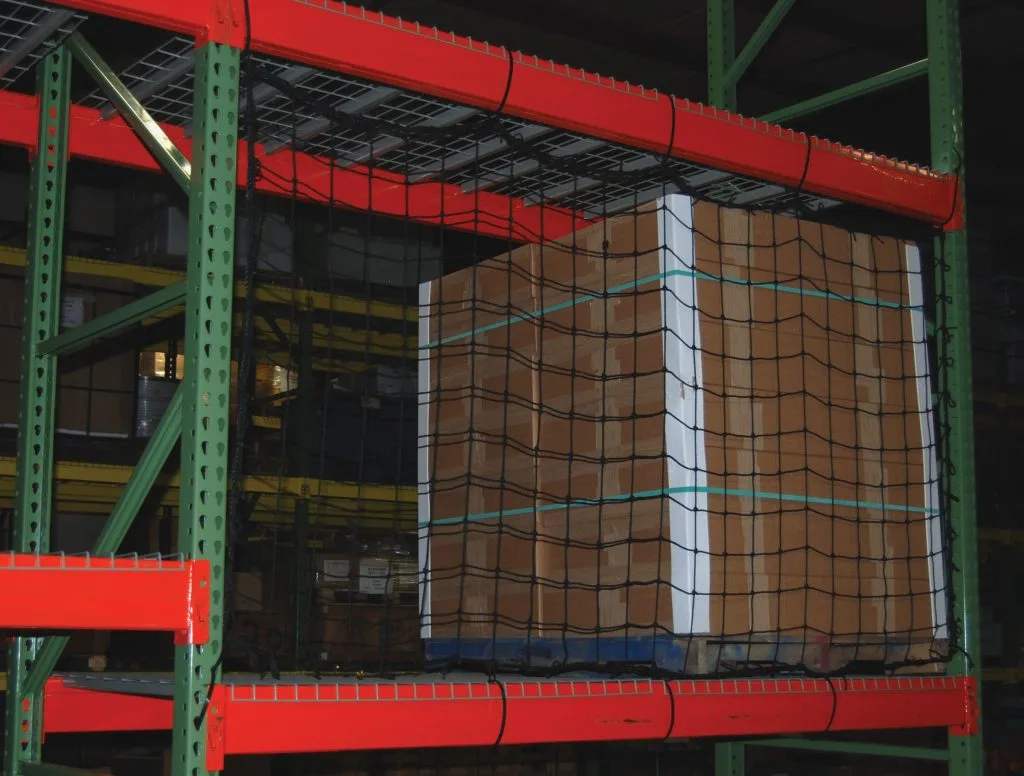
- Water comes down through them to reach the burning product directly, instead of being caught and shed by the tops of sealed cartons on the level above.
When flue spaces are blocked — by pallets pushed too far back, boxes hanging over an edge, or product stacked wider than the beam — both of those mechanisms are degraded. That is why flue space is treated as a life-safety and property-protection issue, not a housekeeping preference.

Our own warehouse storage compliance guide covers the broader NFPA storage-height, aisle and sprinkler-coordination picture; this page focuses specifically on the flue space inside the rack itself.
How flue space gets lost in day-to-day operations
Flue space is almost always correct on the day a rack is installed. It gets lost gradually, as normal warehouse activity pushes pallets around:
- Pallet push-through. A forklift driver seats a pallet a little too far, and it protrudes into the aisle behind the rack, closing the longitudinal gap.
- Oversized or overhanging loads. A pallet wider than the beam, or product that bulges past the pallet edge, narrows or closes the transverse gap to the next pallet.
- Tight, fast putaway. Under pressure to fill every slot, product gets set closer together than the layout intended.
- Mixed pallet sizes. A layout designed around one pallet footprint loses its flue space when a different-sized load is stored in the same bay.
- No physical stop. Without something in the rack that limits how far a pallet can go, there is nothing to correct human error consistently, shift after shift.
Who checks this
Local fire marshals have the authority to enforce flue-space and sprinkler-clearance requirements during inspections, and a warehouse found out of compliance can be ordered to correct its storage or racking before it can keep operating that way. Physical hardware that maintains the gap is more reliable over time than instructions alone.
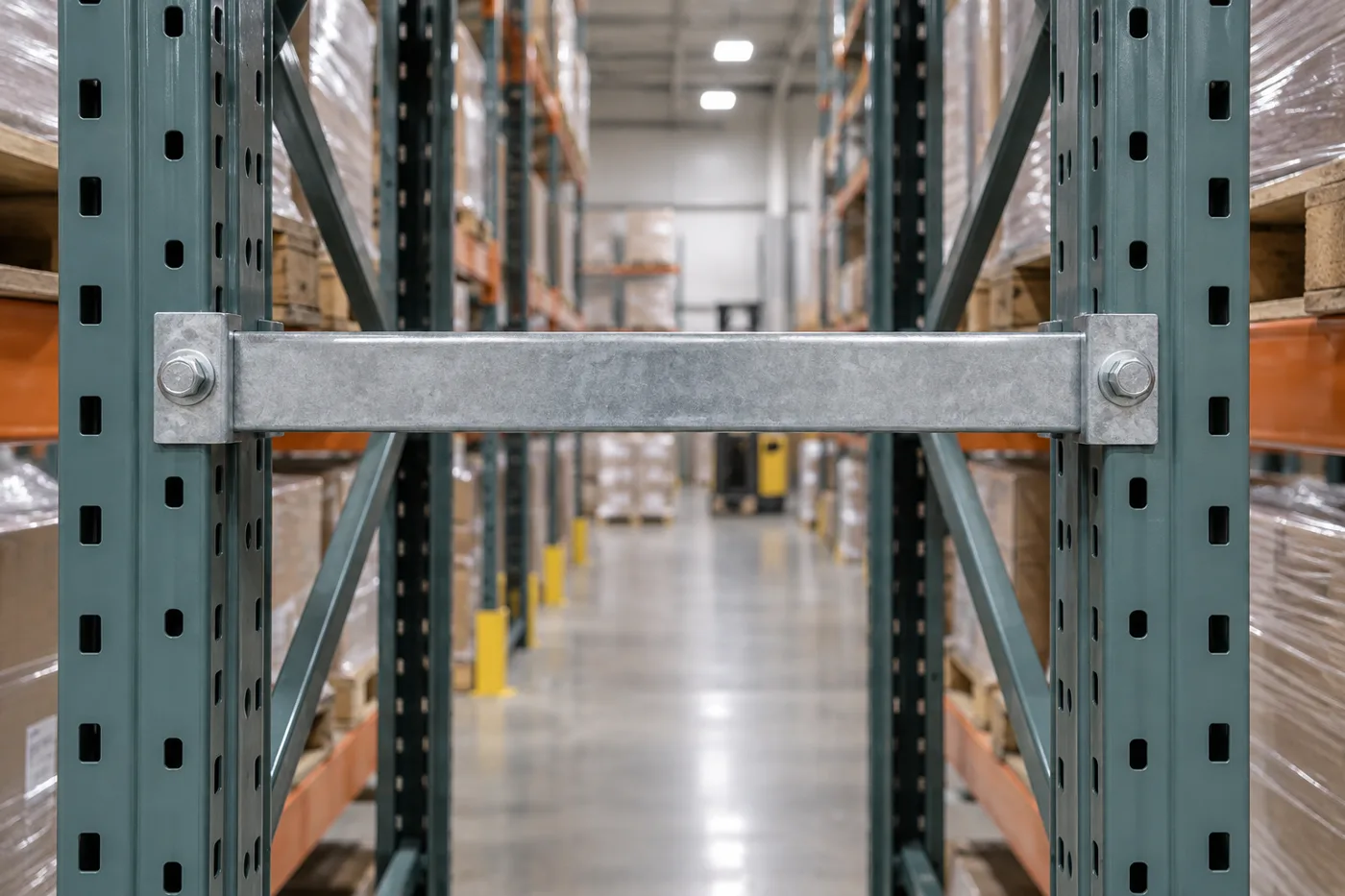
Flue Guard™: keeping longitudinal flue space open
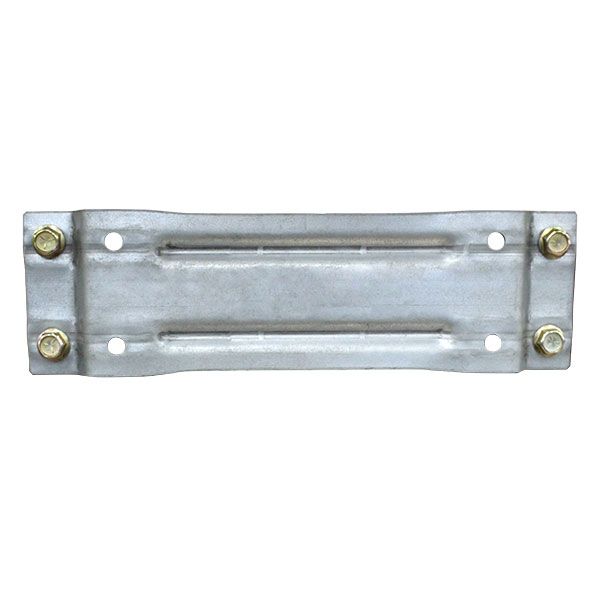
Flue Guard™ is a rack-mounted stop, a registered trademark of Rack Safety Products, LLC, built to keep the longitudinal flue space between back-to-back rows open on a permanent basis, without relying on operators to judge distance by eye every time they set a pallet.
Universal fit. It works with roll-formed or structural racking from any manufacturer, and fits beams of any length or depth — no custom-length beams and no swapping existing rack to add it.
One-person install. It attaches with high-strength tek screws, so it goes on new rack or gets retrofitted onto rack that is already loaded and in service, without a two-person crew or special tools.
A defined, repeatable gap. It is built to hold a consistent minimum flue space (6 inches on the version most commonly installed), so the same standard applies at every bay, on every shift, regardless of who is driving the forklift.
Flue Guard™ vs. a pallet rack backstop beam
The traditional alternative is a backstop beam or wire-mesh backstop spanning the back of the rack. Here is how the two approaches compare on the points that matter most in an operating warehouse:
| Flue Guard™ | Backstop beam | |
|---|---|---|
| Installation | One person, tek screws, fast | Two installers, longer install time |
| Compatibility | Universal — any brand, any beam length | Often needs a matched beam length or wire mesh sized to the bay, sometimes forcing wider row spacing |
| Cost & freight | Lower cost per unit and lighter to ship | Higher unit cost and freight due to weight and size |
| Effect on flue space | Maintains an exact, unobstructed minimum flue space | Can itself encroach on the flue space it is meant to protect, risking non-compliance |
Flue Keeper™: protecting transverse flue space
Where Flue Guard™ targets the longitudinal gap between back-to-back rows, the Original Flue Keeper™ (US Patent #7,857,152) targets the transverse gap between pallets sitting side by side on the same beam level. It is a physical stop that keeps boxes and product from encroaching sideways into that gap, which is exactly where in-rack and ceiling sprinklers rely on a clear path down through the storage.
- The standard Flue Keeper™ is 42 inches by 3 inches and installs on new or existing racking in either direction.
- It is designed to meet fire code expectations for transverse spacing across the US, but the exact clearance your building needs still depends on your sprinkler design, commodity class and local fire code — confirm specifics with your sprinkler contractor or fire marshal before finalizing a layout.
- Like Flue Guard™, it is a physical control: once installed, it keeps doing its job without depending on an operator judging the gap correctly every time.
Auditing your racking for flue space
A quick walk-through with these questions catches most flue-space problems before an inspector does:
- Stand at the end of a back-to-back row and sight down the longitudinal gap. Is it a straight, open channel end to end, or does it narrow or close anywhere?
- Check pallets on the same beam level for gaps between them. Are any touching, or overhanging their pallet onto the neighboring one?
- Look for oversized loads that were placed without adjusting for their width.
- Ask whether any bay has a mixed pallet footprint that the original layout was not designed around.
- If flue space keeps closing in the same bays, that is a sign the layout needs a physical stop — not a reminder to staff.
Our team can review a layout for flue-space, aisle and rack-spacing questions alongside a broader pallet rack design consultation, and our rack inspection and repair team can flag flue-space issues during a routine rack safety inspection. For long, exposed loads where a cantilever rack layout is in use, flue-space planning works a little differently — ask us about your specific layout.

Flue space requirements by rack type and storage height
Once you know why flue space matters, the next question in any layout review is how much is required. For sprinklered rack storage, the International Fire Code answers it in Section 3208.3: flue spaces must follow Table 3208.3, and required flue spaces must be maintained. The table sets transverse and longitudinal widths by rack configuration, storage height and sprinkler arrangement. NFPA 13, the standard the sprinkler system itself is designed to, has its own flue provisions, also split at 25 ft of storage height. The values below come from the 2021 IFC.
| Rack type | Flue | Ceiling sprinklers, storage up to 25 ft | Ceiling sprinklers, storage over 25 ft | In-rack sprinklers at every tier (any height) |
|---|---|---|---|---|
| Single-row | Transverse | 3 in | 3 in, vertically aligned | Not required |
| Single-row | Longitudinal | Not required | Not required | Not required |
| Double-row, Option 1 | Transverse | 6 in (note a) | 3 in, vertically aligned | Not required |
| Double-row, Option 1 | Longitudinal | Not required | 6 in | Not required |
| Double-row, Option 2 | Transverse | 3 in | 6 in, vertically aligned | Not required |
| Double-row, Option 2 | Longitudinal | 6 in | Not required | Not required |
| Multiple-row | Transverse | 6 in | 6 in, vertically aligned | Not required |
| Multiple-row | Longitudinal | Not required | Not required | Not required |
“Ceiling sprinklers” means sprinklers at the ceiling with or without minimum in-rack sprinklers. Note a: where ESFR sprinklers protect the storage, the table allows 3-in transverse flues instead, provided at least every 10 ft. Random variations in flue width and alignment are allowed as long as the arrangement does not block water penetration. Source: International Fire Code 2021, Section 3208.3 and Table 3208.3 (same values in the Utah and Colorado adoptions).

How to read the table
- Double-row racks get two options. Up to 25 ft, Option 1 uses 6-in transverse flues with no longitudinal flue, and Option 2 uses 3-in transverse flues plus a 6-in longitudinal flue. Over 25 ft the pairing flips: Option 1 is 3-in transverse plus 6-in longitudinal, and Option 2 is 6-in transverse with no longitudinal flue. The right choice depends on beam length, load width and row spacing, so settle it before frames and row spacers are ordered.
- Over 25 ft, transverse flues must line up. Every transverse flue in that column has to be vertically aligned from level to level.
- Single-row and multiple-row racks never need a longitudinal flue in this table; their protection rests on transverse flues.
- In-rack sprinklers at every tier remove the table requirement, but the sprinkler design may still assume open flues, so confirm with your sprinkler designer before closing gaps.
- Protection devices. Section 3208.3.1 lets the fire code official require approved devices that protect required flues above the first tier, and those devices may not be removed or modified. This is the job hardware such as Flue Guard™ and Flue Keeper™ does.
- Permit drawings. Section 3201.3 lists the dimension and location of transverse and longitudinal flue spaces among the items a high-piled storage permit submittal must show.
Measure the flue between loads, not between frames
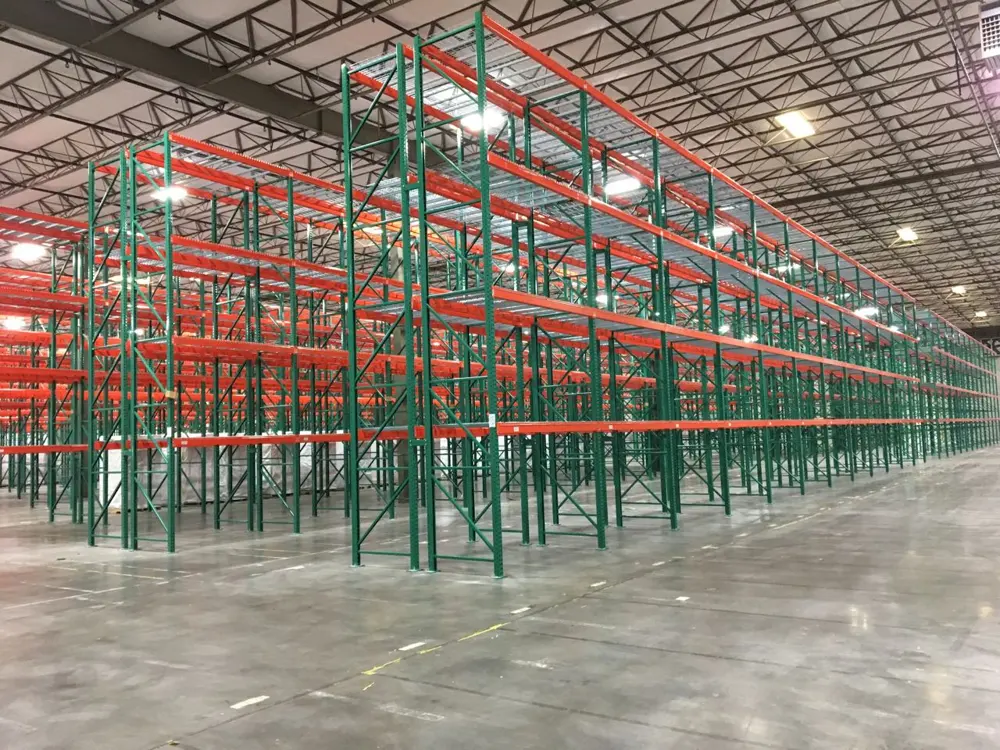
Code flue widths are clear openings between stored loads. Pallets usually overhang the rear beam, so the gap between back-to-back frames on an empty rack is not the flue. Worked example: with a 3-in rear overhang on each side, a 6-in clear longitudinal flue needs the frames set about 12 in apart (3 + 6 + 3). Deeper pallets, extra overhang or loads pushed back too far all shrink that number, which is why row-spacer length should come from real load depth.
BHD Storage gives the same field advice: measure frame to frame, subtract the actual overhang on both sides, and check several beam levels.
Photo: BHD Storage Solutions
Plan each bay so transverse flues survive putaway
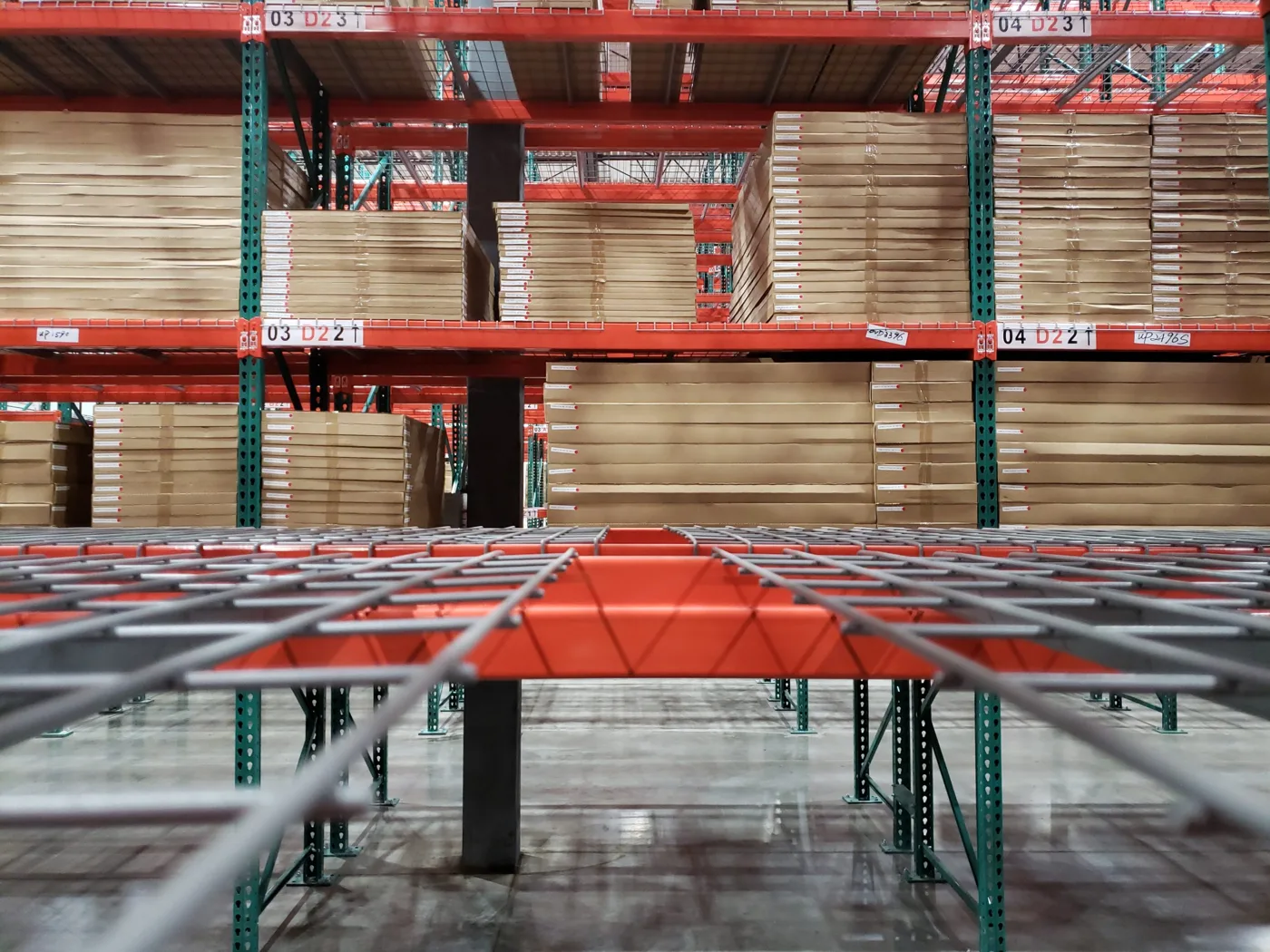
Transverse flues come from loading math. Two 40-in-wide loads in a bay with about 96 in between uprights leave 16 in to share: hold 6 in in the center and roughly 5 in remains at each upright. Wider loads or three-wide bays tighten that quickly, so run the numbers for your actual pallet faces before choosing beam lengths.
Open pallet rack wire decking lets water pass down through each level, but it does not replace a required flue. Racks with solid shelves larger than 20 sq ft are a separate case that IFC Section 3208.2.2 sends to NFPA 13 protection.
Photo: BHD Storage Solutions
Editions, amendments and insurers
These are model-code values from one edition. Your state or city may enforce an older or newer IFC edition or local amendments, NFPA 13 sets its own flue rules for the sprinkler design, and some insurers apply stricter criteria. Treat the table as a planning starting point and confirm the governing numbers with your fire code official and sprinkler designer before you finalize a layout.
Shop Flue-Space & Rack Safety Products Online
Buy select items directly from our online store, or request a quote for volume, custom sizes and freight-rated orders.
Frequently asked questions
What is the difference between longitudinal and transverse flue space?
Why does NFPA 13 care about flue space?
Can Flue Guard™ and Flue Keeper™ be installed on existing racking?
Will Flue Guard™ and Flue Keeper™ work with the racking brand I already have?
What should I do if a fire marshal flags flue space during an inspection?
Does keeping flue space open affect how much I can store?
Do you serve businesses outside Utah with these products?
How much flue space is required between back-to-back pallet racks?
Do I need flue spaces if my racks have in-rack sprinklers?
Ensure NFPA 13 flue-space compliance today
Don’t wait for a fire marshal inspection to find a blocked flue space. Talk with a specialist about Flue Guard™, Flue Keeper™ and your overall pallet rack layout. Free design consultation.