
Wire Decking for Pallet Rack
Wire mesh deck panels matched to your rack’s beam profile, load pattern and sprinkler layout.
Talk with a pallet rack specialist. Call (800) 326-4403 or email Sales@MH-USA.com
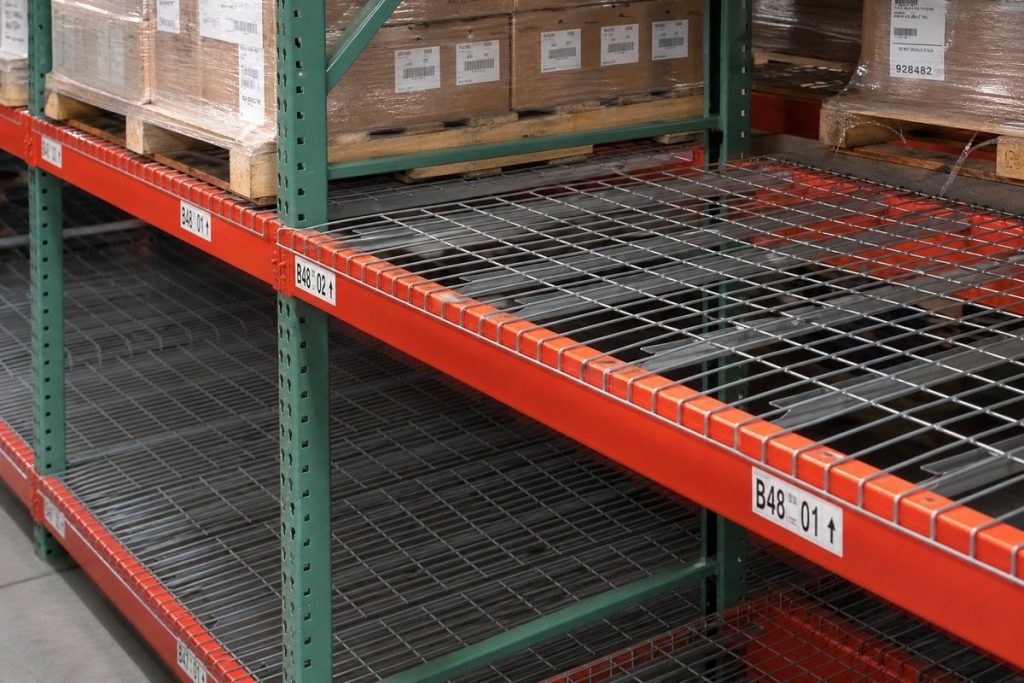
What Wire Decking Actually Does
Wire decking adds a mesh support surface between pallet rack beams. A properly selected panel can support the intended goods and reduce some fall-through risks, while its openings admit light and air. It is not a catch-all safety barrier: small items can pass through the mesh, and a damaged pallet does not become safe simply because decking is underneath it.
Select the rack, deck and load arrangement together. The beam profile, panel dimensions, support-channel engagement, mesh openings and actual load contact pattern all matter. A panel that appears to fit is not necessarily rated for the way you will use it.
The Rack Manufacturers Institute’s decking guidance explains why buyers should give the deck manufacturer the load geometry and confirm the rating for that application. This page helps you collect those details before requesting a quote.
Pallet rack beams alone leave open space between them. Per Tony Sineni, Director of Sales at Rack Builders Inc. (a Rack Manufacturers Institute member), “wire deck can prevent loose items, small products, cartons, or compromised pallets from falling between the beams.” RMI also publishes ANSI MH26.2, the industry standard governing rack decking design and testing.
Decking also changes how load reaches the beam: RMI’s guidance states decking “helps distribute the load evenly across the beam… that minimizes point loading and reduces beam deflection” at the beam level. That’s a documented beam-level benefit — it does not mean the deck panel itself is rated for any load pattern placed on it; the deck’s own capacity is a separate question, covered below.
The right deck for your rack depends on three things: your beam profile (step beam vs. box beam), the load pattern actually sitting or moving on the deck, and any fire-protection requirements that apply to your building. We review all three before recommending a deck.

Why Facilities Add Wire Decking
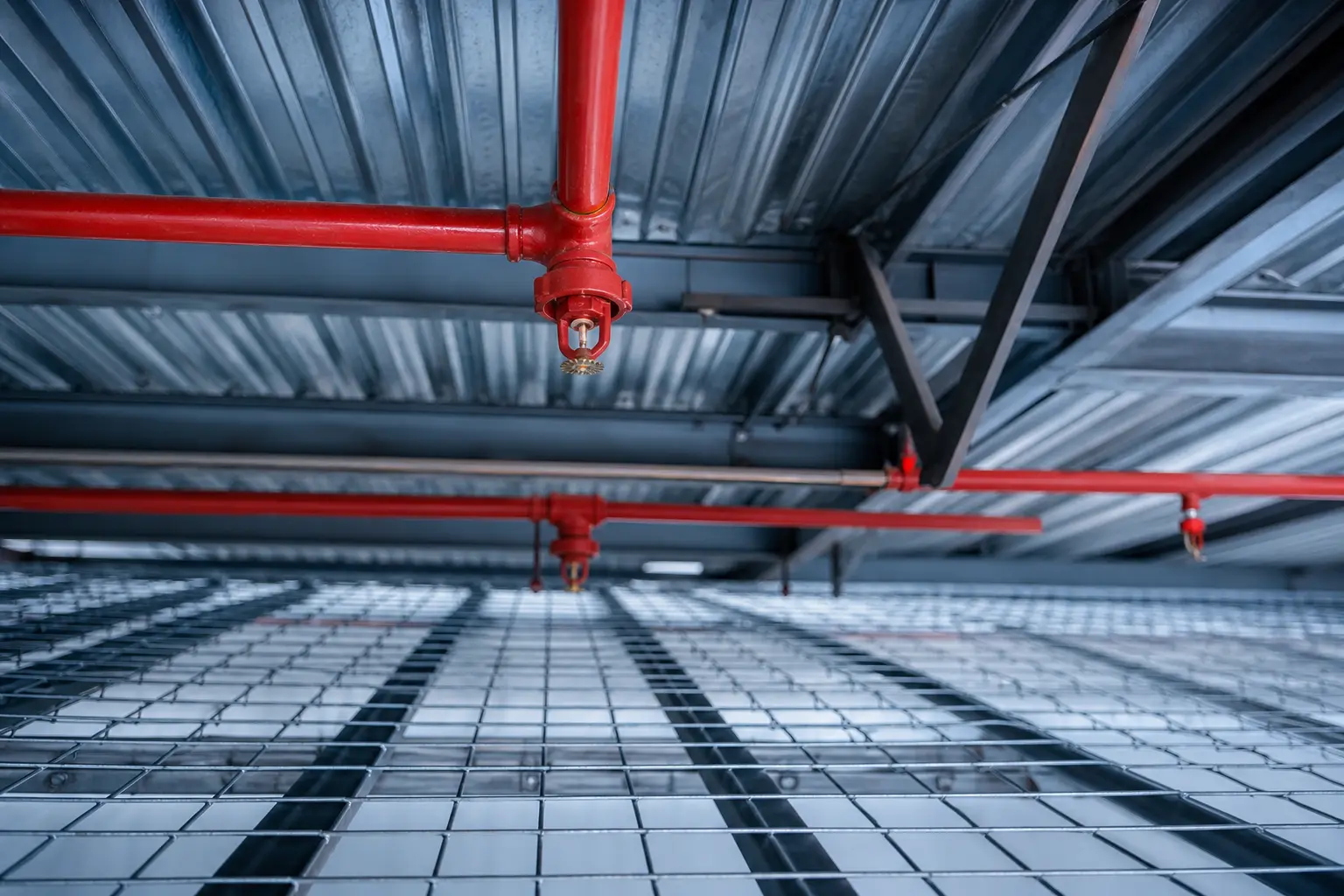 Open Area for Sprinkler DesignWire mesh has open area that lets sprinkler discharge pass through, which is why it’s a deck style commonly specified where in-rack storage falls under a sprinkler design. Whether wire decking satisfies your specific sprinkler design depends on your storage commodity, rack height and the applicable fire code — that’s a determination for your fire-protection engineer or local AHJ, not a blanket rule any deck vendor can promise.
 Light & Product VisibilityOpen mesh lets overhead lighting and airflow reach lower rack levels instead of the shadows a solid shelf creates — a byproduct of open area, not a substitute for proper aisle lighting or labeling.
 Larger, More Forgiving Placement SurfaceDecking gives operators a larger placement target than beams alone, per RMI’s guidance, which can help handling accuracy for cartons and irregular goods. It still has to be seated per that manufacturer’s placement instructions — a panel not fully seated on both beams doesn’t perform as rated.
Match the Deck to What Actually Sits — or Moves — on It
A uniformly distributed load, or UDL, spreads weight over the specified supporting area. A point or concentrated load places more weight on a smaller contact area. The same total weight can stress a deck differently depending on the pallet runners, feet or container base touching it.
Do not assume a familiar pallet size or evenly stacked cartons automatically create the rated loading condition on the mesh. Provide the pallet’s underside construction and actual contact points as well as its loaded weight. Confirm the load basis and test conditions for the exact panel.
- Palletized loads: Confirm loaded weight, pallet construction and contact pattern rather than treating every standard pallet as a UDL.
- Equipment feet, metal bins, drums or narrow pallet runners — concentrated point loads needing a deck rated for that footprint, not just a UDL number.
- Loose cartons or bins without a pallet — may need tighter mesh spacing so small items don’t fall through.
- Pallet jacks, carts or wheeled equipment rolling across the deck — a different loading condition than static UDL, needing its own review, not an assumption from the catalog number.
RMI describes uniform and concentrated loading as separate selection questions. A static rating is not permission to walk on decking or roll a pallet jack across it. If the intended application includes people, wheels, impact or moving loads, stop and have that use specifically reviewed before selecting the system.
Point Loads: What Wire Decking Can’t Safely Carry
A stock wire deck is rated for weight spread across the whole panel. BHD Storage Solutions, a rack and deck manufacturer, states that a deck rated about 3,500 lb under a uniform load may only hold roughly 2,000–2,500 lb when the weight bears on a few contact points. Treat that as a warning, not a rating.
Pallet orientation matters most. A pallet should bridge the front and rear beams so the beams, not the mesh, carry the load.
Photo: BHD Storage Solutions
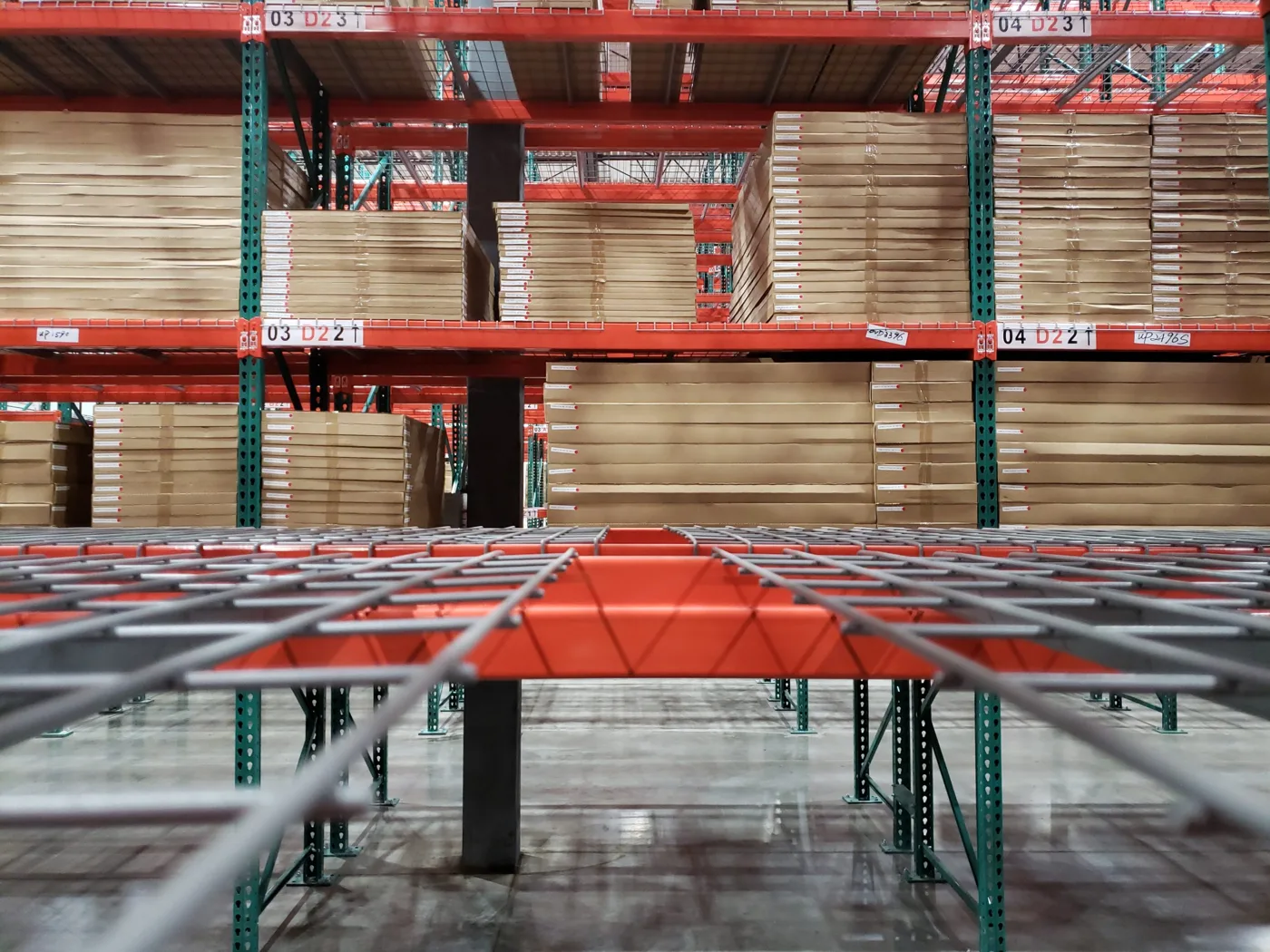
On a 42 in. deep frame that usually means a 48 × 40 in. pallet with its 48 in. side running front to back. A pallet too short to reach both beams, or one turned so its runners sit between the beams, puts its weight on the mesh as a line or point load.
Loads that turn into point loads
- Footed containers, drums and steel bins: each foot or rim presses on a few wires instead of the whole panel.
- Broken or missing pallet boards: weight shifts onto the boards that are left, often away from the support channels.
- Heavy items stacked on one corner of a pallet: the deck sees a concentrated load even when the pallet itself is the right size.
- Hand-stacked heavy parts set straight on the mesh: fine for light cartons, risky for dense items like castings or cases of liquid.
- Fork contact during put-away: tines that drag or drop onto the deck dent wires and create weak spots for the next load.
Fixes when your load isn’t a uniform load
- Change the pallet or its orientation so the runners span both beams. This is usually the cheapest fix.
- Add support: a deck with more or heavier support channels, or front-to-back pallet supports under the load, cuts the unsupported span.
- Ask for a deck rated for the actual load pattern. RMI notes that a deck manufacturer can design decking for hand stacking or point loading when told the load geometry.
- Use a different surface for drums, footed totes or very dense parts if no rated deck fits, then confirm the sprinkler impact before going solid.
When you compare catalog decks, such as the Jaken 42 × 46 in. wire mesh deck or the Interlake wire deck for pallet rack in our shop, read the capacity as a uniform-load number unless the manufacturer states otherwise. Send us the pallet type, the loaded weight and a photo of the pallet underside and we’ll check the deck against how the load really sits.
Wire Decking Selection Categories
Decking is generally described by two independent things: the support-channel style that engages the beam, and the mesh panel’s edge treatment. We confirm your beam profile before recommending either — a channel built for one manufacturer’s step beam does not automatically seat correctly on another, and there is no single “universal” deck that fits every rack.
| Category | How It Generally Seats | What to Check |
|---|---|---|
| Step-beam support channel | A channel section built to seat on the stepped ledge of a step-beam profile. | Specific to step-beam rack — confirm your beam’s exact step dimension with the manufacturer before ordering. |
| Flared or universal support channel | A wider flared channel typically designed to sit across box-beam or mixed-profile applications. | “Universal” describes the channel shape, not a guarantee it fits every beam — confirm against your specific beam profile. |
| Waterfall or flush mesh edge | The wire mesh panel’s own edge treatment (waterfall drop-down or flush/flat edge), independent of the support-channel category above. | Edge style affects how the panel seats and how it looks from the aisle — verify with the beam manufacturer’s spec, not by matching color or hole pattern between brands. |
Dimensions and quantities to send with your quote request
- Beam information: Manufacturer/model if known, beam profile and a clear photo of the ledge or top surface that supports the panel.
- Panel width and depth: Identify which dimension runs along the beam and which runs front to back. Supply actual measurements or a current drawing; do not substitute the beam span for panel width.
- Support-channel details: Photograph the underside of a safely accessible, unloaded panel if available. Include channel shape, seating and any product label.
- Quantity basis: State panels per level, number of levels and total panel count. A beam pair and a deck panel are different order units.
- Load and environment: Maximum load, contact points, mesh-opening needs and any moisture, wash-down or corrosion exposure. Confirm the specified finish for those conditions.
For a replacement order, send the existing part number and drawing revision when available. For a changed load or rack configuration, ask whether both the deck and supporting rack need review. Make measurements only from a safe, accessible position; do not climb or disturb loaded rack.
Matching existing equipment? Use our pallet rack identification and compatibility checklist to organize labels, connector photos and order units.
Wire Deck Size Chart: Depth, Width and Decks per Bay
Wire decks are listed as depth × width, for example 42 in. × 46 in. Depth runs front to back and matches the depth of your upright frames, so a 42 in. deep frame takes a 42 in. deep deck. Common depths are 36, 42, 44 and 48 in. On a waterfall deck the mesh drops over the front and rear beams, so you order the frame depth, not the gap between the beams. Width runs along the beam. Decks are made so two or three fill the beam length, and the standard widths are 46, 52 and 58 in. Measure the beam length and the frame depth, then read the deck count off the chart below.
Many buyers only know the 46 in. deck, because it suits the common 8 ft (96 in.) beam. If your beams are 9 ft (108 in.), you need two 52 in. decks per level, and 10 ft (120 in.) beams take two 58 in. decks. A 12 ft (144 in.) beam goes back to 46 in. decks, three per level.
Which deck width fits your beam length
| Beam length | Deck widths per level | Decks per level |
|---|---|---|
| 72 in. (6 ft) | 2 × 34 in. | 2 |
| 84 in. (7 ft) | 1 × 34 in. + 1 × 46 in. | 2 |
| 92 in. (7 ft 8 in.) | 2 × 46 in. | 2 |
| 96 in. (8 ft) | 2 × 46 in. | 2 |
| 102 in. (8 ft 6 in.) | 1 × 46 in. + 1 × 52 in. | 2 |
| 108 in. (9 ft) | 2 × 52 in. (or 3 × 34 in.) | 2 (or 3) |
| 120 in. (10 ft) | 2 × 58 in. (or 2 × 34 in. + 1 × 46 in.) | 2 (or 3) |
| 132 in. (11 ft) | 1 × 34 in. + 2 × 46 in. | 3 |
| 144 in. (12 ft) | 3 × 46 in. | 3 |
Beam fitting per Nashville Wire Products’ published wire deck beam fitting chart (72–132 in.) and common dealer sizing for 144 in. beams. Nashville Wire notes its stock 46 in. decks actually measure 45-3/4 in., so two fit a 92 in. beam. Confirm actual panel sizes on your quote.
How many decks you need
Count decks per bay, then multiply. Decks per bay = decks per level × number of decked beam levels. Example: a run of 10 bays with 96 in. beams and three decked levels needs 2 × 3 × 10 = 60 decks of 42 × 46 in. if the frames are 42 in. deep. Loads stored on the floor under the first beam level don’t need a deck. Bays in a row share uprights, but each bay still needs its own decks.
Common stock sizes
42 × 46 in. is the most common wire deck size. Other common sizes pair the four standard depths with the three standard widths: 36 × 46, 36 × 52, 36 × 58, 42 × 52, 42 × 58, 44 × 46, 44 × 52, 44 × 58, 48 × 46, 48 × 52 and 48 × 58 in. Shallower decks (24 and 30 in.) and deeper ones (60 in.) are also made. Narrow 34 in. decks fill odd beam lengths. Mesh openings are usually 2 × 4 in. or 2-1/2 × 4 in.
Channel and edge styles
| Style | Fits | Notes |
|---|---|---|
| U-channel (standard) | Step beams with a 1-1/2 to 1-5/8 in. step | The most common deck. Channels sit in the beam step and the mesh drops over the beam face (waterfall). |
| Inverted U-channel | Step beams | Same step-beam fit as a U-channel, with the channel turned upside down. |
| Flared channel | Box beams and structural beams | Channel ends flare out to rest on top of a beam with no step. |
| Inside waterfall / flat flush | Applications that need the deck level with or inside the beams | Mesh stays inside the beams instead of draping over the beam faces, giving a flush front edge. |
| Up-turned waterfall | Loads that could roll or slide off the back | Rear edge turns up to act as a low stop. |
Load ratings
Wire deck capacity is published per deck as a uniformly distributed load (UDL) under the RMI’s ANSI MH26.2 decking standard. In Nashville Wire’s quick-ship list, ratings run from about 1,750 lb to 3,650 lb per deck. The rating depends on the number of support channels, the wire gauge and the size, so two 42 × 46 in. decks can carry very different loads. Compare the rating of the exact part, not just its size. Nashville Wire also explains that a load only counts as uniformly distributed when it covers all the support channels and most of the deck, within about 2 in. of the front and rear beams. The deck rating doesn’t raise your beam capacity either: everything on the decks at one level still has to stay within that beam pair’s rating.
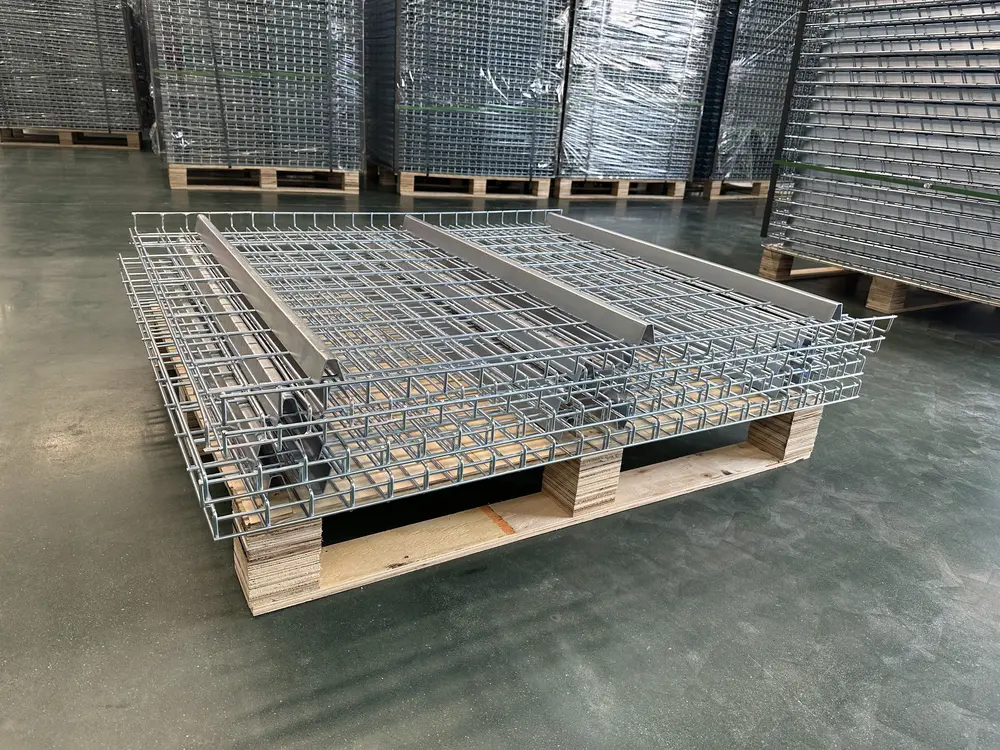
Galvanized, Powder-Coated or Painted Wire Decking
The finish decides how long a deck lasts where moisture, salt or cleaning chemicals are present. Most decks come in one of three finishes: galvanized (a zinc coating bonded to the steel), powder-coated (a baked-on polymer layer) or painted.
Zinc protects the steel even where the surface gets scratched, because the zinc corrodes first. Paint and powder coat only protect while the layer is intact, so chips from forks and pallets become rust points.
Photo: BHD Storage Solutions
In a dry, heated warehouse any of the three can work. In coolers, freezers, wash-down areas, near dock doors or outside, galvanized is the safer choice.
| Finish | How it protects | Good fit | Watch for |
|---|---|---|---|
| Galvanized | Zinc layer bonded to the steel; zinc corrodes before the steel does | Cold storage, freezers, wash-down, humid or outdoor areas, high-wear put-away | Higher price up front; white surface oxidation is normal |
| Powder-coated | Heat-cured polymer shell over the wire | Dry warehouses and retail backrooms where color or appearance matters | Chips and scratches from pallets expose bare steel |
| Painted | Liquid industrial paint | Light-duty, dry, low-traffic storage on a tight budget | Wears fastest; peeling and rust at worn spots |
Two manufacturers back this up with their own testing. J&L Wire’s technical bulletin reports that after abrasion and salt-spray tests, painted and powder-coated samples showed red rust while its galvanized samples showed mostly white rust. BHD states that painted or powder-coated decks lose about 11–12% of their deflection capacity in corrosive conditions, compared with 1–2% for galvanized. These are the manufacturers’ own results, so confirm the finish on your quote for the exact deck.
Planning a cooler or freezer? See our cold storage pallet rack page. For food plants with wash-down cleaning, our food and beverage pallet rack page covers rack finish and layout. Tell us the temperature, humidity and cleaning chemicals and we’ll quote the finish that matches.
Using Your Own Lumber or Plywood on Pallet Rack
Some buyers want pallet rack upright frames and beams for strength and durability, then lay their own 2x boards or plywood across the beams as shelves instead of buying decking. That works, but the beam profile decides how well the wood sits, and the wood becomes the part nobody has load-rated.
- Step beams seat wood best. The stepped inside ledge holds 2x boards or plywood flush with the top of the beam, so the boards can’t slide off the front or back. Order the beam and the board thickness together so the wood sits level with the step.
- Box or structural beams have no ledge. Wood laid on top can shift. Add front-to-back pallet supports or crossbars under it, or switch to a flared-channel wire deck made for that beam.
- The beam rating isn’t the shelf rating. Rack capacity is published for beams and frames. The board’s capacity depends on species, grade, thickness and span, and you own that number. Keep heavy items over the supports, not mid-span.
- Solid wood blocks sprinkler water. Solid shelves change how water reaches the lower levels, and some jurisdictions require wire or slatted decking or in-rack sprinklers. Ask your fire marshal or fire-protection engineer before going solid, especially in a vault or cage room.
- Shallow or short frames are possible. Upright frames come shallower than standard pallet depth, and short frames fit low ceilings in vaults and cage rooms. Send your depth and ceiling height so we quote frames that exist instead of a custom part.
- Leave the floor open if you need it. Set the first beam level high enough to clear hard cases or totes stored on the floor underneath.
Not sure which way to go? Send a photo of the space, the ceiling height and what each shelf holds, and we’ll quote frames, beams and decking (or frames and beams only) side by side. For government purchases that need multiple quotes, we can return a formal quote letter.
Wire Decking and NFPA 13: Open vs. Solid Shelves
Sprinkler design for rack storage follows NFPA 13, the Standard for the Installation of Sprinkler Systems. The 2016 edition treats rack shelves of wire mesh, slats or similar material that are more than 50% open as open racks, as long as the flue spaces stay clear. Solid shelves of 20 sq ft or less also count as open racks. Larger solid shelves are “solid shelving,” which can call for in-rack sprinklers under the shelf levels.
Your fire marshal decides which NFPA 13 edition applies to your building.
Photo: BHD Storage Solutions
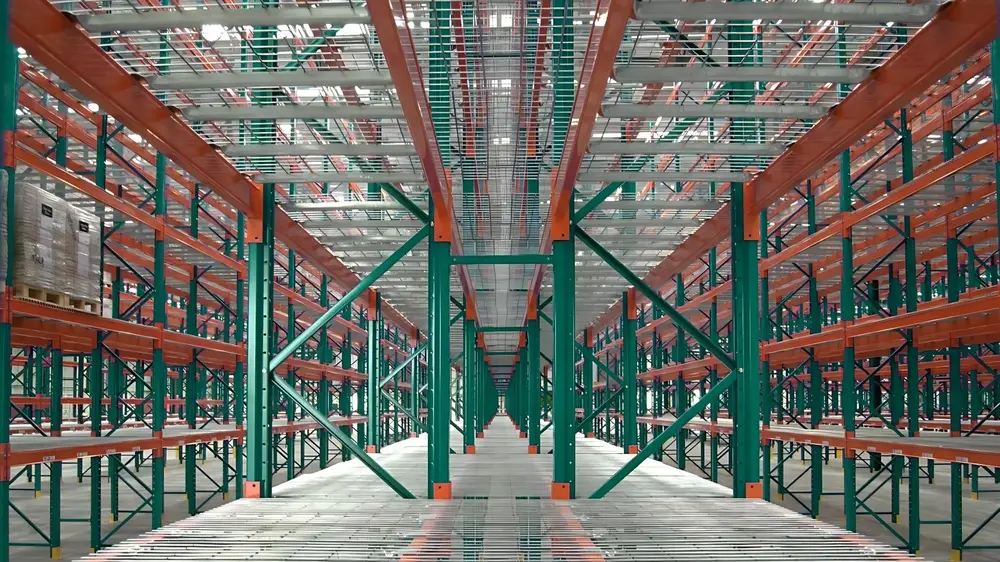
That is why open wire decking is the usual choice under ceiling-only sprinklers.
Ways a wire-decked rack ends up treated as solid
- Plywood, cardboard or slip sheets laid over the mesh. Plywood across a 96 × 42 in. bay is about 28 sq ft of solid surface, above the 20 sq ft line.
- Loads pushed together side to side, closing the gaps between pallets that act as transverse flue spaces.
- Back-to-back rows pushed together, closing the longitudinal flue between them. Our warehouse fire safety guide explains flue space sizes.
- A deck with less open area than assumed. Ask the deck supplier for the open-area percentage in writing and share it with your sprinkler designer.
If you need a solid surface for small parts, ask about it before you buy. A sprinkler contractor can tell you whether a change in deck, flue layout or in-rack sprinklers is needed. We can request the deck manufacturer’s data your fire-protection engineer asks for.
Wire Deck Inspection Checklist
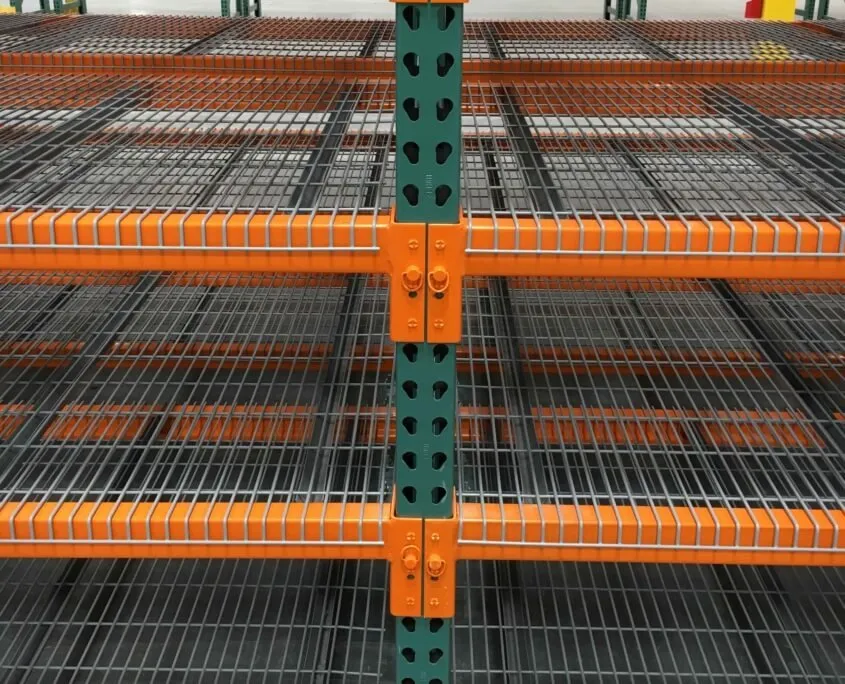
Damaged decks rarely fail all at once. They bend a little with each heavy load until a wire or weld lets go. Check the decks when you walk the racks, after any rack hit, and whenever the loads stored on a level change. BHD suggests every few months as a baseline. RMI states that owners are responsible for regular inspections and that damaged rack or decking comes out of service until it is repaired or replaced.
Unload a damaged deck before you take it out. Replace it rather than bending wires back, since straightened steel won’t carry the load it was rated for.
Photo: BHD Storage Solutions
Found rack damage beyond the decks? See our pallet rack repair and inspection page for beams, uprights and connectors. We can quote matching replacement decks once we know your beam profile and frame depth.
Shop Wire Decking & Accessories
Current Interlake listings (we have access to some common sizes in stock at select manufacturers; availability must be confirmed).
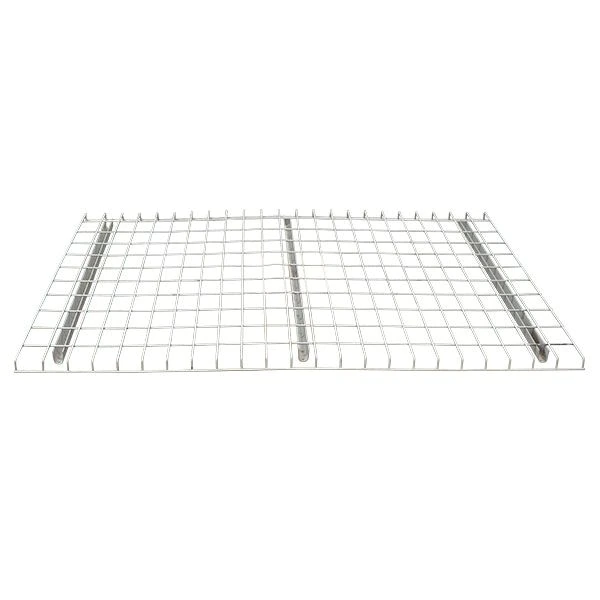 Interlake Wire Deck for Pallet RackFrom $95.38 per panel, depending on size/capacity configuration.
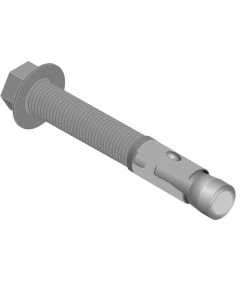 Interlake Pallet Rack Anchor Bolts$3.64 each — confirm the anchor type your engineering documentation specifies.
 Interlake Pallet Rack Column ProtectorFrom $69.68, depending on configuration.
Get a free quote
Tell us what you are storing, the room size and your timeline. A project specialist will follow up with layout options and pricing. Prefer to talk? Call (800) 326-4403.
Wire Decking FAQ
Is wire decking required by fire code?
What capacity wire decking do I need?
How is wire decking installed?
Does wire decking work with all rack brands?
How much does wire decking cost?
Can I use 2x lumber or plywood instead of wire decking?
What is the difference between galvanized and powder-coated wire decking?
How do I know when a wire deck needs to be replaced?
Can I lay plywood on top of wire decking?
Pallet Rack Accessories
Rack Guards · Rack Netting · Anchor Bolts · Selective Rack · All Pallet Rack →
Design Your Pallet Rack System in 3D
Use our free interactive Pallet Rack Configurator to lay out your rack, see a 3D preview, get a bill of materials and request a quote.
Need Wire Decking for Your Rack?
Tell us your beam profile, deck size and what’s actually going on the deck — we’ll match the right product and get you a fast quote.