
Pallet Rack for Food & Beverage Operations
Food and beverage operations live and die by inventory rotation, food safety compliance, and distribution speed. We design and install pallet rack systems that keep your products moving in order, meet FDA and FSMA requirements, and maximize throughput from receiving to shipping.
Talk with a pallet rack specialist. Call (800) 326-4403 or Email Sales@MH-USA.com

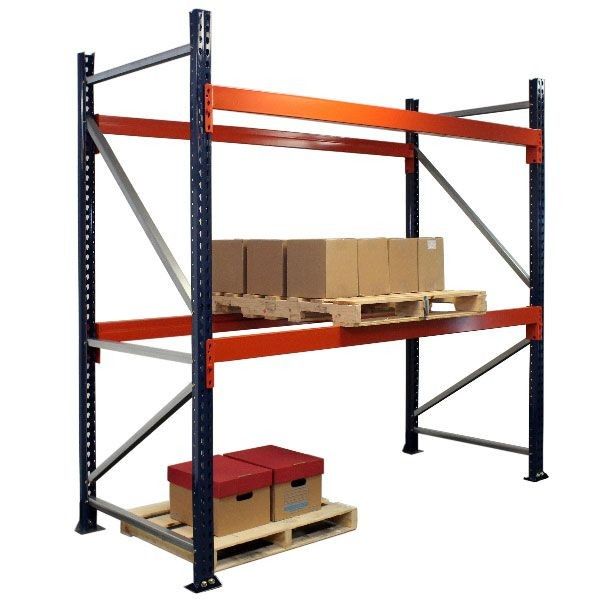
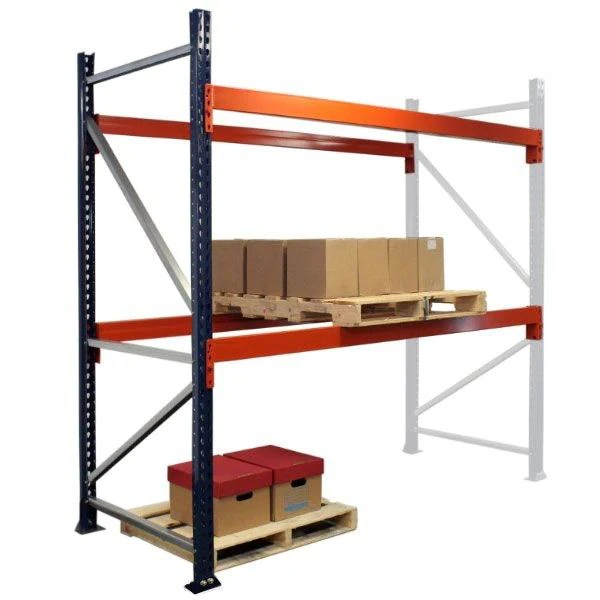
Shop Complete Pallet Rack Starter & Add-On Units
These are complete Interlake pallet rack bays you can order online: a starter unit for the first bay and add-on units that share its upright to extend a run. They suit standard selective storage. Pallet flow lanes, push-back, multi-zone plant layouts and permitted seismic installs are engineered and quoted per project, so use the quote form below for those.

Why Food & Beverage Racking Requires Specialized Design
Food and beverage warehouses face challenges that general merchandise operations don’t. Expiration dates make inventory rotation critical — ship the wrong date code and you risk recalls, returns, and lost retail accounts. Temperature zones create different storage environments within the same facility. And FDA/FSMA regulations require traceability, sanitation, and separation that affect your rack layout.
Material Handling USA designs food and beverage racking systems around these realities. FIFO configurations ensure date code compliance. Corrosion-resistant finishes handle washdown areas. And our layouts separate allergen zones, raw ingredients, and finished goods as required by your food safety plan.
Recommended Rack Types for Food & Beverage
The right rack type depends on your products, throughput, and facility. Here’s what works best for food & beverage operations.
| Rack Type | Why It Works |
|---|---|
| Pallet Flow Rack | The gold standard for food FIFO compliance. Gravity-fed rollers automatically rotate inventory — first pallet loaded is the first pallet picked. No manual rotation, no date code errors. Speeds and brakes control pallet flow regardless of weight. Best For: Date-coded products, dairy, bakery, fresh foods |
| Drive-In Rack | Maximum density for single-SKU food products. Store pallets 5–10 deep when you’re warehousing large quantities of one product (beverage cases, frozen foods, canned goods). LIFO operation — use when all pallets in a lane share the same date code. Best For: Beverage distribution, canned goods, single-SKU frozen storage |
| Selective Rack | Direct access to every pallet position. Essential for distribution centers with hundreds of food SKUs that each need immediate availability. Use with FIFO discipline (pick from one side, replenish from the other) for date code management. Best For: Multi-SKU food distribution, variety pack operations |
| Push-Back Rack | Stores 2–6 pallets deep with front-aisle access. Better selectivity than drive-in — each lane holds a different SKU. LIFO operation works when each lane’s pallets share a production date. Best For: Beverage brands, snack foods, multi-SKU food warehousing |
| Mobile Rack | Maximum density for high-value food products. Racks on powered carriages eliminate aisles. Often used in temperature-controlled environments where minimizing refrigerated space directly reduces energy costs. Best For: Premium food products, cold storage, high-value inventory |
| Cantilever Rack | For food industry items that don’t fit on standard pallets — rolled packaging materials, long boxes, catering equipment, restaurant supplies. No front columns for easy loading. Best For: Packaging materials, restaurant supply, catering equipment |
Food & Beverage Storage Challenges We Solve
Every industry has unique racking requirements. Here’s how we address the specific challenges of food & beverage storage.
🔄 FIFO / Date Code Compliance
Shipping expired or out-of-rotation product costs money and damages retailer relationships. Pallet flow rack automates FIFO. For selective rack, we design one-way flow layouts where replenishment enters from one aisle and picks exit from another — enforcing rotation without relying on manual discipline.
🧹 Sanitation & Washdown
Food facilities require regular cleaning. Rack systems in washdown areas need corrosion-resistant finishes — galvanized or stainless steel components. We design rack layouts with adequate clearance for cleaning equipment and specify materials rated for your sanitation protocols.
🌡️ Temperature Zones
Many food warehouses have multiple temperature zones — ambient, cooler (35–45°F), and freezer (0°F and below). Each zone needs different rack configurations, coatings, and density levels. We design integrated systems that work across all zones.
📋 FDA / FSMA Compliance
The FDA Food Safety Modernization Act requires traceability, allergen separation, and facility controls that affect rack layout. We design systems that support zone separation, clear labeling, and the workflow your food safety plan requires.
What Affects Food & Beverage Racking Cost?
Temperature Rating
Rack components rated for freezer environments (galvanized, specialty coatings) cost more than standard finishes but are required for longevity. Standard paint fails within 6–12 months in freezer conditions.
FIFO Requirements
Pallet flow rack (gravity-fed FIFO) costs more per position than selective rack but eliminates date code errors, reduces labor for manual rotation, and prevents expired-product write-offs. The ROI is often under 18 months.
Food Safety Layout
FDA/FSMA-compliant layouts may require additional separation, wider aisles for cleaning, and zone-specific configurations. We design for compliance from the start — avoiding costly retrofits later.
Ingredient and Packaging Storage for Food Production: FIFO Lanes, Lots and Line Feed
Food distribution racks are built around outbound orders. Food production racks are built around the line: ingredients, oils, sweeteners, cartons, film and labels have to reach the kitchen or filler in date order, lot by lot, without the forklift feeding production fighting the forklift unloading trucks. That changes which pallet rack type makes sense.
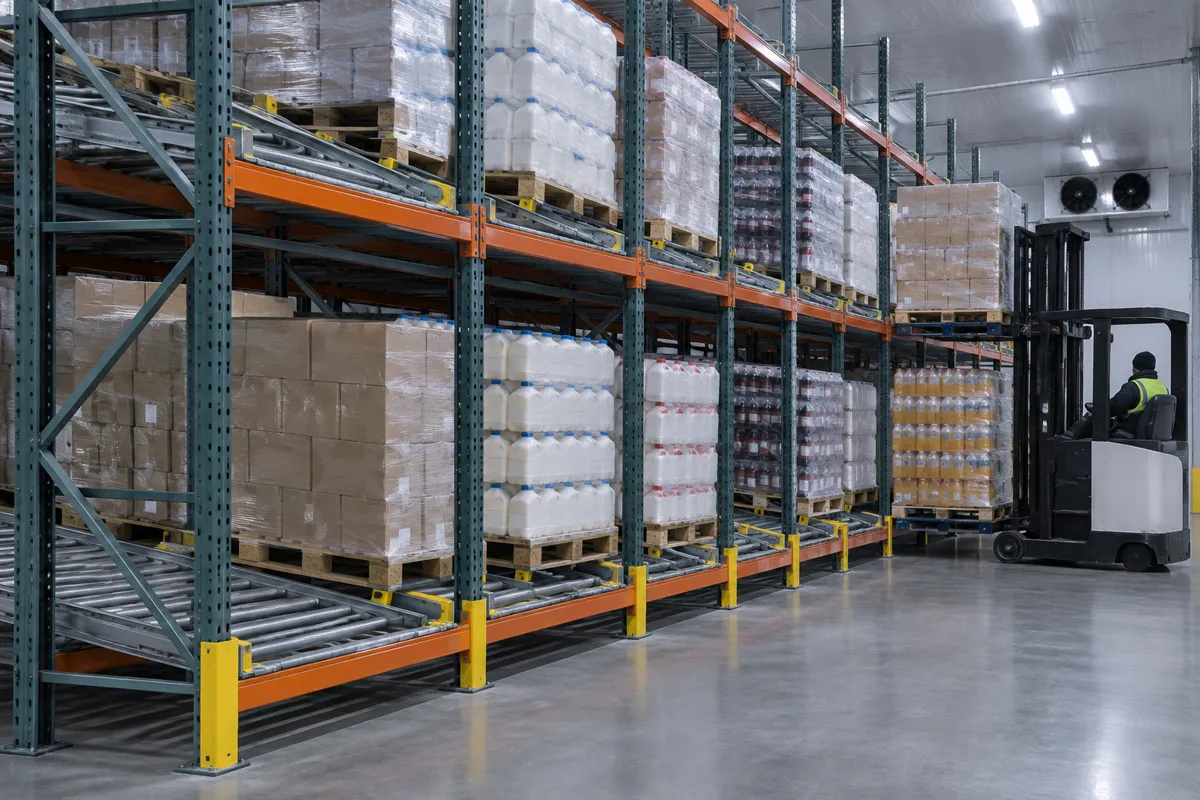
Gravity pallet flow for ingredients the line uses every shift
Pallets load at the rear and roll to the pick face, so the oldest pallet is always the one presented to production. Receiving loads from one aisle; production pulls from another. That built-in first-in, first-out rotation suits high-use ingredients and packaging and keeps receivers out of the production aisle. Note that FIFO by arrival is not automatically FEFO (first-expired, first-out): the earliest expiry is not always the earliest arrival, so FEFO still depends on assigning lots and expiry dates to lanes and on operating controls, not on the flow hardware alone.
Plan for one item per lane, good-quality pallets and enough lanes that a new lot is never loaded behind an old one of the same item that you need to keep separate.

Bulk totes, drums and bags of ingredients
Stainless totes, fiber drums and bulk bags are heavy, not always on standard pallets, and often slow-moving compared with cartons. Selective rack with pallet supports or decking usually suits these better than flow lanes, which need consistent pallet bottoms to roll safely. Ask us to check beam capacity against filled-tote weights, not empty ones.
Where push-back fits, and where it does not
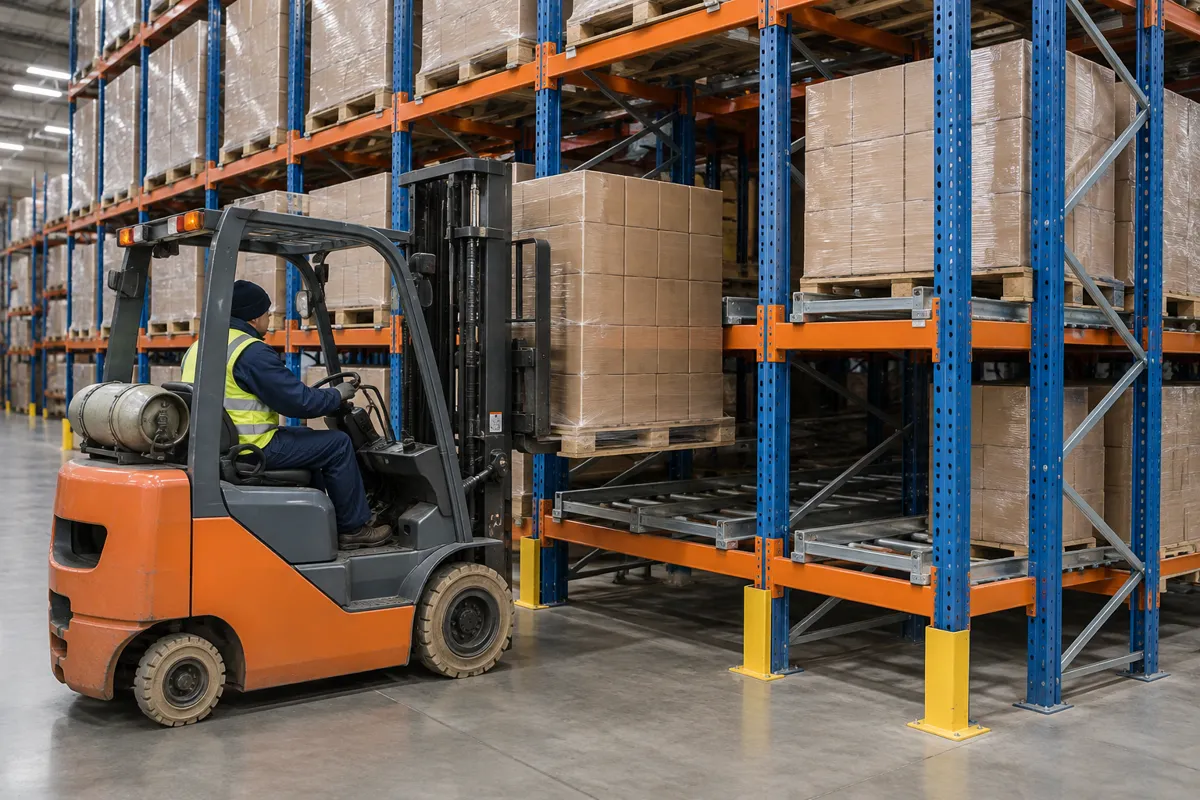
Push-back gives dense storage with a pick face for every lane from a single aisle, which suits finished goods built in large single-lot runs or packaging that does not expire. It is last in, first out within each lane, so it is the wrong choice for date-coded ingredients unless every lane holds a single lot and is emptied before it is refilled.
| What you store | Rotation need | Usually fits | Limitation |
|---|---|---|---|
| High-use ingredients and packaging | FIFO by arrival (FEFO needs lot/expiry controls) | Pallet flow | One item per lane; pallet quality matters |
| Many low-volume ingredients | Lot visibility | Selective rack | Lower density, more aisle |
| Finished goods, single-lot runs | Lot kept together | Push-back | LIFO within a lane |
| Frozen or chilled stock needing FIFO | FIFO plus density | Pallet flow rated for the temperature, or drive-through rack with true FIFO access | Push-back only where LIFO is acceptable in controlled single-lot lanes; see cold storage rack design |
Manufacturer project example: food production plant, Horse Cave, Kentucky
When the T. Marzetti Company built a new production facility, its rack requirements were a large variety of raw materials, quick access to a continuous flow of material, high-density storage of similar material and maximum use of space. The installed answer was 6-deep gravity flow rack with 660 lanes and about 4,000 pallet positions, feeding production first in, first out.
Project facts summarized from a Ridg-U-Rak published project profile (T. Marzetti Company, Gravity Flow Rack Storage). This was a manufacturer project, not an MH-USA installation. MH-USA is an authorized Ridg-U-Rak dealer.
For a food plant we start with your ingredient list, daily usage, lot sizes, pallet types and temperature zones, then show lane counts per item and which items belong in flow, push-back or selective rack. Sanitation clearances under the bottom level and wall gaps for inspection are built into the same layout.
Get a free quote
Tell us what you are storing, the room size and your timeline. A project specialist will follow up with layout options and pricing. Prefer to talk? Call (800) 326-4403.
Food & Beverage Pallet Rack FAQ
For food distribution with many SKUs, selective rack provides direct access to every pallet. Add pallet flow rack for date-sensitive products requiring FIFO rotation. Drive-in rack works for single-SKU bulk storage. Most food distributors use a combination of all three.
Pallet flow rack automates FIFO — gravity moves pallets from load end to pick end, so the oldest product is always picked first. For selective rack, we design one-way flow layouts with separate replenishment and pick aisles to enforce rotation without manual intervention.
Yes. We understand FDA and FSMA requirements for food warehousing. Our installations maintain proper clearances, support zone separation for allergens and raw/finished goods, and use food-safe finishes. We work around your production schedule to minimize downtime.
Galvanized steel is the standard for freezer environments. It resists corrosion from moisture, condensation, and temperature cycling far better than standard powder coat. For cooler environments (35–45°F), heavy-duty powder coat may be sufficient.
Absolutely. We design complete multi-temperature food warehouses — ambient receiving/shipping zones, cooler storage, freezer storage, and pick-to-ship areas. Each zone gets the right rack type, density level, and corrosion protection for its environment.
Only with care. Push-back is last in, first out within each lane, so a new pallet loaded in front of an older one of the same item hides the older stock. It works for date-coded items only if every lane holds a single lot and is emptied before refilling. For ingredients that must rotate by date, pallet flow is the safer choice.
Pallet flow presents the oldest pallet at the pick face automatically and separates the receiving aisle from the production aisle. That supports first-in, first-out rotation for high-use ingredients and packaging without relying on operators to dig for the right pallet. First-expired, first-out (FEFO) additionally requires lot and expiry assignment to lanes plus operating controls.
Pallet Rack for Other Industries
Need Pallet Rack for Your Food & Beverage Operation?
Free quotes, free warehouse design, and professional installation. Let’s build the right racking system for your business.
Planning a Complete Food & Beverage Facility?
This page covers pallet rack. For the full program — sanitary shelving, cold storage, security cages, and modular rooms — see Food & Beverage Storage Solutions, and stock the storeroom from Food Plant Supplies & MRO.
Ready to configure your pallet rack system?
Use our guided configurator to choose the right configuration, review your parts and submit it for checkout or a formal quote.