
Mobile Pallet Rack Systems
Mount pallet rack on powered mobile bases that slide open to create an access aisle only where you need it — eliminating all but one aisle to nearly double your pallet storage in the same footprint.
Talk with a pallet rack specialist. Call (800) 326-4403 or Email Sales@MH-USA.com
What Is Mobile Pallet Rack?
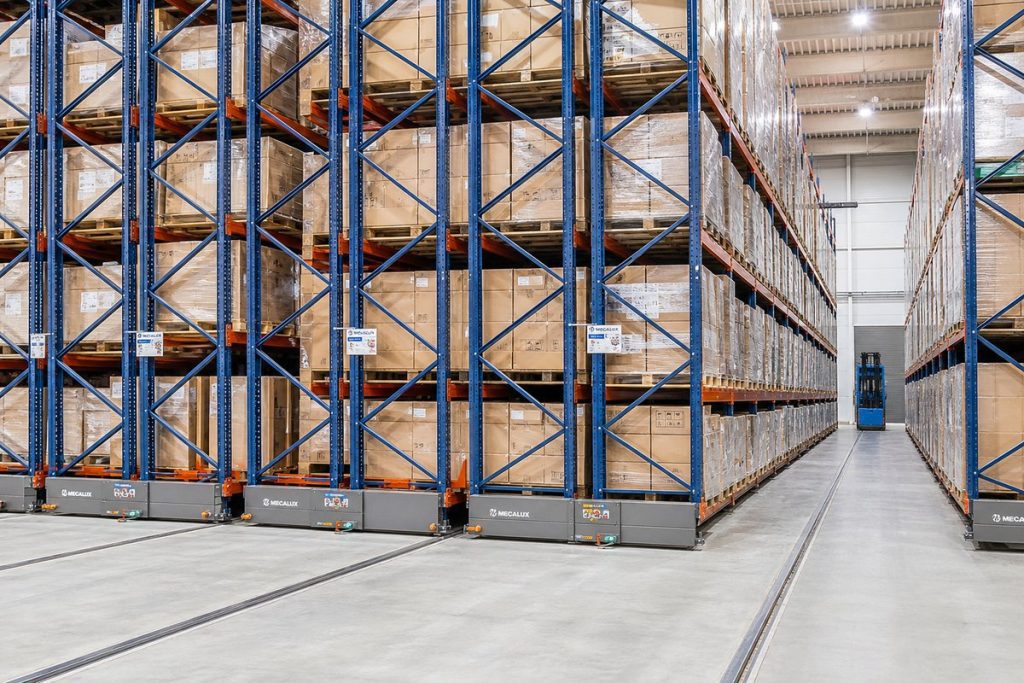
Pallet rack mounted on powered mobile bases (carriages) that roll along floor-mounted rails. Rows compact together to eliminate aisles, then open one aisle at a time where the forklift needs access.
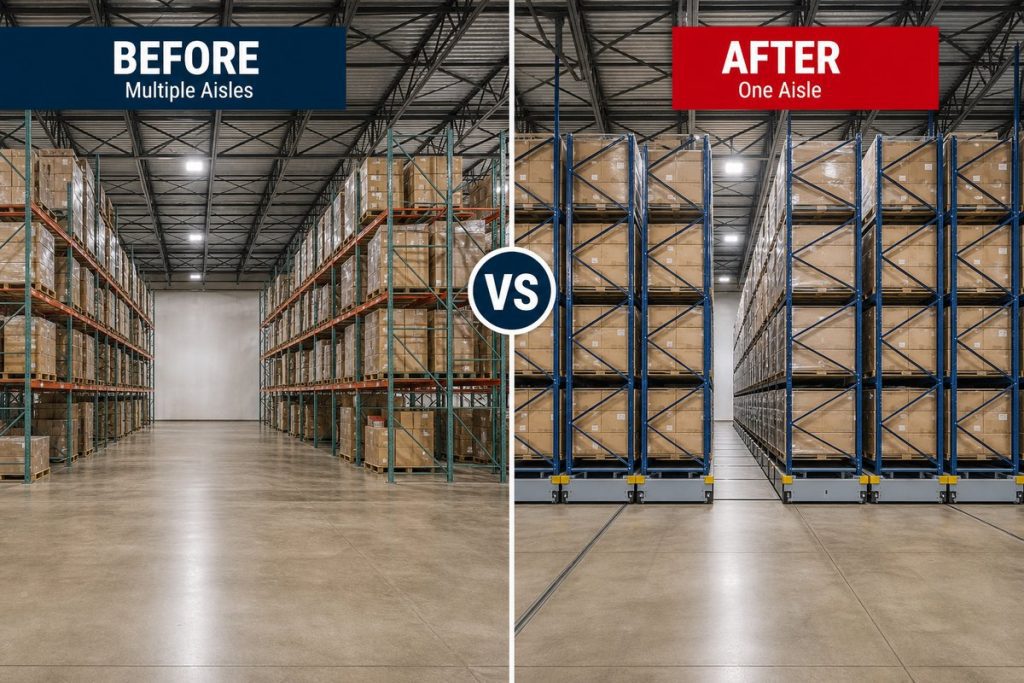
Mobile pallet rack is the highest-density selective storage system available. Standard selective rack requires one access aisle for every two rows of rack — roughly half your floor space is aisles. Mobile rack eliminates all but one aisle by mounting rows of pallet rack on motorized carriages that slide laterally on embedded floor rails.
When a forklift operator needs to access a specific row, they command that section to open (via remote, aisle entry sensor, or control panel). The carriages slide apart to create one full-width forklift aisle exactly where it’s needed. All other rows remain compacted — no wasted aisle space.
The result: up to 80% more pallet positions in the same building footprint while maintaining 100% pallet selectivity. Material Handling USA designs, supplies, and installs mobile pallet rack systems for cold storage, military, government, 3PL, pharmaceutical, and space-constrained operations nationwide.

How Mobile Pallet Rack Works

Floor rails are embedded flush in the warehouse floor (or surface-mounted with ramps). Motorized carriages ride on these rails, supporting one or more rows of pallet rack above. Electric motors drive the carriages at speeds of 20–40 feet per minute. Safety systems include motion sensors, light curtains, and emergency stops to protect personnel.
Access: The operator selects which aisle to open using a remote control, touchscreen panel, or automatic aisle-entry sensors. The system slides rows apart to create one working aisle, then closes behind after the forklift exits.
System Configurations
Electric Powered Mobile

The most common configuration. Electric motors drive carriages along floor rails. Speeds of 20–40 FPM. Control via remote, panel, or automatic sensors. Safety systems include motion detection, light curtains, and auto-stop.
Best for: Large-scale warehouse operations, cold storage, distribution
Hybrid Mobile Systems
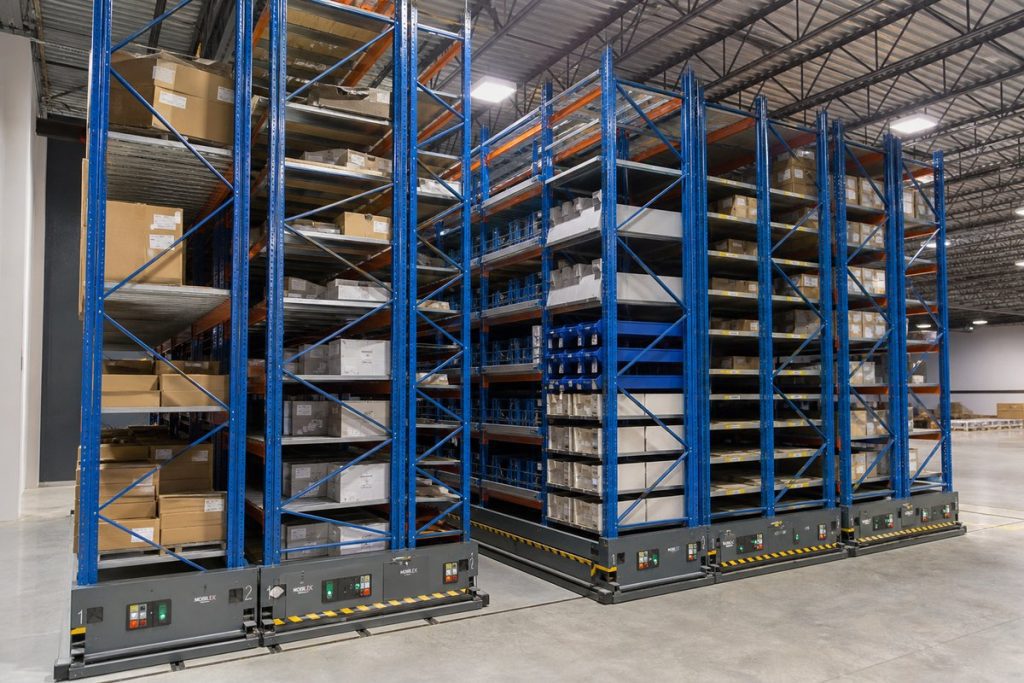
Combines mobile pallet rack with static rows at the ends. Static rows provide permanent aisles for fastest-moving SKUs while mobile rows maximize density for slower-moving inventory. Balances throughput and density.
Best for: Mixed-velocity inventory, 3PL with varying client needs
Cold Storage Mobile
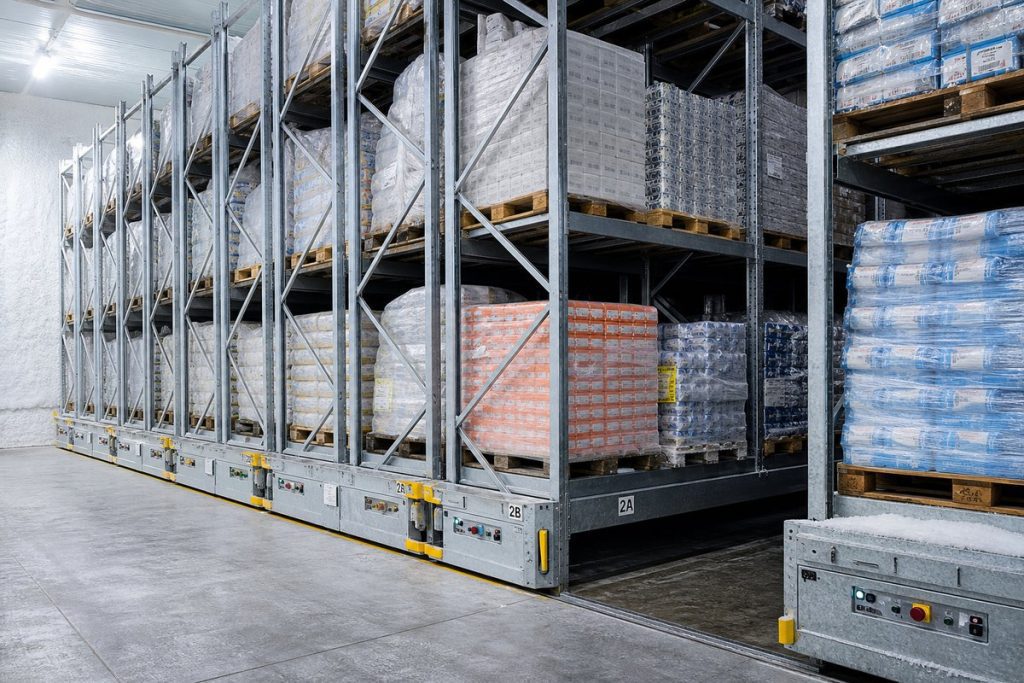
Engineered specifically for freezer and cold storage environments. Components rated for -20°F and below. Maximizes the most expensive real estate in any operation — refrigerated cubic footage. The #1 ROI application for mobile rack.
Best for: Frozen food, pharmaceutical cold chain, temperature-controlled 3PL
Technical Specifications
| Parameter | Mobile Pallet Rack | Notes |
|---|---|---|
| Density Gain | Up to 80% more pallet positions | vs. standard static selective rack |
| Carriage Speed | 20–40 feet per minute | Varies by manufacturer and load |
| Drive System | Electric motors per carriage | Variable frequency drives for smooth operation |
| Floor Rails | Flush-mounted or surface-mounted | Embedded rails preferred for forklift traffic |
| Safety Systems | Motion sensors, light curtains, E-stops | ANSI/ASME B30.17 compliant |
| Control | Remote, panel, auto-sensor, or WMS-integrated | Touchscreen interface standard |
| Rack Type | Selective, double deep, or cantilever on carriages | Structural or roll-formed |
| Max Height | 30’+ typical | Limited by building and forklift, not carriage |
| Temperature Range | -20°F to 120°F | Cold storage rated models available |
| Power | Standard 480V 3-phase | Battery backup available |
Applications & Industries
❄️ Cold Storage & Freezer

The highest-ROI application. Every square foot of cold/freezer space costs 3–5× more than ambient. Mobile rack nearly doubles pallet positions in existing coolers — often eliminating the need for costly building expansions.
🏛️ Government & Military

Defense logistics, FEMA warehouses, and government supply depots. Space is limited, budgets for new construction are tight, and 100% accountability of every pallet is mandatory. Mobile rack delivers all three.
💊 Pharmaceutical
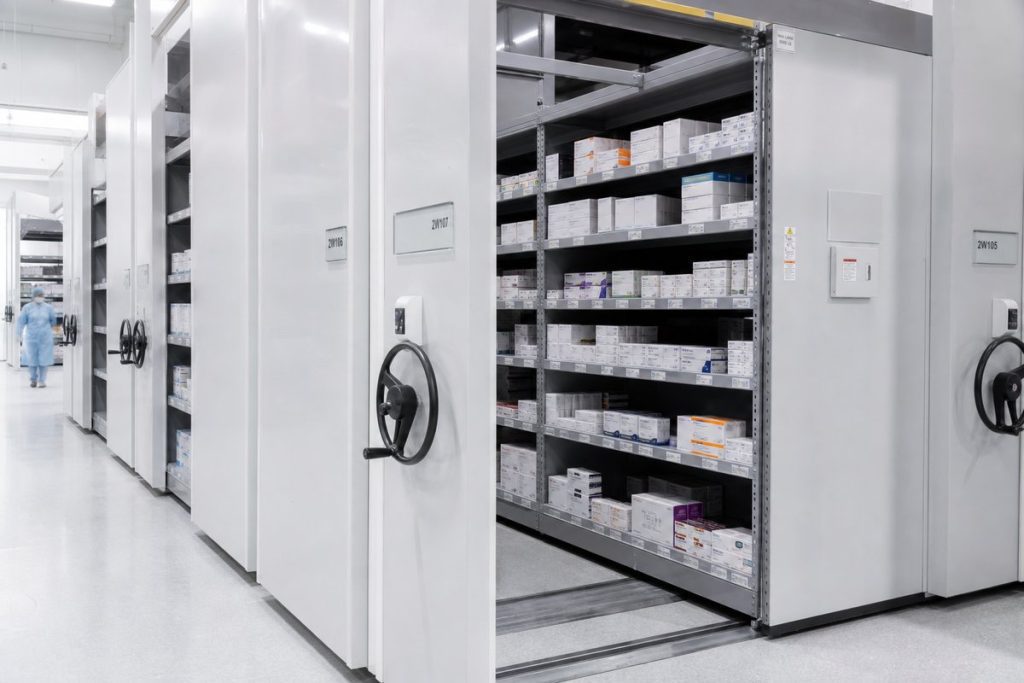
Temperature-controlled drug storage, lot-tracked inventory, DEA-regulated facilities. Mobile rack maximizes controlled storage space while maintaining 100% access for auditsand compliance.
📦 3PL & Distribution
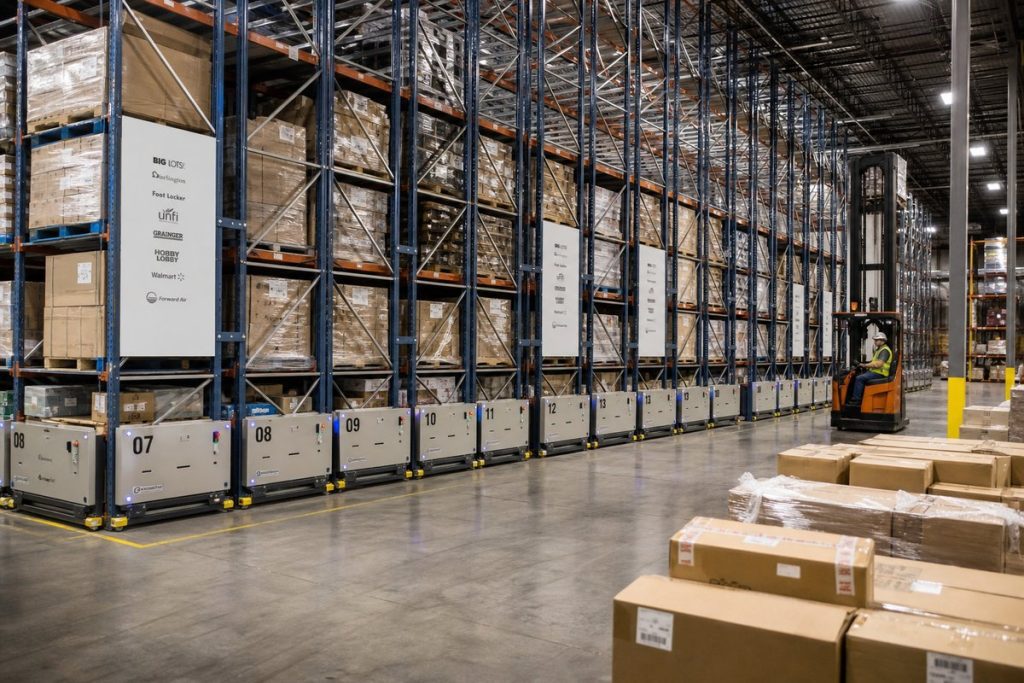
Third-party logistics providers billing per pallet position. More positions = more revenue from the same building. Mobile rack is the fastest path to increased pallet density without new construction.
🏭 Manufacturing
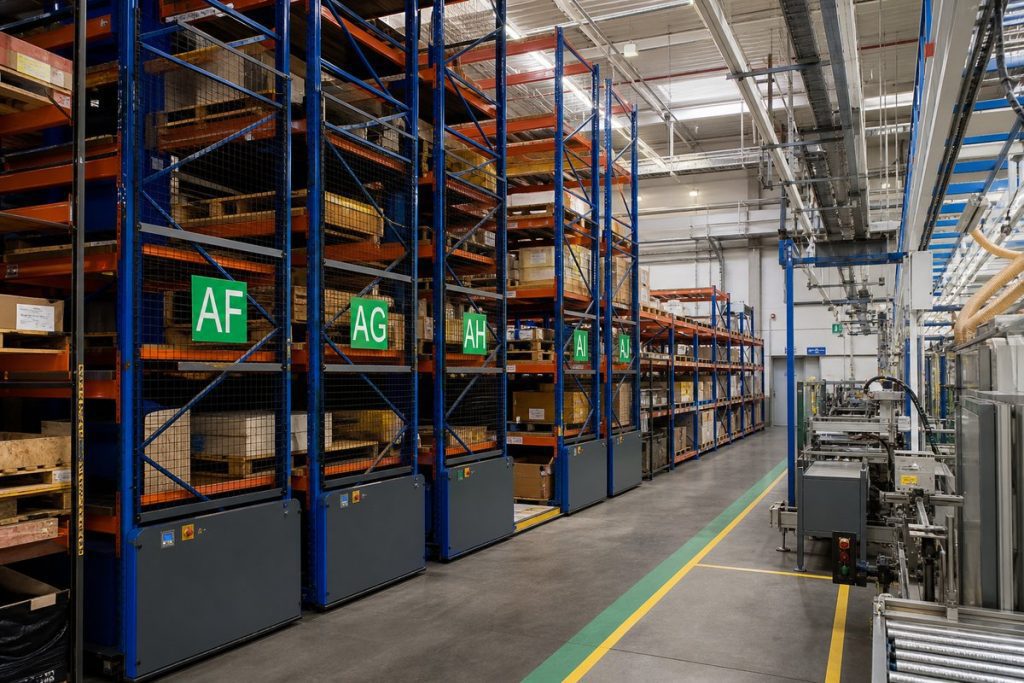
Raw materialand finished goods buffer storage in space-constrained plants. Mobile rack stores more pallets in existing footprints, keeping material close to production lines.
🏢 Urban Warehouses
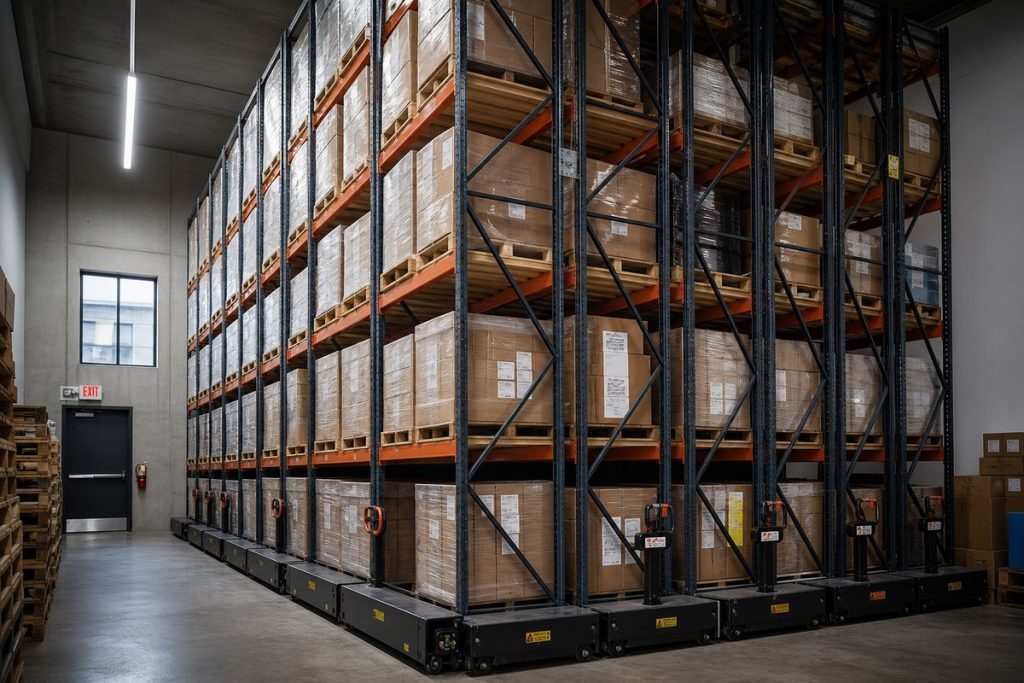
High-rent urban distribution facilities where floor space is at a premium. Mobile rack maximizes storage in buildings that can’t expand horizontally — critical for last-mile fulfillment.
Mobile Rack vs. Other High-Density Systems
| System | Selectivity | Density Gain | Access Speed | Best For |
|---|---|---|---|---|
| Mobile Pallet Rack | 100% | Up to +80% | Moderate (aisle open time) | Max density + full selectivity |
| Drive-In | Low | +75–100% | Slow | Bulk storage, few SKUs |
| Narrow Aisle / VNA | 100% | +40–50% | Fast | High throughput + density |
| Push-Back | ~75% | +40–60% | Fast | Moderate SKUs, fast cycles |
| Standard Selective | 100% | Baseline | Fastest | High throughput, many SKUs |
Choose mobile rack if: You need the absolute highest density while maintaining 100% pallet selectivity. Ideal when building expansion isn’t possible and throughput (picks per hour) isn’t the primary concern.
Consider alternatives if: You need maximum throughput speed (narrow aisle), have few SKUsand can sacrifice selectivity (drive-in), or need the simplest possible system (standard selective).
When to Choose Mobile Pallet Rack
Mobile racking eliminates fixed aisles by mounting pallet rack rows on powered carriages that slide open on demand. One working aisle serves an entire block of rack — delivering the highest possible pallet density with full selectivity.
Ideal Conditions for Mobile Rack
- Space is extremely expensive — Cold storage, cleanrooms, and urban warehouses where cubic footage costs $15–$30+/sq ft per year. Mobile rack can store 80–100% more pallets than selective in the same footprint
- 100% selectivity is required — Unlike drive-in or push-back, every pallet is directly accessible. Mobile rack is the only high-density system that maintains full selectivity
- Moderate throughput — Mobile rack takes 30–90 seconds to open an aisle. High-velocity pick operations may find this too slow, but for bulk storage, reserve stock, or cold storage, it’s ideal
- Avoiding new construction — When expanding your building costs $80–$150/sq ft, mobile rack’s 80–100% density increase in your existing space is dramatically cheaper
Density Comparison
| System | Floor Used for Aisles | Selectivity |
|---|---|---|
| Selective | ~50% | 100% |
| Drive-In | ~20% | ~15% |
| Double Deep | ~35% | 50% |
| Mobile Rack | ~10–15% (1 aisle) | 100% |
💡 Cold Storage ROI
Cold storage space costs 3–5× more than ambient warehousing to build and operate. Mobile rack’s density advantage is most valuable here — storing 80% more pallets in refrigerated space can save hundreds of thousands per year in energy and construction costs.
Carriage & Drive Systems
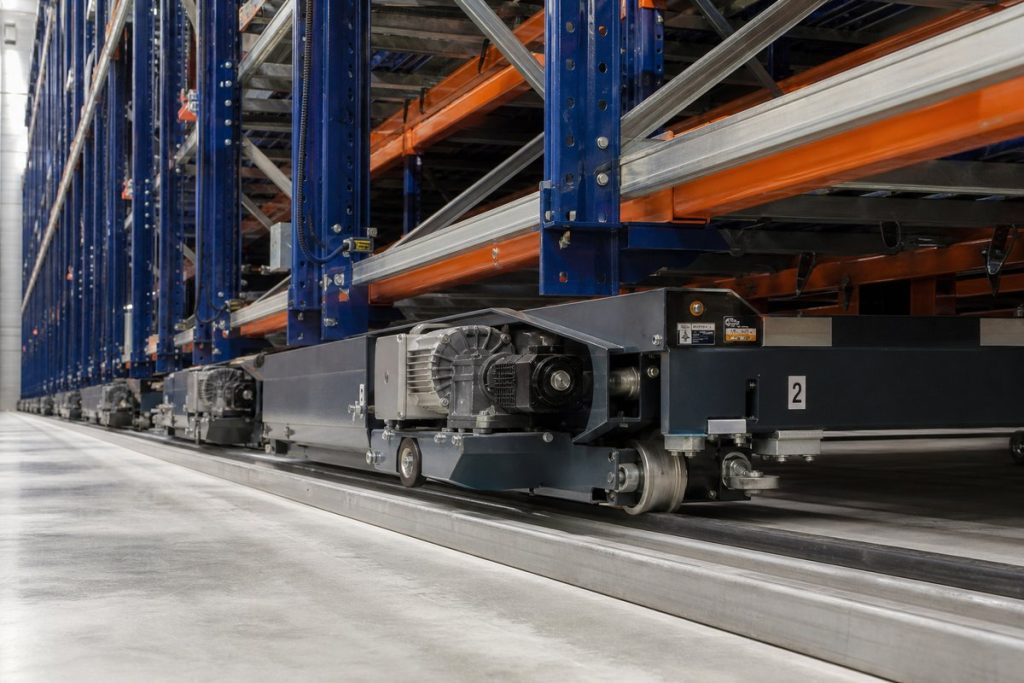
The carriage is the foundation of mobile rack — motorized platforms that move entire loaded rack rows on floor-mounted rails.
How It Works
Each rack row sits on a steel carriage with electric motorsand wheels that ride on steel rails embedded in (or mounted on) the floor. When an operator needs access to a specific aisle, they press a button on the end panel — the carriages move apart to create a working aisle at that location. All other aisles remain closed, maximizing storage density.
Electric Drive
Most common type. Electric motors (typically 1–3 HP per carriage) power the wheels via gear reducers. Smooth, quiet operation. Can move rows weighing 100,000+ lbs loaded. Variable frequency drives (VFDs) provide soft start/stop to prevent load shifting.
Rail Systems
Rails are typically flush-mounted (embedded in the floor) or surface-mounted with transition ramps. Flush rails provide the cleanest floor for forklift travel. Surface-mounted rails are less expensive and easier to install in existing buildings.
Safety Systems & Controls
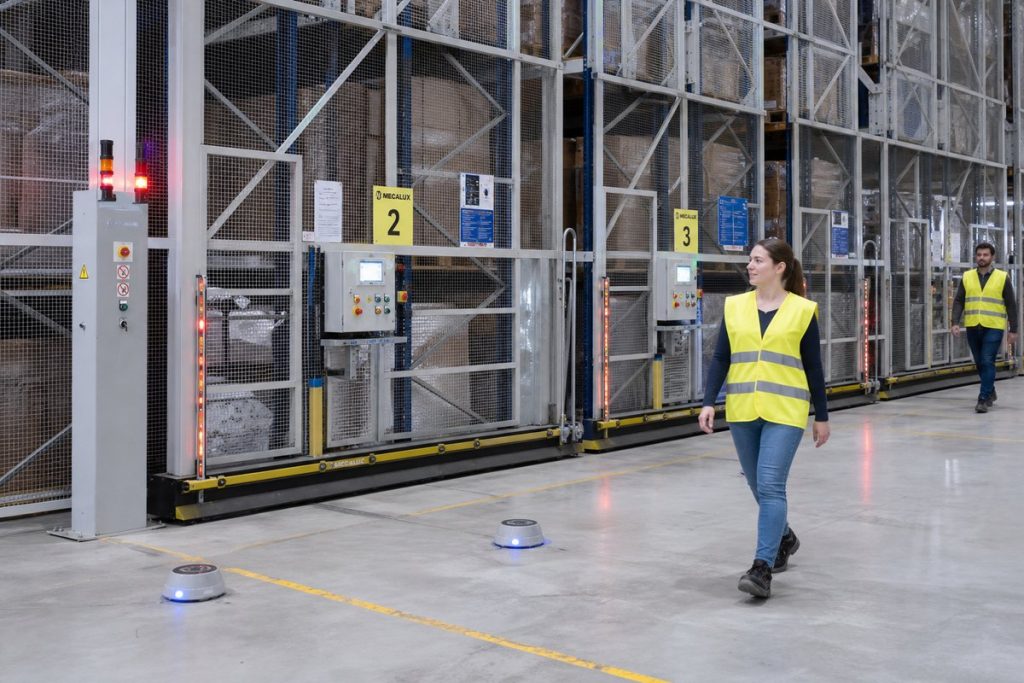
Moving 100,000+ lbs of loaded rack creates serious safety requirements. Modern mobile rack systems include multiple layers of protection.
🔴 Photo-Eye Sensors
Infrared sensors at floor level detect people, forklifts, or objects in the aisle. If anything is detected, all carriage movement stops immediately. Sensors are placed at both ends of every aisle and along the carriage length.
💡 Light Curtains
Vertical light curtains at aisle entrances create an invisible barrier. Breaking the light beam halts carriage movement. This prevents a row from closing while a forklift or person is inside the aisle — the most critical safety function.
🔧 Emergency Stops
E-stop buttons on every end paneland inside every aisle. Hitting any E-stop immediately cuts power to all carriages in the block. Some systems also include wireless E-stops carried by operators for use from inside the aisle.
⚠️ Seismic Locking
In Utah’s seismic zone, mobile rack requires seismic locks that automatically engage when carriages are stationary. During an earthquake, these locks prevent the heavy carriages from rolling uncontrolled on the rails — which could cause catastrophic damage. MH-USA specifies seismic-rated mobile systems for all Utah installations.
What Affects Mobile Rack Cost?
Mobile rack is the most expensive pallet storage system per bay — but often the cheapest per pallet position when you factor in the space it saves.

🏗️ Carriage & Rail System
The carriage system (motors, wheels, rails, controls) typically costs as much as the rack itself. A mobile system costs roughly 2–3× what the same rack would cost as fixed selective. The longer the rowsand heavier the loads, the more robust (and expensive) the carriages must be.
📐 Floor Preparation
Rails must be perfectly level for carriages to operate reliably. Floor leveling, rail installation, and concrete work can add $5–$15/sq ft for the mobile zone. Flush-mounted rails require cutting trenches in the existing floor — surface-mounted rails are less invasive but still need a level surface.
⚡ Electrical & Controls
Each carriage needs power (typically bus bar or trailing cable systems). The control panel, safety sensors, light curtains, and PLC programming add $20,000–$50,000+ per mobile block depending on complexity and safety requirements. Seismic locking systems add further cost in earthquake zones.
Inspection & Maintenance for Mobile Rack
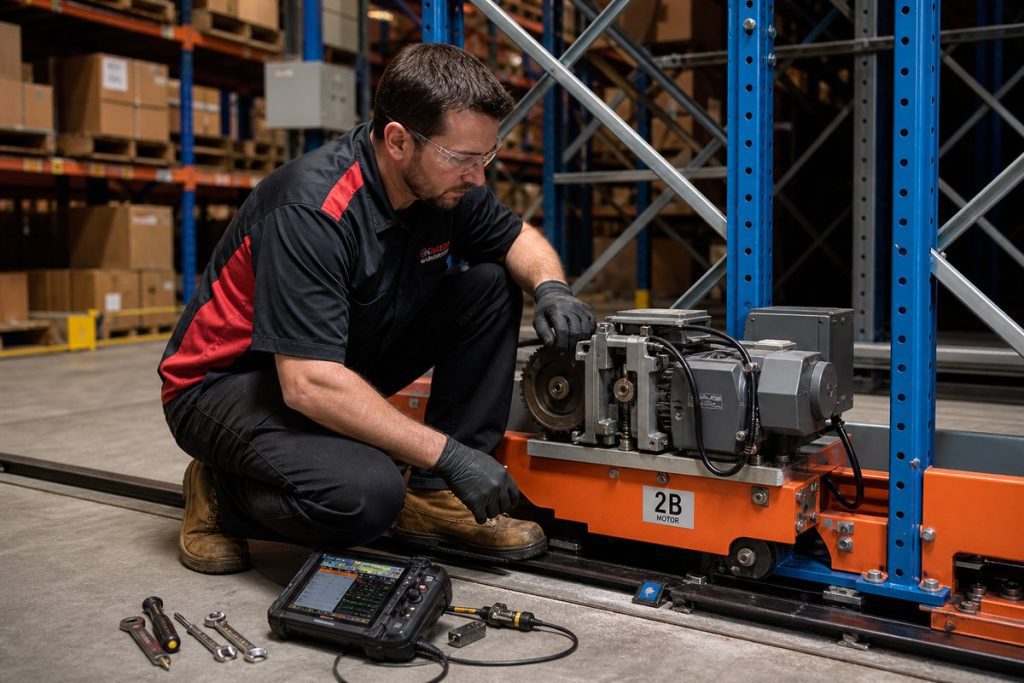
Mobile rack has more moving parts than any other storage system. Preventive maintenance isn’t optional — it’s what keeps the system running and safe.
Maintenance Schedule
| Component | Check For | Frequency |
|---|---|---|
| Safety sensors | Photo-eyes, light curtains, E-stops all functional | Weekly |
| Drive motors | Unusual noise, overheating, smooth operation | Monthly |
| Wheels & bearings | Wear, flat spots, bearing noise | Monthly |
| Rails | Debris, alignment, surface wear, loose bolts | Monthly |
| Seismic locks | Engagement/disengagement, latch condition | Quarterly |
| Electrical connections | Bus bars, cables, control panel, power supply | Quarterly |
🔧 Service Contracts Save Money
Mobile rack systems benefit significantly from preventive maintenance contracts. A carriage motor failure can take an entire block offline — with tens of thousands of pallets inaccessible until repaired. Regular service catches wear before failure. Ask about mobile rack service plans →
Frequently Asked Questions
Up to 80% more pallet positions in the same footprint. The exact gain depends on your current layout and how many static aisles you currently have.
Yes. Modern systems include motion sensors, infrared light curtains, emergency stop buttons, and audible/visual alarms. The aisles won’t close while anyone or anything is inside.
Carriages move at 20–40 feet per minute. A typical aisle opens in 30–90 seconds depending on system size. For time-sensitive operations, hybrid systems with permanent fast-pick aisles are available.
Yes — this is one of the highest-ROI applications. Cold storage mobile rack systems are engineered for -20°F and below with heated componentsand sealed electronics.
Standard counterbalanced forklifts or reach trucks — the same equipment you use with static selective rack. No special forklift needed.
Higher than static rack due to the carriage system, motors, rails, and controls. However, the cost per pallet position is often lower than building a new warehouse. Contact Material Handling USA at (800) 326-4403 for ROI analysis.
Explore More Pallet Rack Solutions
Need to Double Your Pallet Storage?
Material Handling USA designsand installs mobile pallet rack systems for cold storage, distribution, military, and space-constrained warehouses nationwide. Free ROI analysisand design consultation.