
Drive-In & Drive-Through Pallet Rack
High-density bulk storage that eliminates aisles — store 2× to 3× more pallets in the same footprint by letting forklifts drive directly intotherack structure.
Talk with a pallet rack specialist. Call (800) 326-4403 or Email Sales@MH-USA.com
What Is Drive-In Pallet Rack?
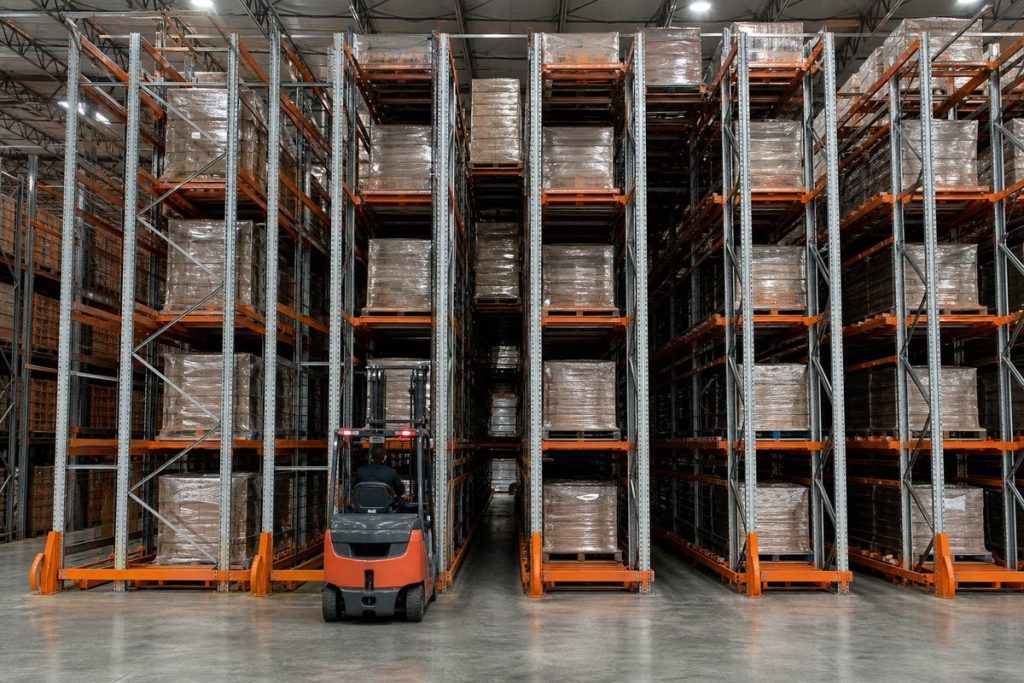
A high-density storage system where forklifts drive directly intotherack structure to load and retrieve pallets from deep storage lanes — eliminating aisles for maximum warehouse density.

Drive-in pallet rack system — forklifts enter the rack structure to store and retrieve pallets
Drive-in pallet rack stores large quantities of the same product in continuous lanes, typically 5 to 10 pallets deep. Unlike selective rack where each pallet has its own aisle-accessible position, drive-in rack eliminates most aisles entirely. The result: 2 to 3 times more pallets in the same warehouse footprint.
Pallets sit on horizontal rails that run the full depth of the storage lane. The forklift enters the lane from one end, drives along a guide rail on the floor, and places or retrieves pallets at each level. Because the forklift enters the rack itself, there are no aisles between rows — only a single entry/exit face aisle.
Material Handling USA designs, supplies, and installs drive-in and drive-through pallet rack systems for cold storage facilities, food distributors, beverage warehouses, manufacturing plants, and any operation that needs maximum pallet density.
Drive-In vs. Drive-Through
Drive-in rack has one entry face — the forklift enters and exits from the same aisle. Pallets are stored and retrieved in a last-in, first-out (LIFO) sequence. This is the most common configuration, ideal for products where date rotation is managed at the SKU level.
Drive-through rack has entry faces on both ends — forklifts can enter from either side. This enables first-in, first-out (FIFO) rotation because pallets loaded from one end are picked from the opposite end. Used when strict date-code rotation is required (perishables, pharmaceuticals).
System Configurations
Drive-In (LIFO)
Single-entry face. Forklifts enter and exit from the same aisle. Last pallet loaded is the first one picked. The most common and space-efficient configuration — requires only one aisle per row of storage.
Best for: Bulk storage with few SKUs, non-perishable goods, seasonal inventory
Drive-Through (FIFO)
Dual-entry face. Forklifts load from one end and pick from the other. Enables first-in, first-out rotation without date tracking. Requires aisles on both ends, reducing density slightly compared to drive-in.
Best for: Perishable foods, beverages, pharmaceuticals, date-sensitive inventory
Cold Storage / Freezer
Drive-in is the dominant rack type in cold storage and freezer warehouses. Structural steel construction withstands sub-zero temperatures. Fewer aisles mean less cold air loss when doors open. Maximizes expensive refrigerated cube space.
Best for: Frozen food distribution, cold storage 3PLs, ice cream, frozen meat
Technical Specifications
| Parameter | Drive-In / Drive-Through | Notes |
|---|---|---|
| Lane Depth | 5–10 pallets typical (up to 12+) | Deeper = more density, slower cycle time |
| Construction | Structural steel (hot-rolled C-channel) | Handles forklift impact inside the structure |
| Pallet Support | Continuous rails per level | Rails run full depth of lane |
| Floor Guide | Embedded guide rail in floor | Keeps forklift centered in lane |
| Levels | 2–5 high typical | Height limited by forklift mast reach |
| Forklift | Standard counterbalanced or reach truck | No specialized equipment needed |
| Space Savings | Up to 75% floor utilization | vs. ~45% for selective rack |
| Inventory Rotation | LIFO (drive-in) or FIFO (drive-through) | Configuration determines rotation method |
| Compliance | RMI / ANSI MH16.1 | Seismic engineering included |
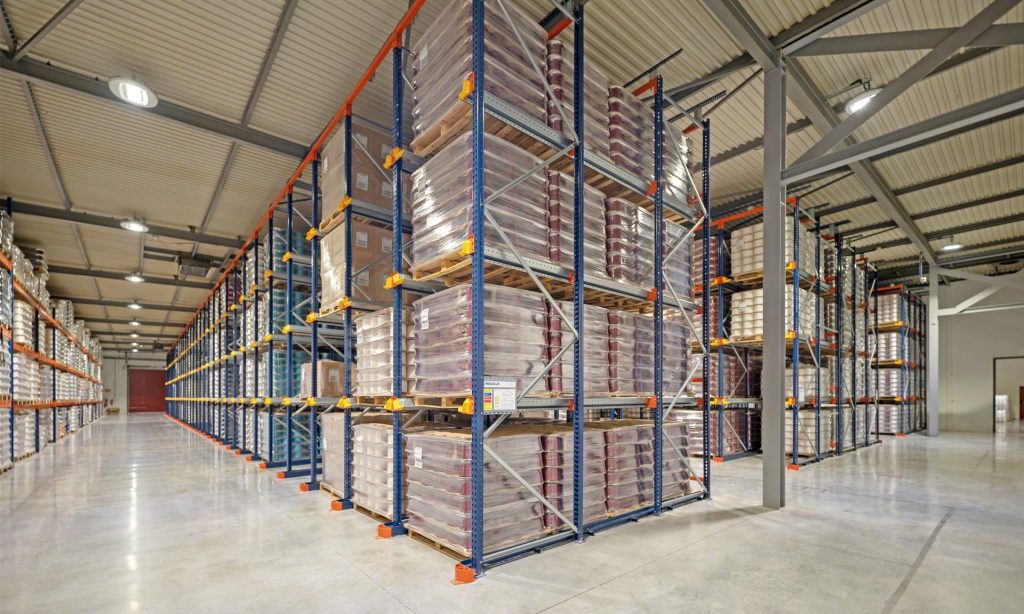
High-density drive-in rack installation — pallets stored multiple positions deep
Applications & Industries
❄️ Cold Storage & Freezer
The #1 application for drive-in rack. Maximizes refrigerated cube space where every square foot costs 3–5× more than ambient. Structural steel handles freezer temperatures (-20°F and below). Most frozen food DCs use drive-in exclusively.
🍺 Food & Beverage
Beer, soft drinks, canned goods, bottled water — high-volume products with few SKUs and large lot sizes. Drive-in provides the density to store full truckloads efficiently.
🏭 Manufacturing
Raw material staging and finished goods buffer storage. Drive-in stores bulk components waiting for production lines. Common in automotive, paper/pulp, chemicals, and building materials.
📦 3PL & Distribution
Third-party logistics providers maximizing client storage per square foot. Drive-in handles bulk-stored SKUs while selective handles fast-moving picks.
🧊 Ice & Seasonal Products
Products manufactured year-round and shipped in concentrated periods. Drive-in stores massive volumes until peak demand hits.
🏗️ Building Materials
Drywall, insulation, cement, roofing — heavy, uniform products stored in bulk. Drive-in’s structural steel handles the weight.
Advantages of Drive-In Rack
- Maximum density — store 2–3× more pallets than selective rack
- Up to 75% floor utilization — vs. ~45% for selective
- Structural steel construction — handles forklift impact and freezer temps
- No specialized forklift — standard counterbalanced or reach trucks work
- FIFO option available — drive-through configuration for date-sensitive products
- Cold storage ideal — dominant rack type in freezer warehouses
- Lower cost per pallet position — fewer aisles = more positions per sq ft
- Scalable — add lanes as storage needs grow
- Bulk-friendly — perfect for few SKUs with high volume each
- Seismic rated — engineered for all U.S. seismic zones
How Drive-In Rack Works

Step 1: Pallet Insertion
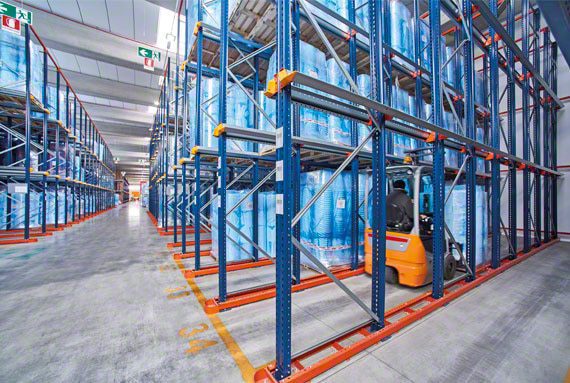
Step 2: Pallet Placement

Step 3: Pallet Retrieval
Drive-In vs. Other Storage Systems
| System | Selectivity | Density | Rotation | Best For |
|---|---|---|---|---|
| Drive-In | Low | Very High (75%) | LIFO | Bulk storage, cold storage, few SKUs |
| Selective | 100% | Standard (45%) | FIFO | Many SKUs, fast picking |
| Push-Back | ~75% | High (60%) | LIFO | More SKUs, faster cycles |
| Pallet Flow | 100%/lane | Very High | FIFO | Perishables, strict rotation |
| Double Deep | ~50% | Moderate (55%) | Modified | Step up from selective |
Choose drive-in if: You store large quantities of the same product, need maximum density, and can accept LIFO rotation.
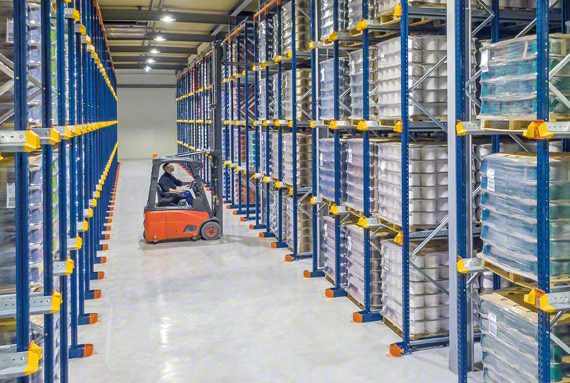
Drive-in rack maximizes warehouse floor space by eliminating aisles between rack rows
Consider alternatives if: You have many SKUs (selective), need FIFO without drive-through aisles (pallet flow), or want faster cycle times with moderate density (push-back).
When to Choose Drive-In Pallet Rack
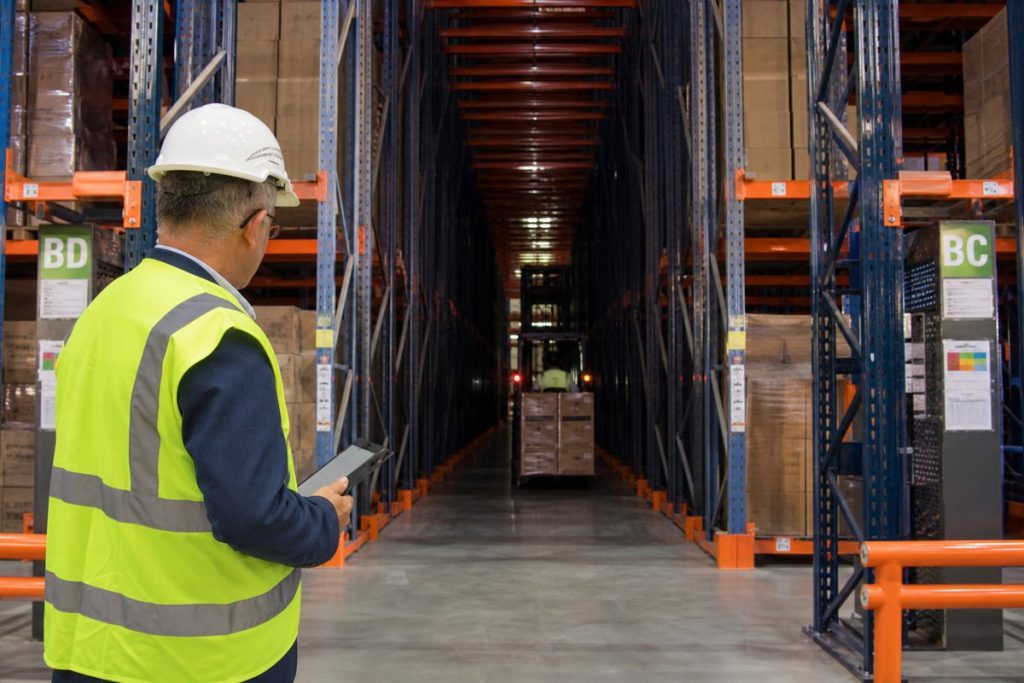
Drive-in rack delivers the highest storage density of any static system — but it’s not for every operation. Here’s how to know if it’s right for you.
Ideal Conditions for Drive-In
- Low SKU count, high volume — You store fewer than 20 different products but need hundreds or thousands of pallets of each
- LIFO inventory is acceptable — Last-in, first-out works for non-perishable goods, seasonal inventory, or buffer stock
- Space is expensive or limited — When you’re paying $8–$15/sq ft and can’t expand, drive-in stores 75% more pallets than selective in the same footprint
- Throughput requirements are moderate — You’re not picking hundreds of pallets per hour from the same SKU (push-back or pallet flow may be faster)
- Cold storage or freezer — Drive-in is the most common rack type in cold storage because building a larger freezer is extremely expensive
When Drive-In Is NOT the Best Fit
- ❌ Many SKUs with frequent picking — Selective rack gives 100% selectivity. Drive-in requires emptying a lane to reach pallets behind.
- ❌ FIFO is required — If you need first-in, first-out (perishables, expiration dates), use pallet flow rack or push-back with lane rotation instead.
- ❌ Inexperienced forklift operators — Driving into narrow lanes between uprights requires skilled operators. Frequent impacts damage guide rails and uprights.
- ❌ Very high throughput — One forklift per lane at a time. If you need 100+ pallets/hour from one SKU, pallet flow with separate load and pick aisles is faster.
💡 Hybrid Layouts
Most warehouses benefit from mixing drive-in with selective rack. Use drive-in for your top 5–10 high-volume SKUs and selective for everything else. MH-USA designs hybrid layouts that maximize both density and selectivity.
Drive-In vs. Drive-Through — Which Do You Need?
🚛 Drive-In (One Entry Point)
Forklifts enter and exit from the same aisle face. The back wall anchors the structure. This is the most common configuration — it’s structurally stronger, uses less floor space (lanes can be against a wall), and costs less. LIFO inventory. Best for: buffer stock, seasonal inventory, non-perishable bulk.
🔄 Drive-Through (Two Entry Points)
Forklifts can enter from either end. No rear wall — the structure needs additional bracing. This enables FIFO inventory (load from one side, pick from the other). More expensive and uses more floor space but essential when product rotation matters. Best for: beverage, dairy, moderate-turnover perishables.
Installation & Operational Safety
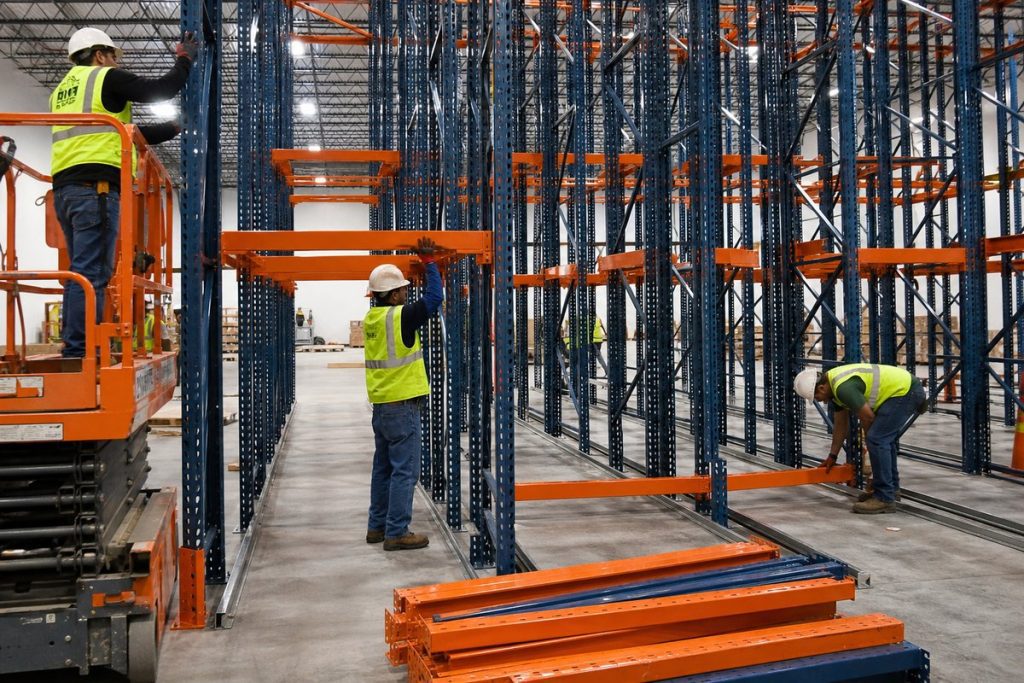
Drive-in rack has unique installation and operational requirements that don’t apply to standard selective rack.
Installation Considerations
Floor Flatness Assessment
Drive-in rack is less forgiving of uneven floors than selective. Forklifts travel 20–40 feet into narrow lanes — even slight floor variations compound over distance. We assess floor flatness (F-number) before designing the system. Grinding or shimming may be required.
Guide Rail Alignment
Floor-level guide rails must be perfectly aligned to direct forklifts into lanes without clipping uprights. Misaligned guide rails are the #1 cause of drive-in rack damage. Our crews use laser alignment for every installation.
Seismic Engineering
Drive-in rack concentrates more weight in fewer uprights than selective. Seismic calculations are critical — especially in Utah’s active fault zone. PE-stamped drawings are required for permitting. We include seismic engineering on every Utah project.
Forklift Operations in Drive-In Rack
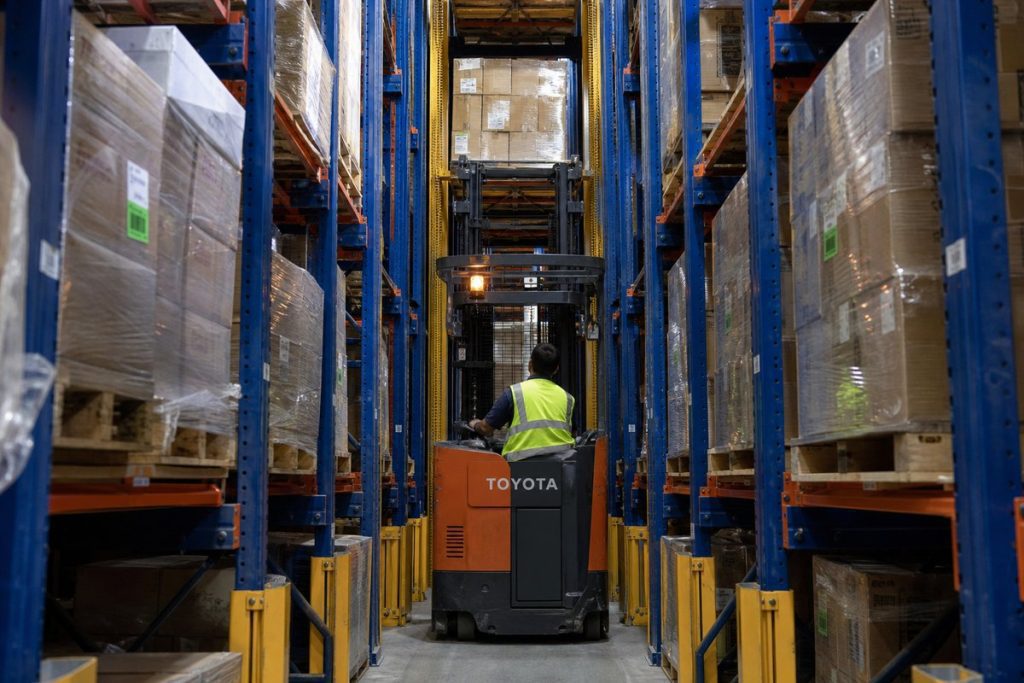
Operating a forklift inside drive-in rack requires more skill and caution than standard aisle operations. The tight clearances between uprights (typically 4–6 inches on each side) leave little room for error.
- Speed limits — Most operations enforce 3–5 mph inside drive-in lanes
- Dedicated operators — Assign your most experienced drivers to drive-in lanes
- Entry/exit protocol — Forks must be lowered and tilted forward before entering; pallets placed on rails before backing out
- One forklift per lane — Never allow two forklifts in the same lane simultaneously
- Damage reporting — Any upright or rail impact must be reported immediately — not after the shift
⚠️ Common Mistake — Overloading Lanes
Drive-in rack is engineered for a specific number of pallets deep at a specific weight. Adding extra levels or exceeding weight limits overloads uprights that carry far more cumulative weight than selective rack columns. Always check load capacity labels before adding inventory to drive-in lanes.
What Affects Drive-In Pallet Rack Cost?
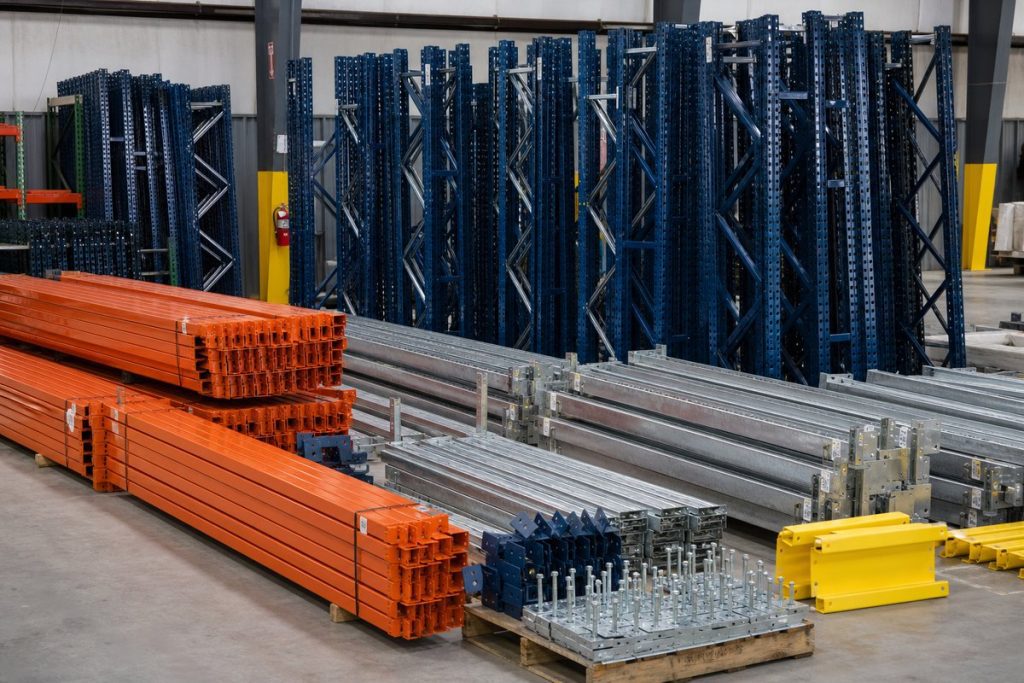
Drive-in rack costs more per bay than selective — but stores significantly more pallets per square foot, often reducing your overall cost per pallet position.
📐 Lane Depth & Height
More pallets deep = more structural bracing needed. Taller systems require heavier-gauge uprights to support cumulative loads from all levels. A 5-deep × 4-high system costs more per bay than 3-deep × 3-high but stores far more pallets per square foot.
⚖️ Pallet Weight
Each upright supports the cumulative weight of all pallets above and beside it. Heavier pallets (2,000+ lbs each) require thicker columns, heavier rail beams, and stronger base plates. Accurate weights prevent over-engineering (wasted money) or under-engineering (safety risk).
🧊 Environment
Cold storage and freezer applications require specialty coatings, stainless hardware, and materials rated for sub-zero temperatures. Frost heave on the floor can affect base plate anchoring. Cold storage drive-in projects typically cost 20–35% more than ambient installations.
🔩 Drive-In vs. Drive-Through
Drive-through configurations (open at both ends) require additional overhead tie bracing since there’s no back wall for structural support. This adds 10–15% to the structural steel cost compared to drive-in with a solid back.
🛡️ Protection Accessories
Guide rails, column protectors, end-of-aisle guards, and entry protectors are essential — not optional. Drive-in rack takes more forklift impacts than any other system. Budget 15–25% of the base rack cost for protection hardware.
🏗️ Installation Complexity
Drive-in rack has more components per bay than selective (rail beams, arm connectors, tie bracing, guide rails). Installation takes longer. For occupied warehouses, phased installation increases cost but keeps operations running.
💰 The Real ROI Calculation
Don’t compare drive-in rack cost per bay to selective — compare cost per pallet position. A drive-in system that costs 40% more per bay but stores 75% more pallets actually costs less per pallet position. Factor in the avoided cost of a larger building or second facility, and drive-in rack often pays for itself in 12–18 months.
Request a free density analysis → We’ll compare your current layout to a drive-in option and show you the pallet position difference.
Inspection & Maintenance for Drive-In Rack
Drive-in rack takes more forklift impacts than any other rack type. Regular inspection is critical to preventing catastrophic failure.
What to Inspect (and How Often)
| Component | Check For | Frequency |
|---|---|---|
| Uprights | Dents, bends, cracks, plumb alignment | Weekly |
| Guide rails | Misalignment, dislodged bolts, deformation | Weekly |
| Rail beams (pallet supports) | Deflection, connector engagement, surface damage | Monthly |
| Overhead tie bracing | Loose bolts, missing braces, impact damage | Monthly |
| Base plates & anchors | Loose anchors, cracked concrete, plate deformation | Quarterly |
| Load capacity labels | Presence, legibility, accuracy | Quarterly |
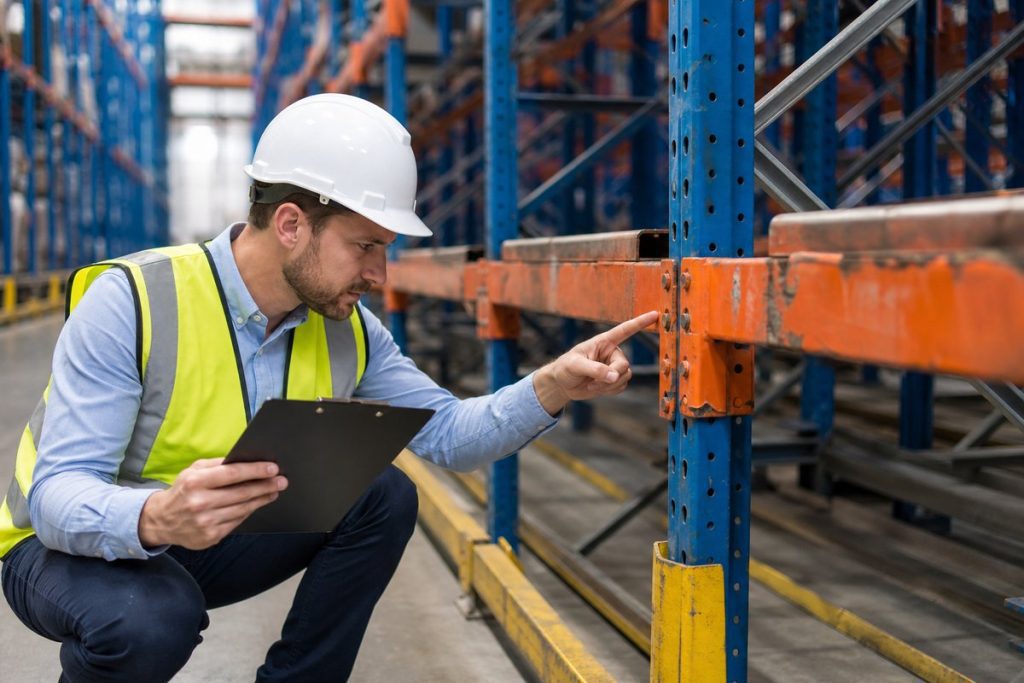
Reducing Drive-In Rack Damage
Drive-in rack damage is inevitable over time, but you can dramatically reduce it:
- Install heavy-duty guide rails — They channel forklifts into lanes and absorb impacts before they reach uprights
- Add column protectors at lane entries — The first two uprights take 80% of all impacts
- Train operators specifically on drive-in procedures — Not just general forklift certification
- Enforce speed limits — Floor markings and signage at lane entries
- Use LED lane indicators — Green (open) / red (occupied) lights prevent two forklifts entering the same lane
⚠️ When One Damaged Upright = System Failure
In selective rack, a damaged upright affects two bays. In drive-in rack, a single damaged upright can compromise an entire lane — potentially dozens of pallet positions and tens of thousands of pounds of inventory. That’s why weekly inspections and immediate damage response are not optional.
🔧 MH-USA Repair Services
We stock replacement uprights, rail beams, guide rails, and bracing for fast-turnaround repairs. Our crews can often replace damaged components without emptying adjacent lanes. Schedule a drive-in rack inspection →
Drive-In Rack Capacity Planning
How deep should your lanes be? How high can you go? Here’s the engineering that determines optimal drive-in rack density.
Lane Depth Optimization
Deeper lanes store more pallets but reduce operational efficiency. The ideal depth depends on your order patterns:
| Depth | Best For |
|---|---|
| 3–5 deep | Moderate volume, frequent lane cycling, mixed inventory |
| 6–8 deep | High-volume bulk storage, seasonal overflow, cold storage |
| 10+ deep | Very high volume, single-SKU lanes, long-term buffer stock |
Rule of thumb: lanes should be deep enough to hold one full truckload of a single SKU per lane.
Height & Load Calculations
Drive-in uprights bear significantly more weight than selective because they support multiple pallets at each level across the full depth of the lane.
- Column load example: A 5-deep × 4-high lane with 2,000 lb pallets = 40,000 lbs per lane. Interior uprights carry half this load from two adjacent lanes.
- Height limits: Most drive-in systems go 3–6 levels high (up to 35+ feet). Taller = more cost-effective per pallet but requires heavier columns.
- Forklift reach: Your forklift’s max lift height determines maximum rack height. Reach trucks typically top out at 30–35 feet.
📊 Free Density Comparison
How many more pallets could you fit with drive-in rack? Send us your building dimensions, pallet count, and current layout — we’ll design a drive-in option and show you the storage increase. Request your free comparison →
Frequently Asked Questions
Typically 5 to 10 pallets deep, though systems can go 12+. Deeper lanes provide more density but increase cycle times. Material Handling USA engineers the optimal lane depth for your operation.
Standard counterbalanced forklifts and reach trucks work — no specialized equipment needed. The forklift must fit within the lane width (typically 5’–6′). Floor-mounted guide rails help navigate cleanly.
Drive-in rack is safe when properly designed and operated. Structural steel absorbs forklift impact better than roll-formed rack. Floor guide rails, column protectors, and proper operator training reduce risk.
Yes — drive-in is the most popular rack type for freezer and cold storage. Structural steel handles sub-zero temps. High-density layout maximizes expensive refrigerated space.
Higher per-position cost than selective due to structural steel, but often the lowest total cost of storage when factoring building square footage saved. Contact Material Handling USA at (800) 326-4403 for pricing.
Explore More Pallet Rack Solutions
Need Maximum Pallet Density?
Material Handling USA designs, supplies, and installs drive-in and drive-through pallet rack systems for cold storage, warehouses, and distribution centers nationwide.
Ready to configure your pallet rack system?
Use our guided BuildQuote tool to choose the right configuration, review your parts and submit it for checkout or a formal quote.