
Pallet Rack for Manufacturing Facilities
Manufacturing operations need storage that works as hard as the production line. Raw materials in, finished goods out, and work-in-progress staged in between. We design and install pallet rack systems that support your manufacturing workflow — heavy-duty, organized, and built to handle industrial loads.
Talk with a pallet rack specialist. Call (800) 326-4403 or Email Sales@MH-USA.com

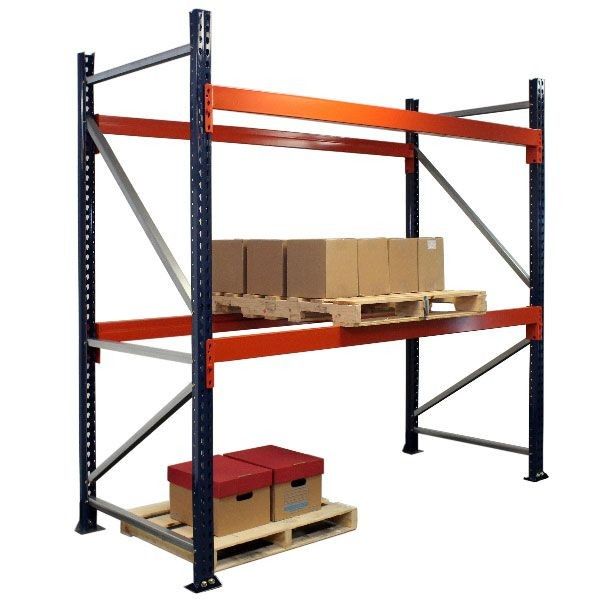
Shop Complete Pallet Rack Starter & Add-On Units
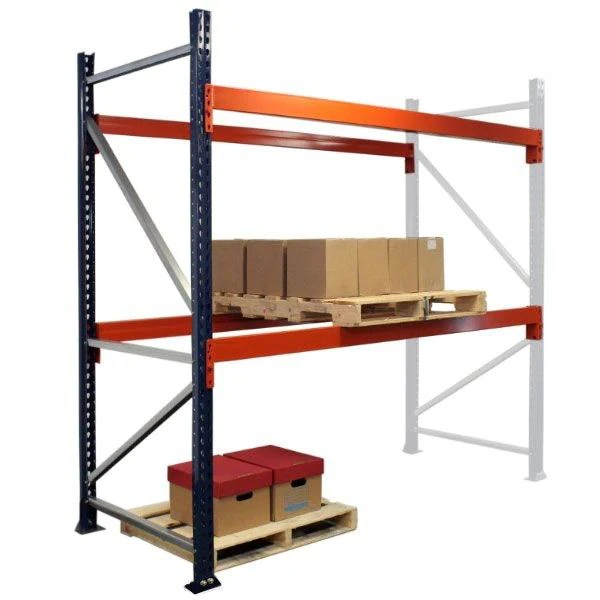
These are complete Interlake pallet rack bays you can order online: a starter unit for the first bay and add-on units that share its upright to extend a run. They suit standard selective storage. Pallet flow lanes, push-back, multi-zone plant layouts and permitted seismic installs are engineered and quoted per project, so use the quote form below for those.

Why Manufacturing Storage Is Different
Manufacturing warehouses aren’t distribution centers. They store raw materials that feed production lines, stage work-in-progress between operations, and hold finished goods awaiting shipment. Loads are often heavier and more irregular than standard distribution pallets. Steel coils, tooling, dies, castings, lumber, and oversized components all need specialized storage solutions.
Material Handling USA designs manufacturing storage systems around your production workflow. We place raw material rack near receiving and production lines, stage WIP areas between operations, and organize finished goods for efficient shipping. Heavy-duty structural rack and cantilever systems handle the loads that standard racking can’t.
Recommended Rack Types for Manufacturing
The right rack type depends on your products, throughput, and facility. Here’s what works best for manufacturing operations.
| Rack Type | Why It Works |
|---|---|
| Structural Pallet Rack | Built from hot-rolled structural steel I-beams and channels — not lightweight roll-formed steel. Handles the heavy, irregular loads common in manufacturing: steel plate, castings, tooling, motors, and heavy machinery components. Withstands forklift impacts that would destroy standard rack. Best For: Heavy industrial loads, high-impact areas, long-term durability |
| Cantilever Rack | The only rack type that handles long, bulky items without front columns blocking access. Steel bar, pipe, tubing, lumber, sheet goods, and rolled materials load and unload easily with forklifts or overhead cranes. Adjustable arm heights accommodate varying material sizes. Best For: Steel, lumber, pipe, tubing, sheet goods, rolled materials |
| Selective Pallet Rack | Direct access to every pallet position. Use for finished goods storage, incoming raw materials, and any area where you need immediate access to specific SKUs or lot numbers. Adjustable beam heights handle varying pallet sizes. Best For: Finished goods, raw material receiving, multi-SKU storage |
| Drive-In Rack | High-density storage for manufacturing operations that produce large batches of a single product. Store pallets 5–10 deep when lot numbers or production runs create uniform inventory. Maximize floor space in your finished goods area. Best For: Batch manufacturing, single-product runs, bulk raw materials |
| Push-Back Rack | Dense storage with better selectivity than drive-in. Each lane holds a different SKU or lot number. Ideal for manufacturing operations with moderate SKU counts that need density without sacrificing access. Best For: Multi-product manufacturing, staged production materials |
| Mobile Rack | The ultimate density solution for manufacturing facilities where floor space is constrained. Racks on powered carriages eliminate aisles. Often used for tooling storage, die storage, and high-value component inventory. Best For: Tooling & die storage, space-constrained facilities, high-value parts |
Manufacturing Storage Challenges We Solve
Every industry has unique racking requirements. Here’s how we address the specific challenges of manufacturing storage.
⚖️ Heavy & Irregular Loads
Manufacturing loads often exceed standard pallet rack capacities. Steel coils, castings, and machinery components can weigh 5,000+ lbs per pallet. We specify structural rack with beam capacities matched to your heaviest loads — with safety factors built in.
🏭 Production Line Integration
Rack placement must support your production workflow. Raw materials near the line, WIP staging between operations, finished goods near shipping. We design layouts that minimize forklift travel between production and storage areas.
🔧 Forklift Impact
Manufacturing environments see heavy forklift traffic with big loads. Impact damage is the #1 cause of rack failure. We recommend structural rack in high-traffic areas, column protectors on every end-of-aisle upright, and row-end guards throughout.
📐 Overhead Crane Access
Many manufacturing facilities use overhead cranes. Rack height and placement must clear crane runways and hook heights. We design rack layouts that integrate with your crane system — maximizing storage without restricting crane operations.
What Affects Manufacturing Racking Cost?
Load Capacity
Heavier loads require heavier rack — thicker gauge steel, deeper frames, stronger beams, and larger base plates. We engineer every system for your actual load weights plus appropriate safety factors.
Rack Type
Structural rack costs more per position than roll-formed rack but lasts significantly longer in manufacturing environments and handles heavier loads. The total cost of ownership is often lower when you factor in reduced damage and replacement.
Floor Condition
Manufacturing floors take a beating. Cracks, uneven surfaces, and existing anchor holes affect installation. We assess your floor condition and specify the right base plate and anchor system for your facility.
Raw Material Replenishment: Matching Rack to How the Line Pulls Material
The question that decides most manufacturing rack layouts is not “how many pallets do we have” but “how does production consume them?” A line that pulls the same resin, coil, carton or ingredient all shift needs a steady replenishment face close to the line. A plant that receives hundreds of different raw materials in small quantities needs a pick face for every one of them. Those are different pallet rack problems, and the rack type should follow the pull pattern, not the other way around.
Pallet flow: continuous feed, first in, first out
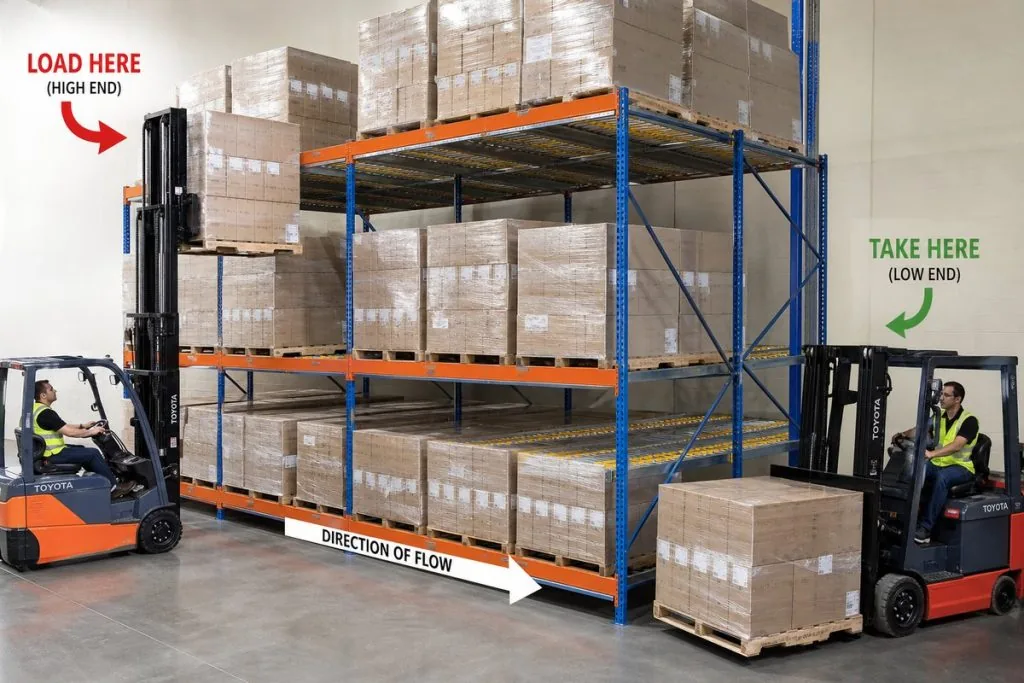
In gravity pallet flow, pallets are loaded at the high (charge) end and roll on an incline to the low (pick) end. The lift truck that replenishes never crosses the path of the truck feeding the line, and every lane rotates oldest-first automatically. It fits materials consumed in volume every day, and anything where lot age matters: resin with a shelf life, adhesives, coated stock, packaging that yellows or curls.
Fit limits: one SKU per lane, two aisles (load and pick), and pallets must be in good condition. Ridg-U-Rak, for example, tests flow lanes with the customer’s actual pallet when it is not a standard GMA pallet.

Push-back: many raw materials, one working aisle
Push-back stores two to several pallets deep on nested carts or rails, loaded and unloaded from the same aisle. Each new pallet pushes the others back; pulling the front pallet lets the next roll forward. Because every lane has its own face at the aisle, you get far more pick faces per square foot than drive-in, which is why plants with a wide raw-material list use it.
Fit limits: it is last in, first out within each lane. Keep one SKU, and ideally one lot, per lane, and do not use it for material where strict lot rotation is required.
Raw material, WIP and finished goods are not one storage problem
| Zone | What usually drives the choice | Rack that tends to fit | Watch out for |
|---|---|---|---|
| Raw material, few SKUs, high volume | Daily line consumption, lot age | Pallet flow (FIFO), deep lanes | Damaged or non-standard pallets in flow lanes |
| Raw material, many SKUs | Number of pick faces, aisle space | Push-back 2–6 deep, selective for slow movers | LIFO rotation within each lane |
| Long stock, sheet, bar, extrusion | Length and handling, not pallet count | Cantilever | Arm capacity and deflection on long loads |
| Work in process | Sequence between operations | Flow lanes or selective staging near the next operation | WIP creeping into raw-material lanes |
| Finished goods | Truck schedule, order mix | Selective, push-back or drive-in for single-SKU runs | Date-coded goods in LIFO lanes |
How many lanes per SKU?
Size lanes from the peak on-hand quantity, not the average. A useful starting guide: peak pallets on hand for a material, divided by lane depth, rounded up, gives a first estimate of the lanes it needs. Illustrative example only: a raw material the line uses 9 pallets of each day, replenished every two days, peaks around 18 pallets, which in 6-deep flow lanes works out to 3 lanes. That simple figure leaves out safety stock, lot segregation and operating reserve, so treat it as a sizing guide, not a design guarantee. If you mix lots in one lane you lose lot control, so a material that arrives in many small lots may need more, shallower lanes even though deeper lanes look denser on paper. Partly empty lanes are the hidden cost of deep storage, so we check the SKU-by-SKU numbers before recommending depth.
Two manufacturer project examples
Food production plant, Horse Cave, Kentucky (T. Marzetti Company): a new production facility needed a large variety of raw materials, quick access to a continuous flow of material and high-density storage of similar material. The installed solution was 6-deep gravity flow rack, 660 lanes and about 4,000 pallet positions.
Composite decking and vinyl window/door plant, Monroe, Ohio (Deceuninck North America): expanding capacity made organizing a growing variety of raw materials in a high-volume production environment a problem. The solution was 3-, 4- and 7-deep push-back, 3 and 4 levels high, to use vertical space while keeping quick access.
Project facts summarized from Ridg-U-Rak published project profiles (T. Marzetti Company, Gravity Flow Rack Storage; Deceuninck North America, Push-Back Storage). These were manufacturer projects, not MH-USA installations; we include them because they show how the systems behave in real production plants. MH-USA is an authorized Ridg-U-Rak dealer.
If your plant has both patterns, the usual answer is a mix: flow lanes for the few materials the line eats all day, push-back for the long tail, and selective or cantilever for slow and awkward items. Send us your material list with daily usage and pallet sizes and we will come back with lane counts per zone.
Get a free quote
Tell us what you are storing, the room size and your timeline. A project specialist will follow up with layout options and pricing. Prefer to talk? Call (800) 326-4403.
Manufacturing Pallet Rack FAQ
Structural pallet rack built from hot-rolled steel I-beams handles the heaviest loads — 10,000+ lbs per beam pair is achievable. For extremely heavy or oversized items, we design custom structural solutions with engineered load ratings specific to your products.
Absolutely. We measure your facility, map existing equipment and production lines, and design rack layouts that integrate with your workflow. Rack placement is optimized to minimize forklift travel between production and storage areas.
Yes. Cantilever rack is designed specifically for long, bulky items like steel bar, pipe, tubing, lumber, and sheet goods. We supply single-sided and double-sided cantilever in heights up to 20+ feet with arm capacities matched to your materials.
We coordinate rack installation around your crane systems. Rack heights are specified to clear crane runways and hook heights. During installation, we work with your crane operators to stage materials efficiently and avoid conflicts.
Yes. We regularly install rack in active manufacturing facilities. We plan installations in phases — working nights, weekends, or in sections — so your production lines keep running. Safety barriers and coordination with your team ensure safe operations throughout.
Use pallet flow when a few materials are consumed in volume every day and lot age matters, because flow lanes rotate first in, first out and separate the replenishment aisle from the line-feed aisle. Use push-back when you have many different raw materials and need a pick face for each from one aisle; it is last in, first out within a lane, so keep one SKU or lot per lane.
As a first estimate, divide the peak number of pallets you hold for that material by the lane depth and round up. Size from peak, not average, then add lanes for safety stock, operating reserve and any lots that must be kept separate. It is a starting guide; final lane counts come from a per-SKU review of your usage data.
Pallet Rack for Other Industries
Need Pallet Rack for Your Manufacturing Operation?
Free quotes, free warehouse design, and professional installation. Let’s build the right racking system for your business.
Related Industry Solutions:
Production Warehouse Pallet Rack for Advanced Manufacturing
An advanced manufacturing plant runs three different storage problems in one building: inbound raw material, work in process that has to stay in sequence, and finished goods waiting on a truck. One rack type rarely serves all three well. The same building usually runs a fourth: the maintenance storeroom. See how we approach industrial racking for an MRO parts storeroom at a water reclamation facility.
Raw material and long stock
Selective rack for palletised material, cantilever for bar, tube, extrusion and sheet that would otherwise sit on the floor in bundles.
WIP that must stay in sequence
Flow rack and push-back keep first-in-first-out discipline on subassemblies so the line does not consume parts out of order.
Finished goods and shipping buffer
Deep-lane drive-in or push-back buys density in the shipping bay when you are building to a weekly truck rather than a daily one.
The pattern that causes the most pain in growing plants is storing everything selectively because that is what was installed first. Selective rack gives perfect access and poor density, so as SKU count and volume rise the building fills with aisle. Mixing in density where the SKU profile allows it, and only there, is normally worth more recovered floor than any single equipment purchase.
Seismic requirements are not optional here. Utah and much of the Mountain West sit in seismic design categories that dictate anchorage, frame capacity and permitting for storage racks, and a plant adding a production line frequently needs the rack permit as part of the same submittal.
Elsewhere in the advanced manufacturing cluster
- Advanced Manufacturing Storage Solutions — the cross-category hub for plants, OEMs and equipment manufacturers
- Parts Storage & Kitting — line-side bins, kit carts and staging that feed assembly accurately
- Assembly Workstations — ergonomic benches and production-line furniture built around throughput
- Manufacturing Floor Space Recovery Calculator — estimate how much production floor a storage change would give back
We will review your SKU profile, pallet counts and clear height and come back with a rack strategy per zone rather than a single system for the whole building.
Free Manufacturing Storage & Material Flow ReviewCall (800) 326-4403
Ready to configure your pallet rack system?
Use our guided configurator to choose the right configuration, review your parts and submit it for checkout or a formal quote.