
Home › Food Plant Supplies
Food Plant Supplies & MRO Storage
Stainless wash-down work surfaces, dunnage and off-floor storage, sanitation supply staging, color-coded tool storage, mobile ingredient carts and MRO storeroom shelving for food and beverage plants.
1997
Serving plants in the West
17,000+
Standard Eagle models
50
States shipped
1 PO
Supplies, storage & MRO
Food Processing Plant Supplies, Specified for the Room They Live In
Production equipment gets engineered. The supplies and storage around it usually just get bought — which is why so many plants end up with a galvanized shelf rusting in a thaw room, sacks stacked on the floor in front of the sanitation crew, and a storeroom where nobody can find the right gasket at 2 a.m.
This page is about that second category: the food plant supplies, storage and sanitation-support equipment that surrounds the process line. Stainless work tables and sinks in wash-down zones. Dunnage racks that get ingredients and packaging off the floor. Mobile tote and ingredient storage. Staging for sanitation chemicals, brushes and squeegees. Color-coded utensil and tool storage that keeps allergen and zone segregation honest. And the MRO storeroom shelving and bins that hold the spares keeping the line running.
MH-USA has supplied this equipment from Salt Lake City since 1997 and we represent Eagle Group, founded 1947 in Clayton, Delaware, with more than 17,000 standard models across stainless, wire, solid, epoxy and polymer product. One supplier covers the wash-down zone, the dry warehouse and the parts crib without three vendors and three freight bills.
Food Handling Solutions by Plant Zone
The fastest way to build a supply list is to walk the plant zone by zone. Wetness, traffic and sanitation frequency decide the material, finish and mobility of everything you put in a room.
 Receiving & Ingredient StorageDunnage racks and platforms under sacks and cases, wire shelving for staged raw material, and case racks that rotate stock automatically.
 Wet Prep & Wash-Down ZonesType 304 stainless tables, enclosed bases where debris cannot be allowed under a table, deep-drawn sinks and floor drainage.
 Sanitation & Chemical StagingMop and flush-floor basins, hose and tool hanging, eyewash-equipped hand sinks near chemical stations, drying and drainage racks.
 MRO & Maintenance StoreroomBin shelving for bearings and fittings, cantilever racks for stock bar and belting, lockable modules for controlled items.
 Transport Between ZonesStainless and wire carts, dolly trucks and shelf trucks rated for wet floors and hose-down cleaning.
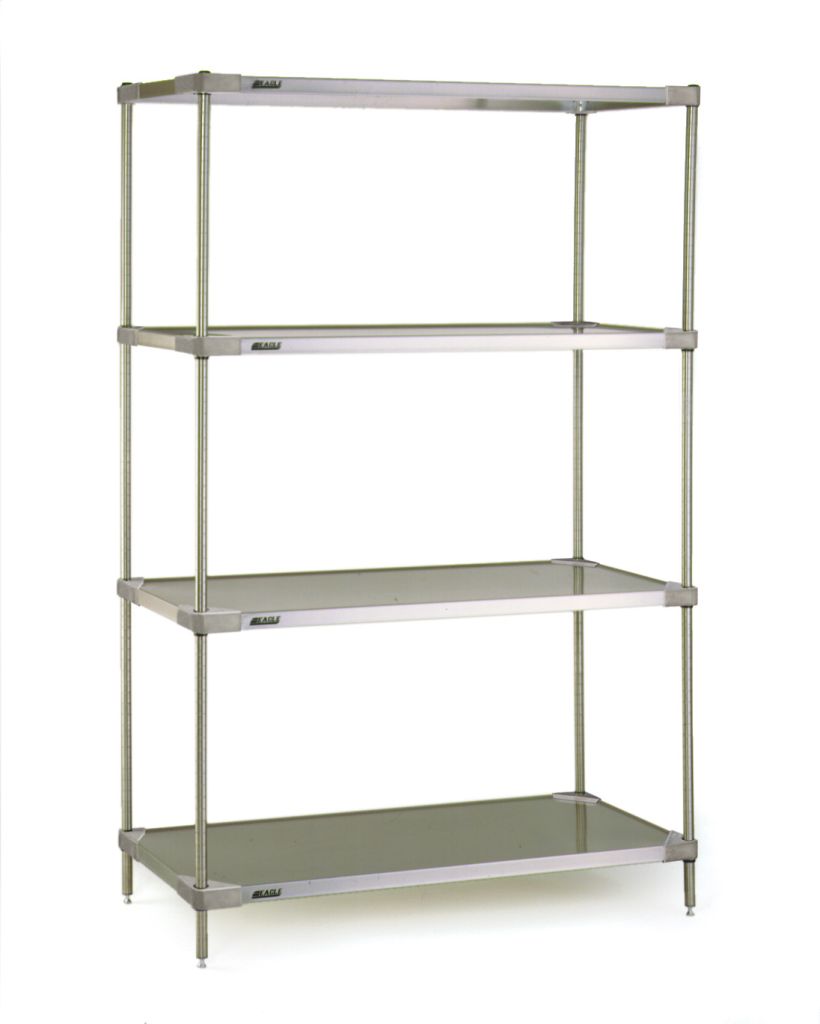 Packaging & ConsumablesSolid and epoxy shelving for film, labels, cartons and gloves, plus lockable modules for high-value or controlled consumables.
Start with a zone map, not a product list
Send us a floor plan with the wet zones shaded and we will mark up which areas justify stainless, which can run epoxy, and where polymer or mobile equipment saves cleaning labor. It usually cuts the stainless line item substantially.
Wash-Down Zone Work Surfaces and Sinks
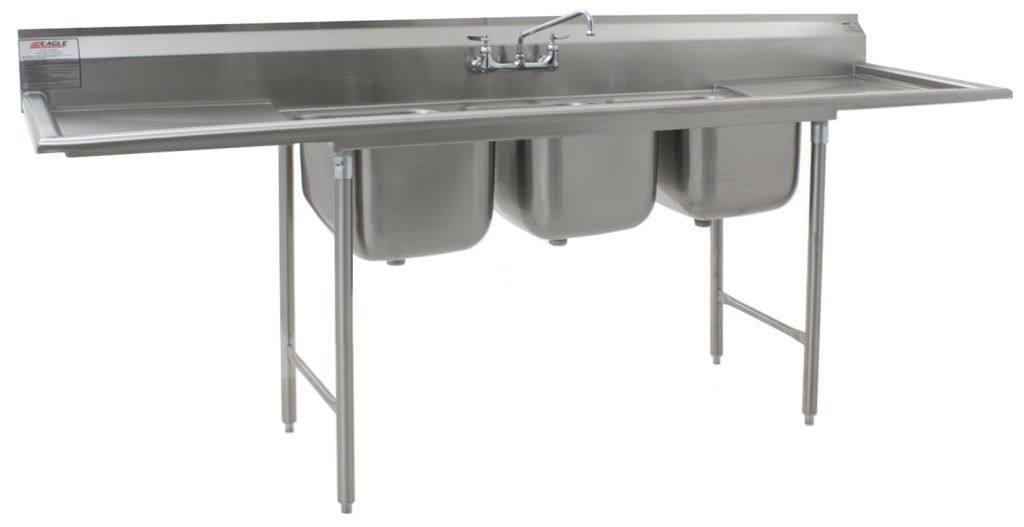
A wash-down zone punishes everything in it: hot water, caustic and acid cycles, high-pressure spray, and a crew in a hurry. Work surfaces there should be type 304 stainless, welded rather than bolted where possible, and detailed so water leaves rather than pools.
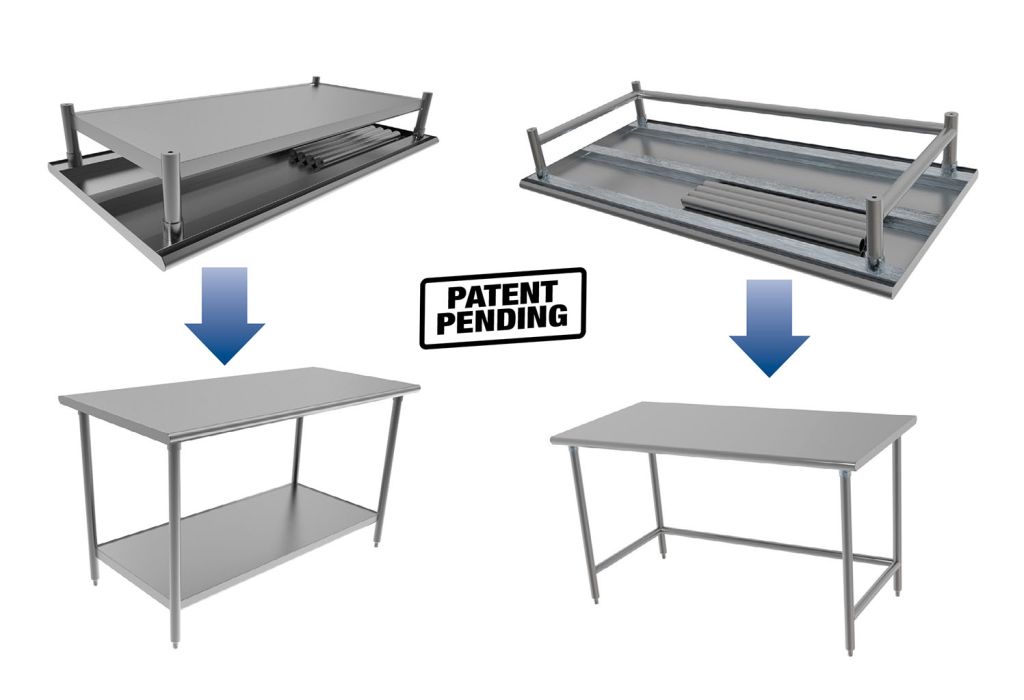
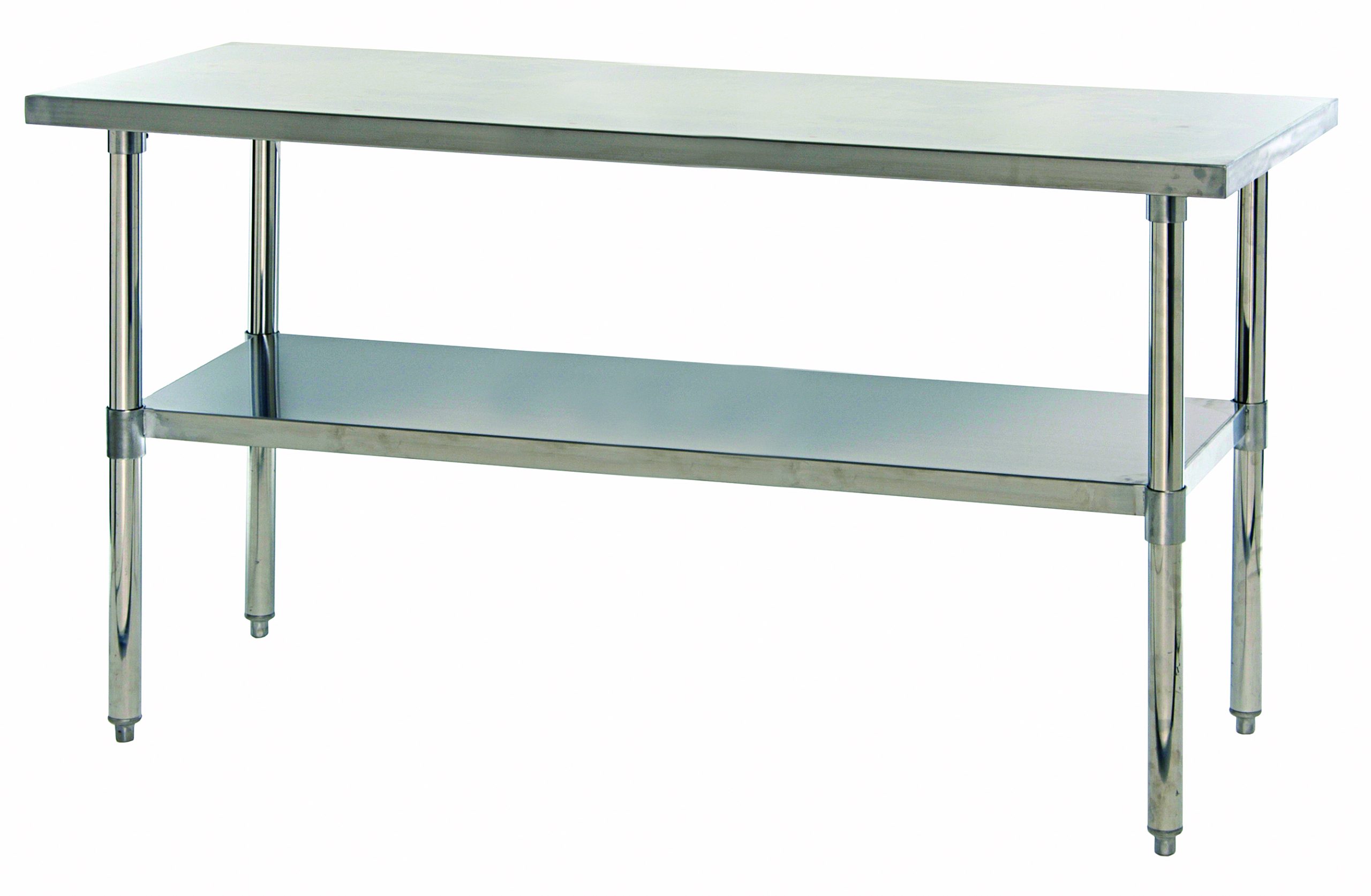
Eagle’s knockdown welded-base worktables suit plants well: a rigid welded base with knockdown construction that cuts freight, 16-gauge 1⁵/₈-inch legs, and a choice of marine-edge stainless undershelf or stainless C-frame tubular base. Where nothing can be allowed under the table, Spec-Master enclosed worktables are all-welded with 20-gauge type 430 stainless doors, open front, sliding or hinged, and a mechanically polished satin top.
For sinks, the 414 Series carries 14-inch seamless deep-drawn bowls, an extra-high backsplash with upturn, leg gussets welded to plates adjacent to the bowls, and creased integral drainboards. Deep bowls matter more in a plant than in a kitchen — you are washing parts, tote lids and utensils.

Off-Floor Storage: Dunnage Racks, Platforms and Drainage
Nothing on the floor is the oldest rule in a food plant and the one most often broken by 3 p.m. on a busy receiving day. The fix is to have enough dunnage capacity that stacking on the floor is never the fast option — and to pick the dunnage material that matches the room.
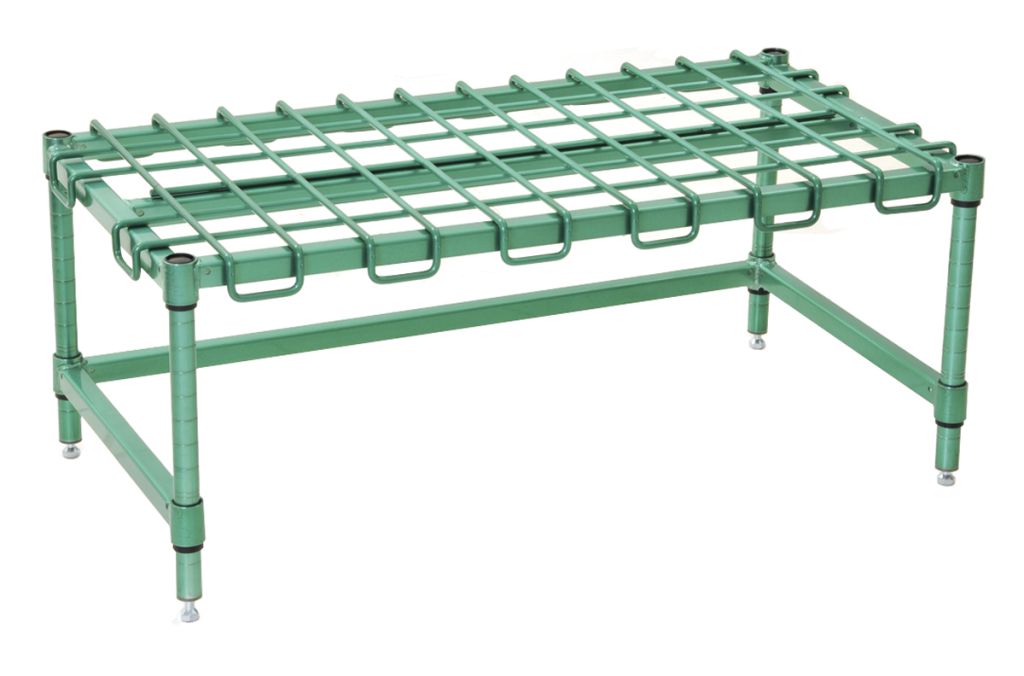 Wire Dunnage RacksDunnage shelf with 1-inch posts grooved on 1-inch centers and a three-sided frame, 14-inch height, stationary or mobile with four 5-inch swivel casters (two braked), in Eaglegard, chrome or stainless.
 Aluminum Dunnage RacksAll-aluminum welded construction, 1½-inch square tubular legs, 8-inch and 12-inch heights, no assembly. Nesting models stack and rate 2,700–3,200 lb.
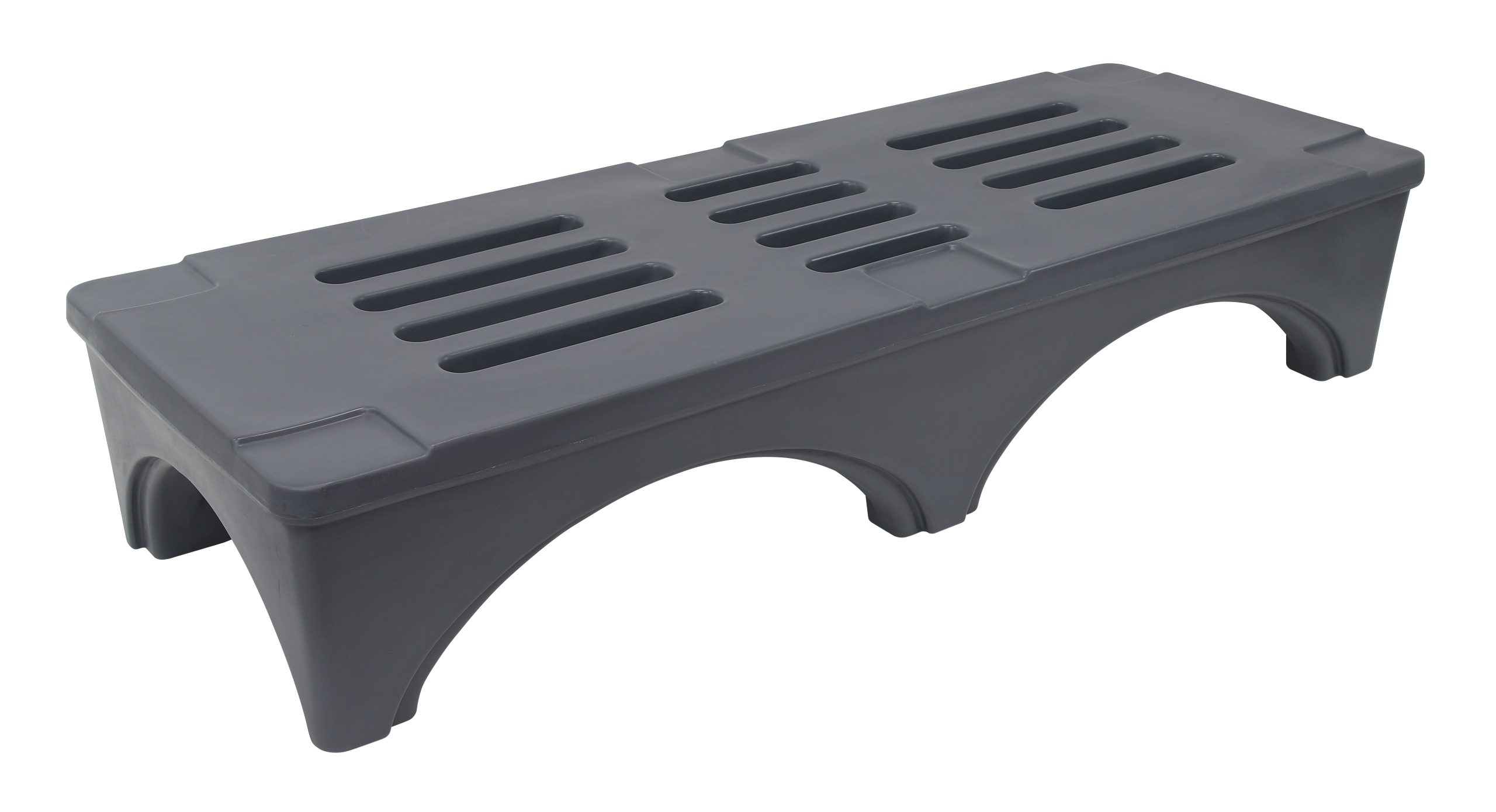
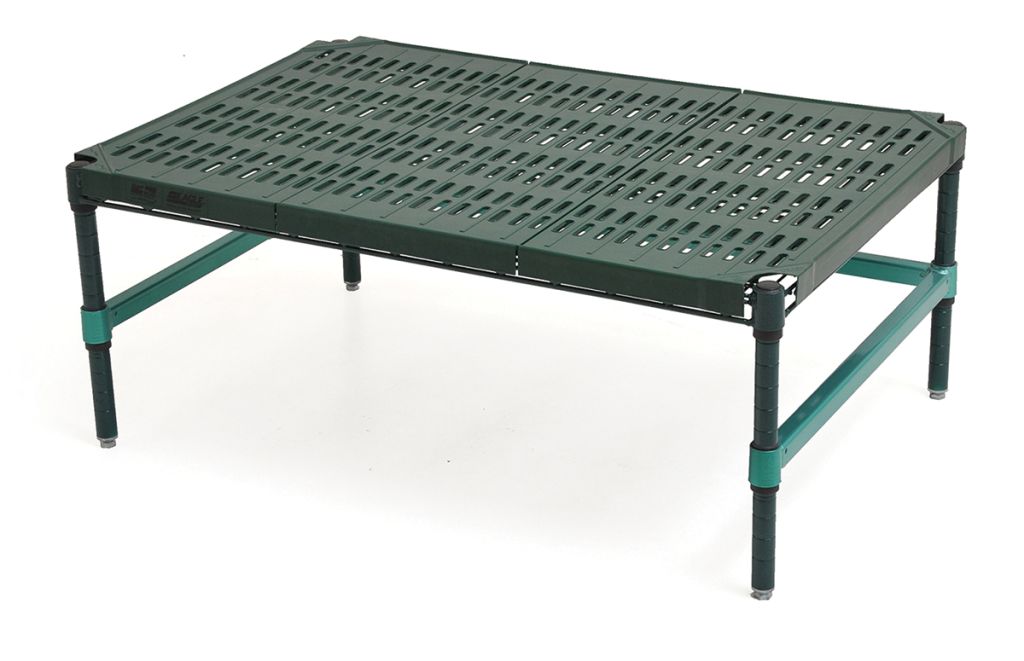 Polymer Dunnage RacksQuadPlus green polymer louvered or solid mats over a wire shelf, up to 1,000 lb. stationary and 800 lb. mobile, 14-inch height — mats lift out for washing.
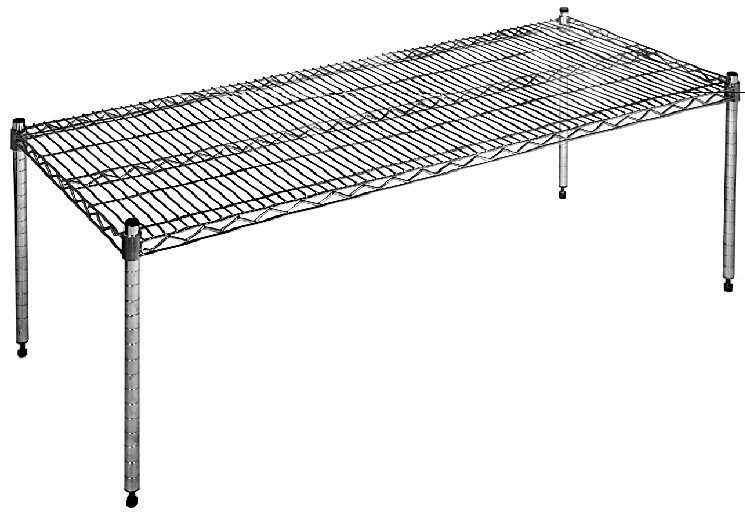 Dunnage PlatformsLow open-wire platforms that permit air circulation and reduce trapped moisture under lighter staged loads.
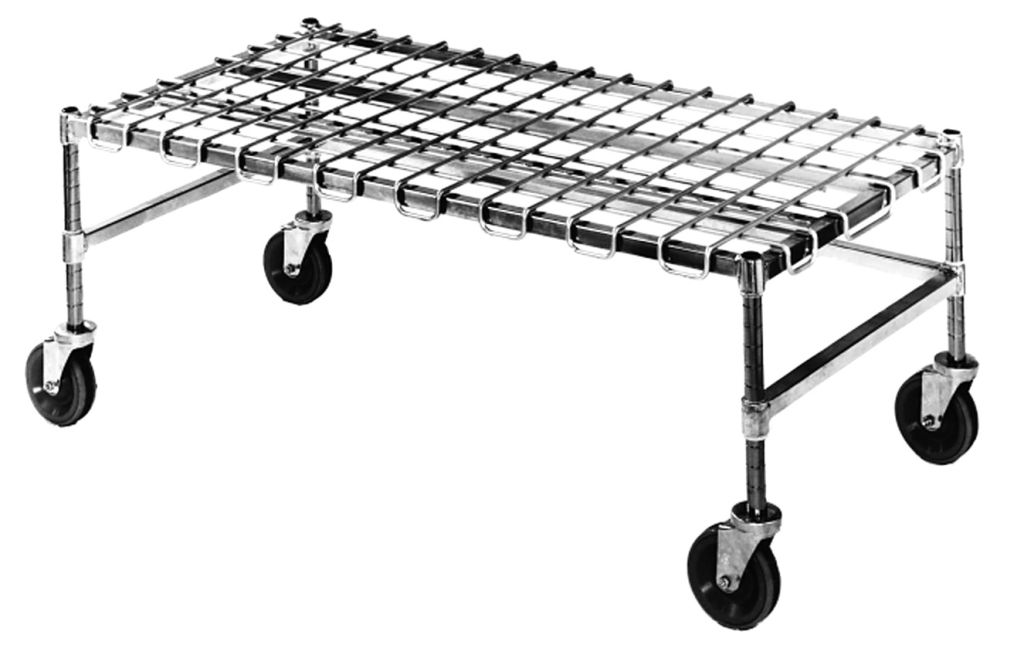 Mobile Dunnage RacksThe same 14-inch dunnage shelf on four 5-inch swivel casters (two braked) so a lane can be cleared for sanitation without unstacking.
 Floor Drains & Drainage14-gauge type 304 drains with polished coved corners, a perforated drain that inverts as a beehive strainer, up to a 4-inch waste pipe, subway-style stainless or fiberglass grating.
Mobile Ingredient and Tote Storage

Minor ingredients, allergen-controlled items and partial totes are where plants lose the most time: too small for pallet racking, too heavy to hand-carry, and moving between warehouse, scaling room and line several times a shift. That is a mobile storage problem, not a shelving problem.
The answer is a small fleet of purpose-built mobile units: mobile dunnage racks under bulk sacks, dolly trucks for staged totes, and case racks that load from the rear and dispense from the front so stock rotates on its own. Full-size Panco can racks are all-welded high-strength aluminum with square tubular framing, cross-braced top and bottom, stationary with adjustable feet or mobile on 4-inch non-marking polymer-tread swivel casters, two braked.
Two sizing rules: size the unit to the tote you actually run rather than to a standard shelf width, and check the narrowest doorway and the drain covers the unit must cross before picking a caster — a small caster that stalls on a grate turns a mobile unit into a stationary one.
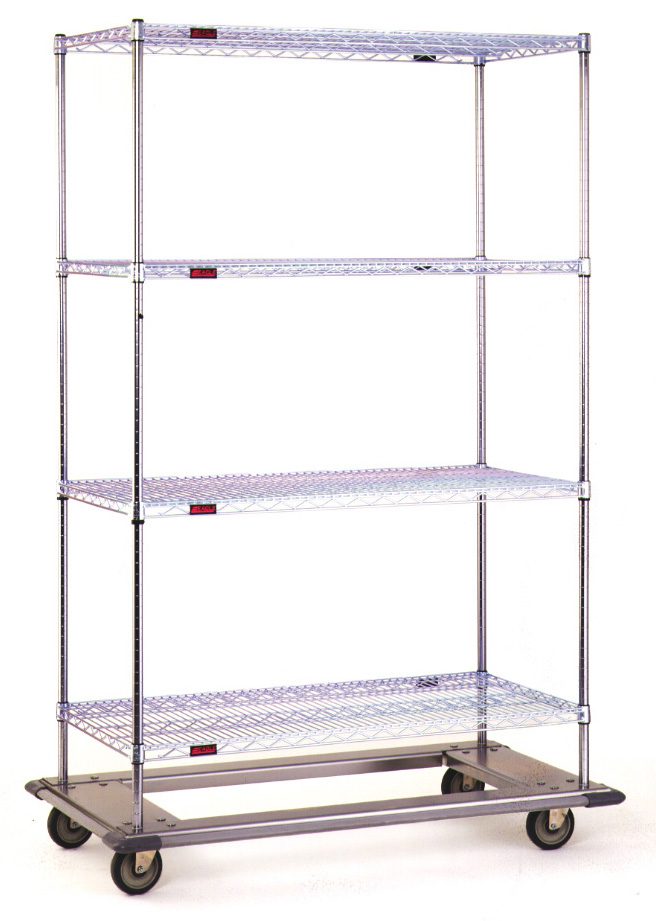
Food Sanitation Equipment and Supply Staging

A sanitation SOP is only as good as the physical staging behind it. If squeegees live in a corner, drums sit under a table and hoses coil on the floor, the crew improvises — and improvisation is what auditors write up.
A stationary mop basin in type 304 stainless with an 8- or 12-inch deep-drawn coved-corner bowl, drain and flat strainer plate handles the classic bucket-and-mop station. Where crews dump heavy water, flush floor mop sinks are better: heavy-gauge type 304 with a built-in pitch to drain, a 16½-inch backsplash plus end splashes, anti-splash angles front and rear, and subway-style grating — nobody lifts a full bucket.
Near chemical staging, a hand sink with a built-in eye/face wash puts the emergency fixture where exposure actually happens instead of down a corridor. Add wall shelving above the station for concentrate and PPE, hanging storage for brushes and squeegees, and a dedicated cart so a crew carries a full kit to the line in one trip.
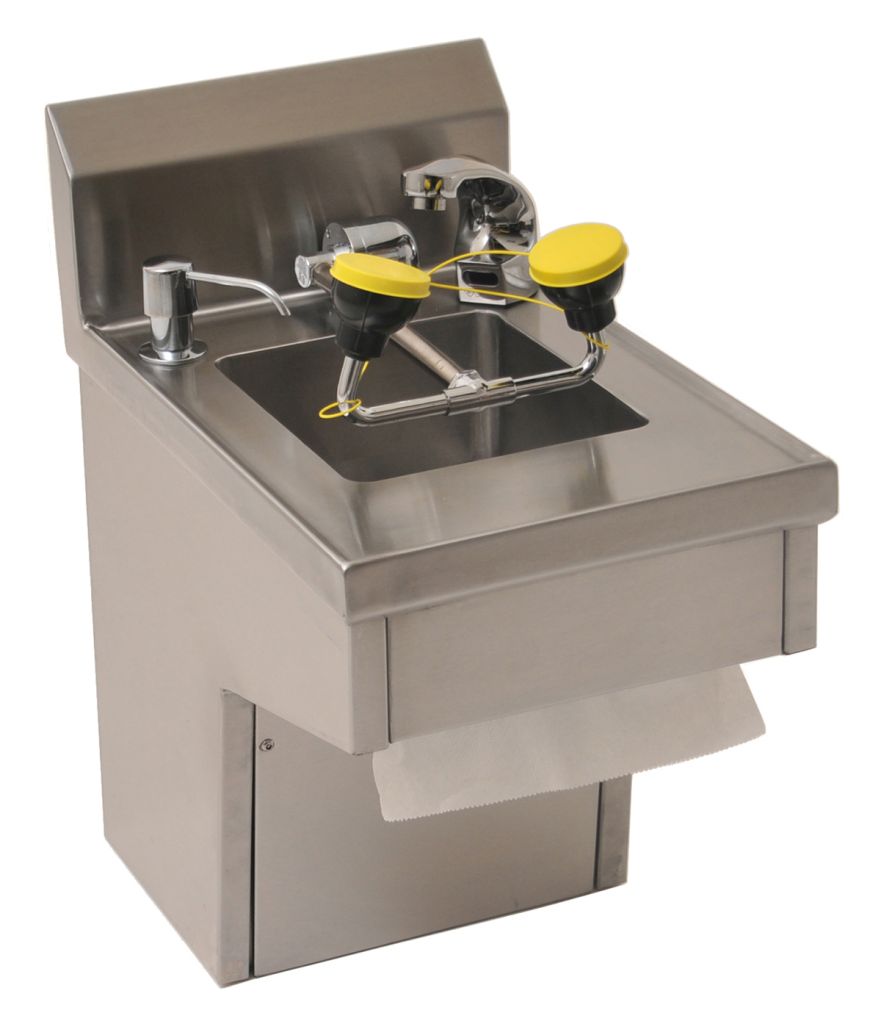
Color-Coded Tool, Utensil and Drying Storage

Color coding is a control, and controls fail when storage is inconvenient. If the red raw-zone scoop and the blue RTE scoop hang on the same rack, the color scheme is decoration. Storage has to enforce segregation physically: one rack per zone, mounted in that zone, sized so every tool has a hook and a missing tool leaves a visible gap.
Wall-mounted pot and utility racks do this well — 3/16-inch by 2-inch aluminum or stainless flat bar with a stainless double-prong sliding hook every 12 inches and stainless mounting brackets. Slide the hooks to match your tool shapes and label the rack to the zone color.
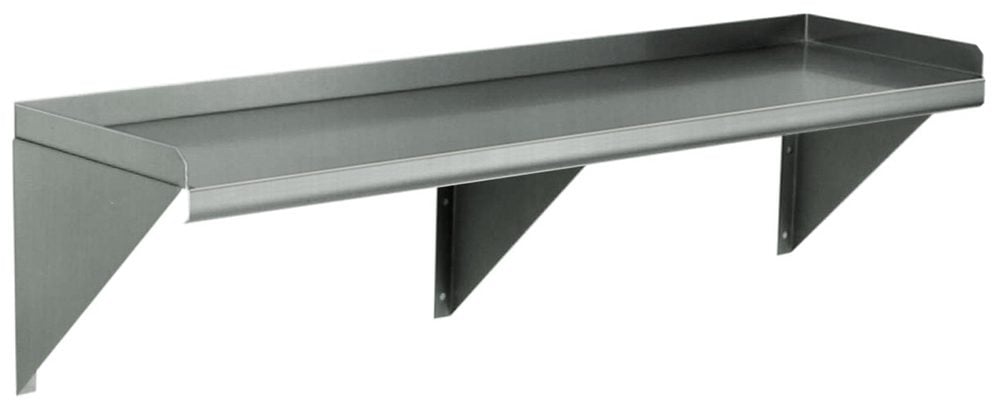
Drying matters as much as hanging: give utensils open wire where air moves on all sides so water leaves instead of pooling. Wall-mounted stainless shelves in 16-gauge type 430, 16-gauge type 304 or 14-gauge type 304 with a 1½-inch roll front and 1½-inch upturn on the rear and ends add dry staging above the work zone without taking floor a hose has to reach.
MRO and Maintenance Storeroom Storage
The maintenance storeroom has the highest cost of failure in the plant. A downtime hour on a packaging line is worth more than the entire shelving package, and most of the delay is not the repair — it is finding the part.
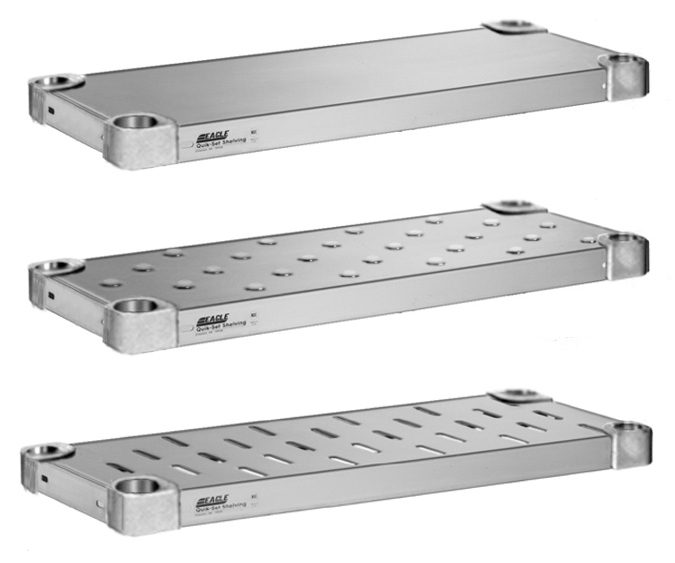
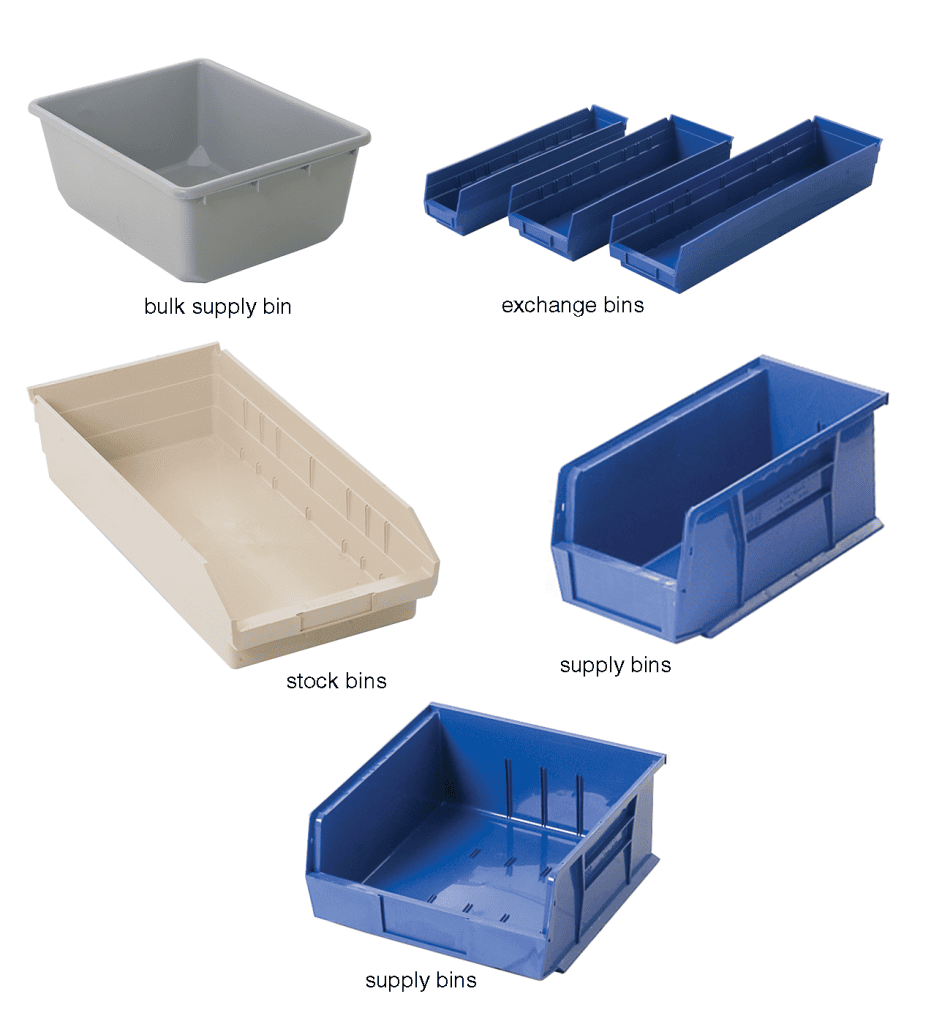
The layout that works is boring and repeatable. Small consumables go in stackable, nestable polypropylene bins with molded label slots on epoxy or wire shelving, arranged by system rather than part type so a mechanic pulls a whole repair kit from one bay. Mid-weight spares go on solid or Quik-Set shelving rated for the load: 14- or 16-gauge stainless or galvanized with Valu-Master gray or Valu-Gard green epoxy, 2-inch downturn with marine edge, aluminum corner castings, and 1,000 lb. evenly distributed per shelf.
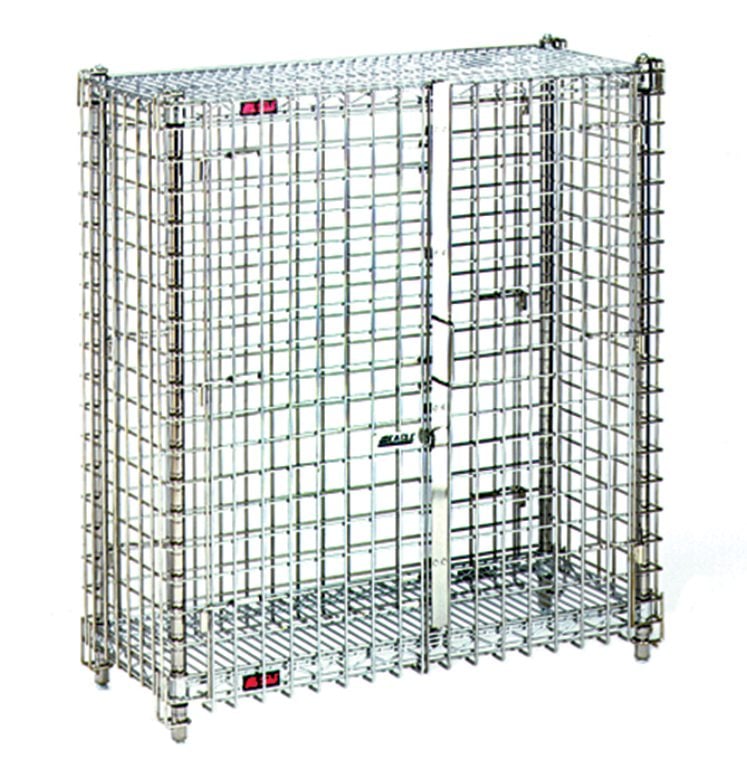
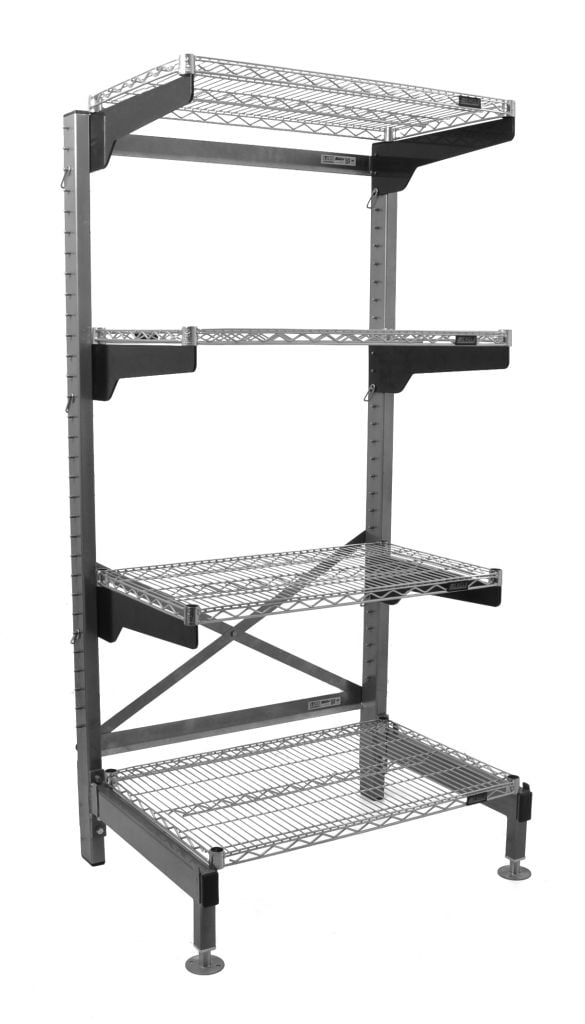
Long stock — bar, shafting, belting, tubing — belongs on cantilever shelving. Q-LEVER units use a 76-inch upright with all-wire shelves, adjust in 2-inch increments without tools, need no wall bolting and take add-on bays. Controlled items go behind security modules that convert part of a shelving unit into a lockable enclosure with hinged or flip-up doors.

Cart and Rack Transport in Wet Areas
Carts fail in food plants for two reasons: the frame corrodes, or the casters do. Both are specification decisions, not durability accidents.
For hose-down areas, stainless utility carts with three shelves welded to angle legs and a galvanized caster channel frame hold up where a painted cart will not. Choose the version with a 1-inch upturn on all sides of all shelves if you move liquid or parts trays; the standard version has the upturn on ends and rear only.
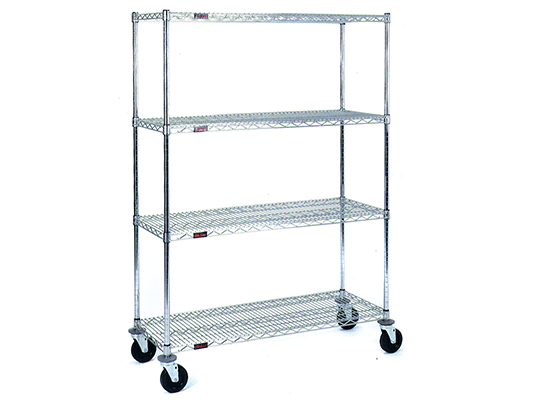
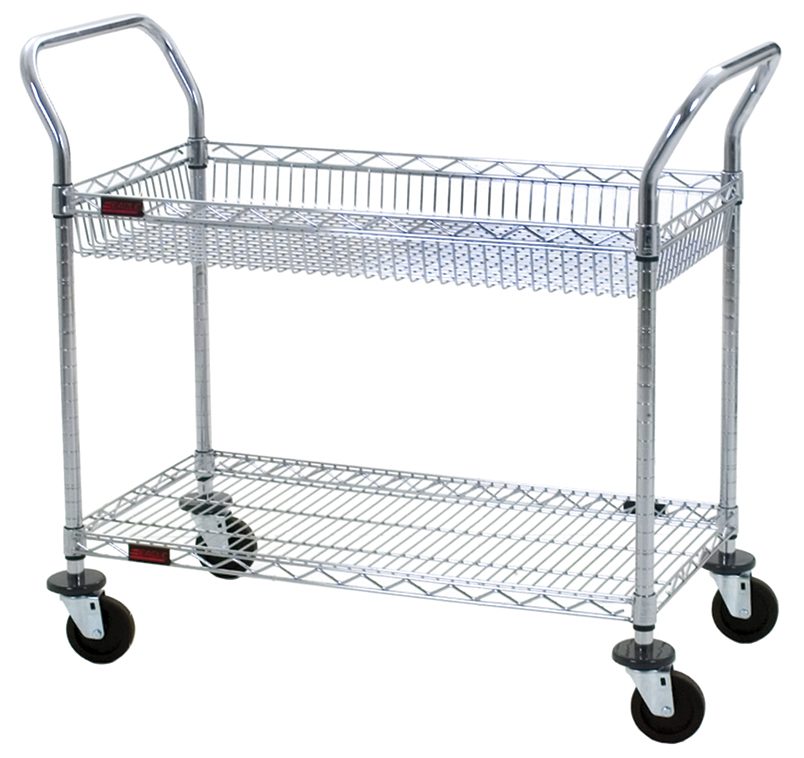
Where airflow beats a solid deck — drying utensils, staging small parts — chrome-plated wire basket carts reduce moisture and dust buildup and run on swivel stem casters with bumpers. Dolly trucks combine four wire shelves with an aluminum truck dolly and wrap-around bumper, ship knockdown to save freight, and take 5-inch resilient or poly casters. Specify brakes on at least two casters and go up a caster size wherever a cart crosses a trench drain.

Stainless vs. Epoxy vs. Polymer: Choosing Food-Grade Material Handling Systems
This table settles most of the arguments in a plant supply spec. The question is never what is best — it is what this room does to a surface every day.
| Material / finish | Where it belongs | Why | Watch out for |
|---|---|---|---|
| Type 304 stainless | Daily wash-down, wet prep, caustic and hot-water cleaning | Handles chemistry and pressure spray, welds cleanly, sheds no coating | Highest cost per foot; overkill in a dry packaging room |
| Type 430 stainless | Doors, splashes and panels in moderate-duty areas | Lower-cost stainless for components out of the direct spray | Less corrosion resistance than 304; avoid chloride-heavy zones |
| Galvanized + gray/green epoxy | Dry storage, packaging supplies, MRO storerooms | Strong and economical; epoxy finishes resist scuffing | Coating chips start corrosion in wet rooms |
| Chrome / Eaglegard wire | Dry-to-damp storage, drying racks, carts needing airflow | Open wire moves air, reducing trapped moisture and dust | Not for constant caustic exposure or standing water |
| Polymer (shelf mats, dunnage) | Coolers, thaw rooms and wet staging | Mats lift out for a wash cycle; no corrosion path | Lower load ratings: about 1,000 lb. stationary, 800 lb. mobile |
| Aluminum | Heavy stacked cases, nesting dunnage, transport racks | High strength-to-weight; nesting racks rate 2,700–3,200 lb. | Softer than steel; edges dent on forklift contact |
Gauges, Heights and Spec Options
Use this as a checklist when you write the requisition. Every line is an option we ask about on a quote, and deciding them up front keeps an order from turning into three change orders.
| Spec item | Typical options | How to decide |
|---|---|---|
| Worktable top gauge | 14 ga (heavy), 16 ga (standard prep), 18 ga (light staging) | Go 14 ga wherever equipment sits on the table or carts strike the edge |
| Table base | Welded, knockdown welded, C-frame tubular, enclosed cabinet | Enclosed base where nothing can sit under the table; knockdown cuts freight |
| Mobility | Stationary feet, 4″ or 5″ swivel casters, two with brake | Larger casters for trench drains and thresholds; brakes on any loading unit |
| Finish | 304 stainless, 430 stainless, chrome, Eaglegard, gray or green epoxy | Match the wash-down frequency of the room, not the plant average |
| Custom | SpecFAB modifications and fully custom fabrication | When a standard model is within inches of right — ask before you buy two |
Ask for listings in writing
Sanitation listings are model-specific rather than line-wide. Send us your model numbers or your equipment schedule and we will confirm the current listing status for each item in writing before you order.
When the Storeroom Is Full and the Building Is Not Growing

The Floor-Trak system puts wire or polymer sanitary shelving on floor track so units slide together, collapsing every aisle but the one you are standing in — Eagle states it stores up to 50% more items in the same area. In a cooler or freezer that is usually the highest-return storage change available.
If your problem is bigger than shelving — pallet loads, bulk backstock, a freezer that needs racking — that is our core business. Start at food & beverage storage solutions, the industry hub this page sits under.
Get a Plant Supply and Storage Quote
Send a zone map, a takeoff or photos of the area. We come back with model numbers, finishes, lead times and freight — one quote covering wash-down, sanitation, ingredient storage and the MRO crib. Call (800) 326-4403.
Brands We Represent
This is our generic food plant supplies page. If you already know the manufacturer you want to standardize on, start here:
- Eagle stainless equipment for processing plants — the Eagle-specific spec detail, series comparisons and model guidance
- Commercial foodservice equipment — the full Eagle Group foodservice catalog hub
- Sanitation-rated shelving solutions — shelving specified for food and clean environments
- Stainless steel shelving — the generic stainless shelving product page
- Utility carts — carts and shelf trucks across manufacturers
- Food & beverage storage solutions — the industry hub covering racking and warehouse storage
How to Order Food Plant Supplies Through MH-USA
Need equipment on the handling side rather than the supply side? See food service material handling solutions.
Shop Food Plant Storage & Work Surfaces Online
Buy select items directly from our online store, or request a quote for volume, custom sizes and freight-rated orders.

Get a free quote
Tell us what you are storing, the room size and your timeline. A project specialist will follow up with layout options and pricing. Prefer to talk? Call (800) 326-4403.
Food Plant Supplies: Frequently Asked Questions
What counts as food plant supplies?
Do you act as a sanitation distributor for a food plant?
Stainless, epoxy or polymer — which should I specify for a wash-down area?
How high off the floor does stored product need to sit?
Is the equipment sanitation-listed?
Can you build a work table or rack to a nonstandard size?
How do I order food processing plant supplies through MH-USA?
Build Your Food Plant Supply Package
Wash-down surfaces, sanitation staging, off-floor storage and the MRO crib — quoted together. Call (800) 326-4403 or send your list.