
Home › NSF Certified Shelving Solutions
NSF Certified Shelving Solutions
What NSF/ANSI 2 actually means for shelving, how listings work, and how to pick the right finish and shelf style for kitchens, coolers, labs and healthcare storage.
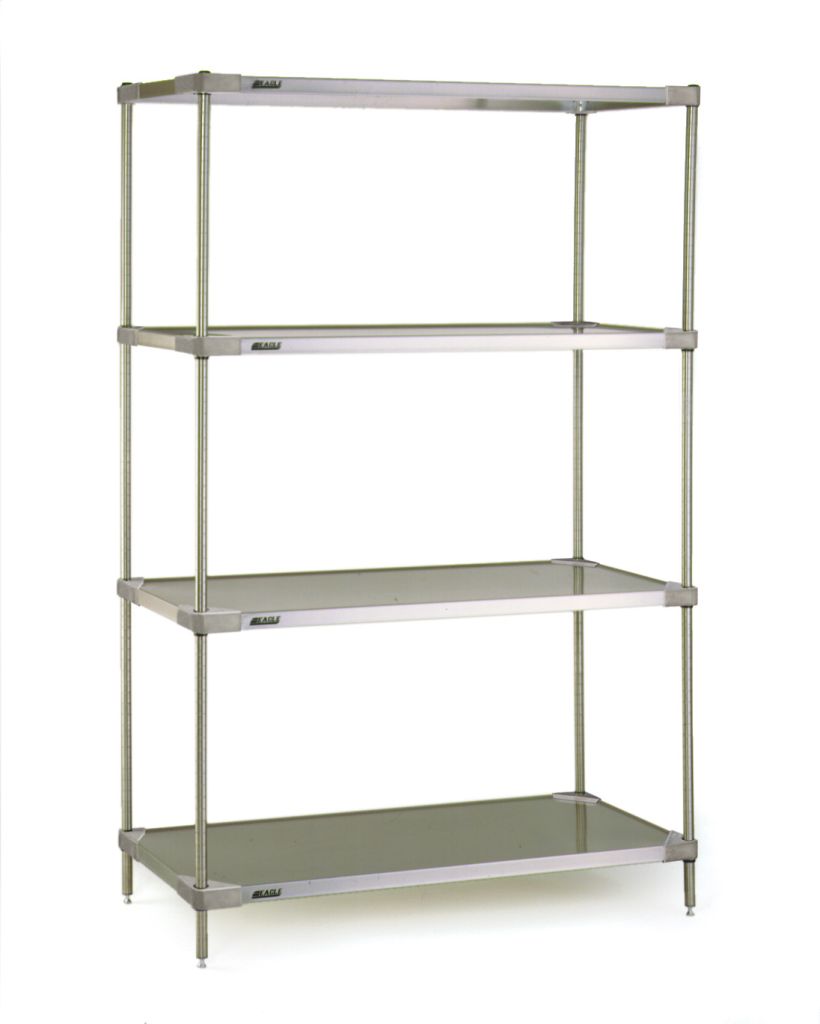
Short answer
In shelving, NSF means the shelving was evaluated against NSF International’s sanitation standard for food equipment, NSF/ANSI 2. It covers corrosion-resistant materials, smooth cleanable surfaces, sound coatings and joints that do not trap soil. Listings are granted model by model to a manufacturer, not to a brand or a whole catalog.
NSF/ANSI 2
Food equipment standard
Model-specific
How listings are granted
1947
Eagle Group founded
1997
MH-USA serving the West
What Is NSF Shelving?

NSF shelving is storage shelving built and listed to NSF/ANSI 2, the sanitation standard NSF International publishes for food equipment. To carry that listing, a shelving model must use corrosion-resistant, non-absorbent materials, present smooth surfaces and rounded or sealed joints that do not trap food soil, and survive routine cleaning and sanitizing without the finish breaking down. The listing is issued to a specific model as built by its manufacturer.
Two words in that definition do most of the work. Standard means there is a written, public specification a product either meets or does not — nobody grades their own homework. Model means the evaluation attaches to a part number in a defined finish and configuration, not to a company, a product family or a marketing line.
People also use “NSF shelving” loosely for any shelving a health inspector will accept — chrome or epoxy wire, solid steel with a marine edge, polymer mats, dunnage racks. The plain-English idea is shelving you can clean that will not rust; the listing is the paperwork that proves it to a third party.
What an NSF Listing Actually Covers
The most common misunderstanding in a shelving purchase is scope. A listing is not a blanket endorsement of a brand and it is not a promise about your installation. Here is what it does and does not reach.
- It covers a model, as listed by its manufacturer. A part number in a stated material and finish, produced at an audited plant.
- It covers materials and construction. Corrosion resistance, coating integrity, absence of crevices and unfinished edges that hold soil.
- It covers cleanability. The surfaces have to be reachable and to survive repeated cleaning and sanitizing chemicals.
- It includes ongoing audits. Listings are maintained, not one-time tests, and can lapse if the product or plant changes.
- It does not cover your layout. Wall clearance, height off the floor, sprinkler clearance and aisle width are your plan reviewer’s questions.
- It does not cover accessories automatically. Casters, mats, dividers, ledges and enclosure kits may or may not fall inside the listed configuration.
- It does not survive substitutions. Swapping a chrome finish for an epoxy one, or a standard shelf for a special length, can put the part outside the listing.
How we handle listings, in writing
We will not tell you a specific model is certified on a web page — the only answer worth having is the current one from the manufacturer for your exact part numbers. Send us the schedule and we confirm listing status per model, in writing, before the order goes in.
Shelving Finishes and Where Each One Belongs
Finish is where most sanitation-rated shelving decisions are won or lost. The frame geometry between a chrome unit and a stainless unit can be identical; what differs is how the surface behaves after two years of condensation, sanitizer and cart strikes. A rusting shelf is a cleanability problem long before it is a strength problem,.
Bright chrome is plated steel. It is the value choice and it is correct in dry rooms — dry storage, offices, packaged goods. Put it in a walk-in and the plating pits at every weld and edge, then the base steel blooms.
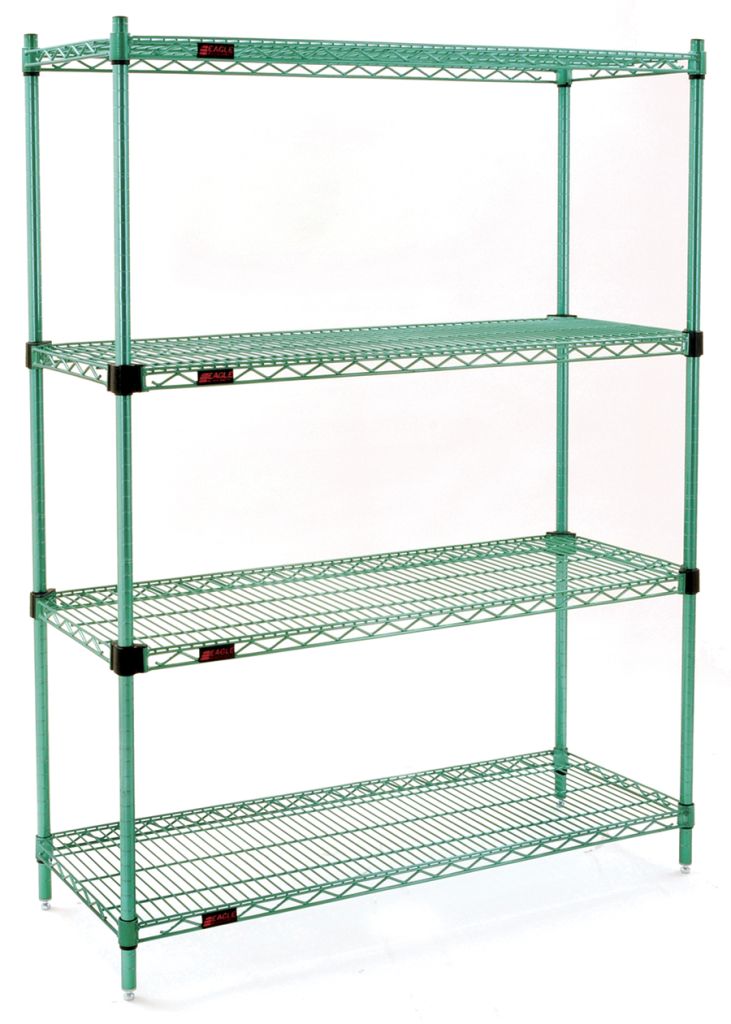
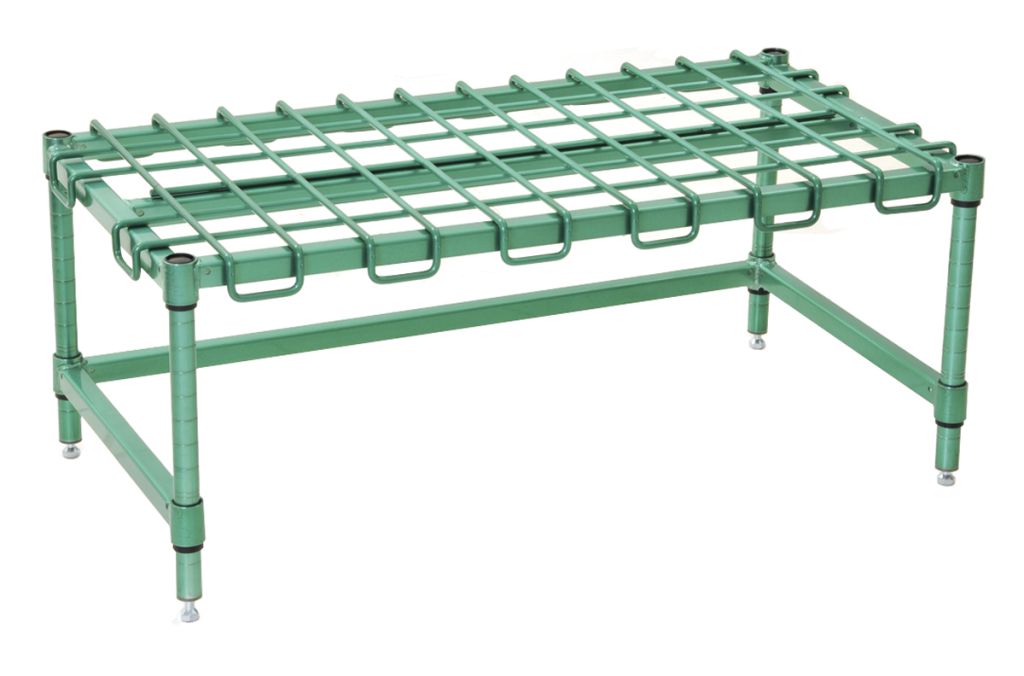
Epoxy-coated steel (Eagle’s Valu-Master gray and Valu-Gard green coatings are the familiar examples) puts a thick baked polymer skin over the wire. It is the workhorse for coolers, damp prep rooms and anywhere condensation is constant. Chips matter: a coating breach is a rust start, so specify epoxy where things get wet but not where forklifts and pallets hit shelves.
Type 304 stainless steel is the top of the range and the right call for freezers with heavy frost cycles, brine and acid exposure, daily chemical sanitizing, labs, clinical rooms and processing areas washed down with a hose. It costs more up front and stops being a decision you revisit.
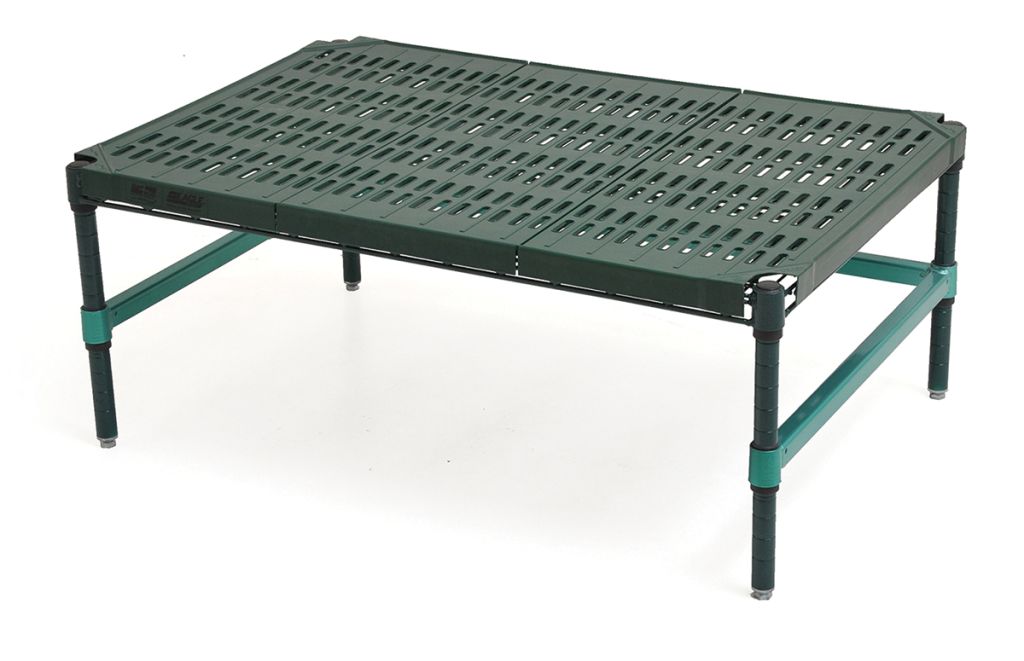
Polymer comes as full polymer shelving or as removable mats over a wire truss frame. Both give a non-porous surface with no coating to breach, and the mats go through the dish machine. Temperature and load limits are lower than steel.
Open Wire vs Solid Shelves
Open and solid shelves fail in opposite ways, which is why good kitchens use both in the same room.
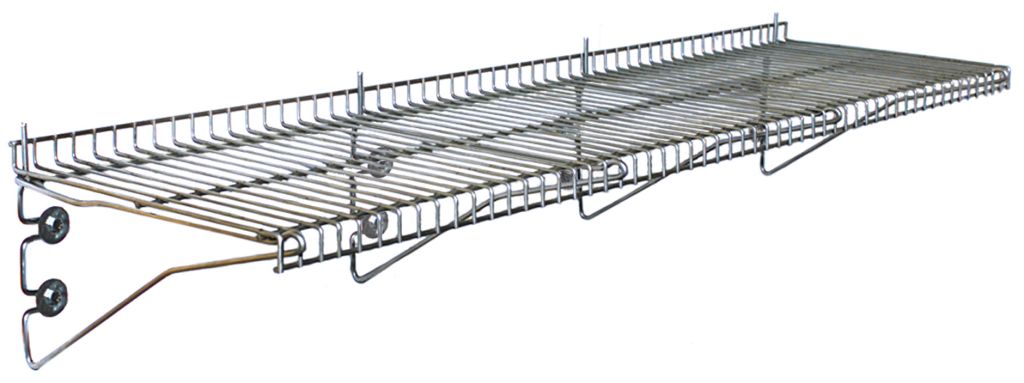
Open wire lets refrigerated air move through the rack instead of stalling against a deck, lets light reach the back of a shelf, keeps moisture and dust from settling in a film, and lets a sprinkler head do its job over a loaded rack. It also lets an inspector see the floor and wall behind the unit without unloading it. Eagle’s QuadTruss shelf design (patent #5,390,803) adds trusses that make the shelf up to 25% stronger than a flat mat and form a retaining ledge that keeps product from walking off the edge.
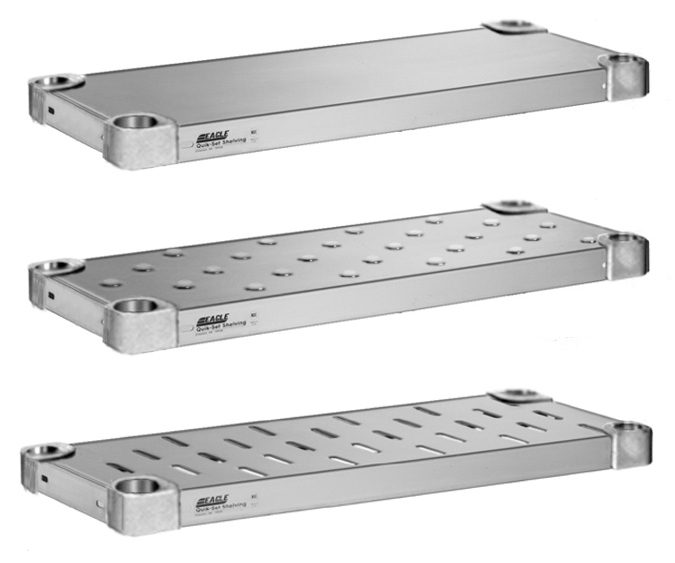
Solid shelves catch what wire drops. Flour, sugar, spice jars, small containers and anything that drips belongs on a solid deck with a raised marine edge, which retains spills instead of sending them down onto the tier below. Solid shelving hemmed with a two-fold thickness of heavy gauge steel is also the stiffer shelf: Quik-Set solid shelves are published at 1,000 lb evenly distributed per shelf, in 14 or 16 gauge stainless or epoxy-coated galvanized steel, with flat, embossed and louvered styles.
The practical rule: solid where the mess starts, wire everywhere else.
Cleanability: What Inspectors Actually Look At
Sanitation standards are written around one idea: a surface that can be cleaned, reached and kept intact. In shelving that comes down to details you can check with your hands.
| Detail | What good looks like | Why it gets written up |
|---|---|---|
| Edges and hems | Rolled, hemmed or marine edges with no raw cut steel | Raw edges hold soil, cut hands and start rust |
| Joints | Welds ground smooth or mechanical joints with no open seam | Open seams trap product and cannot be sanitized |
| Coating integrity | Continuous coating with no chips, blisters or exposed base metal | A chip is a rust start and a harborage point |
| Post-to-shelf lock | Tool-free split sleeves and corner castings, no fasteners to corrode | Loose or corroded hardware means an unstable rack |
| Underside access | Bottom tier high enough to sweep and mop under, or a dunnage rack | Product and debris on the floor is the classic violation |
| Wall clearance | Space behind the unit so the wall can be washed | Racks tight to a wall leave an uncleanable strip |
| Mobility | Casters with brakes where floors are washed daily | Fixed racks in wet rooms make floor cleaning impossible |
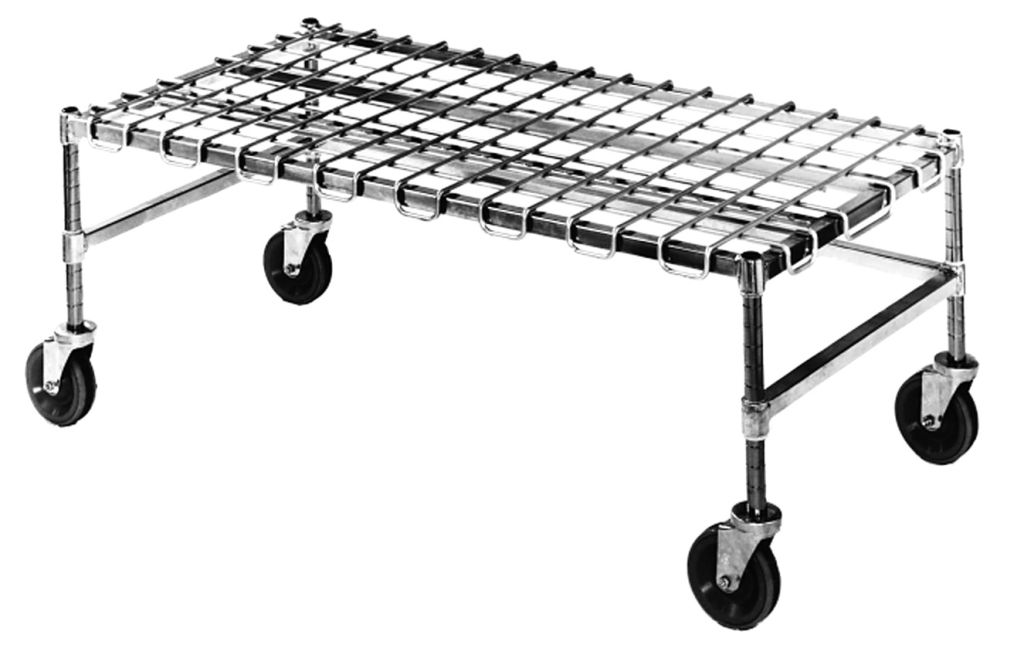
Two construction features are worth insisting on in a washdown room. Tool-free assembly — tapered high-temperature ABS split sleeves that lock tighter as the shelf loads — keeps threaded hardware out of wet joints. And in rooms where the floor is washed nightly, a mobile unit that rolls out beats a stationary unit that gets mopped around.
Wet, Cold and Corrosive Environments

Every environment attacks shelving in its own way, and matching the attack to the finish is most of the job.
Walk-in coolers run a permanent condensation cycle. Epoxy is the default; keep the top tier out of the evaporator’s throw so blown moisture is not aimed at one shelf all day, and leave the unit off the wall so the box can be washed.
Freezers add frost and thaw cycles that work at any coating breach. Stainless is the durable answer, and loads should be lifted, not dragged across a shelf.
Dish rooms and washdown areas combine heat, steam and chemical sanitizer. Stainless or polymer, mobile where possible, and never bright chrome.
Chemical and janitorial storage wants solid shelves with a raised edge to contain a leaking container.
Raw protein and produce prep is where polymer mats earn their money: pull the mat, wash it, put it back.
Labs and clinical rooms — reagents, autoclave steam and daily disinfectant — argue for stainless throughout. Bench, reagent, specimen and clinical supply storage are covered on the pages linked further down.
Not sure which finish your rooms need?
Send us the floor plan and what goes in each room. We will return a shelving layout with model numbers, finishes matched to each environment, load math and documentation — priced and freighted from Salt Lake City to anywhere in the country. Call (800) 326-4403.
How to Read a Shelving Spec Sheet
A spec sheet answers more questions than a catalog photo ever will, if you read it in the right order.
1. Model number and finish code. The finish is usually a suffix or a separate column. Everything else on the page — including any listing — attaches to that complete string, not to the family name at the top.
2. Material and gauge. 14 gauge is heavier than 16 gauge. For solid shelves, gauge plus the hem and edge treatment determines whether a 48-inch shelf sags under case goods.
3. Load rating, and how it is stated. Published wire shelving ratings are commonly 800 lb evenly distributed for shelves up to 48 inches, 600 lb for 54 to 72 inch shelves, and 2,400 lb for a set of four posts. Those numbers assume the load is spread. A single heavy item in the middle of a long shelf is a different calculation — shorten the shelf rather than hoping.
4. Listing status. If sanitation listing matters for the room, this is the line to ask about by model. Treat a general statement anywhere else as marketing.
5. Dimensions and post heights. These tell you whether the unit clears the door, fits the aisle and meets your ceiling clearance.
6. Accessories inside the configuration. Casters, ledges, dividers and mats each change the unit — confirm what stays inside the listed configuration.
Choosing Shelving Room by Room
Most facilities need three or four different answers, not one. This is how we normally lay out a building.
Dry storage is the one room where bright chrome wire is the right economy: space the tiers for case heights, keep the bottom tier high enough to mop under, and leave the aisle wide enough for a cart to turn. Walk-in coolers get epoxy wire plus dunnage for bulk, held off the wall so the box can be washed and clear of the evaporator throw. Everything else is below.
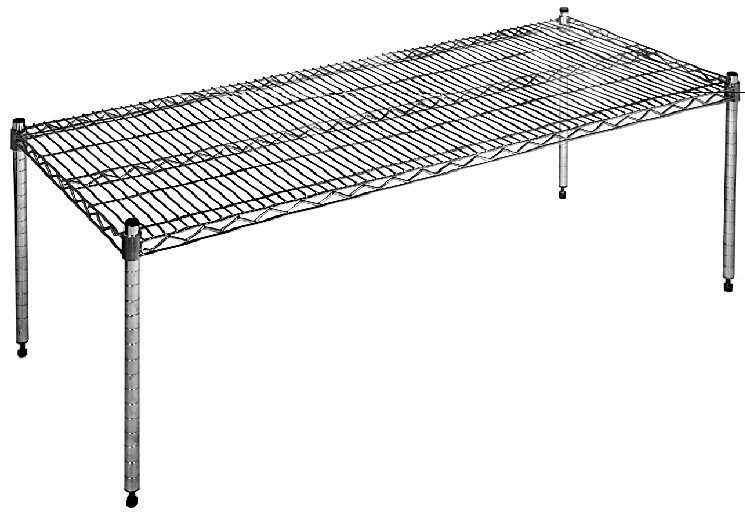 FreezerStainless units and dunnage platforms, loads planned so cases are lifted rather than dragged across the shelf.
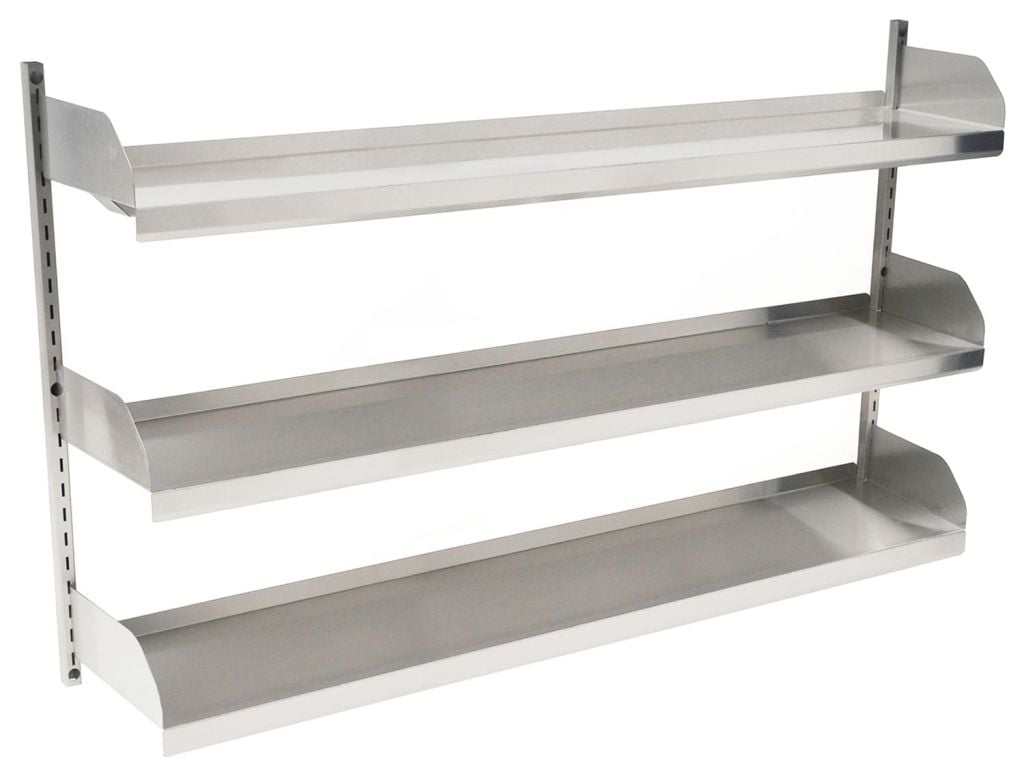
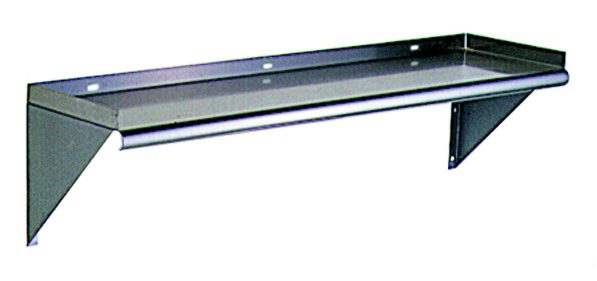
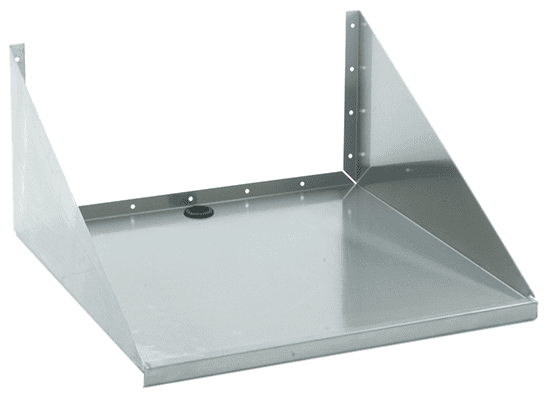
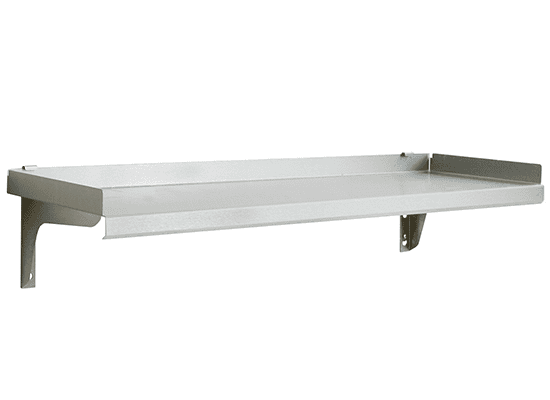 Prep LineSolid stainless wall shelves recover the space above tables and keep small equipment off the work surface.
 Dish RoomStainless and polymer only, mobile where the floor is washed daily, nothing plated anywhere near the machine.
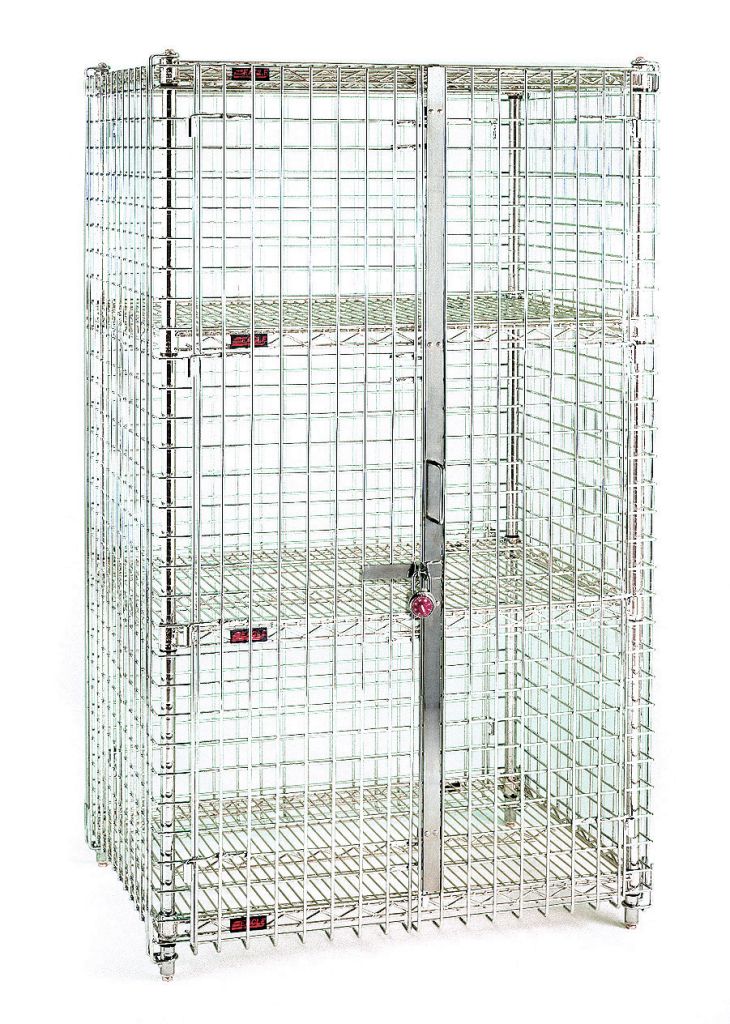 High-Value StoreroomLocking security units for liquor, pharmacy and specialty inventory without dedicating a separate room.
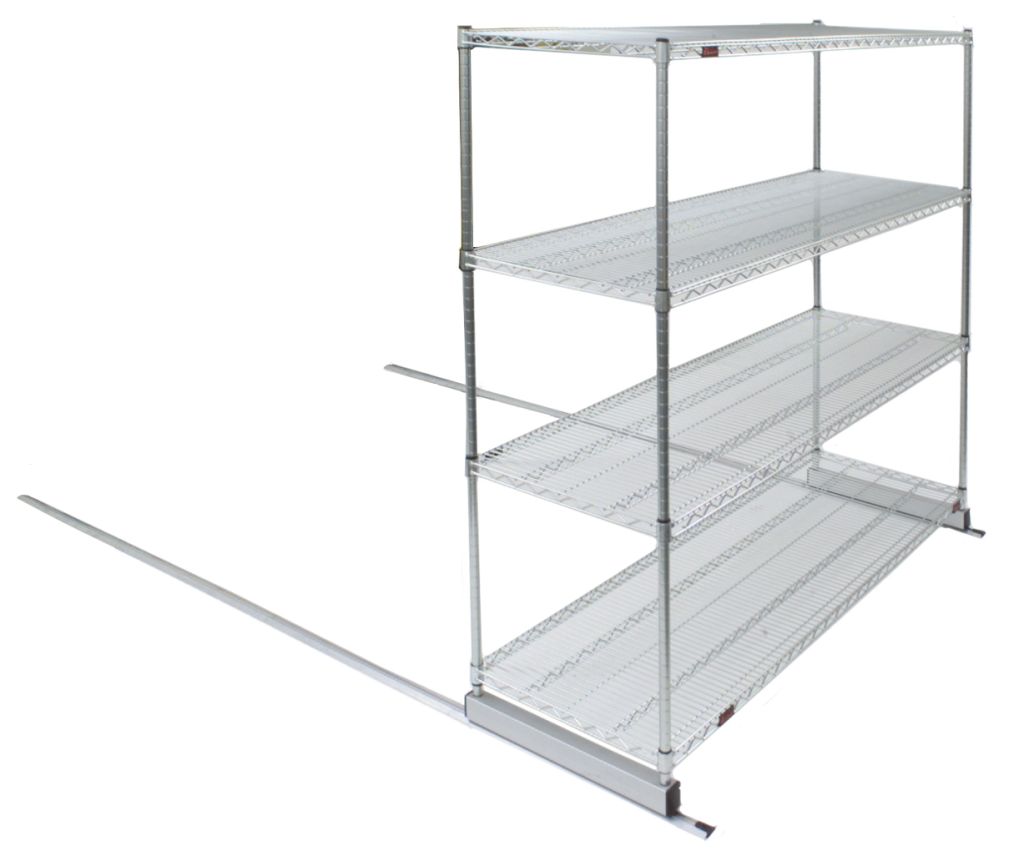 Tight Supply RoomsHigh-density track systems delete standing aisles and recover floor area in a room that cannot grow.
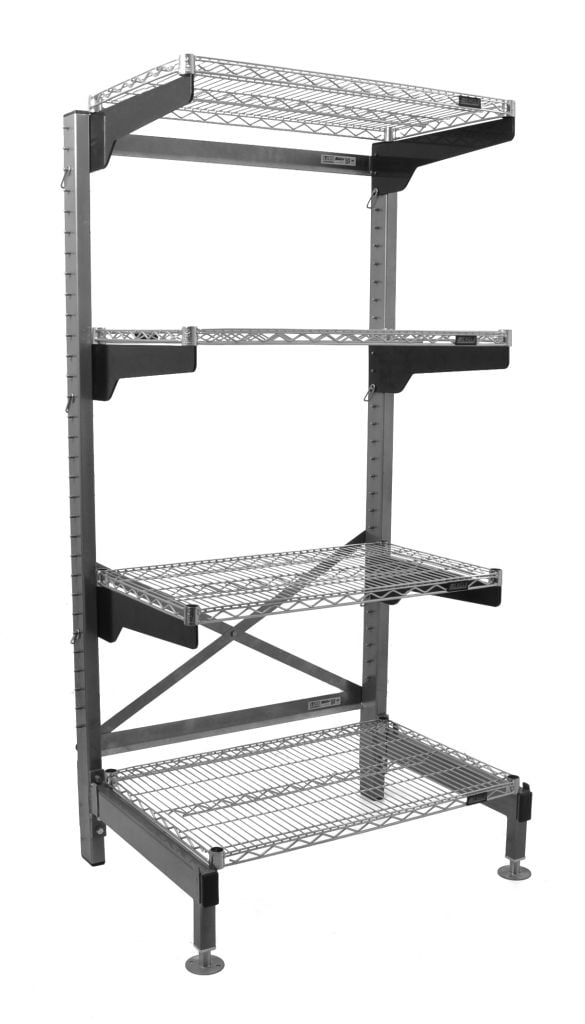 Open-Access StorageCantilever shelving with no front uprights, so long or awkward product loads straight in from the aisle.
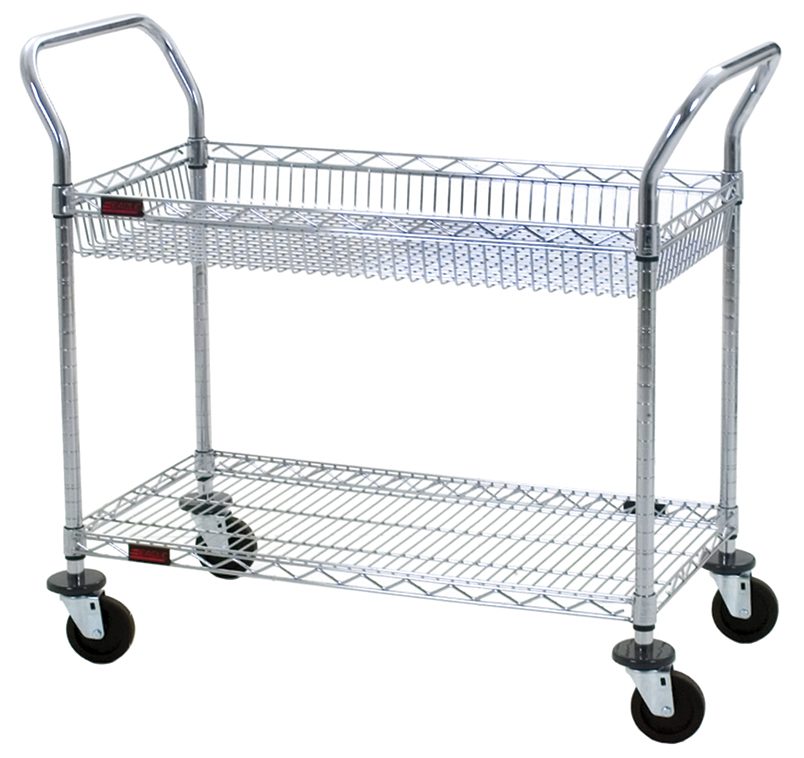 Transport Between RoomsWire basket and utility carts move washed product and small parts without hand-carrying trays.
Shelving Finish and Style Comparison
| Finish / style | Typical material | Best environments | Avoid in | Notes |
|---|---|---|---|---|
| Bright chrome wire | Chrome-plated steel wire | Dry storage, packaged goods, offices | Coolers, freezers, dish rooms | Lowest cost; plating pits fast once condensation is constant |
| Epoxy-coated wire | Baked polymer over steel wire | Walk-in coolers, damp prep and back-of-house | Impact-heavy pallet areas | Coating breaches are the failure mode — inspect edges after cart strikes |
| Type 304 stainless wire | Stainless steel wire | Freezers, dish rooms, labs, clinical, processing | Nowhere, other than on budget | Highest durability; no coating to breach |
| Solid steel shelf | 14 or 16 ga stainless or epoxy galvanized | Chemical storage, dry goods, small items | Refrigerated boxes needing airflow | Marine edge on all four sides retains spills; 1,000 lb evenly distributed per shelf on Quik-Set |
| Polymer mats on wire | Polymer mat, steel truss frame | Raw protein, produce, wet prep | High-heat and very high point loads | Mats lift out and go through the dish machine |
| Dunnage rack | Wire, aluminum or polymer, 14 in. high | Bulk sacks and cases in any room | Anything needing multiple tiers | Keeps bulk off the floor; mobile versions carry up to 800 lb, stationary up to 1,000 lb |
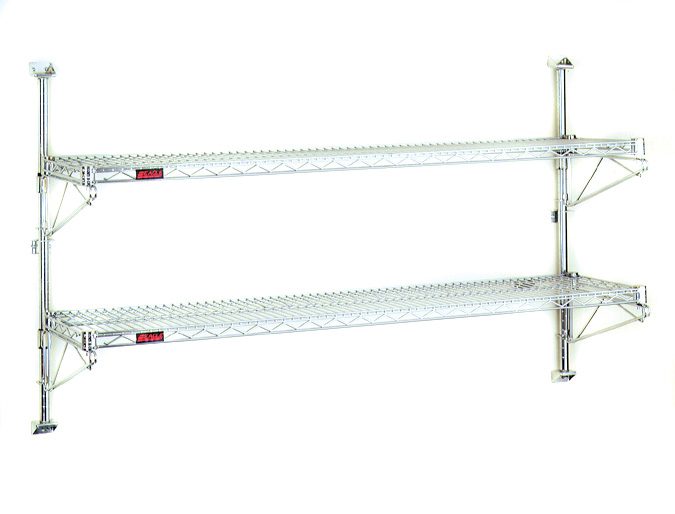
| Wall shelf | Stainless solid or wire, bracket mounted | Above prep tables, pass areas, labs | Heavy bulk storage | Recovers wall space; check the wall structure before specifying length |
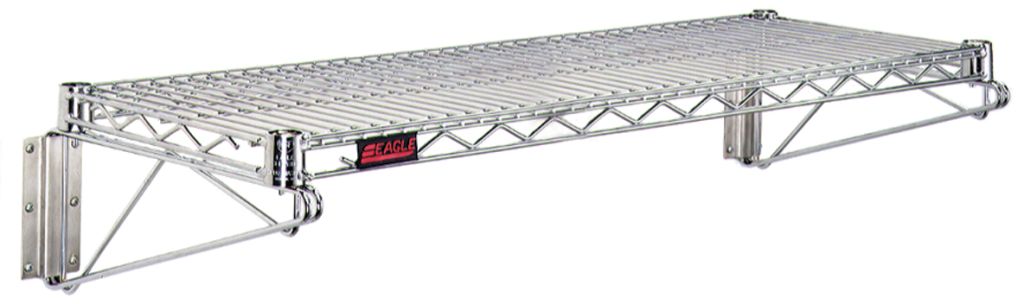
The table simplifies one real decision: how long the shelving has to last in the room it is going into. A chrome unit in dry storage can outlive the lease; the same unit in a cooler is a two-year consumable and an inspection finding in year three. Wall shelving adds a structural question — confirm blocking or backing before you commit to a long shelf full of dishes.

Shop NSF-Listed Shelving Online
Buy select items directly from our online store, or request a quote for volume, custom sizes and freight-rated orders.


NSF Shelving FAQs
What does NSF mean in shelving?
Is NSF certification required for commercial kitchen shelving?
Does a listing cover a whole product line?
Which shelving finish is best for a walk-in cooler?
Wire or solid shelves for a health-inspection environment?
How high off the floor does shelving have to sit?
What should I check on a shelving spec sheet?
Can MH-USA help choose shelving for a plan review?
Get Sanitation-Rated Shelving Specified Correctly
Send your floor plan or model list to Sales@MH-USA.com, or call (800) 326-4403. We represent Eagle Group, confirm listing status per model in writing, and ship nationwide.