
Home › Commercial Foodservice Equipment › Shelving & Storage
Foodservice Shelving & Kitchen Storage
Walk-in, freezer, dry storage, dish room and bar storage built out of Eagle wire, solid and polymer shelving, dunnage racks, wall shelves and security units — specified and quoted by MH-USA.

800 lb
Per wire shelf to 48″
2,400 lb
Per set of four posts
1″
Post adjustment increments
1947
Eagle Group founded
Storage Is the Part of the Kitchen Nobody Draws Carefully
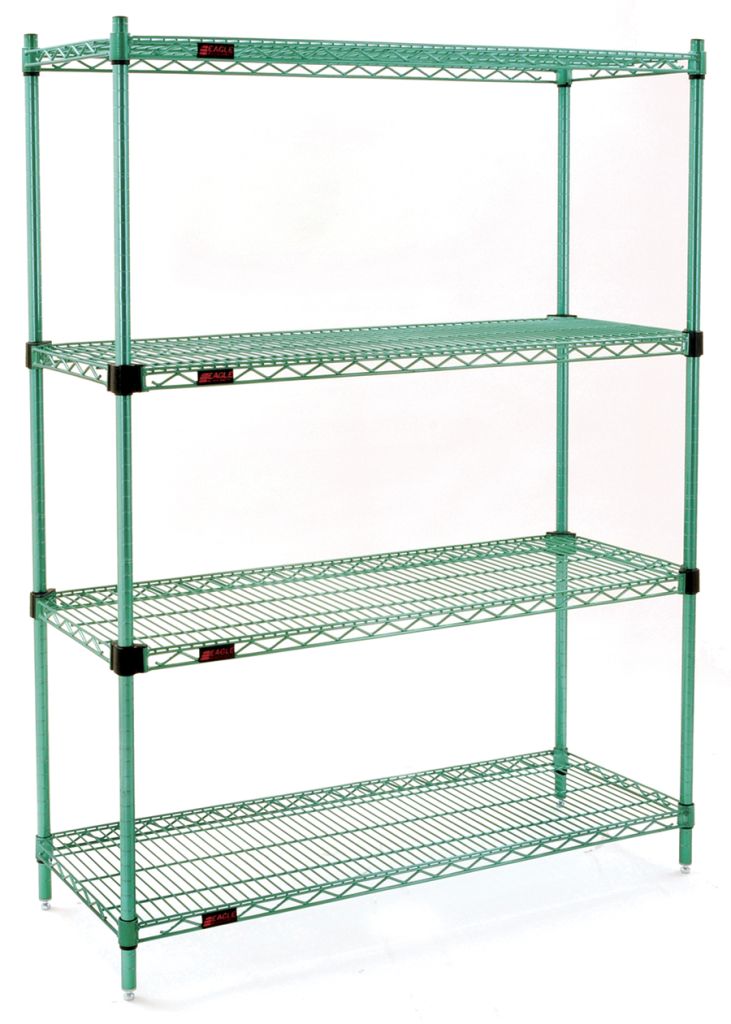
Every foodservice plan gets the cook line right. The walk-in usually gets a note that says shelving by others, and the dry storage room gets whatever the last contractor left behind. Then the kitchen opens, the cases land on the floor because the tiers are spaced wrong, the inspector writes it up, and somebody buys a second round of shelving in the first year.
Kitchen storage is not complicated, but it is specific. What works in a dry goods room fails in a freezer. What works against a wall does not work in a bar well. The shelf that holds 800 pounds of canned goods at 48 inches long holds noticeably less at 72 inches. This page walks through how we actually specify foodservice storage for restaurants, schools, hospitals, senior living kitchens and commissaries — by zone, by product, and by what the sanitation and fire inspectors will look at.
MH-USA has been doing storage from Salt Lake City since 1997, and we represent Eagle Group, the Clayton, Delaware manufacturer that has built foodservice equipment since 1947 across more than 17,000 standard models. Storage is our home category — we do pallet rack, cantilever and industrial shelving all day — so we are comfortable telling you when a kitchen problem has outgrown shelving entirely.
The Two Kitchen Storage Rules Everything Else Follows
You can specify an entire back-of-house storage package off two sentences, and almost every write-up we see in the field is a violation of one of them.
What inspectors actually look for
Product off the floor with clearance to clean beneath it, no cardboard stored in a wet zone, chemicals stored below and separate from food, and clearance below sprinkler heads. Shelving that satisfies those four items usually satisfies the rest of the storage section of the inspection.
Wire, Solid or Polymer — Choose by Zone
The single most common storage mistake is buying one shelving type for the whole building. A kitchen has at least five distinct storage environments and they want different things.
| Zone | Best shelf type | Why | Finish note |
|---|---|---|---|
| Walk-in cooler | Open wire | Air circulation keeps the box at temperature and product visible; light passes through to lower tiers | Epoxy finishes are approved for wet or dry applications; chrome is a dry-storage finish |
| Walk-in freezer | Open wire, mobile where floors must be cleaned | Frost management and airflow; wire will not trap ice on a solid deck | Epoxy; leave the top tier clear of the evaporator throw |
| Dry storage | Wire for cases, solid for flour, sugar and small goods | Wire is cheaper per foot and lets sprinklers work; solid catches spill and small items | Chrome is acceptable in a genuinely dry room |
| Prep and dish room | Solid or polymer mats over wire truss frames | Wet, splash-heavy, constant wipe-down; polymer mats lift out and go through the dish machine | Epoxy or stainless |
| Chemical storage | Solid with marine edge | Contains drips and keeps chemical containers off shelves above food | Epoxy or stainless; always store below and separate from food |
| Bar and backstock | Wire plus a locking security unit | Fast visual counts on wire; liquor and high-value stock behind a lock | Chrome or epoxy depending on how wet the well area gets |
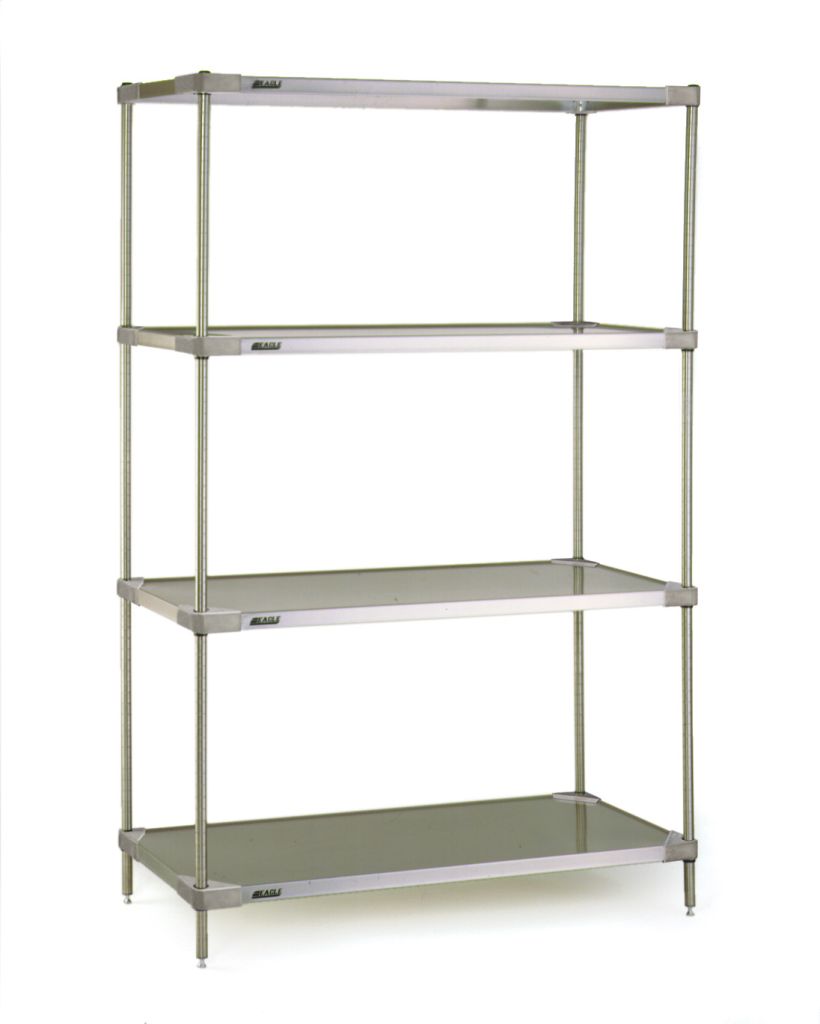
Open wire construction does more than save money. It promotes visibility, allows light to pass through the shelves, permits greater air circulation which helps reduce moisture and dust build-up, and increases the effectiveness of fire-suppression systems — that last point is the one that matters to the fire marshal when shelving sits under sprinkler heads.
Solid shelving is the opposite trade. You give up airflow and gain a contained, wipeable deck. Eagle solid shelves are hemmed with a two-fold thickness of heavy gauge steel and a standard marine edge on all four sides, which retains contents, makes cleaning easier and helps reduce spill of shelf contents onto whatever is below.
Polymer sits between them. QuadPlus polymer shelf mats drop onto wire truss frames, giving a solid working surface that pops out for cleaning. In a dish room or a walk-in where product juice is the daily problem, that removable mat is worth more than either pure option.
How Eagle Wire Shelving Is Built (and Why the Sleeves Matter)
Wire shelving looks like a commodity until you assemble two brands side by side. Eagle’s shelves use the patented QuadTruss design (patent #5,390,803), which makes the shelf up to 25% stronger and forms a retaining ledge that keeps product from sliding off the edge — the reason a properly loaded 48 inch shelf does not develop the smile you see on cheap wire.
The assembly system is the other half. Tapered split sleeves of high-temperature-resistant ABS plastic create a positive lock that becomes stronger as the load increases. Posts are numerically calibrated and numbered in one inch increments so a four-post unit goes up level the first time, and so you can move a tier later without measuring. Assembly is a two-step, no-tool exercise: snap the split sleeves onto the post over the number you choose, then slide the shelf collar over the sleeves. Leveling feet are provided to compensate for uneven floor surfaces — which every kitchen has, especially near a floor drain.
Load ratings for standard wire shelving are 800 lb evenly distributed for shelves up to 48 inches, 600 lb for 54 to 72 inch shelves, and 2,400 lb per set of four posts. Read all three numbers together: it is entirely possible to satisfy the shelf rating on every tier and still exceed what the four posts are rated to carry.
| Spec | Standard wire shelving | Quik-Set solid shelving |
|---|---|---|
| Shelf capacity (evenly distributed) | 800 lb to 48″ long; 600 lb at 54–72″ | 1,000 lb per shelf |
| Post capacity | 2,400 lb per set of four posts | Post system shared with wire shelving |
| Shelf construction | QuadTruss open wire, retaining ledge | 14 or 16 gauge stainless, or 14/16 gauge galvanized with Valu-Master gray or Valu-Gard green epoxy; flat, embossed or louvered |
| Edges | Truss ledge | 2″ downturn with marine edge on all sides |
| Corner detail | Shelf collar over tapered split sleeve | Heavy duty aluminum corner casting accepting a split sleeve |
| Adjustment | Numbered posts, 1″ increments, no tools | Numbered posts, 1″ increments, no tools |
| Best for | Walk-ins, freezers, dry case storage | Heavy load-bearing, prep, chemical and small-goods storage |
A quick word on units versus components
Quad-Adjust starter units ship as two Quad-Adjust shelves, two standard wire shelves and four 74 inch numbered posts with caps and leveling feet — a complete unit in one line item. If you are building a long wall run, ordering starter units plus add-on units shares posts between bays and costs less than buying free-standing units end to end.
Dunnage Racks: Where Bulk Product Actually Goes
A dunnage rack is a low platform, usually 8 to 14 inches high, built to take the abuse that a bottom shelf should not: 50 lb flour sacks, cases of oil, bagged onions, keg backstock, cases of canned goods that come off a pallet jack. Buying dunnage is the cheapest way to fix a “product on the floor” write-up, and it is almost always cheaper than adding another shelving unit.
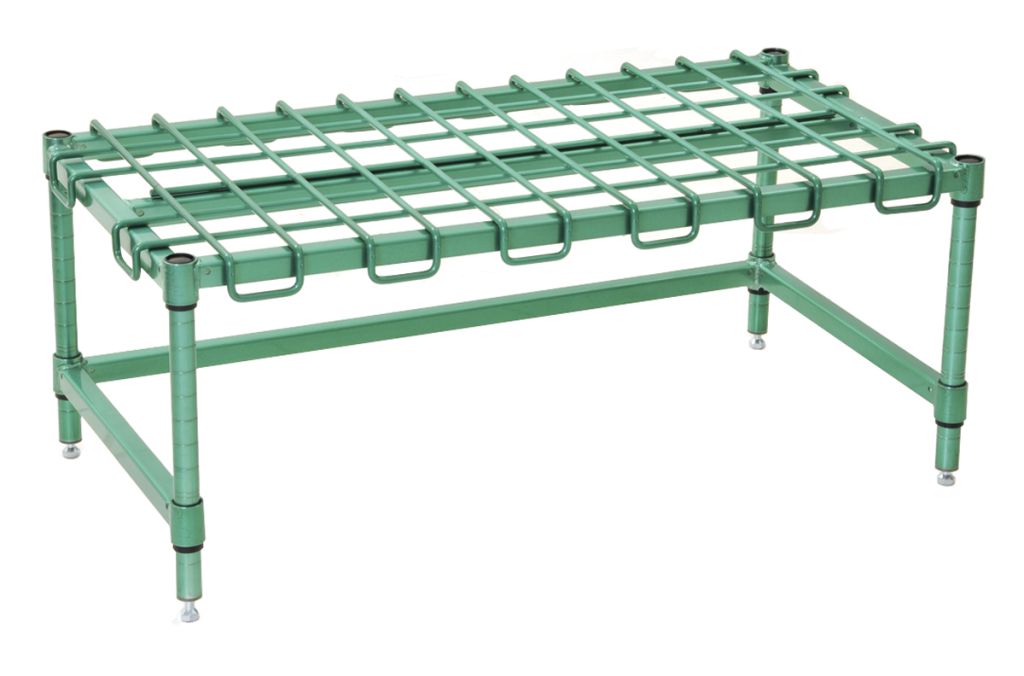 Wire Dunnage RacksDunnage shelf with four-sided frame, center supports and a removable wire mat, or a full dunnage rack with 1″-diameter posts grooved on 1″ centers and a three-sided frame to support maximum weight. 14″ height, stationary or mobile with four 5″ swivel casters (two braked). Platform versions use a QuadTruss wire shelf on 14″ posts, rated 600 lb.
 Aluminum Dunnage RacksAll-aluminum welded construction with 1½″ square tubular legs and bottom plastic caps, in 8″ and 12″ heights, no assembly required. Nesting aluminum versions are stackable at 12″ height and rated 2,700 to 3,200 lb — the right answer for seasonal storage that has to disappear off the floor.
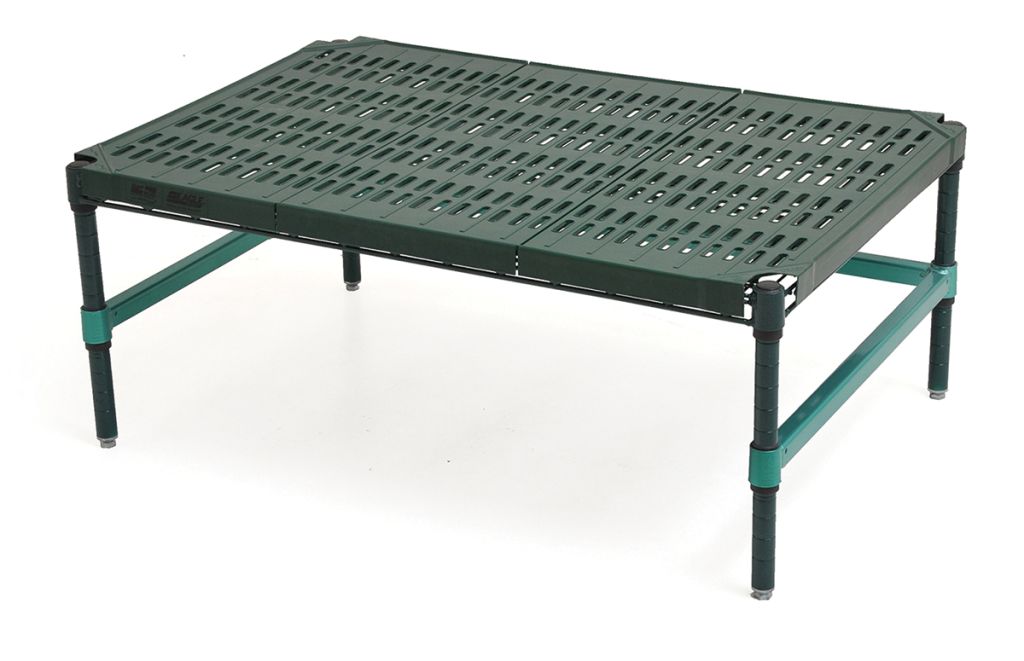 QuadPlus Polymer Dunnage RacksGreen polymer louvered or solid shelf mats over a wire shelf, 14″ height, tool-free assembly. Stationary versions carry up to 1,000 lb, mobile versions up to 800 lb. Polymer versions are the easiest to clean and the best choice where bagged product leaks.
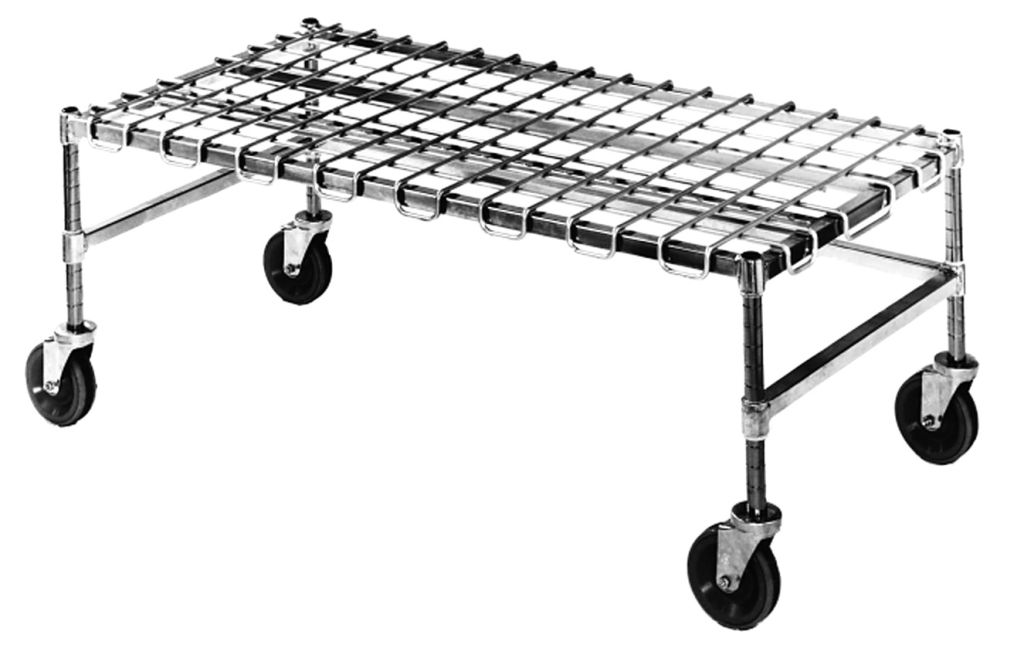 Mobile Dunnage RacksThe same 14″ open-wire dunnage shelf with 1″-diameter posts grooved on 1″ centers and a three-sided frame, mounted on four 5″ swivel casters with two brakes. Open wire keeps air moving under bulk product and reduces trapped moisture, and the whole load rolls out when the floor gets scrubbed.
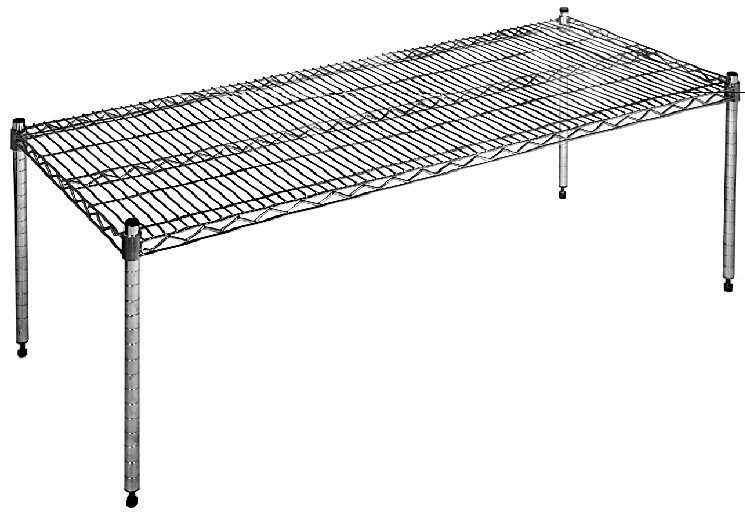 Dunnage PlatformsA stationary low platform version for walk-in corners and storeroom walls where nothing needs to roll. Same three-sided frame and grooved posts, no casters, lowest cost per foot of off-floor storage in the building.
Sizing rule: dunnage width should match the footprint of what lands on it, not the aisle. A 24″ deep rack is right for cases and sacks; 36″ long units fit under most walk-in shelving runs without stealing aisle. If you are stacking above chest height on dunnage, you have outgrown dunnage — that load belongs on shelving or on rack.
Wall Shelves: The Cheapest Square Footage in the Kitchen
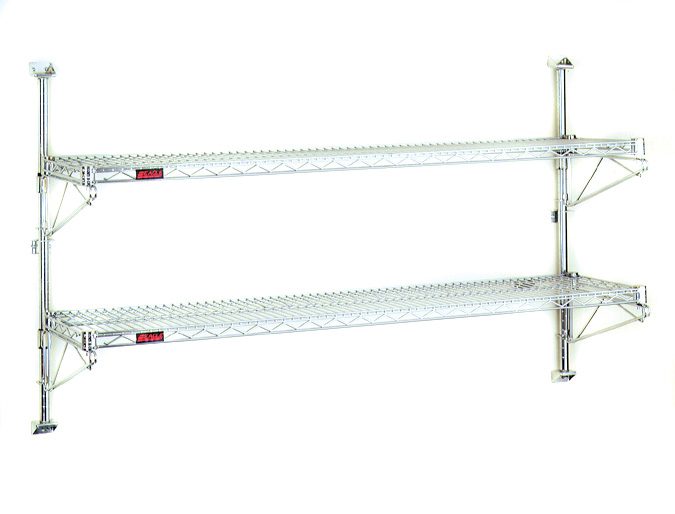
The wall above a prep table, a pass, a dish landing or a bar well is usually empty, and it is the only free storage in a kitchen that is already built. Wall shelving is also the fastest thing to install badly, so the mounting system matters as much as the shelf.
Adjustable post wire wall mount kits put a short section of numbered post on the wall with a positive top and bottom mount plus a center support, so shelf height stays adjustable in one inch increments after installation. Available in chrome, Valu-Gard green epoxy or stainless. Stationary wire wall mounts are for fixed applications that never move: an end unit is a single shelf support with a 14 gauge stainless mounting plate, a mid unit is a double support on the same plate so two shelves share a bracket in a continuous run.
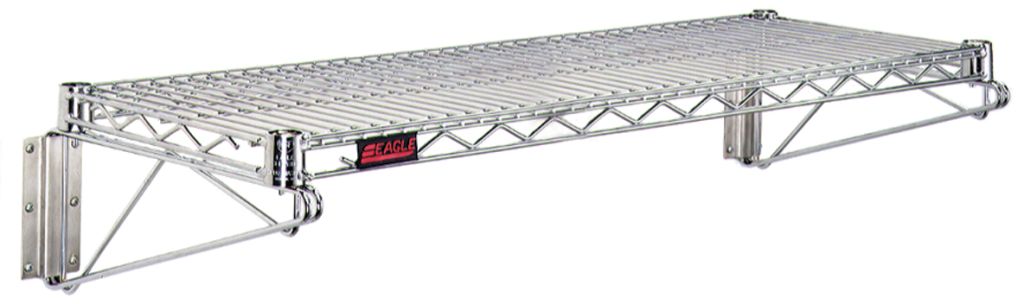
Wire wall shelf kits are the shortcut — one QuadTruss wire shelf plus two stationary wall mounts, in 14″ and 18″ widths and 36″ and 48″ lengths, in chrome, green epoxy or stainless, with no tools needed to attach the shelf to the brackets.
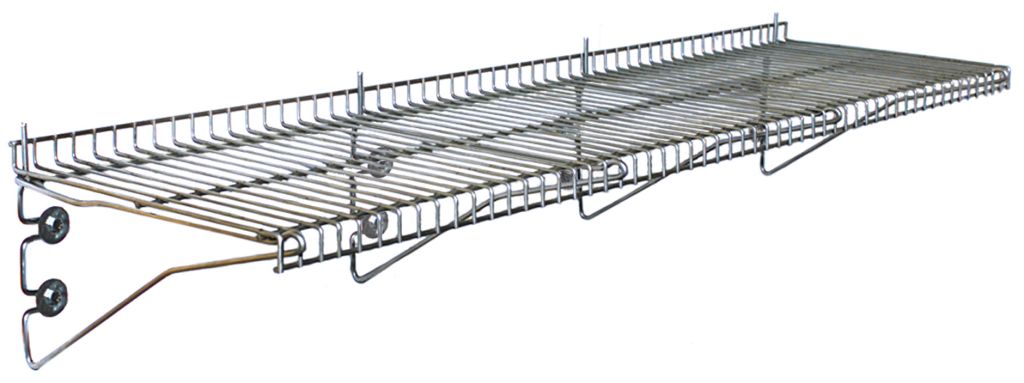 Snap-N-Slide Wire Wall ShelvesOpen wire for air circulation, no tools to attach the shelf to the brackets, and brackets that mount directly to wall studs with no wall backing required. 12″ width, 24″ to 72″ lengths, in chrome, Valu-Master gray, Valu-Gard green and EAGLEgard hybrid epoxy finishes.
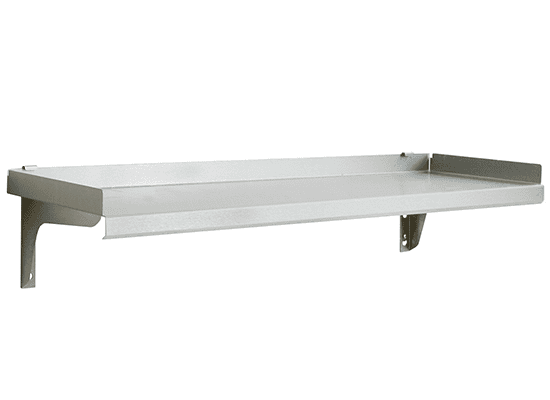 Snap-N-Slide Solid Wall ShelvesSolid version with a 1½″ upturn on the rear and ends and a rolled front edge, in 12″ or 15″ widths. Same stud-mount brackets, so the shelf goes where the studs are instead of where a backing panel was never installed.
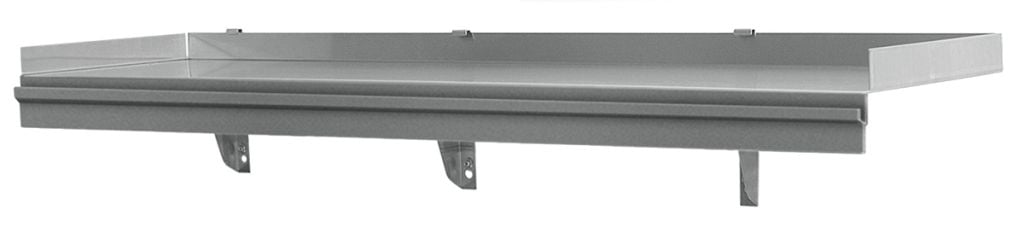 Wall Shelves with Ticket RailHeavy gauge type 430 stainless with a 1½″ upturn on rear and ends; stainless wall brackets ship loose for stud mounting. The ticket rail uses a floating ball mechanism to hold checks and tapes to the flat shelf front — the standard pass shelf for an expo window.
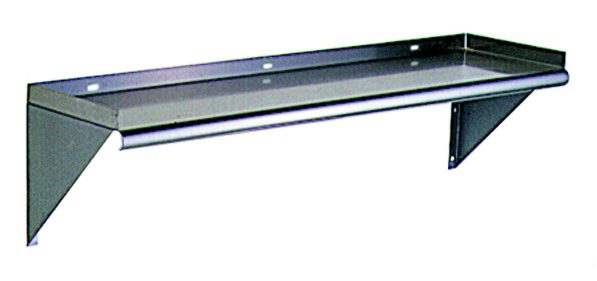 Wall Shelves with Tab Lock16 gauge type 430 stainless with a 1½″ roll on the front and a 1½″ upturn on rear and ends, on stainless mounting brackets with a tab lock for fast assembly. A clean, wipeable shelf for prep and service lines.
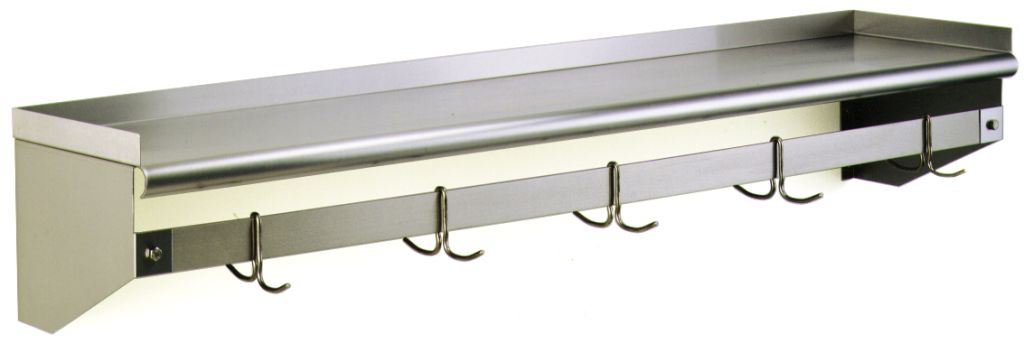 Wall Shelves with Removable HooksSame 16 gauge type 430 stainless shelf with a 2″ x 3/16″ type 304 stainless flat bar and double-prong removable hooks every 12″. Utensils hang, the shelf above stores pans, and nothing lives on the worktable.
 Stationary Wire Wall MountsFixed brackets for wall runs that never move: an end unit is a single shelf support on a 14 gauge stainless mounting plate, a mid unit doubles the support so two shelves share one bracket in a continuous run. Cheaper than adjustable posts when the height is settled.
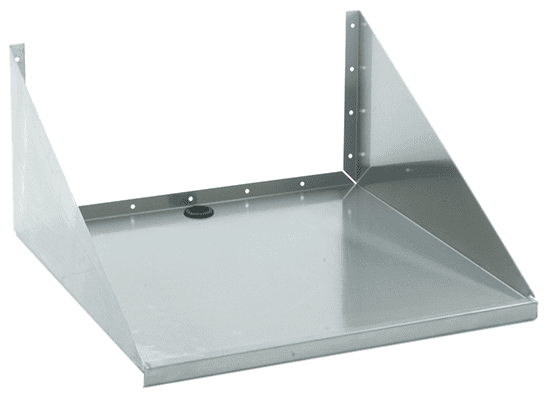 Microwave ShelvesSpace-saving wall mount design in 18″ or 24″ widths, 24″ standard length, heavy gauge stainless polished to a #3 finish. A marine counter edge in front keeps the microwave from sliding off and a grommeted hole at the rear routes the cord.
Two more overhead options that free up table space: table-mounted pot and utility racks, built from 3/16″ x 2″ aluminum or stainless flat bar in triple-bar construction with a double-prong sliding pot hook every 12″, on 1⅝″ O.D. stainless tubular supports that pass through the table and anchor to the adjustable undershelf; and ceiling-mounted pot racks in the same flat-bar construction, suspended on plated chain hangers.
Ceiling-mounted racks look great and work well over an island, but they need real structure above the ceiling and they complicate hood and sprinkler layouts. If the ceiling is questionable, a table-mounted rack gets you the same hanging capacity with none of the structural argument.
Mobile Shelving, Carts and High-Density Systems
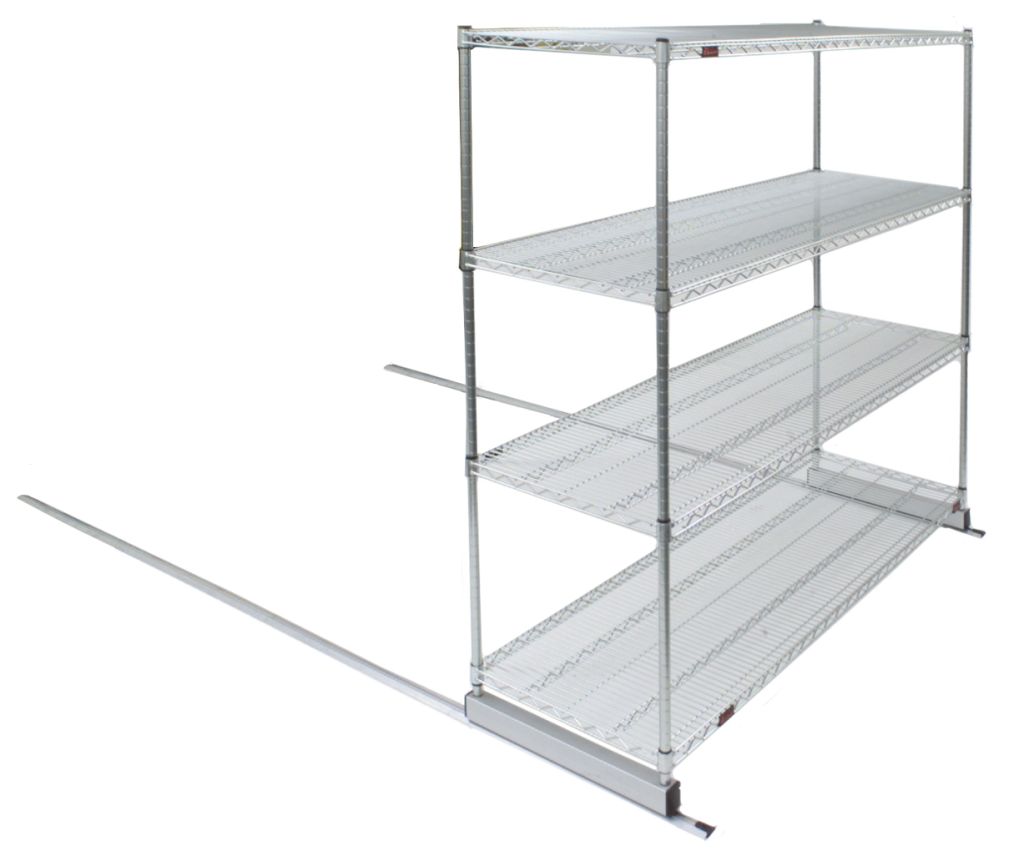
Mobile versus stationary is a cleaning and flexibility decision before it is a budget decision. Stationary units cost less per foot and carry more weight, and they are the right answer for a walk-in wall run that never moves. Mobile units earn their price where the floor under the rack has to be scrubbed daily, where backstock rolls from the walk-in to the prep line without being touched twice, or where a room gets reconfigured for banquets, school breaks or seasonal volume.
When the room itself is the constraint, high-density systems are the next step. Floor-Trak systems put shelving units on floor tracks so that a bank of units slides together and shares one aisle instead of one aisle per run. Single-deep systems suit narrow coolers; double-deep systems recover more floor in a wide room. Master Trak overhead track systems hang the same shelving from above where a track in the floor would collect water or interfere with drainage. In a walk-in freezer, where every cubic foot is paid for twice — once to build and once to keep cold — deleting two aisles out of three is real money.
Before you commit to mobile or high-density, check three dimensions: the clear door opening the unit has to pass through, the turning clearance at the corner where the aisle meets the door, and the floor. Tracks want a reasonably flat slab, and casters want a floor without a two-inch drop to a drain. If you have a seismic requirement in your jurisdiction, ask us about footplate kits at the same time — retrofitting anchorage after the units are loaded is miserable work.
Carts are the other half of mobility, and most kitchens under-buy them. A cart that stages a delivery, moves a prep batch and returns dirty pans to the dish room prevents dozens of trips a day. If you need transport for sheet pans, bun pans or roll-in refrigeration, that is a different family — see pan racks & transport carts. For general facility carts across the building, see utility carts.
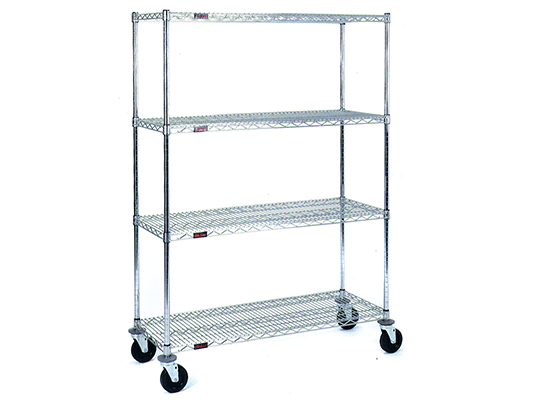 Wire Stem Caster CartsFour shelves on four 63″ posts in Eaglebrite zinc or chrome, with 5″ casters in swivel, swivel/brake or rigid, and poly or resilient wheels. Ships knocked down. The workhorse for moving cases from receiving to the storeroom.
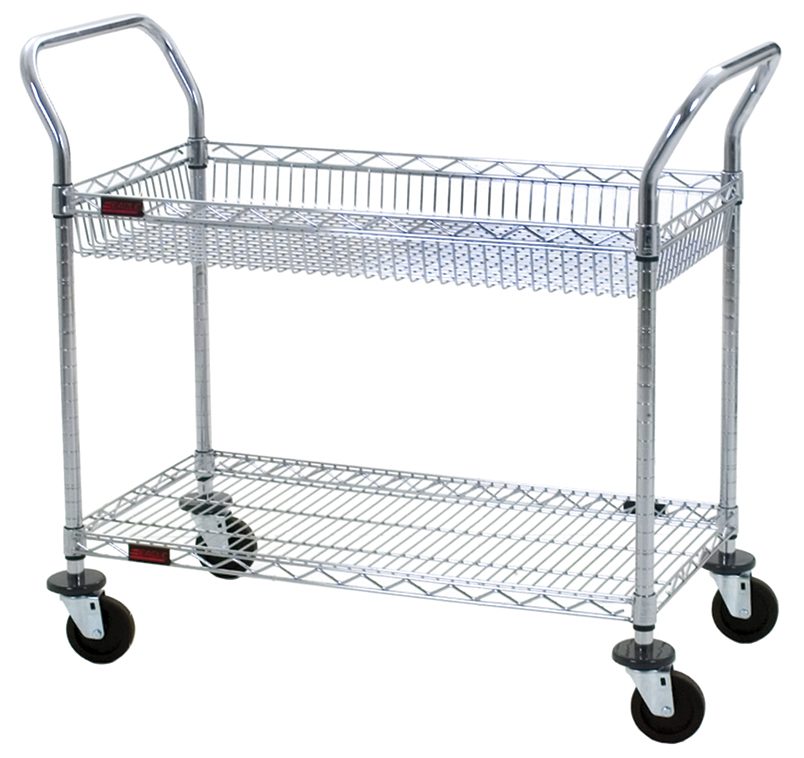 Wire Basket Utility CartsChrome plated open-wire baskets for light-duty work where staff need to see and grab product fast. Open wire permits greater air circulation, which helps reduce moisture and dust buildup. Swivel stem casters with bumpers and two push handles.
 Stainless Steel Utility CartsThree stainless shelves welded to angle legs on a galvanized caster channel frame, with a 1″ upturn on the ends and rear of the top and center shelves or on all sides of all shelves, four 4″ swivel plate casters and a 1″ handle. The choice for wet zones and dish rooms.
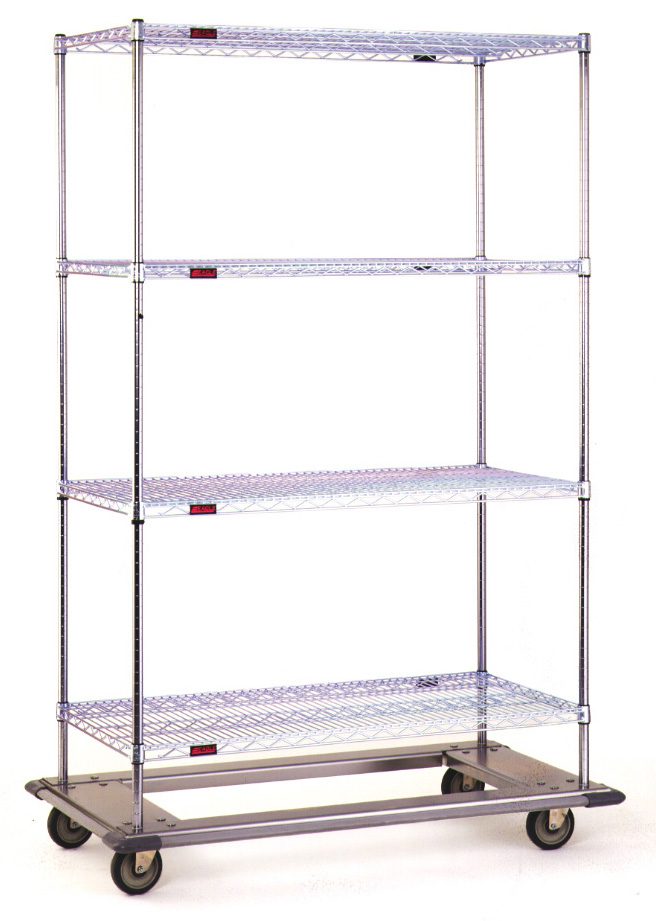 Dolly TrucksFour wire shelves on an aluminum truck dolly with a wrap-around bumper, in Eaglebrite zinc or chrome, with 5″ resilient or poly casters. Ships knocked down to save freight. Good where a loaded unit has to survive being pushed into door frames.
Security Units, Lockers, Cantilever and Storeroom Organization
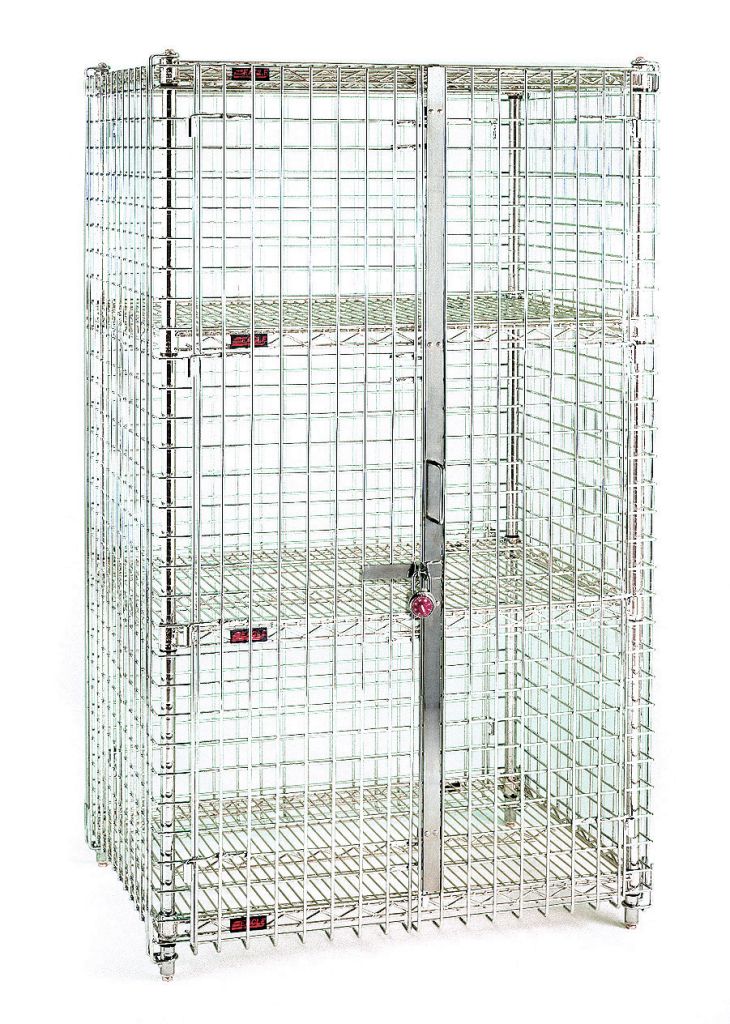
Security units solve the inventory problem shelving alone cannot. They are enclosed shelving with a full-access double door and a quick-action locking feature with hasps for a padlock, offered as stationary units, mobile units with four poly stem swivel casters (two braked), and versions on a dolly truck with a wrap-around bumper. Bars use them for liquor backstock, schools use them for a la carte inventory, and hospitals use them for anything that gets counted every shift.
Security modules are the cheaper move when you only need to lock part of a run: a module converts a portion of an existing shelving unit into a lockable enclosure, with hinged or flip-up doors, and more than one module can be added to a unit depending on its overall height. Mini security units are a 40″ overall height chrome unit with QuadTruss shelves and the same padlock hasps — small enough to live under a counter or in a bar well.
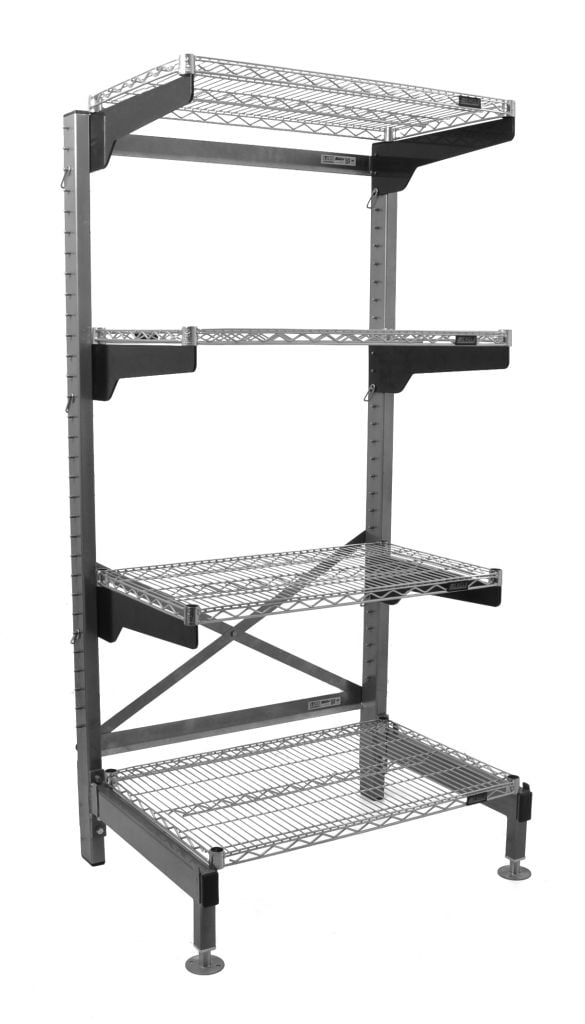
Q-LEVER cantilever storage removes the front uprights entirely. With no post at the front corner, an operator loads and unloads from the front and both sides, which matters in a prep aisle where a four-post unit forces you to work around a leg. Uprights use 2″ adjustment for shelf and accessory spacing, shelves and accessories adjust without tools, and units accept sheet metal or wire overlays. Shelf widths run 18″ to 30″ and lengths 24″ to 72″.
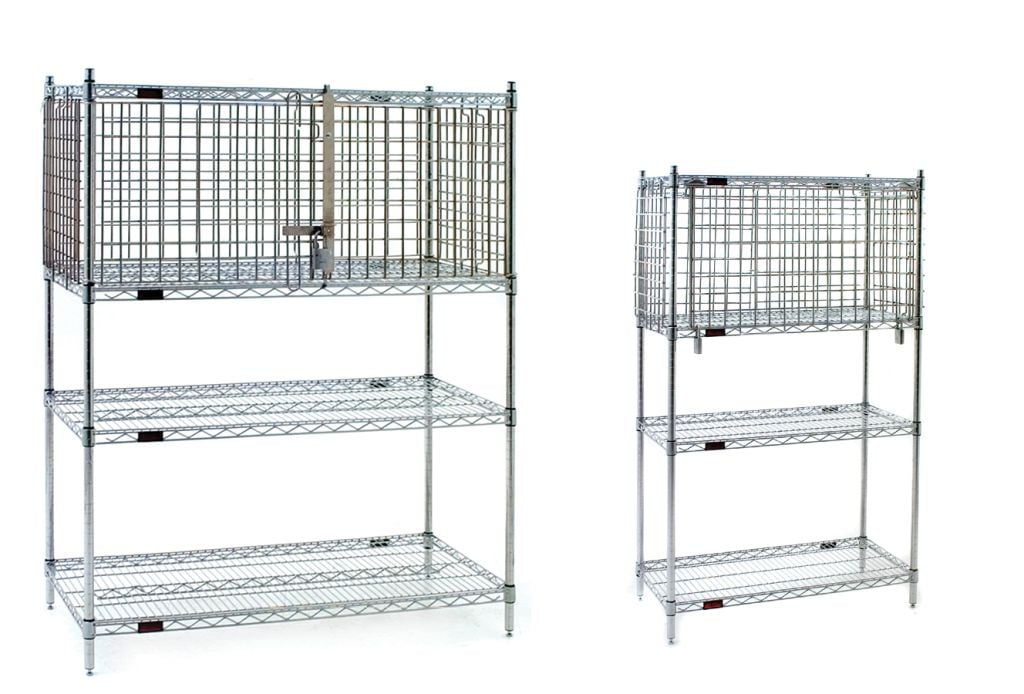 Security ModulesConvert part of a shelving unit into a locked enclosure with hinged or flip-up doors. Stack more than one module on a tall unit. Cheapest way to add controlled storage to shelving you already own.
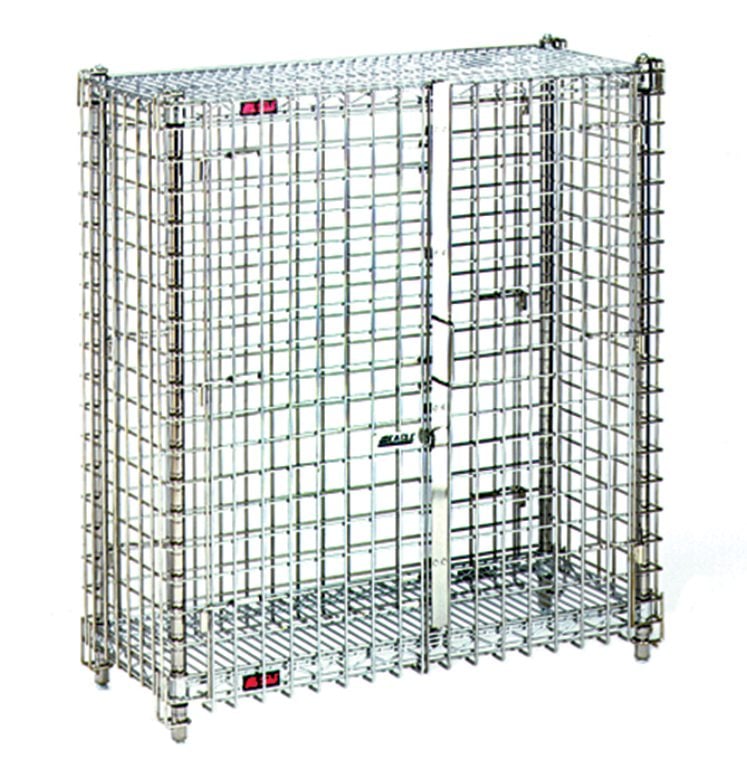 Mini Security UnitsChrome open-wire unit with QuadTruss shelves, full-access double door, quick-action lock with padlock hasps and a 40″ overall height for under-counter and bar-well locations.
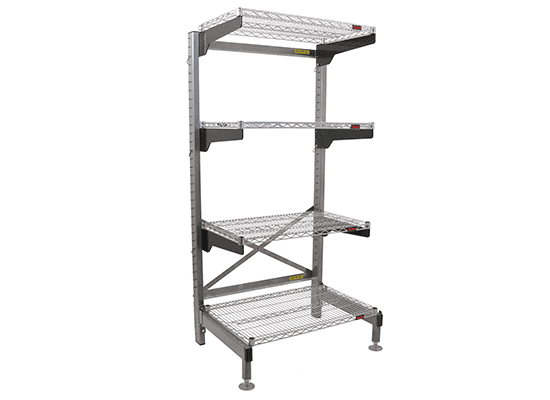 Q-LEVER Cantilever StorageFree-standing cantilever shelving with no front uprights, 2″ upright adjustment, tool-free shelf changes and sheet metal or wire overlays in 18″–30″ widths and 24″–72″ lengths.
 Employee and Staff StorageLockers, hooks and a dedicated shelf run for staff belongings keep coats, bags and phones out of the food zone. Give staff a defined place near the entrance and the storeroom stops absorbing personal items.
Label the shelf, not just the box
Marking boards, shelf-edge labels and a simple color or letter code per aisle are the cheapest productivity tool in a storeroom. Label each tier with what belongs there, date-rotate on the label rather than the case, and put the same labels on the walk-in so a new hire finds an item in one trip instead of three. Clear labeling is also what makes a FIFO rotation survive a busy week.
Send us your walk-in and storeroom dimensions
Give us the room sizes, door and evaporator locations, your product mix and the ceiling height. We will come back with a shelving layout, an elevation your installer can build from, and a line-by-line quote with model numbers and freight. Call (800) 326-4403 or send the plan.
Sizing a Dry Store: How to Lay Out a Walk-In or Storeroom

Start with the aisle, not the shelving. A single-person walk-in works at 30 to 36 inches of clear aisle. If a cart, a hand truck or a rolling rack has to enter, plan 42 to 48 inches. Measure to the face of the loaded shelf, not to the post — a 24 inch deep shelf holding 26 inch cases has just cost you two inches of aisle on each side.
Then set depth by wall. 18 to 24 inch shelves along the long walls, and 24 inch on the back wall if a cart never has to turn there. Deeper is not better in a cold room: anything you cannot reach becomes the product that expires.
Then the tiers. Bottom tier at 6 to 8 inches for cleaning and code, top tier below the sprinkler clearance line and out of the evaporator’s direct throw, and everything between it spaced to the actual product. Because posts are numbered on one inch increments, tell us your case heights and we will number the tiers on the elevation.
Then weight. Heavy, dense product on the bottom two tiers, light and infrequently used on top. Watch the 2,400 lb four-post number on a fully loaded five-tier unit of canned goods — that is a load you can genuinely hit.
- Clear aisle: 30–36″ walking, 42–48″ if carts enter
- Bottom tier 6–8″ off the floor so the floor can be cleaned and inspected
- Top of stored product clear of sprinkler heads — confirm the local clearance requirement
- Never block the evaporator throw or the door swing with a top tier
- Heavy and dense low, light and seasonal high
- Leveling feet adjusted at install — a sloped drain floor is not a level floor
- Leave one unit of empty capacity for the delivery that comes in bigger than planned
The shelf-foot math that tells you how much shelving to buy
Most storerooms are bought by eye and come up short in the first month. The arithmetic is not hard. Count the linear feet of product you hold at peak — the delivery before a holiday weekend, not a Tuesday — by measuring how much shelf a typical case run occupies. A five-tier unit 24″ deep by 48″ long gives you 20 linear feet of shelf. Multiply your peak requirement by 1.25 so there is somewhere to put the delivery that arrives early or oversized, then divide by the shelf feet per unit to get a unit count. Compare that against the wall length you actually have, and if the numbers do not meet, the answer is usually taller posts or a second aisle, not deeper shelves.
Vertical space is the cheapest space in the building and the most commonly wasted. A 74″ post and a 86″ post cost nearly the same and the taller one adds a full tier. Because posts are numbered in one inch increments, tier spacing can be tuned to the product mix later without buying anything new — which is the practical reason to specify adjustable shelving rather than fixed welded units in a room whose menu will change.
When shelving is the wrong tool
If product arrives on pallets and stays on pallets, if you are stacking above eight feet, or if a freezer holds bulk cases you buy by the truckload, you have a rack problem, not a shelving problem. That is our core business — see food & beverage storage solutions for pallet rack, cooler and freezer racking, including drive-in and push-back systems designed for cold storage.
Shelf and Post Finishes for Wet and Dry Zones
Finish is where shelving budgets get wrecked. Chrome is the cheapest and the shortest-lived in a wet room; stainless costs the most and outlives the building. The epoxy finishes in between exist because most kitchen zones are neither perfectly dry nor a washdown environment.
| Finish | Where it belongs | Watch out for |
|---|---|---|
| Chrome | Genuinely dry storage rooms and dry back-of-house | Humidity, splash and cold-room condensation will eventually find it |
| Valu-Master gray epoxy | General kitchen storage and wall shelving | Chipping from cart impact — touch up rather than ignore |
| Valu-Gard green epoxy | Walk-ins, coolers and damp zones; epoxy finishes are approved for wet or dry applications | Still needs cleaning; epoxy is a coating, not a bleach-proof surface |
| EAGLEgard hybrid epoxy | Wet, high-humidity and high-traffic areas | Specify consistently so the run matches visually |
| Stainless steel | Dish rooms, chemical storage, washdown and food-contact adjacency | Highest cost — spend it where the water actually is |
| Polymer mats over wire | Prep, dish and anywhere spill is routine | Mats are removable for cleaning; keep spares in the schedule |
Sanitation listings on shelving are model-specific rather than line-wide. Send us the model numbers you are considering and we will confirm the current listing status for each one in writing before you order — that is what a plan reviewer will ask for anyway. For a deeper look at shelving specified for food-contact and wet zones, see our sanitation-rated shelving and stainless steel shelving pages.
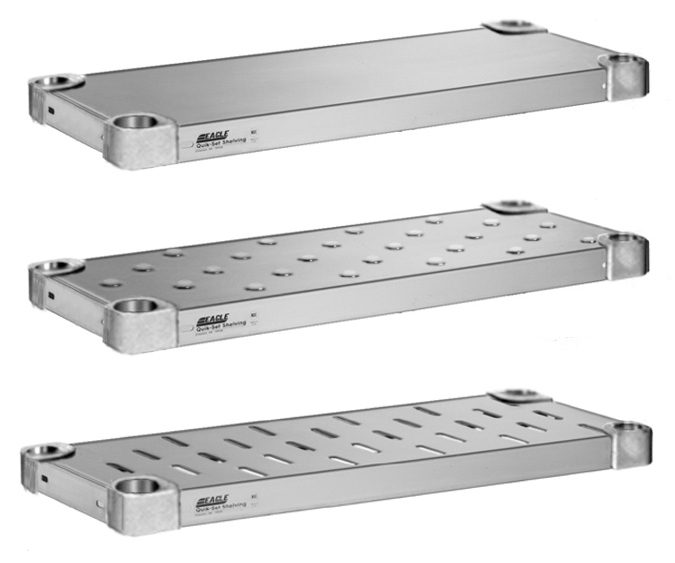
Quik-Set solid shelving deserves a specific mention on finish because it is offered in both directions: 14 or 16 gauge stainless steel, or 14 or 16 gauge galvanized steel with Valu-Master gray or Valu-Gard green epoxy, in flat, embossed and louvered styles. Louvered shelves let a little air move while still holding small items; embossed shelves shed liquid toward a spot instead of pooling flat.
Every side is built with a 2″ downturn and marine edge, and each corner is fitted with a heavy duty aluminum casting that accepts a split sleeve — so a Quik-Set solid shelf and a QuadTruss wire shelf can share the same post system in the same unit. That is genuinely useful: solid on the bottom two tiers where the spills happen, wire above where air movement matters.
Cleaning, Takedown and Keeping Shelving in Service
Shelving fails for two reasons: it never gets cleaned, or it gets cleaned so aggressively that the finish is destroyed. Both are avoidable, and both are decided by how the unit was specified in the first place.
- Design for takedown. Tapered split sleeves and shelf collars come apart without tools, so a full tier can be lifted out, carried to the dish area and washed — specify units the crew can actually disassemble instead of welded shelving they will only ever wipe.
- Use removable mats where the mess is. Polymer shelf mats over wire truss frames lift out and go through the dish machine, which is why they belong in prep, dish and any cooler where product leaks.
- Match the cleaner to the finish. Chlorine-based sanitizers left to dry will pit chrome and attack epoxy edges. Rinse and wipe dry; save the harsh chemistry for stainless surfaces rated for it.
- Clean under the unit, not just on it. Mobile units and dunnage exist so a mop reaches the floor. If a stationary unit blocks the floor, plan a quarterly takedown instead of pretending the floor beneath it is clean.
- Touch up chips early. A cart strike that exposes steel under epoxy will bloom into rust in a humid cooler. Touch-up is a five-minute job the week it happens and a shelf replacement a year later.
- Re-level after every move. Leveling feet compensate for uneven and sloped floors. A unit racked out of plumb loads its posts unevenly and the shelves stop sitting flat on the sleeves.
- Rotate the finish to the environment. If a chrome unit keeps rusting in the same corner, that corner is wetter than the spec assumed — swap in epoxy or stainless there rather than replacing chrome with chrome.
Shop Foodservice Shelving & Storage Online
Buy select items directly from our online store, or request a quote for volume, custom sizes and freight-rated orders.

Design & price it online: Metro Wire Shelving Configurator
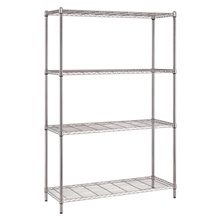
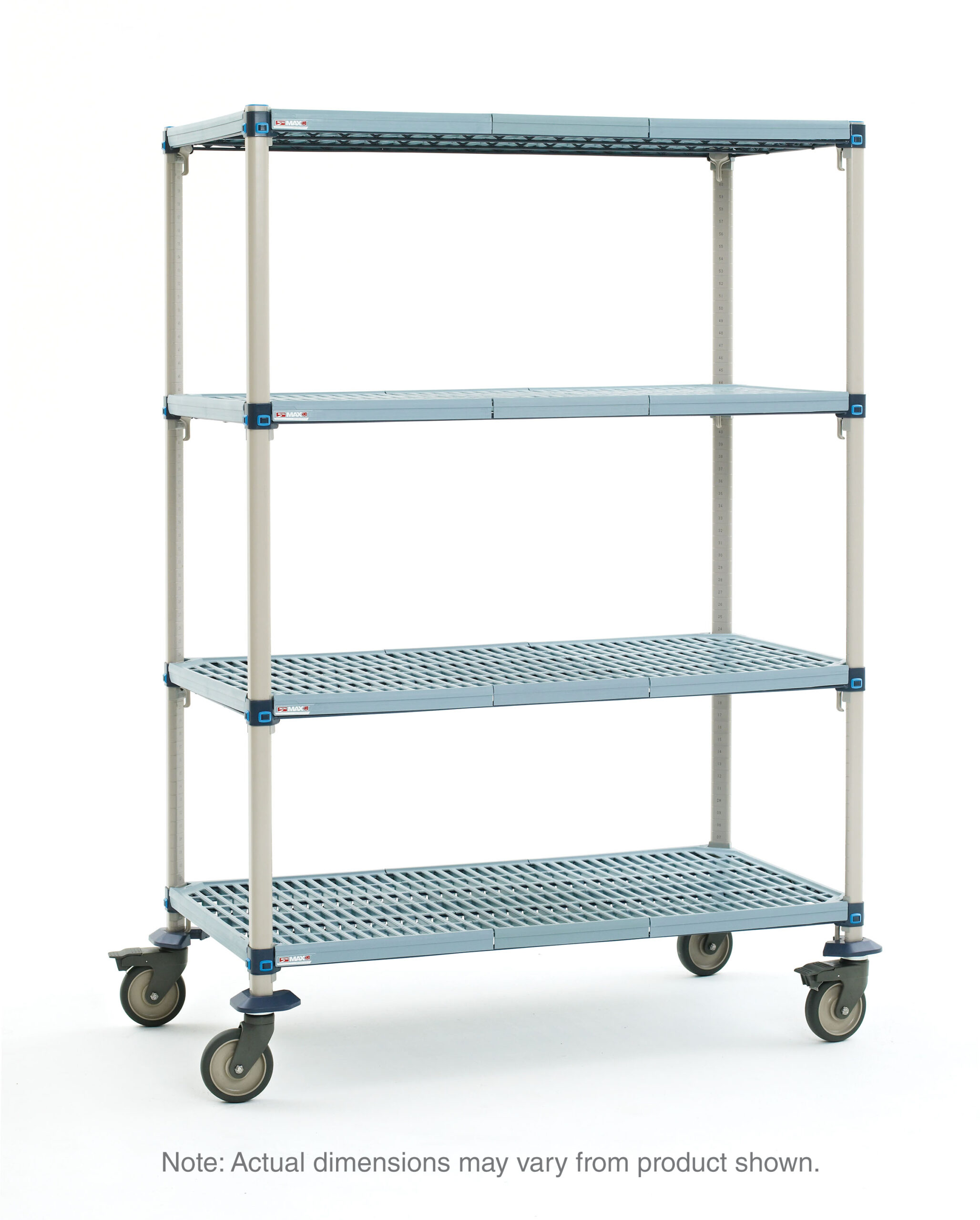
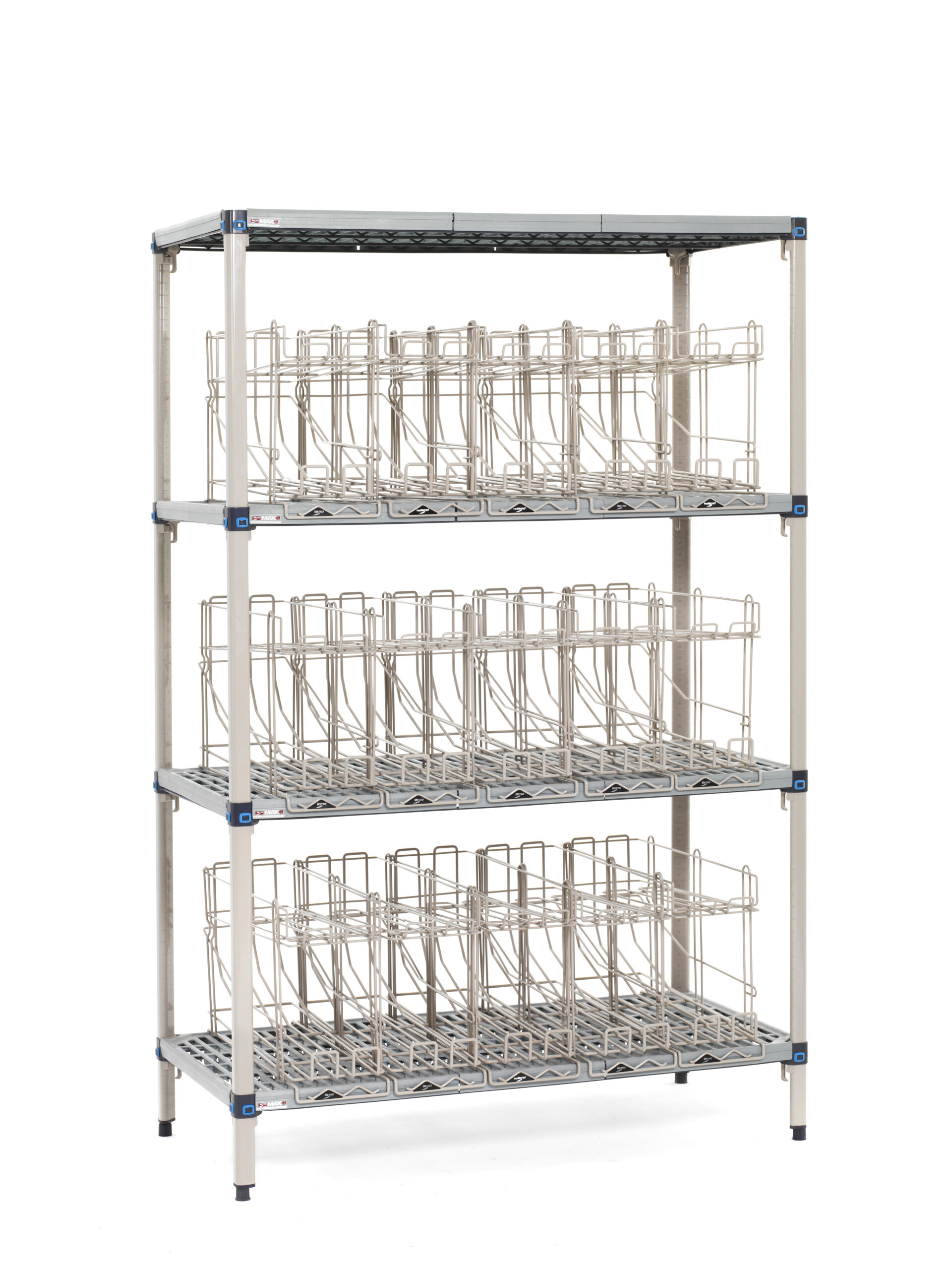
Configure Super Erecta wire shelving units, posts, shelves and casters in our free Metro Wire Shelving configurator — build the layout, see a full bill of materials and save or send the quote in minutes. Need a different Metro product? Browse all 17 tools in the Metro configurator hub.
Get a free quote
Tell us what you are storing, the room size and your timeline. A project specialist will follow up with layout options and pricing. Prefer to talk? Call (800) 326-4403.
Frequently Asked Questions
What shelving should I use in a walk-in cooler?
Wire or solid shelving for a commercial kitchen?
How much weight can a wire shelf hold?
What is QuadTruss and does it matter?
How high can I stack product in dry storage?
How do I clean commercial kitchen shelving?
Can shelving be customized to my kitchen?
Do you help lay out a shelving package?
Get Your Kitchen Storage Quote
Send the walk-in dimensions, the storeroom plan or a photo of the wall. We will lay it out, quote it and ship it.