
Pallet Rack / Pallet Rack Safety Netting
Pallet Rack Netting & Safety Netting
Back-of-rack, flue-space and pick-face netting that keeps cartons and pallet loads from falling into aisles, walkways and work areas. Extruded polypropylene grid, knotted nylon panels, modular clip-in netting and engineered rack net systems — supplied and installed nationwide from Salt Lake City.
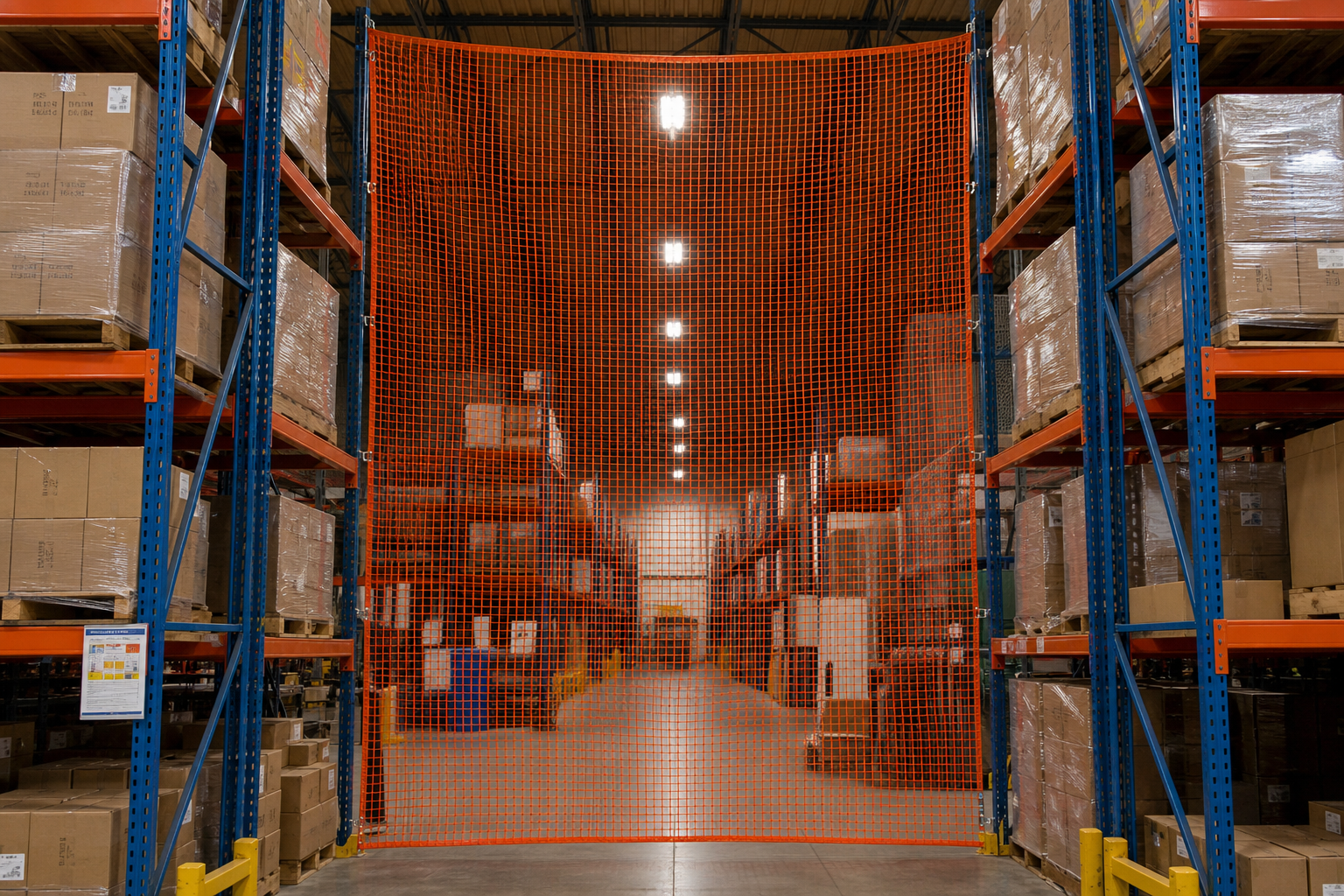
1,300
lb/ft tensile, heavy-duty grid
2,500
lb load rating, nylon net panels
4
Netting materials stocked
0°F
Cold-storage rated grid
What Pallet Rack Safety Netting Does
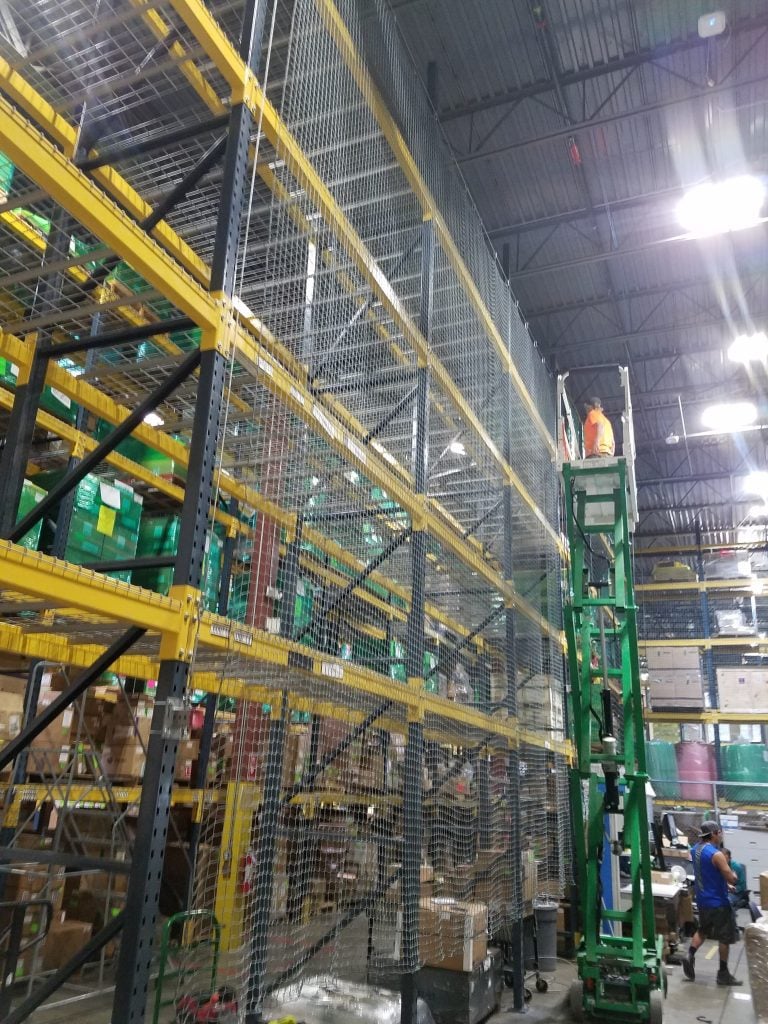
Almost everything that falls out of a pallet rack falls out the back. A driver sets a pallet a few inches too deep, the load behind it shifts, and a carton goes over the far beam into whatever is on the other side — a pick aisle, a walkway, an office wall, a sprinkler riser, or a person. Pallet rack safety netting is the passive control for that failure: a tensioned mesh barrier across the open face of the bay that catches the load instead of the floor.
It is deliberately unglamorous engineering. There is nothing to power, nothing to remember, and no rack modification — roll goods trim with tin snips and hang on cable ties, panels and modules clip to the uprights. That is why netting is usually the lowest-cost meaningful safety upgrade available on an existing rack system, and why it is the first thing we specify when a customer tells us product has come off the back of a run.
What netting is not is a fall-protection system or a structural repair. It contains stored goods vertically. It does not stop pallet push-through on its own, it will not hold a rack up, and it must never be used as a horizontal catch net. Where impact and push-through are the real problem, steel is the answer — see pallet rack backing and rack guards and column protectors.
- Catches cartons and loads pushed off the back of a bay before they reach a walkway
- Installs on loaded rack, bay by bay, with no beam or upright modification
- Available in rolls, made-to-size panels, or tool-free clip-in modules
- Rated by tensile strength per foot (grid) or total load rating (net panels)
- Trims around sprinkler drops, lights and flue spaces without losing strength
What the Standards Actually Say
There is no code line that reads “pallet rack shall be netted.” What the regulations require is that stored material not create a hazard, and that people be protected from objects falling from higher levels. Netting is how most warehouses meet that on a rack run they cannot barricade.
| Reference | Subject | What it requires |
|---|---|---|
| OSHA 29 CFR 1910.176(b) | Secure storage | Storage of material shall not create a hazard; material stored in tiers must be stacked, blocked, interlocked and limited in height so it is stable and secure against sliding or collapse. This is the general-industry hook inspectors reach for on falling-product hazards in racking. |
| OSHA 29 CFR 1926.501(c) | Protection from falling objects | Requires toeboards, screens or guardrail systems, a canopy, or a barricaded exclusion zone to keep objects from falling to lower levels. Netting is the practical screen in a rack aisle where you cannot barricade the floor. |
| OSHA 29 CFR 1926.555(a)(5) | Conveyors over work areas | Where a conveyor passes over work areas, aisles or thoroughfares, suitable guards must protect employees working below — the reason conveyor guard netting is specified on pick modules. |
| ANSI A10.11 | Personnel and debris nets | Traffic and workers are not permitted beneath a work area unless protected from falling objects; where personnel nets are used they must be lined with debris netting of a mesh size and strength sufficient to contain tools and materials. |
| NFPA 13 / sprinkler design | Flue space and obstruction | In-rack storage arrangements depend on clear transverse and longitudinal flue spaces. Any netting in or near a flue must be installed so it does not obstruct sprinkler discharge — which is why offset brackets, not a net stretched through the flue, are the normal specification. |
We do not sell compliance — we sell guarding
No netting product certifies you as OSHA compliant, and nobody can promise that on your behalf. What netting does is give you a documented engineering control for a recognized hazard, which is a far better position in an inspection or an incident review than a barricade tape and a policy. Your authority having jurisdiction and your sprinkler design have the final say on what goes in a given aisle, and we build the guarding layout around both.
Types of Pallet Rack Safety Netting
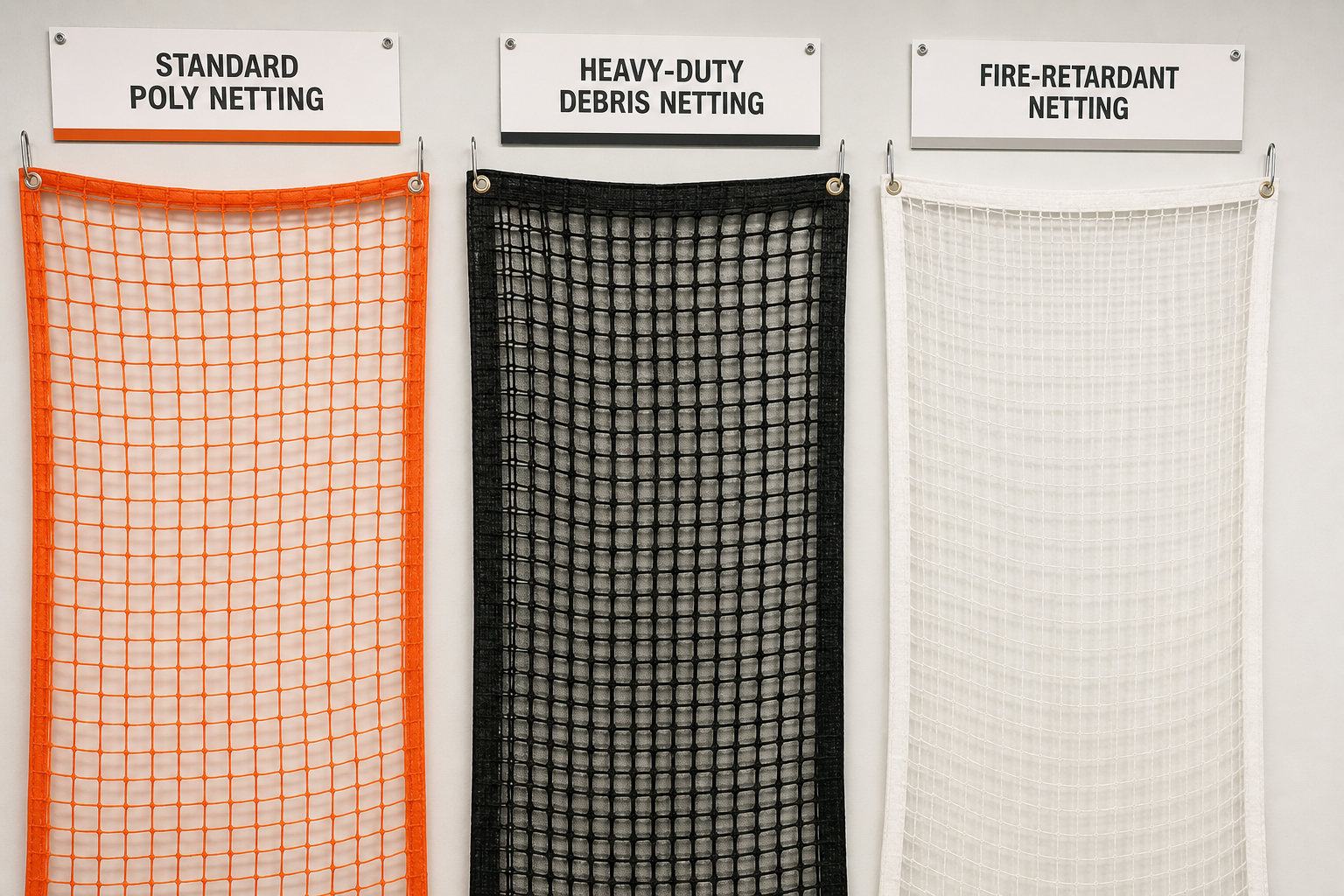
Four materials cover essentially every rack guarding job, and they are not interchangeable. The question is always the same: what is the heaviest thing that could come off this bay, what is the smallest thing that could come off it, and does anyone need to reach through the guarded face?
Loose cartons and mixed cases in a reserve bay are a job for extruded polypropylene grid. Full pallet loads over a pedestrian route are a job for a load-rated net panel or an engineered rack net. A pick face somebody works at all day wants modular netting that lifts out, or steel mesh that can take the abuse. Colors are practical too: high-visibility orange and yellow mark a guarded zone clearly, while black recedes in a customer-facing space.
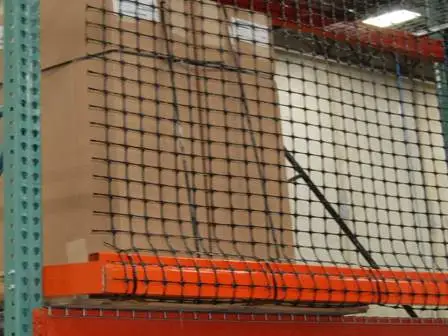 Extruded Polypropylene Grid (RackGuard)The most common choice for back-of-rack containment. The extruded joint structure holds its aperture instead of sagging, is UV stabilized, and will not unravel if a strand or joint is cut. Standard duty carries 850 lb per foot tensile strength and heavy duty 1,300 lb per foot, both in a nominal 1-1/2″ × 1-1/8″ mesh. It is trimmed on site with tin snips or wire cutters and hung with cable ties — no rack modification.
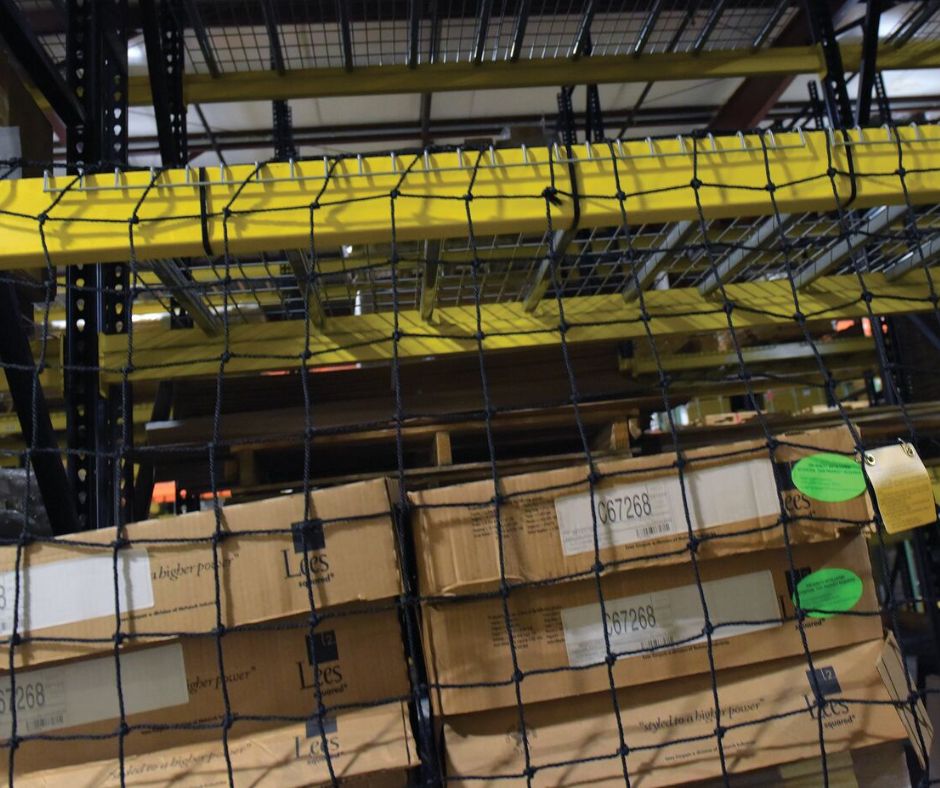 Knotted Nylon Net PanelsPre-sized net panels made from 100% nylon mesh with a 5/16″ poly rope binding on all four edges, flame resistant, and rated to a 2,500 lb load in the 4″ square mesh version. Stock panels cover a single or double bay (8′ × 8′3″ and 8′ × 12′3″) and ship with the zip ties needed to hang them. Best where full pallet loads — not loose cartons — are the falling hazard.
 Modular Polyester Netting & Rack StrapsBay-width net modules in 100% polyester (240 g/m², 5 cm × 5 cm knotless mesh, 1,600 lb burst strength for the netting-plus-hardware assembly) that clip to teardrop or slotted uprights with no tools. They tile vertically and horizontally, so a bay can be guarded level by level and a single module can be removed for access instead of cutting a net.
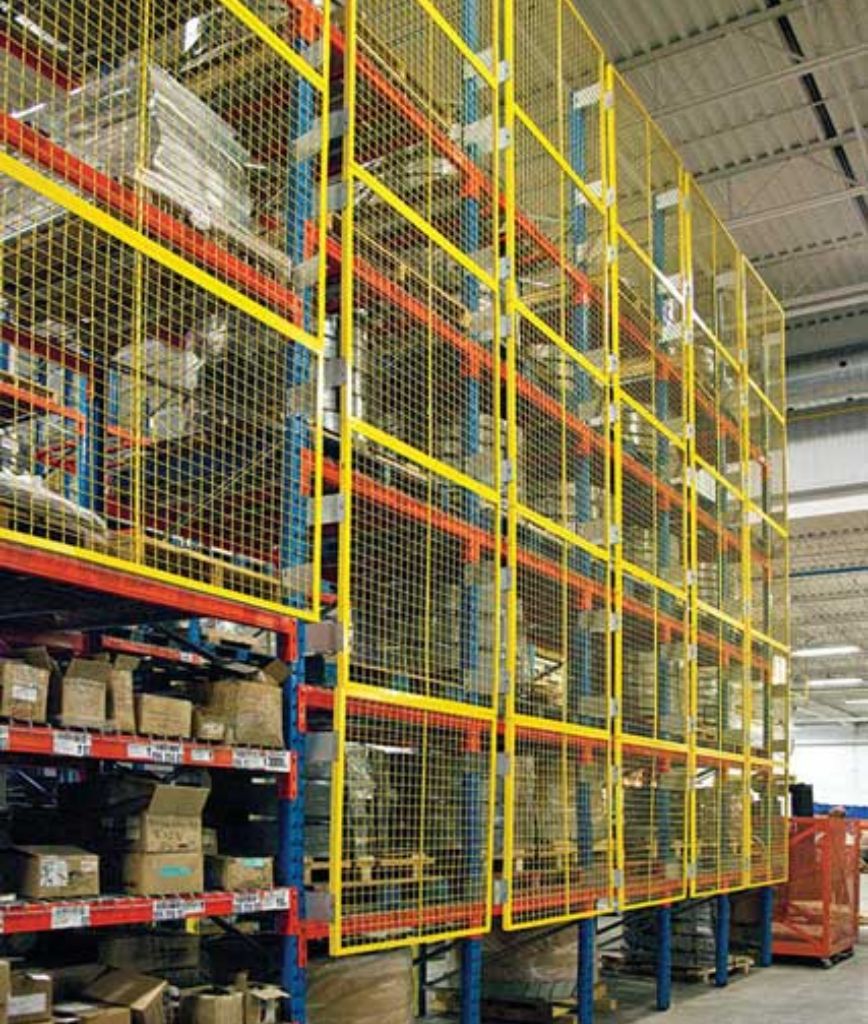 Welded Wire Mesh Rack BackingNot netting, but the same job in steel. Bolt-on woven or welded mesh panels resist forklift and pallet impact, take repeated pallet push-through, and are the right answer where the back of the rack faces a public aisle, a fire-rated wall or a pick module people work in all day. See pallet rack backing for panel options.
Not sure which netting your rack needs?
Send us the bay dimensions, what is stored in the bay, and what is on the other side of the rack. We will come back with the material, the mounting hardware and an installed price — or lay the whole rack system out with you in our free 3D configurator.
Request a Netting Quote Open the Pallet Rack Configurator Call (800) 326-4403
Netting Specifications & Stock Sizes
Representative stocked products and engineered systems. Grid goods are rated by tensile strength per foot of material; net panels and engineered systems carry a total load or burst rating. Custom-cut sizes are available on all of the roll goods and are usually worth it — factory cutting removes most of the on-site labor.
| Product | Material | Mesh | Rating | Stock size | Typical use |
|---|---|---|---|---|---|
| Standard-duty plastic grid (OB1101) | Oriented polypropylene, black | 1-1/2″ × 1-1/8″ | 850 lb per foot tensile | Master rolls 10′, 13′ or 16′ wide × 225′ | General back-of-rack containment for cartons and loose goods |
| Heavy-duty plastic grid (OB1201) | Oriented polypropylene, black | 1-1/2″ × 1-1/8″ | 1,300 lb per foot tensile | Master roll 12.9′ × 164′ | Heavier cartons, high-throughput bays, taller rack |
| Fine security barrier (XB1132) | Diamond polyethylene | 1/2″ diamond | 360 lb per foot tensile | Rolls up to 4′ wide | Shelf and bin dividers, small-parts containment, security screens |
| Nylon net panel, single bay (WB0400) | 100% nylon, 5/16″ rope binding | 4″ square | 2,500 lb load rating | 8′ × 8′3″ panel, 34 zip ties included | Full pallet loads on one bay |
| Nylon net panel, double bay (WB0400) | 100% nylon, 5/16″ rope binding | 4″ square | 2,500 lb load rating | 8′ × 12′3″ panel, 42 zip ties included | Full pallet loads across two bays |
| Modular polyester net module | 100% polyester, 240 g/m² | 5 cm × 5 cm knotless | 1,600 lb burst (assembly) | 60″ high modules for 8′–12′ bays | Tool-free, tileable guarding you can remove for access |
| Engineered rack net system (WebNet) | High-tension synthetic mesh, optional liner | Web straps with optional mesh liner | 2,500 lb load rating | Flush-mount or offset, made to your bay | Low-deflection pallet containment and guarded flue spaces |
| Front-of-rack sliding net | High-strength synthetic mesh on guide cables | Synthetic mesh | 1,500 lb containment capacity | Single or multi-bay, horizontally actuating | Pick modules that need the pick face guarded but accessible |
Choosing Between Netting, Mesh and Straps
| Consideration | Netting (grid or panel) | Welded wire mesh backing | Rack safety straps |
|---|---|---|---|
| What it stops | Cartons and loads falling off the open face of a bay | The same, plus repeated pallet and forklift impact | Pallet push-through at each beam level |
| Installed cost | Lowest | Highest | Low |
| Retrofit on loaded rack | Easy — ties or clips, no hardware on roll goods | Possible, but panels and brackets need working room | Easy — hooks into the uprights |
| Access through the guarded face | Modular netting lifts out; roll goods must be cut | Panels unbolt | Straps unhook |
| Small-parts containment | Yes, with a fine mesh or liner | Yes, with a small mesh opening | No — straps stop pallets, not loose items |
| Impact durability | Moderate — replace damaged sections | High | Moderate; webbing is replaceable |
| Where we specify it | Reserve bays, flue spaces, aisles and walkways behind rack | Public-facing aisles, fire-rated walls, pick modules, heavy traffic | Push-through prevention on pick faces and narrow flues |
Where Rack Netting Belongs
Walk the back side of every rack run in the building and ask what is on the other side. These four situations account for most of the netting we install.
 Back of Single-Row RackThe classic application. When a forklift sets a pallet onto the beams, cartons at the back get pushed off the far side. Netting the full bay height turns that into a caught load instead of a falling one — critical wherever the rear of the rack faces a wall, an office, electrical panels or plumbing.
 Pedestrian Aisles & Work AreasAnywhere people walk, pick or work beside or under elevated storage. Netting is a passive control: it works on the shift when someone forgets, and it keeps a dropped carton from reaching a walkway. Pair it with striped walkway markings and end-of-row column guards.
 Flue Spaces & Back-to-Back RowsIn back-to-back rack, product pushed through one row lands in the flue space or in the pick aisle on the other side. Offset-mount netting guards the flue while keeping the transverse and longitudinal flue space your sprinkler design requires clear of obstruction.
 Mezzanines, Pick Modules & Conveyor LinesOn elevated platforms and pick modules the same netting is used behind rack and along guardrail kick plates to stop small parts from dropping to the level below. Front-of-rack sliding and elevating net systems keep access on the pick face without leaving the bay open.
How Pallet Rack Netting Is Installed

Rolled rack guard is one of the few warehouse safety products a maintenance crew can genuinely install themselves. The tools are tin snips or wire cutters, a bag of cable ties, and safe access to the back of the rack. The two things crews get wrong are tension and tie spacing — a loose net deflects far enough into the aisle to defeat the point, and ties spaced a foot apart let a carton work its way out between them.
A cable-tie tool that tensions and flush-cuts the tie head saves real time on a long run, and UV-stabilized ties are worth the small premium anywhere daylight reaches the rack. In coolers and freezers, switch to stainless steel ties.
Lay Out the Roll
Unroll the rack guard on the floor parallel to the rack run and cut it to the bay length plus a wrap allowance. Confirm the guard height against the top of the load, not the top of the upright.
Secure the Top Edge
Lift one end to the top beam of the bay, wrap the net around the beam and tie it off. The top edge carries the load, so this is where ties are placed closest together.
Work Down the Frame
Tension the net by hand as you go and tie it to each beam and upright, placing ties every four to six inches. A slack net deflects into the aisle when it takes a hit.
Tie Off the Verticals
Secure both vertical edges to the uprights so cartons cannot slip out the side of the bay, and close any gap between adjacent net sections.
Trim and Inspect
Trim the excess with tin snips or wire cutters — the extruded grid keeps its integrity when cut — then walk both sides of the run and confirm no sprinkler head, light or flue space is obstructed.
Get the hardware right the first time
Roll goods need nothing but ties. Panels, modules and engineered net systems need the mounting hardware that matches your upright — standard clips for teardrop and slotted frames, J-hooks for some profiles, U-bolts and steel brackets on cable-supported systems, and offset brackets wherever pallets overhang the beam face. Tell us the rack brand and profile and we will confirm the attachment before anything ships.
Measuring and Ordering
Netting is quoted from six numbers. Get these to us and there is nothing else to ask about.
| What to measure | How | Why it matters |
|---|---|---|
| Bay (beam) length | Face of upright to face of upright, plus the upright width you intend to cover | Nets are ordered by bay: 96″, 102″, 108″, 120″ and 144″ are the common stock widths |
| Guard height | Beam elevation to the top of the load you need contained | Full-height guarding for back-of-rack; 32-1/2″ or 60″ modules where you only need to stop push-through at each level |
| Number of bays | How many bays run continuously without a break | Rolled grid runs continuously; panel and modular products are priced per bay |
| Rack type at the upright | Teardrop, slotted or structural — and which brand | Determines the clip, J-hook or U-bolt hardware; roll goods use cable ties and need no hardware |
| Clearance behind the load | Overhang of pallets and cartons past the beam face | Flush-mount is fine for square loads; oversized pallets need offset mounting |
| Environment | Ambient, cooler, freezer, outdoor, wash-down | Polypropylene stays flexible to 0°F, but use stainless steel ties in refrigerated and freezer spaces; UV-stabilized ties outdoors |
Two details that catch people out
Strand to strand, not edge to edge. Extruded grid is cut to a minimum outside-strand-to-outside-strand dimension, and custom cutting leaves small “nubs” outside that line. For back-of-rack work that is irrelevant. For shelf and bin dividers that have to drop into a fixed opening, specify the edge-to-edge dimension as a maximum so the nubs are included.
Temperature moves plastic. Custom cuts are made at ambient temperature, and polypropylene mesh can expand or contract by 1% to 2% between 40°F and 120°F. On a long run in a freezer or an unconditioned building, allow for it rather than ordering to the exact opening.
Send us your bay dimensions
Bay length, guard height, number of bays, rack brand and what is stored in the bay. We will quote material only if you want to hang it yourself, or material plus installation if you want it done — usually within one business day.
Inspection, Maintenance & Replacement

Netting is a wear item on a rack system that already needs regular inspection. Fold it into the same walk you use for uprights and beams — monthly for most operations, and immediately after any forklift strike in that bay.
The extruded grid tolerates a cut strand without unraveling, which is exactly why damage goes unnoticed: the net still looks intact while its effective strength in that panel is gone. Replace damaged sections rather than patching them, and re-tie any run that has gone slack. If the same bay keeps taking hits, the real fix is upstream — guarding the column, correcting the pallet position, or moving to steel mesh backing.
- Cut, melted or abraded strands — and ties that have failed or gone brittle
- Sag or slack that would let a carton ride over the top edge
- Gaps at the uprights or between adjacent net sections
- Net pushed into a transverse or longitudinal flue space
- Obstructed sprinkler heads, lights or in-rack sprinkler drops
- Damaged uprights, beams and safety clips in the same bay — the underlying problem
Netting is one line item in a rack safety program, not the whole program. Pair it with rack inspection and repair, column and end-of-row guarding, wire decking that stops pallets falling through the beams, and seismic anchorage appropriate to your region.
Pallet Rack Safety Netting FAQs
Is pallet rack safety netting required by OSHA?
What is the difference between plastic rack guard netting and nylon net panels?
What mesh size should I use?
Can safety netting be installed on a rack that is already loaded?
Does netting interfere with sprinklers or flue space?
Can rack netting be used as a horizontal catch net?
Does netting work in cold storage and freezers?
How often should safety netting be inspected?
Do you install pallet rack netting, or is it a DIY product?
How much does pallet rack safety netting cost?
Related Products & Resources
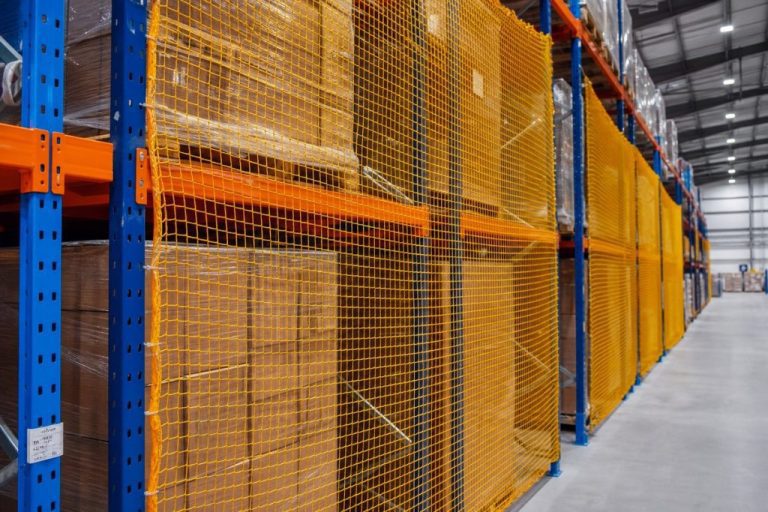 Rack Netting for Pallet Rack SystemsThe netting accessory page in our pallet rack catalog — where netting fits alongside decking, guards and anchors on a new or reconfigured rack system.
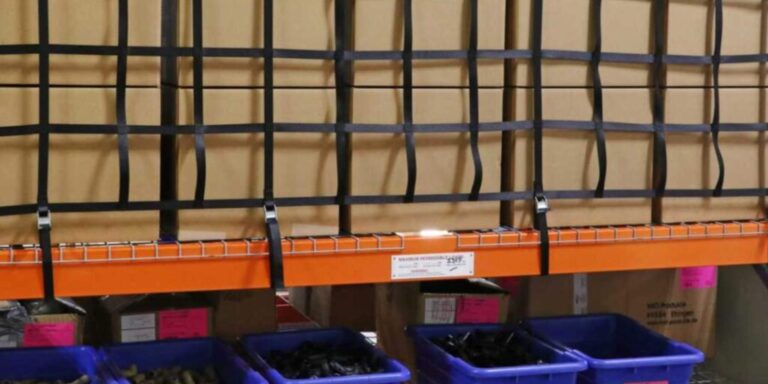 Warehouse Netting SolutionsBeyond racking: mezzanine and guardrail netting, conveyor guards, loading dock nets, truck nets and custom netting for the rest of the building.
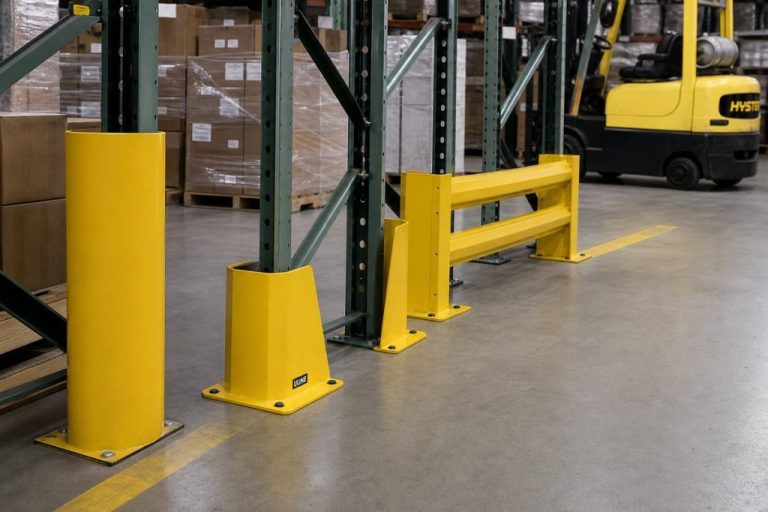 Rack Guards & Column ProtectorsColumn protectors, end-of-row guards and barriers that stop the forklift impact netting cannot — the other half of a rack safety upgrade.
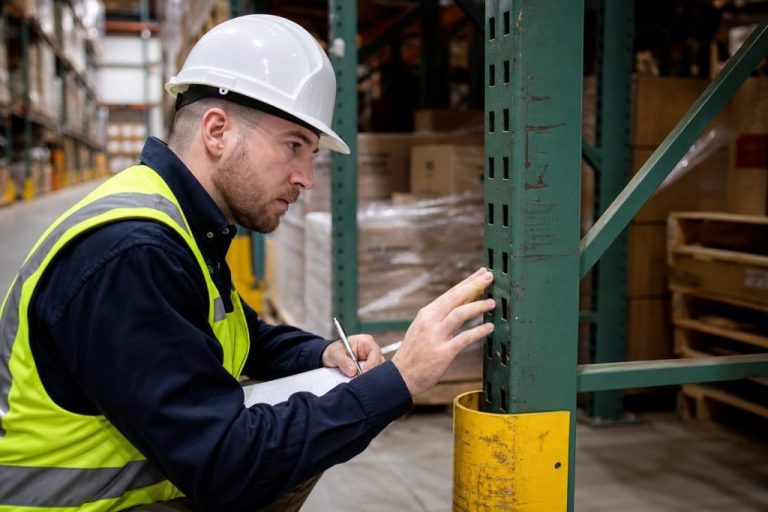 Rack Inspection & RepairDamage assessment, load-capacity review and repair of damaged uprights, beams and clips, so the structure behind your guarding is sound.
Shop Online at MaterialHandling-USA.com
Need safety and warehouse supplies you can buy online today? Our e-commerce store stocks safety and storage products with published pricing and fast shipping.
Guard Your Rack Before Something Falls
Send us the bay dimensions and what is on the other side of the rack. We will specify the netting, the mounting hardware and the installation — and flag anything your sprinkler design or fire marshal will want reviewed first.
Ready to configure your pallet rack system?
Use our guided configurator to choose the right configuration, review your parts and submit it for checkout or a formal quote.