
Pallet Rack / Warehouse Netting Solutions
Warehouse Netting Solutions
Custom-built InCord safety netting for pallet rack, conveyors, mezzanines, loading docks and trailers — specified to your bays, installed by our own crews, and shipped nationwide from Salt Lake City.

2,500 lb
WebNets™ load rating
1,500 lb
Sliding Rack Guard capacity
6
Netting systems we specify
30+
Years designing storage systems
Stop Product Falling Before It Costs You a Person
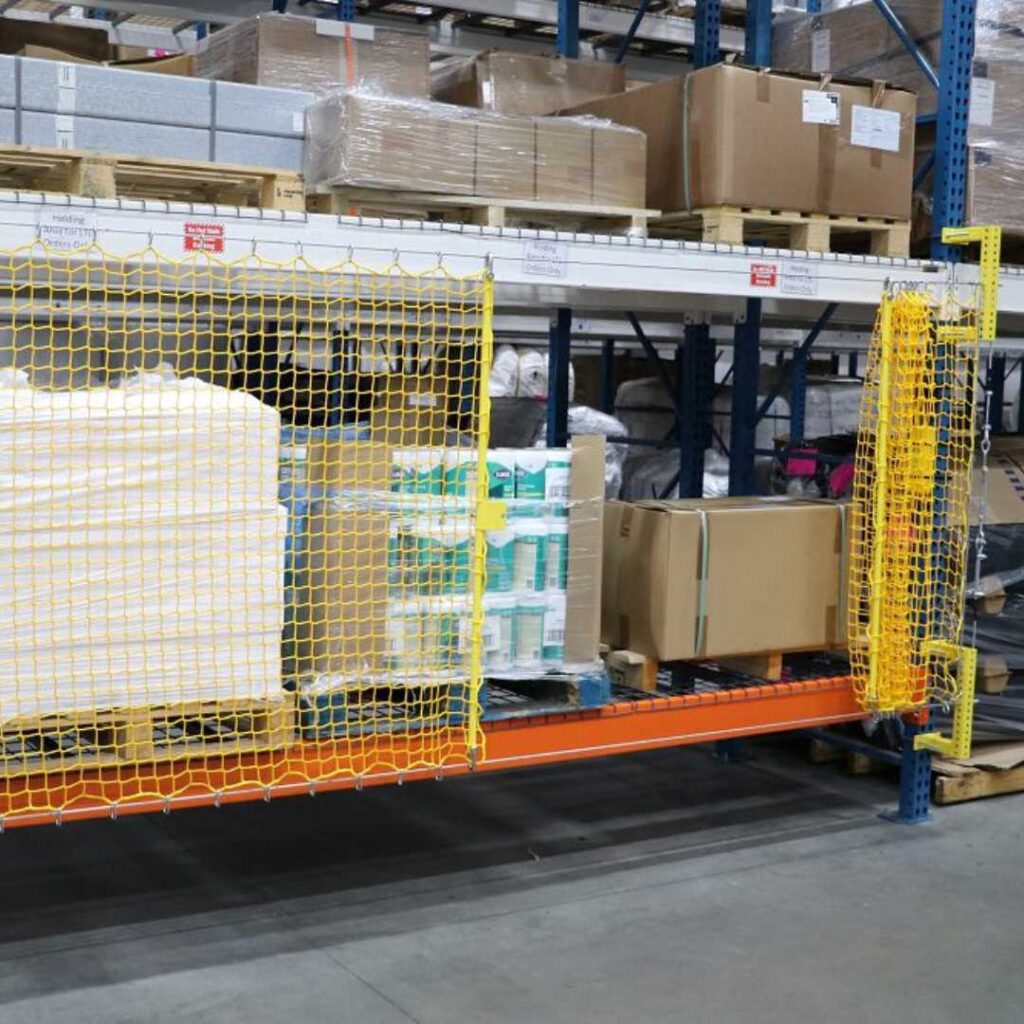
Almost every falling-product incident in a warehouse starts the same way: a pallet is set down a few inches long, a shrink wrap fails, a forklift nudges a load, or a carton is picked from the wrong side of the bay. Nothing about the rack failed. The load simply left the beam — and whatever is behind, beside or below that bay is what gets hit.
Safety netting is the cheapest way to put a physical barrier between that event and your people, your inventory and your equipment. It retrofits to rack that is already standing and loaded, it does not block sprinkler coverage or overhead lighting the way solid panels can, and it can be built to open and close on a pick face so nobody has a reason to defeat it.
Material Handling USA designs, supplies and installs custom industrial netting manufactured by InCord — a US netting manufacturer, a member of the Protective Guarding Manufacturers Association (ProGMA) and an ISO 9001:2015 registered producer with its own in-house test frame built for ANSI A10.11 fall-protection net testing. Every net on this page is made to your bay sizes and your hazard, not cut from a roll.
Warehouse Netting Systems We Specify
Six systems cover nearly every containment and open-edge problem in a distribution or manufacturing building. The right answer depends on what falls, how far it falls, and whether anyone needs to reach through the net during a shift.
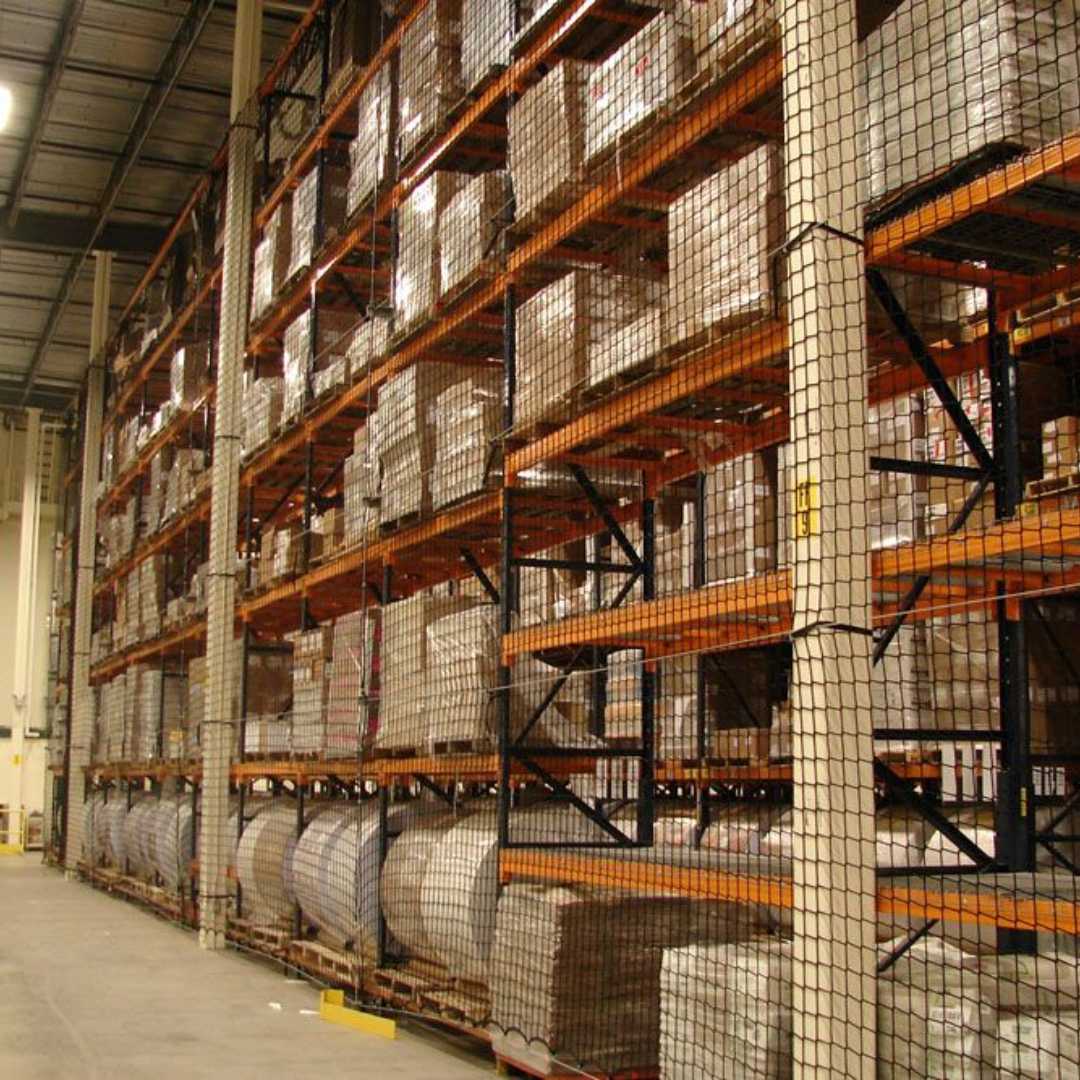 Rack Guard NettingThe core system: custom-fit knotless netting for the front, back, ends and flue spaces of selective and gravity-flow pallet rack. Made from high-tenacity polypropylene (HTPP) knotless mesh with a sewn rope border, sized bay by bay so there are no gaps at the uprights.
 WebNets™ Rack GuardHigh-tension, low-deflection containment built from 1″ polyester webbing instead of cord mesh. Tested to a 2,500 lb load rating, available flush-mount or offset, with optional mesh liners when you also need to hold back small items.
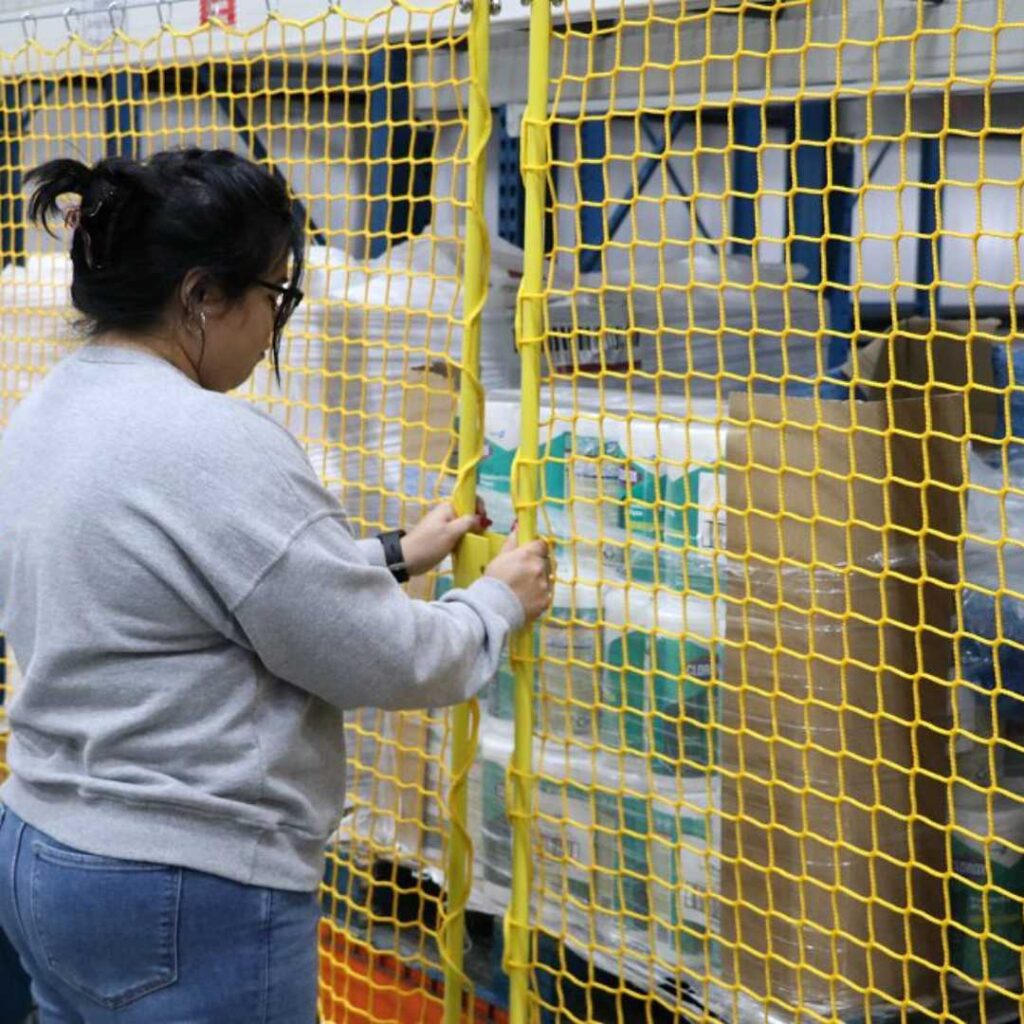 Elevating Rack Guard (ERG)An actuating net that guards and gives access on the same side of the rack. One person raises or lowers it with a pull cord from the floor; it can be configured to open at the top or the bottom of the bay, with right- or left-hand pull. Attaches to existing rack frames with U-bolts and steel brackets carrying the load-bearing cables.
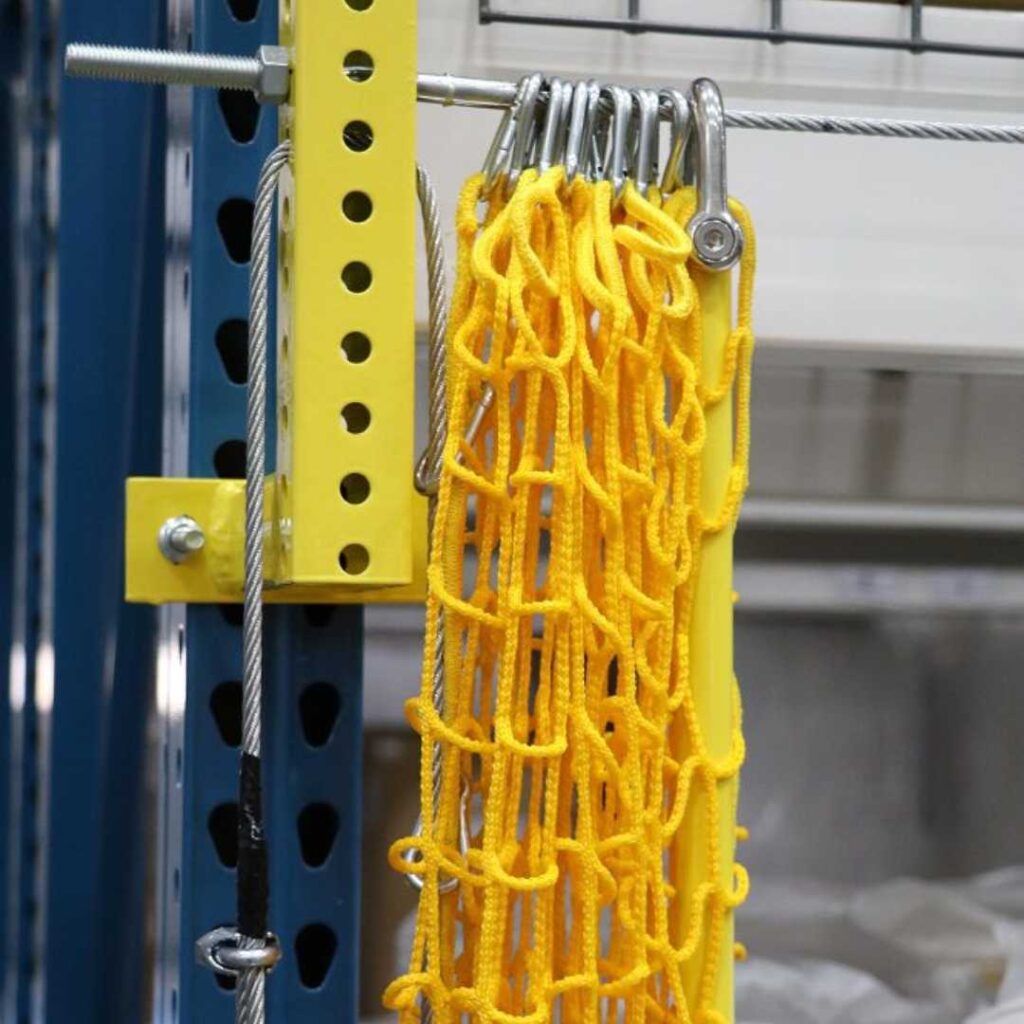 Sliding Rack Guard (SRG)A front-of-rack net that slides horizontally along two guide cables on bounding brackets, so a picker can open one bay without dropping protection across the rest of the run. Containment capacity of 1,500 lb, expandable to multi-bay height and width, compatible with most rack brands and installed with standard hand tools.
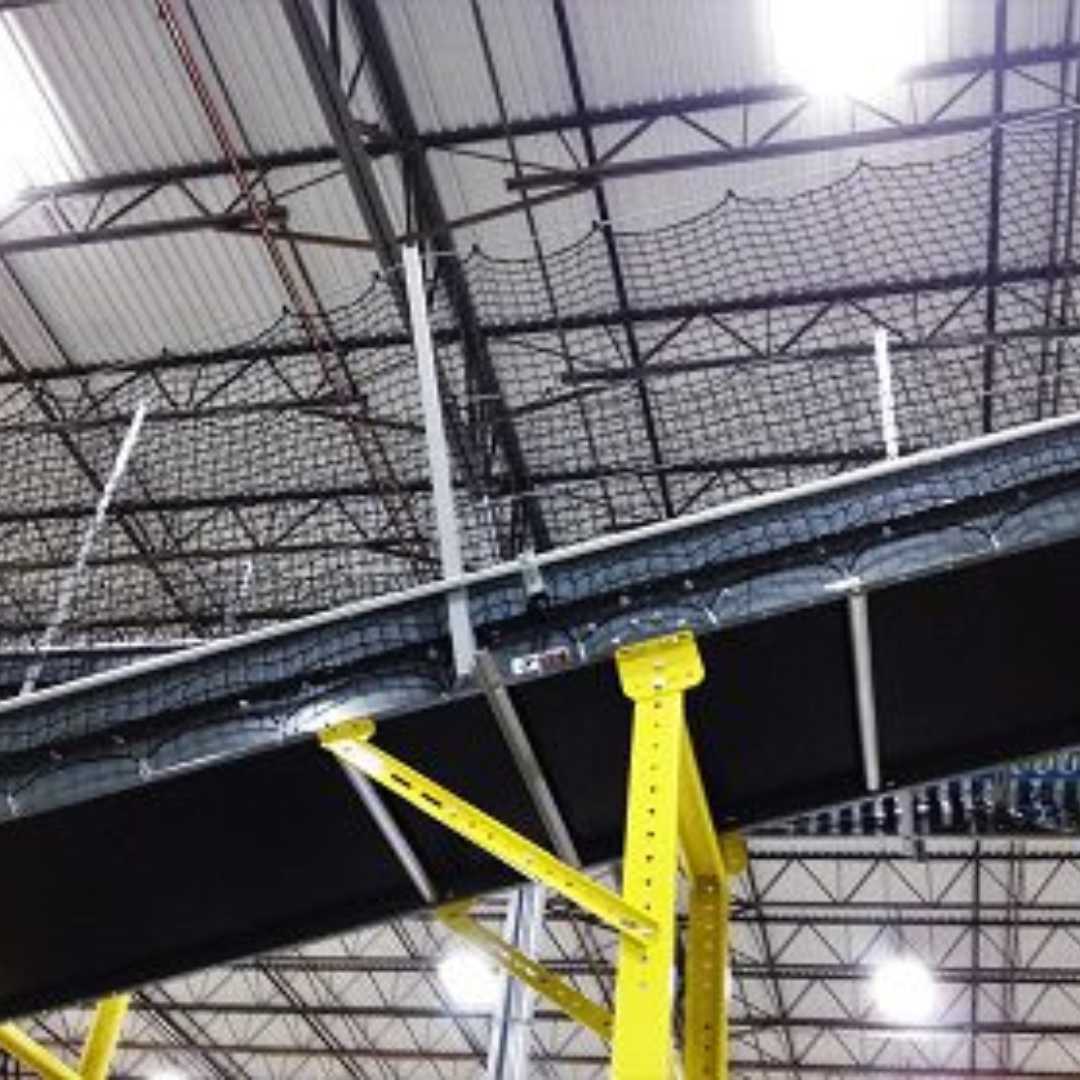 Conveyor Guard®Netting installed under and up the sides of conveyor runs to catch cartons, totes and loose items before they reach the floor or a walkway. Available in mesh sizes from non-porous Spillex™ through 2-1/2″ heavy-duty N820 mesh. Fire-retardant netting is certified to NFPA 701 with ASTM E84 flame and smoke spread ratings.
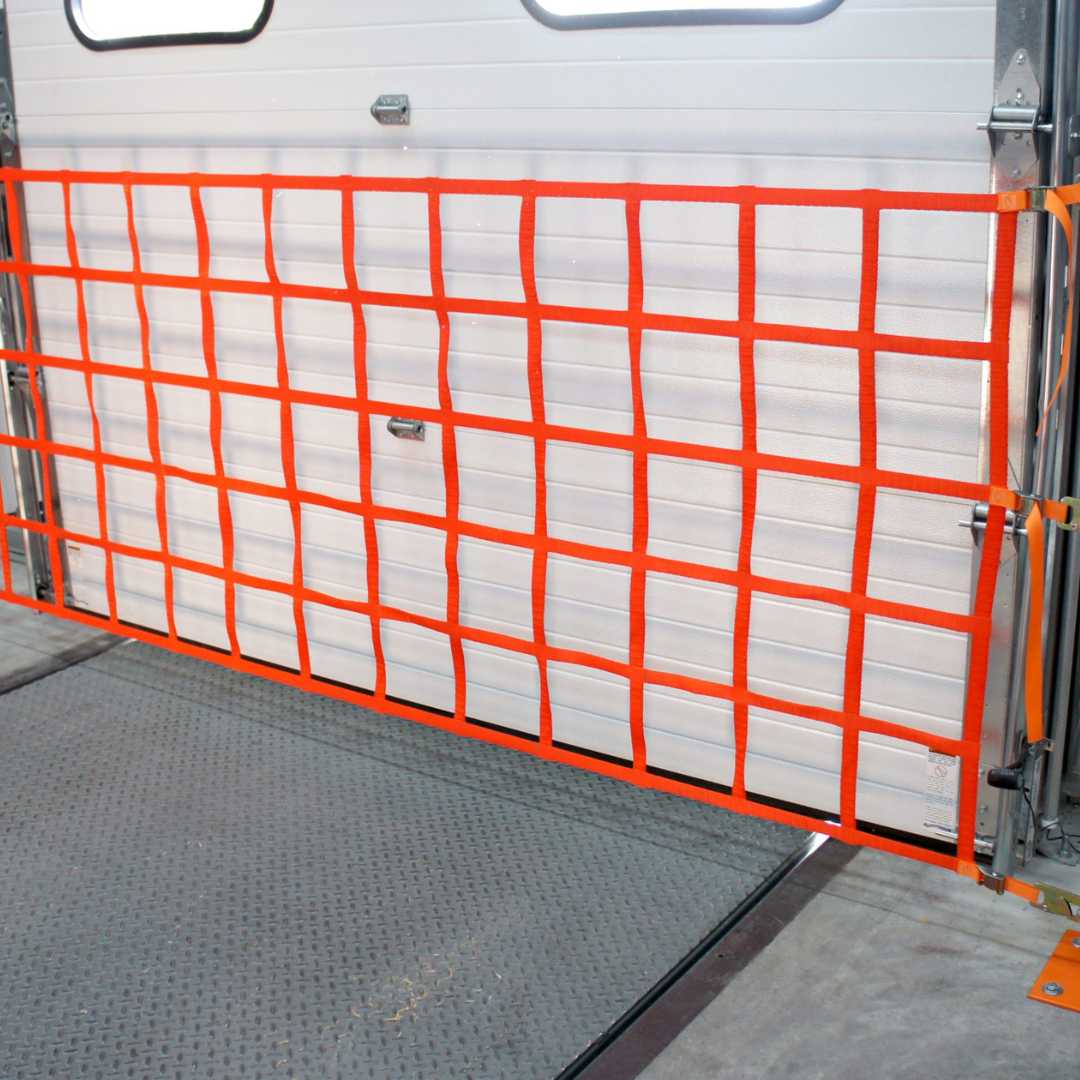 Loading Dock NetsOpen-edge fall protection for dock doors. Built from WebNets 1″ polyester webbing in an 8″ on-center mesh, the high-visibility panel snaps to welded steel stanchions with web straps and adjustable end straps, and spans multiple dock openings using eye bolts on a shared center stanchion.
Not sure which netting system fits your rack?
Send us bay dimensions, what you store and a photo of the run. We will come back with the system, the mesh, the attachment hardware and an installed price — usually the same day.
Request a Netting Quote Lay it out in the Pallet Rack Designer Call (800) 326-4403
Rack Guard: Vertical, Horizontal and End-of-Row Netting
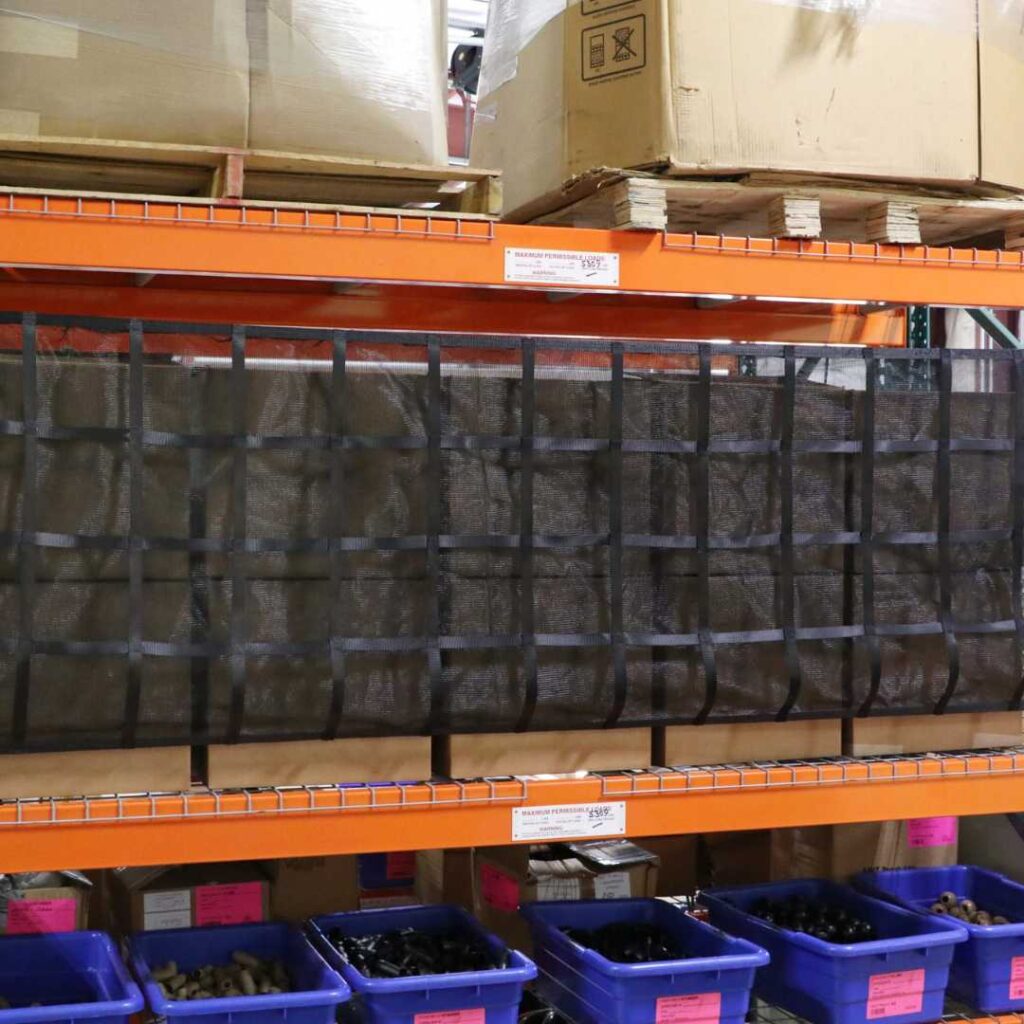
Vertical rack guard netting is installed on a face of the rack: the back of a row, the flue space between two back-to-back rows, or the exposed end of a run. It is the position that matters most in practice, because the back of a rack row is usually the side nobody is watching — an aisle, an office wall, a packing bench or another rack line.
Horizontal rack guard netting is installed under a specific rack area instead, so it catches product (or a person) coming down from above. That is the system we specify over pedestrian routes, pick stations, conveyor take-aways and any piece of equipment that cannot be relocated out from under the rack.
Both are built from knotless high-tenacity polypropylene netting with a sewn rope border. Knotless construction runs the filaments continuously through the mesh instead of tying intersections, which is what keeps a net strong at the point of impact and stops it unraveling when one strand is cut. InCord rates these nets by containment energy and tests them using the ANSI method with a 2× safety factor — an M-3000 net, for example, is rated at 3,000 ft-lb and has been dynamically tested to at least 6,000 ft-lb.
| System | Construction | Rated capacity | Where it goes |
|---|---|---|---|
| Rack Guard netting | HTPP knotless mesh, sewn rope border | Rated by containment energy — e.g. an M-3000 net is rated 3,000 ft-lb | Front, back, end-of-row, flue space and horizontal (overhead) positions |
| WebNets™ | 1″ polyester webbing, flush or offset mount | 2,500 lb load rating (tested) | High-tension, low-deflection containment where clearance is tight |
| Elevating Rack Guard (ERG) | HTPP knotless netting on load-bearing cables | Actuating — one-person pull-cord operation | Pick faces where access and protection share the same side |
| Sliding Rack Guard (SRG) | High-strength synthetic mesh on two horizontal guide cables | 1,500 lb containment capacity | Pick modules and multi-bay runs opened bay by bay |
| Conveyor Guard® | HTPP knotless netting, Spillex™ to 2-1/2″ N820 mesh | FR versions certified to NFPA 701 / ASTM E84 | Under and alongside conveyor runs and transfers |
| Loading Dock Net | WebNets 1″ polyester webbing, 8″ OC mesh | Barrier for personnel, hand carts and light-duty pallet trucks | Dock doors, open edges and similar unprotected openings |
Actuating vs. fixed nets — the decision that gets ignored
A fixed net that has to be unclipped to pick from a bay will be left down inside a month. If people need access on the same face you are guarding, specify an Elevating Rack Guard (pull-cord, opens top or bottom, right- or left-hand pull) or a Sliding Rack Guard (slides bay to bay on horizontal guide cables) at the outset. It costs more per bay than a fixed net and it is the only version that stays in service.
WebNets™: High-Tension, Low-Deflection Containment
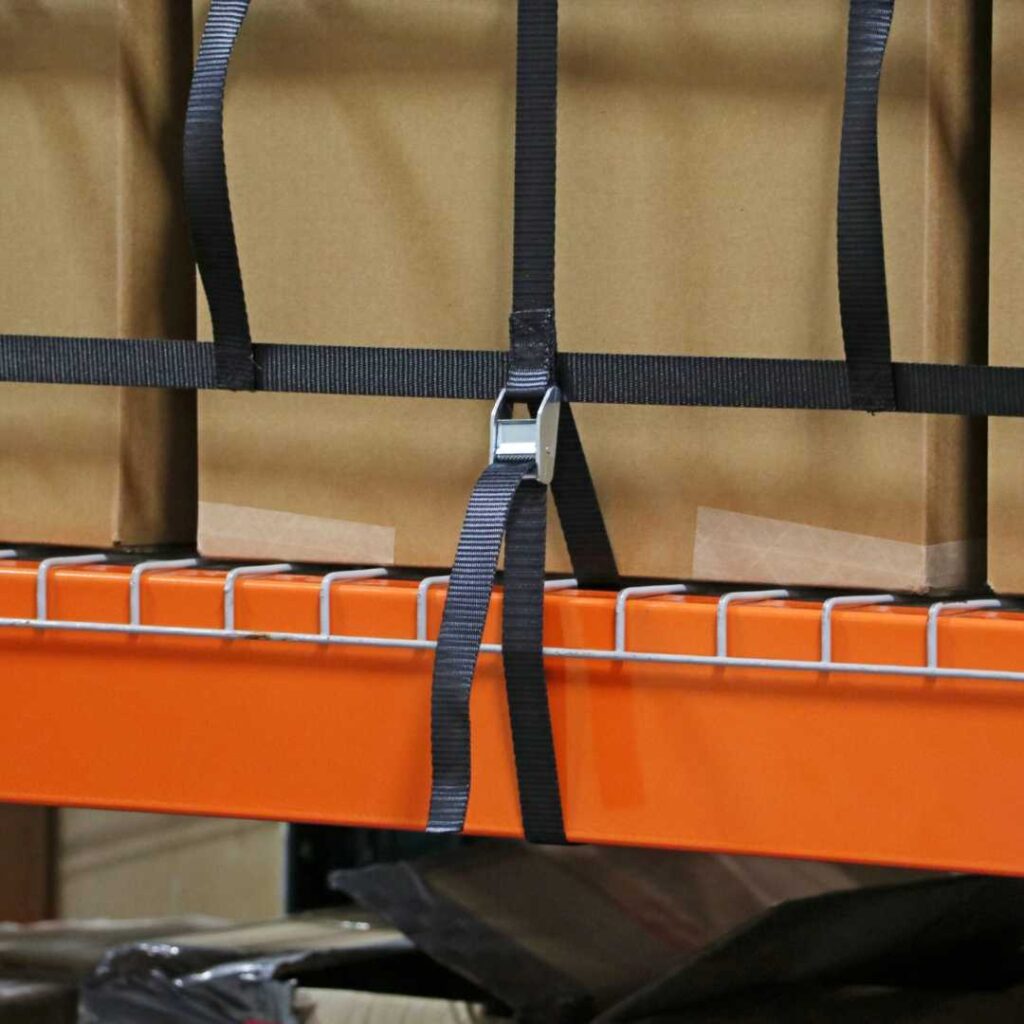
Cord mesh absorbs energy by stretching, which is fine when there is open space behind the net and a problem when there is not. WebNets solve that by replacing the mesh with 1″ polyester webbing on a grid: the same containment, far less deflection, and a tested load rating of 2,500 lb.
They come in two mount styles. The flush-mount version has integrated straps that wrap around the beams and uprights and are hand-tensioned — no special tools and no training required. The offset-mount version stands the webbing off the rack face to give clearance for oversized products and overhanging pallets while still protecting the load and preserving the flue space. Optional mesh liners behind the webbing contain small items that would otherwise pass through the grid.
Because they are so stable under load, WebNets are also the base material for InCord Loading Dock Nets and Truck Nets. See our dedicated WebNets page for more detail on the system.
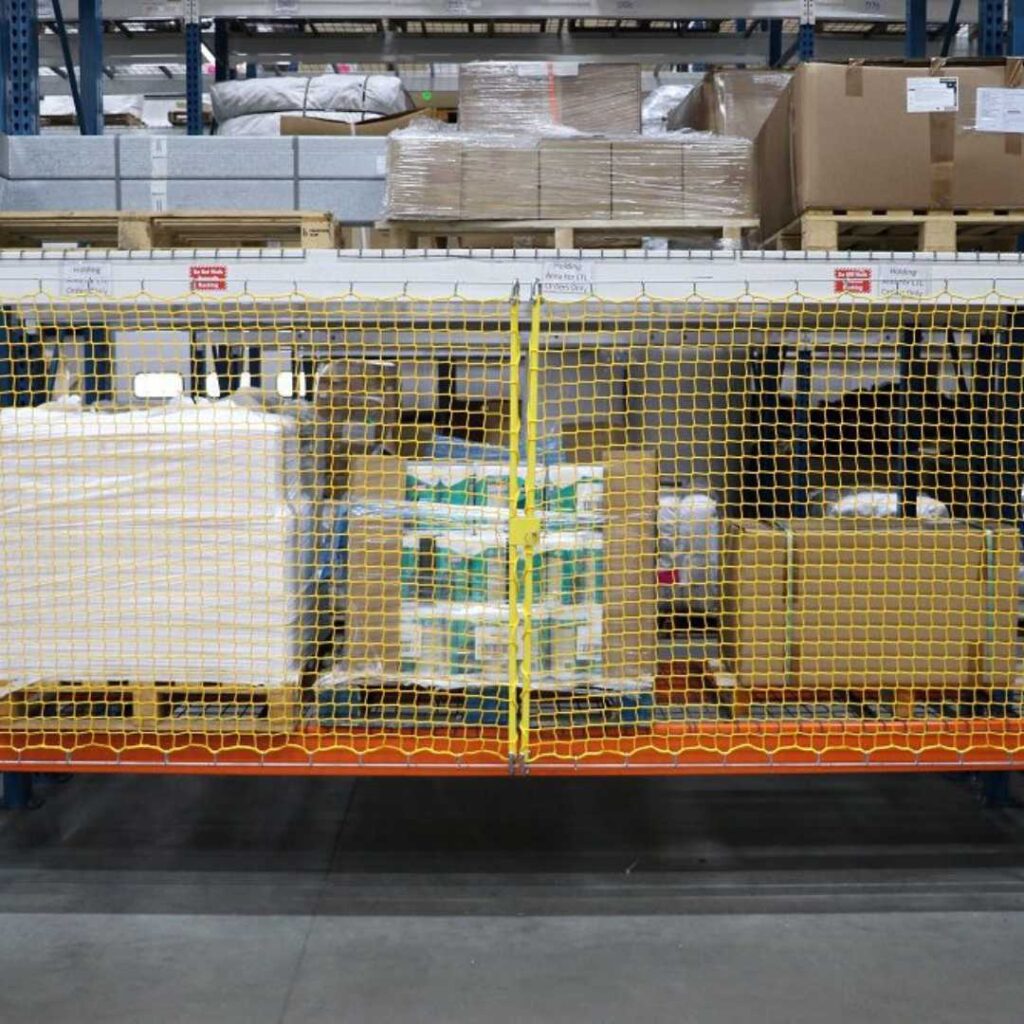
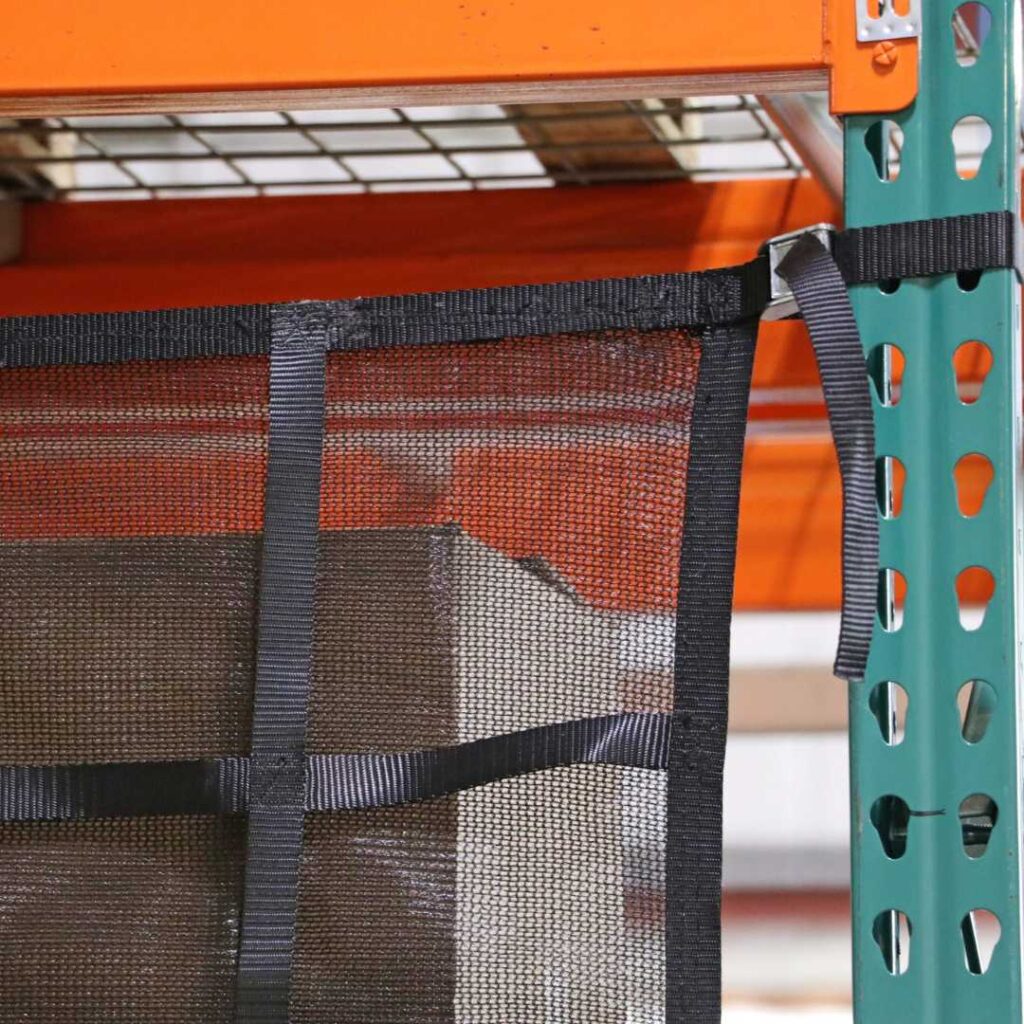 Flush-Mount WebNetsIntegrated straps wrap the beams and uprights and tension by hand. The webbing sits tight to the rack face — the right choice when loads are square to the beam and clearance behind the bay is limited.
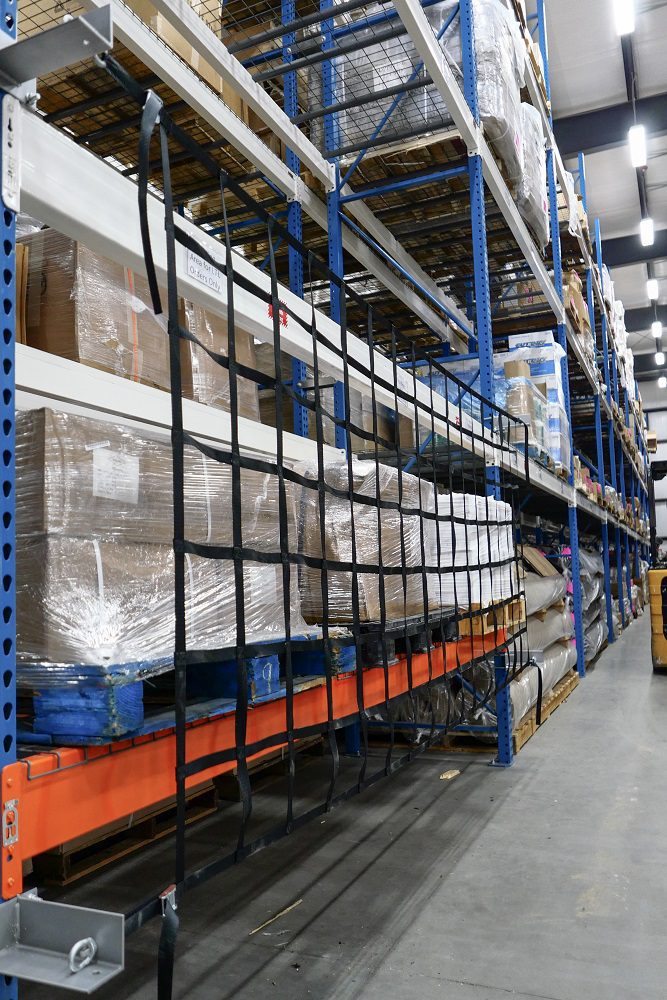 Offset-Mount WebNetsThe webbing is held off the rack face to clear oversized products and pallets that overhang the beam, while still containing the load and keeping the flue space open.
Where Warehouse Netting Earns Its Keep
Netting is not only a pallet rack product. The same manufacturing and the same fibers solve open-edge and containment problems across the whole building.
 Back-of-Rack & Flue SpaceWhere a rack row backs onto an aisle, an office wall or another rack line, vertical netting stops a shifted carton from dropping through the flue. This is the single most common netting retrofit we quote.
 Overhead & Walkway ProtectionHorizontal netting installed beneath the loading level catches falling product and debris above a pedestrian route, a pick station or a piece of equipment that cannot be relocated.
 Mezzanines & Elevated PlatformsNetting behind guardrail on a mezzanine or work platform keeps small parts, hardware and cartons from passing under the rail and falling to the floor below.
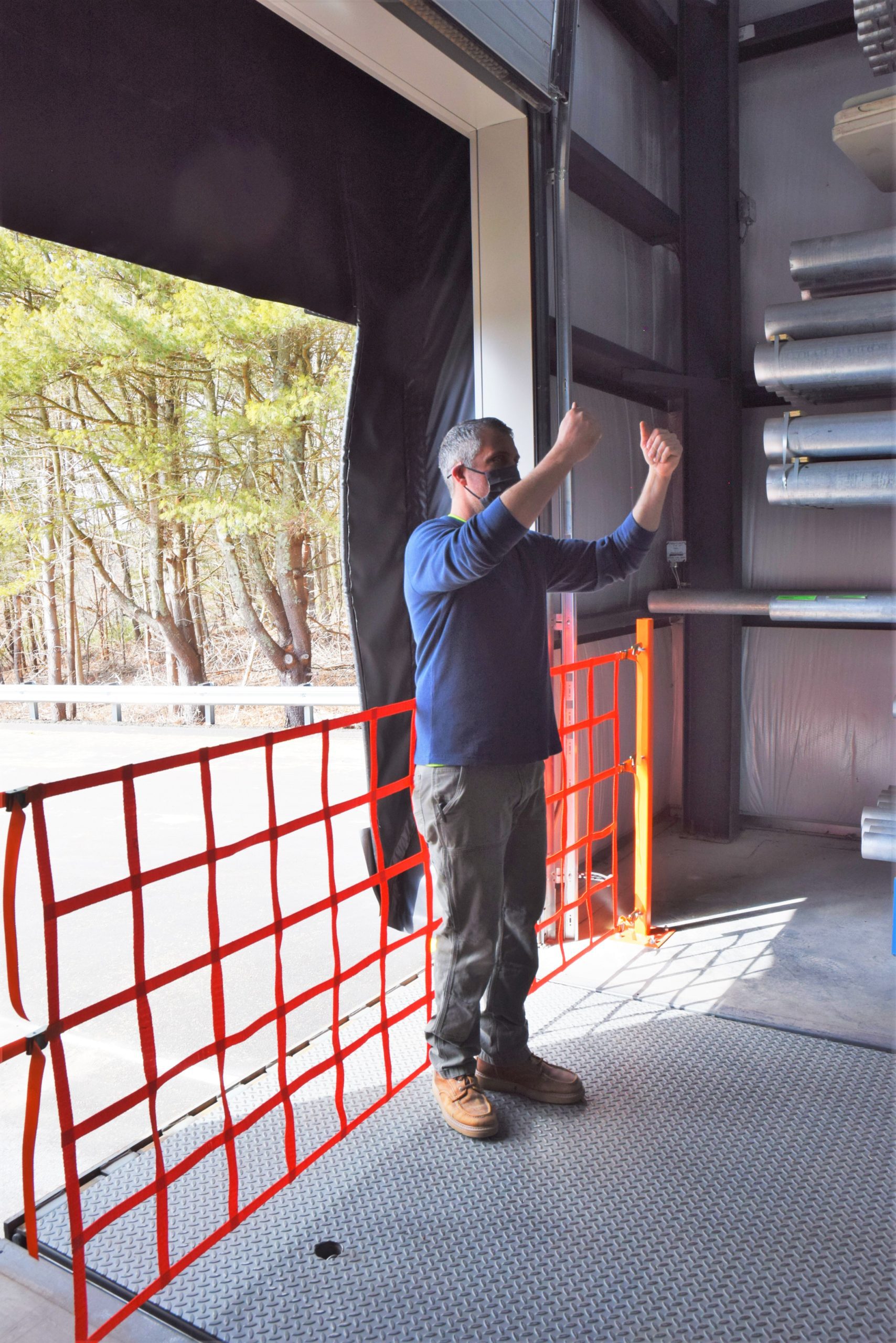 Loading DocksA tensioned dock net gives you an open-edge barrier against personnel, hand carts and light-duty pallet trucks while leaving the door usable and the opening visible.
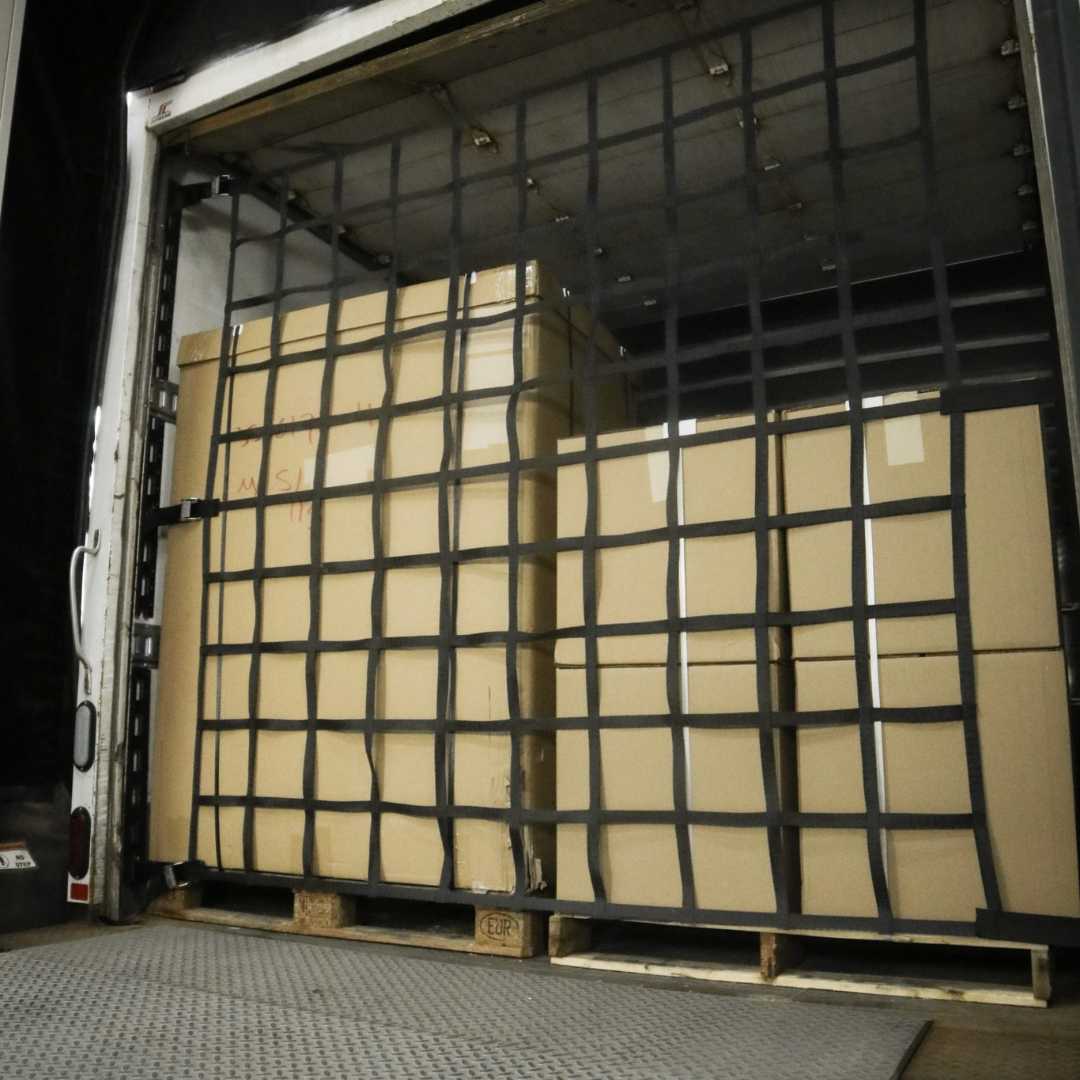 Trailers & Truck LoadingTruck nets contain a load so nothing falls out when the trailer doors are opened, and they can be used to separate stops inside the trailer body. Custom-built to the E-track configuration you already have, with an optional debris liner.
 Ladder Cages & Roof AccessCageX™ nets close the unprotected gap between the top of a ladder cage and the platform handrail. Skylight nets fit any roof hatch or raised-lip skylight with at least 2″ of curb, in safety-orange 1-1/2″ HTPP with a 4″ square mesh rated to contain up to 1,000 lb.
Also available from the same product line
- Conveyor Guard® under and up the sides of conveyor runs, in FR netting certified to NFPA 701 with ASTM E84 flame and smoke spread ratings where required
- CartNet™ reusable containment for food, beverage, trash, recycling, display and distribution carts — it compacts for storage between deliveries
- Cargo lifting nets and slings for bundling and lifting loads up to 6,000 lb, in HTPP knotless mesh with a nylon border rope
- Skylight and roof-hatch nets in safety-orange 1-1/2″ HTPP, 4″ square mesh, rated to contain up to 1,000 lb, strapped to any 2″ raised curb
- CageX™ ladder cage nets spanning the gap from the ladder cage to the platform handrail
- Truck and trailer nets built to your E-track layout, with an optional debris liner
Have an open edge, a conveyor or a dock door to solve?
We quote netting the same way we quote rack: measured, specified and installed. Tell us what is falling and what is underneath it.
Mesh Sizes, Fibers and How to Specify Them

Mesh selection is the one decision customers most often get wrong, and it is simple: the mesh has to be smaller than the smallest thing you need it to stop. A 2″ mesh that comfortably holds a full case will pass a bag of fasteners without slowing down.
High-tenacity polypropylene (HTPP) is the standard fiber for material handling nets. It is light, it resists abrasion and moisture, it carries extra UV stabilizers for high-bay lighting and skylight exposure, and it is available in black, white and safety orange. Nylon knotless netting is used where a finer 1″ mesh is wanted, and polyester webbing is used where deflection has to be minimal.
Fire-retardant versions of the standard netting are certified to NFPA 701 for flammability and tested to ASTM E84 for flame and smoke spread — worth asking about early if your building is sprinklered to a specific commodity class or your insurer reviews guarding materials.
| Mesh / material | Characteristics | Typical use |
|---|---|---|
| Non-porous Spillex™ | Solid, non-porous panel | Powders, granules, small hardware and liquids that a mesh would pass |
| 1″ square knotless mesh (e.g. N250 nylon, M-250 HTPP) | 1/16″ cord, roughly 500 ft-lb load test on the M-250 style | Small cartons, loose parts, cart and conveyor containment |
| 2″ square knotless mesh (e.g. M1250 style) | Higher containment energy, better visibility | Full cases and palletized loads on selective rack |
| 2-1/2″ heavy-duty (N820) | Largest openings, maximum airflow and light | Heavy conveyor guarding and large-carton containment |
| 1″ polyester webbing (WebNets™) | 2,500 lb rating, very low deflection | Rack bays with little clearance, dock nets, truck nets |
| 4″ square 1-1/2″ HTPP (skylight net) | Contains up to 1,000 lb | Skylights and roof hatches with a 2″ raised lip |
Netting vs. the Other Ways to Stop Falling Product
Netting is one control among several, and on most projects we end up specifying two or three of these together rather than arguing for one.
| Control | What it addresses | Strengths | Limits |
|---|---|---|---|
| Safety netting | Falling product, small parts, debris; personnel at open edges | Retrofits to existing rack, no rack redesign, keeps light and sprinkler coverage, actuating options for pick faces | Deflects under load — needs clearance behind or below |
| Wire mesh rack backing / partitions | Falling product plus pilferage and separation | Rigid, minimal deflection, doubles as a security barrier | Heavier, more expensive per bay, harder to retrofit around obstructions |
| Wire mesh decking | Product falling through the beam level itself | Improves sprinkler water flow and light penetration versus solid decking | Protects the level, not the ends, back or flue |
| Column protectors & guard rail | Forklift impact on the structure | Protects the rack itself so it stays plumb and rated | Does nothing about product already falling from height |
| Pallet inspection and load discipline | The root cause of most falls | Cheapest control there is | Depends on people every shift — netting is the backstop |
A worked example
A back-to-back selective rack run with a packing bench on the far side of the flue is a classic case. Wire mesh backing would fix it, but it means shutting the run down, and the sprinkler engineer wants the flue clear. A WebNet on the back face of the affected bays installs from the aisle in an afternoon, deflects very little toward the bench, and leaves the flue open.
Change one variable — small hardware instead of cases — and the answer changes to a WebNet with a mesh liner, or a 1″ cord mesh if there is room to deflect. That is the whole job: match the system to the load, the clearance and who has to reach through it.
How a Netting Project Runs
Walk the hazard
We look at where product actually falls today — back of rack, ends of rows, flue spaces, over walkways, at the dock — and what is underneath it.
Measure and specify
Bay dimensions, beam and upright profiles, load type and weight, clearance behind the rack, and sprinkler and lighting layout drive the mesh, the mount style and the attachment hardware.
Custom manufacture
Nets are built to your bay sizes rather than cut down from a roll, with sewn rope borders and the attachment hardware for your rack brand.
Install and verify
Our crews install to the manufacturer’s instructions — cable terminations and clamp counts matter more than anything else on the job — then walk it with your safety lead.
The details that decide whether a net performs
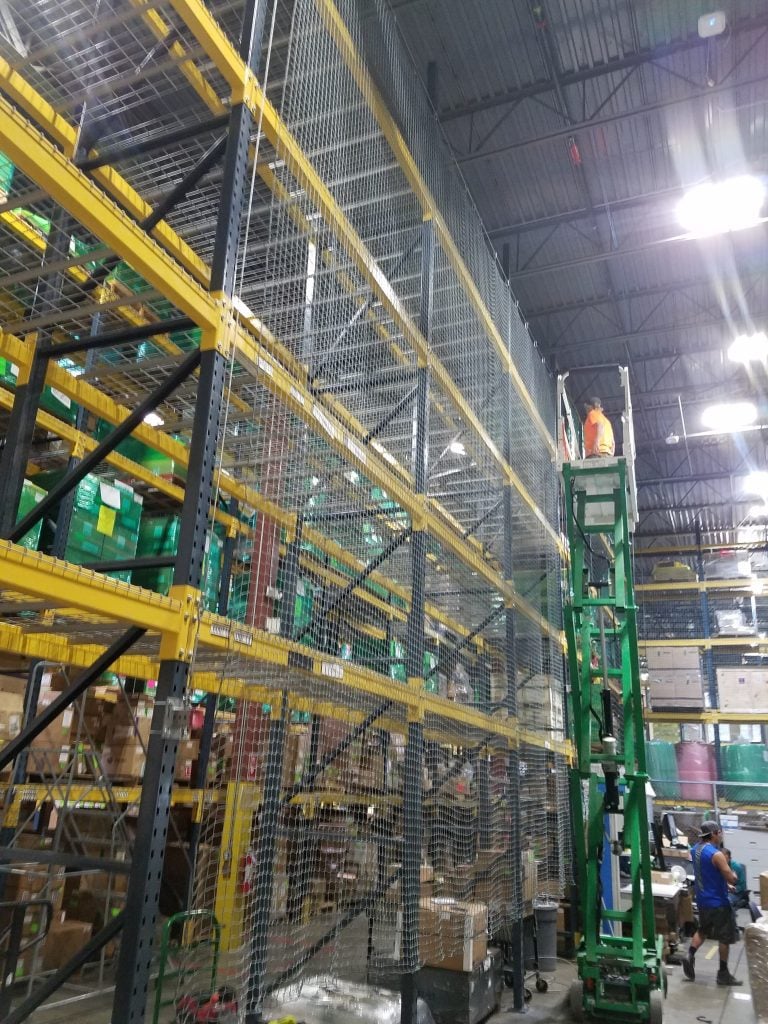
Netting is unforgiving of shortcuts at the terminations. InCord’s own installation guidance is blunt about it: incorrectly installed cable fittings or clamps can reduce pull-out strength by 40% or more. Clamp count, clamp orientation, saddle-on-the-live-end, thimble use and cable tension are not preferences, they are the rating.
The other two failure modes we see on site are equally mundane. Nets get sized to the bay but not to the load, so a pallet that overhangs the beam sits proud of the net and defeats it. And fixed nets get installed on a pick face, get tied up out of the way in week two, and never come back down. Both are specification problems, and both are avoidable in the first site walk.
Once installed, netting goes on the same inspection cycle as the rack: cut or abraded mesh, UV chalking, loose straps, slipped clamps, and any bay where the stored profile has changed. If you already run rack surveys, add the nets to the same checklist — see rack repair and inspection.
Safety Standards, and What Netting Does and Does Not Do

There is no OSHA standard titled “pallet rack netting,” and any supplier who tells you a net makes you compliant is selling, not engineering. What exists are duties that netting helps you meet:
29 CFR 1910.176(b) — secure storage. Material stored in tiers must be stacked, blocked, interlocked and limited in height so it is stable and secure against sliding or collapse. This is the clause most often cited when product comes off rack.
29 CFR 1910.28(c) — protection from falling objects. Where employees are exposed to falling objects, the employer must provide head protection and protect employees from the objects themselves. 1910.29(k) then describes the criteria for the physical measures — toeboards, screens, guardrail infill and canopies. Netting is used as an engineering control in exactly that role.
Netting is also part of how the industry frames rack safety generally: InCord is a member of ProGMA, the Protective Guarding Manufacturers Association, whose members publish guidance on guarding selection for exactly these hazards. For a broader look at designing the hazard out of the floorplan in the first place, see our guide to OSHA-compliant warehouse design.
- Identify every location where product can leave a beam and something or someone is below or behind it
- Specify mesh by the smallest item you need to contain, not by the pallet
- Confirm the clearance available for deflection before choosing cord mesh over webbing
- Use an actuating system (ERG or SRG) anywhere people need access on the guarded face
- Ask for FR netting if your commodity class, fire marshal or insurer requires it
- Install to the written instructions — cable clamps and terminations are the rating
- Add netting to your existing rack inspection checklist
Warehouse Netting FAQs
What is the difference between rack guard netting and WebNets?
Which netting lets pickers reach the load without unclipping anything?
Does warehouse netting make my facility OSHA compliant?
How is netting attached to pallet rack, and will it damage the rack?
What mesh size and material should I specify?
Can netting be installed in an occupied, operating warehouse?
How much deflection should I allow behind a net?
Do you inspect and repair existing netting?
Related Products & Resources
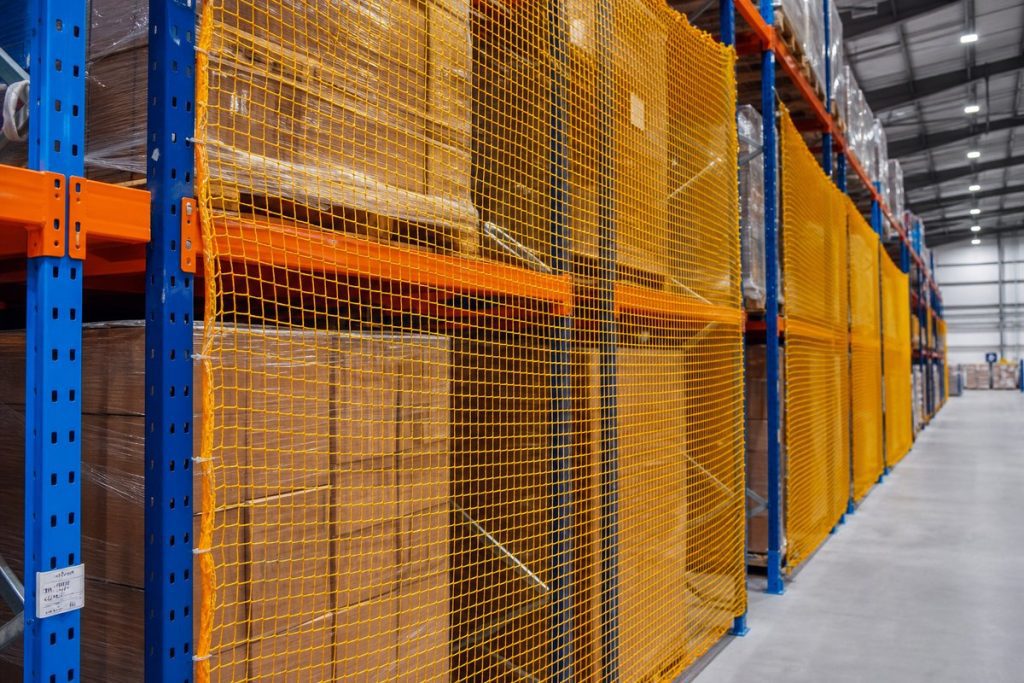 Pallet Rack NettingRack netting types, positions and specification guidance for selective pallet rack.
 Pallet Rack Safety NettingOur dedicated pallet rack safety netting page — vertical, horizontal and end-of-row nets.
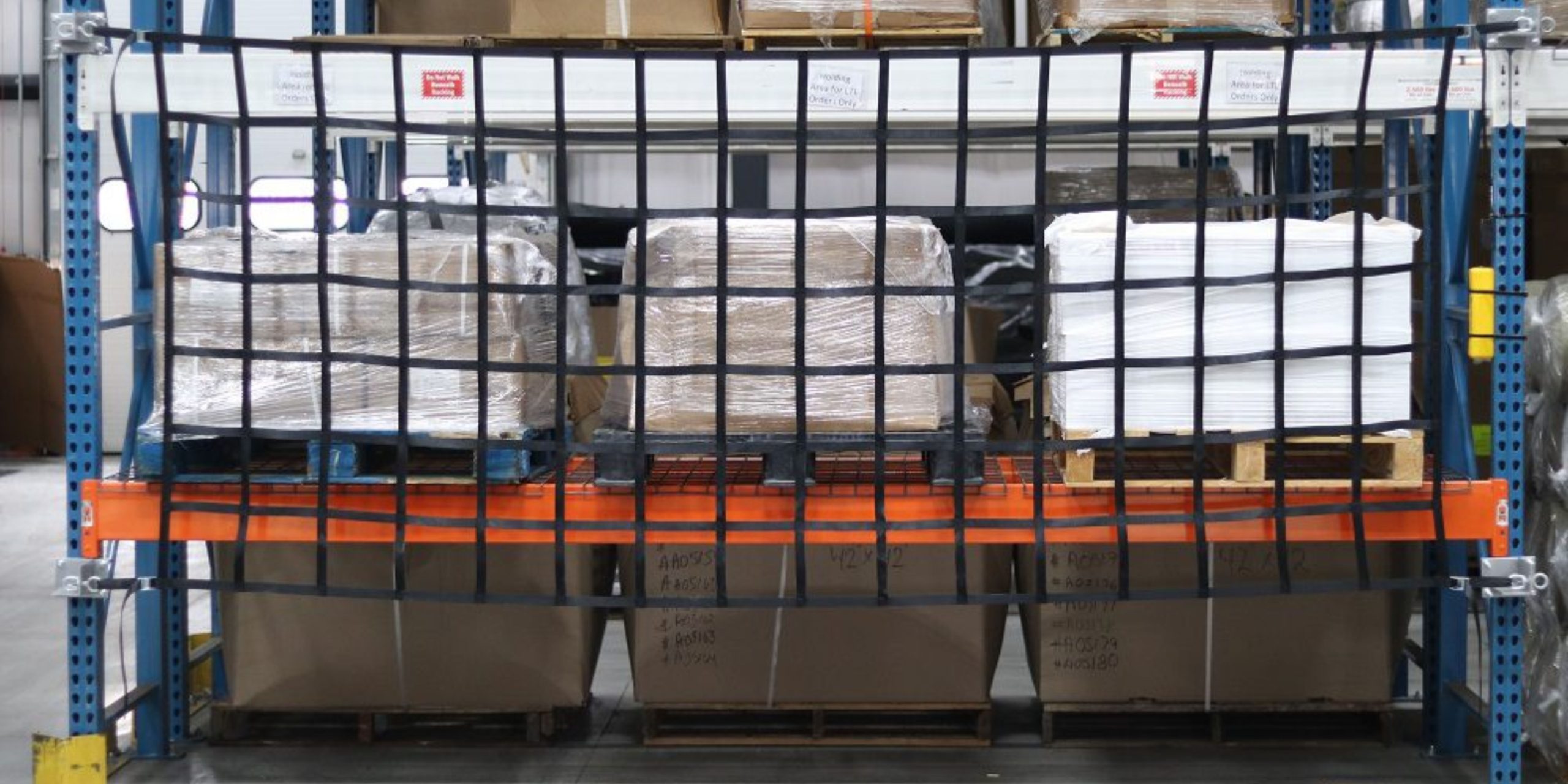 WebNets™The 1″ polyester webbing system: 2,500 lb rating, flush or offset mount, mesh liners.
 Pallet Rack BackingRigid wire mesh and nylon mesh backing panels when you want containment plus a hard barrier.
 Rack Repair & InspectionRack surveys, damage assessment and repair — netting is inspected on the same walk.
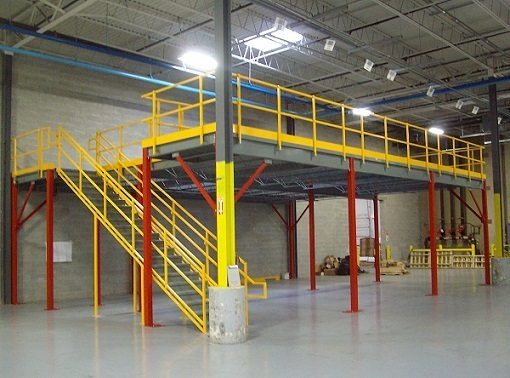 Mezzanines & Work PlatformsElevated platforms with guardrail, gates and netting infill designed and installed together.
Shop Online at MaterialHandling-USA.com
Need warehouse safety and storage products you can buy online today, with published pricing?
Get Your Netting Specified and Quoted
Send us bay dimensions, what you store and what is on the other side of the net. We will specify the system, the mesh and the hardware — and quote the installation with it.