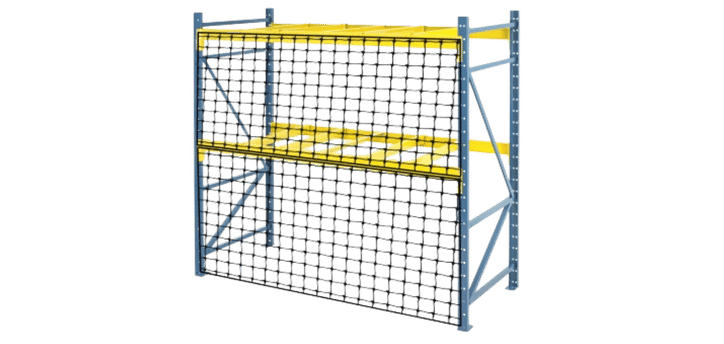
WebNet™ Pallet Rack Containment
InCord WebNet™ is a pallet rack containment option for facilities reviewing the risk of products falling from storage. Material Handling USA helps gather the rack, inventory and access information needed to evaluate a suitable configuration. Start with the application so the net, attachments and surrounding space can be reviewed together.

Define the containment problem

Begin by identifying where material could leave the rack and what is nearby. The concern may be the back of a storage row, the end of a bay or a boundary beside an occupied work area. Record the actual condition rather than treating every side of the rack as the same application.
Observe loading and retrieval as well as storage. An item may shift while a pallet is placed, during replenishment or when another load is handled. Describe those operating conditions to the supplier so the review addresses the exposure you are trying to manage.
InCord lists WebNet within its Rack Guard containment range and describes flush-mounted and offset configurations. That gives the project a starting point, but the suitable arrangement depends on the rack, stored products and available clearance.
- Identify the rack faces and bays included in the project.
- Describe people, workstations and equipment in adjacent areas.
- Record normal handling methods and any recurring load issues.
- Provide photographs of both the loaded and accessible sides.
Containment should be considered alongside the condition of the storage equipment and the handling process. Adding netting is not a repair for damaged rack, unsuitable pallets or an unstable storage arrangement.
Describe the load and the smallest item

A useful inventory description includes more than the total pallet weight. Provide the dimensions and weights of individual items, their packaging and the way they are stacked. A pallet of large cartons presents a different containment question from loose small components or irregular equipment.
Explain whether the material is normally secured to the pallet and what changes during picking. Partially picked loads can expose smaller items that were contained within a larger package when they arrived. Include the smallest object that the system is expected to retain in the application brief.
Webbing openings and optional liners serve different purposes. Ask the supplier to evaluate whether the selected opening is appropriate for the material and whether a finer liner is needed. Do not assume that a strong webbing net will retain everything that could pass through its openings.
Also describe the potential movement of a displaced item. The complete system assessment must consider the intended load condition, containment geometry and attachments. A single capacity number from another installation does not establish performance for your rack.
Identify unusual edges or surfaces that could contact the net so material compatibility can be reviewed before selection.
Treat attachments as part of the system

The net is only one part of a containment assembly. The supporting rack, attachment locations, straps or other hardware and installed geometry all affect the proposed arrangement. Review these as a package instead of selecting a net independently and improvising the connections on site.
InCord describes integrated straps for its flush-mount WebNet arrangement, with straps wrapping around beams and uprights and being tensioned by hand. Use the instructions for the actual supplied configuration; a photograph of a strap is not an installation procedure.
Supply the rack manufacturer and component information when available. Record any accessories, bracing or obstructions near the proposed connection points. Ask the project team to identify concerns about the supporting structure before installation is scheduled.
Do not drill, cut or modify rack components merely to create a convenient attachment point. Any proposed change to the rack should be reviewed by the appropriate supplier or qualified project professional. Existing damage should be addressed through the facility’s rack-inspection process.
- Identify the rack and its current configuration.
- Show the proposed attachment areas in photographs.
- List obstructions and accessories near those areas.
- Request the installation requirements with the proposal.
Retain the approved component list and instructions so future repairs use the correct parts rather than visually similar substitutes.
Compare flush mounting with an offset arrangement

A flush arrangement places the containment close to the rack face. An offset arrangement creates separation between the rack and the net. InCord describes offset WebNets as accommodating larger products and pallets while maintaining containment. The required separation must be established for the actual application.
Measure how far the stored load extends beyond the rack structure. Include packaging, pallet projections and the condition of a partially picked load. Do not use an empty rack measurement alone to define the available space.
The area behind the net matters too. Mark walls, equipment, aisles and other objects nearby. Ask the supplier what clearance the selected containment system requires and how expected movement under the specified condition is accounted for.
Where the arrangement relates to flue spaces or fire-protection requirements, coordinate with the responsible project specialists and authority having jurisdiction. Netting should not be presented as automatically making a storage layout compliant, and a generic drawing cannot establish the requirements for a particular facility.
Use a dimensioned layout for comparison. It should show rack depth, load projection, the proposed net position and nearby obstructions. Resolving these relationships before ordering helps avoid a system that fits its nominal bay dimensions but conflicts with daily operations.
Preserve the access needed for normal work

Containment needs to fit the way the rack is used. Identify which faces are loaded, which are picked by hand and which are intended to remain closed. A fixed barrier in the wrong location can encourage unauthorized removal or create a recurring handling problem.
Describe the handling device, load approach and the sequence used for replenishment. Include any inspection or maintenance activity that needs access through or around the proposed net. These conditions should be part of the selection discussion rather than discovered during installation.
If frequent opening is required, ask about a system designed for that access pattern. InCord’s broader Rack Guard range includes other configurations. Do not assume that a fixed WebNet arrangement should be repeatedly detached or that components from different systems can be mixed.
Related hazards require their own review. Rack product containment, conveyor containment, dock barriers and personnel fall protection are different applications. A system selected for one purpose should not be described as suitable for the others without explicit manufacturer confirmation.
For an adjacent conveyor project, see our conveyor guard planning guide. Keep the scopes coordinated while preserving the requirements of each system.
The final operating procedure should make the intended access clear, including who may open or remove a component and how the area is returned to its approved condition.
Plan installation and an inspection process

Agree on the installation scope before the equipment arrives. Identify who provides access equipment, who clears the work area and whether inventory must be relocated. Include the facility’s requirements for working around active storage and handling operations.
Use the supplier’s installation instructions and approved layout for the actual system. Confirm that the delivered net sizes and hardware match the intended locations. If an unexpected obstruction prevents the specified arrangement, resolve it with the supplier rather than adapting the installation informally.
After installation, document the completed configuration and retain its product information. Include clear photographs and location identifiers in the maintenance record. This creates a reference for later inspections and helps distinguish an approved detail from a change made after handover.
Set inspection and maintenance practices using the manufacturer’s guidance and the facility’s operating conditions. Items to raise with the supplier include damaged webbing, worn connections, loose attachments, chemical exposure and a net that has contained a displaced load. The appropriate response depends on the system and event.
Do not assume that a net remains ready for service after a significant incident because it still looks intact. Follow the facility’s isolation and review process and obtain the required manufacturer assessment before returning the affected arrangement to use.
Keep replacement parts and responsibilities defined. A documented process is more dependable than relying on whoever happens to notice a problem.
Prepare a complete WebNet project brief

A good brief lets the supplier evaluate the application with fewer assumptions. Start with a rack layout showing the bays to be protected and the proposed containment faces. Add bay dimensions, beam elevations and photographs of the connections, loads and nearby areas.
- Define the scope. Identify locations, quantities and the specific containment concern.
- Describe inventory. Include item sizes, weights, packaging and partial-load conditions.
- Map clearances. Show load projections, adjacent equipment and required access.
- Assign responsibilities. Agree on technical review, installation, training and ongoing inspection.
Request a proposal that identifies the system configuration, included components and the assumptions used in selection. Confirm any requirements for the supporting structure and the information still needed before manufacture.
For a multi-row project, record differences between locations instead of assuming every bay is identical. A change in beam elevation, load type or nearby equipment may require a different detail. Location-specific photographs help keep those differences visible.
Coordinate the work with your broader warehouse layout plan. If storage positions or operating routes will change soon, include those changes in the discussion so the proposed containment is reviewed against the intended arrangement.
Material Handling USA can help organize the information for a product-specific review. The objective is a clearly defined containment package and installation scope, with performance and suitability confirmed for the selected application.
Keep a copy of the final layout with the operating team. When inventory or beam positions change, compare the new condition with the approved scope before assuming the existing containment remains suitable. This makes future changes easier to review and document.
Frequently asked questions
Is WebNet the same as every type of rack safety netting?
No. WebNet is an InCord containment product within a broader range of rack netting systems. Different systems address different arrangements and access requirements. Identify the exact product and configuration in the proposal.
Can I choose a net from a weight rating alone?
No. Provide the load dimensions, weight, packaging, potential movement and supporting rack information. The supplier needs to review the complete system, including attachments and clearance, for the intended application.
When should an offset arrangement be considered?
An offset may be relevant when stored products project beyond the rack or the containment needs separation from the structure. The required distance depends on the actual load, nearby objects and selected system. Have the supplier confirm the arrangement.
Will webbing retain small loose items?
That depends on the openings and the items involved. Describe the smallest object the system is expected to retain and ask whether a compatible liner is needed. Do not assume webbing alone provides fine-particle containment.
Can rack containment be used as personnel fall protection?
Do not make that substitution. Personnel fall protection is a separate application requiring a specifically selected and approved system. A product-containment proposal should clearly state its intended use and limitations.
What should happen after a net catches a displaced load?
Follow the facility response process and manufacturer guidance. Isolate the affected condition as required and arrange review of the net, attachments and supporting structure. Do not assume the system is ready for further use based on appearance alone.
Start with your rack and inventory information
Send photographs, rack dimensions, product sizes and a description of the area you want to protect. We can help define the information needed for a WebNet containment proposal.