
Cantilever Pipe Rack and Tubing Storage Racking
Cantilever racking that keeps steel pipe, PVC, conduit and tubing sorted by size, supported along its length and loadable from the aisle without front columns in the way.
Planning a row? Try the free 3D Cantilever Rack Configurator or shop cantilever rack parts.
10°
Slope on Vestil incline arms
12 to 48 in
Arm lengths in our shop
3,400 lb
Per arm, Vestil XHD 36 in (published)
Free
Layout and arm-spacing check
Shop Cantilever Pipe Rack Parts by Category
Each card opens a shop category with current online prices; the price shown is the lowest-priced in-stock item in that category. For pipe, start with incline arms (they slope back toward the column so round stock rolls inward), then match uprights and brace sets to your bay spacing. Freight is quoted by destination; some common sizes in stock at select manufacturers, subject to confirmation.

What Is a Cantilever Pipe Rack?
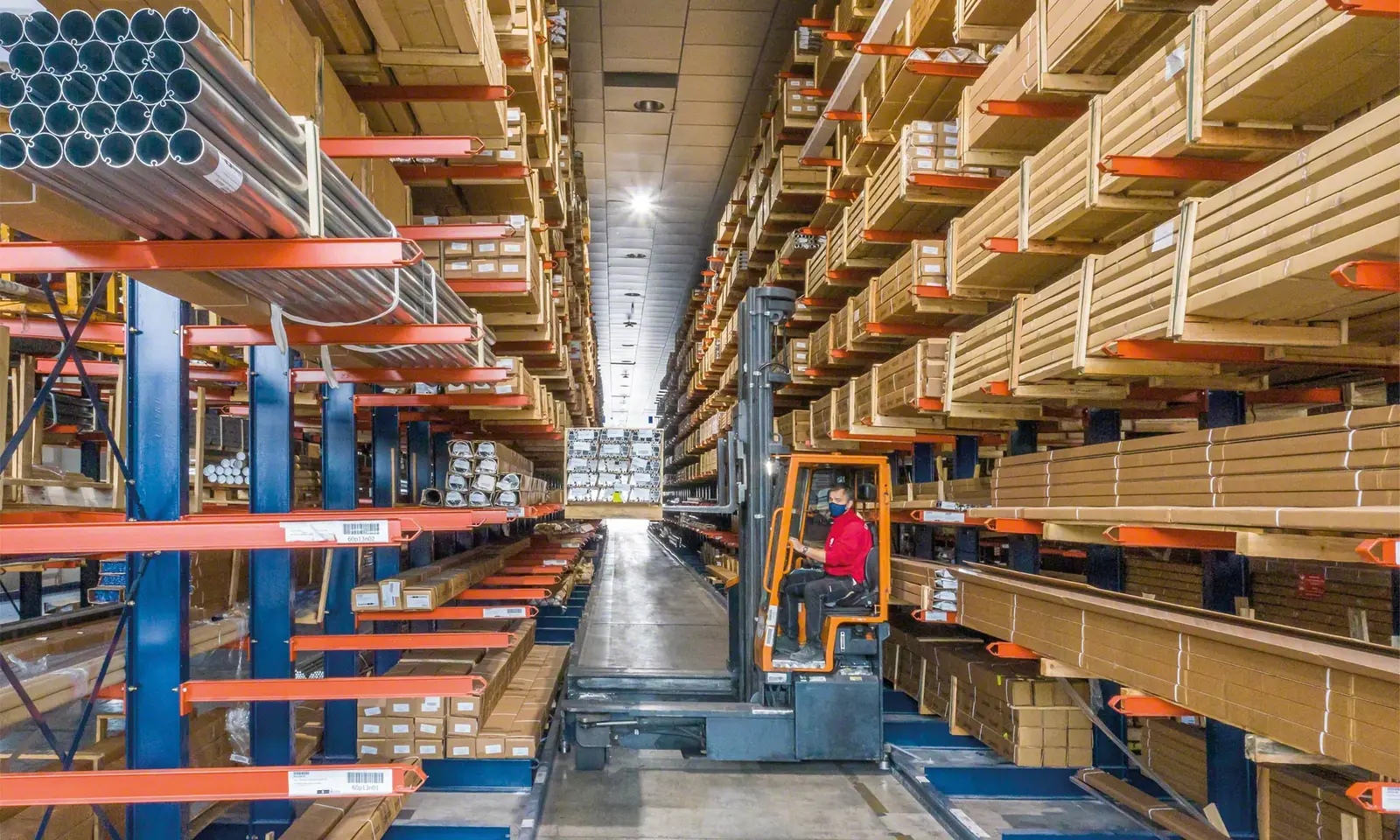
A cantilever pipe rack is a row of columns with arms that reach out from one or both faces. Pipe and tube lie lengthwise along the row, across several arms, so a 20 ft length is supported at several points instead of sagging over two. Nothing stands at the front of the bay, so a forklift, side loader or crane can set a full bundle straight onto the arms.
It is the same system as our cantilever rack, configured for round stock.
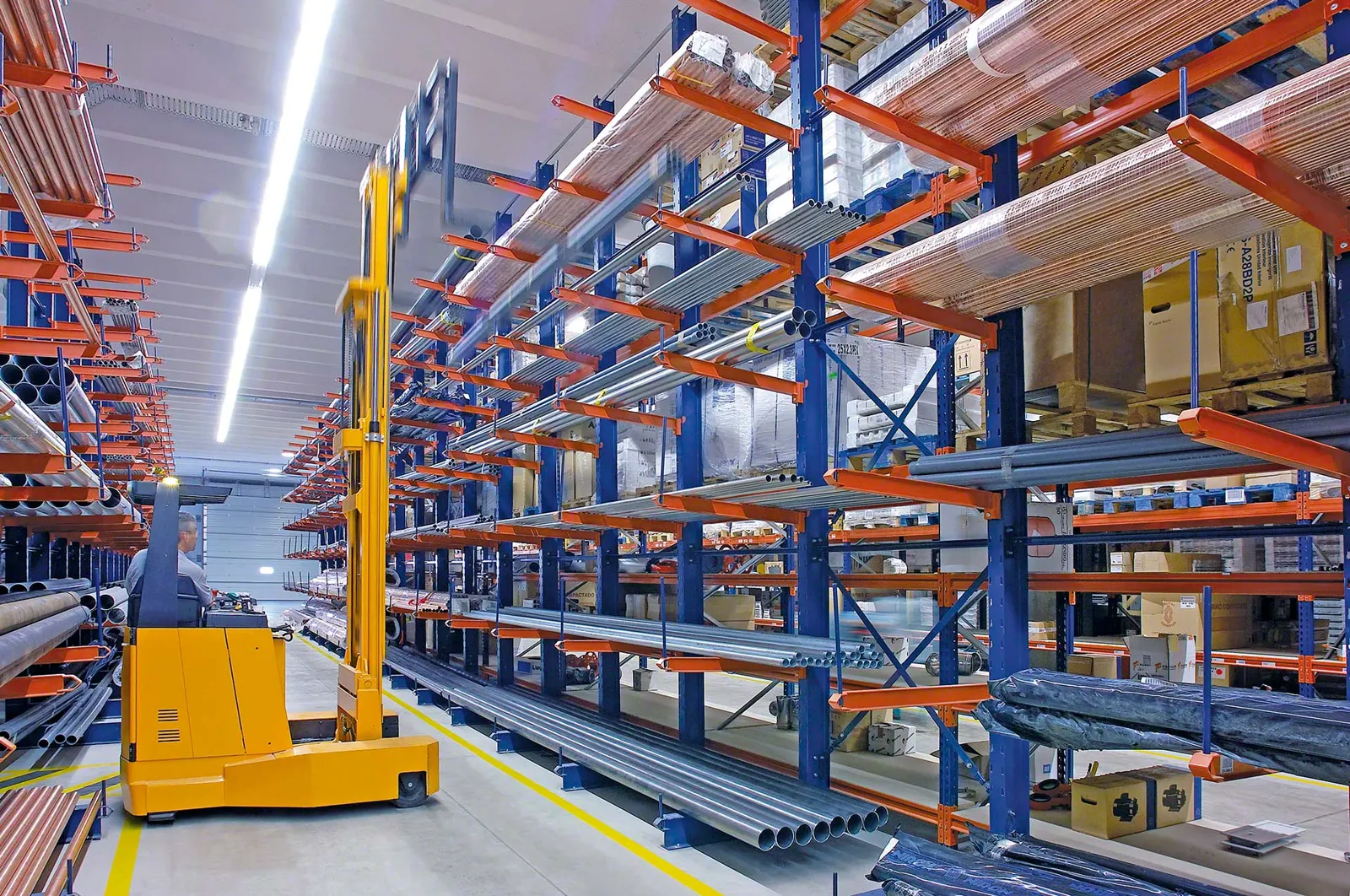
Photo: Interlake Mecalux (authorized use).
Why pipe yards choose cantilever over floor stacking or pallet rack
- Open face: no front columns, so any length from a 10 ft stick of EMT to a 40 ft double-random length loads from the aisle.
- Sorted by size: each level or bay holds one diameter or schedule, so pickers pull the right pipe without unstacking a pile.
- Off the ground: pipe stays clear of water, mud and snow, and the bottom layer is not crushed by everything above it.
- Rolls stay put: incline arms and end stops keep round stock from rolling off the arm tip.
- Grows with you: add a bay with one upright, one brace set and its arms; the new bay shares the last column of the run.
Incline Arms, Straight Arms and Pipe Stops
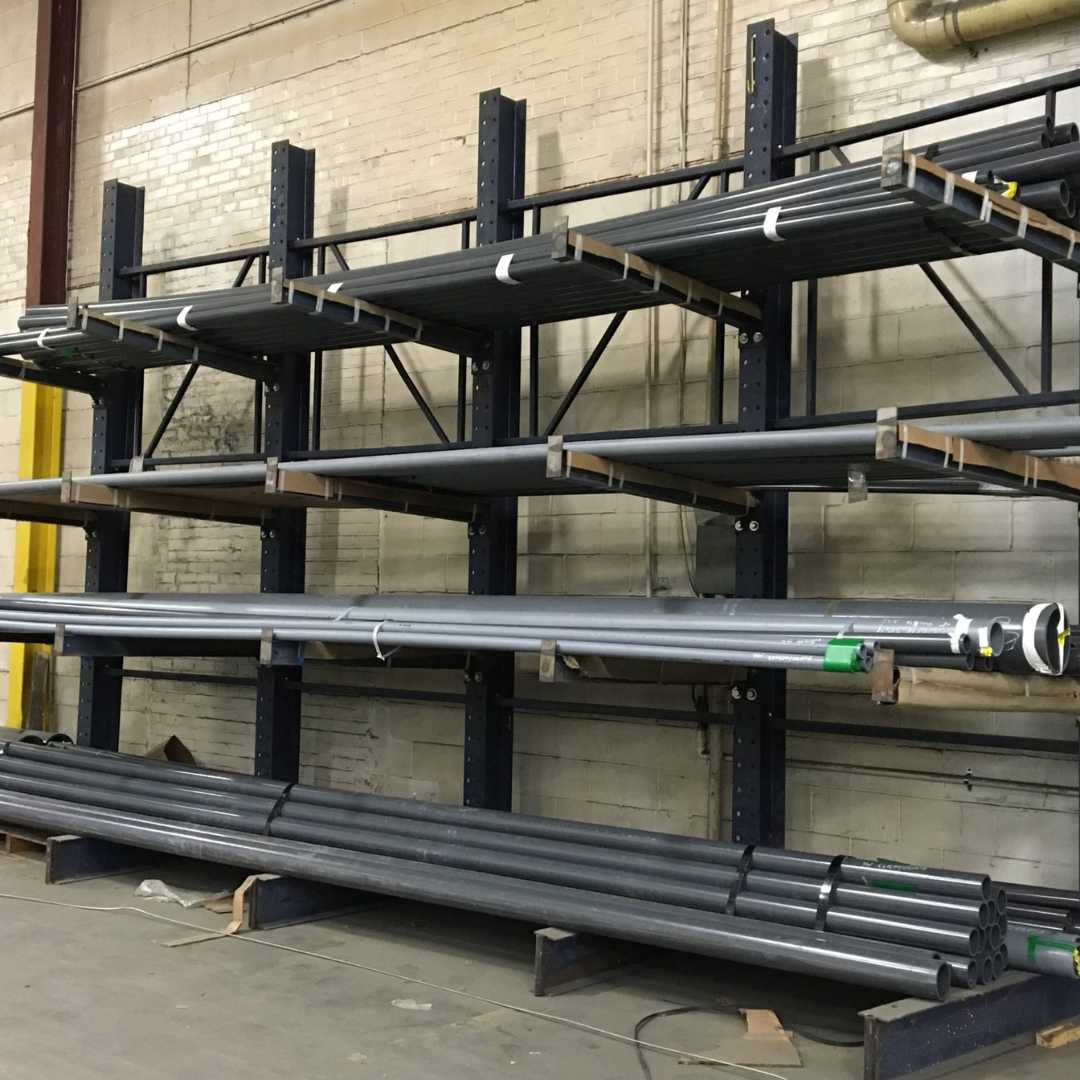
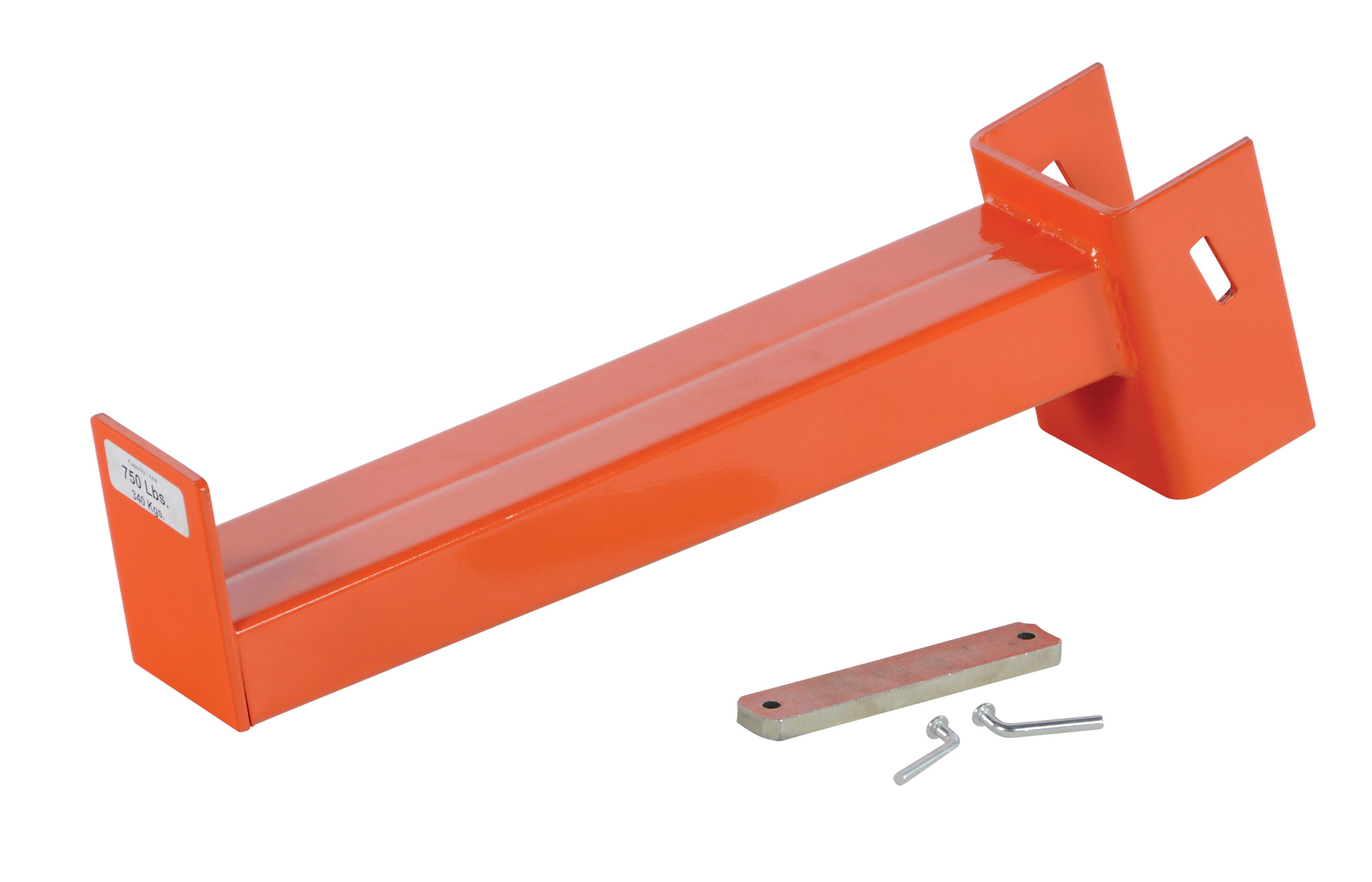
Incline arms slope back toward the column (Vestil uses 10 degrees), so pipe rolls inward instead of off the tip. They are the default for loose round stock. Straight arms with a raised lip or bolt-on end stop suit banded bundles, square tube and mixed stock. Decking can be added for short pieces.
Compare duty classes in the cantilever arm capacities by length table.
| Arm or accessory | Best for | Watch for |
|---|---|---|
| Incline arm (about 10°) | Loose round pipe, tube, conduit, round bar | Usable depth is a little shorter than the arm length |
| Straight arm with lip | Banded bundles, square and rectangular tube, angle | Loose round stock can roll if the lip is low |
| Bolt-on end stop / pipe stop | Stopping round stock at the arm tip | Must be rated with the arm; quoted per system |
| Decking on arms | Short cut-offs, fittings boxes, mixed small stock | Adds weight; counts against arm capacity |
| Arm wear strips or pads | Polished stainless, copper, painted or coated pipe | Confirm the pad does not change the arm rating |
Arm Spacing, Overhang and Pipe Sag
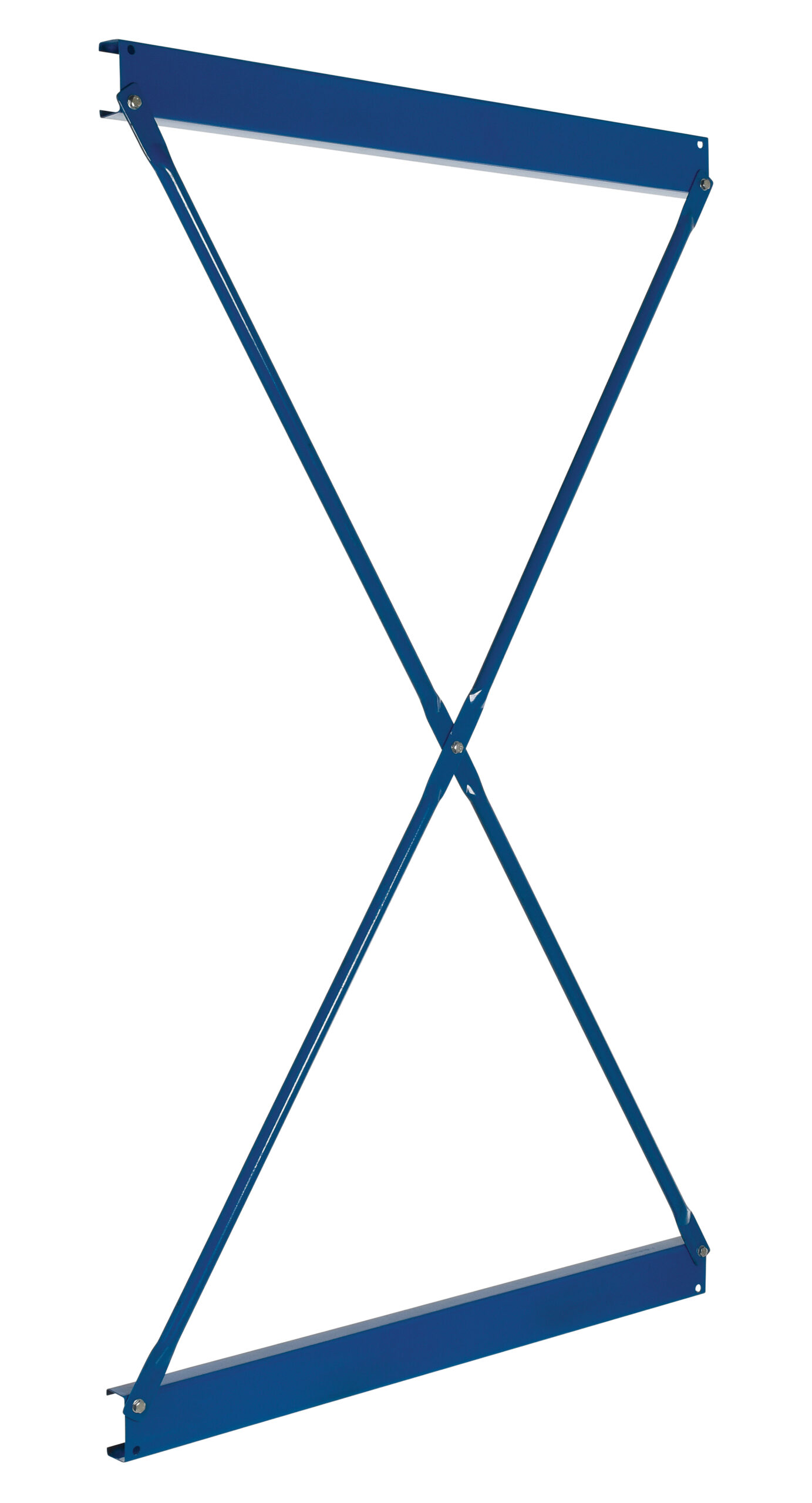
Arm spacing along the row is set by the brace set length between uprights, so it is decided when you choose the bay layout, not after. Two planning rules cover most pipe yards:
- Overhang rule of thumb: the stock that hangs past the end arms should be no more than about half the distance between arms. A 20 ft length on arms 4 ft apart wants arms at least every 4 ft along most of its length.
- Support the flexible stuff more: PVC, thin-wall tube, copper and aluminum sag between supports, so they need closer arm spacing (or decking) than heavy-wall steel of the same length.
- Every arm carries a share: divide the load on a level by the number of arms under it, then check each arm’s rating, not just the upright rating.
| Stock (typical length) | Typical support | Notes |
|---|---|---|
| EMT conduit, small copper (10 ft) | 3 arms, or 2 arms plus decking | Light but floppy; group in bundles |
| PVC pipe (10 or 20 ft) | Arms about every 3 to 4 ft | Sags in heat; shade outdoor PVC from sun |
| Steel pipe, single random (about 20 to 21 ft) | 4 to 6 arms | Heavy: check per-arm capacity first |
| Steel pipe, double random (about 38 to 42 ft) | 7 or more arms, longer run | Plan aisle length and turning room for the truck |
| Aluminum or thin-wall tube (20 to 24 ft) | Arms about every 3 to 4 ft | Dents easily; consider arm pads |
Sort before you space. Racks that hold one length range per bay are easier to space correctly. Mixing 6 ft cut-offs with 20 ft lengths on the same level leaves short pieces hanging between arms. Keep drops and remnants on a decked level or a separate small rack.
Arm spacing is one of the inputs in our cantilever rack design guide.
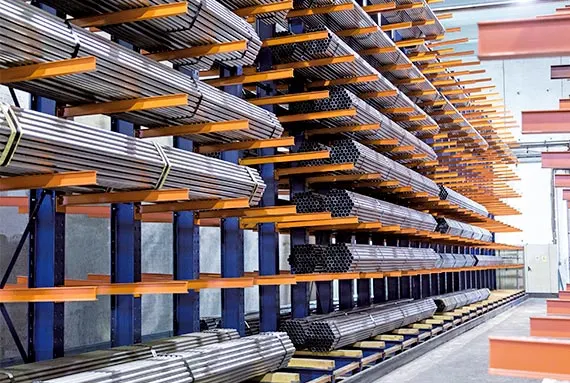
Photo: Interlake Mecalux (authorized use).
How Much Does a Level of Pipe Weigh?
Pipe is heavier than it looks, and steel pipe is where most undersized racks fail. Start with weight per foot, multiply by length and count, then divide by the arms under the bundle. Standard Schedule 40 steel pipe weights (plain end, per ASME B36.10) are a good reference:
| Schedule 40 steel pipe | Weight per foot | One 21 ft length | Bundle of 20 lengths |
|---|---|---|---|
| 1 in | 1.68 lb | 35 lb | 706 lb |
| 2 in | 3.65 lb | 77 lb | 1,533 lb |
| 3 in | 7.58 lb | 159 lb | 3,184 lb |
| 4 in | 10.79 lb | 227 lb | 4,532 lb |
| 6 in | 18.97 lb | 398 lb | 7,967 lb |
Worked example with published ratings
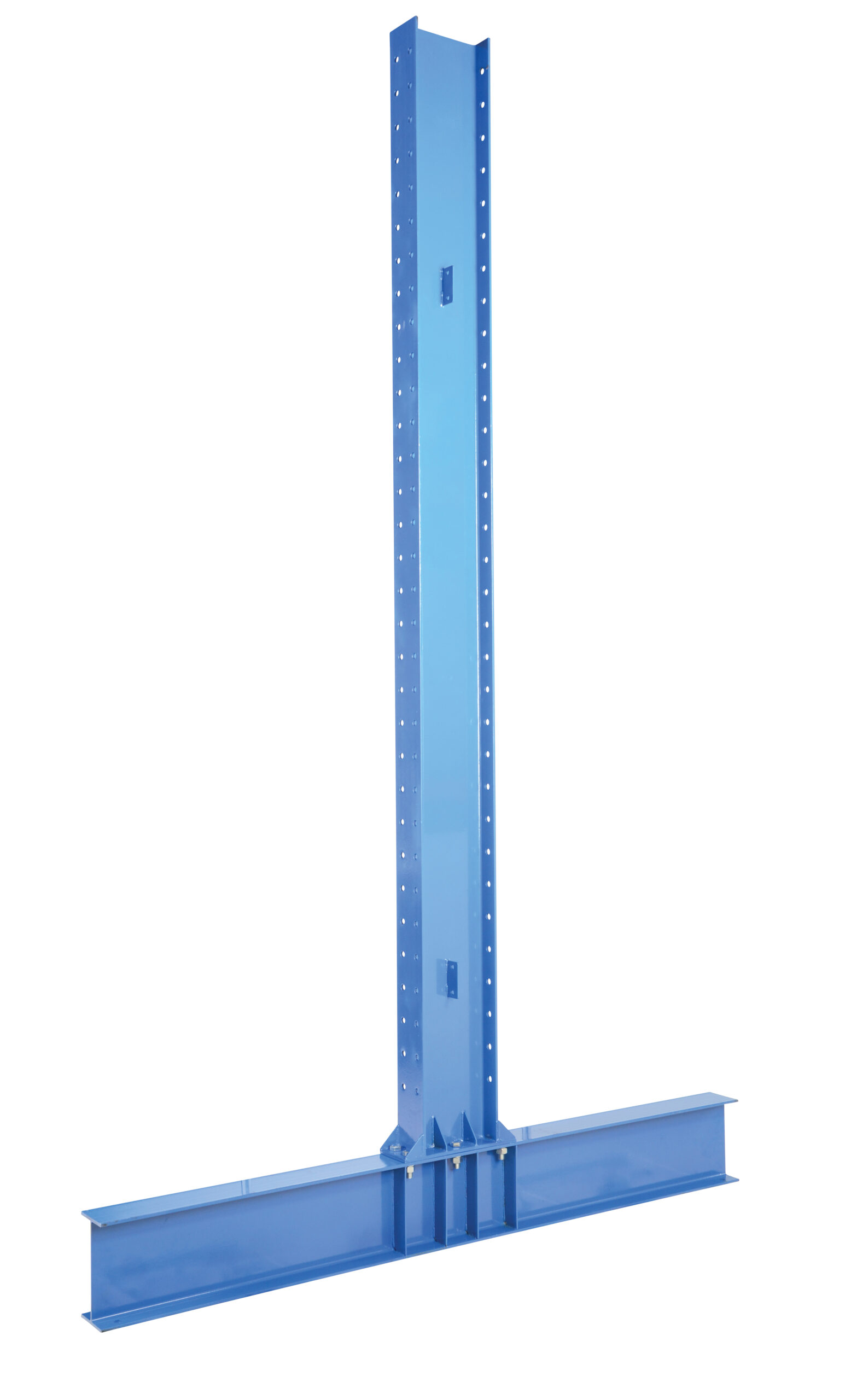
A bundle of twenty 21 ft lengths of 4 in Schedule 40 weighs about 4,532 lb. Spread over four arms that is roughly 1,133 lb per arm. Vestil publishes 400 lb for a 24 in standard arm and 600 lb for a 24 in medium arm, so neither works; its 24 in heavy-duty arm is rated 2,000 lb and its 36 in extra-heavy arm 3,400 lb (uniform loads). Then add up every level on one column and stay under the upright rating: Vestil lists 21,500 lb for a heavy single-sided 8 ft upright with 24 in arms and 43,000 lb for the double-sided version.
Ratings are uniform loads
Published arm capacities assume the load is spread evenly along the arm. A bundle sitting out at the tip, or a point load from a crane drop, uses up capacity faster. Confirm current ratings on the product page or your quote.
PVC, aluminum and copper are far lighter per foot than steel, so the limit there is usually sag and arm spacing rather than arm capacity. Our load capacity by arm length guide explains why capacity drops as arms get longer.
Organizing a Pipe Rack by Diameter, Length and Material
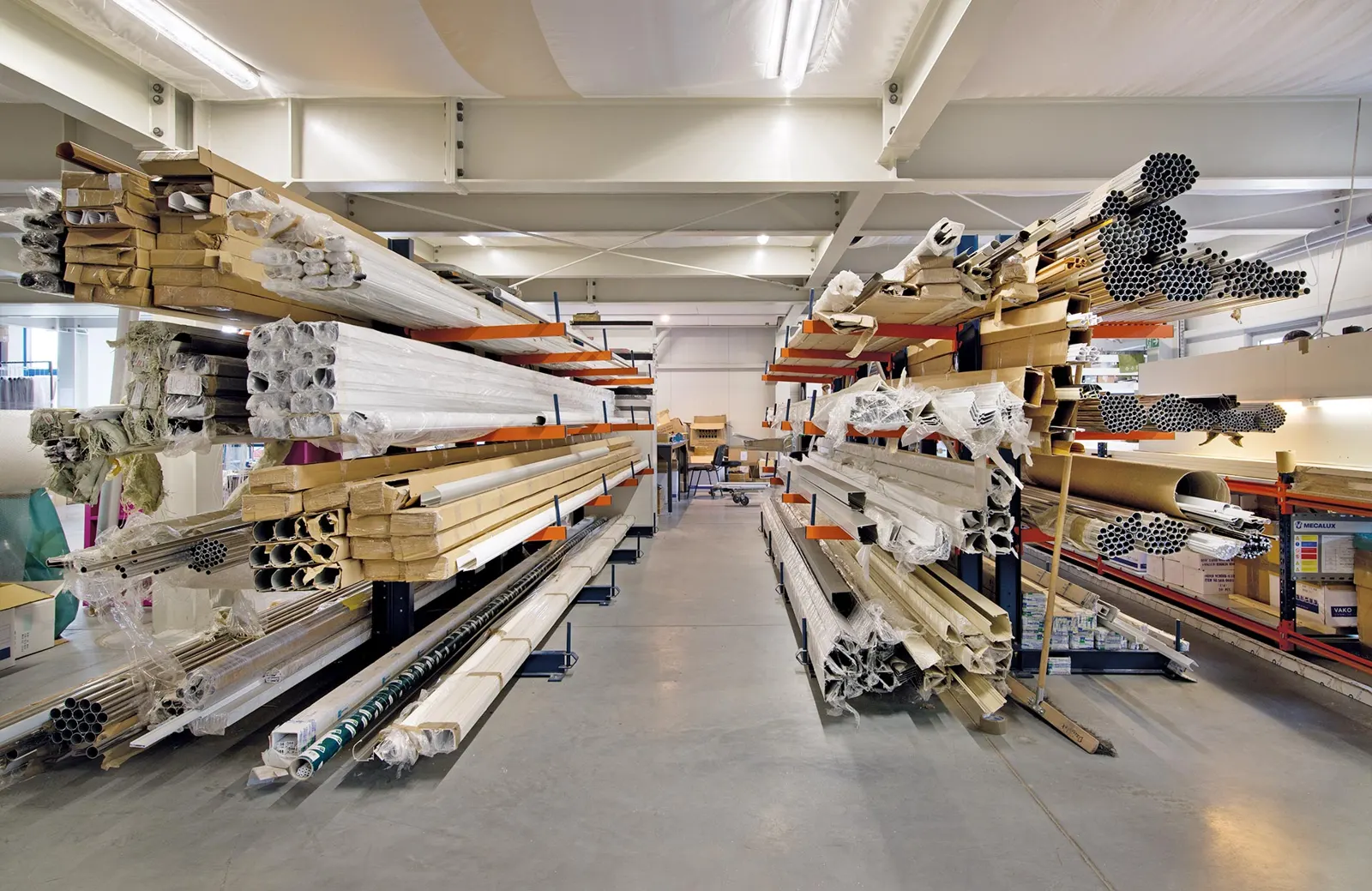
Put the fastest-moving sizes at waist to shoulder height and on the levels a forklift reaches without a long lift. Heavy, large-diameter pipe goes on the bottom levels or on the base arms, where the column is strongest and a dropped bundle has the shortest fall. Light conduit and tube can go higher.
Photo: Interlake Mecalux (authorized use).
- Label every arm level with size, schedule and material, and color-code by material family (steel, PVC, copper, aluminum).
- One material per level where you can: stainless and carbon steel touching each other can cause contamination and staining.
- First in, first out: on double-sided rows, load from one face and pick from the other for slow-moving stock.
- Remnant zone: give cut-offs their own decked level so they do not hang between arms.
- Leave a gap: keep bundles a few inches back from the arm tip and clear of the column face for safe fork entry.
Steel, PVC, Copper, Aluminum and Conduit: What Changes
Storing solid bar, structural shapes or sheet metal as well? See cantilever racking for metal and steel storage.
Outdoor Pipe Yards
Most pipe lives outside, so the rack does too. Specify hot-dip galvanized columns and arms for exposed yards; painted rack rusts at scratches and bolt holes. Anchor to footings or a slab designed for the rack, and plan for wind and snow: a lightly loaded outdoor bay has less dead weight holding it down.
Adding a roof? See cantilever rack with a roof.
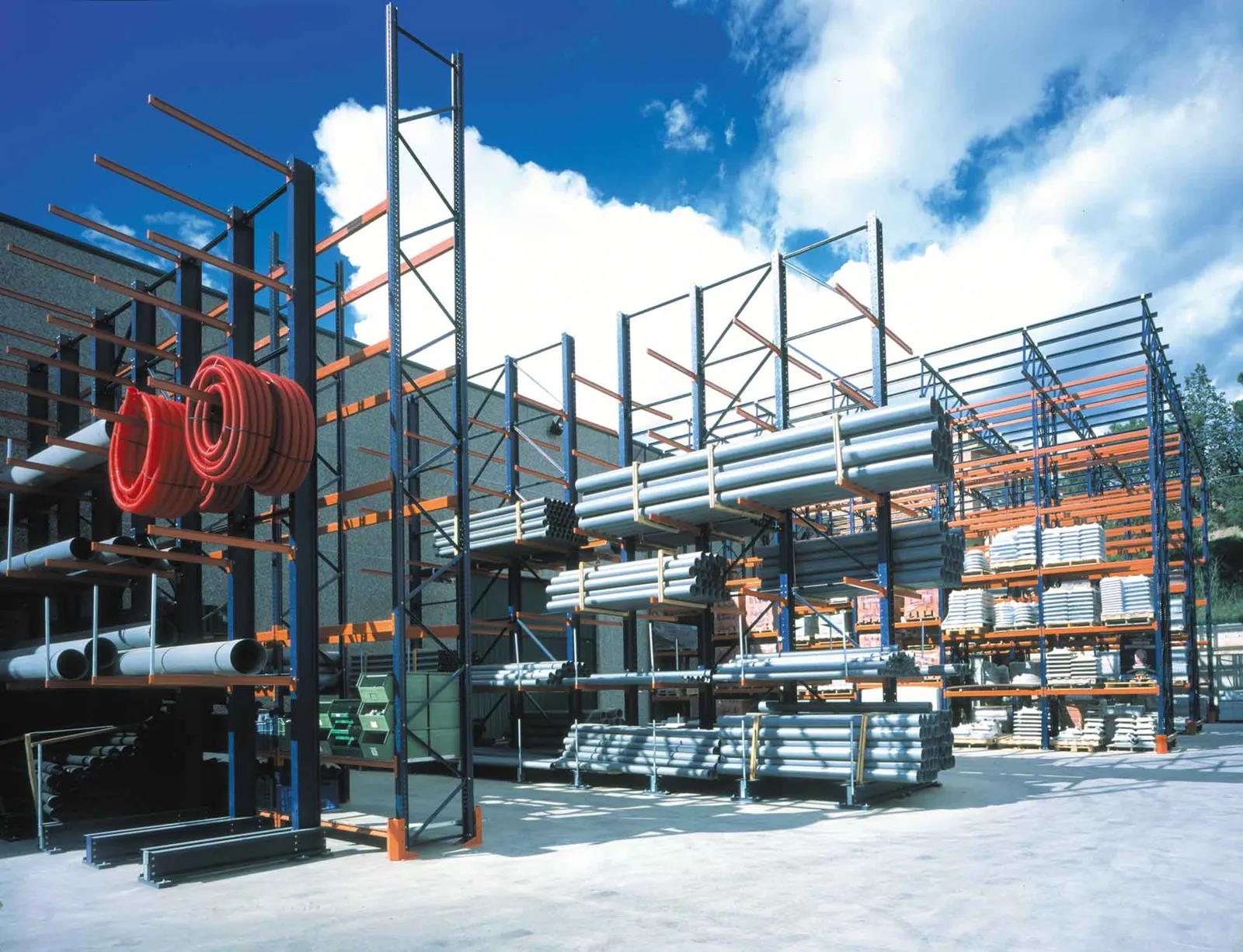
Photo: Interlake Mecalux (authorized use).
- Drainage: slope the yard so water does not pond under the bases.
- UV: cover or roof PVC and plastic pipe; sunlight weakens it over time.
- Snow and ice: snow sitting on top-level loads adds weight the arms must carry.
- Permits: outdoor and roofed cantilever often needs engineering and a building permit; ask your local building department early.
Loading Methods and Aisle Width
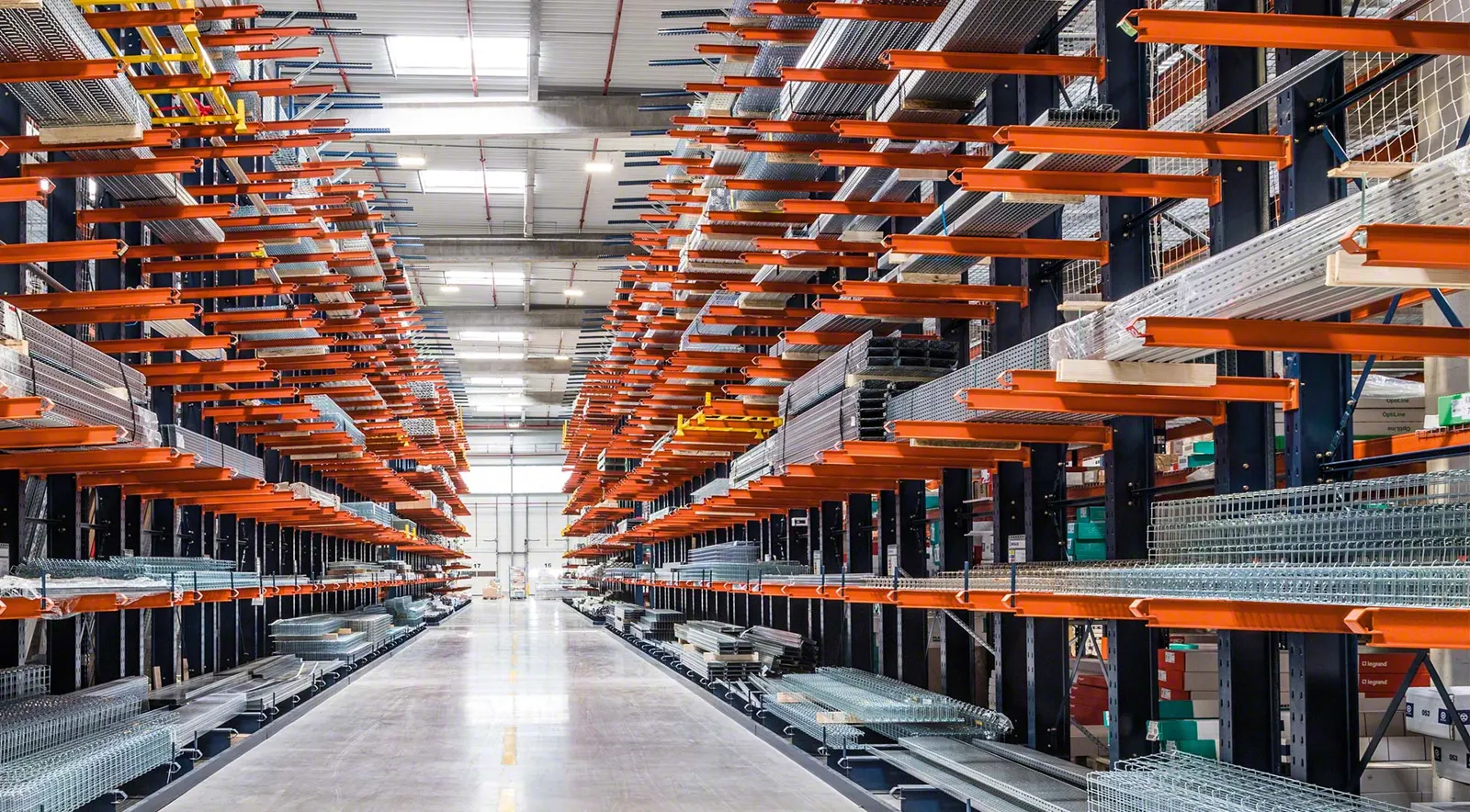
How you load decides the aisle. A counterbalance forklift carrying 20 ft pipe crosswise needs a very wide aisle. Side loaders and multidirectional trucks carry long loads lengthwise, which narrows the aisle a lot. Overhead cranes need clearance above the top arm, and hand-loaded shop racks need arms within easy reach.
Sizing an aisle? Use our forklift aisle width guide.
Photo: Interlake Mecalux (authorized use).
| Handling method | Aisle impact | Rack notes |
|---|---|---|
| Counterbalance forklift (load crosswise) | Widest aisle: roughly load length plus clearance | Simple; fork extensions help with deep bundles |
| Side loader / multidirectional truck | Narrow aisle; truck travels with the load | Floor flatness and guidance matter more |
| Overhead crane with lifting beam | Aisle sized for people and crane drop zone | Leave clearance above the top level |
| Hand loading (shop racks) | Standard walkway | Keep top arms reachable; consider a welded compact rack |
Cantilever vs A-Frame Pipe Racks, Vertical Bar Racks, Pallet Rack and Pipe Carts
Buyers searching for a pipe rack usually compare five systems. Cantilever wins for long, heavy or forklift-loaded stock; the others win for smaller volumes, short stock or mobility.
| System | Best for | Loads with | Limits |
|---|---|---|---|
| Cantilever pipe rack | Long pipe and tube, heavy bundles, yards and warehouses | Forklift, side loader, crane or hand | Needs aisle space; must be sized per arm |
| A-frame pipe rack | Mixed short and long stock in a shop | Hand | Low capacity; not for full bundles |
| Vertical bar rack | Short bar and tube stood on end | Hand | Length limited by ceiling; pieces tip and slide |
| Pallet rack with beams | Palletized fittings and boxed goods | Forklift | Front columns block long loads; round stock rolls |
| Mobile pipe cart | Moving stock to saws and work cells | Hand or forklift pockets | Small capacity; cart, not storage |
Our Utah team compared a compact cantilever rack with a bar rack for a real customer in the cantilever vs bar rack project, and the cantilever vs pallet rack comparison covers mixed warehouses.
Who Uses Cantilever Pipe Racks
 Electrical and mechanical contractorsConduit, unistrut and pipe sorted by size so crews load trucks fast.
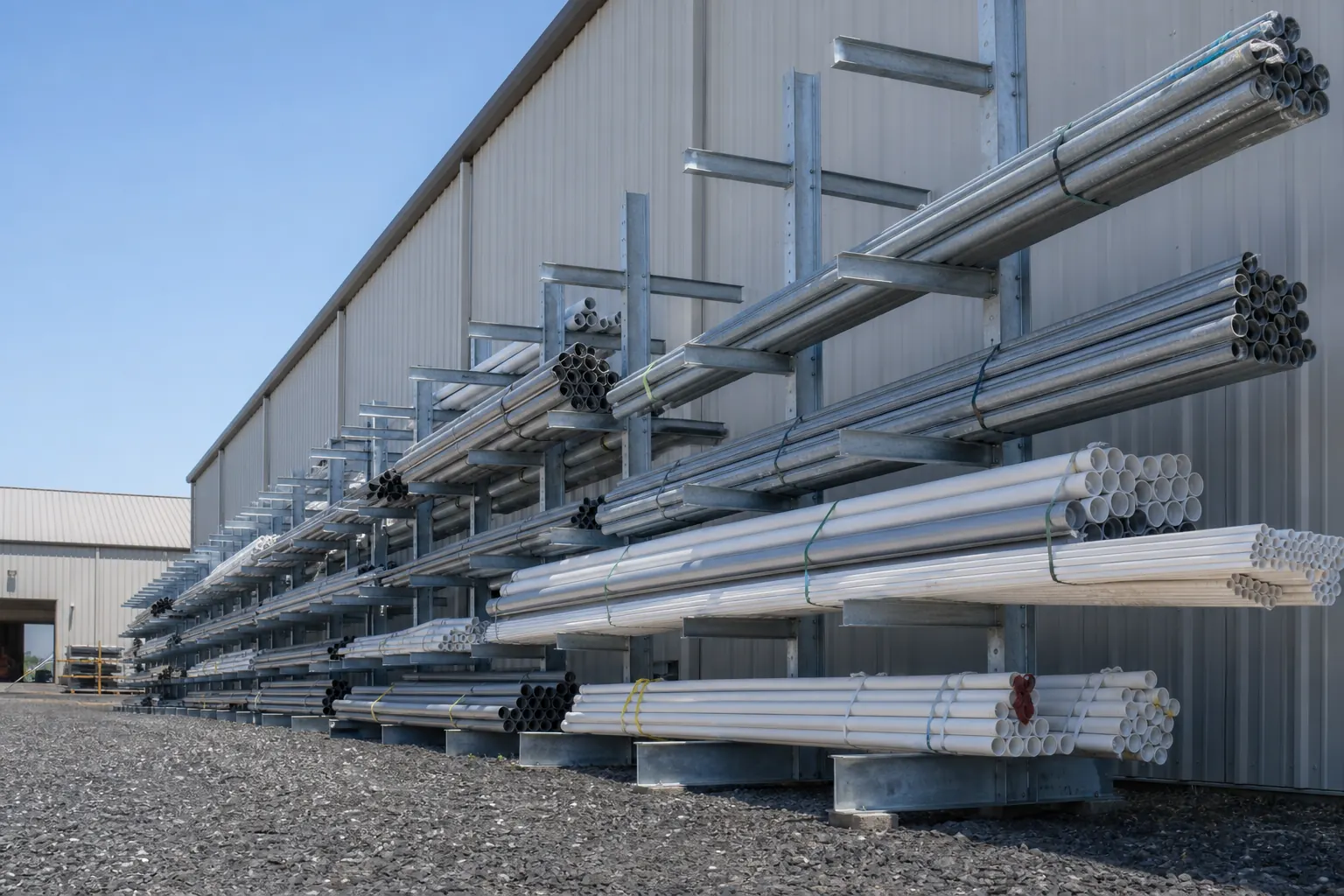 Waterworks and plumbing distributorsPVC, ductile and copper by diameter, with remnants kept on their own level.
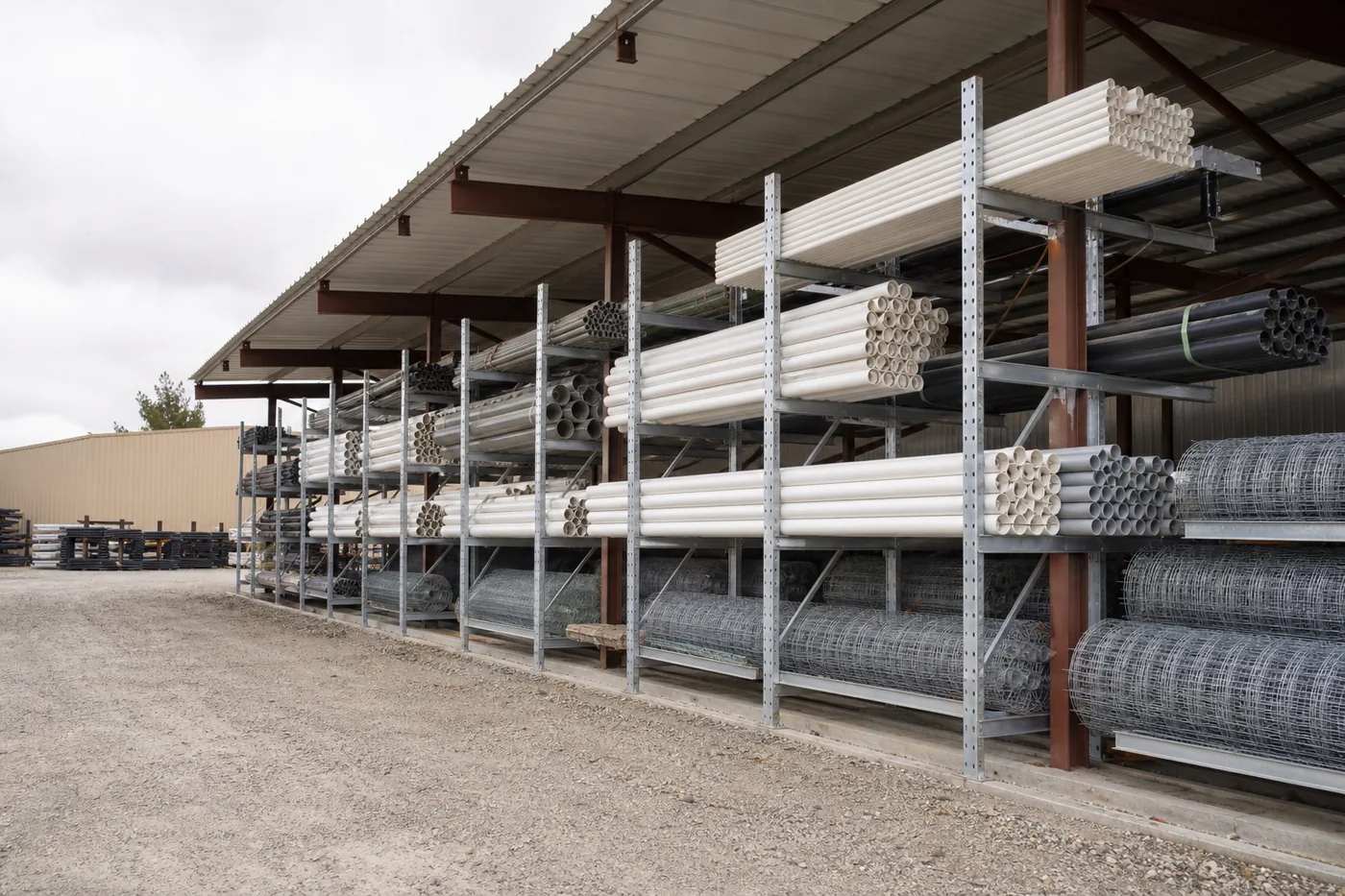 Farm, irrigation and fence supplyIrrigation pipe, fence posts and rails outdoors on galvanized rack.
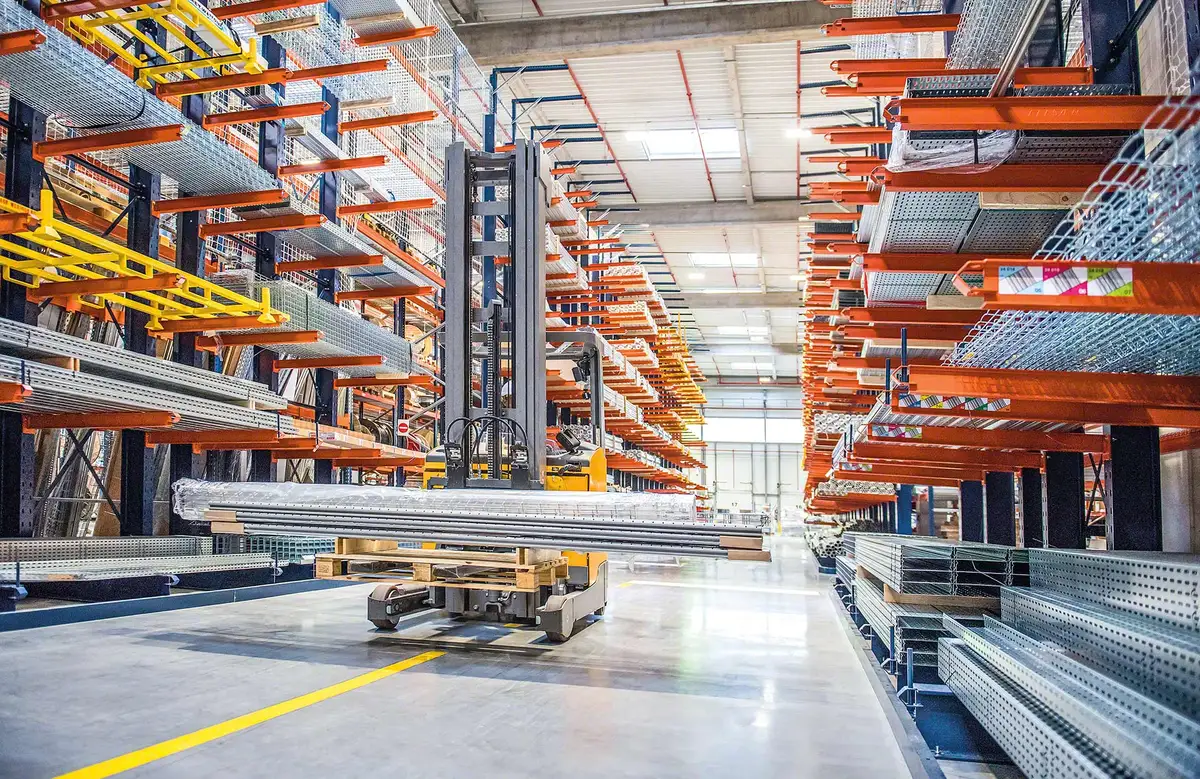 Steel service centersPipe, tube and structural shapes on heavy or structural arms.
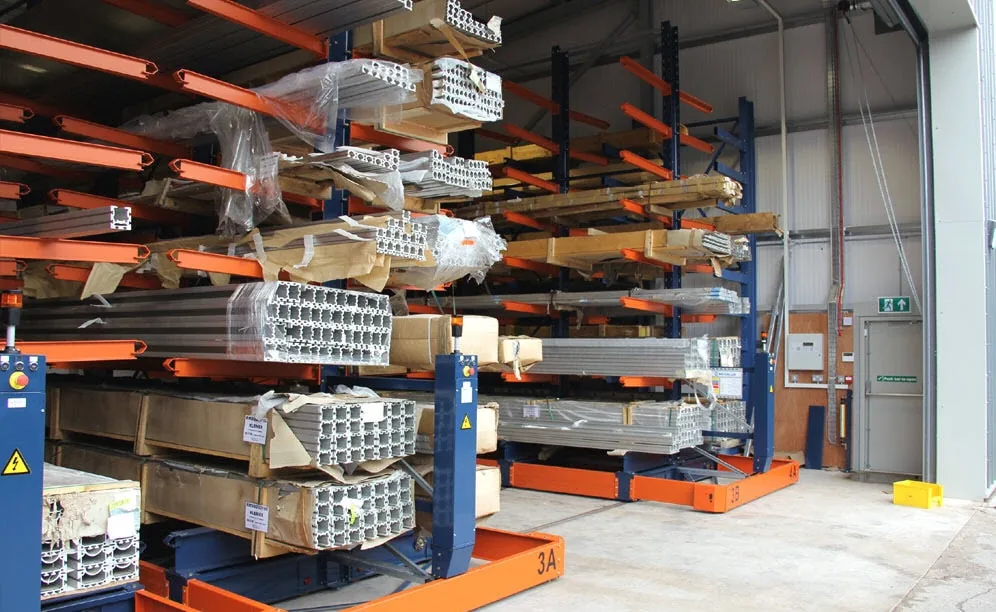 Fabrication and manufacturingRaw tube and extrusions staged near saws and work cells.
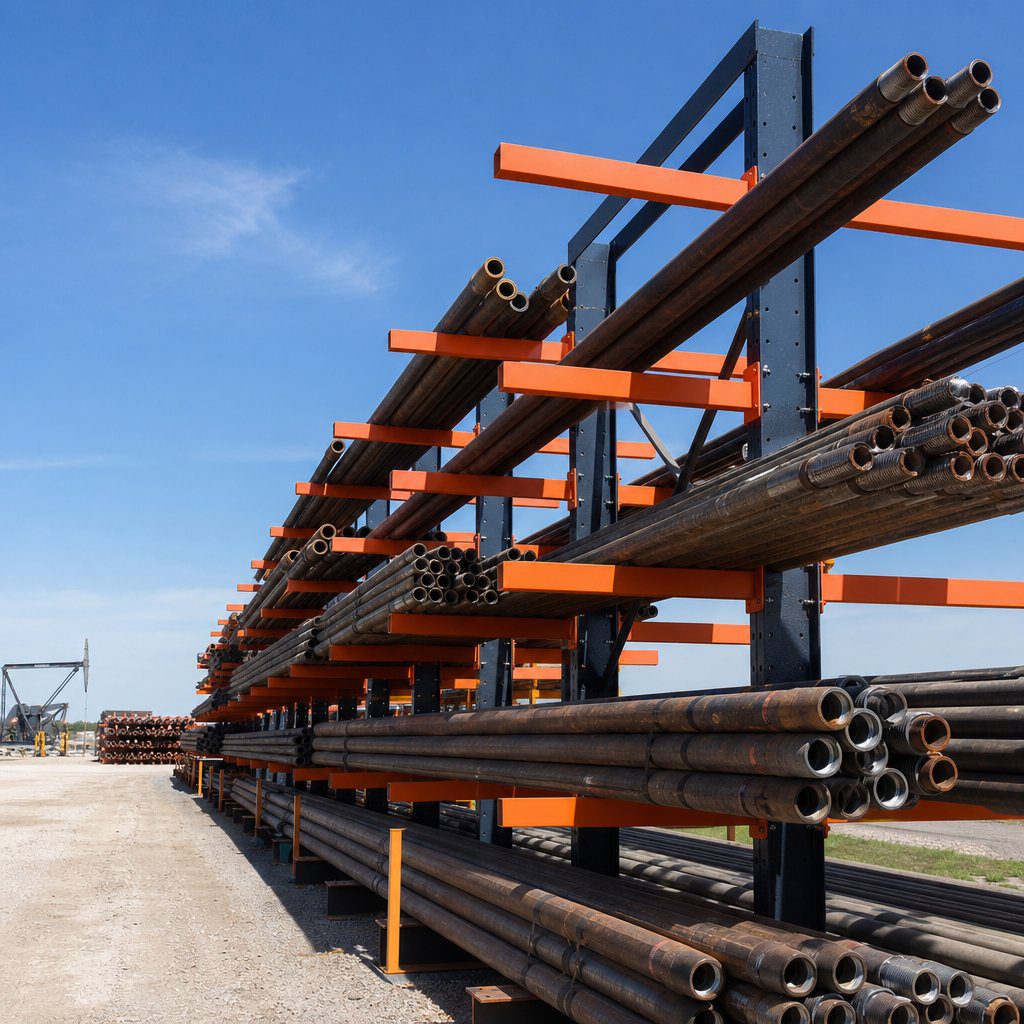 Oil, gas and utility yardsLine pipe and casing in outdoor yards on heavy galvanized rack.
Real Project: Fence Post and Pipe Storage
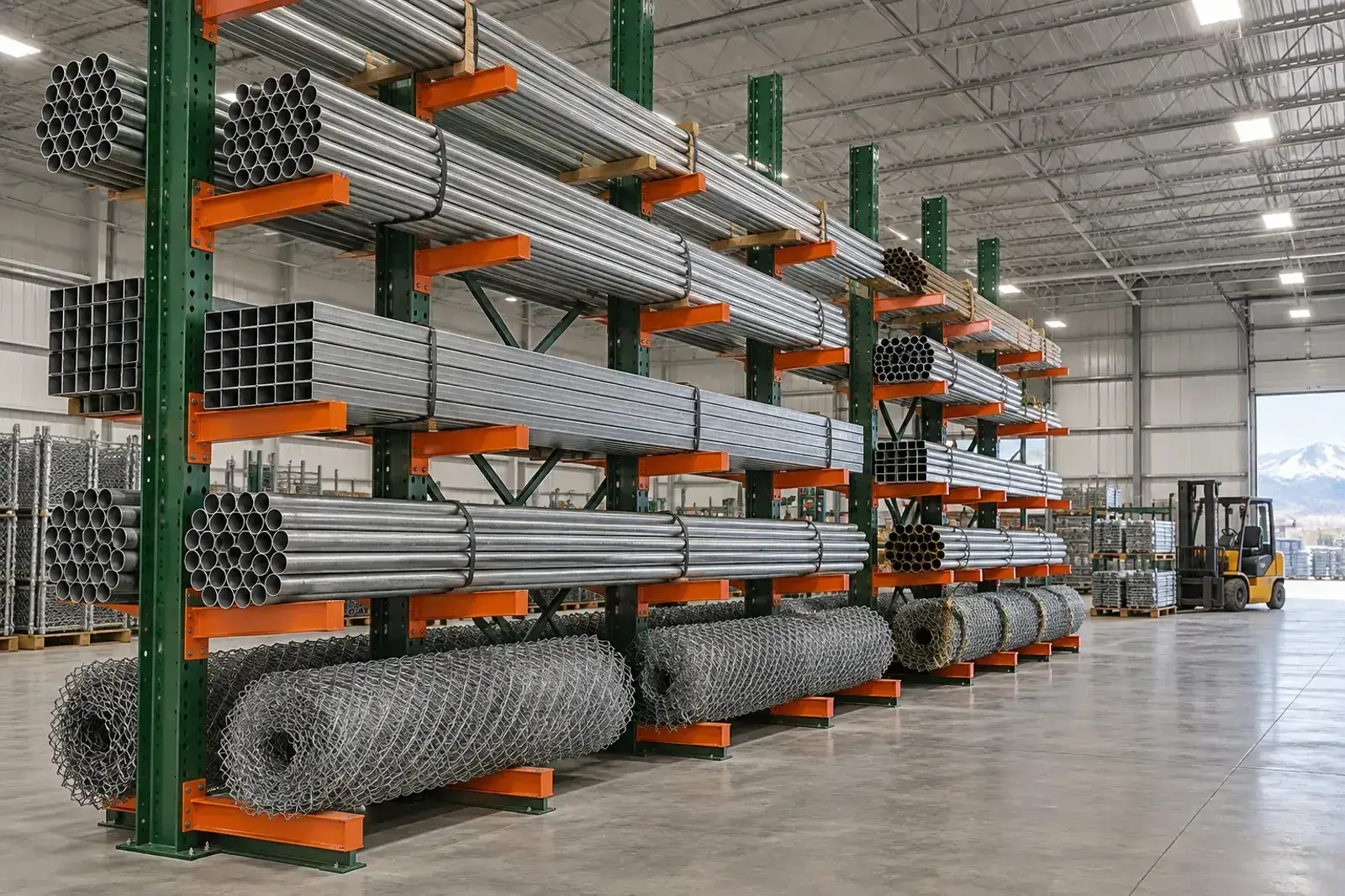
Merchants Metals in Murray, Utah stores galvanized fence posts, pipe and rolled chain-link on structural cantilever rack that MH-USA supplied. Read how the arms, levels and bays were chosen for long round stock in the fence post and pipe cantilever rack case study.
How We Plan a Pipe Rack With You
Send your stock list
Diameters, schedules, lengths, counts per bundle and indoor or outdoor.
We size the arms
Per-arm load, arm length, incline or straight, stops and spacing.
We size the uprights
Levels, height, single or double-sided, duty class and anchoring.
Layout and quote
Row length, aisles for your truck, freight and optional installation.
Install and inspect
Anchoring, load signs and a walk-through before the first bundle goes up.
Safety basics for pipe racks
- Post the arm and upright capacity at each row and train loaders to read it.
- Never climb arms or stand under a suspended bundle; use the right truck or crane attachment.
- Inspect for bent arms, loose arm locks, missing stops and damaged bases after any impact.
- Cantilever racks are covered by the ANSI MH16.3 standard published through the Rack Manufacturers Institute.
- Installing in Utah? See cantilever rack installation, permits and anchoring.
Get a free quote
Tell us what you are storing, the room size and your timeline. A project specialist will follow up with layout options and pricing. Prefer to talk? Call (800) 326-4403.
Cantilever Pipe Rack FAQs
What is the best rack for storing pipe?
Should I use incline or straight arms for pipe?
How far apart should cantilever arms be for pipe?
How much weight can a cantilever arm hold?
How do I calculate the load on a pipe rack?
What arm length do I need for pipe?
Can cantilever pipe racks go outdoors?
Do outdoor or roofed pipe racks need a permit?
Can I store PVC and steel pipe on the same rack?
What is the difference between a cantilever pipe rack and an A-frame pipe rack?
Do you sell cantilever pipe rack parts online?
Is used cantilever rack a cheaper option for a pipe yard?
Can you design and install a pipe rack for my yard?
Plan Your Pipe and Tubing Rack
Send your pipe sizes, lengths and bundle counts, indoor or outdoor. We will size arms, uprights and spacing and quote freight and installation.