A missing torque wrench can stall a repair. A missing specialty cutter can hold up a line change. In many facilities, the underlying problem is not the tool itself. It is the lack of a controlled place where tools are stored, checked out, and returned.
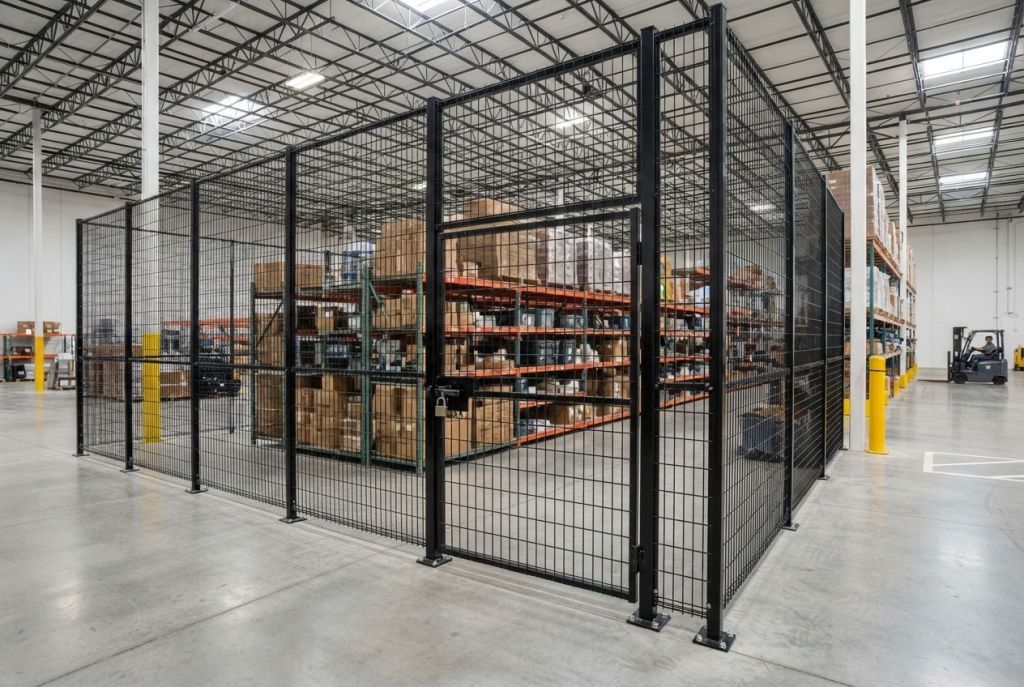
That is why a wire partition for a tool crib matters. It turns an open storage area into a defined, secure zone without building permanent walls. Managers get visibility, accountability, and a layout they can adjust as needs change.
The payoff is practical, not theoretical. Industry reports indicate that 70% of material handling facilities using wire mesh tool cribs report a 35% decrease in tool theft incidents within the first year of implementation. For buyers, that matters because every missing tool creates replacement cost, labor delay, and unnecessary searching.
Introduction Why Your Tools Need a Secure Home
Most buyers start looking at a wire partition for a tool crib after the same pattern shows up more than once. High value tools are spread across benches, cabinets, and maintenance corners. People borrow items without a clear return process. A supervisor has to stop what they are doing to find out who took what.
A proper tool crib fixes that by creating one controlled point for storage and access. It is not just a cage. It is a way to support inventory discipline, reduce misuse, and make daily work less chaotic. Because the mesh stays open, teams can still see inside, monitor activity, and keep airflow and light moving through the area.
Why this often costs less than doing nothing
When tools stay unsecured, the losses usually show up in small ways first. Extra purchases. Delayed work orders. Time spent tracking down missing items. Those costs are easy to ignore until they become part of the routine.
Practical rule: If your team spends time asking where a tool is, you already have a storage control problem.
Wire partition systems solve that problem with a modular structure that can fit existing floor space, support lockable access, and adapt as the operation changes. For many facilities, that makes a wire partition tool crib one of the simplest upgrades to justify.
Understanding the Core of Wire Partition Systems
A wire partition system is a group of steel mesh panels, posts, and connecting hardware used to form secure interior enclosures. In a tool crib application, those parts create walls, doors, and, when needed, a ceiling. The result is a contained storage area that does not require conventional construction.
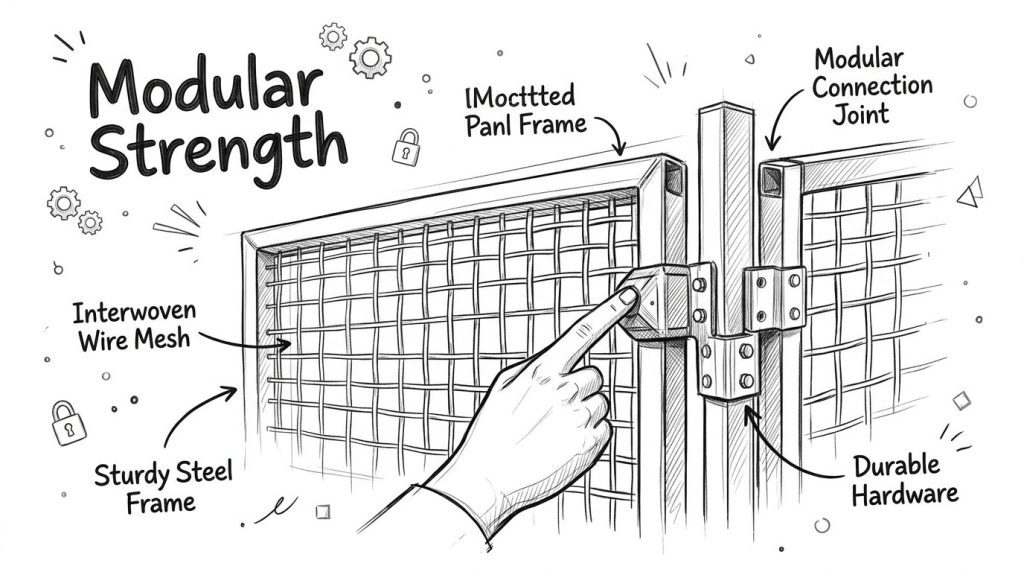
Two panel styles come up most often. Woven wire panels use interlaced mesh inside a steel frame. The Style 840 Woven Wire Partition System is a common example, with panels configured in 1 foot increments from 1 ft to 10 ft wide and standard panel heights of 4 ft and 5 ft, stacked to create taller enclosures, as shown in wire partition systems for secure industrial storage. Welded wire panels use wire welded at each contact point for extra rigidity.
Woven wire and welded wire
The best choice depends on the level of abuse, the value of the contents, and the environment.
- Woven wire panels: Common in modular partition systems where visibility and easy field configuration matter.
- Welded wire panels: Better when you expect impact, tougher handling, or a higher security threshold.
The construction detail matters. The welded wire construction of tool crib partitions uses heavy-duty 6-gauge wire welded at every individual wire contact point, creating panel strength that prevents tool theft and withstands high-impact environments, according to CSS wire partition specifications.
Why modular construction changes the buying decision
A modular system is different from a framed room built from drywall or block. Buyers can size panels in predictable increments, stack heights, and rework the enclosure later if inventory grows or workflow changes.
That makes the system easier to plan and easier to own long term. You are not just choosing a barrier. You are choosing a storage structure that can move with the operation instead of forcing the operation to work around a fixed room.
Key Components and Configuration Options
A wire partition for a tool crib is simple in concept, but the component choices change how well it works day to day. The core building blocks are mesh panels, support posts, mounting hardware, doors, and optional roof panels.
The biggest mistake I see in planning is overfocusing on wall size and underthinking access. Door type affects traffic flow, picking speed, and even how safely employees move through the area.
What makes up the system
- Panels: These form the walls and, if needed, the roof. Wire partition panels for tool cribs are designed to be stacked one on top of the other to build vertical walls and ceilings, allowing for limitless customization of wall lengths and ceiling heights without requiring custom fabrication, based on tool crib cage panel construction details.
- Posts: These carry the load and define corners, door openings, and long straight runs.
- Hardware: Bolt-together hardware holds the system together and supports later changes.
- Doors: Single swing, double swing, sliding, or other specialty options depending on use.
For buyers comparing preconfigured options, tool crib security cages are a useful reference point because they show how standard parts become a finished enclosure.
Choosing the right door for your tool crib
| Door Type | Best For | Space Requirement | Pros | Cons |
|---|---|---|---|---|
| Hinged door | Small to mid-size tool cribs with foot traffic | Needs swing clearance | Simple, familiar, cost-conscious | Can interfere with aisle space |
| Double hinged door | Wider openings and cart access | Needs more swing area | Better for moving bulky tools | Requires more open floor area |
| Sliding door | Narrow aisles or crowded layouts | Minimal swing space | Good where aisle clearance is tight | Usually more hardware and planning |
| Vertical rise door | Openings used by equipment or frequent movement | Needs overhead clearance | Keeps floor area clear | More specialized and may increase cost |
Door selection should follow workflow, not preference. The wrong door can slow access every day, even if the rest of the enclosure is well designed.
Guidelines for Tool Crib Sizing and Layout
Sizing a tool crib starts with what you need to store today. Good sizing also leaves room for shelving, access paths, and future growth. If the crib is packed tight on day one, it will be inefficient almost immediately.

One of the biggest advantages of modular partitions is predictable sizing. Tool crib storage cages built from wire partition panels require a minimum panel width of 1 foot and can be configured up to 10 feet wide using standard 1-foot modular increments, enabling facilities to design secure enclosures that meet specific space and compliance thresholds, according to Explore MH-USA security cage solutions.
Start with these layout questions
-
What will live inside the crib
Count hand tools, powered tools, kits, repair parts, and consumables. Then separate fast access items from less frequent issue items. -
How will people move in and out
If technicians need fast counter-style access, the layout should support quick entry and direct sight lines. If carts or bins move in and out, door width becomes a critical factor. -
What has to happen next year
Leave room for added shelving or a larger issue area. Modular systems are easier to expand when the original footprint has been planned sensibly.
What works in real operations
Open mesh helps more than many buyers expect. The enclosure keeps light moving through the space and avoids the closed-in feel of solid walls. It also helps managers supervise activity without having to enter the crib.
Wire partition systems for tool cribs have been standardized since the 1980s to meet federal workplace safety mandates, using stackable panels that support OSHA 1910.22(a)(1) requirements for organized storage and allowing rapid reconfiguration because they are non-permanent. That matters when a facility wants secure storage without committing to fixed construction.
A good layout reduces walking, searching, and waiting. Security matters, but the daily labor pattern matters just as much.
Selecting the Right Security and Access Control
A tool crib does not need the same lock strategy in every facility. The right level of control depends on what is stored inside, how many people need access, and whether the operation needs a simple lock or a traceable entry record.

Three common levels of control
- Keyed access: Straightforward and familiar. This works well for smaller teams with one or two responsible users.
- Mechanical keyless access: Useful when key control becomes messy. Codes can be changed without rekeying hardware.
- Electronic access control: Best when you want tighter accountability or integration with broader facility security.
For buyers reviewing lock hardware, security cage lock options show the range from basic physical locking to more controlled access points.
Electronic access is often worth the extra thought in larger operations because it can support audit trails and user-specific permissions. If your project includes broader gate or door management, this overview of Explore MH-USA security cage solutions gives a useful plain-language explanation of how access control systems are structured.
Match the lock totherisk
Store common hand tools with limited access needs, and a keyed lock may be enough. Store specialty diagnostic gear, controlled inventory, or expensive calibrated tools, and it makes sense to step up the access method.
What usually does not work is overbuilding security while underbuilding process. A high-end lock on a poorly organized crib still creates delays and confusion.
Installation Best Practices and Code Considerations
One reason buyers choose a wire partition for a tool crib over conventional construction is the installation process. Most systems assemble with bolt-together components. There is no need for field welding, and on many layouts there is no complicated site modification.
That simplicity reduces disruption in active facilities. It also helps preserve the finish and fit of factory-built components, which is harder to do when parts are cut and altered on the floor.
What usually speeds up installation
The strongest projects are planned before anything ships. That means checking dimensions, floor conditions, door swing, clearances around columns, and any interference from existing equipment or utilities.
The Style 840 Woven Wire Partition System uses fully framed, self-contained mesh panels configured in 1 foot increments from 1 ft to 10 ft wide, with standard heights of 4 ft and 5 ft. This design eliminates the need for special on-site tools or post-installation anchoring and can reduce project timelines by up to 40% compared to traditional chain-link fencing, according to Explore MH-USA security cage solutions.
Code and compliance details that buyers should not skip
Wire partition systems for tool cribs have been standardized since the 1980s to meet federal workplace safety mandates, utilizing stackable panels that support OSHA 1910.22(a)(1) requirements for organized storage and are non-permanent, allowing for rapid reconfiguration.
That non-permanent character is one of the practical advantages. In many facilities, it simplifies planning because the enclosure behaves more like equipment than fixed construction. Even so, buyers still need to confirm local requirements, floor anchoring needs, and access path conditions.
For projects where mounting details connect to broader facility work, buyers sometimes review hardware references such as high-quality metal roofing screws to compare fastening approaches and material compatibility across job scopes.
Material Handling USA provides custom layouts and planning support for secure storage projects, which can help buyers avoid ordering the right panels in the wrong arrangement. That matters because rework is where simple projects start getting expensive.
Analyzing Cost Factors and Long-Term Value
The purchase price of a wire partition tool crib is only part of the decision. The more useful question is what the enclosure costs over its full life, including installation time, layout flexibility, and the losses it helps prevent.
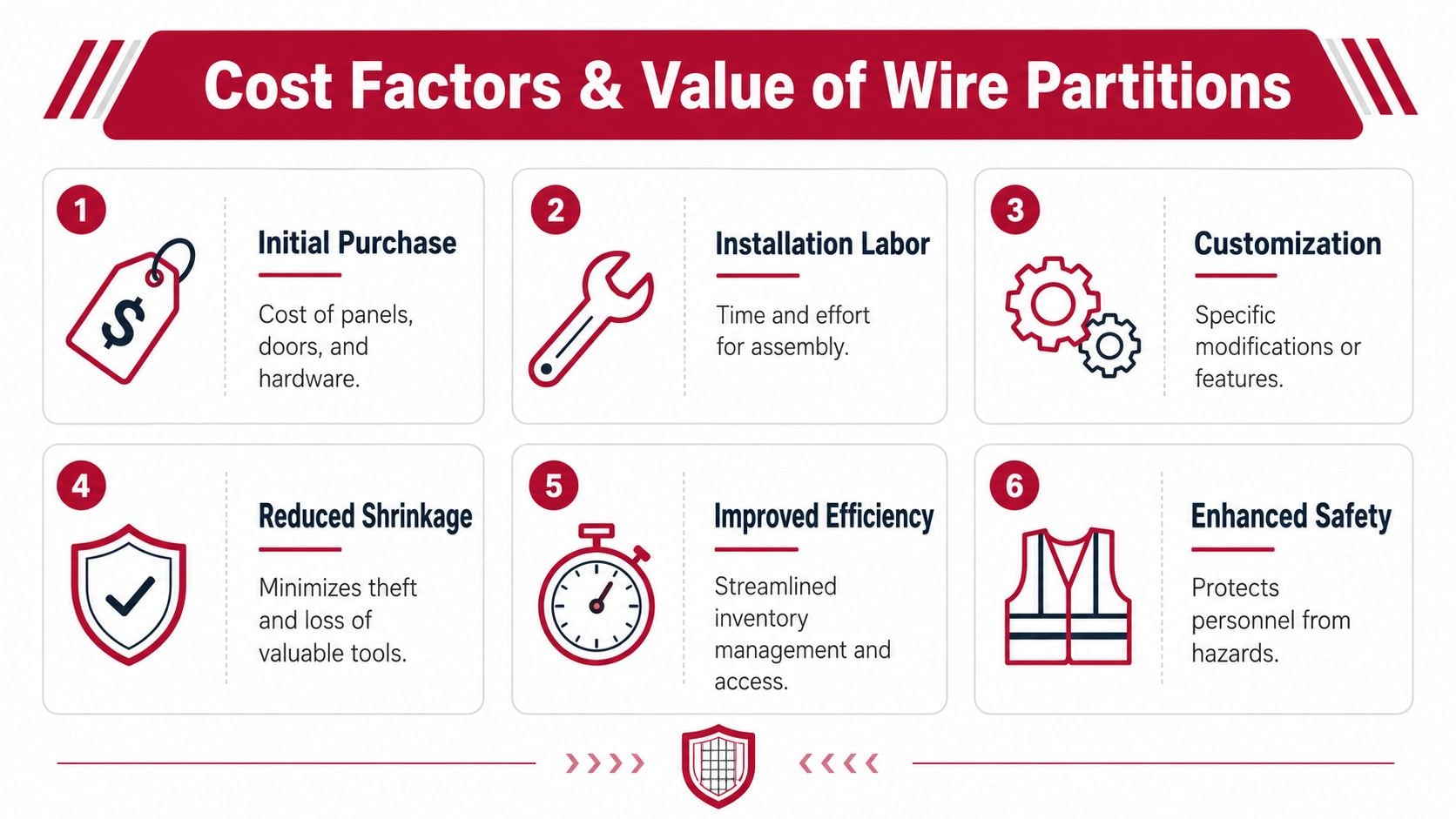
What drives cost
A few variables usually determine the budget:
- Overall footprint: More linear wall length means more panels, posts, and hardware.
- Height: Taller enclosures may require stacked panels and sometimes roof sections.
- Door design: Wider or more specialized openings add cost.
- Access level: Basic keyed entry costs less than electronic control.
- Customization: Special cutouts, unusual layouts, or integration with other systems can increase complexity.
Why total cost of ownership matters
A 2025 study by the Logistics Management Institute found that 45% of manufacturing plants face inventory volatility challenges, and scalable, reconfigurable wire partition systems that can expand or contract with those fluctuations offer a cost-effective solution. For buyers, that means flexibility has real economic value when inventory levels and storage priorities change.
The least expensive layout on paper can become the most expensive one to own if it slows access, wastes space, or forces replacement when the operation changes.
The flexibility of wire partitions often leads them to outperform fixed walls. If the facility grows, moves shelving, or changes issue points, the enclosure can usually be reworked instead of torn out and rebuilt. That is the part many feature-only comparisons miss.
FAQs About Wire Partition Tool Cribs
Are wire partitions better than drywall for a tool crib
For most industrial tool crib applications, yes. Wire partitions give you visibility, ventilation, and simpler reconfiguration. Drywall may make sense in spaces where visual privacy matters more than operational visibility, but it is usually less flexible once installed.
How do wire partitions compare with chain-link
Wire partition systems typically look cleaner, fit modular layouts better, and create a more finished interior enclosure. Fully framed panels also tend to make installation more predictable. Chain-link can work, but it often feels more improvised in an indoor tool crib environment.
Can my team install a wire partition tool crib ourselves
In some facilities, yes. Bolt-together systems are designed to simplify assembly. The decision depends on layout complexity, available labor, and whether your team is comfortable handling measurement, anchoring, and door alignment. Larger or code-sensitive projects often benefit from experienced installation support.
Do I need a roof on the tool crib
Not always. A roof is usually added when the contents need a higher level of protection or when full enclosure is part of the site security plan. For lower-risk storage, side walls and a secure door may be enough.
What about fire suppression and code issues
This is one of the most common oversights. While wire partitions offer strong visibility and ventilation, integrating them with fire suppression systems is critical for compliance. Facilities must ensure sprinkler head placement is not obstructed and meets NFPA 130 guidelines, because that is a frequent source of violations.
How fast can a tool crib layout be changed later
That depends on the original design and what components were selected, but modular systems are built for reconfiguration. If future changes are likely, it is smart to plan around standard panel sizes and avoid unnecessary custom conditions.
Where else can the same system be used
The same partition approach is commonly used for evidence storage, server cages, tenant lockers, maintenance stockrooms, and other controlled-access areas. That versatility can help standardize secure storage methods across the facility.
Secure Your Assets and Streamline Your Operations
A wire partition for a tool crib does more than lock up tools. It creates structure around how tools are stored, issued, and protected. That improves accountability, supports organized storage, and gives buyers a flexible enclosure that can adapt as operations change.
The best results come from planning the layout, door style, and access method around the actual workflow. That is where long-term value shows up. Better visibility. Less searching. Fewer losses. Fewer delays caused by missing equipment or poorly controlled storage.
Projects like this also move more smoothly when the layout is settled early. Buyers who plan sooner usually get cleaner installs, better space use, and fewer scheduling headaches later.
If you're planning a wire partition tool crib, Material Handling USA can help you compare options, build a layout, and price the right configuration for your facility. For a free quote or design consultation, Contact Us, email Sales@MH-USA.com, or call 800-326-4403. If you're ready to purchase standard products online, you can also Buy Online.
Online Store
Shop at MaterialHandling-USA.com
Need barriers, access control, or secure storage? Shop online:
Lockers
Warehouse Equipment & Supplies
Browse security & access control products →