
Home › Storeganizer › Pharmaceutical & Medical Supply
Pharmaceutical and Medical Supply Storage — High-Density Pocket Systems
Wide consumable ranges, lot-level control and no floor space to spare. Convert existing pallet rack into thousands of discrete, scannable, labelled locations for packaged pharmaceutical and medical supplies.

1 SKU
per labelled pocket
44 lb
per pocket
4 rows
deep per bay
Relocatable
reconfigure as the range changes
Why pharmaceutical and medical inventories run out of locations first
Pharmaceutical distribution, medical device supply and hospital central stores share a storage profile that shelving handles badly: a very wide range of packaged items, small individual cube, shallow depth per line, and a hard requirement that each line — often each lot — stays separately identifiable. The binding constraint is not cubic volume. It is the number of discrete, controlled addresses the building can offer.
What actually goes wrong
- Shelf levels are sized for cartons and then hold three blister packs, wasting most of the cube.
- Lines get combined when addresses run short — the point at which lot segregation becomes a manual discipline instead of a physical one.
- Stock spreads out as the range grows, so picker travel rises even though volume did not.
- Expansion means leasing space, and in a validated or temperature-controlled environment that is the most expensive square footage you can buy.
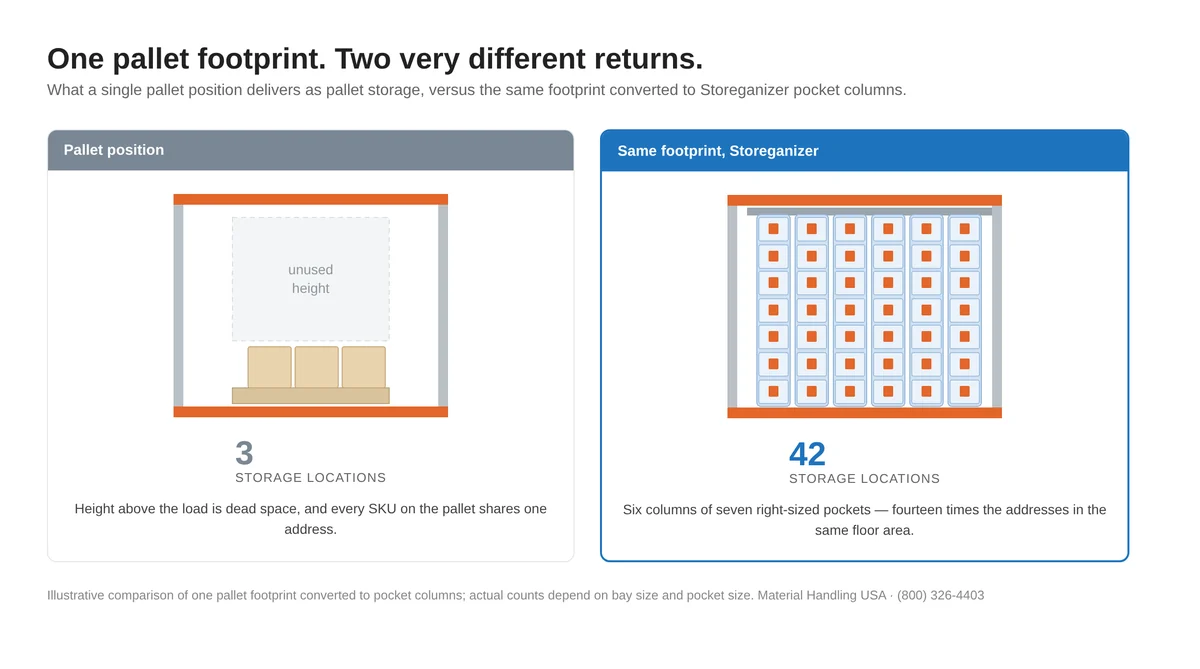
Hanging pocket columns in rack you already own attacks the actual constraint: it multiplies addressed locations inside existing cube. The mechanism is covered in how Storeganizer works.
Lot, expiry and traceability control

One address, one lot
Every pocket takes a label holder and a barcode, so each becomes its own location in your existing warehouse management system. Nothing is licensed or integrated — you are adding addresses, not a system.
For operations running FEFO, that granularity is the point. Dedicating a pocket per lot on the fast-moving lines turns lot rotation into a physical arrangement rather than a procedural one, and scan verification at the pick face confirms it.
Where two lines must genuinely share a pocket, dividers keep them physically separate inside it. Where an open front is unacceptable, front covers are available per pocket size.
A physical control beats a written one
Most lot-mixing incidents trace back to a shared location, not to a careless operator. If your address count is the reason lines are sharing bins, adding addresses is the corrective action — and it is cheaper than a lease.
Where it fits
If your operation is a third-party logistics provider handling healthcare accounts, see also 3PL and e-commerce fulfillment — the account-churn argument for a relocatable system is the same one.
Environment and compliance — stated honestly
We would rather tell you the limits than sell past them. Three points worth settling before a quote:
| Requirement | How pocket storage relates to it |
|---|---|
| Temperature-controlled storage | The columns take the environment of the room they hang in. A bay inside a cold or controlled room is a controlled location; the system itself does not create or maintain temperature. |
| Controlled substances | Pockets are open-front unless covers are specified and are not a secure enclosure. Where regulations demand a cage, safe or vault, use that — pockets can serve the surrounding non-controlled range. |
| Cleaning and validation protocols | The textile is technical fabric, maintenance free, with nothing to service. Confirm your specific cleaning agents, frequency and any validation requirement with us before ordering rather than assuming compatibility. |
The product’s own primary and secondary packaging continues to be the barrier to the environment. Pocket storage is a location structure — a better shelf, not a container.
What changes in space and picking
Independent research at the University of Leuven in Belgium (2013) measured, across the systems it studied, roughly 40% more usable storage in the same footprint, about 42% less travel time, approximately 26% better picking efficiency and around a 40% carbon reduction. We attribute those figures rather than restate them as a promise about your building — your own number comes from your own bay dimensions.
~40%
more usable space
~42%
less travel time
~26%
better picking efficiency
~40%
carbon reduction
Do this before you request a quote
Count the discrete pick locations in one representative bay today. Then configure the same bay in the Storeganizer Configurator using your real beam width, depth and clear height. The ratio between those two numbers is the whole business case, and you can get it without speaking to anyone.
For a structured way to decide which lines belong in which pocket size, see SKU slotting and rack-space ROI. For cost drivers and payback, see cost and ROI.

Get a free quote
Tell us what you are storing, the room size and your timeline. A project specialist will follow up with layout options and pricing. Prefer to talk? Call (800) 326-4403.
Pharmaceutical and medical supply storage — FAQs
Can Storeganizer be used for pharmaceutical and medical supplies?
Is it suitable for controlled or temperature-sensitive stock?
How does it support lot and expiry control?
Can it be cleaned?
What weight can each pocket hold?
Does it work for hospital and lab supply rooms as well as distribution?
Related reading
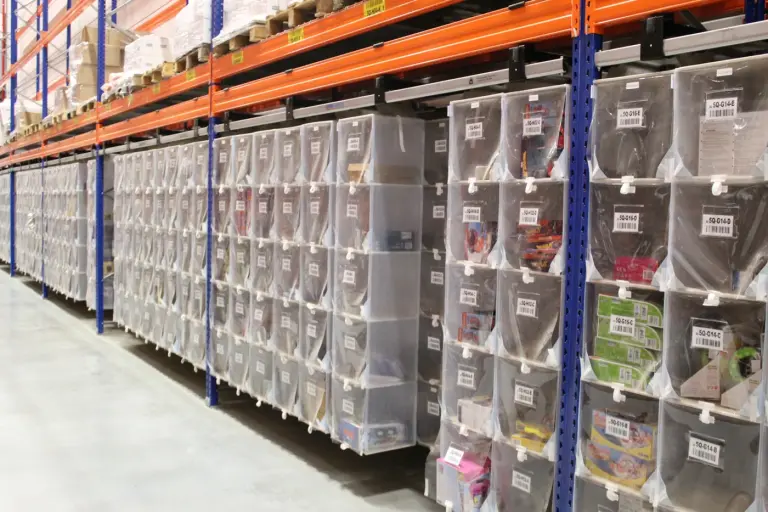 Storeganizer high-density pocket storage overviewStoreganizer turns unused pallet rack into hundreds of small-parts pick faces – 40% more usable space, 42% less…
 How Storeganizer worksHow Storeganizer high-density pocket storage works: universal rack suspension, up to four rows deep, pocket sizes…
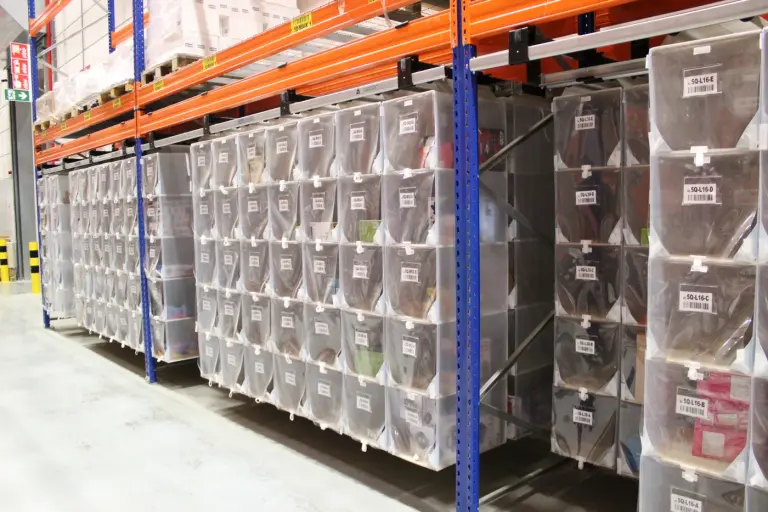 Small parts and high-SKU-count storageTurn one pallet rack bay into up to 396 right-sized small-parts pick locations with Storeganizer textile pocket…
 3PL and e-commerce fulfillment storageAbsorb more client SKUs without another lease. Storeganizer pocket columns add hundreds of dense, barcoded pick faces…
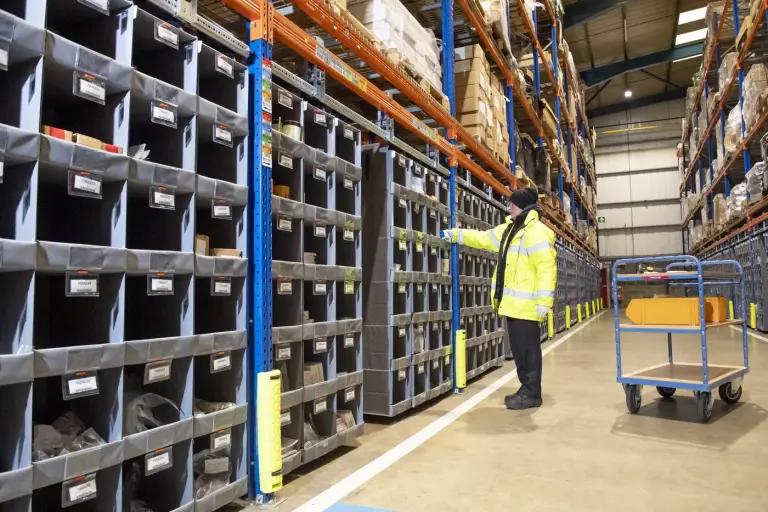 Order picking efficiencyTravel is the biggest consumer of a picker’s shift. See how a denser pick face cut travel 42% and lifted picking…
 Case studies and measured results8,611 sq ft consolidated into 1,335. Picking from 25-30 to 60-80 lines per hour. 4,000 SKUs in 16 bays. Attributed…
Get a configuration for your supply range
Send bay dimensions and a line-item profile. You will get a pocket mix, a location count, and a straight answer on anything that belongs in secured or controlled storage instead.