A good distribution center storage layout starts before you pick a single rack style. If your team is dealing with long travel paths, crowded docks, or fast movers buried in the wrong area, the fix usually begins with data, flow mapping, and a layout built around how orders move.
Foundational Planning Data, Flow, and Core Concepts
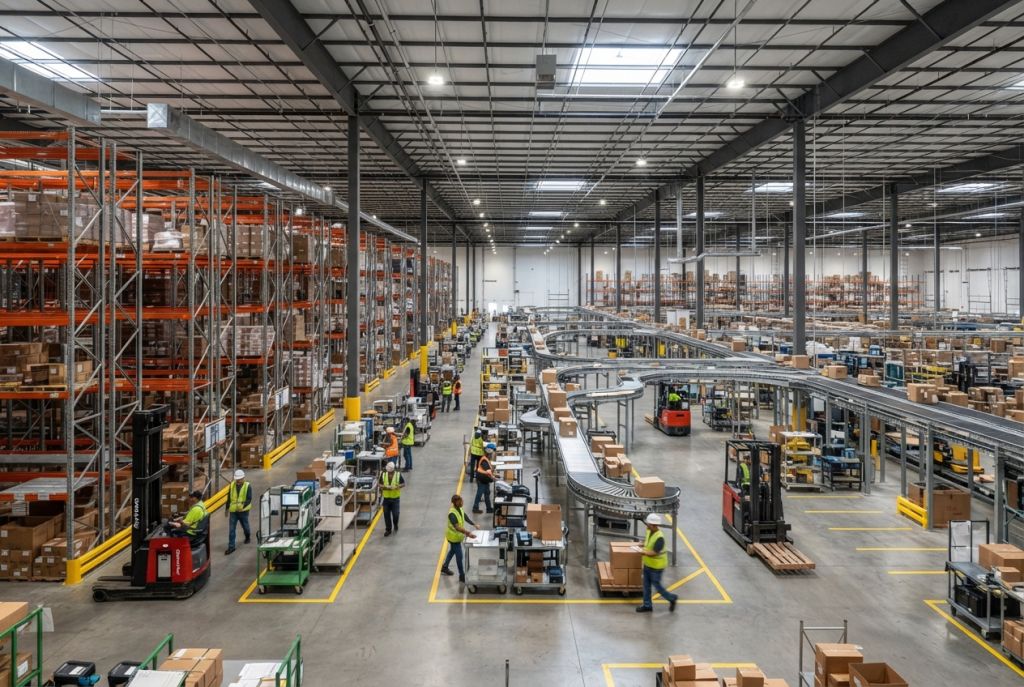
A distribution center storage layout is the physical plan for how product moves through receiving, storage, picking, packing, staging, and shipping. That sounds simple, but a DC is not just a warehouse with more racking. A true distribution center is built around throughput, replenishment, and order flow.
General warehouses often prioritize storage first. Distribution centers have to balance storage with motion. That means dock placement, pick paths, staging lanes, and replenishment access matter just as much as the rack footprint.

What makes DC layout planning different
In practice, most layout problems start with one of three issues:
- Poor product flow that forces inventory to cross paths or backtrack
- Weak staging design that clogs docks during busy receiving or shipping periods
- Bad slotting logic that puts high velocity SKUs too far from the work areas that touch them most
Those are operational problems first. Hardware comes second.
A rigorous planning process should start with material flow, SKU families, order profiles, inventory policy, and growth projections, then turn that into a conceptual design with dock-door counts, clear height, storage density, and equipment quantities before detailed slotting is finalized, as outlined by Tompkins.
The inputs to collect before drawing anything
Before a layout draft starts, collect the inputs that shape the building around the work:
- SKU count and SKU families so you can separate pallet storage, case pick, each pick, and special handling items
- Order volume and order profile so you know whether the building is driven by pallet moves, carton picks, or mixed orders
- Inventory turnover and pick frequency so fast movers don't end up deep in reserve storage
- Receiving and shipping volume so dock and staging space match your real workflow
- Equipment type and travel paths so aisle widths and turning areas fit the trucks used
- Peak season and growth expectations so the layout doesn't look fine on day one and fail during surge periods
Practical rule: If you can't explain how a pallet moves from inbound dock to final shipment, the layout isn't ready.
The same logic applies outside the four walls. Transportation schedules, carrier patterns, and dock timing affect how much staging you need and where it belongs. If you're reviewing the broader flow around your building, this guide on selecting logistics partners is a useful complement to internal layout work.
For operations that want software and physical design to line up, it's also worth reviewing how WMS integrated warehouse design where data defines your layout affects slotting, replenishment, and zone planning.
How distribution centers differ from general warehouses
A DC has more moving parts than a bulk storage warehouse. Returns may need inspection space. Packing may need workstations near picking. Replenishment may need to happen during active shifts. That changes the floor plan.
A standard warehouse can tolerate some dead space if inventory sits for long periods. A distribution center can't. Every unnecessary move shows up as extra labor, more congestion, and harder supervision.
Selecting Your Core Storage Systems
Once flow is defined, storage equipment selection gets easier. The right answer usually isn't one product. Most facilities need a mix of pallet rack, shelving, mezzanines, and sometimes conveyor support around those zones.
Pallet rack planning for distribution centers
Pallet rack is still the backbone of most distribution center racking layout plans because it handles reserve inventory well and uses vertical space efficiently. But not every DC needs the densest possible rack configuration.
If your operation needs frequent access to a wide range of SKUs, accessibility usually wins. If you hold slower reserve inventory in deeper quantities, denser storage can make sense. The mistake is choosing rack based only on cubic capacity and ignoring replenishment speed, selectivity, and traffic flow.
For buyers comparing rack options, this guide to selecting pallet rack for your warehouse is a useful starting point.
Shelving and mezzanines for pick zones
Case picking and each picking need a different approach. Industrial shelving works well where teams need direct hand access to small items, split cases, and mixed-SKU orders. It also makes it easier to create clean warehouse picking zones close to packing.
Mezzanines are often the most practical answer when the building has usable height but the floor is tight. Instead of pushing every function outward, you can separate storage, pick modules, light assembly, or packing support vertically. That's especially useful in mixed-SKU operations where the same building must support bulk pallet storage and smaller order fulfillment.
Dense storage only helps when people and equipment can still move through it cleanly.
Material Handling USA offers pallet racking systems and mezzanine solutions that fit into these blended layouts, along with layout support during planning. In many projects, the value isn't just the product. It's matching the product to the flow.
Distribution Center Storage Solutions Comparison
| Storage Solution | Primary Use Case | Key Benefit | Planning Note |
|---|---|---|---|
| Selective pallet rack | Reserve pallet storage with frequent access | Strong SKU accessibility | Best where replenishment touches many SKUs |
| Dense pallet storage systems | Slower inventory with higher storage pressure | Better cube usage | Make sure access trade-offs fit the order profile |
| Industrial shelving | Case pick and each pick zones | Fast hand access to small items | Keep close to packing or active pick faces |
| Mezzanines | Expanding usable space inside existing shell | Adds functional floor area | Works best when ceiling height is available |
| Conveyor-supported storage areas | Moving cartons or totes between zones | Reduces walking between functions | Only makes sense when flow is repetitive enough |
Designing for Material Flow and Movement
The first real test of a DC layout happens at 8:00 a.m., when inbound trailers are waiting, pickers are already active, and outbound orders need floor space before the first route cutoff. If pallets have no clean path from receiving to storage, or staged orders spill into travel aisles, the problem is not labor discipline. The layout was built without enough room for movement.

Staging areas for receiving and shipping
Staging needs to be sized from operating conditions, not whatever space is left after rack is drawn in. Start with inbound and outbound peaks. Look at trailer arrival patterns, unload rates, order cutoffs, average dwell time on the floor, and how often product waits for quality checks, putaway, consolidation, or loading. Those inputs determine whether staging can stay contained or will keep bleeding into active aisles.
Inbound and outbound staging should be separated whenever the building allows it. Receiving needs space for unloading, checking, counting, labeling, and short-term hold. Shipping needs space for order consolidation, route sort, and load sequencing. Combining both in one shared open zone can work in a small, low-volume operation, but in a busy DC it usually creates mixed pallets, blocked doors, and avoidable rehandling.
The common mistake is easy to spot. Storage expands one row at a time, and staging shrinks until every peak period becomes a floor-management problem.
Aisle width, forklift access, and traffic flow
Aisles should match the equipment, load type, and turning behavior in the building. A reach truck serving standard pallets has different needs than a sit-down lift handling long loads, and both behave differently once pedestrians, replenishment, and cart traffic enter the same zone.
Use these checks during layout review:
- Set aisle widths by truck model and load dimensions, including turning and placement clearance
- Protect cross-traffic points between storage, packing, offices, and battery charging areas
- Keep forklift routes out of primary pedestrian paths wherever possible
- Give rack ends enough maneuvering space for turns, staging, and recoveries from bad approaches
- Separate replenishment from active pick faces if order volume is high enough to create recurring conflicts
Many paper layouts prove ineffective. A drawing may show enough linear aisle space, but operators still lose time if every turn requires backing up or waiting for another truck to clear.
Conveyors and material flow planning
Conveyors make sense when product movement is repetitive, volumes are stable, and the path between functions is predictable. They are far less useful in operations with frequent exceptions, irregular order profiles, or constant process changes. Before adding any powered transport, map where cartons, totes, and pallets travel during a normal day and during peak.
That review should answer a few practical questions. How many touches does an order take from pick to pack to ship. Where do items stop and wait. Which transfers happen often enough to justify fixed equipment. In many projects, the best answer is not more automation. It is fewer handoffs, shorter travel paths, and better placement of workstations.
If the operation relies on zone picking, packing handoff, or repetitive carton movement, these picking and packing system layouts can help connect work areas without forcing more foot traffic into lift-truck aisles.
Good flow design reduces touches, separates conflicting traffic, and protects space for the work that happens between storage locations. That is what keeps a layout functional after volume grows, SKU mix changes, and peak weeks put real pressure on the floor.
Optimizing for Picking Efficiency and Scalability
Peak week exposes weak slotting fast. A building can have enough rack capacity on paper and still miss outbound targets because fast movers sit too far from the pick path, replenishment cuts across active zones, and reserve locations do not support the order profile the operation is shipping.

Slotting by velocity and pick path
Good slotting starts with operating data, not rack type. Review SKU velocity, cube, order lines per order, units per line, seasonality, and how often each item needs replenishment. Then assign pick faces based on the work the SKU creates. The goal is shorter travel, fewer touches, and less interruption inside the active pick area.
In practice, that usually means:
- Fast movers near shipping, forward pick zones, or active pick modules
- Medium movers close enough to support efficient travel without taking the best ergonomic slots
- Slow movers in denser or less convenient locations
- Items often ordered together grouped to reduce repeated trips
- Bulky or awkward SKUs placed where picks are safer and replenishment is easier
High-density storage still has a place, but density is only one variable. If a dense solution increases replenishment frequency or forces pickers into longer paths, total labor goes up even when storage utilization improves.
Operations refining zone design and workstation placement often use picking and packing system layouts to connect pick, pack, and handoff points without adding unnecessary travel inside core pick aisles.
Keeping capacity flexible
Picking efficiency drops when every location is full. Teams trying to maximize storage often give away more labor than they save in capacity because reserve slots become harder to access, replenishment windows get tighter, and overflow inventory starts taking staging or aisle space.
Leave room for change. That buffer supports seasonal swings, SKU churn, and temporary imbalances between inbound receipts and outbound demand. The exact amount depends on the operation, but the principle is consistent. A DC packed too tightly is harder to replenish, harder to slot cleanly, and harder to scale.
This is a real trade-off. Finance and operations leaders often push for more positions in the same footprint. Sometimes that is the right call. In many facilities, though, protecting access to pick faces and keeping a workable reserve structure produces better throughput than squeezing in another row of storage.
Re-slotting after demand changes
Slotting is not a one-time setup. Promotions, new customers, channel mix shifts, and SKU proliferation can turn a good layout into a labor-heavy one within a single planning cycle, as noted by Cin7.
Re-slot when the operation shows clear symptoms:
- Pick travel increases without a staffing change
- The same aisles or zones stay congested
- Replenishment interrupts picking too often
- Fast movers have migrated into reserve-friendly but labor-heavy locations
- Order profiles have changed since the last slotting review
A practical review cadence ties back to the business rhythm. High-volume e-commerce operations may need frequent slotting reviews during peak periods. More stable B2B networks may only need scheduled reviews around seasonal resets, major assortment changes, or customer onboarding. The point is to use current demand and order behavior, not last year's slotting logic.
Avoiding Pitfalls and Implementing Your Layout Plan
A layout can look efficient on paper and still fail in the first busy week. The usual pattern is familiar. Inbound trailers arrive early, outbound staging overruns its marked area, replenishment drivers cut through active pick paths, and supervisors start creating workarounds by day two. The issue is rarely the rack itself. The issue is that the operating rules, space allocation, and slotting logic were never tested together.

Common DC layout mistakes to avoid
The most expensive mistakes usually happen before installation.
Teams often approve a layout before they have pinned down the inputs that matter most: SKU velocity by family, order line distribution, pallet in and pallet out by day, replenishment frequency, and dock activity during peak overlap. Without that baseline, it is easy to build a plan that looks space-efficient but creates extra touches.
Watch for these failure points:
- Flow paths that force backtracking between receiving, storage, picking, packing, and shipping
- Staging areas sized for average days instead of peak windows
- Fast movers assigned to locations that make replenishment or picking harder than necessary
- Storage compressed so tightly that forklift travel, pick access, and safety all suffer
- No separation between replenishment activity and active picking zones
These are trade-offs, not drafting errors. Adding more storage positions can reduce floor space available for staging, cross-aisles, battery charging, packing, quality hold, or returns. In many buildings, the right answer is fewer positions and better flow.
A 5 step checklist for planning a distribution center storage layout
-
Collect operating inputs before finalizing the drawing
Start with SKU counts, cube, pallet dimensions, order profiles, receipt patterns, shipping peaks, equipment types, and labor assumptions. Separate average-day demand from peak demand. A layout that only works on a normal Tuesday is not finished. -
Map product movement by transaction type
Trace full pallets, case picks, each picks, returns, value-added work, and replenishment separately. Mixed operations break down when one path is drawn as if every unit moves the same way. -
Assign space by function before maximizing storage
Protect receiving, inspection, reserve, forward pick, packing, shipping, and staging first. Then calculate how much footprint is available for storage media. This prevents the common mistake of filling the building with rack and leaving operations to fight for floor space later. -
Stress-test the layout under simultaneous activity
Check what happens when receiving is active, replenishment is running, pick waves are releasing, and outbound staging is full. If core aisles block under those conditions, the layout needs revision before go-live. -
Implement with controls, not just equipment
Mark lanes clearly, label locations, define staging rules, train supervisors on travel paths, and set a review point after launch. The first weeks should be used to correct slotting, congestion points, and replenishment timing before bad habits harden.
Treat the layout as an operating system. The drawing, slotting rules, labor plan, and floor discipline have to work together.
Decision scenarios buyers should think through
Different operating profiles drive different layout choices.
| Operation Type | Layout Priority | Storage Solution | Benefit | Planning Notes |
|---|---|---|---|---|
| Ecommerce fulfillment | Forward pick density, packing access, outbound staging | Shelving, carton flow, conveyors where volume supports them | Handles high line-count orders | Size packing and staging from peak order release patterns, not average demand |
| Wholesale distribution | Reserve access, pallet flow, dock turnover | Pallet rack with clean replenishment routes | Supports pallet and case movement | Keep replenishment paths from crossing dock staging lanes |
| Bulk pallet storage | Cube use with workable forklift travel | High-bay pallet rack | Improves vertical capacity use | Aisle count, lift speed, and turning space matter as much as position count |
| Mixed SKU operation | Separation of pallet, case, and each workflows | Combination of rack, shelving, and mezzanine areas | Supports multiple fulfillment methods | Build around order profile by channel, not around a single storage standard |
| DC expansion | Added capacity without breaking current flow | Mezzanines, re-slotting, selective reconfiguration | Creates room for growth | Check docks, staging, and replenishment first. More storage alone may not raise throughput |
Questions to ask before requesting a layout consultation
A good design conversation starts with operating pressure points, not a rack catalog.
Use these questions to frame the work:
- Which SKUs, customers, or channels create most of the daily movement
- Where does congestion show up during peak hours
- What order profiles drive labor today: pallets, cases, eaches, or mixed orders
- How much floor area must stay open for staging, packing, quality checks, and traffic
- What changes are expected during the next few years: more SKUs, higher throughput, new value-added work, or channel mix shifts
- Is the main problem storage capacity, labor efficiency, dock flow, or a combination of all three
A layout plan is ready for implementation when the team can answer those questions clearly and translate them into space, travel paths, and operating rules. That is what keeps the facility efficient now and usable after the business changes.
Frequently Asked Questions About DC Layout Planning
What is the first step in DC layout planning
A layout project usually starts after the operation has already felt the pain. Picks are late, staging spills into aisles, or inbound and outbound teams are fighting for the same floor space.
The first step is to document operating inputs before anyone talks about rack types or automation. That means SKU velocity, order profiles, unit handling by area, replenishment frequency, dock schedule, seasonal peaks, and current travel paths. Without that baseline, the layout turns into a space-filling exercise instead of an operating plan.
How is a distribution center different from a regular warehouse
A distribution center is designed around flow. Inventory still needs storage, but the building earns its keep by receiving, replenishing, picking, packing, staging, and shipping product with consistent speed.
That changes the layout priorities. A general warehouse can tolerate slower access if storage density is the main goal. A DC usually cannot, especially when the order mix includes cases, each picks, retail compliance work, or short ship windows.
What storage system works best for a distribution center
The best system is the one that fits the order profile and replenishment method. In practice, that usually means a mix of storage types instead of a single standard across the building.
Reserve pallet rack works for bulk inventory. Shelving or carton flow may fit small-item pick zones. Mezzanines can add useful pick or pack space if vertical clear height supports them. Conveyors only make sense when movement between zones is repetitive enough to justify the cost and operating constraints.
How much space should be reserved for non-storage functions
More than many first-pass layouts allow.
A DC needs room for receiving checks, outbound staging, packing, quality holds, returns, battery charging, empty pallet handling, and equipment travel. Teams that maximize rack count too early often create a building that looks efficient on paper and clogs up during peak weeks. As noted earlier, strong layouts protect enough open floor area for the work that happens between storage and shipment.
Why do staging areas matter so much
Staging controls dock performance. If inbound product has no defined space, it lands in travel lanes. If outbound orders have no buffer, shipping crews start hunting for freight, reprioritizing loads, and blocking doors with partial pallets.
That is usually where congestion starts.
The right staging footprint depends on wave size, shipment timing, order consolidation needs, and trailer activity by shift. Under-sizing this area is one of the most common planning mistakes I see.
How often should slotting be reviewed
Review slotting whenever the business changes enough to affect travel or replenishment. Common triggers include a shift in top-selling SKUs, new customer requirements, promotions, channel mix changes, or repeated congestion in the same pick zones.
A fixed calendar can help, but performance signals matter more than the date. If labor hours are climbing and the same SKUs keep getting moved by hand to make the day work, the slotting plan is already behind the operation.
Should every available rack location be filled
No. A layout needs operating flexibility, not just high occupancy.
If every location is full, replenishment gets tighter, problem inventory has nowhere to go, and putaway decisions start to damage pick flow. Leaving some capacity open gives the team room to absorb variability, handle inbound spikes, and correct slotting mistakes without disrupting the whole building.
When does a mezzanine make sense in a DC
A mezzanine makes sense when floor area is constrained, clear height is usable, and the operation has a defined function that benefits from being lifted off the main floor. That may include each-picking, packing, light assembly, supplies, or support space.
It is not an automatic fix for growth. Before adding a mezzanine, check whether the constraint is dock throughput, replenishment response time, or staging capacity. Extra levels help only if the rest of the flow can support them.
If you're planning a new distribution center storage layout or fixing one that no longer supports your order flow, Material Handling USA can help you review pallet rack, mezzanines, shelving, and movement paths as part of a no-obligation layout discussion. Better planning usually means fewer install delays, cleaner growth options, and a faster path to a layout that fits the work. For a free distribution center layout consultation, Contact Us, Request a Quote, or Call (800) 326-4403.
Related Solutions
Online Store
Shop at MaterialHandling-USA.com
Running a fulfillment center? Stock up on shipping essentials:
Poly Bags & Packaging
Packaging Tape
Stretch Wrap & Shrink Film
Shipping Labels & Tags
Shop all shipping supplies →