
Home › Storeganizer › Case Studies › Everten Supplies
Everten Supplies — absorbing e-commerce growth without moving warehouse
An online kitchenware retailer at the limit of a 1,056 m² building put 2,759 storage locations into 50 m² of floor, cut mispicks by half, and stopped looking for a new facility.

18
Storeganizer bays
2,759
storage locations created
50 m²
floor area used
−50%
mispick rate
The situation
| Project profile | |
|---|---|
| Industry | E-commerce retail |
| Application | Online kitchen and homeware fulfillment |
| System | Storeganizer high-density textile pocket columns in existing pallet rack |
| Source | Results as reported by the operation and its Storeganizer manufacturer, KTP conTeyor |
Everten Supplies sells kitchenware online, and by the time warehouse manager Kelvin Plain joined in 2017 the business was outgrowing its 1,056 m² warehouse. Growth was fast, the product range kept expanding through acquisitions, and a large share of the stock was small items sitting on conventional shelving that was never designed for them.
The symptoms were the familiar ones and they compounded each other: items took longer to put away, got pushed into the next location, got interchanged, got mixed up. That produced stock discrepancies that took time to unpick and mispicks that reached customers. The company was at the limit of its capacity and already exploring options to move out.
What was installed
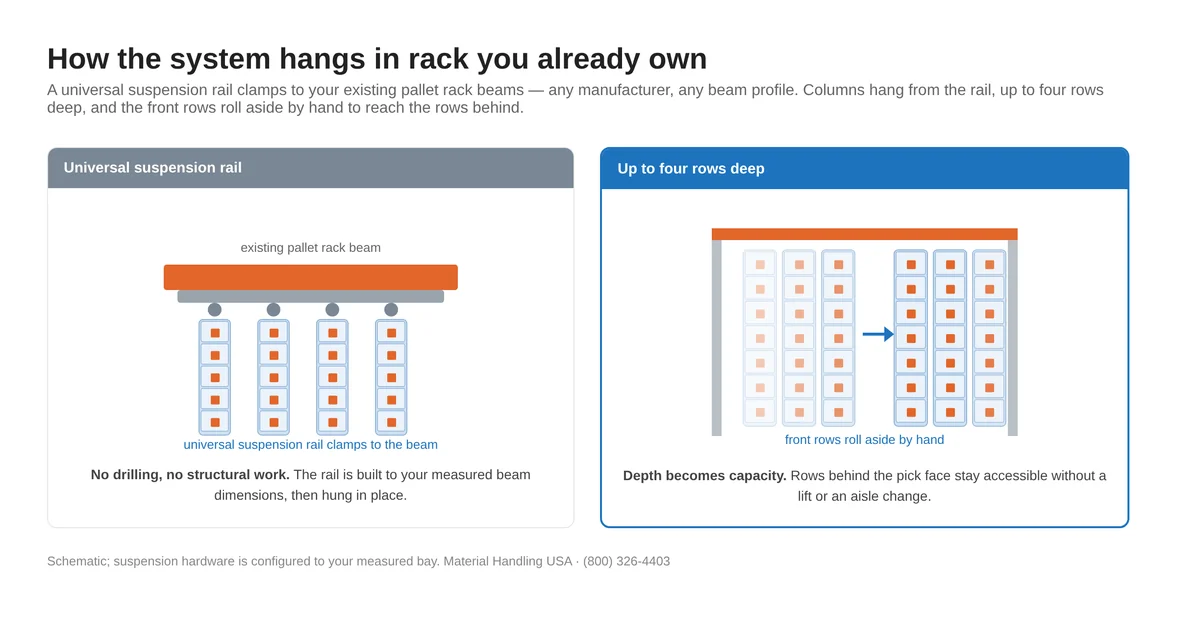
Eighteen bays were installed, deliberately combining pocket sizes — small, medium and large — to generate 2,759 optimised storage locations. Individualised pockets removed the root cause of the mixing: an item can no longer be pushed into the next location, because there is no next location to push it into.
Kelvin Plain was, by his own account, hesitant at first. That is worth including in a case study, because scepticism about textile storage is common and the operators who report the largest gains are frequently the ones who started out unconvinced.
Reported results
| Measure | Before | After |
|---|---|---|
| Storage locations | Conventional shelving locations | 2,759 across 18 bays, mixing three pocket sizes |
| Share of total stock lines in that footprint | 10% | 25% |
| Floor area used | Shelving across a larger area | 50 m² |
| Pickers required in that area | 3 full-time | 1 full-time equivalent |
| Mispick rate | Baseline | Down 50% |
| Relocation | Actively exploring a move | Postponed; growth absorbed in place |
“Before, we had three full-time pickers in that area. Storeganizer helped to bring this down to one full-time equivalent, while the mispick rate dropped by 50%.”
The strongest number here is the one that never appears on an invoice: the relocation that did not happen. A move to a larger facility carries fit-out, new racking, downtime, and a rent increase that continues for the length of the lease. Deferring it by converting 50 m² of an existing building is a different order of expenditure entirely.
The share of stock lines held in that footprint rising from 10% to 25% is the density figure stated honestly — not a claim about the whole warehouse, but a measurement of what one converted area now carries.

What this means for a US operation
Every warehouse is different, and a result reported elsewhere is evidence rather than a forecast. These are the transferable parts:
- Mixing pocket sizes in one installation is what produces high location counts. Everten used small, medium and large together to reach 2,759 locations.
- Discrete addressing fixes mixing, not just density. The stock-discrepancy problem and the mispick problem were the same problem.
- Compare a conversion against the cost of moving. For a growing e-commerce operation, that is almost always the real alternative.
The measured averages behind these cases — around 40% more usable space, 42% less travel time and 26% better picking efficiency — come from independent research at the University of Leuven, Belgium (2013), comparing Storeganizer with conventional rack and shelf. To see what the same arithmetic produces in your own bay, use the Storeganizer Designer or ask us to run the numbers with you.
Why this inventory profile suits pocket columns
The transferable part of any case study is the profile, not the logo. These are the characteristics that made this operation a good candidate — and they are the ones worth checking against your own inventory before you consider a conversion.
How a conversion like this runs
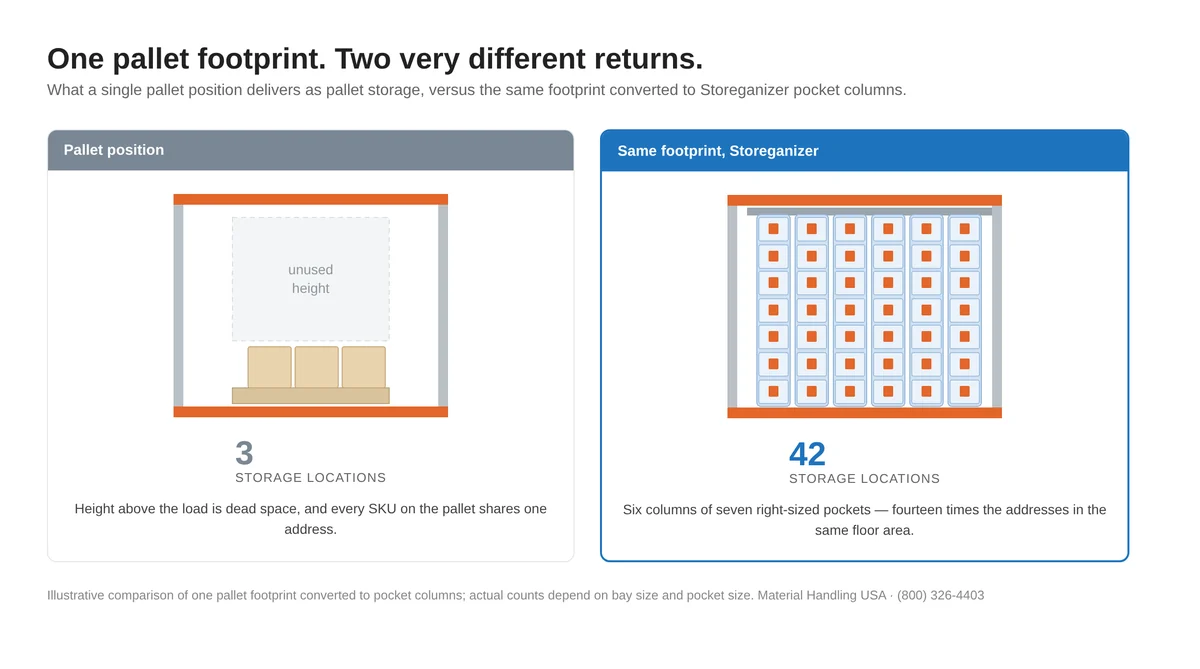
Four steps, and none of them involve construction. The sequence matters: the slotting analysis comes before the measurement, and the count comes before the order.
Profile the SKUs
We look at item size, stock depth and order frequency for the zone in question — the three properties that decide whether a pocket is the right home for a part.
Measure the bays
Inside width, inside depth, clear height and beam profile. The suspension rail is then manufactured to those dimensions.
Configure and count
Pocket sizes are selected per SKU group and the location count is calculated before anything is ordered.
Install and slot
Columns hang from existing beams in an operating warehouse — no drilling, no anchoring, no permit drawing — then stock is slotted in.
We handle all four in the United States, including the install. Because the system is maintenance free — no motors, no controls, no annual service contract — there is nothing scheduled after handover.
Questions about this project
How many storage locations did Everten create?
How much stock does that footprint hold?
What happened to the mispick rate?
Did Everten still need a bigger warehouse?
Related reading
 Storeganizer for 3PL and e-commerce fulfillmentAbsorb more client SKUs without another lease. Storeganizer pocket columns add hundreds of dense, barcoded pick faces…
 E-commerce fulfillment center designDesign a high-velocity e-commerce fulfillment center built for speed and accuracy. We optimize layouts for high-SKU…
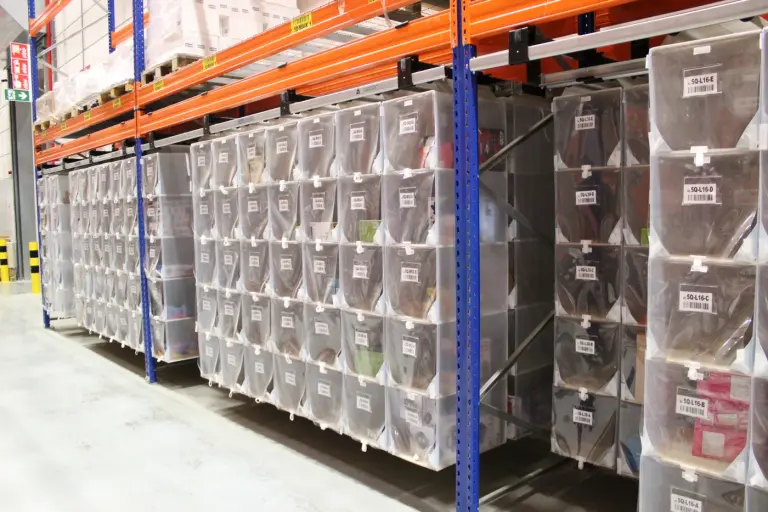 Small-parts warehouse storageTurn one pallet rack bay into up to 396 right-sized small-parts pick locations with Storeganizer textile pocket…
 All Storeganizer case studies and measured results8,611 sq ft consolidated into 1,335. Picking from 25-30 to 60-80 lines per hour. 4,000 SKUs in 16 bays. Attributed…
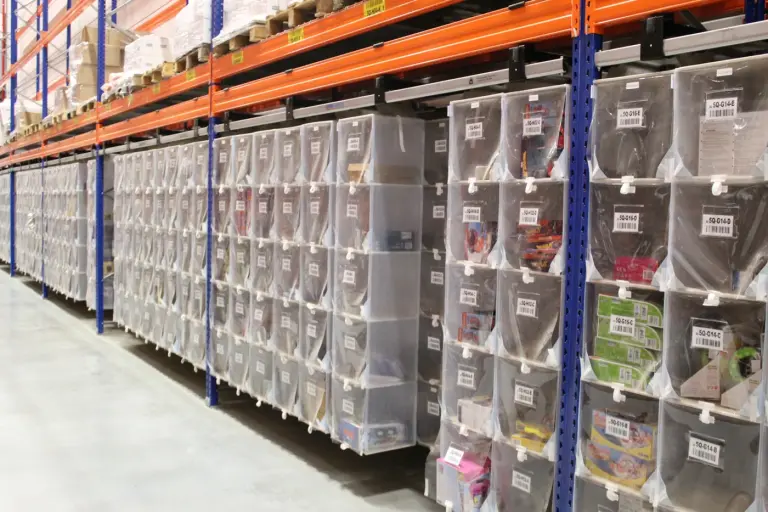 Storeganizer high-density pocket storage overviewStoreganizer turns unused pallet rack into hundreds of small-parts pick faces – 40% more usable space, 42% less…
Could your rack do this?
Tell us the bay dimensions and the SKUs giving you trouble. We will come back with a configuration, a location count and an honest view of whether a conversion is worth it.