
Home | Storeganizer | Retail Backroom & BOPIS
Retail Backroom, BOPIS and Returns Storage With Storeganizer
Click-and-collect, curbside staging and returns all landed in a backroom that never grew. Storeganizer pocket columns and the mobile Picking Hive add dense, labelled locations — in existing rack, or on a rolling unit that needs no installation at all.
The backroom is the constraint, and it is not getting bigger

Retail backrooms were sized for a world where the store sold what was on the shop floor. They now also hold click-and-collect orders waiting for pickup, curbside orders staged by time slot, returns waiting to be processed, and the overflow from a fast-turning assortment — all in the same square footage, usually on shelving that was never designed for any of it.
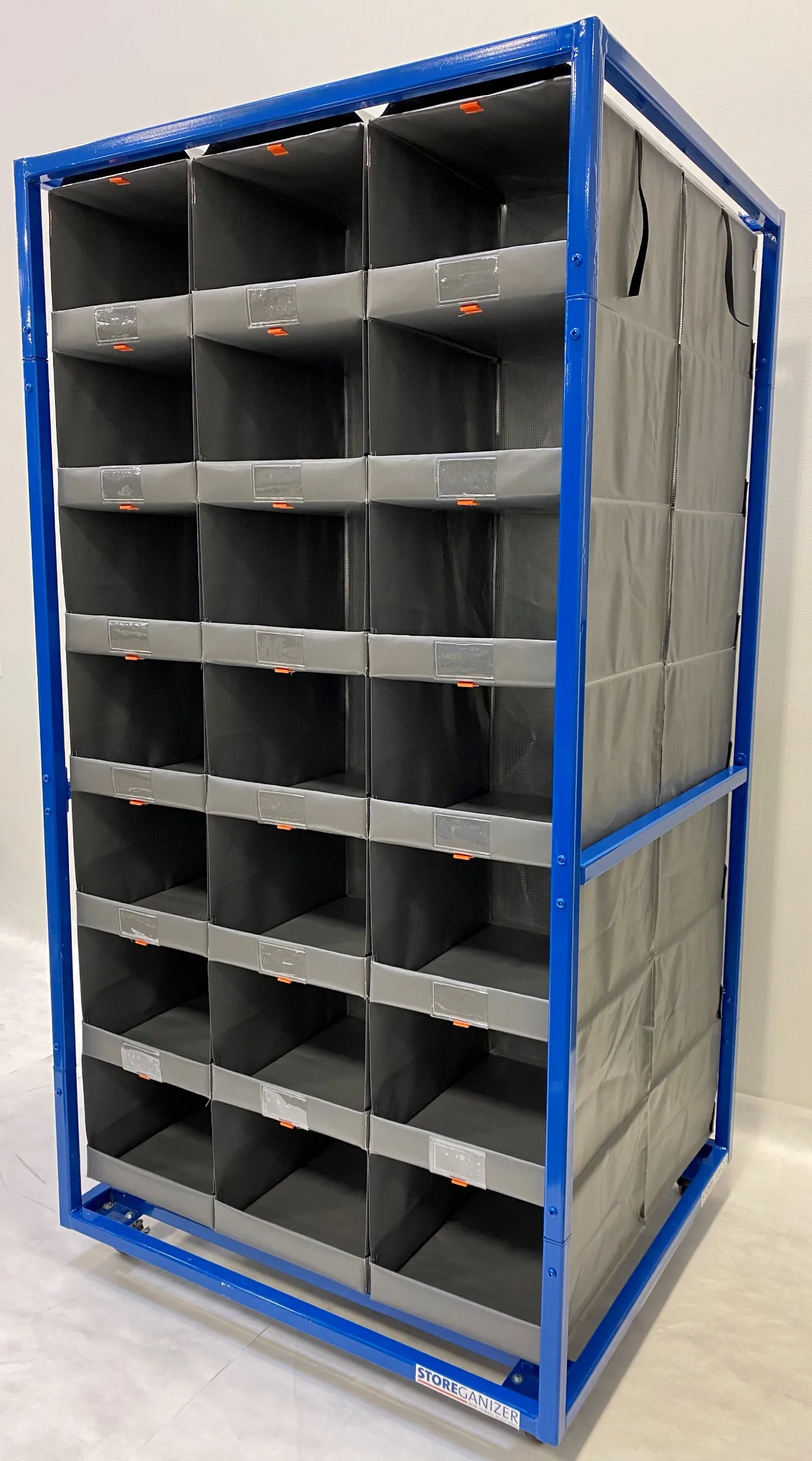
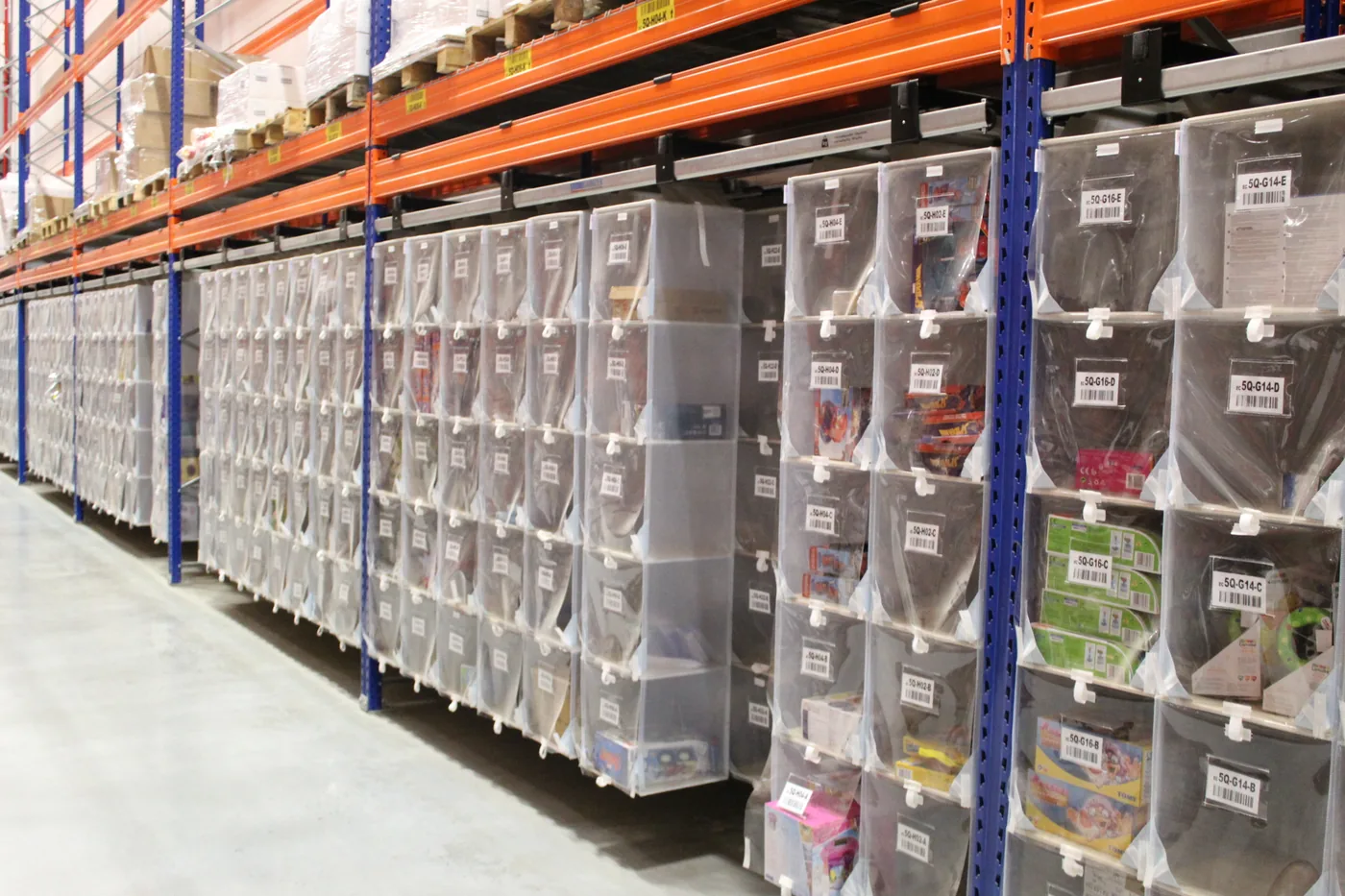
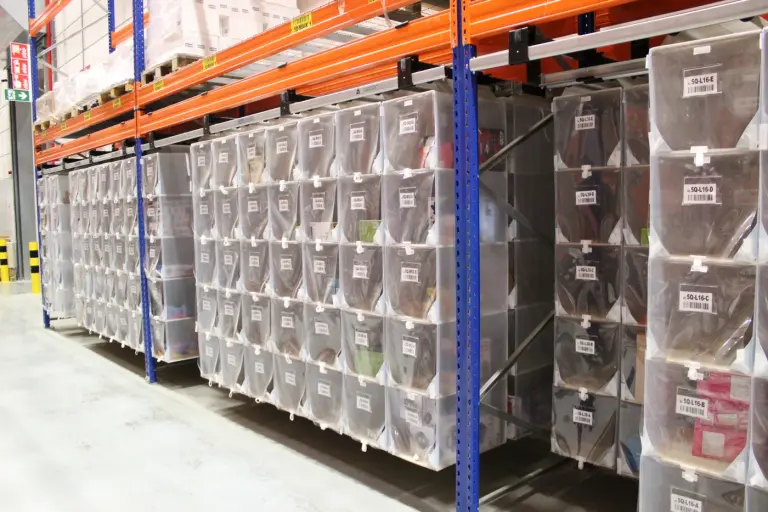
Storeganizer addresses this in two forms. Pocket columns hang in existing backroom rack to compress overflow and small-item stock into dense, labelled locations. The mobile Picking Hive — a self-supporting unit on a standard pallet footprint — rolls into place with no rack and no installation, which suits order staging, temporary pick lines and returns.
Retail and BOPIS applications
Picking Hive: standard US sizes
The Hive is the same textile pocket system in a self-supporting mobile frame. One person sets it up in a few minutes, the top suspension is universal, and there is a click-together assembly with no tools required. These are the three standard US configurations.
| Size | Reference number | Pocket (W x D x H) | Pocket max weight | Pockets | Frame (W x D x H) | Frame max weight |
|---|---|---|---|---|---|---|
| Extra Small | PH-XS-US-404154 | 14.5″ x 19.5″ x 6″ | 44 lb | 60 | 48″ x 42″ x 76.5″ | 1,320 lb |
| Small | PH-S-US-404920 | 14.5″ x 19.5″ x 12″ | 44 lb | 30 | 48″ x 42″ x 76.5″ | 1,320 lb |
| Medium | PH-M-US-404921 | 14.5″ x 19.5″ x 20″ | 44 lb | 18 | 48″ x 42″ x 76.5″ | 792 lb |


The Hive is also the basis of Storeganizer Pick 360, where the pocket face is used as the static pick front that autonomous mobile robots travel to.
Configure rack-hung Storeganizer bays
The free designer covers the rack-hung system — bay height, pocket size, bay count, textile grade and options. For Picking Hive quantities and lead times, call us or send an enquiry.
Rebuilding a live storeroom without stopping work
The reason storerooms stay bad for years is that nobody can take them offline. A pocket-column conversion is one of the few storage changes that can genuinely be done in stages, because each bay is independent and nothing is anchored, wired or bolted into the building.
Clean before you convert
The cheapest storage is the part you no longer keep. Run a dormancy report, get engineering to sign off on superseded and obsolete spares, and dispose of them first. It is normal for this step alone to remove a fifth of the room.
Convert the dormant tail first
Start with the bays holding the parts nobody touches. Nothing urgent is at risk, the crew learns your building, and you free working-height space immediately for the parts that matter.
Stand up the new face, then migrate
Hang and label a run of bays before moving stock, so parts move once, into a location that already has a code. Migrate by part family so technicians always know where a family lives.
Re-slot by criticality and velocity
Once stock is in, move the line-stopping and fast-issuing spares into the golden zone. This is the step most projects skip, and it is where the search-time improvement actually comes from.
Decommission and reclaim
Pull the emptied shelving out and hand the floor space back. Record the before-and-after square footage: it is the number that funds the next phase.
On a typical MH-USA project a crew hangs a full run of bays in a shift. There is no drilling, welding, anchoring or electrical work, no permit drawing and no downtime for the rest of the building. If the rack you want to hang from is not there yet, we can supply and install pallet rack in the same visit.
Explore the Storeganizer cluster
 Storeganizer hubWhat the system is, specs, options, process and results.
 Small-parts warehouse storageRight-sizing pick locations for fasteners, fittings and boxed components.
 3PL & e-commerce fulfilmentMore SKUs per square foot when the footprint cannot grow.
 Spare parts & MRO storageCritical spares findable in seconds without a parts-room expansion.
 Aerospace & defense partsTraceable, high-value small parts in a controlled parts room.
 Pallet rack space optimizationRecover the cube you already pay for before leasing more building.
 How Storeganizer worksThe suspension system, pocket columns, four rows deep, and installing into existing rack.
 Cost & ROIWhat drives price, why cost per pick location beats cost per square foot, and payback.
 SKU slotting & rack ROIUsing SKU size, stock volume and order frequency to maximise rack-space return.
Frequently asked questions
What is the Picking Hive?
What sizes does the Picking Hive come in?
Is this suitable for BOPIS and curbside order staging?
Can we use it seasonally and put it away?
How does it handle apparel and bagged goods?
Designing a backroom that survives peak
A retail backroom fails in a predictable way. It works all year, then in November the reserve stock arrives, the BOPIS shelf fills with customer orders, returns pile up beside the door, and the aisle that staff use to reach any of it disappears. The constraint is almost never total volume — it is that four different kinds of inventory are competing for the same floor.
Separating the four flows
- Reserve stock belongs in bulk: pallet rack or stockroom shelving high and out of the way, replenished in cases.
- Singles and small SKUs belong in pocket columns, where each style, size or colourway gets its own address instead of sharing a shelf and getting mixed.
- Customer collection orders need a defined, countable location per order — pockets work, and where handoff needs to be unattended and accountable, parcel lockers or smart lockers do the job properly.
- Returns awaiting disposition need a holding area that is visibly separate from sellable stock, or it stops being sellable stock.
Why pockets fit this room specifically
Backrooms are the hardest place to justify a construction project and the easiest place to run out of room. Pocket columns hang from rack that is already installed, go in without drilling or permits, and unhook and move if the store is remodelled or the format changes. For a chain rolling out the same layout across many sites, that reversibility matters more than the density does — a configuration that works in one backroom can be replicated and, if it does not fit the next store, relocated instead of written off.
For the wider picture, our retail stockroom design and retail distribution centre pages cover how the backroom connects back to the DC that feeds it.
Get the backroom under control before peak
Tell us what your backroom is holding and how many collection orders you stage a day. We will recommend rack-hung columns, mobile Hive units or both.