
Storeganizer vs. a Mezzanine or a Building Expansion
Three ways to solve the same complaint — “we have run out of room”. Here is what each one really adds, what it disrupts, and how to tell which problem you actually have.
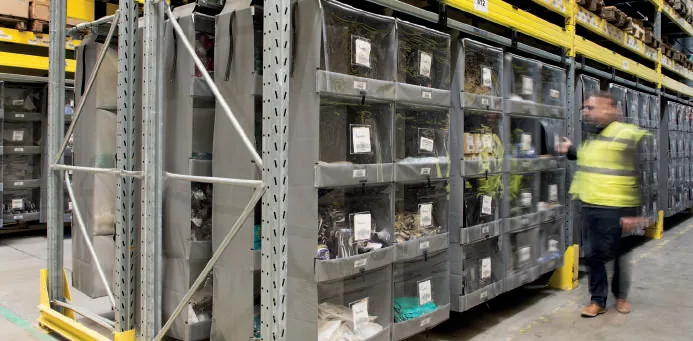
Up to 40%
more usable space (Leuven, 2013)
42%
less travel time (Leuven, 2013)
220 lb
per pocket column
4 rows
of pockets deep per bay
First question: are you short of floor, or short of pick faces?
Almost every space conversation starts the same way — the aisles are congested, stock is on the floor, and somebody has priced a mezzanine. Before that becomes a capital project, it is worth separating two very different shortages.
Short of floor means you need area: staging, assembly, offices, bulk pallets, seasonal overflow. No amount of clever slotting creates floor area.
Short of pick faces means you have plenty of building but not enough individual locations to put things. That is the shortage that pocket storage was designed for, and it is the one most often misdiagnosed as a building problem.
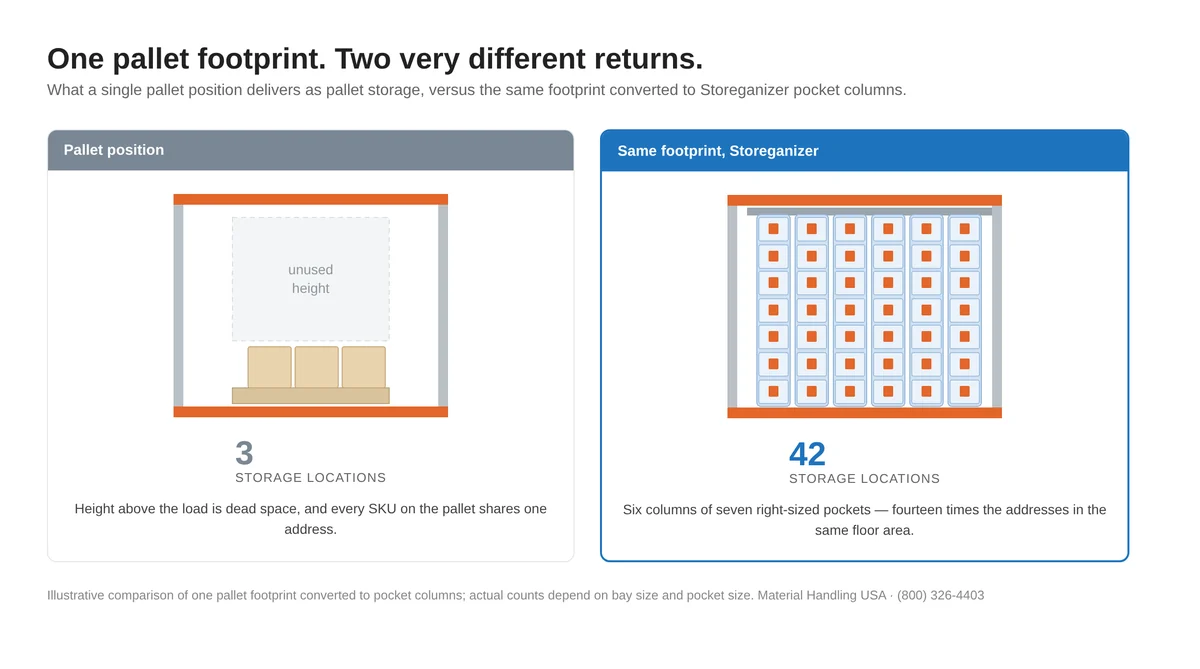
The tell is what is actually consuming your square footage. If a walk through the building shows long runs of shelving holding small, light, slow-moving items — each shelf half empty because a carton or a bin sets the pitch — then the building is not full, the slotting is full. A single selective pallet rack bay used that way commonly holds a handful of storage positions where it could hold dozens.
Storeganizer, a mezzanine and a building expansion, side by side
MH-USA sells all three kinds of answer — pocket storage, mezzanines and rack layouts — so this table is written the way we talk to customers on site rather than as a sales pitch for one of them.
| Storeganizer pockets | Mezzanine | Building expansion | |
|---|---|---|---|
| What it adds | Pick locations inside rack you already own | New usable floor area above the existing floor | New floor area, and new building envelope |
| Where the space comes from | Unused cube between and above beam levels | Clear height above the working floor | Land, yard or adjacent tenancy |
| Best suited to | Small, hand-pickable SKUs — slow and medium movers | Bulk stock, work areas, offices, assembly, overflow | Growth you expect to keep for years |
| Typical disruption | Bay by bay, inside a live operation | Contractor work above the operation; usually permitted | Construction project with design, permitting and downtime |
| Structural / code review | No new structure — columns hang in existing rack | Deck, stair, guardrail, egress and sprinkler review by your AHJ | Full building code, fire and site review |
| Reversible? | Yes — columns and rails can be moved or re-slotted | Partly — steel can be dismantled, at cost | No |
| Effect on picking | Shortens routes: many locations per linear foot of aisle | Adds vertical travel, lifts and often a second pick zone | Usually lengthens travel until layout is reworked |
The row that changes most decisions is the last one. Density and picking are not the same objective. A mezzanine stores more, but it usually adds vertical travel and a second pick zone to manage. Pocket columns keep everything on one level in the aisle you already walk, which is why the Leuven study measured a travel-time reduction alongside the space gain.
If you want the equipment-by-equipment version of this comparison — shelving, bins, carton flow, carousels and VLMs — that lives on our Storeganizer alternatives comparison.
When a mezzanine is the right answer
We would rather sell you the right thing twice than the wrong thing once, so: there are clear cases where a warehouse mezzanine beats any slotting exercise.
- You need area, not locations — kitting benches, returns processing, packing lines, an office, a break area.
- The inventory is bulky or heavy — cases, drums, tires, long goods, anything past hand-pick weight.
- You have clear height to spare and a long lease, so a structure you cannot easily move is still a good bet.
- You are consolidating two operations and genuinely need a second floor’s worth of everything.
Plan for the whole scope, not the steel
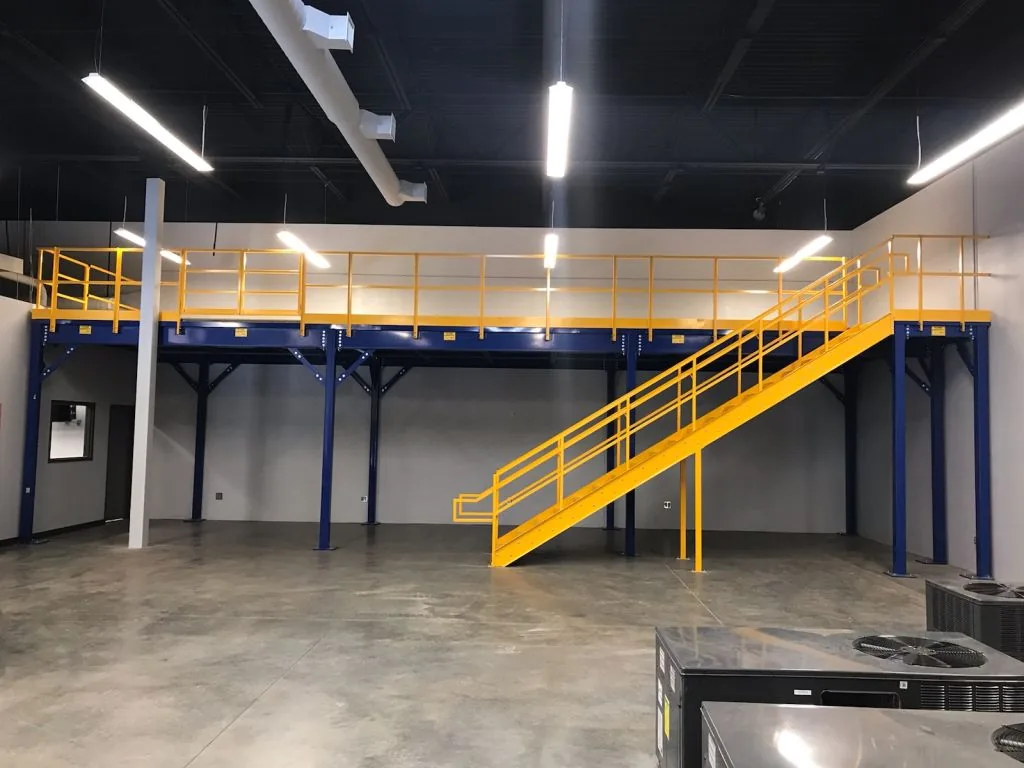
A mezzanine is a building project as much as an equipment purchase: deck, stair, guardrail, gates, lighting, sprinkler coverage, egress and permitting all belong in the budget, and the requirements are set by your authority having jurisdiction and your insurer — not by the steel supplier.
When a building expansion is the right answer
Expansion is the honest answer when the constraint is the building envelope itself. Dock doors, trailer yard, clear height, column spacing and floor flatness cannot be slotted around. If you are turning away volume because trucks queue, or because the building has no room for the equipment your process now needs, density work only buys time.
- Growth is structural and sustained, not seasonal — the extra volume will still be there in three years.
- The limiting factor is docks, yard, staging or clear height, not the number of pick locations.
- You own the site or hold a long lease, and capital is available for a construction timeline.
- You have already recovered the easy cube — otherwise you will expand and refill the same way, and be crowded again inside two years.
That last point is the one worth pausing on. Building square footage is the most expensive storage you will ever buy, and it is worth confirming that the cube you already pay rent on is genuinely full before you buy more of it. Our pallet rack space optimization page walks that audit bay by bay.
When pocket storage wins — and for which SKUs
Storeganizer is a textile pocket system from KTP conTeyor that hangs on a suspension rail inside a standard pallet rack bay. Nothing is built; the bay you already own becomes a wall of individually labelled locations.
The fit is decided by SKU profile, not by industry. Pockets earn their place when items are small, hand-pickable, and slow to medium moving — the long tail that eats shelving because every item needs its own location but very little of the volume.
Fast, high-volume movers usually stay where they are. Heavy items stay on shelving, in a pallet position or on a mezzanine. Each pocket is rated to 20 kg (44 lb) and a column to 100 kg (220 lb), which is the practical boundary of the conversation.
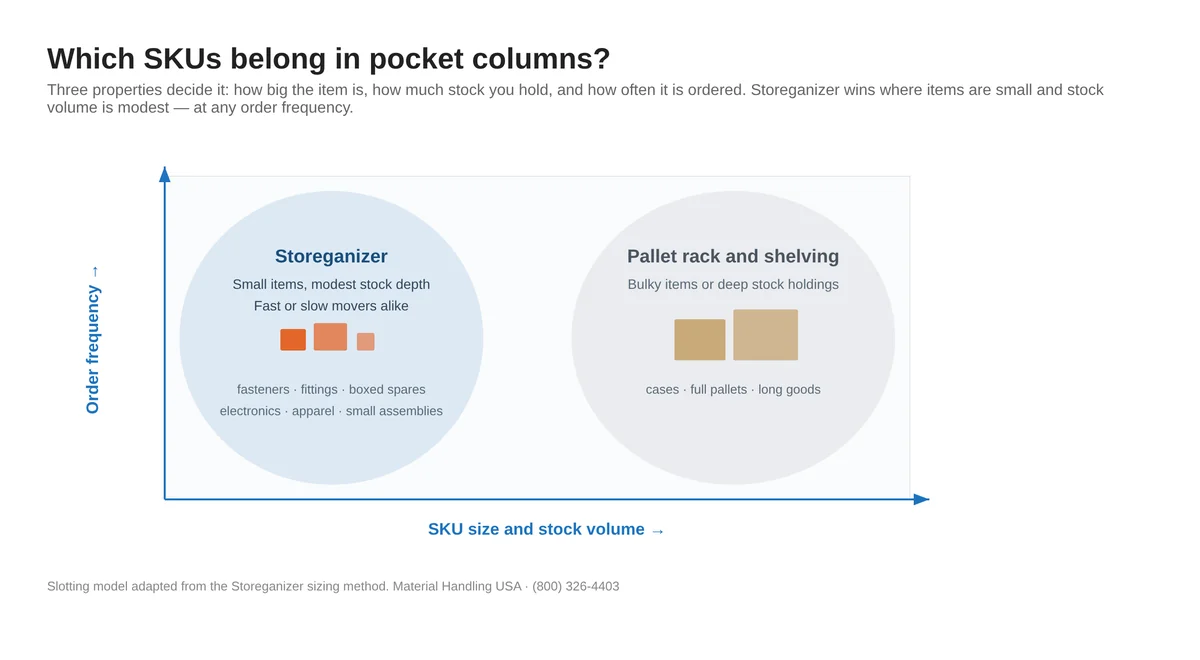
The five standard US pocket sizes
The US range runs from XS to XL, and the size mix is what determines how many pick locations a bay holds. Published pick locations per 96" bay run from 252 at the smallest size down to 28 at the largest — the full size table and textile grades are on the Storeganizer specifications page, which is the only place we publish dimensions.

Depth is the other half of the density story. Pockets can sit up to four rows deep in a bay, and the front columns roll aside by hand so a picker reaches the back rows without a ladder, a lift or a second aisle.
That is also why pocket storage tends to shorten pick routes rather than lengthen them: the locations stack up along the aisle face instead of spreading down it.
Model your own bays before you price a building
The Storeganizer Designer lets you set bay size and pocket mix and see how many pick locations you would gain — useful evidence to put next to a construction quote.
Request a Quote Open the Storeganizer Designer Call (800) 326-4403
What operations published after doing this
These are the manufacturer-documented results we are willing to stand behind, each attributed to the operation that reported it. Results depend entirely on SKU profile, so treat them as evidence that the approach works, not as a forecast for your site.
| Operation | What changed | Published result |
|---|---|---|
| Chalhoub Group | Static mezzanine shelving replaced with 46 bays of pockets, three rows deep | 8,611 sq ft of shelving consolidated into 1,335 sq ft; 25–30 to 60–80 pick lines per hour |
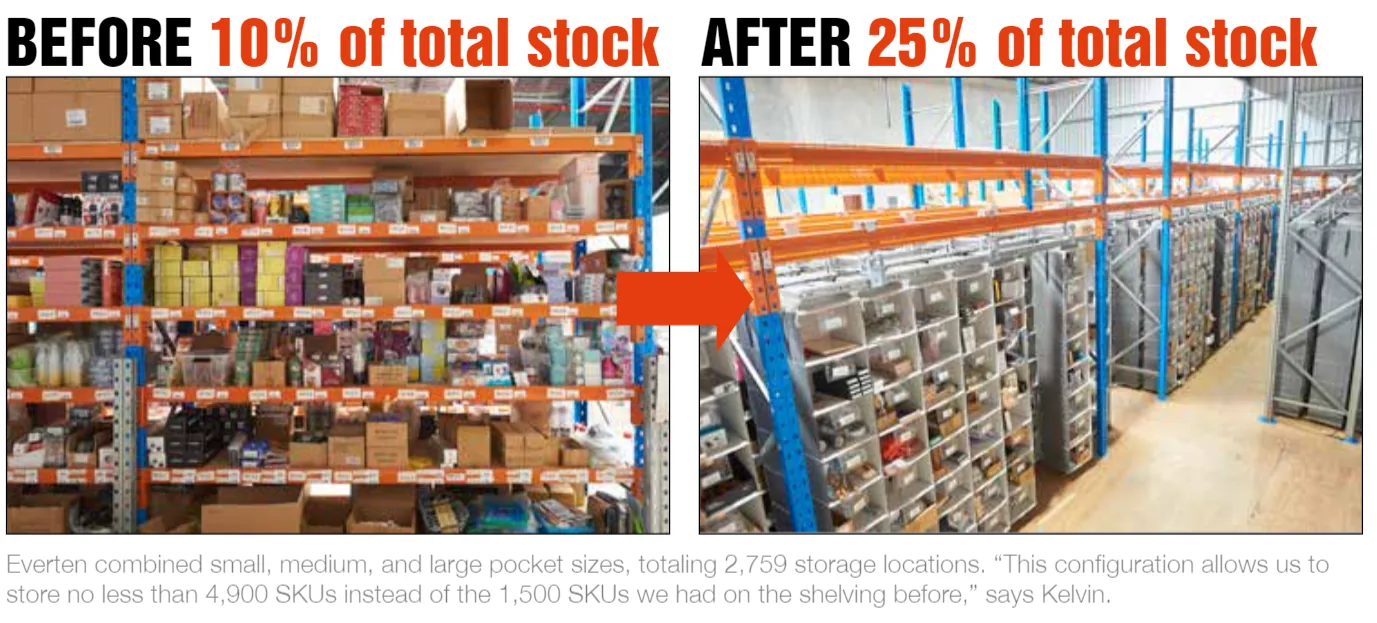
| Everten Supplies | 18 bays mixing small, medium and large pockets in an at-capacity warehouse | 2,759 locations in 50 m²; relocation postponed; mispicks down about 50% |
| DSV | 19 medium-pocket bays | Reported 50% space saving and 30% picking efficiency gain in the first weeks |
| Gates | Previous small-parts system replaced with pocket columns | Roughly 90% space saving against the previous system |
| CEVA Logistics, Daventry | 26 bays across five pocket sizes on a 90,000 sq ft site | Scattered small parts consolidated; picking accuracy reported at 100% |
Chalhoub is the clearest mezzanine comparison in the set: the stock came out of static mezzanine shelving and into 46 bays of pockets, three rows deep and six columns high, and pick rates rose as the footprint shrank.
Our own documented project is a US aerospace and defense parts room — read the aerospace parts storage case study, or browse every vetted result on the Storeganizer case studies index.

Is your rack a candidate? A short bay checklist
Before anything is quoted, these are the questions we ask — most of them you can answer from a walk and a tape measure.
- Bay width and depth, and the beam elevations you are willing to give up.
- Clear height above the top beam — wasted cube at the top of a bay is usually where the locations come from.
- Aisle access: is this a hand-pick aisle, or is a forklift working it?
- Item size and weight: does the heaviest item stay inside pocket and column ratings?
- Pick method: paper, scan-verified or voice — label and barcode holders are an option on the pocket face.
- How many SKUs are genuinely long tail, which is what sizes the job.
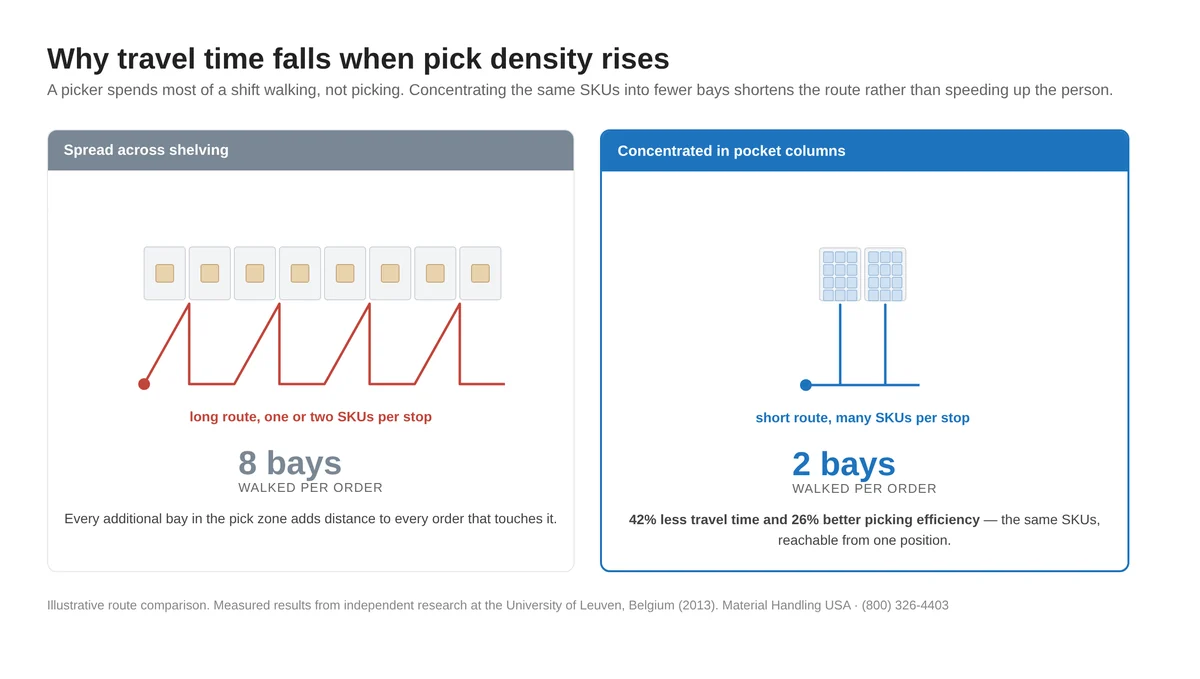
The number that decides it
Not square feet — pick locations per bay. Count what one of your bays holds today, then compare it with what the same bay holds as pocket columns. If the multiple is large across dozens of bays, the space you were about to build may already be inside the building.
How we decide with you
Define the shortage
Floor area, pick locations or throughput — in writing, before any equipment is discussed.
Audit the cube you own
Bay dimensions, beam elevations, wasted height, and how much of your shelving is holding long-tail items.
Slot on paper
Which SKUs belong in pockets, which stay on shelving, and which need a pallet position or a mezzanine level.
Price the real options
A pocket retrofit, a mezzanine, or a phased combination — with install scope and disruption spelled out, not just equipment.
Install without stopping work
Pocket retrofits go in bay by bay in a live operation; mezzanine work is scheduled around production.

Plenty of projects end up as a combination: a mezzanine for the bulky stock and work areas, pockets for the long tail that was crowding the aisles. Because we quote both, there is no incentive to force one answer.
Price drivers for the pocket side — bay count, size mix and textile grade — are set out on the Storeganizer cost and ROI page, and the system itself is explained on the Storeganizer hub.
Related reading
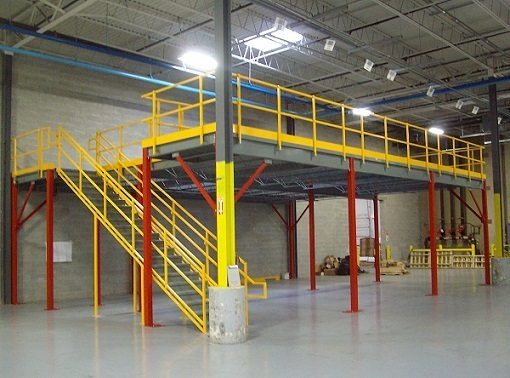 Warehouse MezzaninesWhen you need floor area rather than pick faces — decks, stairs, guardrail and install scope.
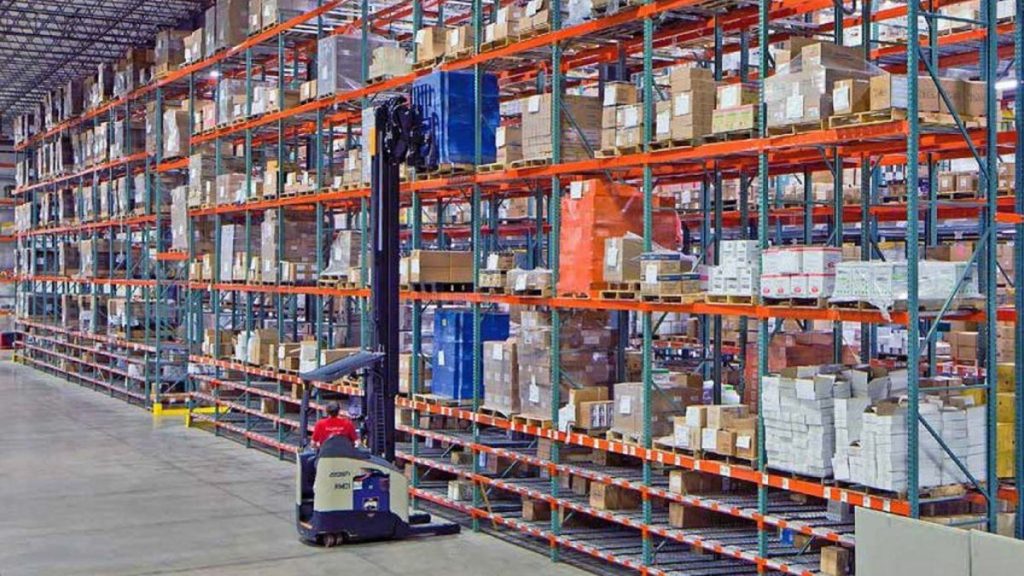 Pallet Rack SystemsCompare rack systems for your loads, forklifts and space — the structure pocket columns hang in.
 SKU Slotting and Rack-Space ROISlot by SKU size, stock volume and order frequency to get the most pick locations per bay.
 Storeganizer vs. Shelving, Bins, Flow Rack and VLMsAn honest equipment comparison from a distributor that sells all of them.
Frequently asked questions
Is Storeganizer a replacement for a mezzanine?
How much space can pocket storage actually give back?
Do I need a building permit for Storeganizer?
What weight can a pocket and a column hold?
Can we keep using the rack we already own?
What does it cost compared with building?
Find out whether you need a building or a better slotting plan
Send us your bay dimensions and a list of your slow-moving SKUs and we will tell you honestly which of the three answers fits — or model it yourself in the Storeganizer Designer. Call (800) 326-4403.