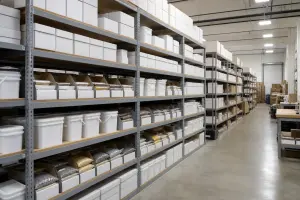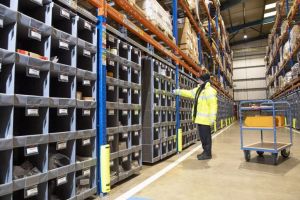
A US warehouse can lose an entire aisle to fasteners, fittings, electrical parts, and service items that each need only a small pick face. Storeganizer small parts storage uses vertical pockets to concentrate those SKUs in existing rack space, while keeping locations visible and manually accessible. The right choice depends on part size, weight, velocity, bay dimensions, and replenishment flow.
What Storeganizer Small Parts Storage Is
A Storeganizer bay fits a warehouse or production cell with many small components and limited usable pick-face space. It is a high-density storage system founded in 2012 and supported by Belgium-based conTeyor, according to Material Handling Industry's member profile. The decision still depends on part weight, pocket size, bay height, replenishment method, and the labor required to reach each location.
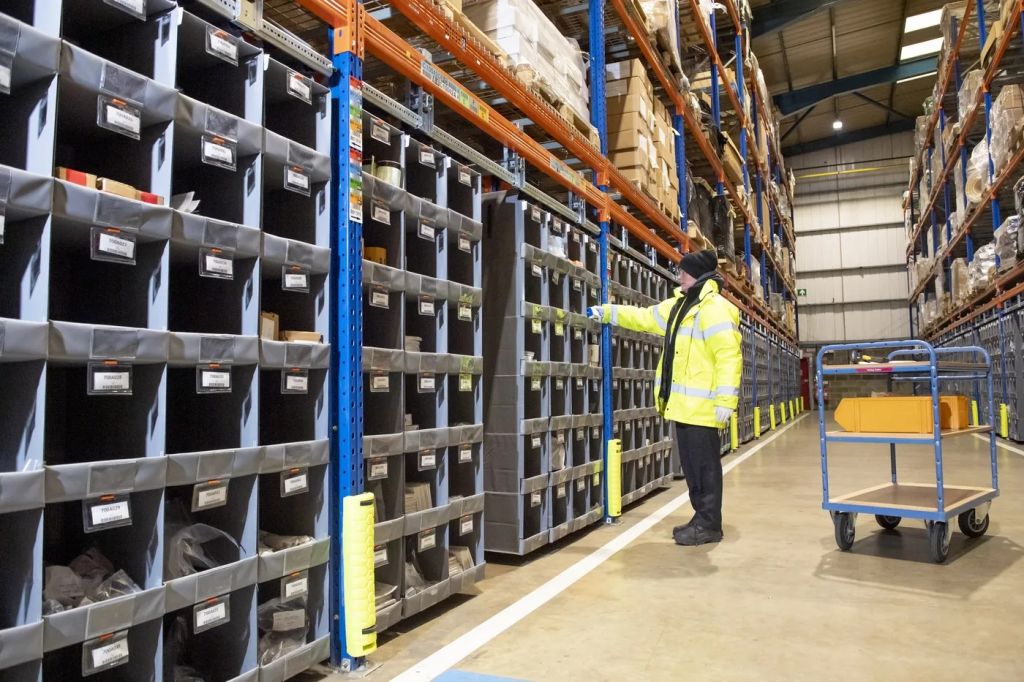
The system suspends columns of pockets inside a steel bay. Each pocket provides a defined pick face for one SKU or a controlled group of related items. Textile pockets suit light and medium small parts. Rigid pockets and load-rated frames address heavier or more demanding applications, with a corresponding effect on specification and cost.
A buyer can describe the operating principle this way: Storeganizer is vertical pocketed storage that compresses small-parts inventory into a smaller footprint while keeping each SKU at a single, fast pick face.

What the capacity looks like
Bay capacity provides a useful first screening test. A 96-inch-high bay can hold 252 extra-small pockets or 126 small pockets, while a 144-inch bay can hold 396 extra-small pockets or 198 small pockets, based on specifications published by Material Handling USA.
One German manufacturer expanded to 2,759 storage locations and stored about 4,000 SKUs in space that previously held roughly 1,000 items on shelving, producing a fourfold SKU density improvement in that installation. The result does not transfer automatically to every building. It shows why SKU dimensions, access frequency, and pocket allocation must be checked before approving a layout.
The system also has a research basis. A University of Leuven study cited by MHI reported 40% more usable storage space, 42% less operator travel, and a 26% gain in picking efficiency compared with conventional rack-and-shelf storage.
For the mechanical sequence, review how Storeganizer works, then check the bay envelope, access height, and replenishment path against the existing shelving.
How Storeganizer Compares to Other Small Parts Storage Options
The right format depends on the work being done at the location. Storeganizer suits visible, hand-picked small parts. Drawer cabinets contain heavier components, while a vertical lift module adds controlled, goods-to-person retrieval at a higher capital and service burden.
| Storage Format | Density | Pick Time | Best-Fit SKUs | Primary Cost Driver |
|---|---|---|---|---|
| Storeganizer pockets | High for small, light parts. A 96-inch bay can hold 252 extra-small or 126 small pockets | Direct manual access, with no powered retrieval step | Fasteners, fittings, MRO parts, electrical components, service items | Bay count, pocket mix, frame rating, accessories, freight, installation |
| Shelf bins | Flexible, but unused space often remains above and around containers | Fast for nearby items, slower when locations are spread across shelving | Mixed small parts, changing assortments, low setup budgets | Shelving, bins, labels, and floor footprint |
| Drawer cabinets | Dense and organized, but each cabinet needs front clearance | Direct access, with drawer opening and closing | Dense hardware, tools, parts needing containment | Steel construction, drawer size, dividers, load rating |
| Mobile shelving | Can store the same capacity as static shelving in half the floor space, or twice the storage in the same footprint, according to Wolter's mobile shelving guidance | Access requires opening an aisle or moving a carriage | Low to medium velocity inventory with strong footprint pressure | Carriages, tracks, drive systems, floor preparation |
| Vertical lift module | Very high density and controlled retrieval | Automated presentation, but dependent on machine cycle and software | High-value or controlled parts, compact inventory, goods-to-person workflows | Machine, controls, software, service, building height |
A drawer cabinet is often the safer choice for dense hardware or tools that exceed pocket limits. Published industrial drawer cabinet specifications describe heavy-duty steel drawers rated for loads up to 400 pounds per drawer. That load capability comes with front-clearance requirements and a drawer-opening motion that Storeganizer avoids.
Storeganizer sits between open shelving and automated storage. It works well where operators need many small SKUs in direct view and can pick them manually without a retrieval cycle. Its limits are equally practical: full cases, pallets, long material, very heavy parts, and inventory requiring locked or enclosed protection belong in another format.
Floor pressure can justify mobile shelving, but the carriage must open an aisle before access. A vertical lift module saves floor space and controls presentation, yet its cycle time, software, maintenance, and building-height requirements affect the business case. See how these trade-offs play out in our comparison of Kardex carousel alternatives, and compare the format trade-offs with the Storeganizer alternatives comparison before fixing the equipment type.
Use movement data rather than appearance to choose. Hybrid BI inventory management can connect SKU demand, replenishment activity, and storage decisions. The layout should then be judged by pick frequency, part weight, package size, access method, and the labor required to replenish each location.
How to Size and Specify Your Storeganizer Layout
A good layout starts with the parts, not the catalog. Collect the following information before requesting a quote.

-
Build the SKU list. Record the part number, unit of issue, average weekly picks, dimensions, weight per piece, case dimensions, and case weight. Include the largest package operators will replenish.
-
Group by velocity. Use A, B, and C tiers to separate frequent picks from occasional picks. Place high-frequency items in the comfortable working zone, while slower items can occupy less convenient positions.
-
Measure the installation envelope. Capture clear height, bay width, depth, columns, sprinkler locations, lighting, obstructions, and equipment paths. If a lift truck or cart serves the area, record its turning and approach requirements.
-
Match pockets to the package. Select the smallest pocket that accepts the part and its packaging without forcing operators to crush, overfill, or dig through inventory. A pocket that looks efficient on paper can fail if replenishment stock won't fit.
-
Confirm safety and facility requirements. Review aisle access against OSHA's material storage requirements, along with local fire protection and building requirements. Your engineer or authority having jurisdiction may require additional review.
-
Test the configuration. Use the STOREGANIZER Designer to test bay height, pocket mix, location count, and layout assumptions before releasing the order.
Practical rule: Measure the part envelope, the package envelope, and the replenishment envelope. The largest of those three controls the pocket choice.
What Drives the Cost and Lead Time of a Storeganizer System
Storeganizer pricing depends on the complete installed configuration, not just on the number of bays. Bay quantity, pocket dimensions, frame rating, textile selection, labels, dividers, back panels, freight, and installation all affect the final quote.
A larger project can spread fabrication and freight across more locations, but custom pocket positions and accessories can add schedule complexity. Nonstandard colors, unusual depths, integrated lighting, or power and data channels also require more coordination than a standard manual configuration.
| Driver | Impact on Unit Cost | Impact on Lead Time | Buyer Action |
|---|---|---|---|
| Bay quantity | More frames and pockets, with project scale affecting the overall package | Fabrication and freight planning become more involved | Confirm the initial phase and future expansion plan |
| Pocket size and mix | Larger or heavier-duty pockets use more material | Custom combinations may require additional engineering | Provide actual part and case dimensions |
| Back panels and accessories | Labels, dividers, totes, lighting, and panels add components | Separate components may ship on different skids | List every required accessory before approval |
| Site conditions | Delivery restrictions and installation labor affect total installed cost | Restricted windows can change crew scheduling | Share dock, lift-gate, access, and shift requirements |
| Code and anchoring review | Engineering and compliance work can add professional services | Approval may affect the release date | Identify seismic, fire, and structural requirements early |
There's no honest universal price range without the bay count, configuration, delivery location, and installation scope. A small standard run usually has fewer variables than a large mixed-pocket project, while custom layouts and site work create a wider planning range. Treat any early figure as a planning estimate until the supplier confirms dimensions, freight, installation, and site conditions in writing.
For the financial side, see Storeganizer cost and ROI. Starting the layout earlier can help avoid a later redesign, especially when fabrication capacity, delivery windows, or installation crews are already committed to other projects.
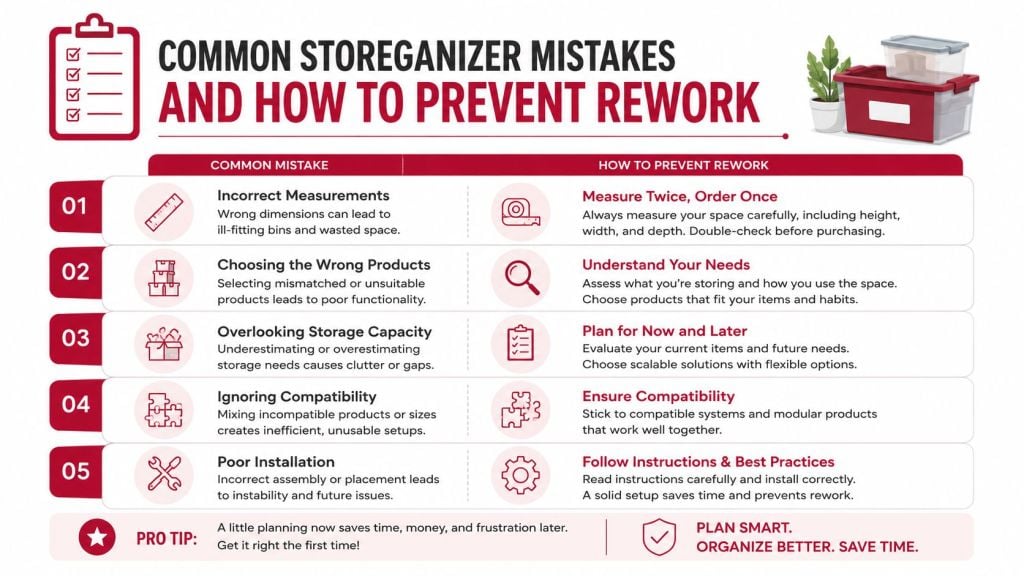
Common Storeganizer Mistakes and How to Prevent Rework
Most rework starts with a room measurement that never gets matched to the inventory. A team measures the bay, orders a convenient pocket size, and discovers during stocking that the case pack is taller, wider, or heavier than the design assumed.
The correction is simple but must happen before drilling or final approval. Measure the largest package, identify the unit of issue, and test the pick motion with a representative part.
Five installation checks that matter
-
Do not anchor to drywall. Attach frames and support points to suitable floor structure or wall studs where the design requires anchoring. Weak attachment can allow movement under repeated reach cycles and damage the surrounding finish.
-
Do not lock the back panel too early. Assign pockets and confirm the pick sequence before installing panels or accessories that make changes harder.
-
Keep fast movers in reach. High-velocity items belong in the working zone, not on the floor or overhead. Safety guidance recommends placing high-turn items between knee and elbow height and matching heavier loads to cart and shelf height, as described by Safe at Work California.
-
Mock up the pick face. Load a representative section, move the front pockets, and test replenishment. This catches awkward reach angles before the full run is installed.
-
Label before go-live. Each location needs a clear part number and, where applicable, a barcode. Waiting until after stocking encourages memory-based picking and makes the first inventory count harder.
The installer's best protection against a second visit is a paper slotting plan followed by a physical trial. That sequence costs less than moving a completed bay after the operators reject it.
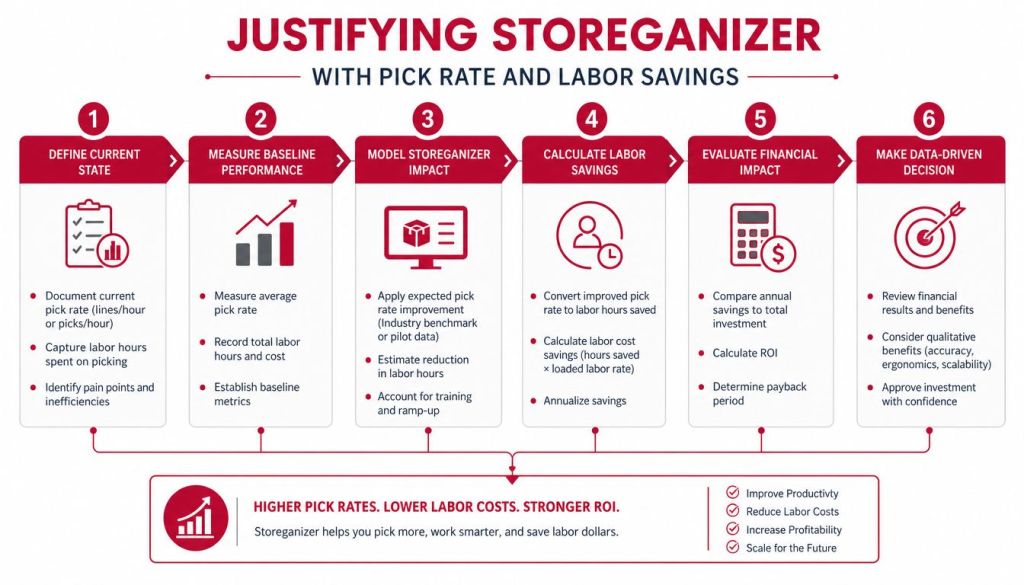
Justifying Storeganizer With Pick Rate and Labor Savings
A Storeganizer case should start with observed work, not a density claim. Measure pick time, accuracy, and travel distance in the existing area, then compare those results with a proposed pocket layout.
Use a stopwatch study covering representative picks. Record the time from the start of the line to confirmed selection, walking distance, and whether the operator chooses the correct part on the first attempt. Repeat the test in a mocked-up or pilot section with velocity-based slotting. Include replenishment activity if the proposed layout changes how stock reaches the pick face.
Calculate labor impact with:
Daily labor hours saved = daily picks × seconds saved per pick ÷ 3,600
Multiply the result by the fully loaded labor rate used by finance. Keep each benefit visible in the review:
- Direct labor: Shorter walks and faster part identification return operator time.
- Accuracy: Fewer mis-picks can reduce returns, credits, and investigation work. See our guide to improving warehouse inventory accuracy for more ways to track this.
- Training: Clear single-SKU locations can shorten the time a new operator needs to learn the area.
- Space: Released shelving or rack cube may delay expansion or support another use of the footprint.
- Inventory control: Labels and fixed locations simplify cycle counting.
An independent comparison reported 42% less operator travel and a 26% gain in picking efficiency, as cited by MHI. Treat those figures as planning evidence, not a promise. Your result will depend on slotting quality, pocket fill, replenishment frequency, and the distance to the next task.
Finance test: If the labor model works only with full pockets and an ideal pick path, it is too optimistic. Recalculate using realistic fill, replenishment, and training conditions.
FAQ: Storeganizer Small Parts Storage Questions Buyers Ask Most
Is Storeganizer suitable for heavy parts?
It works best for small and medium parts that operators can pick manually. Very heavy items, sharp exposed components, and products that need rigid containment may require a different storage format or a specially specified pocket and frame.
How many locations can one bay provide?
A 96-inch bay holds 252 extra-small pockets or 126 small pockets, while a 144-inch bay holds 396 extra-small or 198 small pockets, according to the published Storeganizer capacity information. Final capacity depends on the selected pocket mix and usable bay dimensions.
Does Storeganizer replace pallet rack?
Usually, it uses available rack space for small-parts pick faces rather than replacing pallet storage for full pallets. Full-case and pallet inventory still needs a format designed for those loads.
Can loose parts fall out?
Open pockets may need front stops, covers, or dividers when parts are small, slippery, or difficult to control. The correct option depends on the product and how operators replenish it.
What environments can use it?
Common applications include fasteners, fittings, electrical components, maintenance parts, repair kits, and small service inventory. Dust, oil, washdown, contamination control, or secure-storage requirements may change the material and enclosure specification.
How should buyers verify capacity?
Confirm bay height, width, depth, pocket pitch, load limits, packaging dimensions, and replenishment reserve. Pocket count alone doesn't prove that the stored inventory will fit safely.
How long does installation take?
The schedule depends on site readiness, bay quantity, custom pocket positions, delivery access, and installation scope. A confirmed schedule requires measured conditions and a defined configuration.
Design Your Storeganizer Layout and Request a Quote
Start with measured part envelopes, not catalog assumptions. For every storage profile, record length, width, height, orientation, unit weight, packaging method, average quantity, peak quantity, and replenishment quantity.
Then map the operating path. Mark the pick side, replenishment side, aisle, cart position, sprinkler clearance, lighting, and any forklift or lift access. A layout that makes picking easier but creates a difficult replenishment route can lose the expected labor benefit.
Your quote should identify the number and width of bays, pocket configuration, accessories, freight conditions, installation scope, and site constraints. Ask the supplier to state any seismic, anchoring, fire, or washdown assumptions so competing proposals can be compared on the same basis.
Use the free STOREGANIZER Designer to test a preliminary configuration, then submit the dimensions and SKU assumptions for review. The three decisions that move the project forward are the storage profile, the available envelope, and the ownership objective, whether that objective is capacity, pick speed, inventory control, or a defined balance.
Material Handling USA provides layout development, product sourcing, installation coordination, free designs, and free quotes for US projects. Buyers can request a quote, contact the team at Sales@MH-USA.com, or call (800) 326-4403 to review a measured Storeganizer plan before ordering.
Material Handling USA can help you configure Storeganizer small parts storage around actual SKUs, bay dimensions, replenishment needs, and site requirements. Visit Material Handling USA to use the design tools and request a free layout and quote, then call (800) 326-4403 if you want an engineer to review the configuration before fabrication and installation.
Design it yourself, then get a quote
Use our free online design tools to configure exactly what this article describes, then send the configuration to our team for pricing: