You're comparing carousel systems because the current unit stores parts well, but the next SKU, higher pick volume, or tighter software requirement may expose its limits. The right Kardex carousel alternative depends on item size, carrier load, ceiling height, throughput, integration, and code constraints. In many facilities, a vertical lift module is the practical next step. In others, a shuttle, miniload, or simpler carousel fits better.
Why Buyers Look Beyond the Kardex Carousel
A vertical carousel stores carriers on a continuous loop and brings a selected carrier to an operator opening. That design works well for consistent parts, moderate activity, and limited floor space. It becomes less attractive when the inventory profile changes faster than the machine can accommodate.
A common example is a parts room that handles many small fittings, then receives hose assemblies, cartons, or irregular maintenance items. The original carrier layout may still run, but the operator has to split one inventory family across several locations. That creates extra touches and weakens the value of automation.
Five constraints usually drive the search for alternatives:
- Carrier fit: Fixed carrier geometry can struggle with mixed totes, cartons, long parts, and fragile goods.
- Load balance: Heavy or unevenly distributed inventory can slow operation and increase mechanical stress.
- Pick demand: A single access point can become a bottleneck during replenishment waves or order consolidation.
- Ceiling use: A short building may not provide enough height to justify a tall vertical system.
- Controls integration: A system that doesn't communicate cleanly with the WMS, ERP, or WCS can force manual entries.
Practical rule: Choose the automation class after measuring the work, not after choosing a brand.
The broader AS/RS category is expanding. Grand View Research values the global market at USD 6.52 billion in 2024 and projects USD 10.31 billion by 2030, with an 8.0% CAGR from 2025 to 2030. That growth helps explain why buyers now compare carousels with VLMs, shuttles, and other software-controlled systems rather than treating a carousel as the default answer. Grand View Research's AS/RS market outlook provides useful market context, while rights-cleared robotics data can help teams organize the operational data needed for a more defensible technology decision.
The Seven Automation Classes That Compete With Carousels
There isn't one universal replacement for a Kardex carousel. These seven automation classes solve different combinations of storage density, item variability, labor access, and throughput.
-
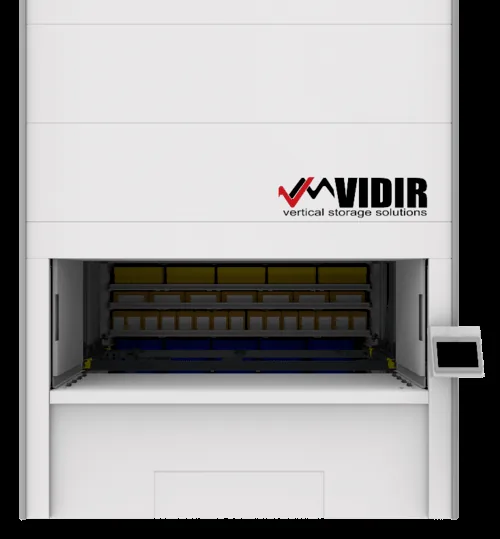
Vertical lift modules: Two storage columns surround a central extractor. The machine selects an individual tray and presents it to the operator. VLMs are usually the strongest fit for mixed SKU sizes, adjustable tray layouts, and ergonomic goods-to-person picking.
-
Vertical carousels: These remain a valid alternative when the inventory is consistent and activity is moderate. They can suit MRO rooms, records, and indirect parts where controlled access matters more than maximum throughput.
-
Horizontal carousels: Bins move around an oval track at operator level. Several units can work as a batch-picking pod, reducing travel for grouped orders.
-
Miniload AS/RS: Stacker cranes retrieve totes or trays from dense rack structures. This class fits controlled tote inventory and facilities that can support a larger controls and infrastructure project.
-
Unit-load AS/RS: Crane systems handle pallets, cases, or larger loads. They belong in high-volume distribution or manufacturing environments where pallet storage and retrieval drive the business case.
-
Bin shuttles and 3D shuttle systems: Robotic devices move bins through dense lanes or grids. They provide strong scalability, but the project needs careful software, fire protection, and maintenance planning.
-
Goods-to-person robotic cells: Mobile robots or cube-based systems bring storage locations to a workstation. These systems suit each-picking operations with changing order profiles, especially when the floor plan can support charging, workstations, and replenishment paths.
Material Handling USA also outlines the broader role of automated storage and retrieval systems. Vidir vertical storage solutions covers several of the equipment classes described below. The controls decision deserves equal attention. If transportation planning is part of the project, a resource on how to find the right TMS for your fleet can help separate warehouse storage requirements from fleet management requirements.
How to Size a Vertical Storage System Before You Quote
Quotes go wrong when buyers provide a rough room dimension and an average item weight. An integrator needs the operating extremes, the building constraints, and the expected work pattern.
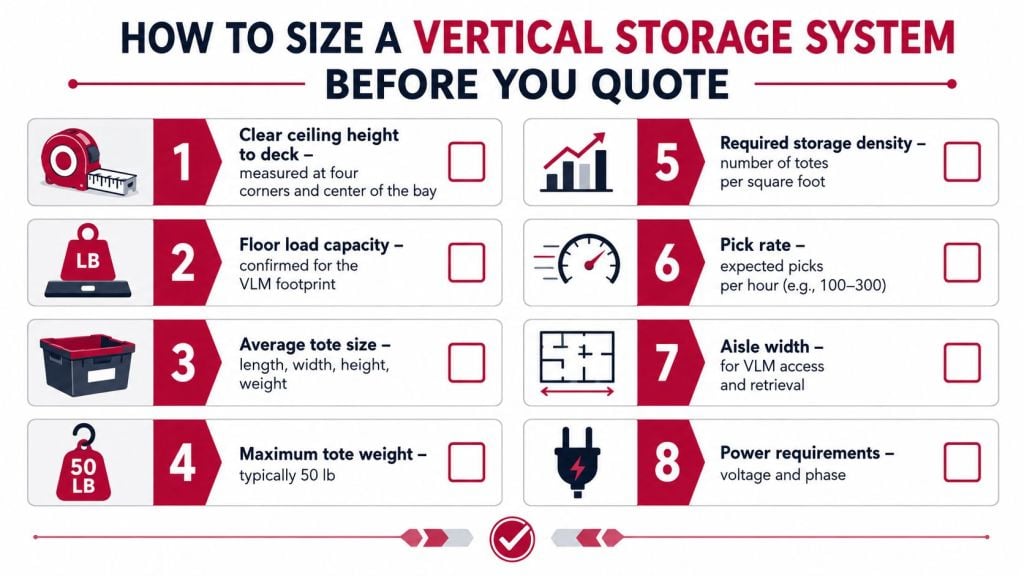
Collect these inputs before requesting a design:
-
Clear height: Measure from finished floor to the lowest obstruction. Check all four corners and the center of the proposed bay. Include beams, ductwork, lights, sprinkler mains, and maintenance access.
-
Footprint: Record the usable length and depth, then mark the operator position, service access, nearby aisles, doors, columns, and egress routes.
-
SKU profile: List active SKUs and identify the items that account for the most picks. A system for uniform fasteners needs a different tray strategy than one for cartons and irregular components.
-
Container dimensions: Capture length, width, height, and weight for each tote or bin family. Don't size from the largest outside carton if the actual stored unit is smaller.
-
Peak demand: Provide peak picks per hour by shift. Daily averages hide the short periods that create queues.
-
Load distribution: Record average load, high-percentile load, and the heaviest single item. Note whether operators place mixed weights on one tray.
-
Fire protection: Identify the sprinkler type, rack or in-rack coverage, and the available clearance. The fire protection engineer must review the final envelope.
-
Seismic design: Obtain the building's seismic design information from the drawings or structural engineer. Mountain West projects often need anchorage and equipment calculations before release.
Planning ranges may help frame the conversation. The specified planning notes for this project use VLM heights from 12 to 39 feet, carrier depths from 17 to 30 inches, and pick rates from 30 to 120 picks per hour, depending on extractor position and configuration. Treat those as design ranges, not guaranteed performance.
Kardex Carousel Alternatives Compared Side by Side
The table below is a screening tool, not a substitute for engineered layout work. Capacity, height, speed, and installed cost vary with manufacturer, controls, building work, fire protection, and installation conditions.
| Alternative | Typical height | Capacity range | Pick rate | Best-fit use case | Seismic code note | Install cost band |
|---|---|---|---|---|---|---|
| VLM | 12 to 40 ft | 30,000 to 120,000 lb total system range | Moderate to high | Mixed parts and tote storage | Anchorage and equipment review may apply under IBC and ASCE 7 | Mid to high |
| Vertical carousel | Under 14 ft in constrained applications | 1,500 to 4,500 lb per carrier | Moderate | Consistent MRO and records | Review anchorage, balance, and building movement | Low to mid |
| Horizontal carousel | Site dependent | 50 to 400 SKUs per pod | High in batch work | Grouped order picking | Review anchorage and aisle layout | Mid |
| Miniload AS/RS | Up to 60 ft | Tote and tray based | High | Dense, controlled tote inventory | Structural, seismic, and fire review required | High |
| Unit-load shuttle or crane AS/RS | 100 ft and up | Pallet and case based | High | Full-case and pallet operations | Major structural and seismic coordination | High to very high |
| Bin-stack mini loader | Under 16 ft | Bin based | Moderate | Line-side kitting and compact parts | Confirm anchorage and floor loading | Mid |
| Cube storage robotics | Project specific | Tote or bin based | High | Flexible each-picking cells | Review grid, floor, fire, and egress conditions | High |
Code review should include the adopted IBC edition, applicable ASCE 7 seismic criteria, sprinkler design, and access routes. For taller equipment, sprinkler clearances and the building's occupancy classification can change the usable height. A buyer comparing storage ideas should also consider how the available room is used, including cost-effective basement storage ideas when a facility has constrained expansion options.
For a focused vertical comparison, review vertical carousel versus vertical lift module configurations. The practical question is not which table row looks most advanced. It's which system stores the actual item profile without creating a new labor or maintenance bottleneck.
Which Alternative Wins for Your Throughput and Floor Plan
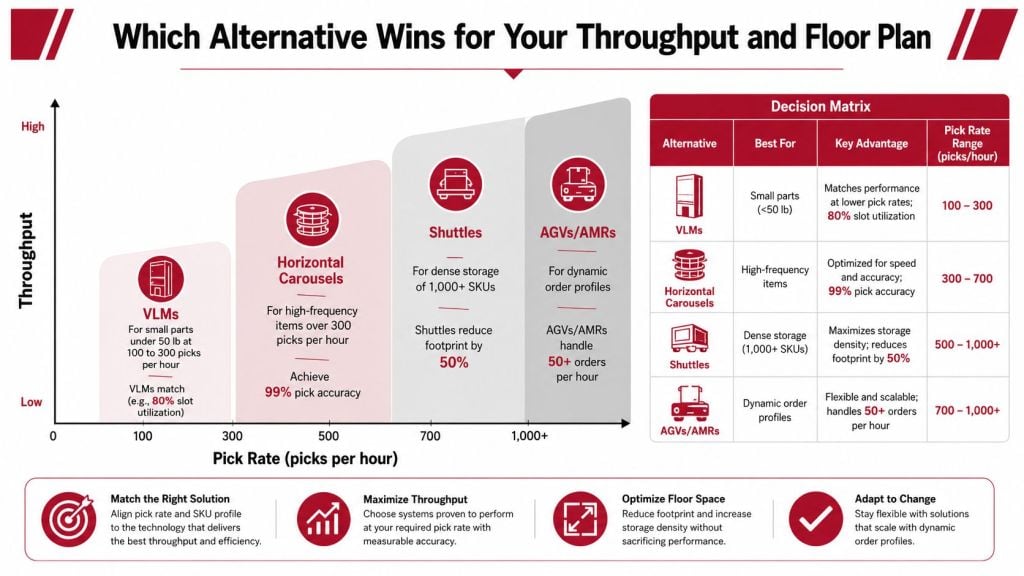
Start with the item, then the pick rate, then the floor plan. Buyers often reverse that order because the available room feels like the most obvious constraint. A narrow room matters, but it doesn't tell you whether the stored goods belong in trays, bins, shuttles, or pallet locations.
For small parts and totes under 50 pounds, the planning framework calls for VLMs and miniloads when demand is between 100 and 300 picks per hour. Higher-frequency work above 300 picks per hour may favor horizontal carousels or shuttle systems, provided the operation can feed and clear the workstations fast enough. Those thresholds are screening inputs, not promises, and should be tested against order lines, replenishment, travel, and operator count.
Medium totes and tote-in-carton work may fit tote shuttles in structures from 40 to 60 feet when the facility has the height and the volume to justify the controls project. Full-case and pallet work generally belongs in unit-load or crane-based cube storage, rather than a small vertical machine.
Use floor and building rules as filters:
- Short ceiling: A vertical carousel can remain practical where clear height is capped under 14 feet.
- Mid-height building: VLMs often deserve review where usable height falls between 18 and 36 feet.
- Tall storage envelope: Shuttles or cube storage merit evaluation above 40 feet, subject to fire and structural design.
- Dense SKU profile: A high number of active SKUs favors adjustable trays, bins, or dynamic storage locations.
- Batch labor model: Horizontal carousels can work well when several units feed one picking cell.
- Integration-led operation: Choose the controls architecture that communicates with the WMS, not the logo on the cabinet.
A useful benchmark from independent review research reports AS/RS implementations raising overall productivity by around 50% and increasing order-fulfillment capacity by about 15%. The same review cites picking-cycle performance improving from 42.86% to 65.59% after implementation, but results depend heavily on layout, software, SKU discipline, and operator workflow. The comparative VLM and AS/RS review is useful for understanding why extractor-based systems can reduce travel and operator dwell time.
Where Each Alternative Performs Best in the Real World
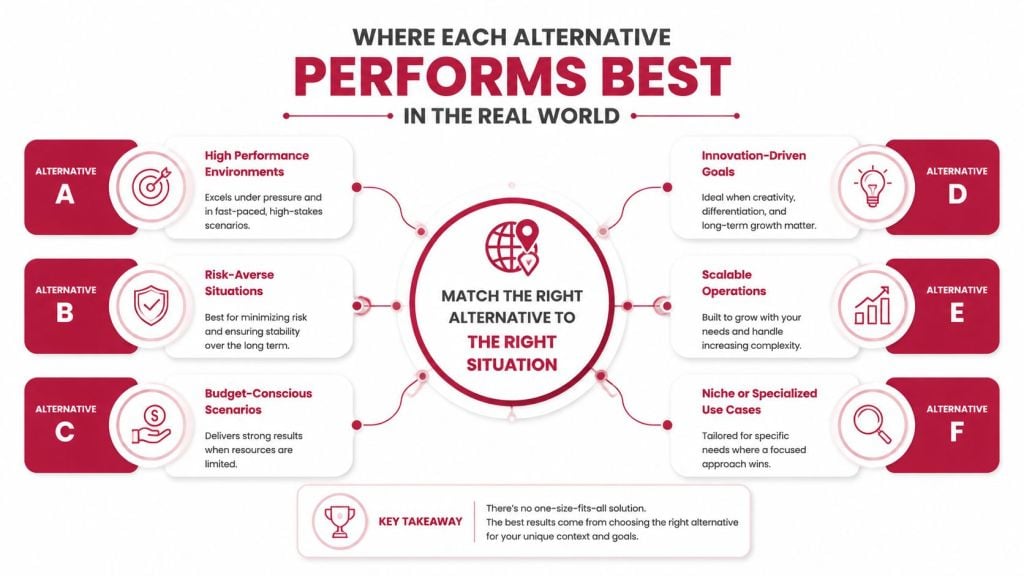
The right system changes with the work around it.
In aerospace, heavy industry, and MRO, VLMs often fit indirect parts rooms because the inventory includes many SKUs with uneven demand. Adjustable trays and controlled access help organize fittings, tools, electrical parts, and maintenance kits without sending technicians through long shelving aisles. The KPI is usually retrieval time and inventory control, not maximum pallet throughput.
Pharmaceutical and healthcare distribution needs a more controlled design. A miniload AS/RS can suit tote-based storage when temperature zones, validation, traceability, and WMS interfaces drive the specification. The project team must define the software validation and environmental requirements before selecting equipment.
Evidence rooms and records centers often value security and auditability over raw speed. A vertical carousel can be a good fit when chain-of-custody controls, access logging, and compact storage matter more than handling a wide range of carton sizes.

Retail back rooms may benefit from horizontal carousels when several operators batch orders at a common work area. E-commerce operations tend to look toward shuttles paired with mobile robots and ergonomic put walls when each-picking volume and order variability are central.
Manufacturing line-side kitting has a different need. A bin-stack system coupled to replenishment or conveyor flow can keep components close to the line and support takt-driven work without installing a large distribution-center system.
Independent comparative research finds vertical carousels strong ergonomically, but not usually the top choice for throughput or flexibility. The same Chalmers study identifies vertical buffer modules and AutoStore as especially ergonomic because travel is eliminated, while horizontal carousels can be less ergonomic when goods aren't presented at a comfortable picking position. That distinction matters when labor hours per order, reach frequency, and operator fatigue are part of the business case.
Common Mistakes When Switching Off a Kardex Carousel
Retrofits fail in predictable ways. The most common is a ceiling measurement taken from a leasing plan instead of a field survey. A beam, sprinkler cross-main, light fixture, or service clearance can remove the height needed for the proposed unit.
Seismic design is another late-stage problem. Equipment anchorage and bracing should be reviewed with the building information, especially in Mountain West facilities. The structural engineer, fire protection engineer, controls team, and integrator need the same layout revision.
The pre-shipment checklist
Before equipment release, confirm:
- Ceiling scan: Measure clear height and map every overhead obstruction.
- Floor review: Confirm slab condition, floor loading, anchors, and equipment placement.
- Seismic calculation: Coordinate the equipment anchorage with the building's design criteria.
- Egress drawing: Check operator access, doors, exit paths, and powered industrial truck movement against applicable OSHA requirements.
- Fire protection plan: Confirm sprinkler coverage and required clearances with the fire protection designer.
- Software map: Document item master fields, location logic, permissions, transactions, and error handling.
- Throughput simulation: Test peak demand, replenishment, batching, operator count, and workstation queues.
- Controls signoff: Have the integrator's controls engineer approve the final interface and operating sequence.
Don't order a VLM before confirming tray dimensions, peak load, and actual pick demand. A machine can meet its mechanical specification and still fail the operation because the bins are wrong, the access bay is poorly placed, or the software leaves operators with duplicate work.
Installer's observation: The cheapest redesign is the one completed before the purchase order, when a drawing can still change without moving steel, utilities, or people.
Costs and Lead Times for Carousel Alternatives
Installed cost isn't a single equipment number. It includes the machine, controls, delivery, rigging, electrical work, floor preparation, software integration, training, permits, fire protection changes, and installation labor. A compact vertical carousel may have a lower project cost than a VLM, while a shuttle or crane system can require a much larger engineering and infrastructure commitment.
The main cost drivers are:
- Equipment envelope: Height, width, depth, tray count, carrier size, and load rating.
- Controls scope: Standalone controls cost less to integrate than a system connected to WMS, ERP, WCS, scanners, or robotics.
- Building changes: Relocated lights, ductwork, sprinkler piping, slab repairs, and structural reinforcement add work.
- Site access: Tight doors, occupied facilities, rooftop obstructions, and restricted delivery windows affect installation.
- Compliance: Seismic calculations, stamped drawings, permits, inspections, and fire protection coordination change the project scope.
- Service requirements: Remote support, spare parts, preventive maintenance, and response expectations affect lifecycle value.
Lead time also depends on the design stage. A standard configuration may move faster than a custom machine with unusual trays, special finishes, controls integration, or building modifications. Current demand for automated storage can also affect engineering and installation schedules, so early layout validation helps protect the target window without forcing a poor equipment choice.
Material Handling USA provides free layouts and quotes for projects that need a design rather than a product-only price. Buyers can compare competitive pricing, quality materials, delivery options, and installation scope in one review. A quote should show assumptions clearly, including what is included and excluded.
Frequently Asked Questions About Kardex Carousel Alternatives
What are the main Kardex carousel alternatives?
The main classes are VLMs, vertical and horizontal carousels, miniload AS/RS, unit-load systems, bin shuttles, cube storage robotics, and goods-to-person cells. Selection should start with item profile, throughput, clear ceiling height, seismic requirements, and labor model, not brand name. For a direct Kardex Remstar and Vidir comparison, review the Kardex Remstar vs. Vidir vertical carousel comparison.
Is a VLM better than a Kardex carousel?
A VLM generally suits mixed SKU dimensions, adjustable tray layouts, and controlled goods-to-person presentation. A vertical carousel can fit consistent parts, moderate demand, and shorter buildings. Confirm tray load, carrier dimensions, usable height, and required picks before choosing. A taller VLM may add capacity but can require more building, fire protection, and seismic coordination.
What should I measure before requesting a quote?
Record clear ceiling height, usable footprint, obstructions, doors, aisles, egress paths, SKU dimensions, tote sizes, load weights, peak picks per hour, fire protection details, seismic criteria, and software requirements. Include replenishment and maintenance access, because those conditions can change the workable layout.
Are horizontal carousels good for high-volume picking?
They can support batch picking when several units serve a shared workstation. Performance depends on order grouping, operator balance, replenishment timing, and whether the presentation area clears quickly. They need enough floor length and operator access, so a high pick rate alone does not establish fit.
When should I consider a shuttle system?
Consider a shuttle when tote density, order volume, and planned expansion justify a larger automated installation. Compared with one vertical machine, it brings more controls, fire protection, structural coordination, maintenance planning, and commissioning work.
Can these systems integrate with a WMS?
Many can connect to WMS, ERP, WCS, scanners, and warehouse robotics. Define transaction maps, API responsibilities, permissions, fault recovery, testing, and ownership before quoting. Integration scope often determines whether a machine works as intended in the labor model.
How does seismic design affect vertical storage?
Seismic criteria can change anchorage, bracing, equipment calculations, slab preparation, and inspections. The integrator and structural engineer should review the machine against the adopted building code and project design criteria before release. This review is especially important where ceiling height and equipment mass constrain the layout.
Configure Your Alternative and Request a Free Layout
Start with a real configuration, not a generic product page. Open the Automated Vertical Storage Designer and enter the clear ceiling height, available footprint, average bin size, peak unit load, and target pick rate. Use the resulting layout as a working document for a VLM, vertical carousel, bin system, or broader AS/RS discussion.
Next, submit the layout, capacity assumptions, and operating profile for a code-aware review. The design team should verify building height, sprinkler coordination, seismic anchorage, operator access, egress, electrical service, and the WMS or ERP controls scope. Free layouts and designs with no obligation make it easier to compare alternatives before committing capital.
Finally, schedule a design call to test the assumptions. Ask the engineer to review peak picks, replenishment, operator count, workstation position, maintenance access, delivery conditions, and the installation sequence. Material Handling USA serves the Mountain West, including Utah, Idaho, Colorado, Nevada, and Arizona, as well as projects across the United States, with in-house installation support and nationwide quoting.
Call (800) 326-4403, email Sales@MH-USA.com, or use the online form to Request a Quote. Planning earlier can improve design and delivery coordination, especially when a project includes permits, seismic review, fire protection changes, or software integration.
Material Handling USA can compare VLMs, vertical carousels, shuttles, and related storage systems around your actual item profile and floor plan. Configure a solution through the free design tools, then visit Material Handling USA to request a free layout, free quote, and practical installation plan.
Design it yourself, then get a quote
Use our free online design tools to configure exactly what this article describes, then send the configuration to our team for pricing: