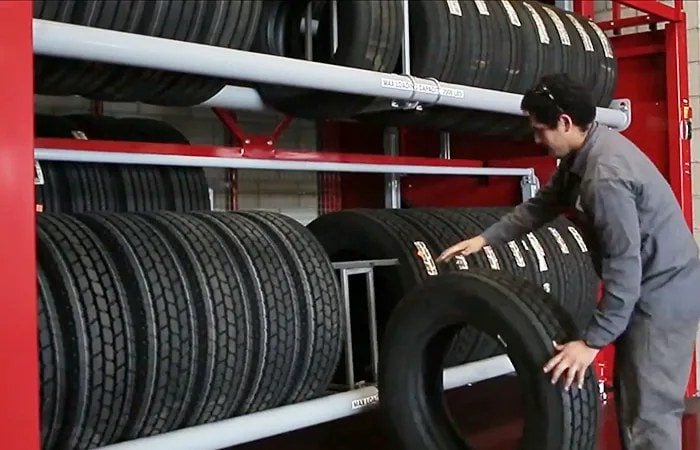
A tire carousel is a powered vertical storage machine. It holds tires on a loop of carriers, uses the height of the room instead of floor space, and brings the selected carrier down to the operator. This guide explains how tire carousels work, which type fits a small back-of-shop room, a dealership, or a heavy-duty aviation or fleet shop, how to size one, and what drives the installed cost. It can be a strong fit for dealerships, service centers, fleet shops, and tire warehouses with limited floor space. The key is to size the machine for the real tire mix and the building, not a brochure maximum.
Quick buyer checklist
- Count tires by diameter and width, including seasonal peaks.
- Identify the largest tire and note whether tires are stored with rims.
- Measure clear height to the lowest beam, light, duct, or sprinkler component.
- Record the floor area, approach aisle, doors, turns, and delivery route.
- Confirm slab, anchoring, electrical, permitting, and fire protection needs.
- Compare usable capacity and installed scope, not only tire count.
When Tire Carousel Storage Makes Sense

A carousel changes the storage pattern. Static racks spread tires across aisles and walls. A carousel uses building height and delivers a carrier to one access point. This can reduce walking and ladder use while making inventory easier to organize.
The best candidates have a repeatable tire assortment, enough clear height, and frequent picks from a limited floor area. A carousel may be a poor fit when the site lacks delivery access, suitable height, utility service, or a practical place for the operator zone. Very low-volume storage may also be simpler on fixed racks.
OSHA does not approve a specific tire carousel. Its general material-handling rule says aisles used by mechanical equipment need safe clearance and storage must remain stable and secure. Review OSHA 1910.176 as one planning reference, then have the local authority and project team review the actual installation.
How a Vertical Tire Carousel Works
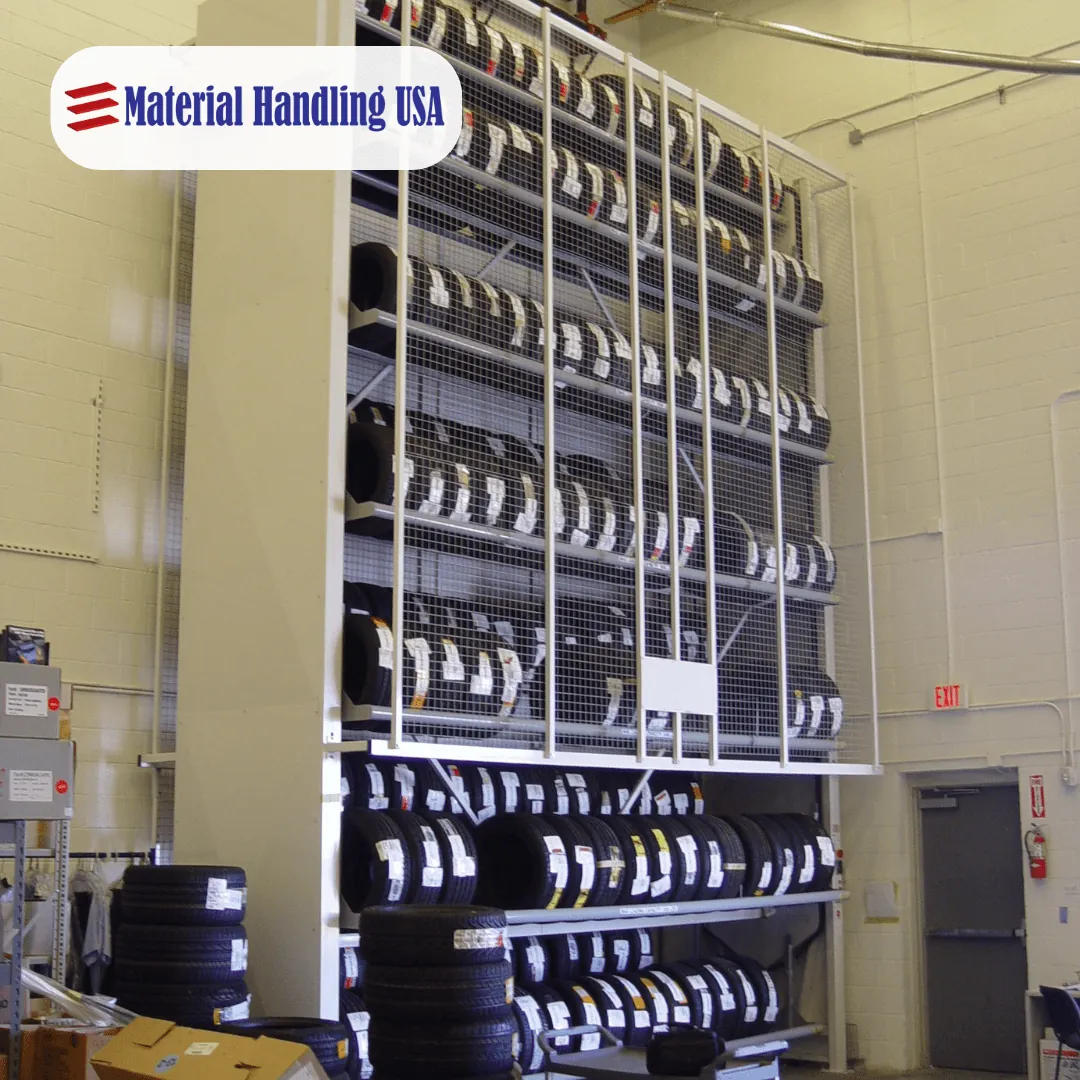
The machine stores tires on carriers connected in a vertical loop. A drive rotates the carriers until the selected location reaches the access opening. The operator then loads or retrieves tires from that opening.
This is a goods-to-person process. The machine moves the inventory instead of sending a worker to an upper rack level. OSHA’s ergonomics resources note that material handling can contribute to muscle strains and low-back injuries. Bringing work to a consistent access point can help reduce some reaching and climbing, but safe results still depend on training, load limits, guarding, and work practices. See the neutral OSHA ergonomics overview.
Main parts to confirm
- Carriers: The supports that hold each row of tires.
- Drive and controls: The powered system that moves a selected carrier to the opening.
- Access opening: The floor-level point used for loading and picking.
- Guarding and safety devices: Features that limit access to moving parts. Exact features vary by configuration.
- Frame and anchors: The structure and site-specific attachment that keep the unit stable.
Tire Carousel Types: Compact, Standard, and Heavy Duty
Tire carousels are built in families based on the largest tire they can hold and the height of the room. The right family depends on three things: the biggest tire in your inventory, the clear height you have, and the floor area you can give up. The table below is a fit guide, not a spec sheet. Exact dimensions and counts come from the manufacturer data for the quoted unit.
| Carousel type | Typical fit | What to check first |
|---|---|---|
| Compact tire carousel | Small tire shops, quick-lane bays, and back-of-shop rooms with limited floor space and a modest passenger-tire mix | Clear height, door and hallway route for delivery, operator zone in front of the opening |
| Standard tire carousel | Dealership parts rooms, service centers, and tire warehouses storing passenger, SUV, and light-truck tires, with or without rims | Tire count by size, seasonal peaks, and whether one tall unit or two shorter units fits better |
| Heavy duty tire carousel | Aviation maintenance, transit and truck fleets, mining and military bases storing large-diameter, heavy, or wheel-mounted tires | Largest outside diameter and weight, per-carrier load, slab and anchoring, and traceability needs |
Compact tire carousel for limited back-of-shop space
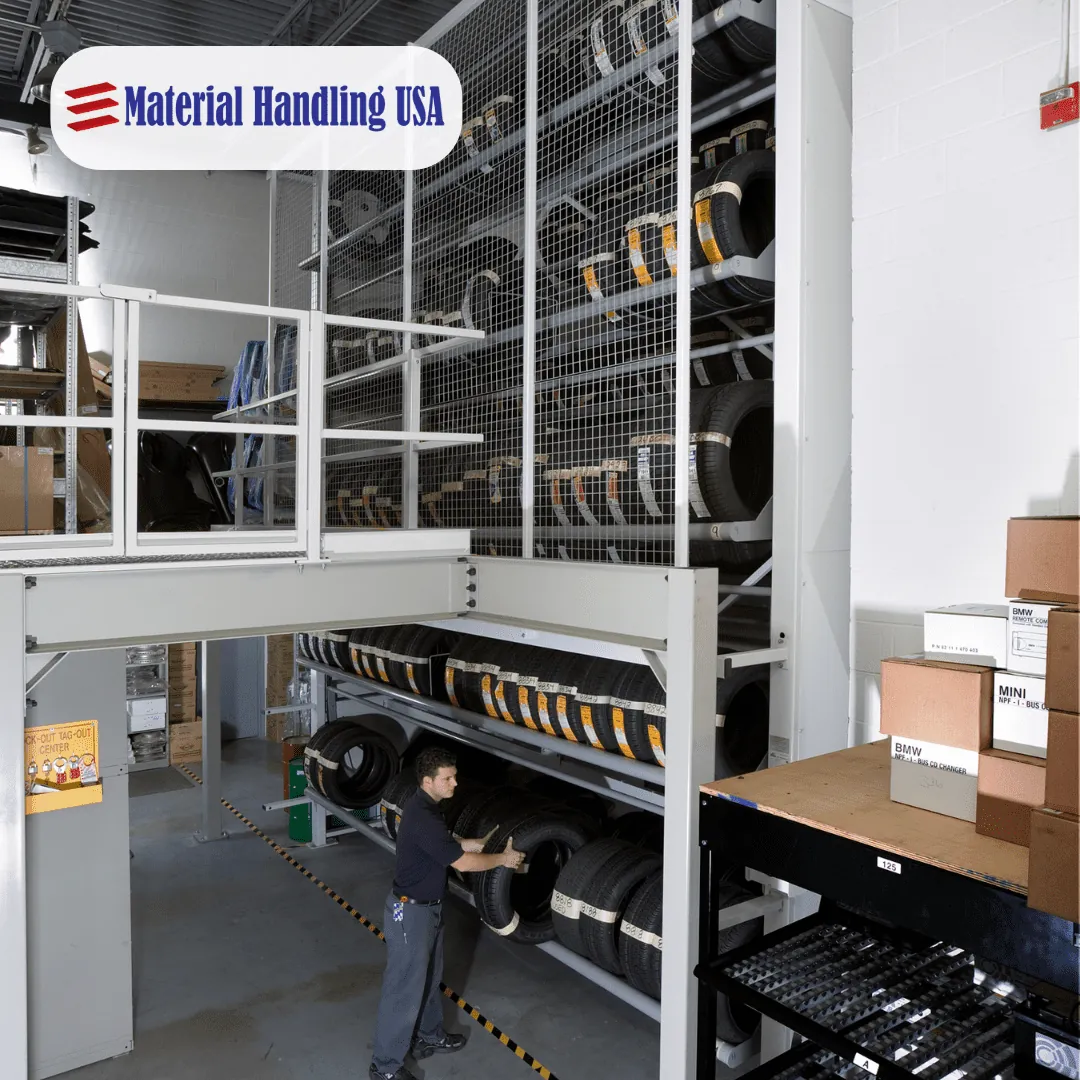
Many tire shops and service bays have the same problem. The back room is short on floor space but has unused height above the parts shelving. A compact tire carousel uses that height. It takes one footprint near the wall and stores tires in a column instead of along the walls and aisles.
When you plan a compact carousel for a small shop, check these points before you ask for a quote:
- Clear height. Measure from the finished floor to the lowest light, duct, beam, or sprinkler component. A shorter unit holds fewer tires, so the height you have sets the practical limit.
- Delivery route. A compact unit may still be taller and heavier than the doorway or hallway allows. Walk the route from the truck to the final spot and note every door, turn, and floor change.
- Operator zone. The opening needs open floor in front of it so a technician can load and retrieve tires without stepping into a vehicle path or a lift area.
- Power location. The machine needs an electrical circuit. Note where the nearest panel is so the electrician can plan the run.
- Growth. If the tire mix will grow, ask whether a second unit could sit beside the first later. Placing the first machine with that in mind avoids moving it.
For a small shop that only stores a few dozen customer tire sets, a high-density tire storage rack may still be the simpler answer. A compact carousel starts to make sense when the floor is full, the height is there, and technicians pull tires many times a day.
Heavy duty tire carousel for aviation parts and large tires

Aviation maintenance shops, transit fleets, truck fleets, and military bases store tires that are much larger and heavier than passenger tires. Some are stored as complete wheel assemblies. A heavy duty tire carousel is built for this load. It uses a stronger frame, wider carrier spacing, and a higher rated load per carrier than a standard unit.
Aviation parts rooms add a few needs that a normal tire shop does not have:
- Traceability. Aircraft tires and wheel assemblies are tracked by part and serial number. Plan how each carrier position will be labeled and how the storage location will be recorded in your maintenance system.
- Storage conditions. Follow the tire manufacturer’s storage instructions and your maintenance program. The FAA’s Advisory Circular 20-97B covers aircraft tire maintenance and operational practices and is a useful neutral reference for the team that owns the storage program.
- Handling. Large tires and mounted assemblies can be too heavy for one person to lift safely. Confirm how tires will move between the carousel opening and the work area, and whether a lift assist or cart is part of the plan.
- Load and anchoring. Heavy tires raise the total machine weight. Ask for the installation specification early so a structural engineer can review the slab and anchoring, especially in a seismic region.
- Procurement. Government and base projects often buy under a formal solicitation. Ask for submittal documents, published capacities, and the installed scope in writing so the quote matches the solicitation.
Give the largest tire’s outside diameter, section width, and weight, and say whether it is stored mounted. Those four facts decide whether a standard or heavy duty carousel is the right machine. For very large off-the-road tires, a commercial tire storage rack may be the better fit than a carousel.
Tire Carousel Size and Capacity
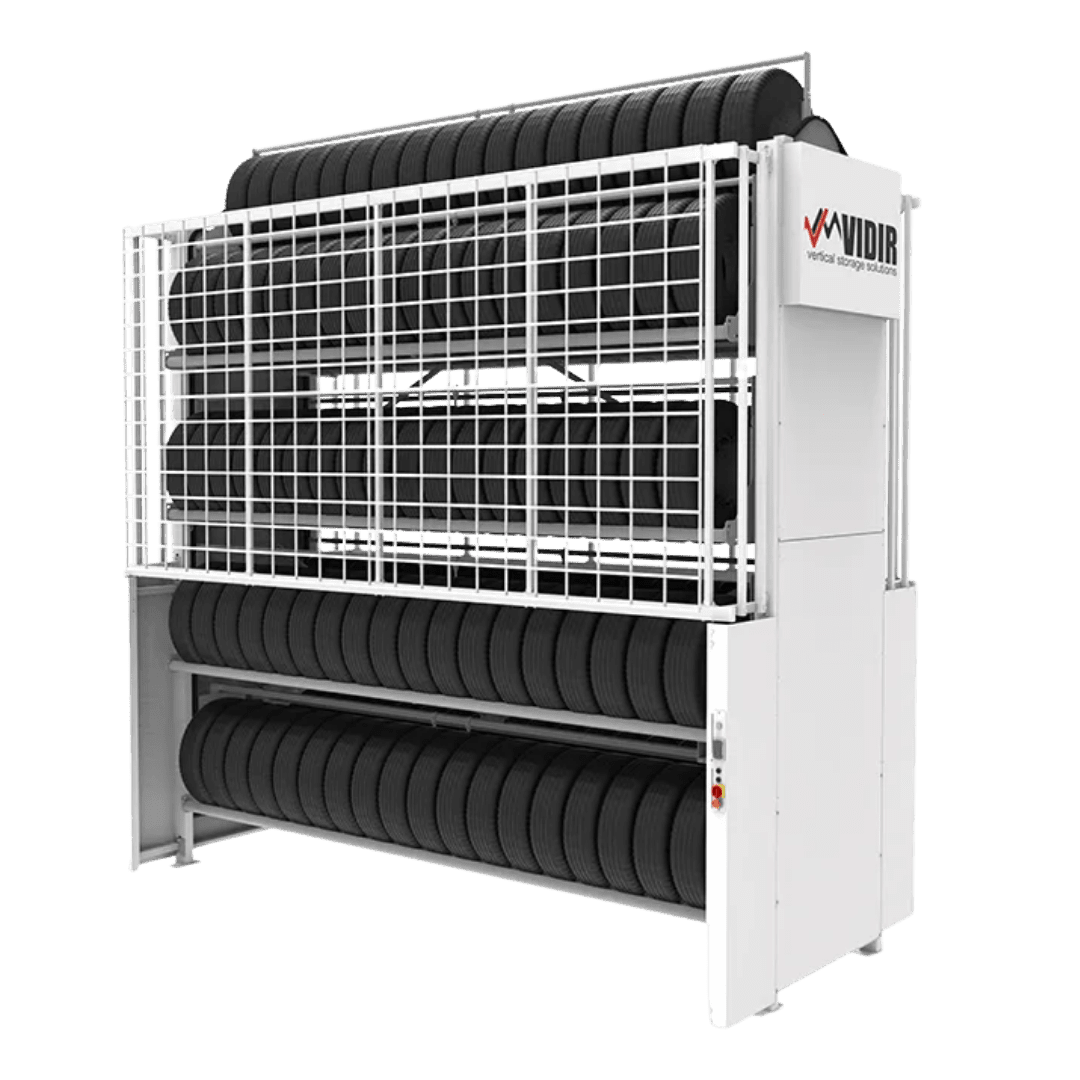
There is no single tire-carousel capacity. Unit height, unit width, carrier count, tire diameter, tire width, rims, and the mix on each carrier all change the practical total. Published product families include different configurations for passenger, SUV, and larger truck tires. The final selection must follow the current manufacturer data for the quoted configuration.
| Decision factor | What to record | Why it changes the selection |
|---|---|---|
| Largest tire | Outside diameter, section width, and whether it has a rim | Sets the minimum carrier clearance and can reduce the number stored per carrier |
| Inventory mix | Quantity by size, type, and season | A mixed assortment rarely matches a brochure’s best-case count |
| Clear height | Finished floor to the lowest permanent obstruction | Limits the unit height and available carrier count |
| Available floor area | Machine zone, operator zone, maintenance access, and nearby traffic | Controls width, depth, and placement |
| Site access | Dock, doors, turns, aisle width, and unloading route | A unit that fits the room may still be hard to deliver or erect |
| Floor and utilities | Slab information, anchoring constraints, and available electrical service | Affects engineering, installation scope, and cost |
For product-family details, review the Vidir tire carousel product page. For a broader choice between fixed racks and powered systems, start with our tire storage systems guide.
Published capacity, height, and speed figures vary by configuration, so confirm exact numbers against the manufacturer submittal for the quoted unit. Our Vidir tire carousel buyer’s guide walks through the published model families, and the Vidir vertical storage solutions hub covers related carousels and vertical lift modules.
How to Measure and Specify a Tire Carousel
- Build the tire list. Count current and peak inventory by diameter and width. Mark tires stored with rims and any specialty sizes.
- Measure the room. Record length, width, and clear height. Show columns, doors, lights, ducts, sprinkler components, pipes, panels, and other fixed items.
- Map the work zone. Show receiving, staging, the operator position, nearby vehicle or lift-truck paths, and the route to service bays.
- Check delivery access. Record the dock or unloading area, door openings, turns, floor changes, and the path to the installation point.
- Document the site. Provide photos, a dimensioned plan, site address, slab information if available, and the location of electrical service.
- Review the proposed configuration. Check the largest tire, usable count by size, unit dimensions, rated load, controls, guarding, utilities, anchoring, service access, and installed scope.
- Confirm local requirements. Ask the authority having jurisdiction and project professionals about permits, seismic criteria, fire protection, egress, and inspections before release.
Get a layout review before pricing
Use our automated vertical storage configurator to share the room and project needs. Material Handling USA can compare the tire list, site constraints, and installation scope before a quote is prepared. You can also call (800) 326-4403.
What Affects Cost and Project Schedule
Published list prices and generic lead times are not a sound budget. A complete quote may include the machine, controls, guarding, options, freight, unloading, rigging, anchoring, electrical work, permits, inspections, training, and site restoration. The scope changes by project.
- Equipment size: Height, width, carrier count, tire range, and rated load affect the build.
- Controls and security: Access control, identification, and other options can change the package.
- Freight and rigging: Distance, unloading conditions, doors, turns, and erection access affect field work.
- Site preparation: Floor work, structural review, power, fire protection changes, and permits may be separate.
- Coordination: Final approvals, submittals, production, shipping, installation, and inspection all affect the schedule.
Ask each bidder to state what is included and excluded. Our vertical storage cost and pricing guide explains how to build an installed budget without relying on an unverified one-price claim.
Common Tire Carousel Buying Mistakes
- Using an average tire size. The largest tire can control carrier spacing and practical capacity.
- Buying the highest tire count. A headline number may assume one tire size and a specific configuration.
- Missing overhead obstructions. Clear height ends at the lowest item, not the roof deck.
- Ignoring the delivery route. Room dimensions do not prove the equipment can reach the room.
- Leaving utilities and slab review until later. These items can change placement and field scope.
- Comparing incomplete quotes. Freight, rigging, electrical work, anchors, permits, and training may not be included.
- Treating guarding as an option to decide later. Review access, moving parts, operator flow, and required safety devices with the supplier and site team.
Tire Carousel vs. Other Tire Storage
| Storage type | Best fit | Main tradeoff |
|---|---|---|
| Vertical tire carousel | Frequent picks, limited floor area, and enough clear height | Requires power, equipment controls, site coordination, and a higher capital budget |
| Static tire rack | Simple storage, low to moderate pick rates, and flexible layouts | Uses more aisle and wall space as inventory grows |
| Mobile tire rack or cart | Small batches, staging, and movement between work areas | Lower density and added floor traffic |
| Mezzanine or multi-level storage | Large rooms where a second level supports a broader operation | More stairs, structure, access, fire protection, and code coordination |
For the static and mobile alternatives in that table, see our high-density tire storage rack and mobile tire rack breakdowns. Buy the workflow, not only the machine. Compare pick frequency, labor path, tire mix, building constraints, and installed cost. The vertical carousel versus traditional storage guide covers the wider operational tradeoffs.
Tire Carousel Storage FAQ
A tire carousel is a powered vertical storage system. Tires rest on carriers that rotate inside a frame. The selected carrier moves to an access opening for loading or retrieval.
Capacity depends on tire diameter, tire width, unit width, carrier count, and the inventory mix. Do not size a system from a single headline number. Provide a count by tire size so the proposed configuration can be checked against the real assortment.
A carrier may hold different tire sizes when the approved configuration allows it. The largest tire and the required spacing can reduce the practical count, so mixed inventory should be modeled before purchase.
Provide the clear height, available floor area, lowest overhead obstruction, route from the unloading point, access aisle, door sizes, tire dimensions and quantities, utility information, and site location. Floor and anchoring details should also be reviewed.
Power needs vary by model and options. Confirm voltage, phase, amperage, disconnect needs, and control location from the selected manufacturer data before ordering.
A carousel can reduce ladder use, reaching, and travel by bringing stored tires to a floor-level access point. It does not remove the need for training, guarding, clear aisles, safe loading, and site-specific procedures.
There is no useful one-price answer. Size, height, tire range, controls, guarding, freight, rigging, electrical work, anchoring, permits, and site access can all affect the installed price. A measured layout and tire list are the right starting point for a quote.
Yes, in a heavy duty tire carousel built for large-diameter and heavy tires. Give the largest tire’s outside diameter, width, and weight, and say whether it is stored mounted on a wheel, so the correct carrier configuration and rated load can be selected.
Plan Your Tire Carousel Storage Project
A reliable proposal starts with two items: a dimensioned room plan and a tire count by size. Material Handling USA can use those details to review fit, compare configurations, and define the installation scope.
Start with the automated vertical storage configurator, review the Vidir tire carousel models and capacities, request a tire-storage layout review, or call (800) 326-4403.
Mixed-fleet operators can apply the same preference for field-based planning used with GPS tracking for HGV fleets, while keeping the focus on actual tire storage conditions.