
Home › Pallet Rack › Tire Storage Rack › High-Density Tire Storage
High-Density Tire Storage Racks
Most tire rooms are not full — they are badly pitched. Here is how to get far more tires into the same footprint: level spacing, bay depth, deep-lane and mobile options, mezzanines, and the fire-code limits that decide how far density can go.
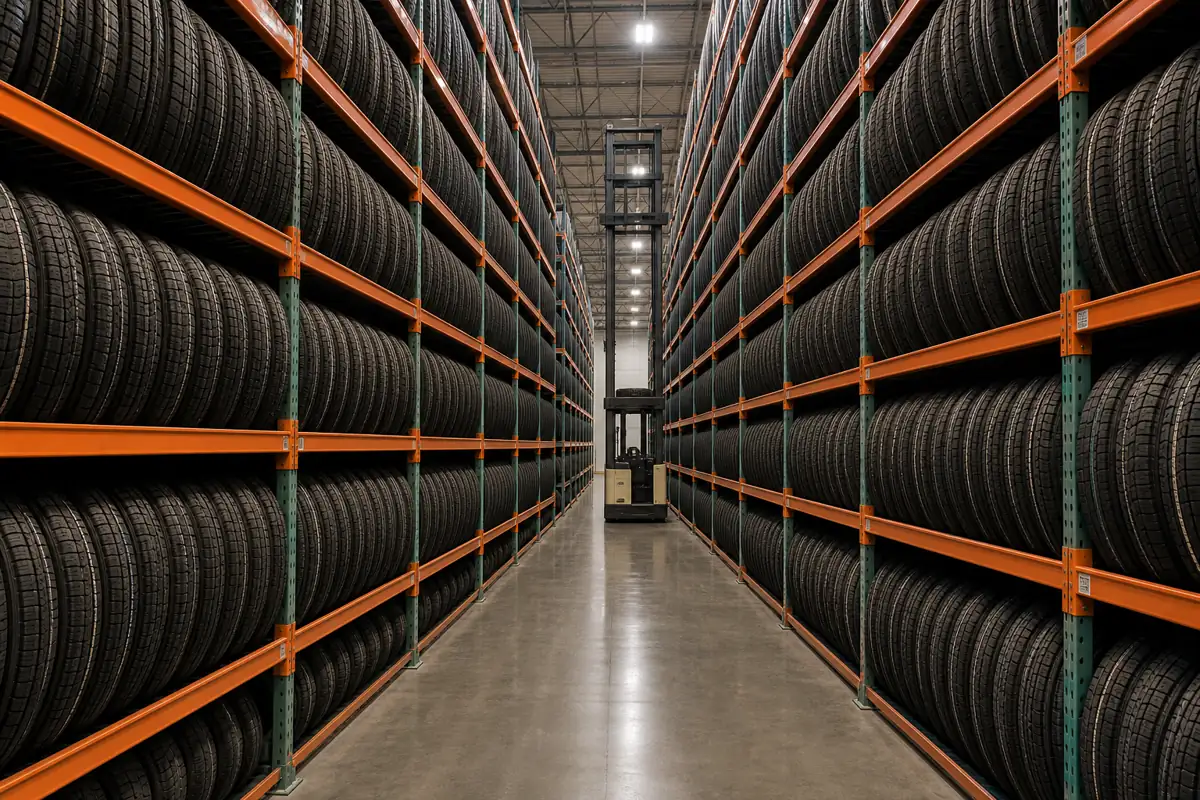
Level pitch
The cheapest density you own
Bay depth
Capacity traded for selectivity
Aisle share
Floor you are not storing on
Code limits
What caps on-tread height
Why tire storage wastes more space than almost any other commodity
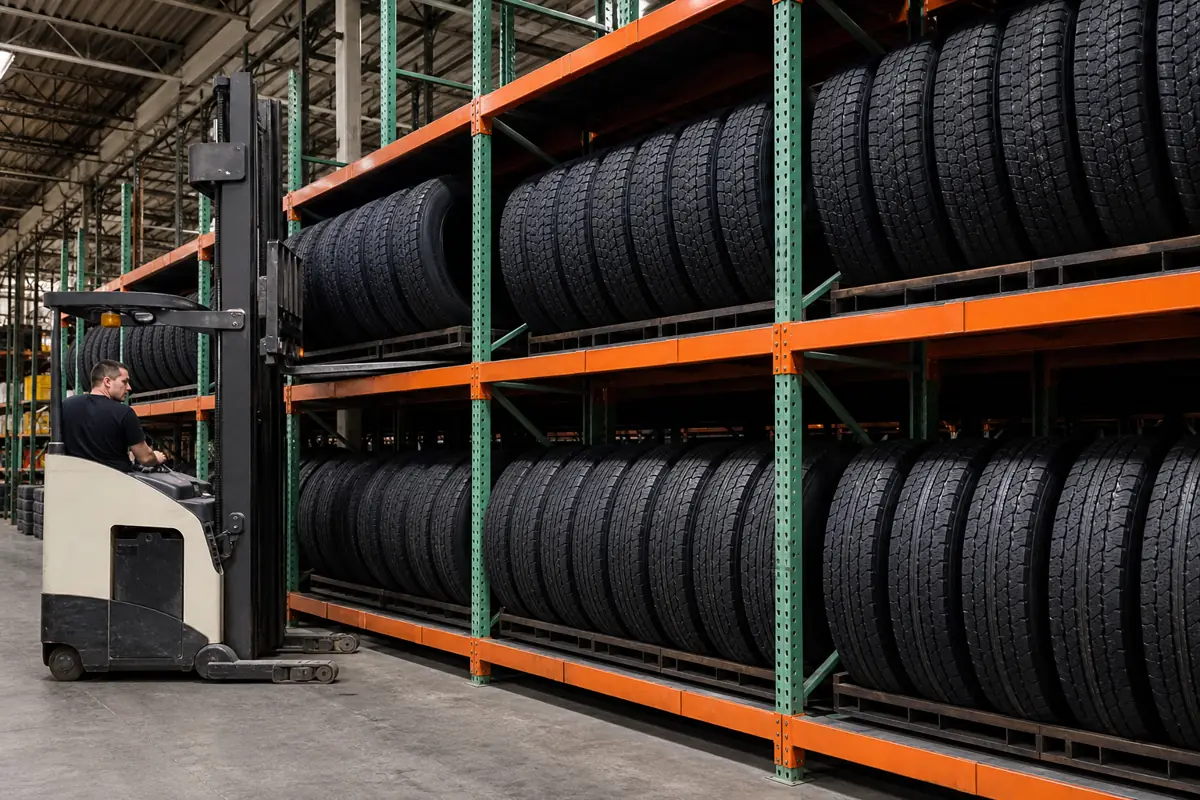
A tire is bulky, light, awkward and available in dozens of sizes. That combination produces a specific failure: rooms built to hold the largest tire on site, holding mostly the smallest. Every level is pitched for a 44 in. diameter when four fifths of the stock is under 30 in., every bay is deep enough for a row that is never placed, and every aisle is sized for a truck that visits twice a week.
The result is a room that feels full while storing a fraction of what the building could hold. Before pricing new steel, it is worth knowing which of the four levers below you have actually left on the table — the answer changes what you should buy, and often means you buy less.
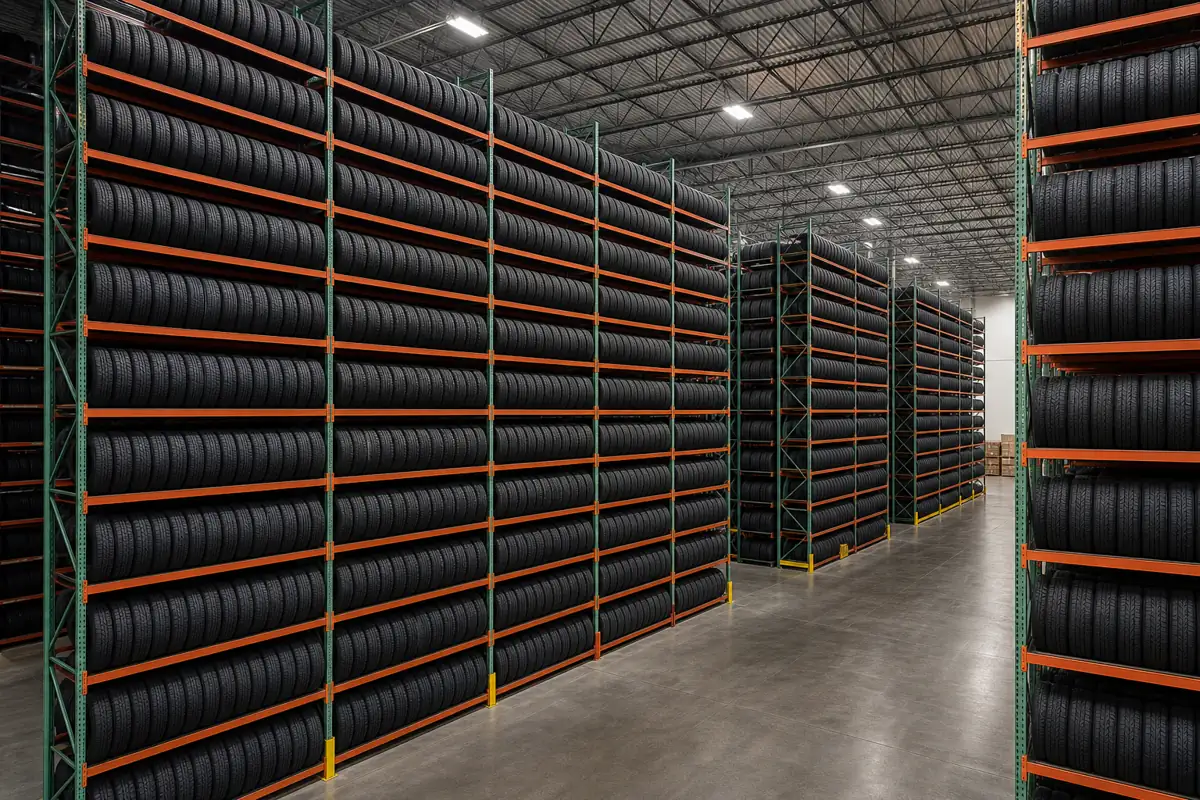
Density is a geometry problem, not a strength problem
Passenger and light-truck tires rarely trouble a properly specified beam. A level holding a dozen of them is usually well inside its rating, which is why capacity charts are not where tire density is won or lost.
What is scarce is air. Unused vertical space above each row, unused depth at the back of each bay, and floor given to aisles are the three places tire capacity disappears. A dense tire room is one where all three have been squeezed deliberately, in the right order, and where the load plan is still honest about rack weight capacity for the heavier sizes.
Heavy commercial sizes are the exception that proves the rule — they are heavy enough to be governed by steel rather than geometry, which is why they get their own treatment for truck and OTR tires.
Shop High-Density Tire Racks Online
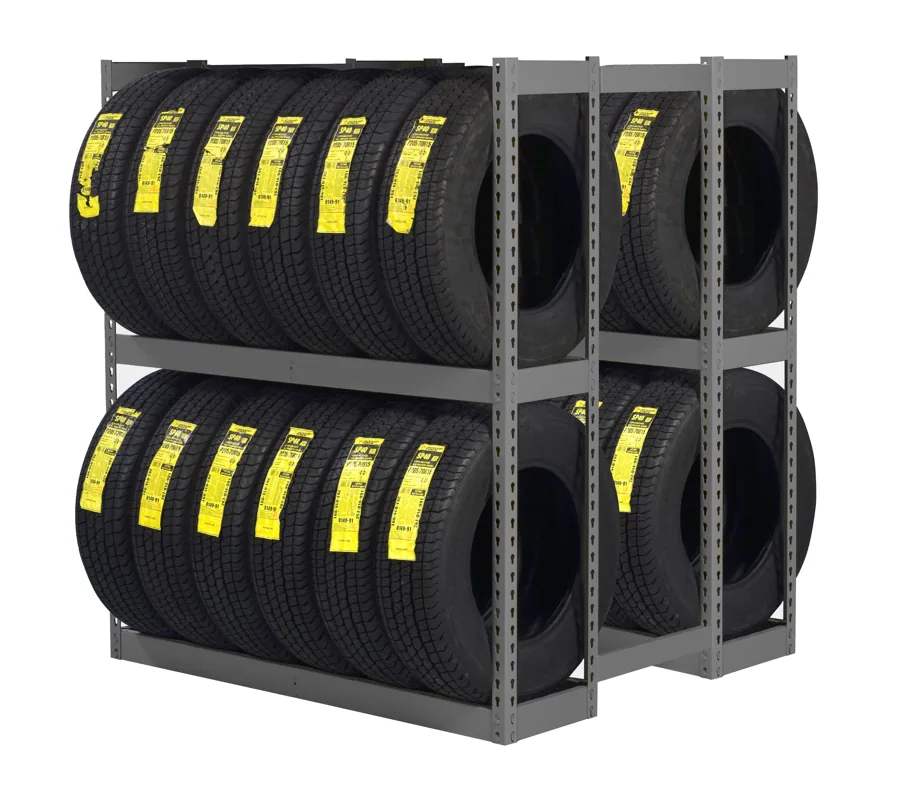
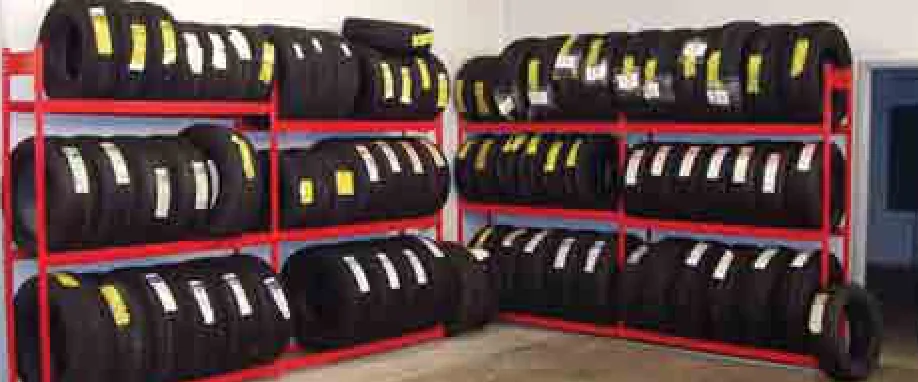
Genuine tire racks you can order online. Prices are current store prices for the lowest-priced in-stock starter unit in each line; add-on bays, other sizes and freight are in each category. Some common sizes are in stock at select manufacturers, subject to confirmation. Larger rooms on pallet rack are quoted.


The four density levers, in the order they pay
Work them in this sequence. Each one is cheaper than the one after it, and doing them out of order is how operations end up buying equipment to solve a layout problem.
| Lever | What it changes | Cost | What it costs you |
|---|---|---|---|
| 1. Level pitch | More levels in the same upright height by matching spacing to each size band. | Labour only, in an existing rack. | Nothing, if handling clearance is kept honest. |
| 2. Aisle width | Converts aisle floor into storage floor. | Low — re-layout, sometimes different trucks. | Manoeuvring room; must match the equipment actually used. |
| 3. Bay depth | A second or third row behind the first in the same bay. | Moderate — deeper frames or deep-lane hardware. | Selectivity: rear positions become last-in, first-out. |
| 4. Height and structures | Taller bays, or a mezzanine level over the storage. | Highest — steel, install, fire protection review. | Access equipment, and a fire protection design conversation. |
The order matters more than the choice
A surprising number of tire rooms could hold 20 to 40 percent more stock with no purchase at all, simply by re-pitching levels to the sizes actually held and tightening aisles to the trucks actually used. Measure that first. If it closes the gap, you have saved a capital project; if it does not, you now know exactly how much depth or height you need to buy.
Measure your own mix before anyone quotes
Every density figure in a brochure assumes a tire size. Yours is the only one that matters, and four numbers per size band are enough to design the whole room.
Section width, per size band
Tread and casing width across the tire is what sets how many nest along a beam. Measure the widest common size in each band rather than an average.
Overall diameter, per size band
Diameter plus handling clearance sets level pitch. This is the number that decides whether you get four levels or five.
Real counts held, per size band
Peak inventory by band, not annual volume. Density built for the wrong band is wasted capital.
Handling method and clearance
Hand-placed, rolled, or forklift-placed changes the clearance you must leave above a row and the aisle you must keep. Write it down before sizing anything.
Then compute, do not guess
Tires per level = usable beam length / section width. Levels = usable height / (diameter + clearance). Rows per bay = usable depth / section width. Multiply for tires per bay and compare with today.
Where the arithmetic usually finds capacity
Banding the sizes. Running one pitch for passenger tires and a separate taller pitch for light-truck and commercial sizes is the single most common win. Uniform pitch across a mixed inventory is convenient to build and expensive to own.
Depth in an already-deep bay. Many tire bays are physically deep enough for a second row that nobody places, because the location convention only recognises the front. Deep positions need a code and a discipline, not new steel.
The top level nobody uses. If the top level is empty because it is awkward to reach, that is a handling problem to solve, not capacity to write off — and it is usually the cheapest capacity in the building.
Want the arithmetic done on your building?
Send your tire size mix, peak counts, clear height and floor plan. We will lay out the densest workable configuration and show what each lever is worth before anything is quoted.
High-density layout options for tires
These are the configurations worth pricing, and what each is genuinely good at. All of them are built from the same family of components as our pallet rack systems, which is why a tire room can usually be densified with standard, serviceable steel rather than a proprietary one-off.
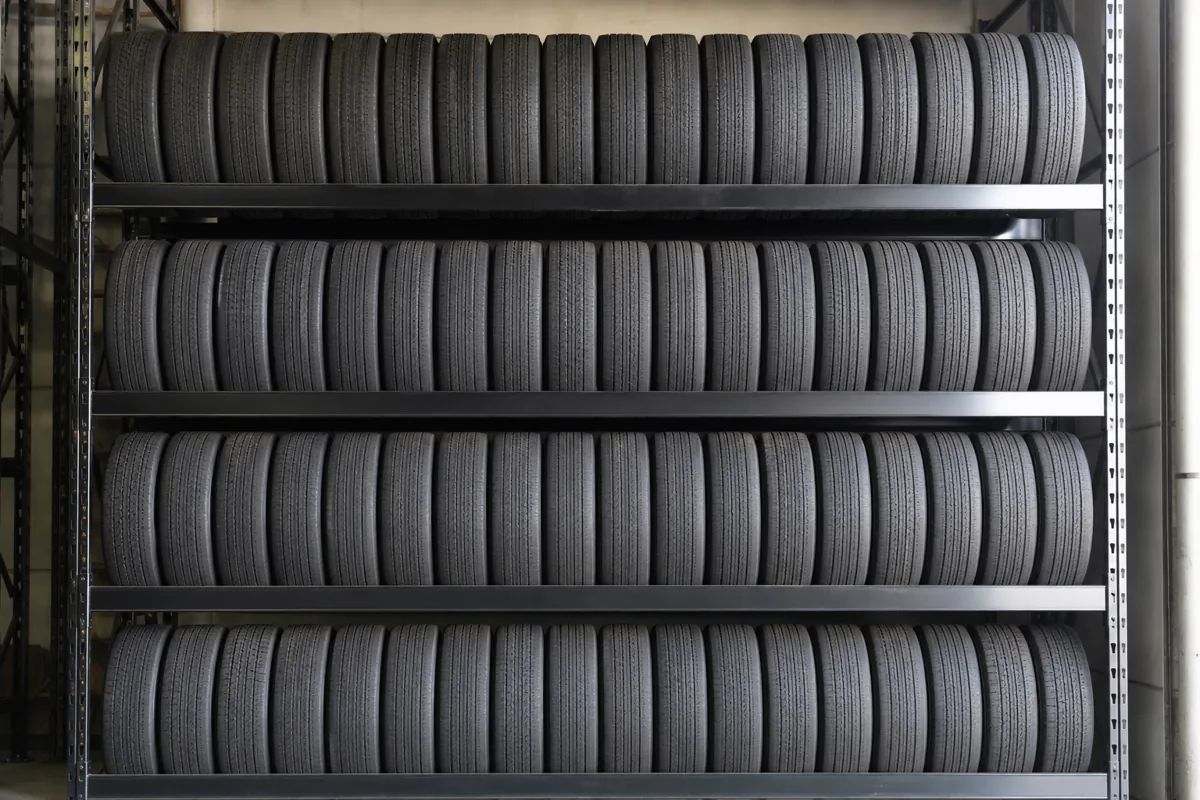 Multi-level tire bays with banded pitchThe default and usually the best value: more levels at tighter, size-banded pitch, hand-loaded, full selectivity on every level. Cheapest capacity per tire stored.
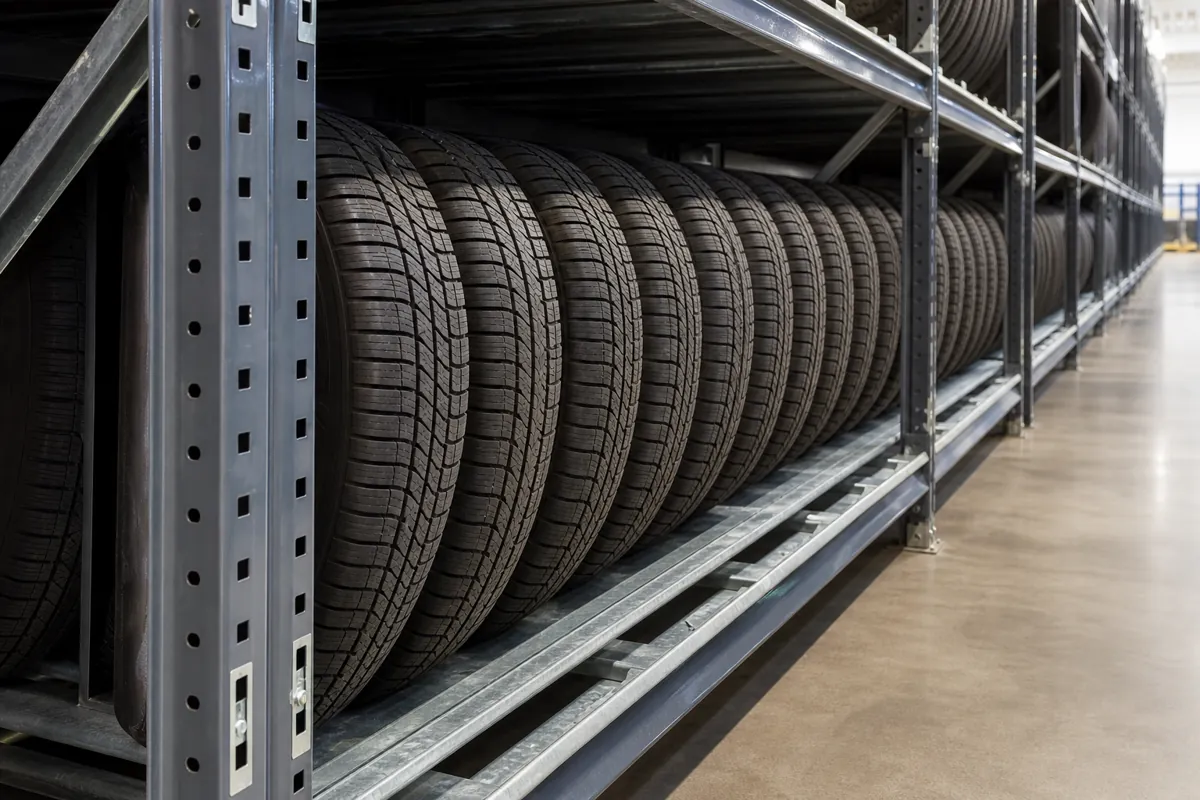 Deep-lane and double-deep baysTwo or more rows behind one another in the same bay. Big capacity gain for few sizes and high volume; rear positions are last-in, first-out and need a location convention.
 Cantilever arms for wide sizesFront columns removed so long, wide or oversize tires load without obstruction. Density gain comes from usable level length rather than from depth.
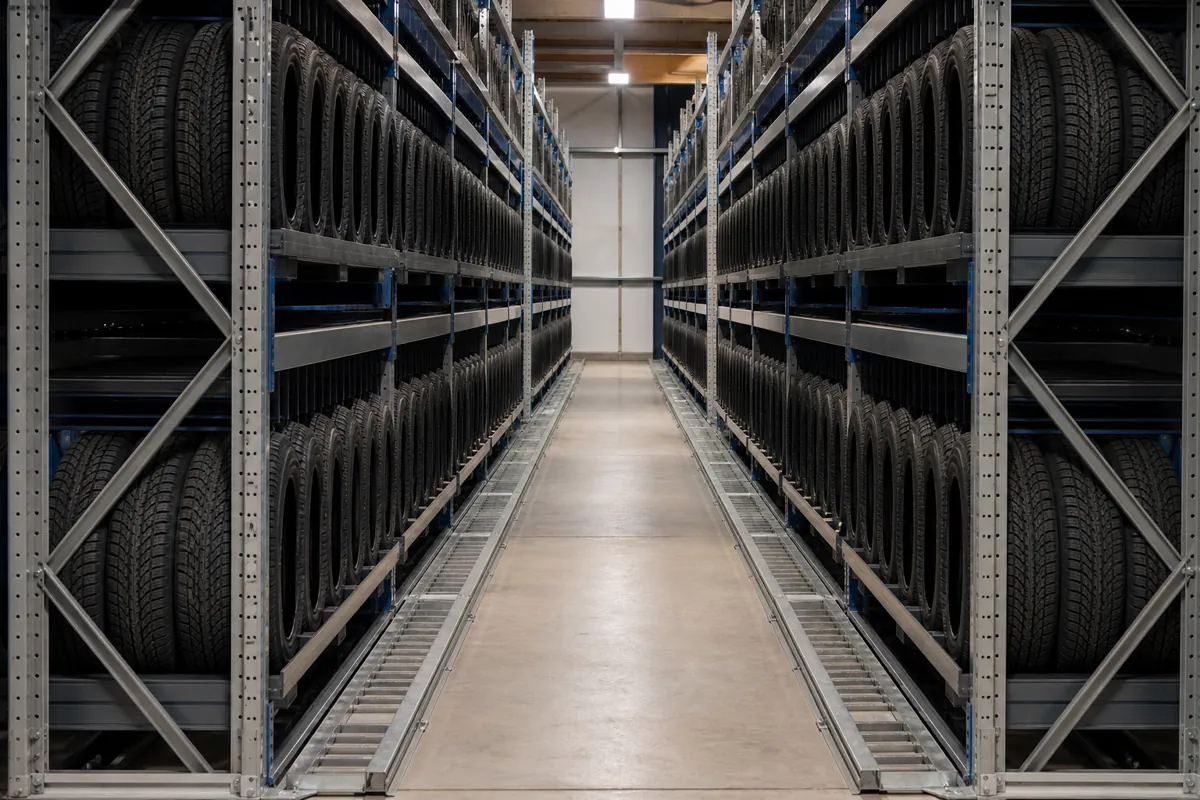 Mobile carriage racking on railsFixed rows mounted on carriages sharing one open aisle. The largest floor-area recovery available short of automation, at the cost of one aisle at a time.
Two options sit outside this grid and are worth knowing about. A vertical tire carousel converts height into a single access opening and suits high, stable volumes where floor area is very expensive. At the other end, a fleet of mobile tire racks adds no density at all — it solves handling. Buying mobility when the constraint was density is the most common and most expensive mistake in this category.
Depth versus selectivity: the trade you have to make consciously
Every step toward depth buys capacity and sells access. The question is not which is better in general, but which one your size mix can afford.
| Configuration | Access | Best for | Watch out for |
|---|---|---|---|
| Single-deep bays | Every position directly picked. | Wide size mix, daily picking, service shops. | Aisle share is high, so aisles must be sized honestly. |
| Double-deep bays | Front row direct; rear row behind it. | Distribution and wholesale with few sizes, many tires each. | Rear positions need reach capability and a location code. |
| Deep-lane / flow lanes | First out, then the lane advances. | One size per lane, steady replenishment. | Mixed sizes in one lane destroy the benefit. |
| Mobile carriages | One aisle open at a time. | Buildings where floor area is the hard limit. | Capital cost, rail install, simultaneous-access limits. |
- Match depth to size count per position: the fewer sizes and the more tires of each, the more depth pays.
- Never place a deep position your location convention cannot express — unreachable recorded stock is worse than empty space.
- Check the truck before the steel: depth without reach capability is a bay you cannot load. Our aisle width guide covers the equipment side.
- Keep one selective face for the long tail of odd sizes. Every dense room still needs a place for the awkward ones.
- Decide decking early — wire decking or solid shelves change what a deep bay can hold and how safely tires stay put.
- Have the layout installed and inspected properly; a dense bay is unforgiving of an out-of-plumb frame. See rack installation and rack inspection and repair.
If you are weighing depth against a straightforward selective layout for a distribution operation, the same trade-off is worked through for pallets in our notes on selective versus push-back racking and on selective pallet rack — the logic transfers directly to tires, with size mix standing in for SKU count.
Going up: height, mezzanines and the ceiling you actually have
Height is the biggest prize and the most constrained lever. The constraint is rarely the rack — it is what sits above it.
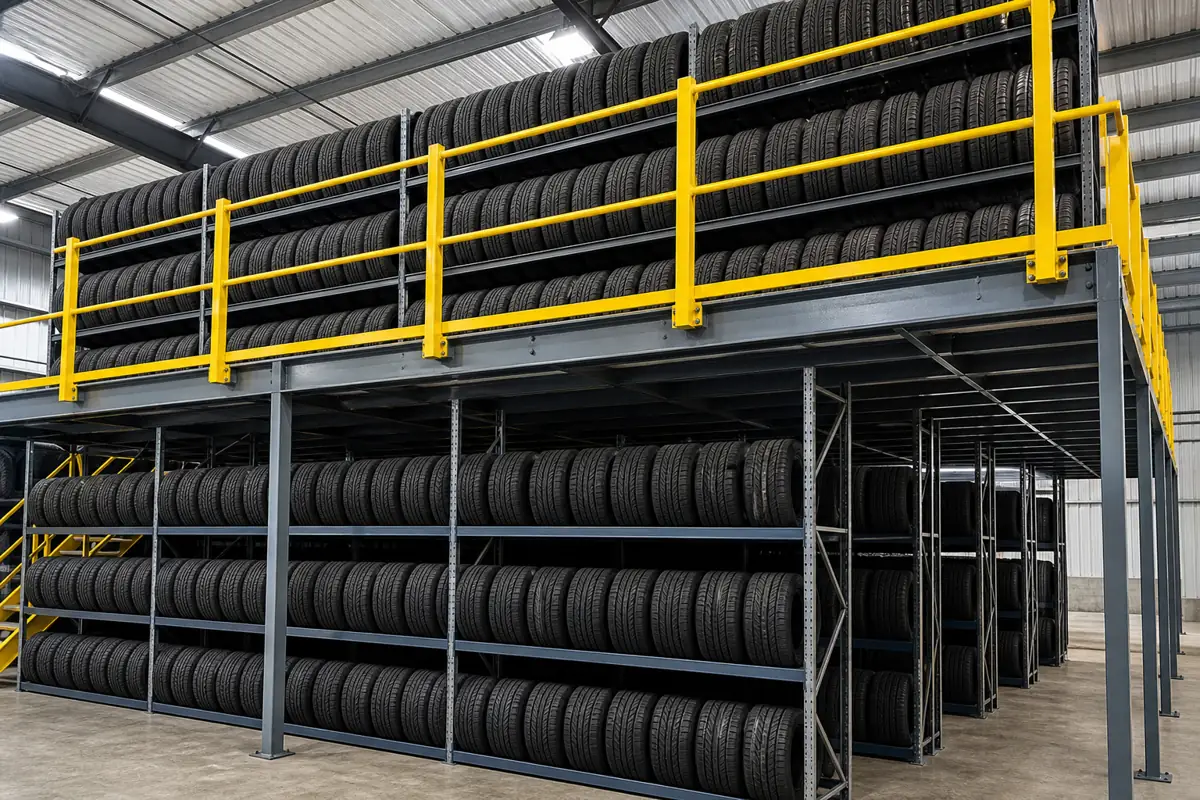
What limits tire storage height in practice
Sprinkler design. Rubber tire storage is a high-challenge commodity. Storage height and arrangement drive the protection required, so height is a fire protection decision before it is a purchasing decision.
Clearance to sprinklers and structure. Available storage height is the height at which commodity can sit while keeping the required clearance below sprinkler deflectors — not the distance to the roof deck.
Handling. A level nobody can safely reach is not capacity. Above hand height, you are committing to a truck, an order picker or a mezzanine, and each has its own aisle and access implications.
Stability and floor. Taller and denser means higher loads at the base plates, which puts slab thickness, anchoring and frame protection back on the table.
Mezzanines: design with the fire protection scheme, not after it
Adding a deck above a high-challenge commodity changes sprinkler coverage, egress and floor loading at once. Every one of those is resolvable, and all of them are cheaper to resolve on paper. Bring the fire protection engineer and the authority having jurisdiction into the layout stage rather than the inspection stage.
Fire code is the real ceiling on on-tread density
This is the part most density conversations skip, and it is the part that decides whether a plan is buildable. Tires are treated as a high-challenge commodity because of how they burn and how hard they are to wet, and the arrangement matters as much as the height.
What we will and will not tell you
We will size the racking, the levels, the depth and the layout, and we will tell you honestly where a density idea is likely to collide with fire protection. We will not promise that any arrangement is code-compliant in your building — that determination belongs to the fire protection engineer of record and the authority having jurisdiction, and anyone who tells you otherwise is selling steel rather than solving your problem.
Density raises the cost of every defect
Beyond fire, dense storage concentrates risk in ordinary ways. General materials handling requirements — secure storage that cannot slide or collapse, aisles and passageways kept clear and marked, storage areas kept free of accumulation — get harder to satisfy as a room fills up, and they are exactly what an inspector looks at.
- Marked capacities per level and a written load plan, especially where size bands mix light and heavy tires in one bay.
- Nothing overhanging into an aisle. In a dense room, the last tire on a beam is the one that gets clipped by a truck.
- Frame protection where trucks work, because dense bays put more load above every upright that can be struck.
- Clear, marked aisles and passageways kept clear as the room fills — the first thing lost when stock exceeds plan.
- Scheduled rack inspection with damaged components taken out of service, not nursed along. See rack inspection and repair.
- Tires on the tread, never on the sidewall, and off the floor on a smooth surface: industry storage guidance is explicit that tires belong raised off the ground on a flat, smooth support rather than a grated one, which can indent a tire over long periods.
- Density must not eat handling clearance where finished wheels are stored: see tire and wheel assembly storage racks for why a marked rim costs more than a recovered inch.
A worked sequence for densifying an existing tire room
If you do nothing else on this page, do these six steps in this order.
Count and measure the real mix
Peak counts, section widths and diameters by size band. One afternoon with a tape measure sets up every decision that follows.
Re-pitch levels by size band
Set beam heights to the bands you actually hold, with honest handling clearance. Capture the extra level per bay before spending anything.
Tighten aisles to the equipment
Size aisles for the trucks and people that genuinely use them, then convert the recovered floor into bays.
Add depth where the size mix allows
Deep or double-deep positions for the few sizes held in volume, with a location convention that names front and rear.
Test height against fire protection
Take the proposed height and arrangement to the fire protection engineer before buying steel or planning a mezzanine.
Lock in load plan, marking and inspection
Capacities marked, load plan written, inspection scheduled. Density without documentation is a hazard waiting for its first audit.
Where this fits in the wider tire storage decision
Density is one of four questions a tire storage project has to answer — the others being tire weight, handling method and mobility. The tire storage rack overview works through all four and is the right place to start if the layout is still open.
If your mix is dominated by commercial sizes, read heavy-duty truck tire storage racks first: weight, not geometry, will govern your design. If staff are walking tires across the building all day, the constraint may be handling rather than space, and mobile and rolling tire racks is the page to read. And whichever way it goes, the steel comes from the same pallet rack platform, so a dense tire room stays serviceable, re-configurable and repairable years later.
Get a free quote
Tell us what you are storing, the room size and your timeline. A project specialist will follow up with layout options and pricing. Prefer to talk? Call (800) 326-4403.
High-Density Tire Storage FAQs
What actually makes tire storage high-density?
How do I calculate how many more tires I can fit?
Does storing tires on the tread hurt density?
Is there a code limit on how high I can stack tires?
Which is better for tires: double-deep bays or narrower aisles?
Can I put a mezzanine over a tire storage area?
Do mobile carriage systems work for tires?
What is the fastest density win in an existing tire room?
How does high-density tire storage change inspection and safety?
Find out what your building could really hold
Send us your tire size mix, peak counts, clear height and floor plan. We will show the densest workable layout, what each lever is worth, and where fire protection will set the ceiling. Call (800) 326-4403.