
Lumber Yard Racking Systems: Wheelwright Lumber
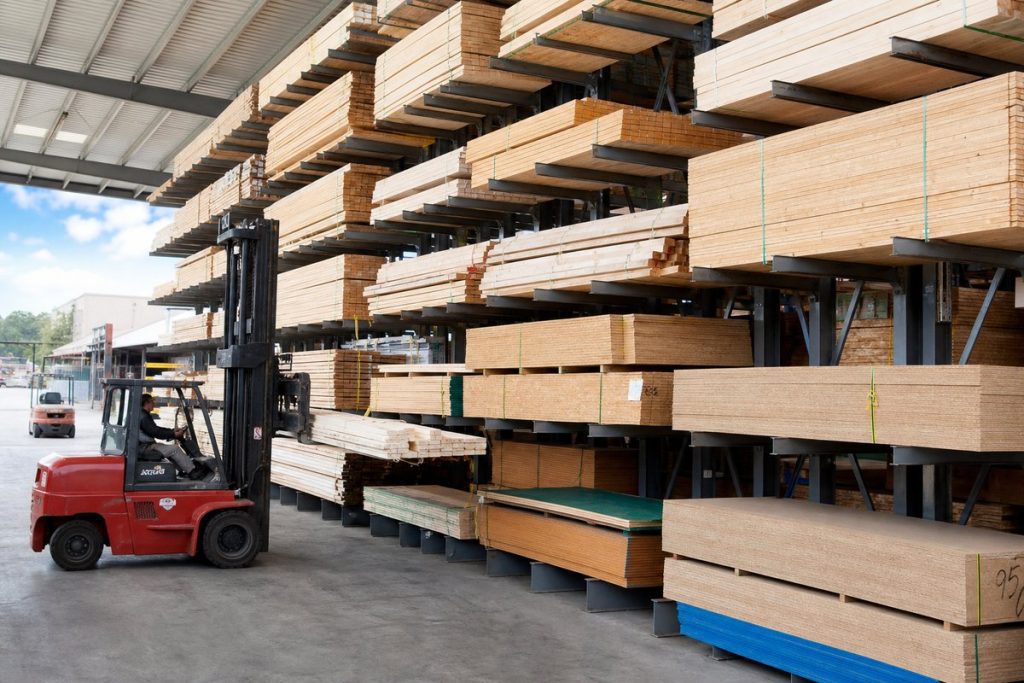
Dimensional lumber, sheet goods, trim and long material each want a different storage answer — and half of them live outdoors. Here is how Material Handling USA plans custom lumber yard racking systems around a real building material inventory. A construction supply house stores an even wider mix — see our construction supply yard racking case study for bagged goods, rebar and will-call counter stock.
2021 – 2026
Years Wheelwright Lumber has worked with us on racking
Building materials
Lumber and building supply distribution
Indoor + covered
Storage spans conditioned, covered and open areas
Long material
The load type that changes the whole design
The project
Wheelwright Lumber is a lumber and building materials supplier. Material Handling USA has supplied pallet rack for the company across several projects, in 2021, 2022 and again in 2026.
A lumber yard is really three storage problems sharing one address. There is long material that no pallet rack system was designed to hold. There is palletized and banded product that behaves like normal warehouse inventory. And there is a large amount of both sitting outdoors or under a canopy, exposed to weather, wind and the occasional very determined forklift.
This page uses that relationship as the starting point for how we plan lumber yard racking. The client, the years and the product category supplied are the only project specifics we publish; the rest is general planning and engineering guidance for any building materials operation.
What we publish
We publish the client, the years we have worked together and the product category supplied. We never publish facility layouts, yard dimensions, storage quantities, contract values or anything else specific to a customer’s site.
Start by sorting the inventory, not the building
Building material inventories look chaotic until they are grouped by how the product has to be handled. Almost every yard sorts into five groups, and each one points at a different storage system.
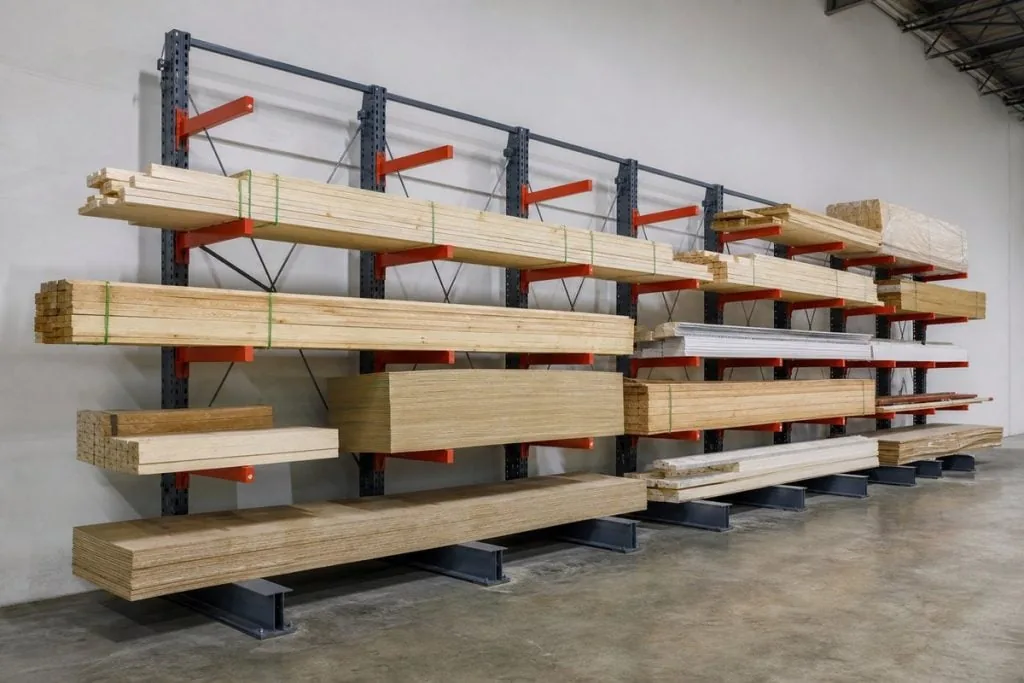
Long, banded units — dimensional lumber, timbers, engineered wood, trim, moulding, steel studs, pipe and tube. These are what cantilever rack exists for.
Sheet goods — plywood, OSB, drywall, sheathing and panel products. Flat, heavy, awkward and easily damaged at the edges; they want full-support storage rather than open arms.
Palletized and banded material — fasteners, adhesives, shingles, masonry products, bagged concrete. Ordinary selective racking territory, though the pallet weights are often at the heavy end.
Small and loose stock — hardware, hangers, connectors, short lengths and cut-offs. These need shelving or bins near the counter, not a pallet position at the back of the yard.
Bulk and irregular — rebar, mesh, culvert, landscape products. Often outdoors, often the last thing anybody plans for, and often the reason an aisle is blocked.
Cantilever rack versus pallet rack in a lumber yard
The most common storage mistake in a building materials operation is trying to make one system do everything. Long material laid across pallet rack beams loads them in ways they were not designed for and makes retrieval awkward and unsafe; palletized goods stacked on cantilever arms waste the arm capacity and lose the pallet support that keeps the load stable.
The useful way to decide is by asking what supports the load and where the operator has to reach.
| Cantilever rack | Pallet rack | |
|---|---|---|
| Best for | Long, unpalletized units: lumber, trim, pipe, tube, moulding, steel | Palletized and banded goods with a stable footprint |
| Front obstruction | None — arms are open at the front, so a unit can be slid in from the side or the face | Front columns at every bay define the opening |
| Load support | Arms at intervals; deck the arms where product would sag or slip | Beams plus decking or pallet supports |
| Sheet goods | Works well with decked arms or a sheet-goods configuration | Works when sheets are palletized and handled as a unit |
| Outdoor use | Common, with galvanized components and a designed foundation | Possible, but less common; still needs corrosion protection and engineered anchorage |
| Reconfiguration | Arms adjust on the column; capacity depends on arm length and level | Beams adjust in teardrop slots; capacity depends on beam level configuration |

In practice a yard usually runs cantilever rack for long material, selective pallet racking with wire decking for palletized goods, and structural rack in the rows that take real forklift traffic.
Sizing cantilever: the numbers that matter
Cantilever rack looks simple and is easy to specify badly. Five inputs do most of the work.
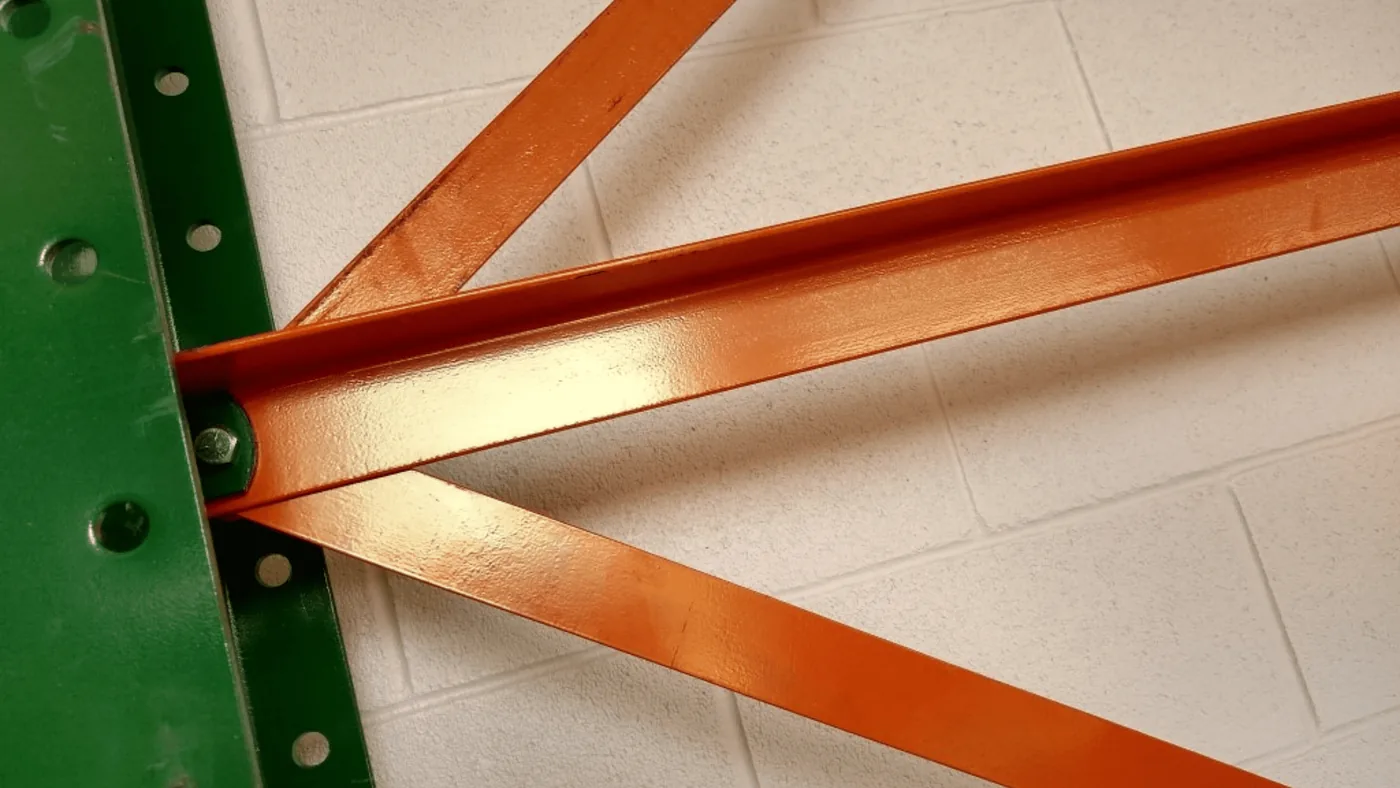
Load length and weight per arm. Capacity is quoted per arm, and the arm rating depends on how far out the load sits. A long arm is not the same as a strong arm.
Arm length versus load depth. Arms should support the load, not extend past it into the aisle. Product that overhangs the arm tip is unstable; arms that overhang the product are a hazard to anyone walking by.
Level spacing. Set from the actual bundle height plus handling clearance. Too generous and you lose whole levels of capacity; too tight and every put-away becomes a fight.
Single-sided or double-sided. Single-sided racks stand against a wall; double-sided freestanding racks work in open floor and store from both faces. The base depth and bracing differ, and so does the foundation.
Arm tilt and stops. Upward-inclined arms and arm-end stops keep round or slick material from rolling forward. For pipe, tube and poles they are not accessories.
Deck the arms when the product asks for it
Bare arms suit banded units that span several arms comfortably. Loose stock, short lengths, sheet goods and anything that could sag or slip between arms wants decking on the arms — timber, steel or wire — specified to the load it will actually carry.
Outdoor and covered storage
Half a lumber yard is usually outside, and outdoor racking is a genuinely different engineering problem from an indoor row.
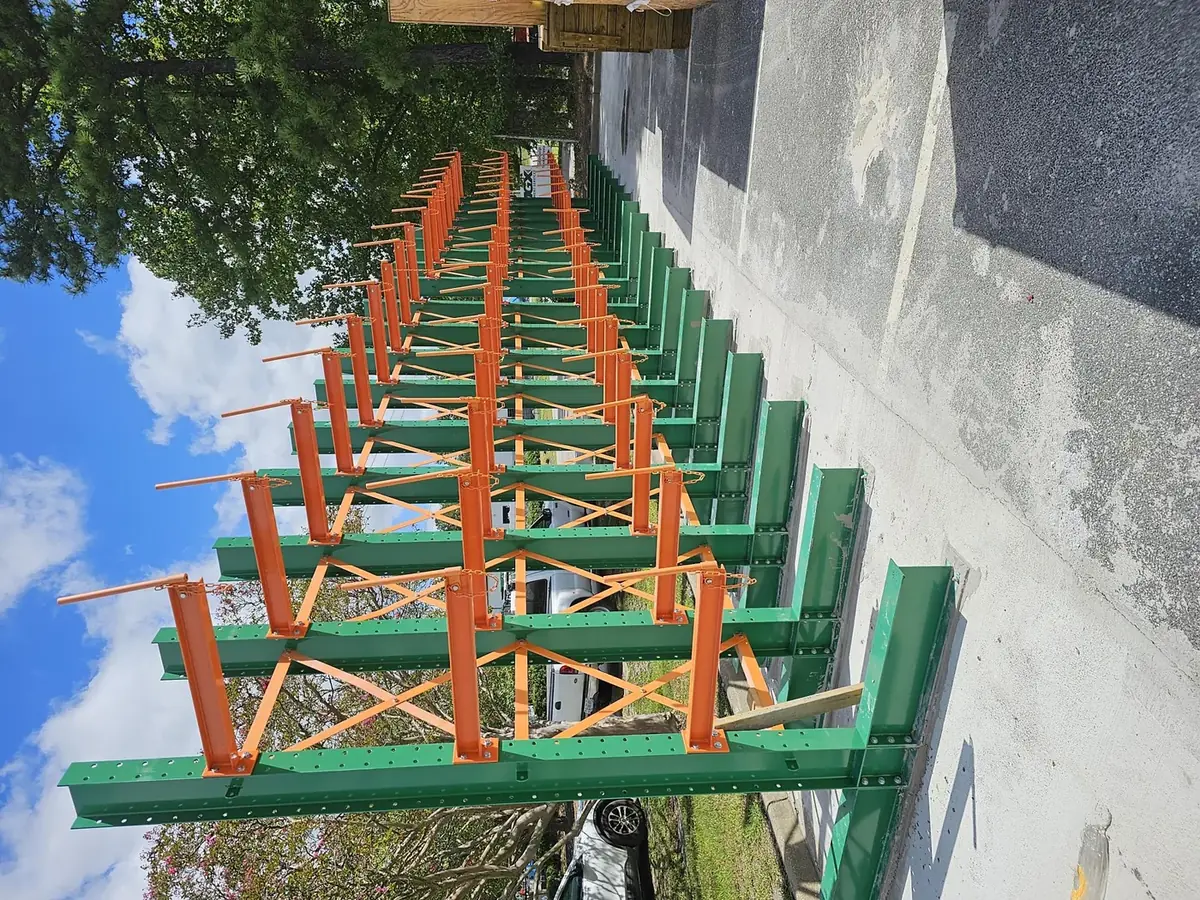
Wind is a design load. An outdoor rack, loaded or empty, has to be designed for the wind demands of its site under the adopted building code. Anchorage, foundations and bracing follow from that calculation, and it is not something to be assumed from an indoor design.
The foundation is part of the rack. Outdoor installations frequently need engineered footings or a designed slab rather than a general yard surface. Asphalt is not an anchoring surface. Frost depth, drainage and how the base plate sheds water all matter.
Corrosion protection is specified, not assumed. Galvanized components are the normal choice for exposed racks; painted rack outdoors has a much shorter honest service life, particularly at base plates and in areas that see road salt.
Cover changes the product, not just the rack. Lumber that will be sold as dry, straight material needs protection from sun and moisture cycling, so the value of a canopy is usually in reduced product degradation rather than in rack longevity.
Yard traffic, aisles and pick sequence
Lumber yards are handled by big equipment carrying long loads, and the aisle plan has to allow for the turning circle of a loaded machine, not an empty one.

Protection, anchorage and inspection
Long, heavy loads and large equipment make a building materials yard unforgiving of damaged storage. Three habits keep it safe.
Protect the impact points. Column guards, bollards and end-of-row protection at aisle ends, gates, corners and loading positions cost a fraction of a bent column and an emptied row.
Anchor and level properly. Cantilever and pallet rack are both anchored to the specified anchor type, size and embedment, plumbed and shimmed. Outdoor racks add wind demands, and above defined heights engineered drawings and permitting apply. Rack design follows ANSI MH16.1 from the Rack Manufacturers Institute at MHI; cantilever systems have their own design provisions within that family of standards. An experienced installation crew matters more here than on an ordinary warehouse row.
Inspect and act. Walk the rows on a schedule, look specifically at arms, arm connections, base plates, bracing and anchors, and treat any impact as a reason to unload the bay and have it evaluated through a documented rack inspection and repair route. OSHA’s materials-handling rule, 29 CFR 1910.176(b), requires stored material to be stable and secure against collapse — with banded units at height, that is not a paperwork obligation.
Lumber yard racking FAQs
What racking should a lumber yard use?
Can lumber be stored on ordinary pallet rack?
How is cantilever rack capacity determined?
Can cantilever rack be installed outdoors?
How should sheet goods such as plywood and drywall be stored?
How wide should lumber yard aisles be?
How often should lumber yard racking be inspected?
Planning storage for a lumber or building materials yard?
We design, supply and install cantilever rack and pallet rack for building material suppliers across Utah and the Intermountain West, including Ogden.
Storage Designed Around Long, Heavy, Awkward Product
Material Handling USA designs, supplies and installs cantilever rack and pallet rack for lumber yards and building material suppliers across Utah and the Intermountain West.