
Construction Supply Yard Racking: Intermountain Concrete Specialties
A construction supply house sells everything from a 90 lb bag of mix to a 20 ft length of reinforcing steel — often to the same contractor, at 6:30 in the morning, in one trip.
2024, 2025 & 2026
Years Intermountain Concrete Specialties worked with us
Construction supply
Concrete accessories, tools and building materials
Pallet rack
Product category we supplied
Counter-paced
Storage designed around will-call, not around cube
The project
Intermountain Concrete Specialties distributes concrete accessories, construction supplies, tools and equipment. Material Handling USA supplied pallet rack for the company in 2024, 2025 and 2026. The client, those years and the product category supplied are the only project details we publish.
Construction supply is one of the most demanding distribution formats there is, because it combines three storage problems that most businesses only face one of. It stores extremely dense palletized goods — bagged mix, admixtures, anchors, fasteners in bulk. It stores long, bulky, unpalletized material — rebar, mesh, form panels, stakes, pipe. And it runs a counter, which means part of the inventory has to be picked by the piece, fast, while a contractor waits with a truck idling outside.
Below is how we plan pallet rack systems, cantilever racking and yard storage for a construction supply operation, and what to settle before the steel is ordered.
Why a supply yard is not a distribution warehouse
Five differences change the design, and none of them show up in a standard warehouse layout exercise.
| Difference | What it means day to day | Design consequence |
|---|---|---|
| Extreme weight per position | Bagged and boxed concrete products are dense | Beam and frame capacity governs, not pallet cube |
| Very wide load profile | From a fastener box to a 20 ft bundle of rebar | Three separate storage systems in one building |
| Counter and will-call service | Customers are served, not just orders shipped | Pick faces at hand height near the counter, reserve stock above |
| Indoor and outdoor inventory | Weather-tolerant product lives in the yard | Galvanized or coated structure, drainage and anchoring design |
| Seasonal peaks | Demand swings hard with the building season | Buffer capacity and flexible slotting rather than fixed density |
| Contractor pace | Loading happens fast, often by the customer | Guarded, forgiving layouts with wide approach and clear aisles |
The last row deserves emphasis. In a supply yard, some of the traffic around the racking is not your own trained operators — it is contractors backing trailers, loading their own material and moving quickly. Protection and clearance that would be generous in a controlled warehouse are the baseline here.
Heavy palletized goods: capacity first
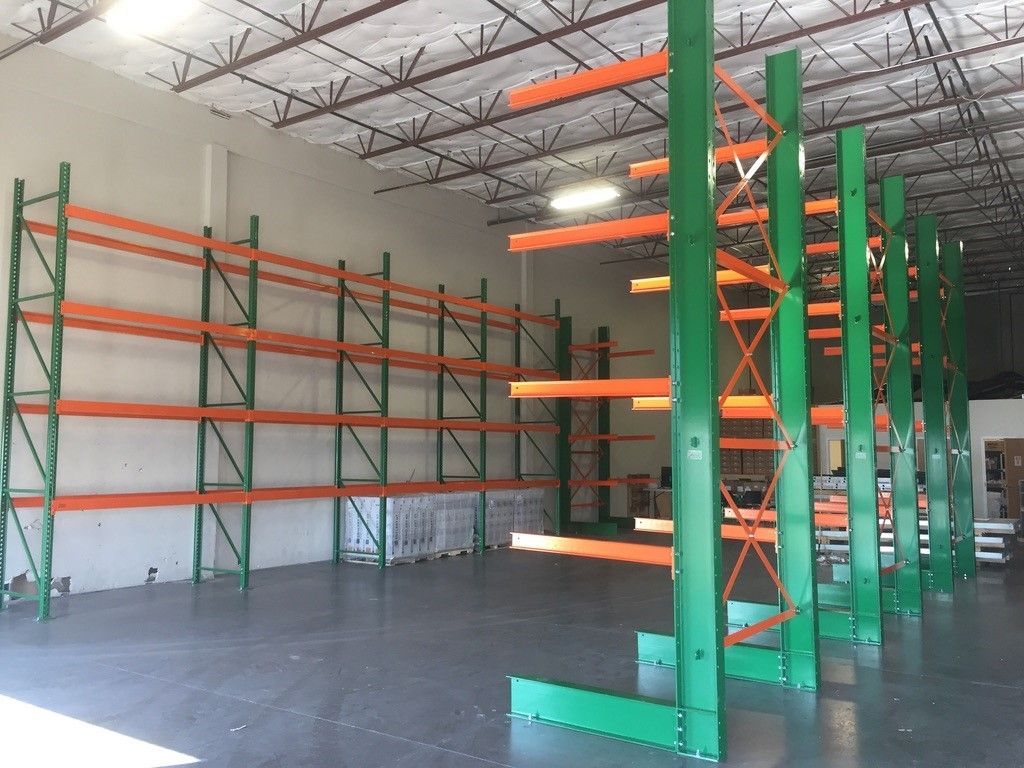
Bagged cement, mortar and mix, buckets of sealer and admixture, boxes of anchors and pallets of hardware are among the densest products in any distribution setting. A pallet of bagged product can approach the load rating of a typical beam pair on its own.
Design from the actual heaviest pallet. Not the average, and not a “standard” assumption. Where bagged goods are stored, check both the beam rating and the frame capacity for the number and spacing of levels you are actually installing.
Keep the dense product low. Bagged goods at the lowest levels lowers the system’s centre of gravity, shortens the fall if a load is disturbed, and means the heaviest handling happens at the safest height.
Deck what needs decking. Bags shift, split and settle. Full-width wire decking supports partial pallets and loose bags, stops product falling into the aisle, and keeps sprinkler paths clearer than solid decks.
Consider structural rack where handling is hardest. Structural pallet rack, with hot-rolled columns and bolted connections, tolerates the impacts that a busy yard produces and can be repaired in place. Where budgets favour roll-formed selective racking, spend the difference on heavier frames and serious protection rather than on extra levels.
Storing dense or bagged product?
We size selective and structural pallet rack from your real load weights, not from a catalogue average.

Long and bulky material: cantilever, not pallet bays
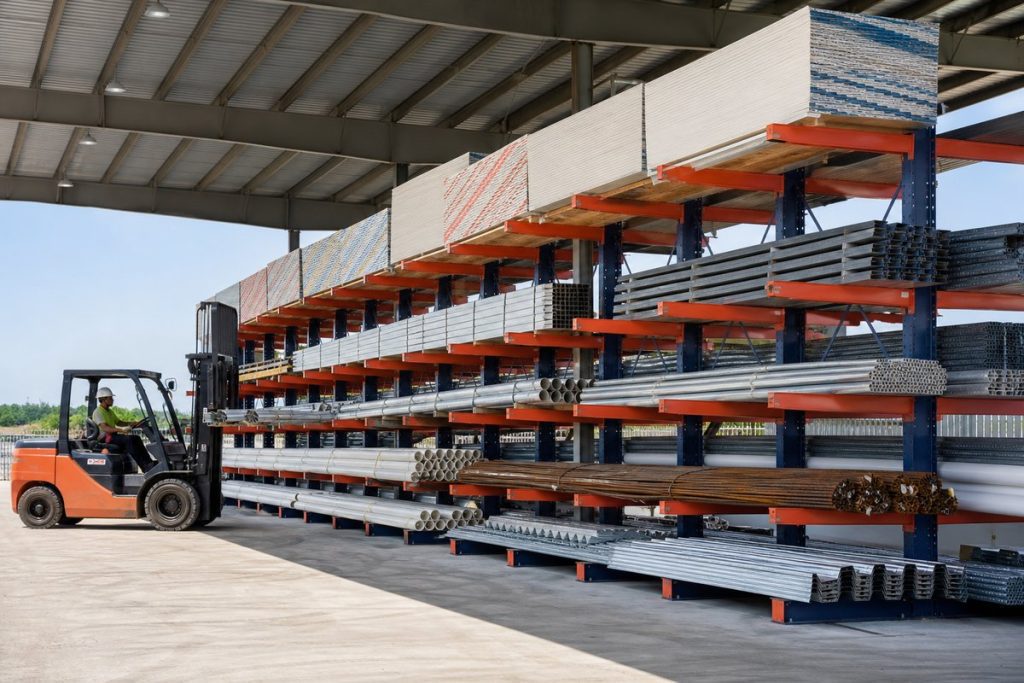
Rebar, mesh sheets, stakes, form panels, conduit, PVC and sleeves do not belong in pallet positions. Forcing them there produces overhang, damaged product, blocked aisles and a storage face nobody can pick from safely. Cantilever racking is the correct system, and the sizing exercise is straightforward once the inputs are known.
Support points. Column spacing should be chosen so no bundle is carried on fewer than three arms. Long, flexible product such as rebar sags between supports and becomes both hard to handle and hard to keep tidy.
Weight per arm and per column. Arm capacity falls as arm length increases, and the column has a separate total rating. Both are checked against the heaviest bundle actually stocked.
Arm length versus load depth. The arm carries the full bundle depth; product hanging past the arm tip is outside the rated condition.
Single or double sided. Double-sided runs down the floor centre give the most storage per base; single-sided runs against a wall or fence suit yards where one side is the only accessible face.
Mesh sheets are their own problem. Flat, springy and awkward, they need either a decked, restrained horizontal position or a purpose-built vertical arrangement — not a beam level they can slide off.
The cantilever rack design guide works through the sizing inputs in detail.
Small parts and the will-call counter
The counter is where a supply house wins or loses its reputation, and it is almost always the part of the building that receives the least storage design attention.
- Put a real pick face within a few steps of the counter: anchors, ties, blades, chalk, form hardware and the fast-moving consumables that make up most transactions.
- Use shelving, bins and drawers for piece-picked items — a product that ships one at a time should never occupy a pallet position.
- Keep reserve pallets of the same item directly above or behind the pick face so replenishment is one move, not a trip across the building.
- Slot by how often something is sold, not by product family. Catalogue order is for catalogues.
- Label pick locations so a new hire and a covering driver can find stock without asking anyone.
- Keep a clear, protected walking route between counter, pick face and the loading door — foot traffic and forklifts should not share it.
Where the mix is small parts in volume, the choice between shelving and racking is worth thinking about explicitly — our boltless shelving versus pallet racking guide covers the trade-offs, and parts and small-item shelving is usually the right home for counter stock. Whichever is chosen, the goal is the same: fewer steps per transaction while the customer is standing there.
Outdoor and covered yard storage
Plenty of construction supply inventory tolerates weather, and putting it outside is the cheapest capacity available — provided the storage is engineered for outdoor service rather than moved outside and hoped for.
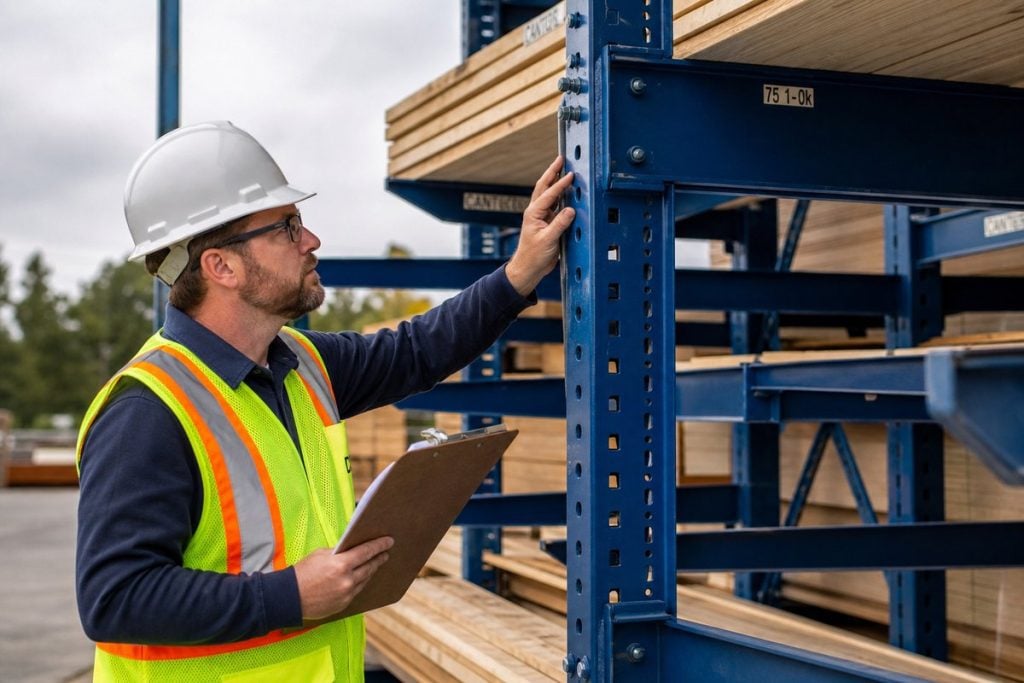
Corrosion protection. Galvanized or suitably coated steel, and a plan for how touch-up is handled after installation damage. Uncoated rack outdoors in a freeze-thaw climate has a short and worsening life.
Wind and snow. Outdoor racking is exposed to wind loads that indoor racking never sees, and in the Intermountain West to snow accumulation on any covered arrangement. Both belong in the engineer’s design, along with the seismic case.
Foundation and drainage. Anchoring depends on what is actually under the base plate. An asphalt yard is not a concrete slab; a properly designed pad or footing for the rack line is often the difference between a straight run and a leaning one after two winters.
Access in bad weather. Aisle widths that work on a dry day in July want more margin in January. Snow storage, drainage runoff and where meltwater refreezes all belong on the layout drawing.
Security and separation. Yard material is exposed to more than weather. Clear sightlines, defined boundaries and separation between customer loading areas and staff-only storage reduce both loss and accidents.
Safety, code and keeping it in condition
Post the capacities. Load plaques stating the rated capacity per level and per bay for the as-built configuration are a basic safety control and the practical defence against creeping overload — particularly where product weight varies as much as it does in construction supply.
Seismic design. Storage racks above a defined height are non-building structures with seismic design requirements under the International Building Code as adopted locally, with rack design to ANSI MH16.1. Because construction products are heavy, the seismic mass is high and the anchor design matters more than in a lightly loaded warehouse. Anchor type, size, embedment and count come from the rack engineer’s drawings for the actual slab or pad.
Protect what will be hit. Column guards and end-of-row protection at aisle ends, door approaches, counter walkways and any position a customer’s truck can reach are essential in a yard where not every driver is your employee.
Installation and inspection. Plumb columns, verified connections, correct anchor torque and a documented handover with posted capacities are what a professional rack installation produces. A documented inspection interval, an immediate unload-and-report rule for damage, and rack repair that restores engineered capacity keep it that way. Our guide to designing a pallet rack layout covers the planning method behind all of this.
What we publish
We publish the client, the years we worked together and the product category supplied. We never publish facility layouts, room dimensions, inventory volumes or contract values.
Construction supply racking FAQs
What racking does a construction supply yard need?
How do you store rebar and mesh safely?
Can pallet racking be installed outdoors in a supply yard?
How heavy are pallets of bagged concrete products?
How should will-call counter stock be organised?
What extra protection does a supply yard need?
Do outdoor racks need inspecting more often?
Laying out a supply house or contractor yard?
We design, supply and install cantilever, selective and drive-in racking across the Intermountain West, including Utah.
Storage Built for Building Materials
Material Handling USA designs, supplies and installs pallet rack, cantilever rack and yard storage for construction supply houses and contractors across Utah and the Intermountain West.