
How to Store Tires Properly
Tires age on the shelf as well as on the road. How you stand them, what they rest on, where the rack sits and which tire leaves first decide whether stock and customer sets come out the way they went in.
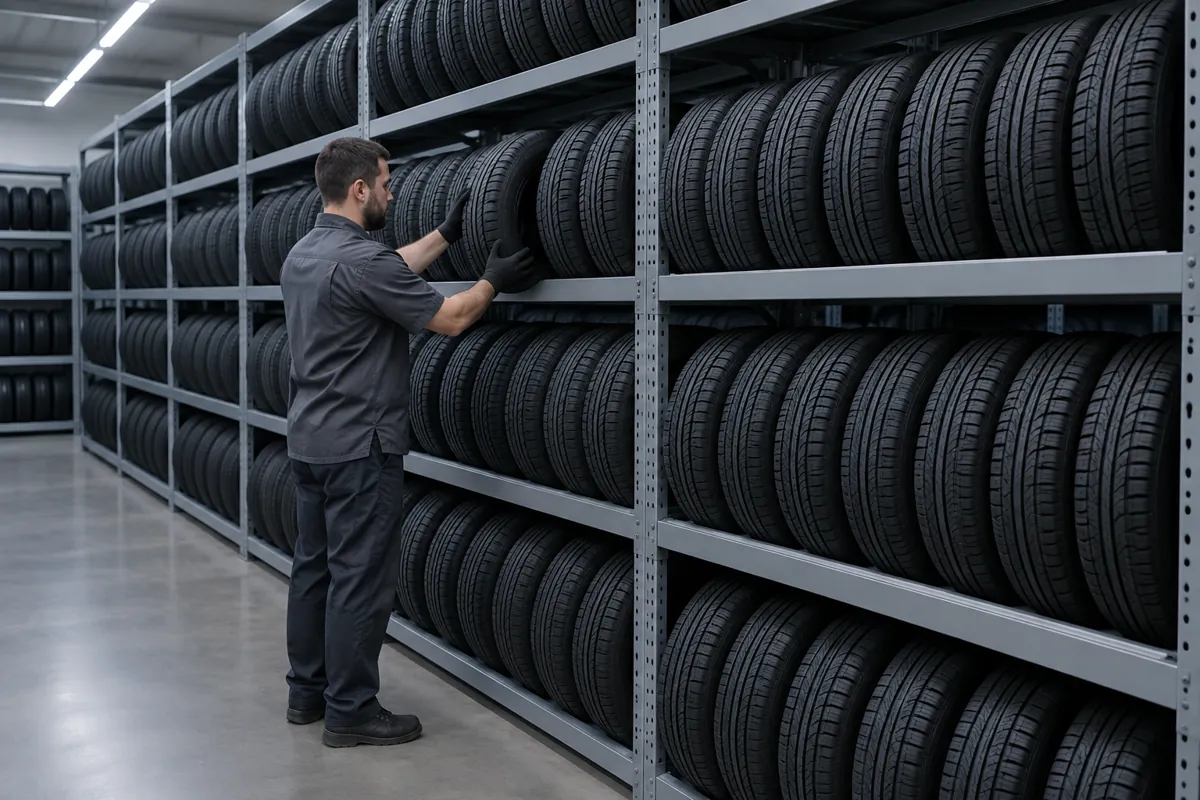
Shop Tire Storage Racks Online
Proper storage starts with tires off the floor on a smooth, level deck. These tire racks can be ordered online; prices are current store prices for the lowest-priced in-stock starter unit in each line. Some common sizes are in stock at select manufacturers, subject to confirmation.


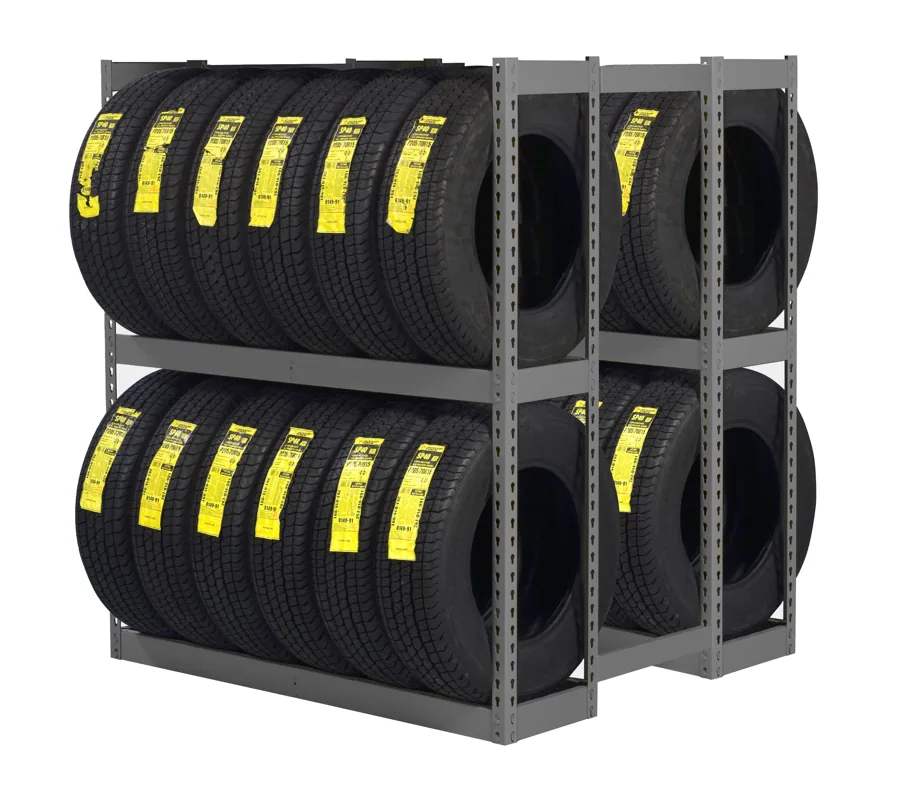
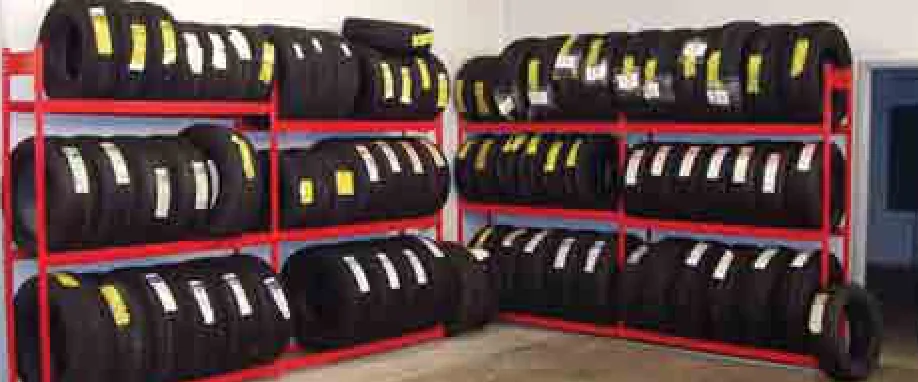
How to store tires: the short version
Every tire maker’s storage advice comes back to the same handful of rules. The U.S. Tire Manufacturers Association storage bulletin is the reference most of the industry works from, and it applies whether you hold four winter tires or four thousand SKUs.
- Indoors, in a clean, dry, well-ventilated area with little circulating air.
- Cool and dark: mild temperatures, shaded, never in direct sunlight.
- Off the floor, on a storage rack or a sound pallet with a flat, smooth surface.
- Sidewall to sidewall for unmounted tires, and whitewall to whitewall where it applies, so black rubber does not stain white lettering.
- Away from ozone: electric motors, battery chargers, generators and welding equipment.
- Away from chemicals: fuel, oil and other petroleum products and volatile solvents.
- Oldest first: tires that have been in stock longest are used first.
- Inspect before service: a stored tire gets a visual and hands-on check before it is mounted.
The rest of this guide is about turning those rules into a storage room: the rack, the orientation, where the rack sits, how tires go in and how they come out again.
Stacking vs racking: why tires belong on a rack
Floor stacks fail in predictable ways
Floor-stacked tires sit on concrete that can be damp, dirty or oily. The bottom tires carry everything above them, which is exactly what the industry bulletin warns against, and a tall stack is hard to rotate because the oldest tire is always underneath.
Stacks also lean and topple. Federal workplace rules require stored material to be stacked, blocked or limited in height so it stays stable and secure against sliding or collapse.
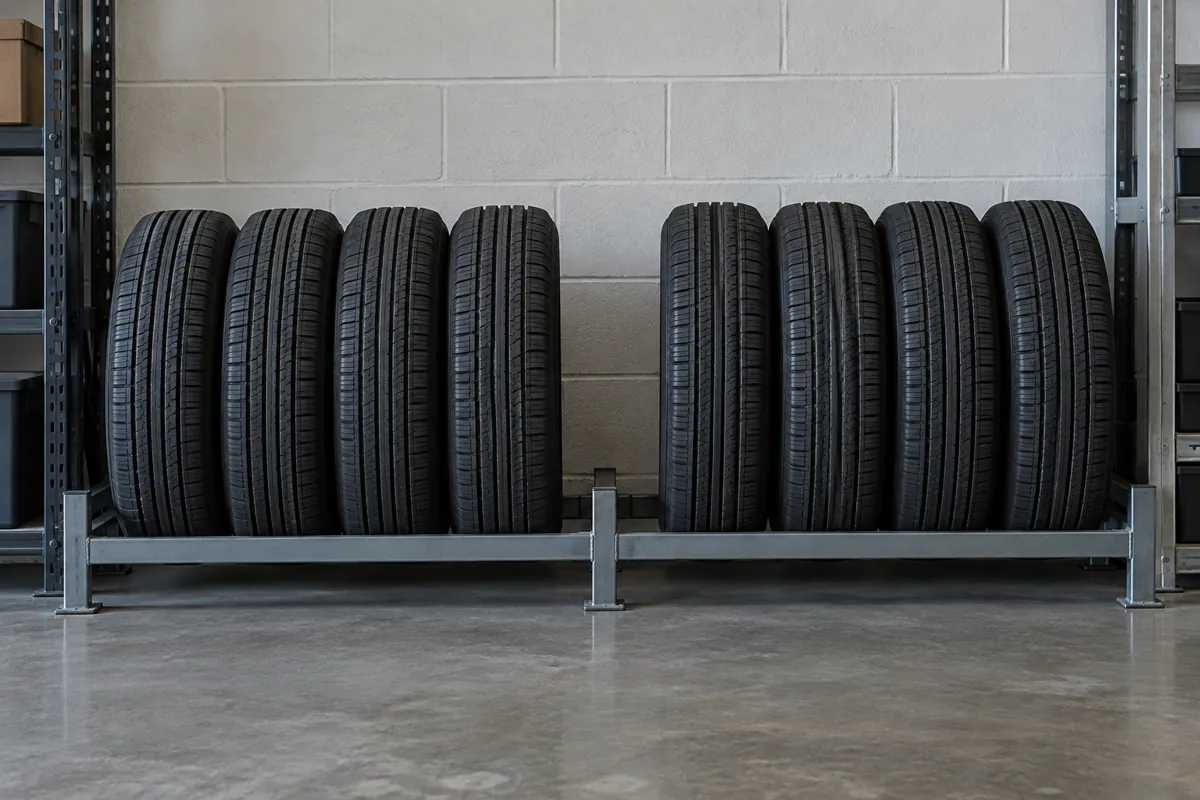
A rack fixes all three problems at once: every tire is off the floor, none carries another, and any single tire can come out without moving the rest.
| Floor stacking | Racking upright on the tread | |
|---|---|---|
| Moisture and dirt | Bottom tires sit on the slab | Every tire raised off the floor |
| Load on each tire | Bottom tires carry the stack | Each tire carries only itself |
| Picking one tire | Unstack to reach the oldest | Any tire, any time |
| Rotation (oldest first) | Hard; oldest is buried | Easy; load from one end, pick from the other |
| Stability | Leans and topples as it grows | Held by the rack; aisle stays clear |
| Floor space | Cheap until the stacks spread | Uses height; levels set by tire size |
If you do stack, keep stacks short, on a clean flat surface, and treat it as temporary staging, not storage. For portable stacking frames that keep tires upright and off each other, see stackable tire racks. For a whole room, the commercial tire storage racking guide compares pallet rack, dedicated tire rack and carousel options.
Horizontal or vertical? Mounted vs unmounted tires
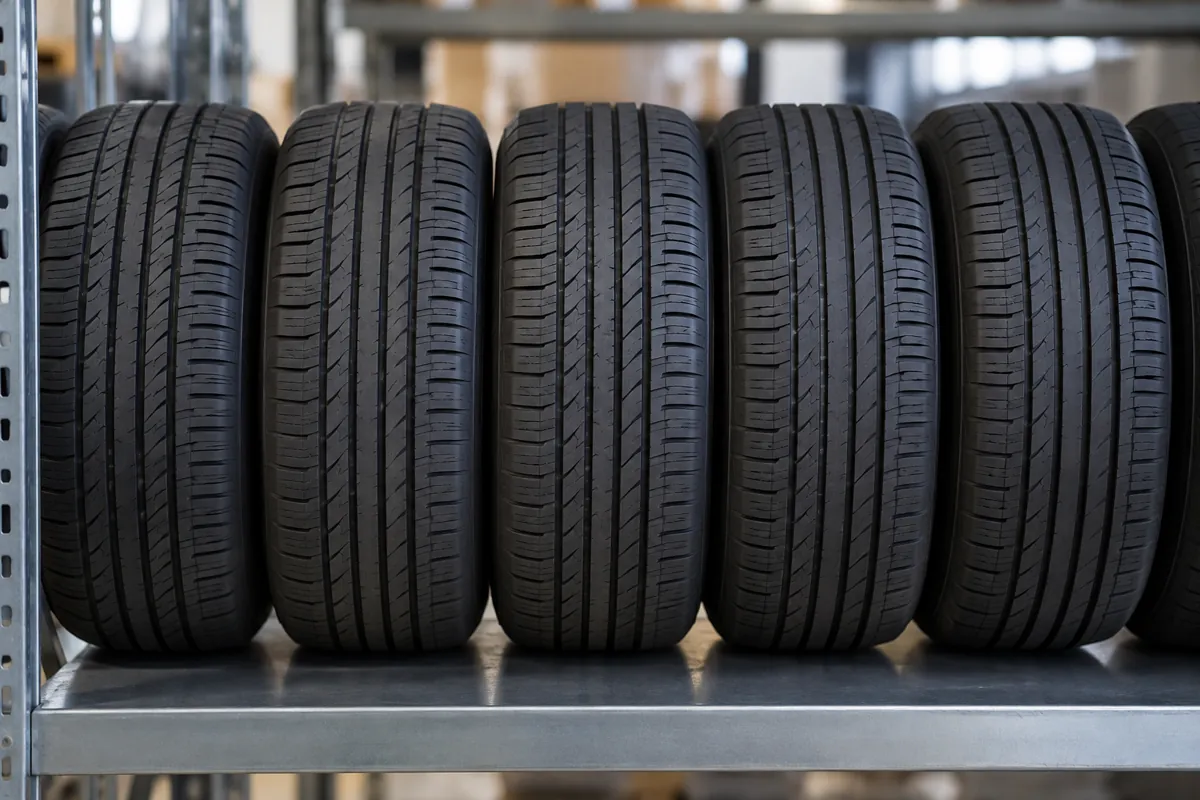
Unmounted tires: stand them up
An unmounted tire has no wheel to hold its shape, so it is happiest standing upright on its tread, side by side with its neighbors. That is “sidewall to sidewall” storage in a rack.
The industry bulletin also allows short horizontal “stovepipe” stacks of unmounted tires, but warns not to over-stack them. At least one major tire maker goes further and says not to stack or hang unmounted tires at all. Upright in a rack satisfies both.
Never hang an unmounted tire on a hook or peg; the bead carries the whole weight at one point.
| Tire type | Common guidance | What to check |
|---|---|---|
| Unmounted passenger / light truck | Upright on the tread, sidewall to sidewall, on a smooth level deck | Do not hang; avoid tall flat stacks; shift long-stored tires now and then |
| Mounted tire and wheel assemblies | Guidance differs: some tire makers say stack or hang mounted tires rather than stand them; many commercial rooms rack them upright to protect rim faces | Follow the vehicle or tire manufacturer for orientation and inflation; keep sets together |
| Tires on a stored vehicle | Take the weight off the tires, or unload the vehicle and keep tires inflated | Move the vehicle at least every three months |
| Large truck, ag and specialty tires | As the manufacturer specifies; racing and similar tires can have special requirements | Rack levels and decks rated for the real tire weight |
Mounted assemblies are heavier and the wheel is often worth more than the tire, so they change the rack design as well as the orientation question. Our page on tire and wheel assembly storage racks covers level capacity and rim protection, and heavy-duty truck tire storage racks covers commercial casings.
Ozone, UV, heat and moisture: where the rack should go
Where you put the rack matters as much as which rack you buy. Rubber is attacked by four things a typical shop has plenty of, and all four are layout decisions.
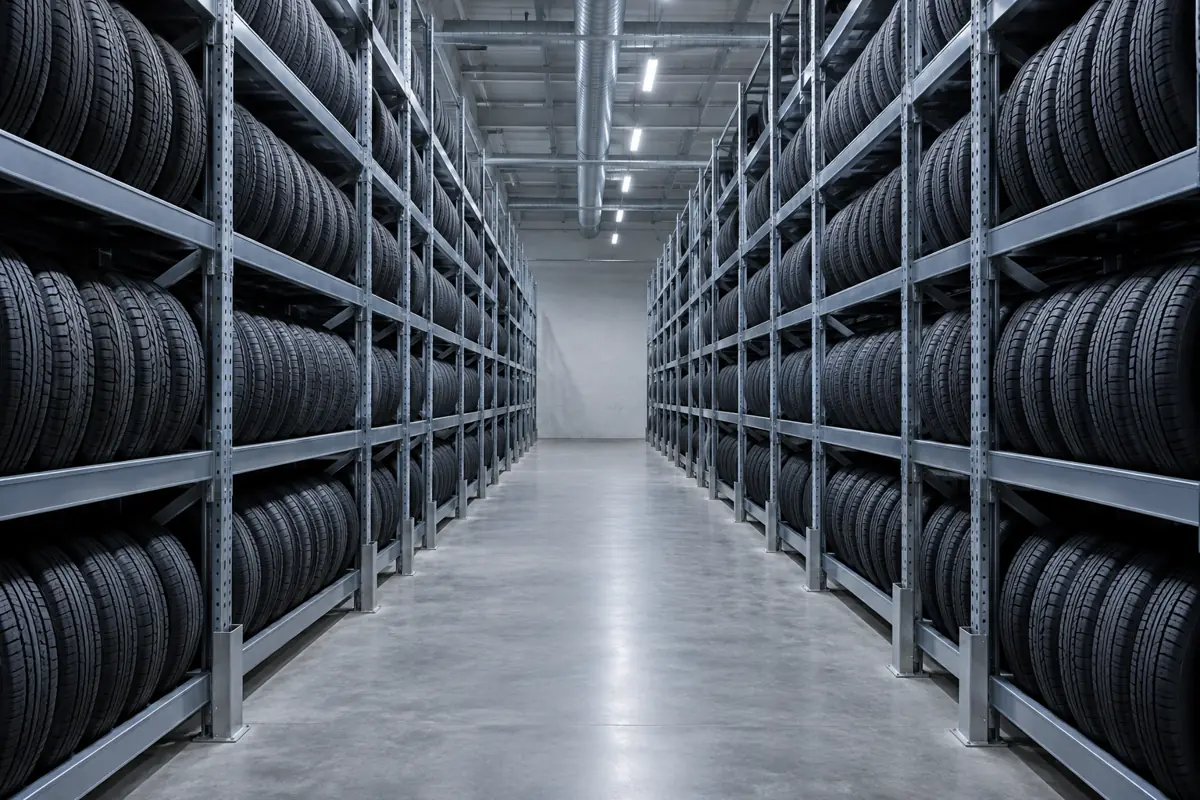
What the ideal tire room looks like
Windowless or shaded, cool, dry, and away from the electrical room and charging stations. Racks run in clean rows with clear aisles, every tire is off the slab, and nothing that drips or fumes is stored nearby.
If your racking uses wire decking, check how long tires will sit on it. For seasonal or long-term storage, a smooth solid surface spreads the load and avoids grid marks.
Preparing tires for storage, step by step
Clean
Wash off road grime, brake dust and any oil, and pick stones out of the tread.
Dry completely
A damp tire in a bag or a closed room is how mildew and corrosion start.
Inspect
Note cuts, bulges, cracking or uneven wear before the tire goes away, not when it comes back.
Mark position
For customer sets, record where each tire came off the vehicle so it can be rotated at the next fitting.
Bag or tag the set
Bagging limits ozone exposure; a tag or bin location keeps the set of four together.
Rack it
Upright on the tread, sidewall to sidewall, in the level sized for that tire.
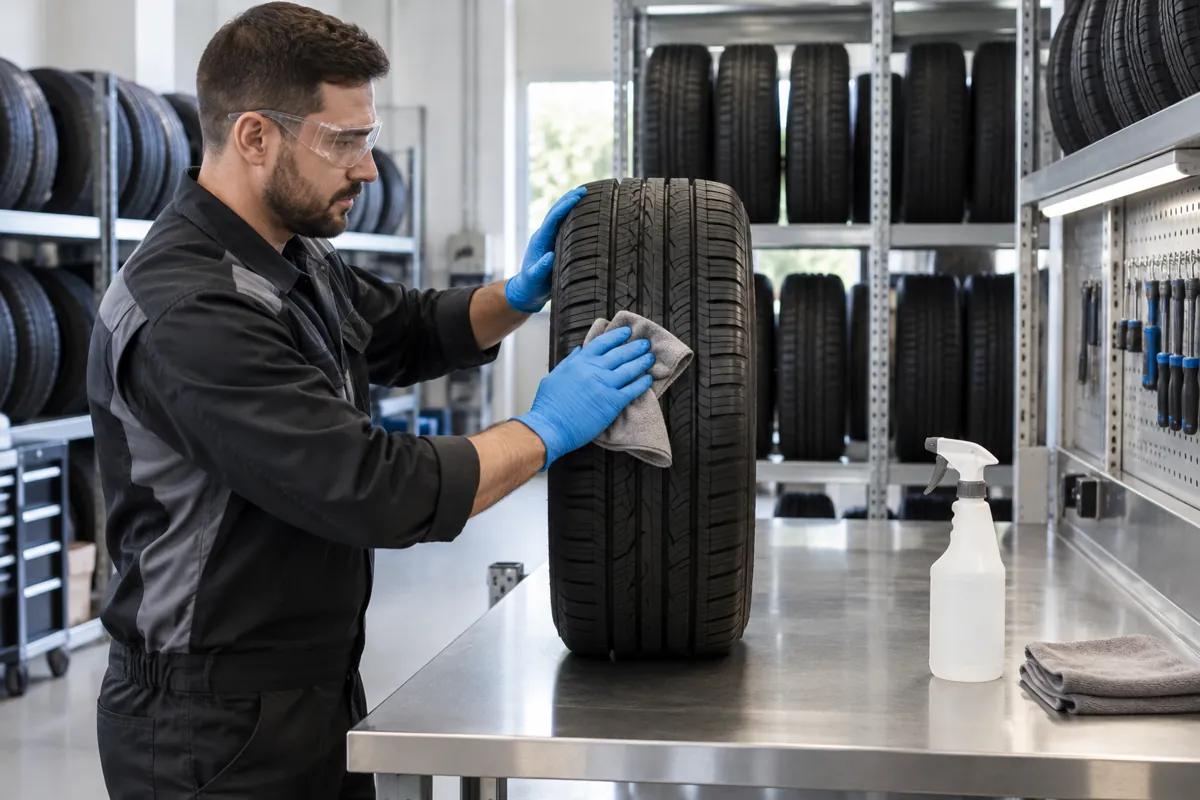
Clean and dry before it goes on the rack
Dirt holds moisture against the rubber, and oil and fuel residue keep working on it while the tire sits. A quick wash, a full dry and a look for damage takes minutes per tire and saves arguments later about whether a problem started in storage.
For customer-owned sets, photograph or note the condition at intake. It protects you and the customer.
Rotation and first-in, first-out by DOT date
Read the date, then lay out the rack around it
The last four digits of a tire’s DOT identification number are the week and year it was made. That is the number rotation runs on.
First-in, first-out is easy to promise and hard to do in a deep lane where the newest delivery blocks the oldest tire. Single-deep levels, loaded from one end and picked from the other, make the oldest tire the easiest one to reach.
Label bin locations by size, and when a delivery arrives, put it behind existing stock of the same size, never in front of it.
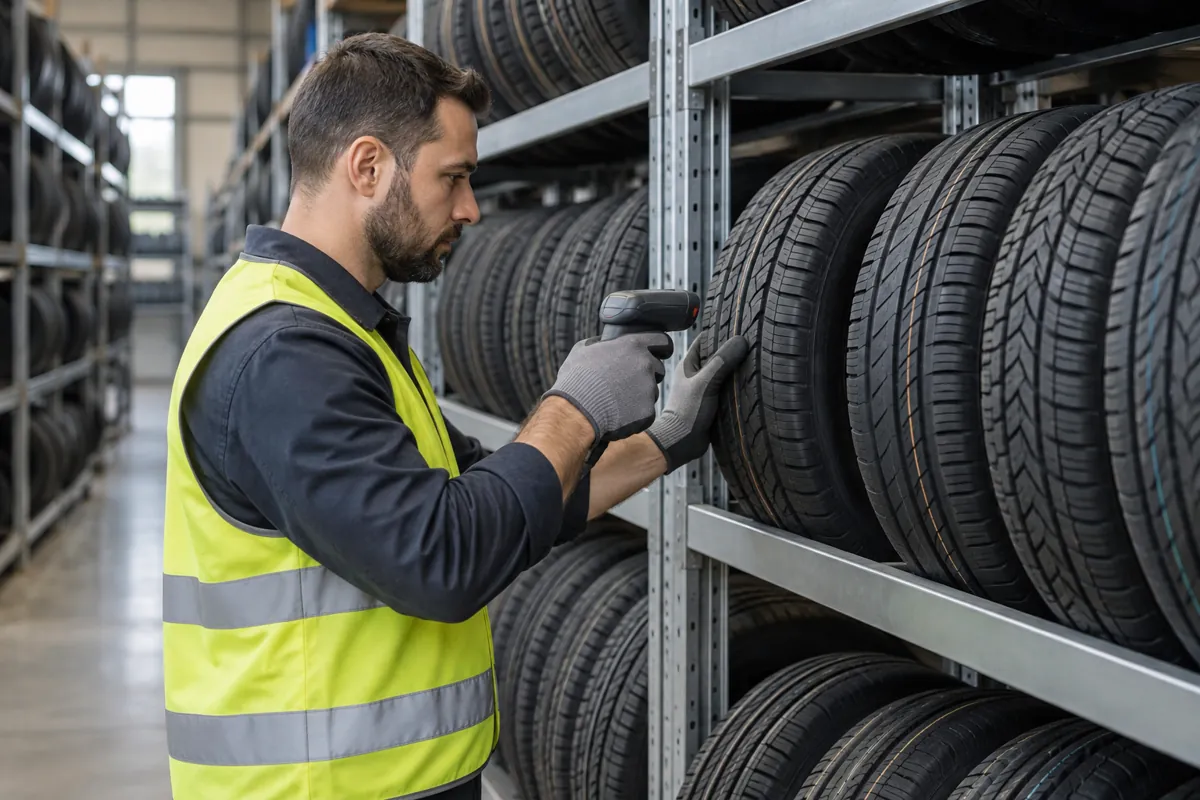
Fast movers belong at waist height near the service door; slow and seasonal sizes go high or deep. If space forces denser storage, our high-density tire storage page explains how to gain capacity without burying old stock. For distribution-scale rotation with reserve and pick faces, see the tire warehouse and distribution center page.
Storing seasonal and customer tire sets

Keep the set of four together, every time
Dealerships and tire shops that hold customers’ winter or summer sets face a different problem from retail stock: every set belongs to someone, and the whole lot arrives within a few busy weeks each spring and fall.
Give each set one location, tag it with a number that ties to the customer record, and size levels so a set of four fits a single slot. Mounted sets are heavier, so check the level capacity.
See dealership tire storage and service station and quick-lube tire storage for room layouts.
Where floor space is the real limit, an automated carousel brings each stored set down to the counter instead of sending a technician up a ladder; our Vidir tire carousel page covers that option.
Safety and fire code: what to settle first
Tires are their own fire commodity
Fire codes and sprinkler standards treat rubber tires as a separate, high-challenge commodity, and storage height and arrangement feed directly into the sprinkler requirement under NFPA 13. A small, incidental amount of tire storage is handled differently from a dedicated tire room or warehouse.
Before you fix rack heights, confirm the current code edition and local amendments with your fire-protection engineer and the authority having jurisdiction. In Utah, our tire rack installation, anchoring and permits guide explains the local thresholds.
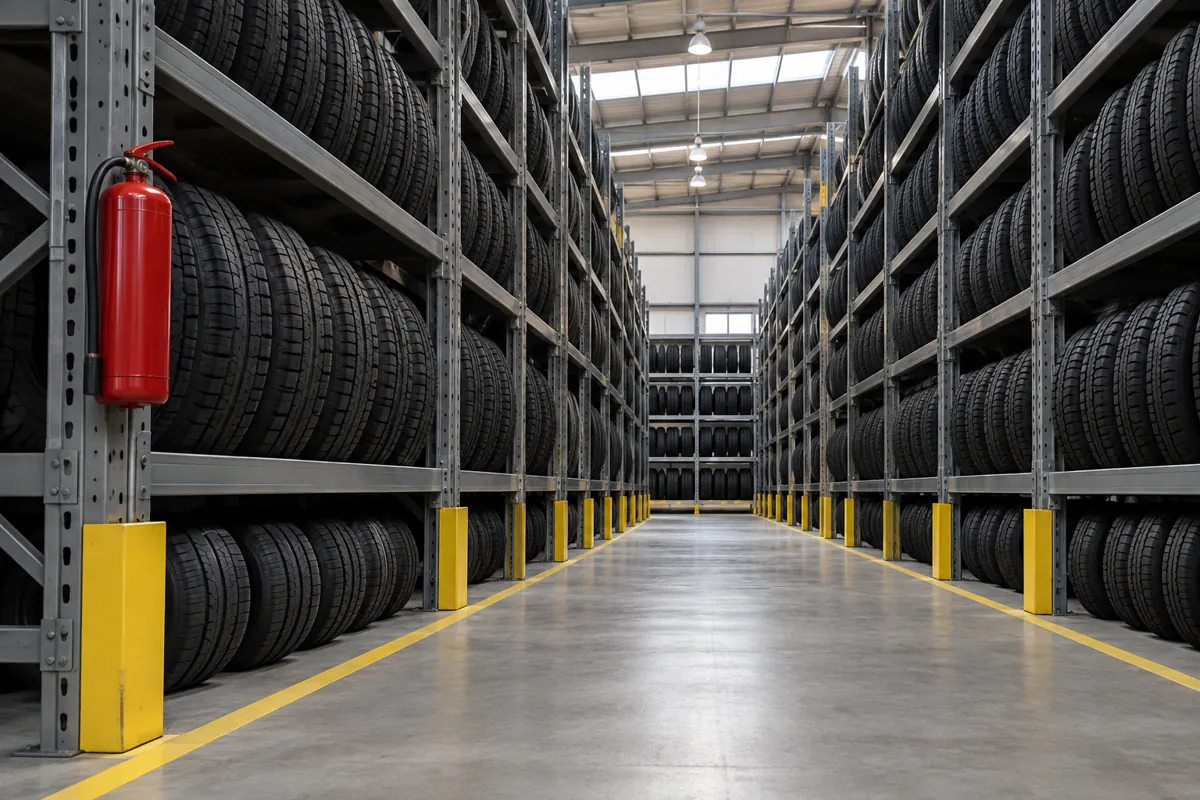
- Stable storage: OSHA 1910.176 requires stored material to be stable and secure against sliding or collapse, with clear aisles and good housekeeping.
- Clear aisles and exits: no tires parked in the aisle “for now”; extinguishers, panels and exits stay reachable.
- Nothing on top of the rack: storage above the top level pushes the top of storage past what the sprinklers were designed for.
- Anchored and undamaged racks: stationary racks are anchored per the manufacturer or engineer, and struck uprights are protected with rack guards and repaired.
- Level capacity known: especially for mounted, light truck and commercial tires.
Turn these rules into a rack count: try the Tire Rack Builder
Enter how many tires you store, the size mix and whether they are mounted. The free builder works out tires per level, levels and bays from real catalog rack sizes, then sends the plan to a specialist. Final pricing is quoted.
Choosing a tire rack for the way you store
The right rack follows from the answers above: how many tires, what sizes, mounted or not, how long they sit and how often you pick. Start with the page that matches your operation, or go back to the tire storage racking hub for the full comparison.
Not sure how many bays that adds up to? The free Tire Rack Builder turns your tire count, size mix and mounted-or-loose answer into levels and bays from real catalog rack sizes.
Larger rooms are usually built on the same pallet rack platform as the rest of the building, with decked levels set for tires. Send us the tire count, size mix, room dimensions and ceiling height and we will lay it out.
Get a free quote
Tell us what you are storing, the room size and your timeline. A project specialist will follow up with layout options and pricing. Prefer to talk? Call (800) 326-4403.
How to store tires: FAQs
What is the best way to store tires?
Should tires be stored standing up or lying flat?
How do you store tires without rims?
How do you store tires on rims?
Can tires be stored outside?
Should stored tires be bagged?
How long can tires stay in storage?
What causes stored tires to crack?
Do you sell tire storage racks?
Need a better place to store tires?
Tell us how many tires you hold, the size mix and the room, and we will recommend and quote the right rack. Call 800-326-4403.