
Home › Pallet Rack › Tire Storage Rack › Stackable Tire Racks
Stackable Tire Racks
Portable, collapsible and stacking tire frames are the right answer for seasonal surge, tight leases and storage that has to move — and the wrong answer for permanent capacity. Here is how to tell which situation you are in, and how high a stack can safely go.
No install
No anchors, no permit conversation
Stack limits
Loaded and empty are different numbers
Seasonal
Storage that folds away in the off-season
Height cap
Set by fire code, not by the frame
What a stackable tire rack actually is
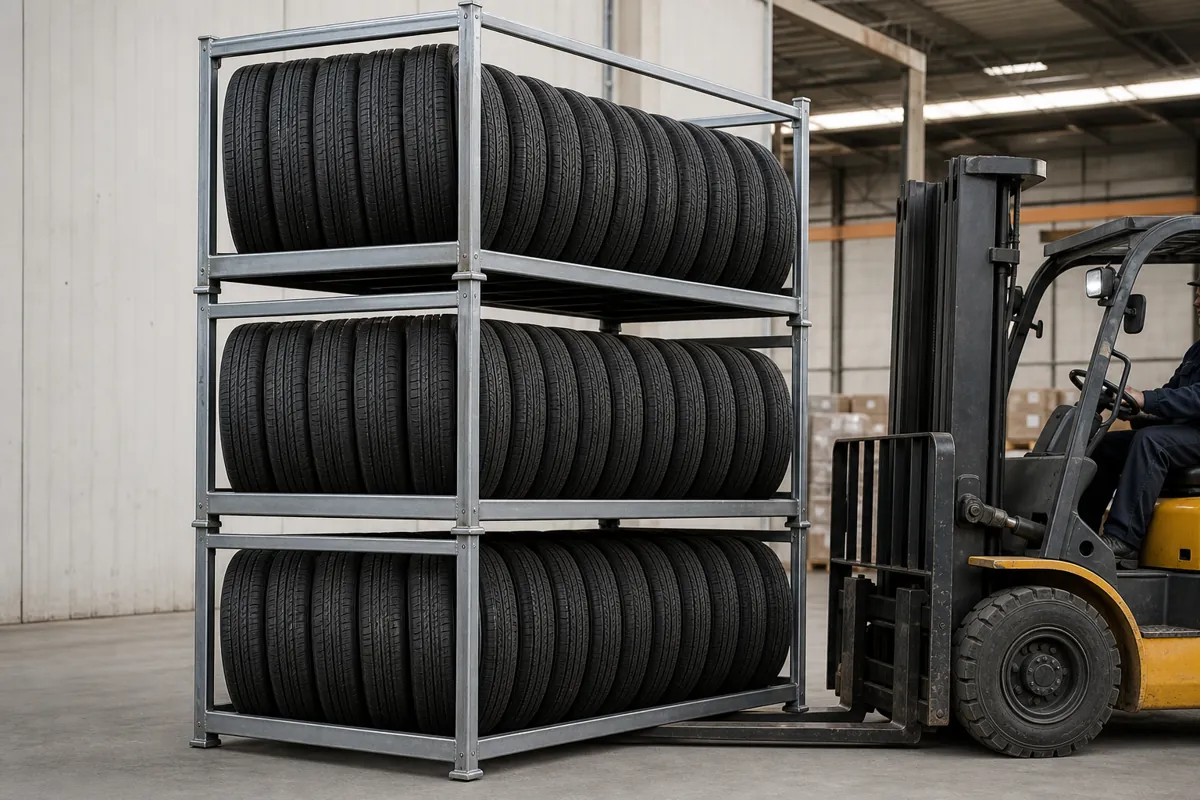
A stackable tire rack is a free-standing steel frame that holds tires upright on their tread and is designed so that identical frames sit securely on top of one another. Corner pockets, nesting posts or stacking lugs locate the frame above onto the one below, so a loaded column behaves as one structure instead of a pile.
That single design decision changes everything about how the storage behaves. There are no uprights to anchor, no beams to level, no aisle layout to commit to and nothing to dismantle when the space is needed for something else. Storage becomes inventory: you buy frames, you deploy them where the tires are, and you take them away when the season turns.

Why tires ended up with their own category of frame
Tires are light for their bulk, awkward to hand-stack, and arrive in seasonal waves. A tire that weighs 25 lb still occupies most of a cubic foot, and a delivery of several hundred of them shows up in one truck. Conventional storage handles the weight easily and the surge badly.
Portable stacking frames were the practical answer: a unit of storage roughly the size of a pallet position that can be created and removed at the speed of the season. The same logic explains why they are so common in distribution yards, seasonal changeover operations and shops with more inventory than building.
They are not a replacement for the tall, selective bays covered on our tire storage rack overview. They are a different tool, and using the wrong one is the single most expensive mistake in this category.
Shop Tire Racks Online
Genuine tire racks you can order online. Prices are current store prices for the lowest-priced in-stock starter unit in each line; add-on bays, other sizes and freight are in each category. Some common sizes are in stock at select manufacturers, subject to confirmation. Larger rooms on pallet rack are quoted.


When stacking frames are genuinely the right call
There are four situations where portable stacking frames beat installed racking outright, and it is worth being honest about whether you are in one of them.
The test that settles it
Ask how many months a year the frames will be full. Under six, portable frames almost always win on total cost because you are not paying to keep empty steel standing. Over nine, fixed racking wins, because it uses building height that a stack of frames cannot reach and stores far more tires per square foot of floor.
The four types worth pricing
These are the configurations that come up in real tire operations. All of them coexist happily with an installed layout, and the fixed portion is normally built from the same components as our pallet rack systems, which is why a room can start as frames and grow into racking without throwing anything away.
 Open-frame portable stacking racksThe default. A rigid welded steel frame with open sides, loaded by hand, lifted and stacked by forklift. Best value per frame and the easiest to buy in quantity.
 Collapsible and folding framesHinged gates or knock-down construction so empty frames fold flat and nest. Costs more per unit and pays for itself the first off-season if your demand is genuinely seasonal.
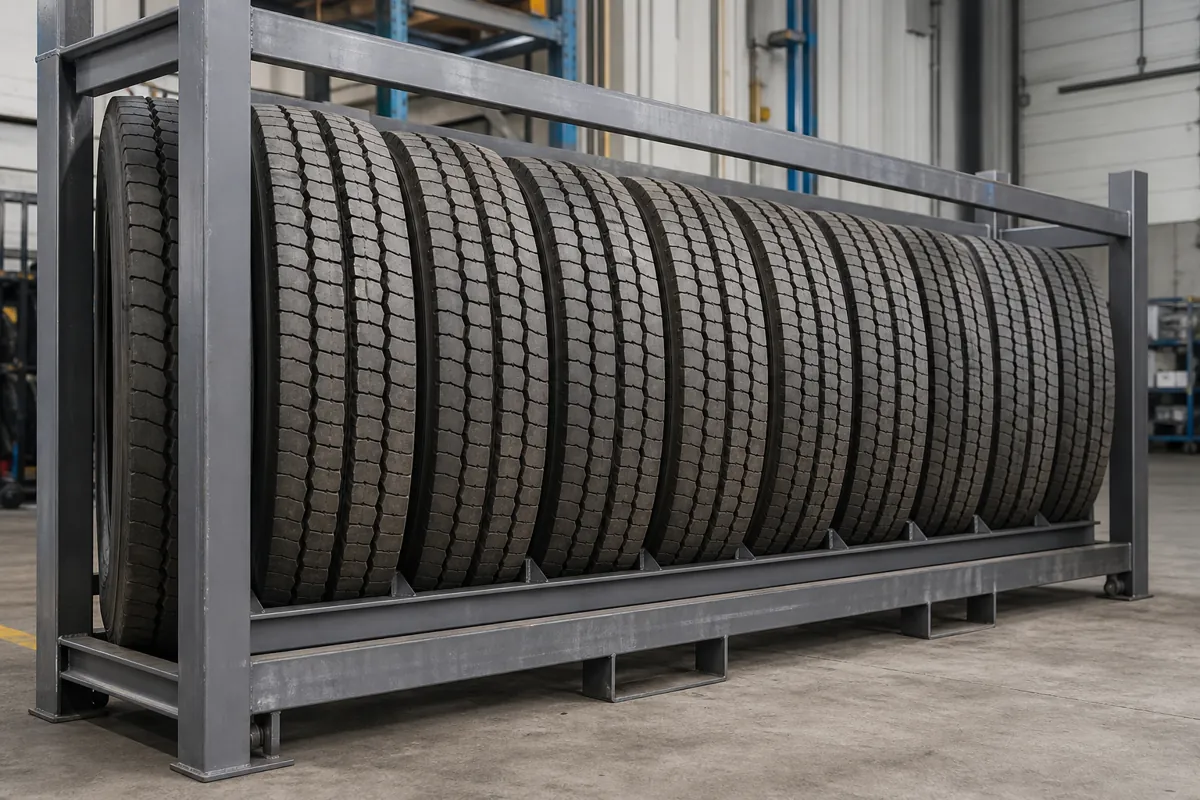 Heavy commercial stacking framesLarger, deeper frames rated for truck and bus tires. Weight, not bulk, governs here — see the commercial-tire page before assuming a passenger frame scales up.
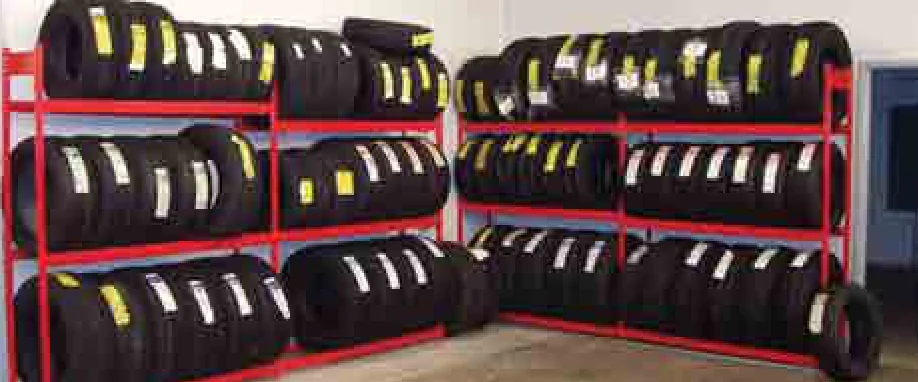
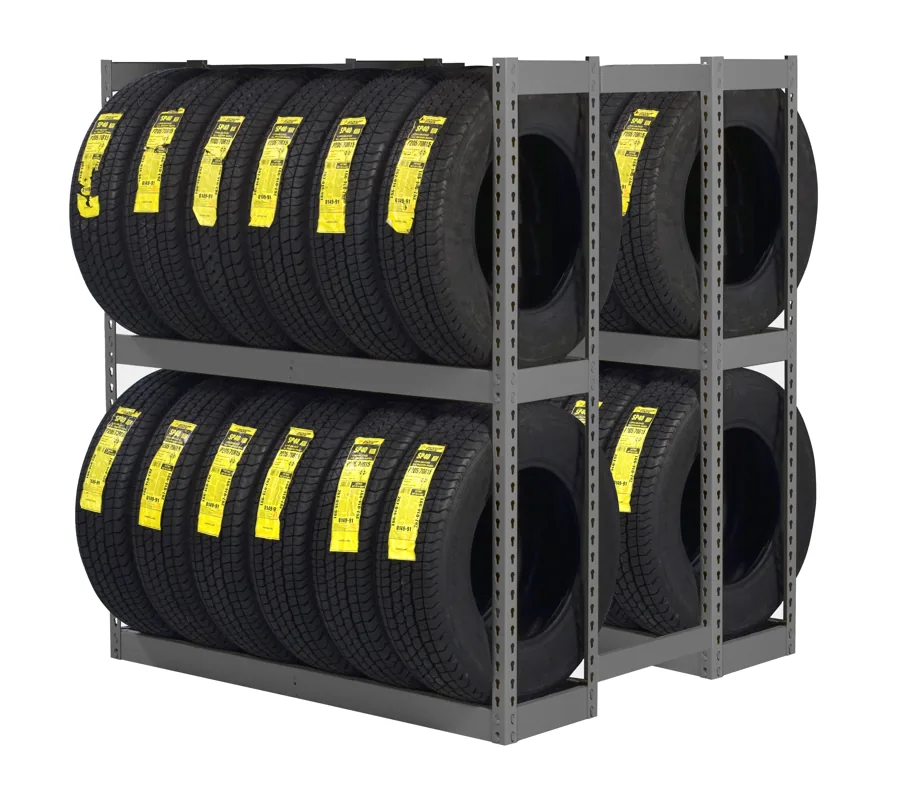
 Boltless shelving tiers as a stacking alternativeFor indoor storerooms with no forklift, tiered boltless shelving gives similar flexibility with better selectivity, and assembles without tools or anchors.
One category deliberately sits outside this list. Racks on casters are not stacking racks — they solve handling rather than storage, and they do not stack while loaded. If what you actually need is tires that come to the technician, read mobile and rolling tire storage racks instead. And if the constraint is that the building simply will not hold what you carry, high-density tire storage racks is the page that deals with it properly, because no quantity of portable frames fixes a density problem.
Stacking limits, and where the load actually goes
Every stackable frame carries two separate published limits, and confusing them is how columns get built that should not exist.
| Limit | What it means | Typical published range | Who governs it |
|---|---|---|---|
| Load capacity per frame | The total tire weight one frame is rated to carry, and to transmit to the frame below it. | Commonly around 2,400 lb for passenger-tire frames; heavier for commercial sizes. | The frame manufacturer’s rating for that specific model. |
| Stack height, loaded | How many loaded frames may sit in one column. This is the number that matters day to day. | Commonly four to six frames for portable steel tire frames. | The manufacturer’s rating, then your floor, then the fire code. |
| Stack height, empty or nested | How high frames may be stacked when empty and folded or nested for storage. | Commonly around twenty frames. | The manufacturer’s rating and safe handling practice. |
| Storage height, code | How high the commodity may be stored in your building for the arrangement you build. | Set by arrangement and use, not by the frame. | Fire protection engineer and the authority having jurisdiction. |

The load path nobody checks
In a fixed rack, load travels down uprights that were designed, anchored and inspected as a system. In a stack of frames, the entire load of the column passes through four corner contacts on the frame below and lands on the slab through the base of the bottom frame.
The bottom frame carries everything. Its rating has to cover the loaded frames above it, not just its own tires. Read the manufacturer’s stacking limit as a limit on the whole column.
The slab carries a point load. A tall column concentrates its weight into four small contact areas. On a thin, old or cracked slab that is a very different loading case from a distributed rack base plate, and it is worth checking before building columns.
Level matters more than it looks. Frames stack squarely on a flat floor and lean on an uneven one. A leaning column of loaded frames has no diagonal bracing to save it, which is the practical reason stacking limits are conservative.
The same discipline applied to fixed racking — documented capacities, marked limits, scheduled inspection — belongs here too. Our notes on rack weight capacity and rack inspection and repair transfer directly.
Not sure whether to buy frames or build bays?
Send your peak and off-season tire counts, your size mix and your clear height. We will price both options honestly, including the case where the answer is a small number of frames and no project at all.
Fire code sets the real ceiling on a stack
This is the part of the conversation that portable-frame buyers skip most often, precisely because there is no installation and therefore no natural moment where anyone reviews the design. Rubber tires are a high-challenge commodity, and the code cares about the arrangement, not about whether the steel holding it was bolted down.
Why this bites harder with portable frames
Installed racking gets designed once, by people who ask about sprinklers. Portable frames get bought by the pallet and stacked by whoever is on shift, and the arrangement drifts upward one frame at a time until it no longer matches anything anyone approved. Set a written maximum stack height for your building, mark it, and hold to it.
Handling, tire condition and rotation
Portable frames make it easy to store tires badly, because nothing about the equipment forces a discipline.
Three habits cover most of the damage we see.
- Tires stand on the tread, never on the sidewall. A tire resting on its sidewall deforms under its own weight and under everything above it. This is the one rule that applies to every page in this cluster and every type of tire storage.
- Keep tires off the floor on a flat, smooth support. Industry storage guidance calls for clean, dry, well ventilated, cool and dark storage on a smooth support rather than a grated one that can indent rubber over time.
- Do not force one more tire in. Over-compressing a row to gain a unit deforms the bottom tires and makes the frame harder to unload safely.
- Rotate oldest stock first. A column of frames is last-in, first-out by construction. Without a written rotation rule, the frame at the bottom becomes a time capsule.
- Secure the load before lifting. A tire that works loose during a lift at height is a serious incident with an unremarkable cause.
- Keep aisles clear and marked as the surge builds — general materials handling requirements do not relax because the storage is temporary. Sizing them properly is covered in our forklift aisle width guide.
- Inspect frames like racking. Bent corner posts, distorted stacking pockets and cracked welds take a frame out of service; they do not get nursed along.

Seasonal surge, done properly
Decide the footprint before the delivery. Mark where surge frames may stand, and where they may not, on the floor. It is far easier to hold a line that was painted in advance.
Store the empty frames somewhere deliberate. The saving from collapsible frames is only real if the folded stack has a home that is not the pick face.
Keep one selective face. Even in peak season, the fast-moving sizes should live in directly picked positions rather than in the middle of a column. Columns are for depth, not for daily picks.
Review after the season. If the frames never emptied, next year’s answer is fixed racking
— and the frames are still worth having for the peak above it.
Stackable frames versus fixed tire racking
Set side by side, the choice is rarely close once the duration of the need is known.
| Stackable / portable frames | Fixed tire racking | |
|---|---|---|
| Best for | Seasonal surge, short leases, storage that moves, temporary works. | Permanent core inventory, tall buildings, daily picking. |
| Capacity per square foot | Limited to the loaded stack height the frame allows. | Uses full usable building height; far more tires per square foot. |
| Selectivity | Column is last-in, first-out; the bottom frame is buried. | Every level directly picked in a selective bay. |
| Install and commitment | None. Deploy and remove in hours; no anchors. | Installed, anchored, levelled and inspected as a system. |
| Cost per tire stored | Higher, because you pay for a frame per unit of storage. | Lower over years, because one bay serves many levels. |
| Flexibility later | Redeployable to another site; resale value if not. | Reconfigurable within the building; components reusable. |
The most common real answer is both. A fixed layout — usually a straightforward selective pallet rack configuration adapted for tire levels — carries the inventory you hold all year, while a modest fleet of frames absorbs the peak. That combination costs less than sizing fixed racking for the peak and stores far more than frames alone. If you are running a retail or service operation rather than a warehouse, the specifics of that mix are worked through on tire shop storage racks.
Specifying frames without guessing
Five numbers make the difference between frames that fit your operation and frames that sit in a corner.
Your real tire mix
Section width and overall diameter for each size band you hold in volume. Frame internal dimensions are quoted for a tire size, and it is rarely yours.
Peak versus base inventory
The gap between the two is the number of frames you need. The base inventory is the number that should be sitting in fixed racking instead.
Loaded stack height you will actually build
Decide this in advance against the manufacturer’s loaded rating, your slab and your fire protection scheme — then mark it on the floor and hold to it.
Handling method
Forklift-placed frames need fork pockets, aisle width and travel clearance for a stacked column. Hand-loaded storeroom frames need none of that and should not be over-specified.
Off-season storage plan
Where the empty frames live decides whether collapsible construction is worth the premium. If they will stay loaded year-round, price fixed bays instead.
Where this fits in the wider tire storage decision
Stackability is one answer to a question that has four: how heavy your tires are, how you handle them, whether they need to move, and whether the building can hold what you carry. Our tire storage rack overview works through all four and is the right starting point when the layout is still open. If your inventory is dominated by commercial sizes, read heavy-duty truck tire storage racks first, because weight rather than bulk will govern the design. If you store customer sets on rims, tire and wheel assembly storage racks covers the extra care a finished rim needs.
And when portable frames stop being the answer, the permanent storage that replaces them comes from the same pallet rack platform — standard, serviceable, reconfigurable steel installed properly. That matters, because it means outgrowing your frames is an upgrade rather than a restart. See rack installation for how that transition is normally handled.
Get a free quote
Tell us what you are storing, the room size and your timeline. A project specialist will follow up with layout options and pricing. Prefer to talk? Call (800) 326-4403.
Stackable Tire Rack FAQs
What is a stackable tire rack?
How high can you stack loaded tire racks?
Are stackable racks cheaper than fixed tire racking?
Can I stack tires without racks at all?
Do stackable tire racks damage tires?
Can a forklift move a loaded stackable rack?
What is the difference between stackable and collapsible?
When should I stop buying frames and install racking?
Can stackable frames and fixed racking be mixed?
Get the right mix of frames and fixed bays
Send your peak and base tire counts, size mix, clear height and how long you expect to need the space. We will show what portable frames should cover, what belongs in fixed racking, and what each costs. Call (800) 326-4403.