
Dealership Tire Storage
A franchise store does not hold one pile of tires. It holds retail stock, mounted assemblies, customer-held seasonal sets and the fast movers the quick-lane burns through daily. Here is how to rack, zone and label all four so the service department stops walking.
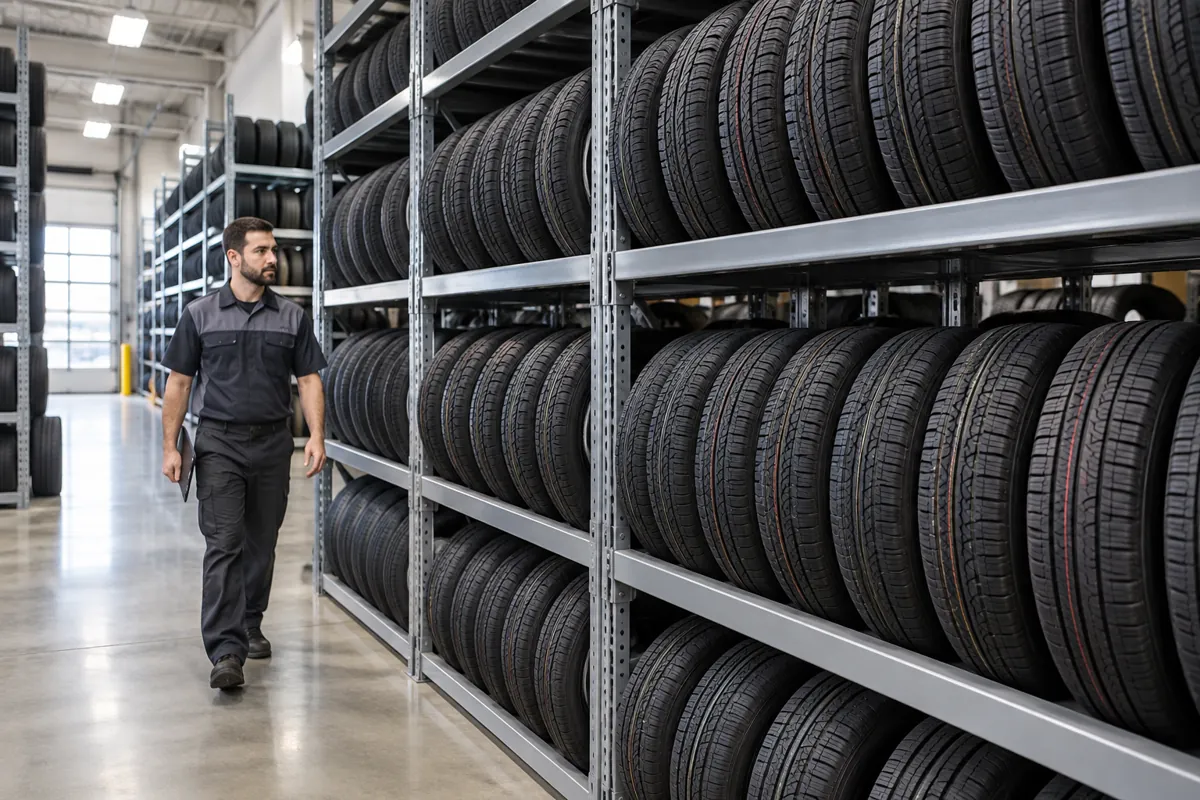
Four populations
Retail, mounted, held, fast-pick
Steps per RO
The metric dealership racking moves
Wheel finish
What mounted storage protects
Marked aisles
The baseline safety requirement
Why dealership tire storage is not just a bigger tire shop
An independent tire shop stores one thing: tires it intends to sell or fit. A franchise dealership stores four different things that happen to look the same, and it stores them for four different reasons — retail tire inventory, wheel-and-tire assemblies from pre-delivery and accessory work, customer property being held between seasons, and the handful of sizes the express lane turns over every single day.
Those populations have different velocities, different value at risk and different consequences when something goes wrong. Mixing them into one wall of racking is the root cause of most of what service managers complain about: the express lane waiting on a tire that is behind the seasonal sets, a held customer set sold by mistake, or an alloy wheel scuffed because assemblies were levered past each other.
The fix is usually layout before purchase
Two of the three problems above are solved with a tape measure, a label printer and a weekend of moving stock. Only the mounted-assembly protection normally needs a specification change, and it is a modest one.
That order matters, because stores are routinely sold equipment to solve problems that were layout problems. Re-pitching beam levels to the size bands you genuinely hold, and reassigning positions by how often each band is fitted, will usually free more usable capacity than a purchase — and it tells you precisely how much extra storage you still need, if any.
If the whole storage approach is still open rather than dealership-specific, start with the tire storage rack overview, which works through rack types before environments.
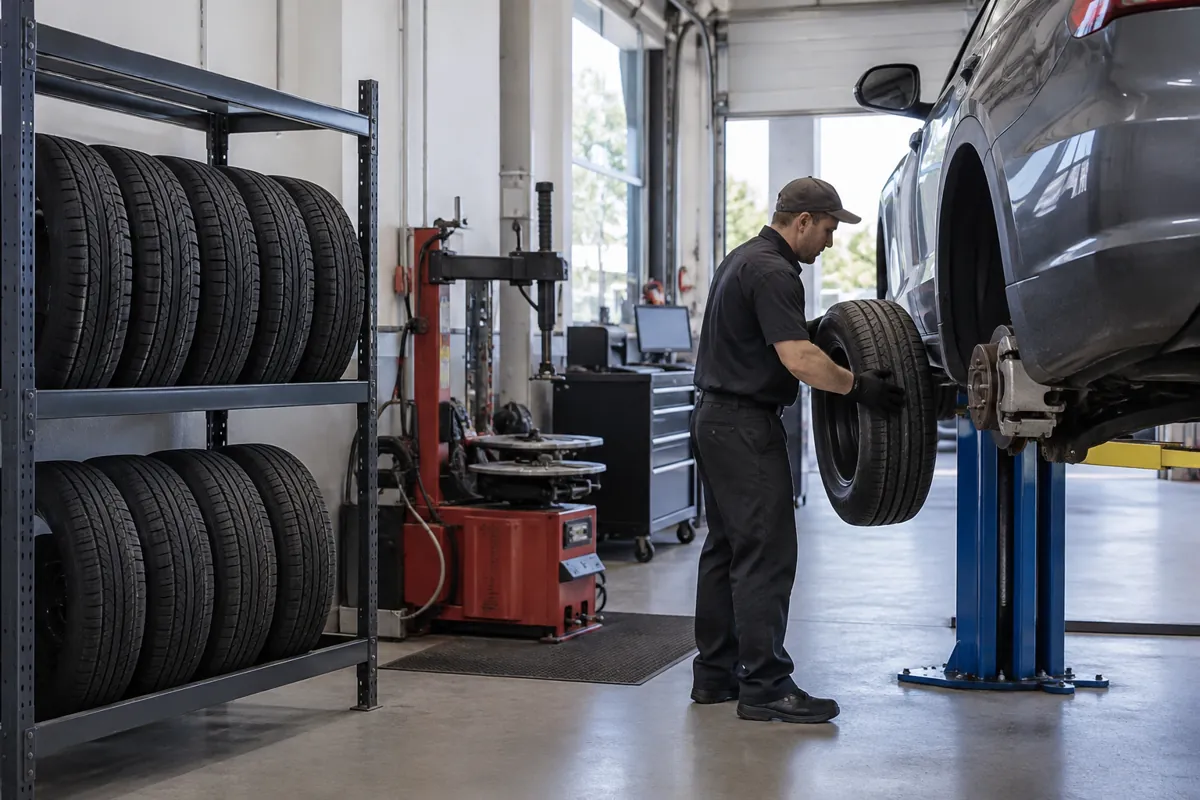
Shop Dealership Tire Racks Online
Genuine tire racks you can order online. Prices are current store prices for the lowest-priced in-stock starter unit in each line; add-on bays, other sizes and freight are in each category. Some common sizes are in stock at select manufacturers, subject to confirmation. Larger rooms on pallet rack are quoted.


The four tire populations a store holds
Write these down for your own store before designing anything. Every storage decision that follows is downstream of how many of each you hold at your peak, and how often each is touched.
| Population | What it is | What it needs | Where it belongs |
|---|---|---|---|
| Express-lane fast movers | The sizes the quick-lane and alignment bays fit every day. | Hand height, single-deep, fully selective, no equipment to reach. | Within a few steps of the lift. |
| Retail and long-tail stock | Sizes carried for sale, seasonal buys, promotional quantities. | Height and depth acceptable; slower access is fine. | Back wall or upper levels. |
| Mounted wheel-and-tire assemblies | Accessory, PDI and take-off assemblies on finished wheels. | Smooth continuous support, generous clearance, no drag-past. | Protected bays with controlled access. |
| Customer-held sets | Seasonal changeover sets and sets awaiting appointments. | Separate area, tagged by set, racked in pickup order. | Near the collection door, away from retail stock. |
The population most stores under-count
Mounted assemblies. They arrive from accessory installs, winter packages and take-offs, they are the most valuable thing in the room, and they are the population most often stored wherever there happened to be a gap. Counting them honestly at peak — not on an average Tuesday — is what determines whether you need a dedicated protected bay run or a few reserved levels.
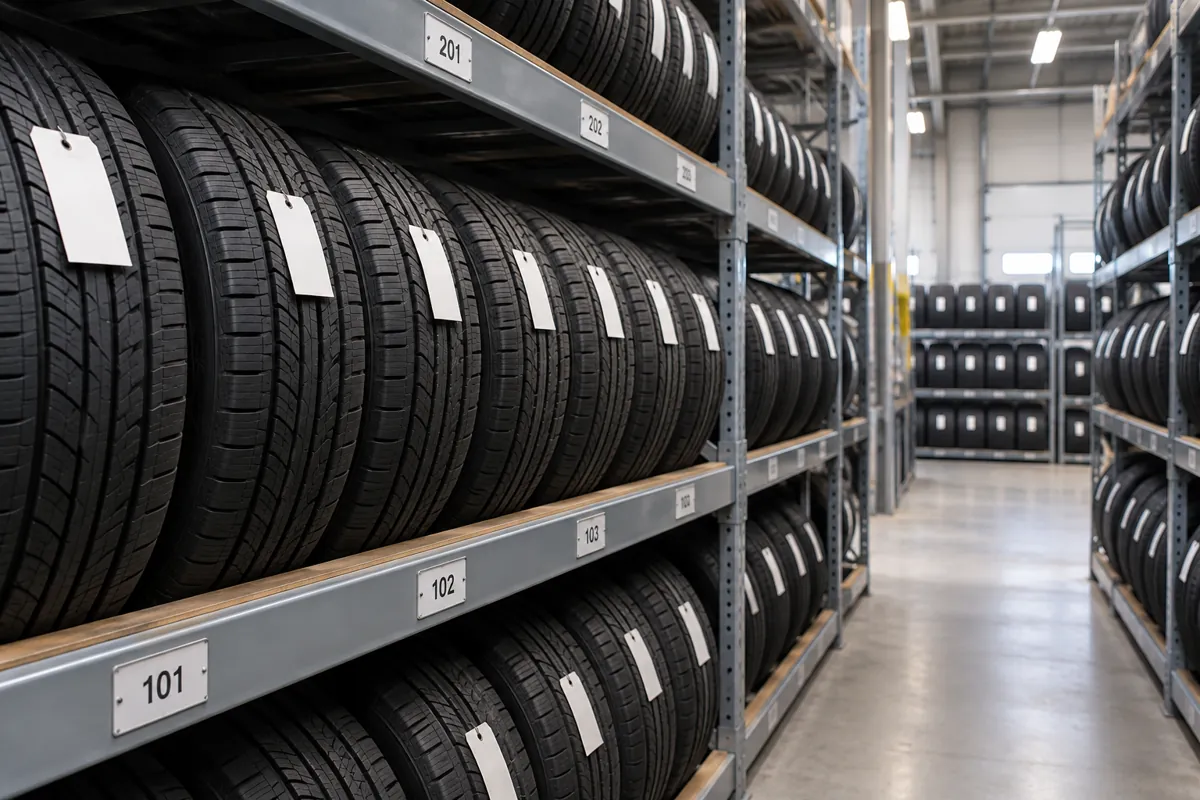
Count at peak, not on average
Peak is what storage must hold. Winter changeover, a run of truck deliveries and an accessory promotion can all land in the same fortnight.
Count by population, then by size band. Totals hide the problem; a store can be comfortable overall and completely out of positions for one band.
Include what is on the floor today. Anything currently stored in a walkway or leaning against a wall is unmet demand, and it is the first thing a new layout should absorb.
Zone the service department before placing a single bay
Dealership tire storage is judged on steps per repair order, not on cubic feet. A room that holds more but adds a walk to every tire job has made the store slower. Zoning first is what prevents that.
Mark the express zone first
Identify the sizes fitted daily and reserve the closest positions to the quick-lane and alignment bays for them. This is the single highest-value storage in the building.
Push bulk to the far wall or upward
Long-tail retail stock can take the walk and the height. Depth and elevation are cheap here because the access is infrequent.
Give mounted assemblies their own run
Protected, clearly delimited and not a shared overflow. Mixed storage is where wheel damage happens.
Separate the customer hold area physically
Different bays, ideally a different area, close to the collection door and never intermingled with stock that can be sold.
Mark a receiving rectangle and keep it empty
Deliveries staged on the floor in an aisle are the most common safety finding and the most common cause of drifting counts. A painted area by the delivery door fixes both.
If the store shares one room between tires and small parts, design each for its own geometry rather than compromising both: tire bays pitched for tire diameters where the service traffic is, shelving sized for cartons elsewhere. Our wider automotive storage solutions section covers the parts-side of that room, including counter, will-call and warranty retention areas.
Size the levels to a dealership mix, not to a catalogue
Every capacity number in a brochure assumes a tire size. Dealership mixes skew larger than an independent shop’s because of trucks, SUVs and larger-diameter factory fitments, so a generic pitch wastes either space or access. Four measurements per size band are enough to design the whole room.
- Section width per band — how wide the tire is across tread and casing. This sets how many nest along a beam. Measure the widest common size in the band, never an average.
- Overall diameter per band — diameter plus honest handling clearance sets the beam pitch, and decides whether you get four levels or five under the same ceiling.
- Peak count per band — how many you hold at your busiest, split by population. Storage built for the wrong band is wasted floor.
- Fitting frequency per band — how often each is actually fitted. This decides what goes bay-side and is the measurement stores most often skip.
- Then compute rather than guess — tires per level = usable beam length / section width; levels = usable height / (diameter + clearance). Multiply for tires per bay and compare it honestly with what the room holds today.
Band the pitch, do not average it
Running one pitch for passenger sizes and a separate, taller pitch for light-truck and larger fitments is the most common capacity win in a dealership tire room. A uniform pitch across a mixed inventory is convenient to build and expensive to own, because every smaller tire is paying for the clearance the largest one needed. Where a real share of the work is commercial vehicles, weight rather than bulk governs the design — heavy-duty truck tire storage racks covers that case.
Want your tire room laid out properly?
Send your size mix, peak counts by population, floor plan and clear height. We will zone the room, pitch the levels to your bands and show what the space can hold before anything is quoted.
The rack options that make sense in a store
Dealerships rarely need exotic equipment. These four cover almost every service department layout, and the fixed ones are built from the same components as our pallet rack systems — standard, serviceable steel that can be re-pitched and extended as the fitment mix changes rather than replaced.
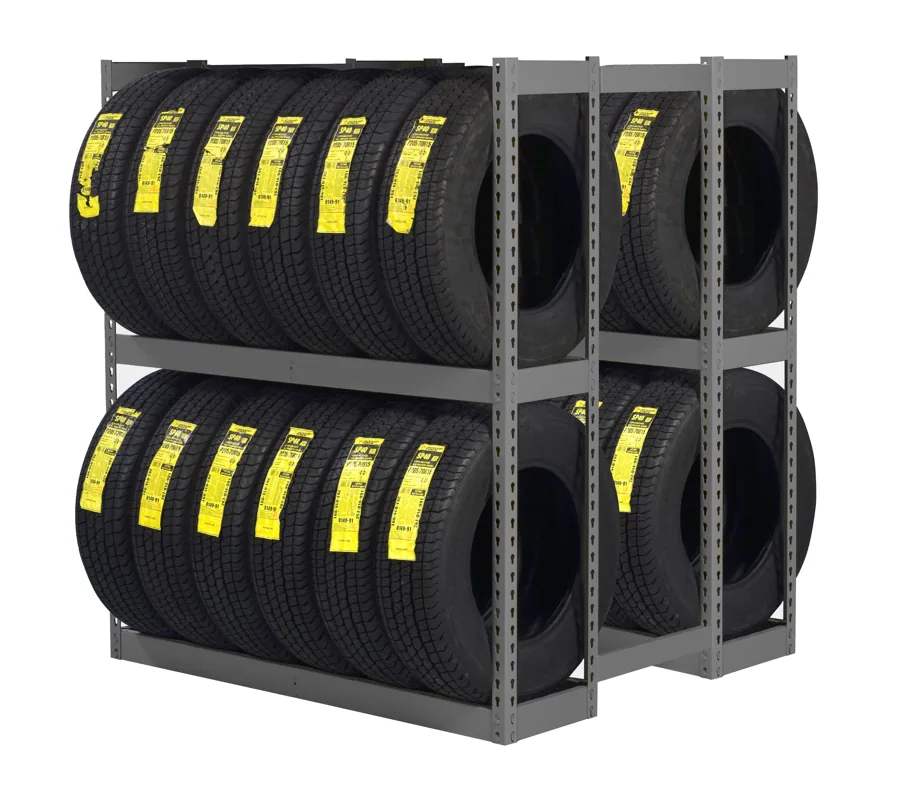
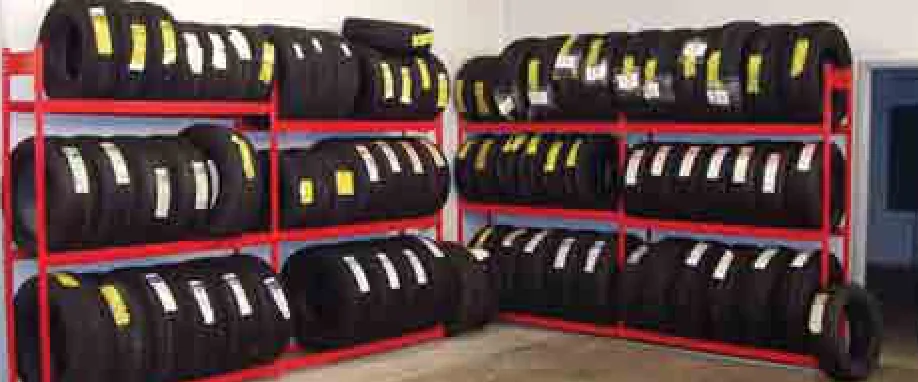
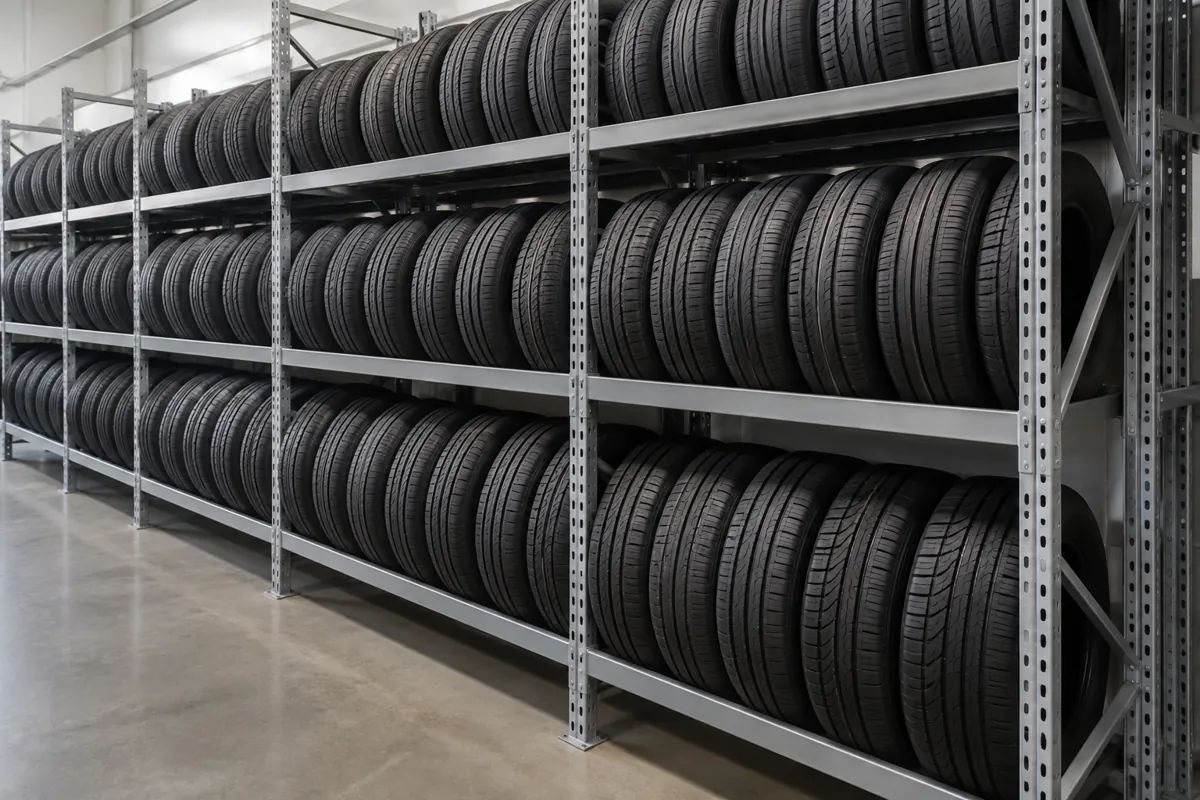 Selective tire baysThe workhorse. Beam levels pitched by size band, hand loaded, every position directly picked. Best value, easiest to reconfigure, and the right default for retail stock and express-lane storage.
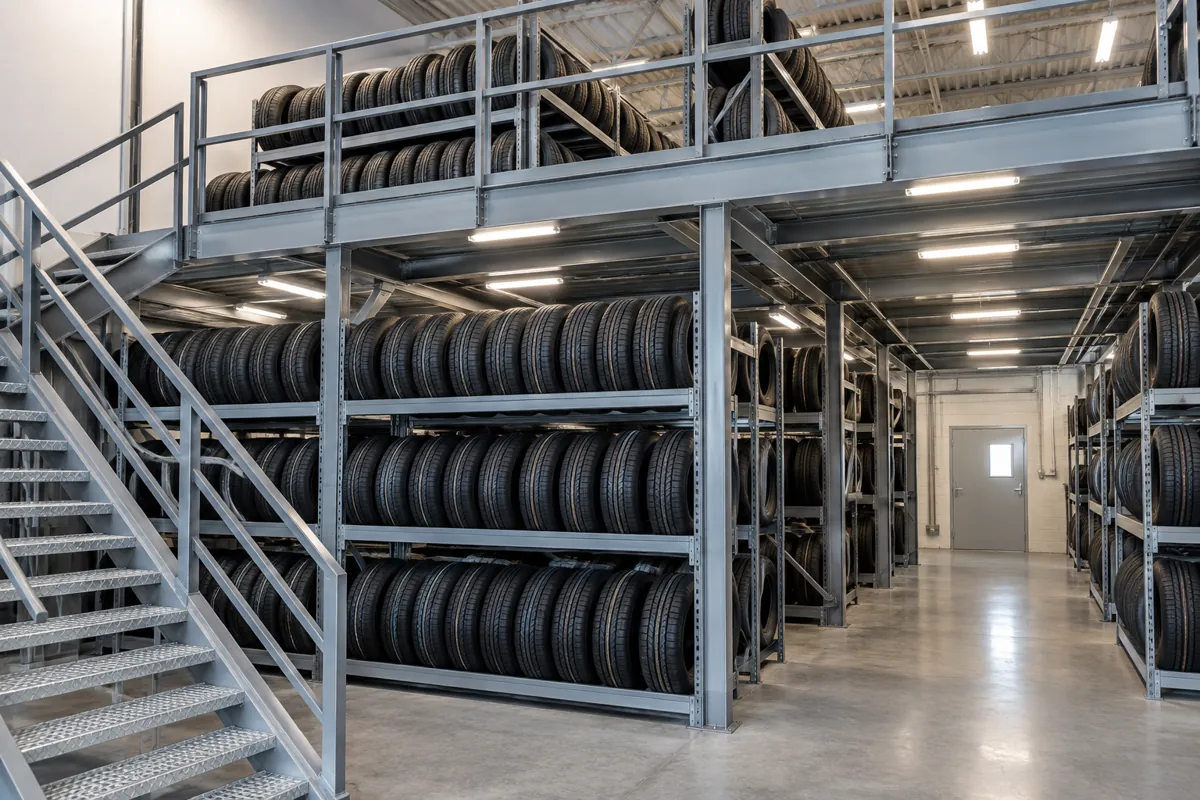 Mezzanine or overhead platformUses the height a tall service building already has by putting slow-moving stock above. A building decision as much as a rack one: floor loading, access and fire protection all change.
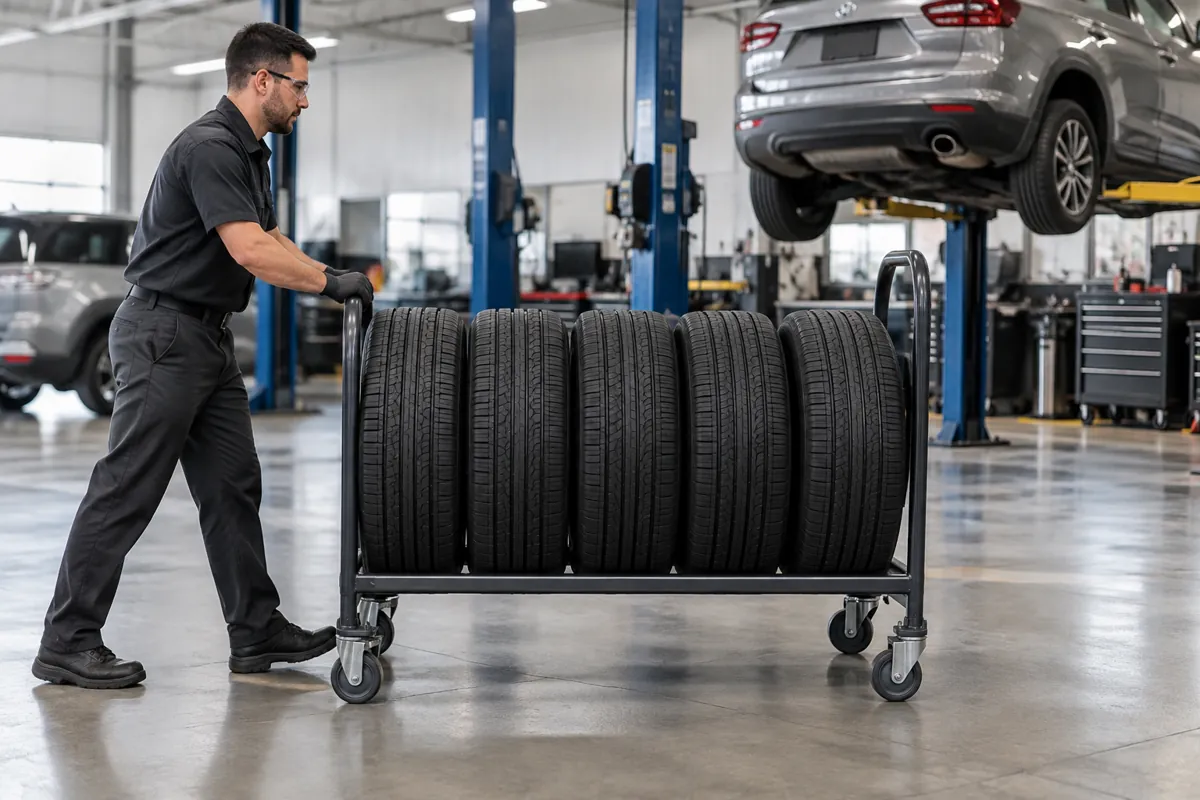 Mobile carts and rolling racksFor stores where tires are walked across the shop all day rather than searched for. Moves the set to the bay instead of the technician to the rack.
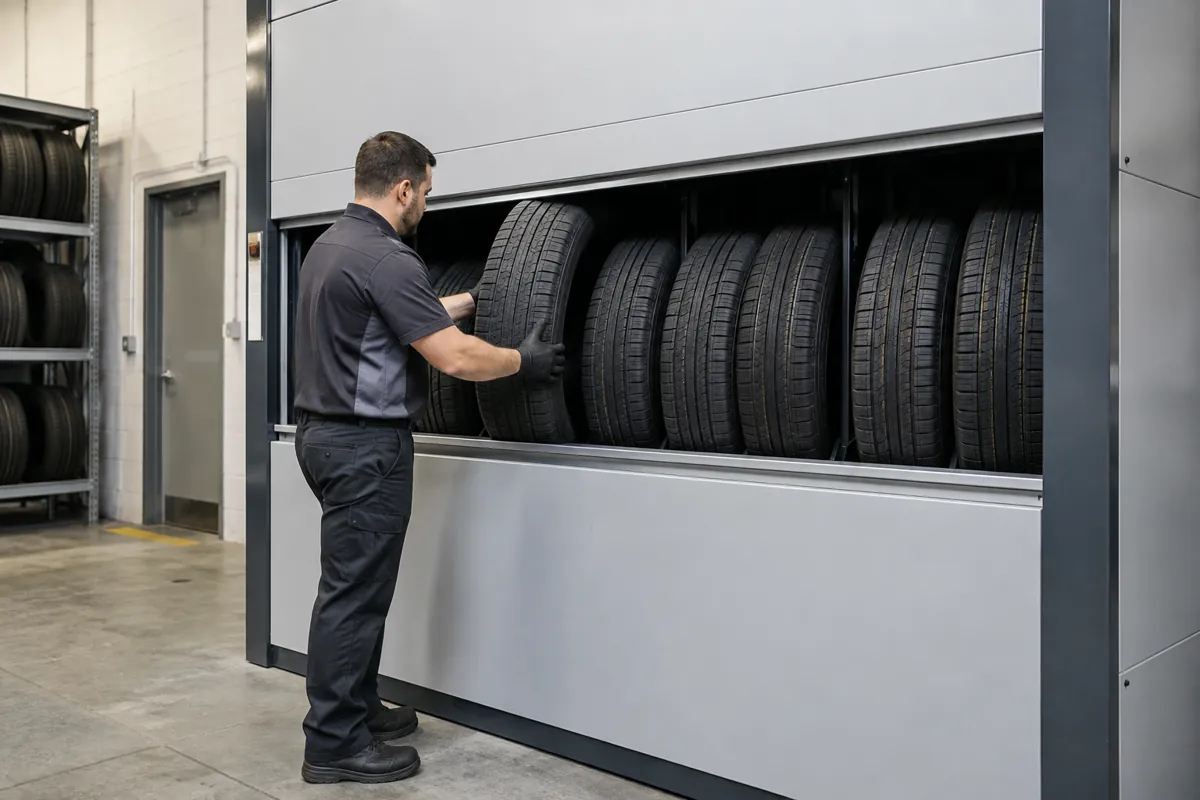 Vertical storage unitsConverts building height into one waist-height access opening. Earns its cost where floor area is genuinely expensive and volumes are high and stable.
Two more options sit around the edges. Stackable and portable tire racks absorb a seasonal changeover surge without committing floor space year-round, and where the building simply cannot hold what the store carries, high-density tire storage racks works through the levers that add real capacity. Stores that also run a public-facing tire counter will find the retail side covered in tire shop storage racks. Independent used vehicle operations have a different shape of problem again, driven by reconditioning volume rather than tire sales: see our used car dealership tire storage racking case study in Tooele, Utah.
Mounted assemblies: you are protecting the wheel, not the tire
The moment a tire goes onto a finished wheel, the storage problem changes. Rubber tolerates handling; painted, machined and polished wheel faces do not, and the damage is cosmetic, immediate and visible to the customer at delivery.
Support continuously and smoothly. Sharp edges and wide-pitch grating mark rubber over time and can catch a wheel lip during handling. Solid shelves or an appropriate wire decking specification both work; the wrong pitch does not.
Buy clearance, not density, here. Assemblies that must be levered or dragged past each other will eventually be scuffed. A slightly emptier-looking level is the cheapest wheel protection available.
Store on the tread, standing upright. Never on the face, never stacked flat under other assemblies. This is the same rule as loose tires, and it matters more when a warranty conversation is attached.
Control who picks from the run. Damage tends to happen when a protected bay becomes general overflow during a busy week.
The level, decking and position-width detail is worked through on tire and wheel assembly storage racks.

Seasonal hold programs: a service, not a corner of the shop
Holding customer sets between seasons keeps the customer attached to the store, and stores that run it well usually charge for it. It fails for two reasons, and neither is a shortage of racking: sets that take too long to retrieve, and sets that get mixed up or sold.
- Tag by set, not by tire, with customer, vehicle and wheel position, using the same code that appears in your scheduling system.
- Record a location — a simple bay-level-position code marked on the beam and stored against the appointment. A location nobody can look up is decoration.
- Rack in pickup order, with the nearest changeover appointments closest to the door. Seasonal storage is a scheduling problem before it is a storage problem.
- Keep held property physically separate from sale stock so a customer set can never be sold by mistake.
- Plan the changeover peak, not the annual average — the number of sets held can double in a few weeks, and temporary frames absorb that better than permanent steel bought for two months of the year.
- Write the retrieval standard down. If a set is meant to be found in under two minutes, that is a layout and labelling target that can be tested, not a hope.
Charge for it, then design for it
A hold program that is free tends to be stored wherever there is room, which makes retrieval slow, which makes staff resent it. A program that is priced gets a designed area, a location system and a retrieval standard — and it becomes a reason customers return to the store for fitting rather than a storage headache.
When vertical or automated tire storage actually pays
Vertical units convert building height into a single waist-height access opening, which removes both the walk and the reach. They are genuinely valuable in the right store and an expensive way to store tires in the wrong one. The honest test is whether the floor area a conventional rack row occupies is worth more to the store than the equipment costs.
Before pricing equipment, do the free work first: re-pitch the levels you already own, and reassign positions by fitting frequency. Many stores discover the room was never full — it was badly organised. If, after that, floor area is still the binding constraint, the detail on vertical tire storage for dealerships and the sizing walkthrough in our tire carousel storage guide are the right next reads.
Whichever way it goes, the conventional racking in the room should be standard, serviceable steel from the same pallet rack range we install in warehouses, so a store that grows can extend and re-pitch what it owns rather than starting again.
Overhead tire lifts: vertical tire storage above the service drive
A carousel isn’t the only kind of vertical tire storage. Dealership shops often have tall ceilings over the bays, and that space can hold seasonal and customer-held sets on ceiling-mounted tire lifts.
Where it fits in a store
The lift lowers to waist height for loading and rises above vehicle height when it is not in use. That suits the populations that move least: held seasonal sets, tires waiting for a pickup or a recall batch, and overflow during a changeover rush. Keep fast-pick sizes and mounted assemblies on the floor racking described above.
Our partner Lift and Store rates its tire rack at up to 44 tires, with standard lifts rated up to 800 lb per 8-ft section.
- Structure: the lift hangs from the roof or ceiling framing, so an installer or engineer confirms it can carry the loaded lift.
- Clearances: keep it clear of sprinkler heads, lights, heaters, hose reels and the travel of vehicle lifts and overhead doors.
- Power: each lift needs power at the ceiling and a hold-to-run switch where staff can see the load move.
- Safety: the manufacturer lists a motor brake that holds the load at any height, a free-fall arrestor, aircraft-grade cables and a double upper limit switch. Warranty is 5 years mechanical and 1 year electrical, and lead time is about six weeks.
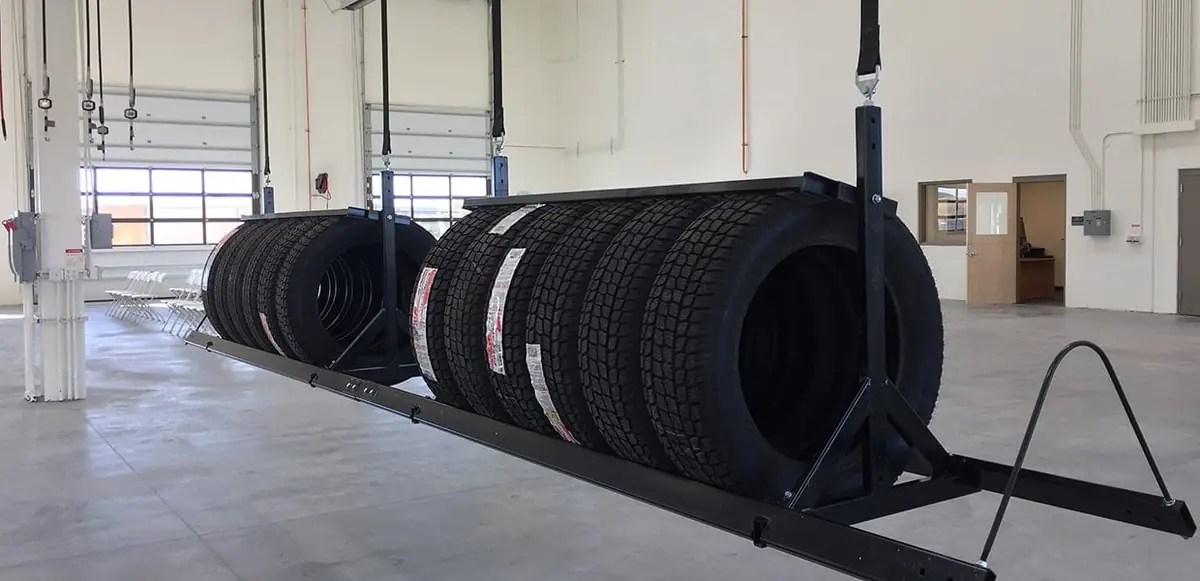
As an authorized Lift and Store dealer, we can quote overhead lifts alongside conventional commercial tire storage racking. Independent shops should see our tire shop storage racks page.
Safety, fire protection and inspection
A dealership tire room is inspected against the same requirements as a warehouse, with the added complication that rubber tires are treated as a high-challenge commodity. None of it is onerous, but it is far easier to design in than to retrofit after the steel is up.
- Install it properly and keep it plumb — a service department takes knocks; see rack installation.
- Inspect on a schedule and take damaged components out of service rather than nursing them along — rack inspection and repair.
- Protect uprights where equipment works, particularly at aisle ends, near the delivery door and anywhere a tire changer or lift is manoeuvred.
- Mark capacities per level where heavy fitments share a room with passenger stock, so nobody has to guess what a beam is rated for.
What we will and will not tell you
We will size the racking, pitch the levels, zone the room and say plainly where a storage idea is likely to collide with fire protection. We will not certify that an arrangement is compliant in your building — that determination belongs to the fire protection engineer of record and the authority having jurisdiction.
Get a free quote
Tell us what you are storing, the room size and your timeline. A project specialist will follow up with layout options and pricing. Prefer to talk? Call (800) 326-4403.
Dealership Tire Storage FAQs
What kind of tire storage does a car dealership need?
How many tires can a dealership store per rack bay?
Should dealership tires be stored on the tread or on the sidewall?
How do we store mounted tire-and-wheel assemblies without damaging the wheels?
How should a dealership run a seasonal tire hold program?
When does vertical or automated tire storage pay for a dealership?
Can tire racking share a room with parts shelving?
How high can we stack tires in a dealership building?
What do safety inspections look at in a dealership tire room?
Get your dealership tire room designed properly
Send your size mix, peak counts by population, floor plan and clear height, and we will zone the room, pitch the levels to your bands and show what it can hold before anything is quoted. Call (800) 326-4403.