
Used Car Dealership Tire Storage Racking: Markosian Auto, Tooele, Utah
A northern Utah used car dealer group needed tire storage that fitted a reconditioning shop, not a warehouse. Starter and add-on tire rack bays did it, and the configuration was repeated on a second order.

Tooele, UT
Store location
2 orders
2025 and 2026
3 bays
Starters plus add-on
Used vehicle retail
Industry
The project
Markosian Auto is an independent used vehicle retailer serving northern Utah, with stores in Tooele, Taylorsville, Ogden and Logan and more than twenty five years in the market. The group also operates Markosian Tire & Service, open to the public in Tooele and Taylorsville. That combination, a reconditioning operation plus a public tire and service shop, is exactly the case where tires stop being an occasional item and become inventory that needs a home.
The requirement that came to us was deliberately modest: tire storage racking for the Tooele store, sized to the space and the way the shop actually works. We quoted tire rack starter sections plus an add-on section, and the order closed in the spring of 2025. In January 2026 the same configuration was quoted and bought again. We are publishing it as a case study because the repeat order is the useful part. A configuration that gets repeated without redesign is a configuration that was specified correctly the first time.
What we supplied
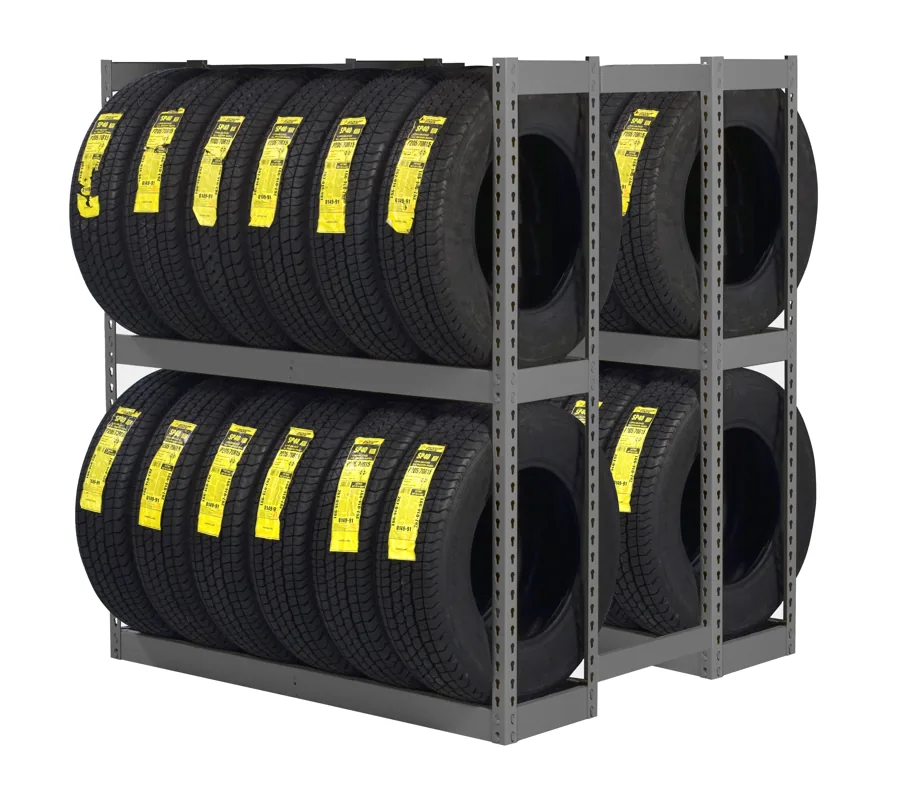
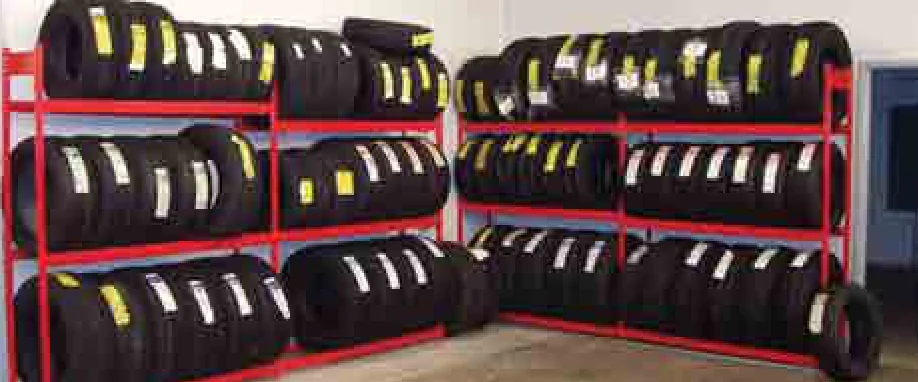
Tire rack starter sections plus an add-on section, forming one continuous run of bays rather than separate islands of shelving.
Conventional bolted steel racking, the same platform as our warehouse pallet rack systems, so levels can be re-pitched and the run extended later.
Freight to the Tooele store on a one to three week lead time, with the same specification repeated on the second order.
We are not publishing prices, drawings or internal layout detail for this customer. The planning method below is the transferable part.

Shop Tire Racks Online
Genuine tire racks you can order online. Prices are current store prices for the lowest-priced in-stock starter unit in each line; add-on bays, other sizes and freight are in each category. Some common sizes are in stock at select manufacturers, subject to confirmation. Larger rooms on pallet rack are quoted.


Why a used car operation stores tires differently
Franchise new car stores plan tire storage around retail stock and seasonal customer sets. An independent used vehicle group has a different shape of problem, driven by reconditioning volume rather than by tire sales, and it changes what the racking has to do.
- Reconditioning sets the pace. Tires are among the most commonly replaced items before a vehicle goes on the front line, so demand follows how many cars are being prepared, not how many tires are being sold over a counter.
- Take-off tires are a second population. Tires removed during reconditioning have to be held somewhere until they are sorted, resold or scrapped. Unmanaged, they are the single most common cause of tires on the floor of a working bay.
- The mix is wide and unpredictable. A used inventory is whatever came in on trade, so size bands are broader than a fleet or a single-brand store and level pitch has to tolerate that.
- The space is a shop, not a warehouse. Bays sit close to lifts, tire changers and traffic, so a short well-placed run beats a long run that adds a walk to every job.
- A public service shop adds retail stock. Once the shop serves customers who did not buy the car there, fast-moving retail sizes need their own positions near the bay.

Storage that keeps the bay clear
Tires on the floor are unmet storage demand. Anything leaning against a wall or stacked beside a lift is telling you how many positions are missing.
Put the racking where the work is. Steps per job is the measure that matters in a shop this size, which is why a compact run beside the reconditioning bay outperforms a bigger room further away.
Store upright on the tread. Never flat, never on the sidewall, and never in a stack that has to be dismantled to reach the tire underneath.
Why starter plus add-on bays were the right specification
Tire racking is sold as starter sections and add-on sections for a reason, and understanding the difference is most of the value in the first conversation. A starter is a complete bay with an upright frame at each end. An add-on reuses the frame of the bay beside it and supplies one new frame with its beams, so each additional bay in a continuous run costs less than the first.
Start with the run, not the bay
Decide where a continuous line of racking can live against a wall or a clear span, then divide it into bays. Runs planned as runs can be extended; islands of shelving cannot.
Buy starters where runs begin
Each separate run needs one starter. A shop with two usable walls needs two starters, which is worth knowing before the quote rather than after delivery.
Add on to grow
Extra bays appended to an existing run reuse its frames. This is what makes an incremental tire room affordable as reconditioning volume grows.
Pitch levels by size band
Set beam heights from the tallest common tire in each band plus honest handling clearance, rather than running one compromise pitch that overpays clearance on every small tire.
Leave the top level flexible
Slow-moving and seasonal stock belongs high. Keeping that level easy to re-pitch is what lets the same steel absorb a changed fitment mix later.
The add-on is the extendability
One shared upright frame is the whole mechanism: the new bay bolts to the frame of the bay already standing, so you pay for one frame instead of two.
It also keeps the run straight and level, which matters for how tires load and for how the run is anchored and inspected over time.
Plan it at quote stage. Retrofitting extendability into racking bought as separate standalone bays usually means buying frames you already own.

How to plan the same thing for your store
Four measurements per size band are enough to size a tire run properly, and they take an afternoon to collect. Doing this before anyone quotes steel is what separates a run that works from one that is full on day one. The same method scales up to the multi-population layouts described on our dealership tire storage page and the retail counter case on tire shop storage racks.
 Band the sizesGroup what you actually fit into two or three bands, measure the widest and tallest common tire in each, and pitch levels per band instead of averaging the whole inventory into one compromise.
 Give take-offs a homeA defined bay or level for tires removed during reconditioning, with a removal schedule. Without one, take-offs quietly consume the positions you bought for new stock.
 Separate retail from reconIf the shop serves the public, hold fast-moving retail sizes in their own positions near the bay so a customer job never has to dig through reconditioning stock.
 Repeat what worksOnce a configuration proves out at one store, repeating it at the next removes the design step entirely and makes stock, labelling and training transferable between locations.
Count at peak, not on an average week
Reconditioning volume is lumpy. An auction run, a seasonal changeover and a promotion can land in the same fortnight, and storage has to hold the peak rather than the mean. Count by population (new stock, take-offs, retail, held sets) and then by size band, and include everything currently stored on the floor, because that is demand you already have and are not meeting.
Want your shop’s tire run sized properly?
Send your store location, peak tire counts by size band and the clear height you have available. We will lay out the run, pitch the levels to your bands and show what it holds before anything is quoted.
Where this configuration fits among the options
Most shops of this size do not need specialised equipment. Fixed bays of conventional selective racking pitched for tire diameters cover the majority of the work, and the wider options only earn their place in specific situations. Our tire storage rack hub compares them all in one place.
- Fixed starter and add-on bays — the default. Best value, easiest to re-pitch,
every position directly picked. This is what Markosian Auto specified, twice. - Stackable and portable tire racks — for absorbing a seasonal or
auction surge without committing floor space year round. - Mobile and rolling tire racks — where sets are moved to the bay
all day rather than picked from a wall. - Tire and wheel assembly racking — once mounted alloy wheels are
being stored, the wheel finish becomes what you are protecting and the level specification changes. - High density tire storage — when the building genuinely cannot
hold what the operation carries and organisation alone will not close the gap.
The parts side of the same shop, counter, will-call and warranty retention storage, is covered in our automotive storage solutions section.
Installation, anchoring and housekeeping
A tire run in a service shop takes knocks that a warehouse row does not, because it lives next to lifts, changers and vehicle traffic. None of what follows is onerous, and all of it is cheaper to design in than to retrofit.
What we will and will not tell you
We will size the racking, pitch the levels to your size bands, lay out the run and say plainly where a storage idea is likely to collide with fire protection or with how your shop moves. We will not certify that an arrangement is compliant in your building. That determination belongs to the fire protection engineer of record and the authority having jurisdiction.
Tire racking for Utah dealerships and service shops
Tooele sits far enough from the Salt Lake valley that stores there run largely self contained service operations, and the same is true of shops in Ogden, Logan and the rural corridors. We supply and support racking across the state, and this project is one of the automotive entries on our Utah tire storage rack page, part of our wider Utah pallet rack work. Nationwide, the design rules and the product are the same, and the technical comparison of every tire rack type lives on our commercial tire storage racking hub.
If your shop is expanding, the useful next step is not a bigger building. It is counting your own populations and bands, then extending a run you already own with add-on bays from the same pallet rack platform.
Frequently asked questions
What tire storage racking did Markosian Auto buy?
Why does a used car dealership need tire storage racking at all?
Should tires be stored on the tread or on the sidewall?
What is the difference between a starter section and an add-on section?
How many bays does a small dealership service shop need?
Can this racking be extended later?
Do you supply tire racking outside Salt Lake City?
Planning tire storage for a dealership or service shop?
Send your store location, peak tire counts by size band and the clear height available, and we will lay out the run and pitch the levels before anything is quoted. Call 801-328-8788.