
Rack-Mounted Roll-Out Pallet Rack Shelves
Bring stored items toward the aisle with a rack-mounted sliding shelf. Before ordering, confirm the usable surface, mounting dimensions, beam compatibility, required clearance and load rating for the exact model and rack configuration.

Rack-Mounted Roll-Out Shelves, Confirmed to Your Model
Also called pallet rack sliding shelves or pull-out shelves, rack-mounted roll-out shelves are a pallet rack accessory, not a standalone product — they only work as well as the rack level they mount to. Before you request a quote, it helps to know which questions actually change the answer: the usable surface, the mounting hardware, the working clearance around the extended shelf and the load rating for the exact model you are considering. The sections below walk through each of those in order, followed by what to measure and photograph, how to use the shelves safely once installed, and a specification checklist and answers to common roll-out selection questions.
How Rack-Mounted Roll-Out Shelves Work

A rack-mounted roll-out shelf supports stored material on a sliding platform that extends from its storage position. It can improve access to material at the back of a rack level when the application, surrounding space and handling method are suitable.
The shelf is part of a larger loaded rack system. Its fit and rated capacity must be checked against the selected model, mounting arrangement and rack configuration. Floor-mounted roll-out units are a different arrangement and should not share an interchangeable specification table.
Access Planned Around the Actual Load
Roll-out shelves are only a good fit once the load, the mounting and the surrounding rack have all been checked together. The questions below cover what to confirm before ordering.
Using roll-out shelves safely once installed
Use these general precautions alongside the current instructions and restrictions for your actual model and rack configuration:
- Follow the load rating and instructions printed on your unit’s label and the current manufacturer manual for that exact model — not a general web page.
- Open only one roll-out shelf in a bay at a time unless your model’s documentation states otherwise for your configuration.
- Do not climb, stand or sit on a roll-out shelf, open or closed; use proper lift equipment for heavy or awkward loads.
- Take a shelf out of service if any component is bent, cracked, missing or does not lock as expected, and have it inspected before it goes back into use.
- Confirm the rack beams and uprights the shelf mounts to are undamaged and properly anchored before loading the bay.
How Do I Measure My Rack for a Roll-Out Shelf Quote?
Two measurements matter here and they are not the same thing. The usable top surface is the flat area actually available to hold your load once lips, backstops or other features are subtracted. The mounting or base dimension is what physically attaches to the rack beams — a wide top plate can still need a narrower base underneath it. A quote built from only one of these can arrive and not fit your bay.
Send the following with your request and we can match a model to your rack instead of guessing from a catalog page:
- The rack manufacturer and model, if you know it — a photo of the upright or beam label helps.
- The clear width between uprights and the beam depth at the level you want the shelf.
- The usable top surface you actually need for your load, separate from the raw beam opening.
- A photo of the empty rack bay from the front and from the side.
- The size and weight of what you plan to store, and how it will be lifted or picked once it is on the shelf.
Confirm These Specifications Before Ordering

Review the final quote and current manufacturer documentation together. Make sure they identify the same model and drawing revision.
| Specification | Required clarification |
|---|---|
| Model and drawing revision | The exact configuration being ordered. |
| Usable top surface | Storage area available after lips, backstops and other features. |
| Base/mounting dimensions | Dimensions relevant to attaching the unit to the rack. |
| Beam and hardware fit | Applicable beam limits, mounting arrangement and included hardware. |
| Capacity and load distribution | The model’s rating and stated loading conditions, including UDL where applicable. |
| Extension and clearances | Travel for the selected model and space needed when extended. |
| Supporting rack | Required review of beams, frames, connections and anchorage. |
| Documentation | Current installation, operation and maintenance instructions. |
Why we don’t list one weight or extension number here
Roll-out shelf capacity, extension percentage, lock options and how many shelves a bay can safely hold are set by the specific model you order, not by the product category as a whole — a figure that is correct for one width, depth or top-plate style can be wrong for another. Rather than list a single number that may not match your configuration, we confirm the rated capacity, extension and installation limits from the current manufacturer documentation for your quoted model, and identify the installation and operating documents required for the order. If you need those numbers before you order, request the model-specific specification sheet and confirm any unresolved rack or mounting questions before release.
Load Surface vs. Permitted Mounting Depth
Usable top surface and permitted mounting depth answer different questions. The first describes the space for the load; the second describes the rack or beam-depth arrangement approved for the unit. Some model drawings state an allowed depth range, while others specify one required depth. Confirm the current drawing for your quoted model rather than assuming the surface size determines mounting fit. Check width, connection and clearance requirements separately.
Factory-Assembled or Field-Assembled?
Ask which parts arrive fully assembled and which attach on site, and confirm the hardware and current instructions shipped with your model — requirements differ by configuration. An unattached component may be intended for field assembly, but confirm the packing list and current manual before deciding that the shipment is complete. Review the manufacturer’s current installation instructions for your exact model rather than a general assembly sequence, and contact us before substituting any fastener or hardware type from what is specified.
Rack-Mounted Roll-Out Shelf Details
The images below are manufacturer product illustrations of the rack-mounted roll-out shelf family — showing the sliding platform, its mounting bracket and the beam connection. Use them to see how the unit sits in a rack bay; confirm exact dimensions and finish against your quote. Illustrations show the mechanism and travel, not an approved loading arrangement or permission to open multiple shelves at once.
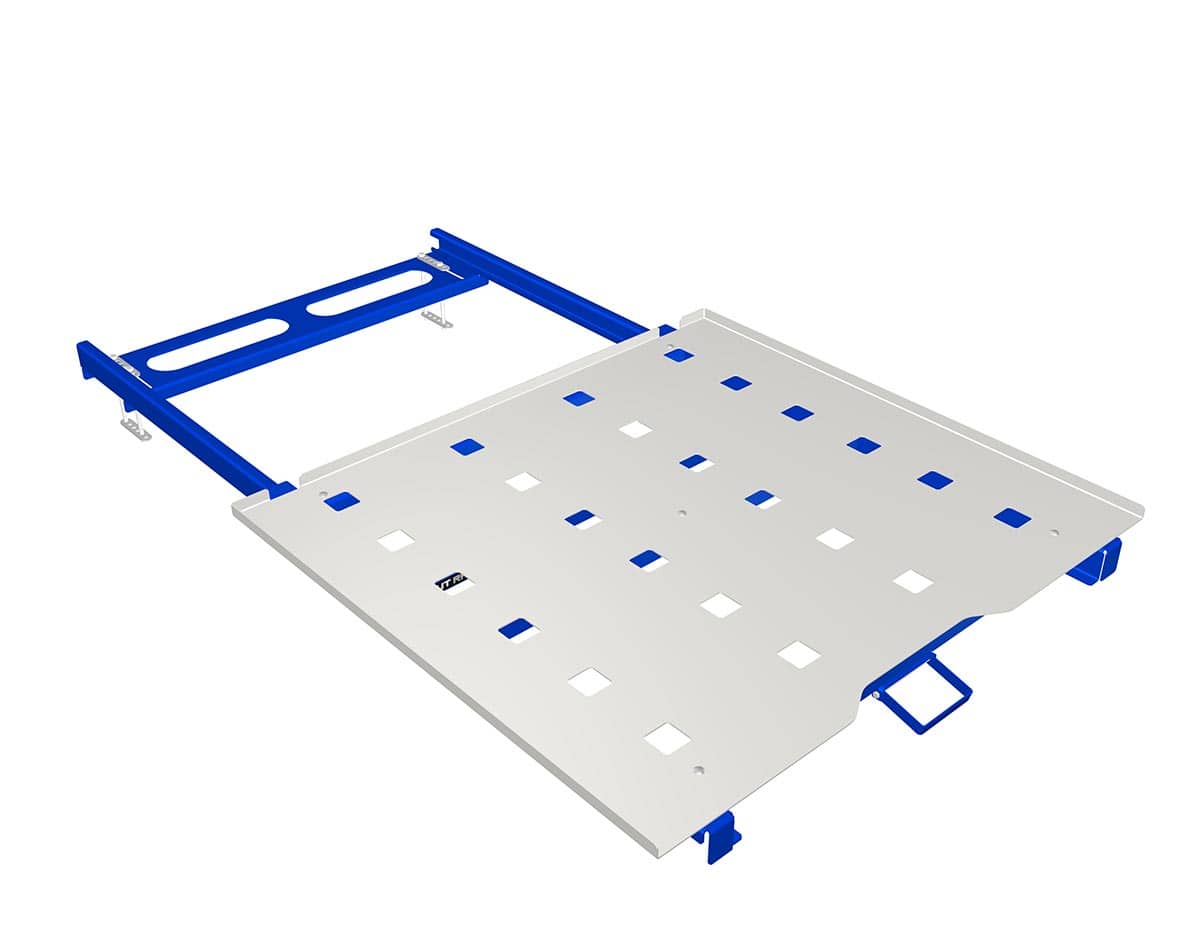
Top plate and handle
Perforated top plate and pull handle used to extend and retract the unit.
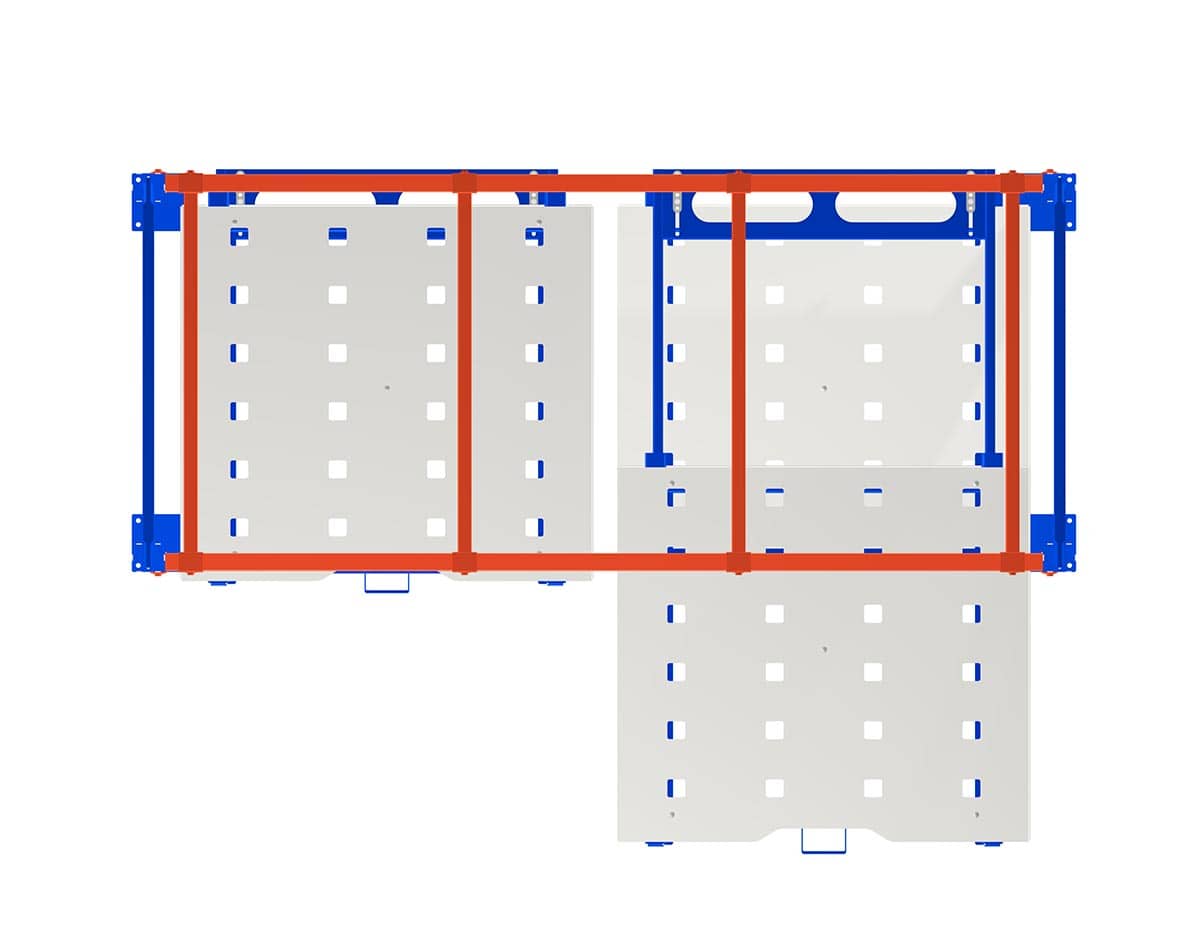
Top-down view
Platform layout as seen from above, showing the mounting bracket connection.
Roll-Out Pallet FAQ
What weight capacity do roll-out shelves support?
Can roll-out shelves be added to existing pallet rack?
How many roll-out shelves fit in one bay?
What is the roll-out extension percentage?
Check Your Roll-Out Shelf Fit
Send the load size and weight, rack identification, beam dimensions and the usable surface you need.