A warehouse can look calm at 8 a.m. and turn chaotic by lunch. Forklifts are moving pallets, a dock door stays open, a picker steps into an aisle, and someone on a mezzanine needs a clear exit path. That's where warehouse safety equipment earns its place, not as a compliance display, but as the hardware that absorbs everyday mistakes before they become injuries, downtime, or a failed audit.
The risk is real and repetitive. OSHA-related summaries report that forklifts are involved in nearly 100,000 accidents per year, with about 20,000 worker injuries annually in forklift accidents alone, and about 25% of forklift accidents involve an overturn; the same source also says roughly 25% of warehouse accidents occur on loading docks, where one serious accident can follow about 600 near misses (warehouse safety statistics and facts). In 2021, the warehouse injury-and-illness rate was 5.5 cases per 100 employees, compared with 2.7 per 100 across all industries, and e-commerce fulfillment centers reached 5.9 injuries per 100 workers in 2022 (warehouse safety statistics). Those numbers explain why managers don't buy safety gear for decoration. They buy it to reduce the chance that a normal shift turns into a reportable event.
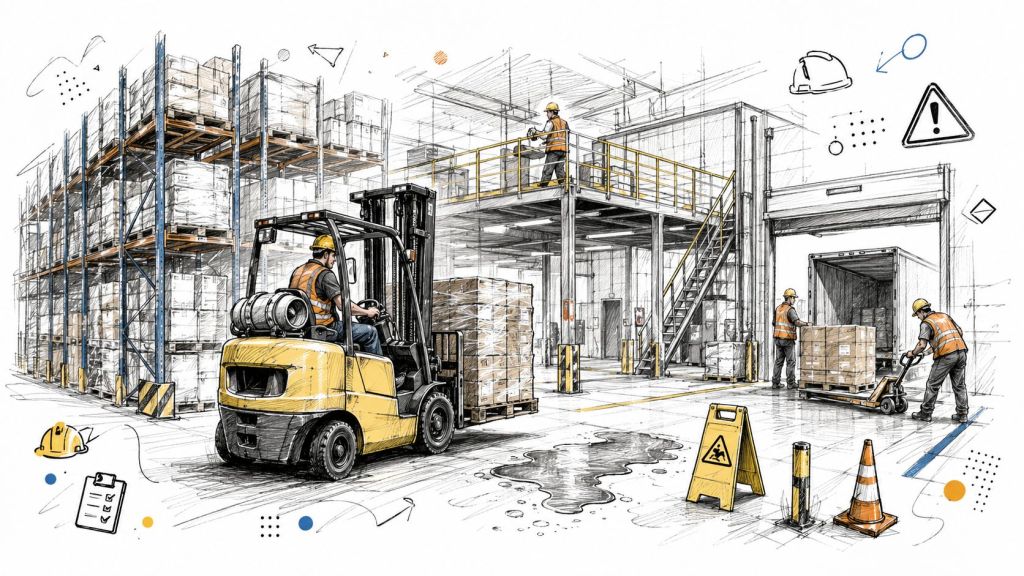
Why Warehouse Safety Equipment Matters on Every Floor
A warehouse usually breaks down at the edges first. A pallet lands a few inches off line, a pedestrian drifts into a travel lane, or a dock corner starts to feel manageable until traffic picks up. Safety equipment is the layer that catches those misses when process, training, or attention slips.
The floor is where the mistakes meet steel, rack frames, and moving equipment.
Warehouse operations, especially fulfillment and dock-heavy sites, deal with powered industrial trucks, stacked inventory, sharp edges, and constant movement. Canada's transportation and warehousing sector reported over 26,000 lost-time injuries in 2022, and one cited estimate places forklift-related direct compensation costs at more than $125 million annually (warehouse safety statistics). Those figures explain why buyers compare guardrails, rack protectors, fire gear, eyewash stations, and traffic controls instead of treating safety as a single product line.
Practical rule: if a hazard shows up every shift, the fix should live on the floor every shift too.
Zone-by-zone planning is where the work gets real. A dock needs different hardware than a high-bay aisle, and a mixed-traffic pick area needs different protection than a quiet storage run. In mixed human-robot layouts, the line between people and equipment has to be obvious at a glance, and high-bay egress needs to stay clear even when storage gets tight. A useful starting point is warehouse safety planning support, because the layout usually shapes the equipment choice as much as the product spec does.
The same thinking applies to observation and perimeter control. If your facility has cameras or monitored zones, Explore our related solutions shows how safety and visibility can work together in busy yards and dock areas.
The best warehouses do not rely on workers being careful. They build in barriers, visibility, and clear routes that make the safe choice the easy choice. That approach carries through every category that follows.
The Main Categories of Warehouse Safety Equipment
A warehouse safety program breaks down by hazard and by zone. A dock, a high-bay aisle, a battery charging area, and a mixed human-robot pick path each call for different gear, because the same control does not solve every risk. In the field, the equipment that gets used every shift is the equipment that matches the way the floor operates.
The eight families work together
PPE is the personal layer. OSHA's PPE rule at 29 CFR 1910.132 requires hazard assessment, proper fit, training, and maintenance, so hard hats, gloves, eye protection, hearing protection, and high-visibility clothing have to be selected for the task, not pulled from a generic stockroom bin. Fire equipment belongs in the same system, but it has to fit the site layout and the local fire plan, while egress, obstruction control, and traffic separation depend on how the building is marked and how people move through it.
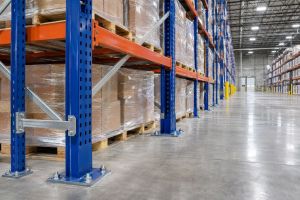
Rack protection is a separate decision. Forklift traffic does not just hit steel, it transfers force into the rack, the floor, and sometimes the product load above, which is why buyers often look at physical barriers and warehouse rack protectors for impact points that see repeat traffic.
Visibility matters as much as hardware. If cameras or monitored zones are part of the site plan, integrated security for WA warehouses shows how observation can support safety in busy yards, dock areas, and other places where blind corners create risk.
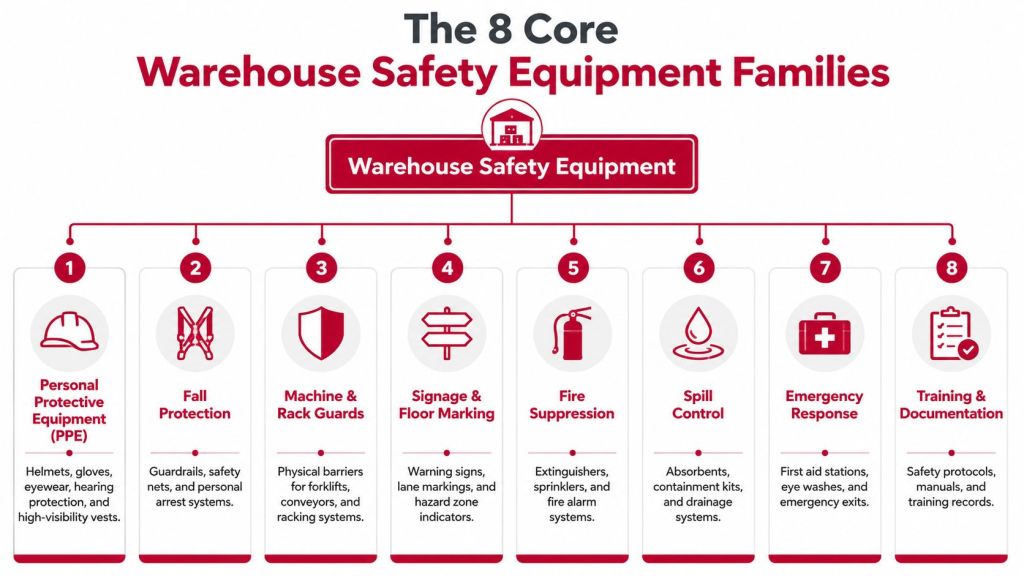
What each layer protects against
- PPE: protects workers from direct exposure, including impact, cuts, noise, and low visibility.
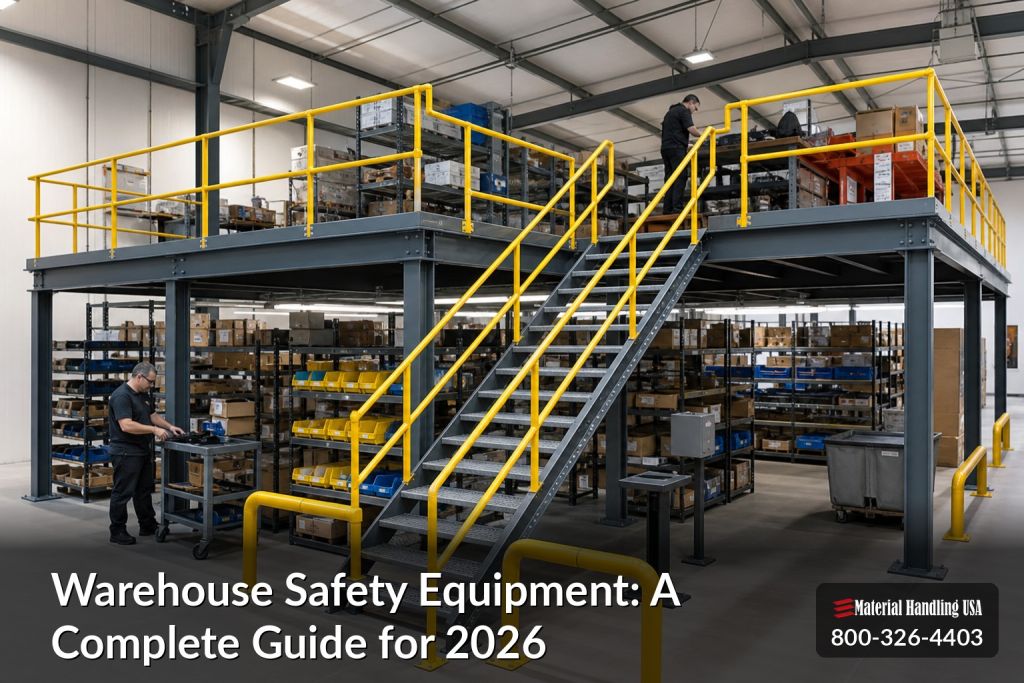
- Fall protection: supports work on mezzanines, platforms, and raised areas.
- Machine and rack guards: take the hit before people or storage do.
- Signage and floor marking: separate pedestrians, trucks, and restricted zones.
- Fire suppression: controls incipient fires before they spread through the building.
- Spill control: keeps liquid hazards from becoming slip hazards or contamination events.
- Emergency lighting and egress: keeps exits usable when visibility drops or alarms sound.
- Material-handling aids: reduce strain, control loads, and make movement more predictable.
A good warehouse ties these layers to the floor plan, the equipment mix, and the work being done in each zone. A site with changing traffic patterns may also need stronger observation and access control, which is where integrated security for WA warehouses can sit alongside the physical controls already in place.
Safety improves fastest when the warehouse is treated as a system. One weak zone can undo a strong one.
Choosing the Right Equipment for Each Hazard Zone
The best quote on paper can still be the wrong fit on the floor. A fire extinguisher that's too far from the hazard, a rack protector in the wrong aisle, or PPE that doesn't match the task all leave gaps that show up later as incidents or inspection findings.
Match the gear to the hazard
For fire response, one practical benchmark is to keep portable extinguishers within 75 feet of employees for Class A hazards and within 50 feet for Class B hazards (fire protection guidance). For egress, warehouses should maintain two marked exit routes and keep aisles, walkways, and passages unobstructed (warehouse safety guidance). For storage, OSHA guidance says materials in tiers must be blocked, stacked, or interlocked, heavier loads belong on lower shelves, and maximum safe load limits should be posted in storage areas (warehouse storage guidance).
| Hazard Zone | Recommended Equipment | Benchmark or Rule |
|---|---|---|
| Forklift travel lanes | Guardrails, rack protectors, mirrors, warning signs | Separate people and trucks, protect impact points |
| Dock areas | Dock bumpers, edge marking, barriers, warning lights | Keep docks clearly marked and unobstructed |
| Storage aisles | Rack protection, load labels, floor marking | Post load limits, keep aisles clear |
| Fire risk zones | Extinguishers, alarms, sprinklers | Keep extinguishers within 75 feet for Class A, 50 feet for Class B |
| Egress routes | Exit signs, emergency lighting, unobstructed paths | Maintain two marked exit routes |
| PPE-controlled tasks | Helmets, gloves, eyewear, hearing protection, high-vis vests | Match the PPE to the hazard and train on use |
| Spill-prone work areas | Absorbents, containment kits, drainage controls | Use kits sized to the material handled |
PPE selection should be task-based, not generic. A cut risk calls for gloves that resist abrasion and slashes, while a dim mixed-traffic zone calls for visibility gear that stays visible after repeated wear. If your warehouse has storage changes, note how the load pattern affects shelf choice and signage, because the rack layout has to support the safe-load discipline, not fight it.
One more practical point. More equipment isn't always the answer. In some zones, removing the hazard or separating traffic by design is better than piling on gear that people won't use correctly.
Where Standard Checklists Fall Short
Most warehouse safety lists handle forklifts, PPE, and racking well enough. They get weaker when the facility changes shape, especially with mixed human-robot warehouses and high-bay or high-density storage.
Mixed human-robot zones need different controls
AMRs and automated transport change the hazard profile. Static barriers help in some places, but they don't solve every interaction point where a worker steps into a robot path or a machine changes direction based on a sensor input. Recent guidance that focuses on task- and zone-specific controls is more useful here than broad rules, because the right protection depends on who is exposed and where the interaction happens (Explore our related solutions).
That's why vendors and integrators should be asked about exclusion zones, traffic logic, and human-robot crossing points, not just floor square footage. If they can't explain how the layout handles live interaction, the equipment package is incomplete.
High-bay storage changes fire and egress planning
Tall racks, mezzanines, cold storage, and long aisle runs change sightlines and travel time. Common checklists often list sprinklers and exit signs, but that's not enough if the geometry works against evacuation or fire spread. One source specifically notes that in-rack sprinklers should be used with ceiling sprinklers in high-ceiling facilities, and another points to emergency underpasses for very long aisles (Explore our related solutions).
Ask one question before buying: does this product still work when the aisle is long, the ceiling is high, or the traffic is automated?
That question filters out a lot of weak recommendations. It also keeps the buying process focused on the actual environment instead of a generic product sheet. In these layouts, the right answer is often a combination of layout changes, zoned controls, and carefully placed hardware, not a longer catalog order.
Inspection and Maintenance Routines That Hold Up
PPE only protects people if it stays usable. OSHA treats PPE as part of an employer-managed system, so hazard assessment, fit, training, maintenance, and replacement have to work together. That same approach should apply across the warehouse, from rack protection to eyewash stations.
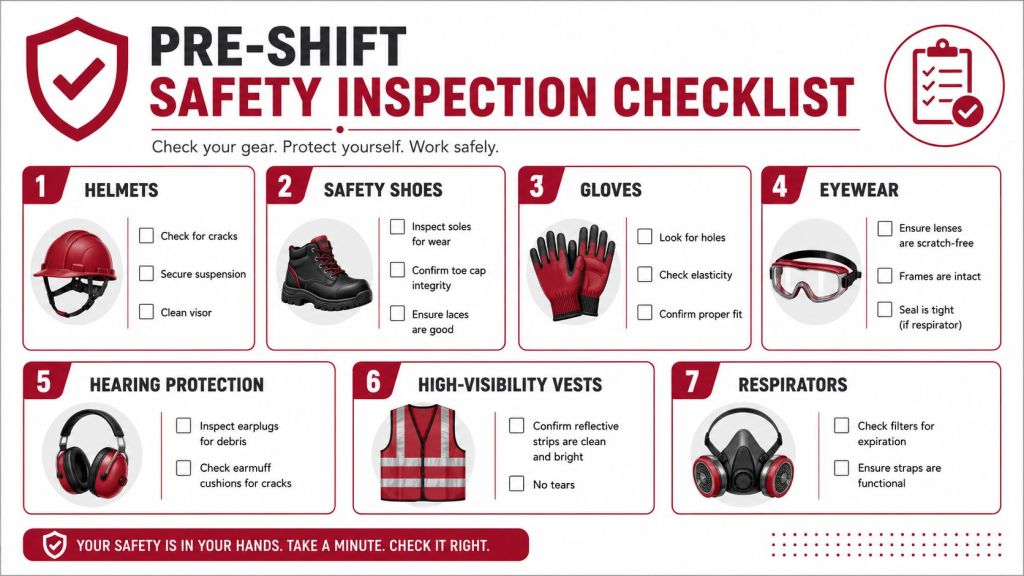
A pre-shift check should be specific
A useful inspection routine is direct and repeatable:
- Helmets: no cracks, dents, or damaged suspension.
- Safety shoes: intact sole, undamaged toe cap, good grip.
- Gloves: no holes, tears, or excessive wear.
- Safety glasses: clean lenses, no scratches or cracks.
- Hearing protection: clean, undamaged, and fitting properly.
- Safety vests: bright color and reflective strips intact.
- Respirators: correct fit, filters within service life.
- Harnesses: no cuts, frayed webbing, or damaged hooks.
Those checks come from a practical warehouse PPE checklist and turn “inspect gear” into something a shift lead can enforce. For buyers, the useful signal is wear patterns, because they show which products hold up and which ones fail early.
Maintenance should cover the whole protection chain
Inspection is not limited to PPE. Racks need damage checks, guards need to stay anchored, extinguishers need clear access, and eyewash stations need to be ready without clutter. If you are comparing service programs or setting a repair cycle, a pallet rack repair and inspection review helps frame maintenance as part of the equipment decision, not an afterthought.
A simple check only works if someone can act on it. That is where a partner that can comply with warehouse safety laws matters, because a clean inspection record means little if damaged uprights, bent beams, or blocked access points stay in service.
If a product is hard to inspect, it is hard to trust on a busy floor.
That is why durable finishes, readable labels, replaceable parts, and simple check points matter during purchase. A cheap item that fails suddenly creates more work than a better one that stays easy to verify.
Training, Audits, and the ROI of Getting It Right
Safety purchases pay off when workers know how to use them, supervisors know what to look for, and the site keeps records that stand up in an audit. Without that, the gear becomes inventory instead of risk control. With it, the warehouse gets fewer surprises and cleaner handoffs between shifts.
Short training beats long lectures
Toolbox talks work best when they are brief, tied to what people saw on the floor, and repeated often. A dock team can review blocked exits this week, rack damage next week, and PPE fit after that. The point is to keep the message close to daily work so it sticks without slowing operations down.
Audits matter for the same reason. They catch worn reflectors, low battery emergency lights, missing labels, and damaged guards before the issue becomes a reportable event. They also make procurement easier, because documented findings show which products hold up and which ones should be replaced with a different specification.
ROI shows up in the quiet wins
The payoff isn't just fewer injuries. It's less downtime, simpler inspections, fewer layout surprises, and faster installs when safety is designed in instead of retrofitted. Material Handling USA also works with documentation and specifications that support audits, which is the kind of detail procurement teams appreciate when they're comparing quotes and planning approvals.
That matters because good safety design speeds up the rest of the project. A clean layout, known equipment specs, and documented maintenance expectations reduce back-and-forth later. In practice, that can be the difference between a smooth upgrade and a facility that keeps revisiting the same problem.
Planning Your Next Safety Equipment Upgrade
The simplest way to plan a better warehouse is to start with the hazard, then pick the zone, then choose the hardware. That keeps the budget tied to risk instead of to a generic checklist. It also helps buyers compare quotes on the same terms.
A practical planning checklist
- Map the highest-risk zones: docks, aisles, mezzanines, storage faces, and crossing points.
- Match gear to the hazard: PPE for exposure, barriers for impact, extinguishers for fire, and markings for traffic control.
- Check the building geometry: high-bay storage, long aisles, or automation may need special egress and fire planning.
- Review inspectability: choose products that can be checked, maintained, and documented without guesswork.
- Plan for the next audit: keep specs, load limits, and maintenance records together.
- Decide on the buying path: standard items can be ordered online, while custom layouts need site review.
For buyers who want standard warehouse safety equipment with straightforward ordering, Shop Now and Buy Online through the Material Handling USA store can keep the process moving. If your facility needs a custom plan, Request a Quote, Call (800) 326-4403, or Contact Us at Sales@MH-USA.com for a free layout and design consultation with no obligation.
Material Handling USA helps teams choose warehouse safety equipment that fits the hazard, the zone, and the way the building runs. If you're comparing options for racks, guards, fire response, or layout support, visit Material Handling USA to request a quote, review product options, or start a free design conversation for your facility.