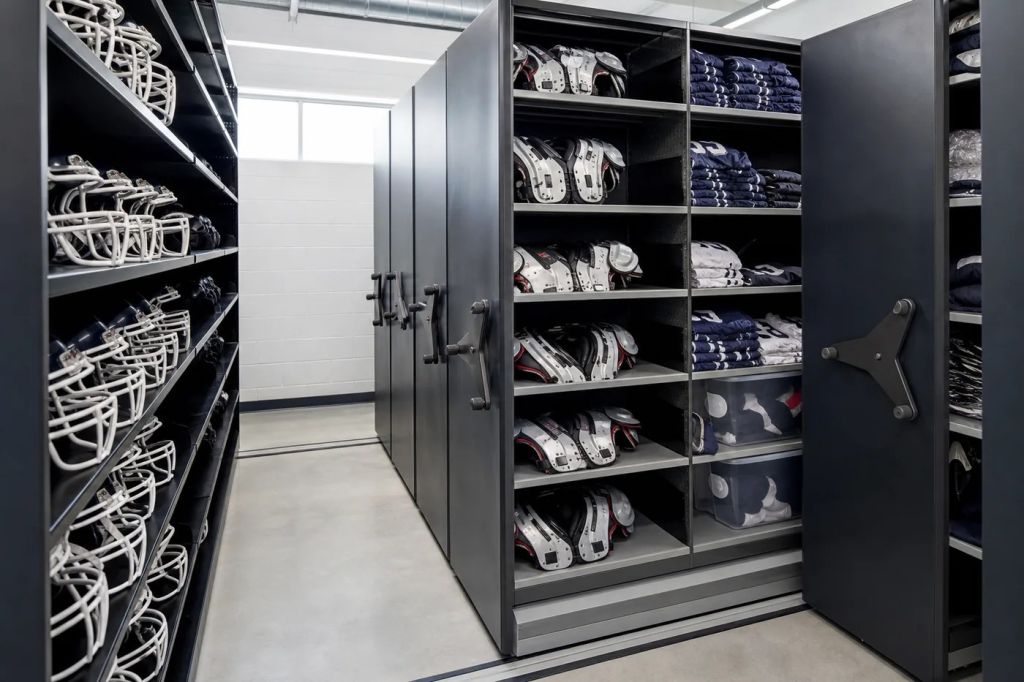
A crowded athletic storage room rarely stays contained. Basketballs roll under benches. Helmets and shoulder pads end up in loose piles. Uniforms, mats, bats and training gear all fight for the same floor. Coaches need gear fast, and the facilities team needs safe paths, clean equipment and a clear record of what needs repair.
That is why athletic equipment storage mobile shelving for Utah schools is a planning decision, not a shelf purchase. Mobile shelving puts storage on carriages that roll on floor rails, so one open aisle serves many rows. That frees floor space, but the layout still has to handle access, cleaning, sprinkler clearance, seismic safety, the floor, and daily traffic. This guide walks Utah athletic directors, facility managers and purchasing teams through each of those steps.
Key points for Utah schools
- Keep daily-use gear in an open zone. Put seasonal, reserve and high-value gear on the mobile carriages.
- Utah school rules require athletic equipment to be kept clean, safe and in good repair, so plan shelves that make cleaning easy.
- Utah’s school facilities manual says earthquake mitigation must meet IBC rules for nonstructural components, including items stored on shelves.
- Keep storage at least 18 inches below sprinkler deflectors, and keep at least one of each storage type within ADA reach range.
- Start with a fast first layout in the free Mobile Shelving Layout Planner.
The Reality of School Athletic Storage
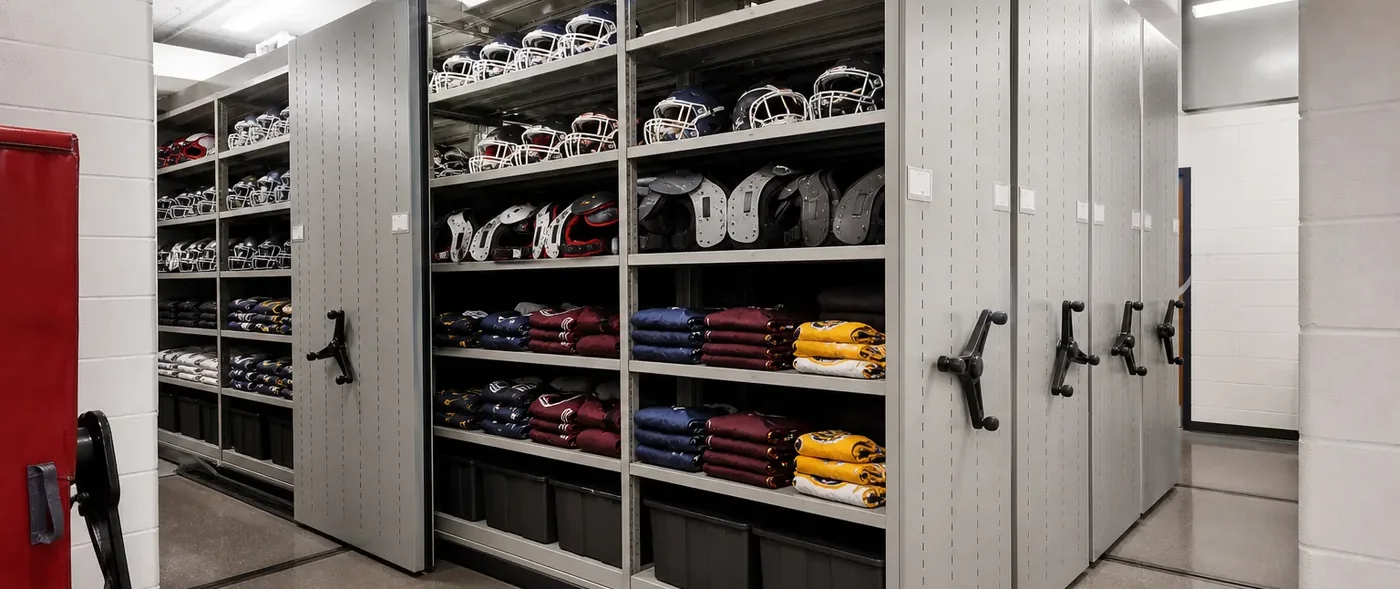
A school equipment room serves many people at once. A coach needs practice balls right now. An equipment manager is sorting helmets for inspection. A custodian needs to clean the floor. When fixed shelves line the walls and fill up, overflow ends up on the floor or in front of the door. Gear gets damaged, paths get blocked, and nobody can see what is there.
Mobile shelving changes that pattern. The shelving sits on carriages, and staff open one working aisle at a time. When the aisle closes, the room gets its floor back. The density only helps, though, if the shelves still load safely, carry clear labels and let people grab gear fast.
Tracking school equipment is not new in Utah. The Utah Division of Archives and Records Service holds Ogden School District equipment and supply inventory files from 1950 to 1968. The district used those lists to track what each school held and to plan replacements (see also these historical school equipment inventory records). Today’s systems follow the same idea with adjustable shelves, labels, controlled access and layouts built around how the gear is used.
Practical rule: Start with the workflow, not the catalog. The right system makes the next issue, inspection, cleaning and return easier.
This guide covers what Utah schools store, how mobile options compare, what to measure, and which safety questions belong in the quote. For the full range of products, see our athletic equipment storage solutions.
What Utah Athletic Programs Actually Need to Store
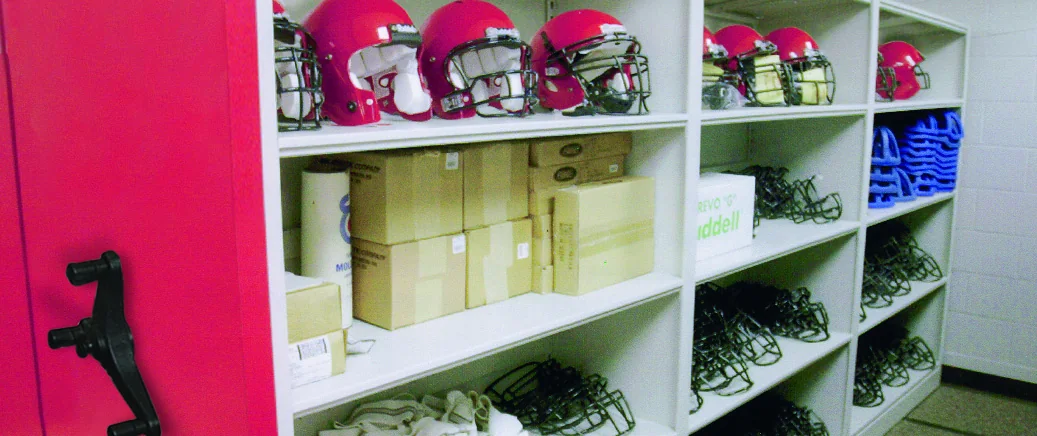
Athletic rooms almost never hold one kind of load. One room can hold soft goods, hard protective gear, long sticks and bats, rolling carts and big training pieces. Each group needs a different shelf depth, opening, support and cleaning routine.
| Gear group | Examples | Best storage approach | Watch for |
|---|---|---|---|
| Protective equipment | Football helmets, shoulder pads, catcher’s gear, shin guards | Open shelves with enough height to lift items out; room for inspection | Heat and crushing; follow the helmet maker’s storage and reconditioning steps |
| Balls and small gear | Basketballs, soccer balls, volleyballs, cones, pinnies | Labeled bins or ball bins on shelves, one bin per sport | Loose items rolling into aisles |
| Uniforms and textiles | Game jerseys, practice gear, towels, warmups | Hanging rods, cubbies or open shelves; lockable doors for game uniforms | Damp items stored before they dry |
| Long or awkward items | Bats, hockey and lacrosse sticks, poles, hurdles, nets | Vertical dividers, bat bins or a dedicated rack zone | Items sticking out past the carriage face |
| Bulky training items | Mats, sleds, blocking pads, equipment trunks | Open floor zone, wire cage or vertical trunk lift | Heavy loads on shelves not rated for them |
| Event and maintenance supplies | Game-day kits, spare parts, cleaning supplies | Fixed shelving near the door or a separate closet | Chemicals stored next to uniforms |
Fixed shelving works fine for even cartons and labeled bins. It works less well when big items mix with small ones. Fixed aisles eat floor space, and odd shapes leave gaps. A shelf can look full and still be hard to use if a mat or trunk blocks the gear behind it.
Cleaning matters too. Utah’s school rule, R392-200-7, says athletic equipment must be kept clean, safe and in good repair. Give each shelf enough height so staff can lift out helmets, pads and uniforms without emptying the bay. Wire or open shelves help gear air out. Solid shelves are better for dense boxes and heavy cases.
Inventory tracking ties it together. Many teams pair shelf labels with a best sports management platform to log what is issued, what is out for repair and what has been retired.
Before you ask for a layout, sort the inventory into daily use, seasonal, high value, oversized, needs inspection, quarantined and retired. Note rough sizes, how each item is handled and how often it is used. That list tells a designer far more than room size alone.
Mobile Shelving Configurations and Trade-Offs
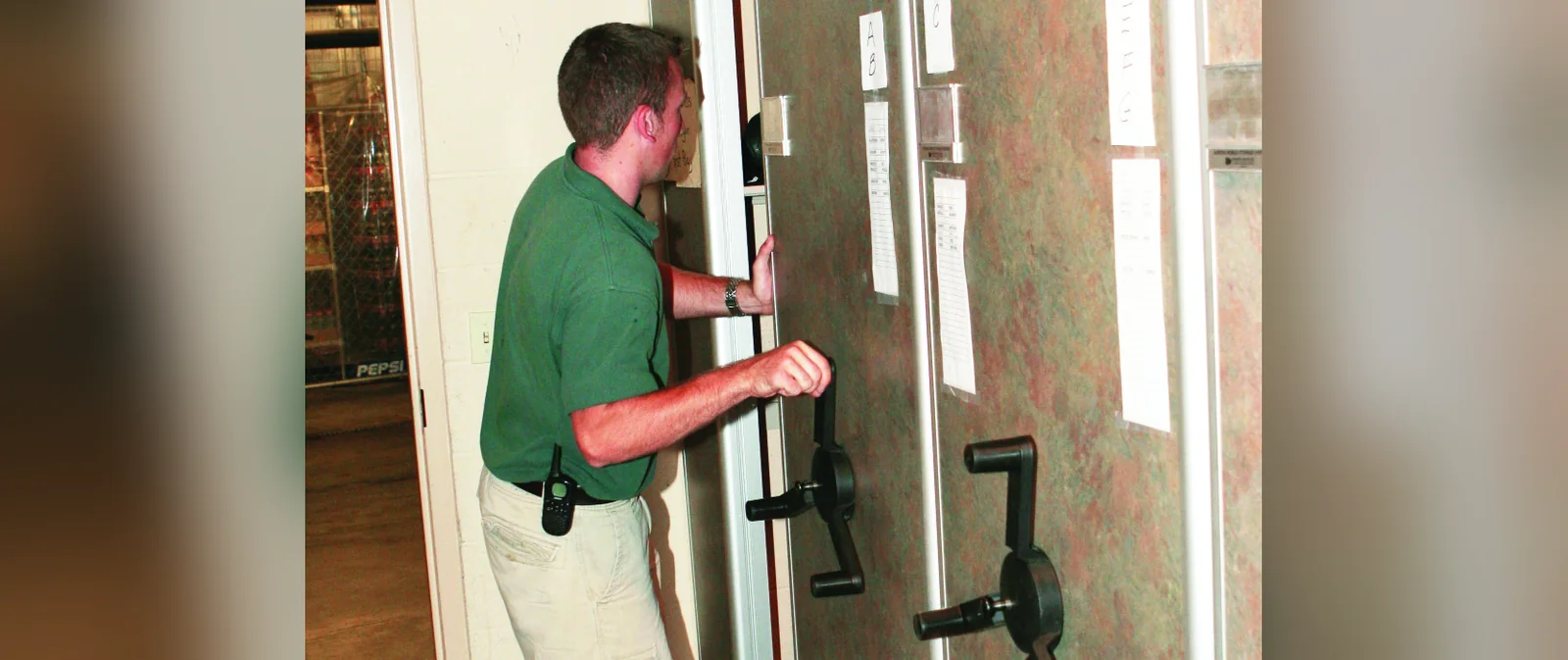
The real choice is not just mobile versus fixed. It is how the carriages move, what the shelves are built to hold, and how fast staff can reach gear on a busy practice or game day.
Manual systems are pushed or pulled by hand. They suit short ranges with light loads and occasional access. Mechanical-assist mobile shelving adds a geared handwheel, so a small hand effort moves a heavy carriage. That makes it a common fit for loaded athletic rooms. Powered mobile shelving opens aisles with push-button controls. It suits long or heavy ranges, very frequent access, or users who need push-button operation, but it adds electrical work, controls and service. Our manual vs. mechanical-assist vs. powered comparison covers the trade-offs in more depth.
Shelf type is the second choice. Open and wire-style shelves give airflow and visibility for uniforms and pads. Solid steel shelves give a stable surface for boxes, cases and dense loads. Many rooms need both.
| Configuration | Best for | Key advantage | Main trade-off |
|---|---|---|---|
| Manual mobile shelving | Short ranges, light loads, occasional access | Simple, quiet, fewest parts | Hard to move as loads and range length grow |
| Mechanical-assist mobile shelving | Mixed athletic gear and regular access | Easier carriage movement without powered controls | Staff still turn a handwheel; train users on safe operation |
| Powered mobile shelving | Long or heavy ranges, frequent access, push-button needs | Push-button aisle access | More project scope, power and service needs |
| Open or wire shelves on carriages | Uniforms, pads, balls, visible gear | Airflow, visibility, easy adjustment | Small loose items need bins |
| Solid steel shelves on carriages | Boxes, cases, spare stock, heavy gear | Solid support for concentrated loads | Less airflow and visibility |
| Fixed open zone (no carriages) | Daily-use balls, first aid, cones | Instant access with no aisle to open | Uses more floor per item stored |

Accessories make the carriages fit the sport. Aurora’s athletic literature lists uniform hangers, shelves, doors, drawers and locker cubbies for its mobile systems, plus color matching to school colors. Lockable doors on end sections help protect game uniforms and high-value gear. See our Aurora K-12 school storage page and the full Aurora high-density mobile shelving line for options.
The best room usually mixes these. Daily-use balls and first-aid supplies sit in an open bay. Seasonal uniforms and high-value gear go on the mobile carriages. Long equipment should not be forced onto short shelves just to make the plan look dense. For the basics of how a system works, read our complete guide to mobile shelving.
Want to see how much gear your room can hold?
Enter your room size in the free Mobile Shelving Layout Planner to see a first layout, or call (800) 326-4403 and our Utah team will review your equipment room with you.
Sizing, Layout and Accessibility
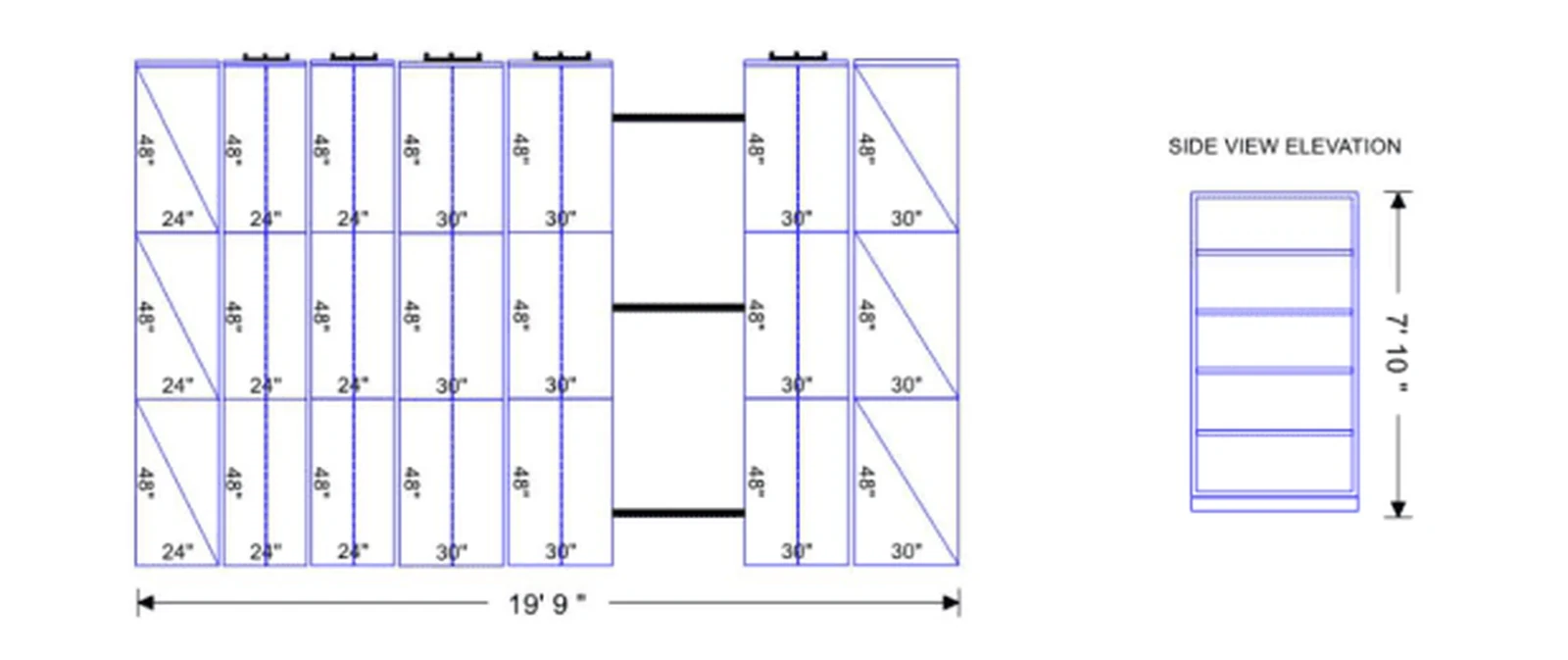
A good layout starts with a measured room, not a guess. The open aisle has to fit the biggest cart or equipment trunk used in the room, not just a person walking empty-handed. Handles, end panels and stored gear must not stick out into the walking path when a carriage moves.
How to size an athletic mobile shelving system
- List the inventory. Group gear by type: protective equipment, balls and small gear, uniforms, long items, bulky items and supplies. Note size, weight and how often each group is used.
- Split daily use from reserve. Daily-use gear goes in an open zone near the door. Seasonal, reserve and high-value gear goes on the mobile carriages.
- Measure the room. Record length, width, ceiling height, doors, columns, drains, outlets, sprinkler heads, floor transitions and the path carts take.
- Check the floor. Note the slab type, any slope or cracks, and whether the rail will sit on the slab with a ramp or be recessed flush.
- Set the aisle width. Size the open aisle for the largest cart or equipment trunk, plus the accessible route the room needs.
- Set shelf height and depth. Match shelf openings to the gear, keep daily items within reach, and keep the tops of storage at least 18 inches below sprinkler deflectors.
- Pick the drive type. Choose manual, mechanical-assist or powered based on carriage load, range length, how often staff open aisles, and who will use it.
- Review safety and seismic needs. Confirm anti-tip design, end stops, locks, aisle safety features and the anchorage the design team requires.
- Get a scaled layout and quote. Test the plan in the Mobile Shelving Layout Planner, then ask for a scaled drawing and a written quote.
Floors matter more than most buyers expect. Rails can sit on the slab with small ramps, or they can be recessed so the floor stays flush. Our guide to mobile shelving floor load requirements explains what to check before you commit.
Plan around how people use the room
Sort gear by how often and how urgently it is needed before you assign shelves. Daily-use balls, cones, first-aid supplies and common uniforms belong closest to the door. Seasonal or high-value gear can sit in the mobile section, as long as staff can open that aisle without moving unrelated gear.
Keep a permanent open path where the route needs one. A dense plan that makes a coach wait for another user, reach over a cart or move loose gear is not efficient in real life. It also creates problems for users with disabilities.
Check reach, controls and protruding objects
The 2010 ADA Standards for Accessible Design set the baseline. Where storage is provided in an accessible space, at least one of each type of storage element must sit within the 15 to 48 inch reach range (sections 225.2 and 308). Controls such as handwheels, locks and push buttons must work with one hand, without tight grasping, pinching or twisting of the wrist, and with no more than 5 pounds of force (section 309). Objects with leading edges between 27 and 80 inches above the floor may stick out no more than 4 inches into a circulation path (section 307).
Ask your supplier how much force it takes to start a loaded carriage moving, and where the controls will sit. Our ADA aisle planning guide for mobile shelving walks through aisle widths and control placement.
A good layout review answers these questions:
- Can a coach get common gear without unloading another bay?
- Can a person using a wheelchair reach the needed shelf and turn safely?
- Can staff inspect and clean helmets and pads in place?
- Does an open carriage block a door, exit, hallway or work route?
- Can users tell ready, needs repair, quarantined and retired gear apart at a glance?
The goal is not the highest shelf count. The goal is a room that stores more useful gear while keeping movement safe and retrieval fast.
Utah Safety, Seismic and Code Requirements
More density is not automatically safer. Closing aisles adds capacity, but a poor plan can create pinch points, block exits, slow emergency access, or leave tall storage unstable around students and visitors.
Plan for earthquakes
Much of Utah’s population lives along the Wasatch Front, near active faults mapped by the Utah Geological Survey. The Utah State Board of Education School Construction and Facilities Resource Manual tells school districts and charter schools to find and fix nonstructural earthquake hazards. It lists cabinetry, furnishings and items stored on shelves, and it says earthquake hazard mitigation shall meet the IBC rules for nonstructural components.
So treat a mobile shelving system as a building component. Review the rails, anti-tip design, anchorage, clearances, loaded height and how stored gear is held on the shelf. Ask for engineering and installation documents instead of assuming a standard unit fits every campus. Our Utah seismic planning guide for mobile shelving and mobile shelving seismic anchoring requirements page are good starting points.
Coordinate fire protection
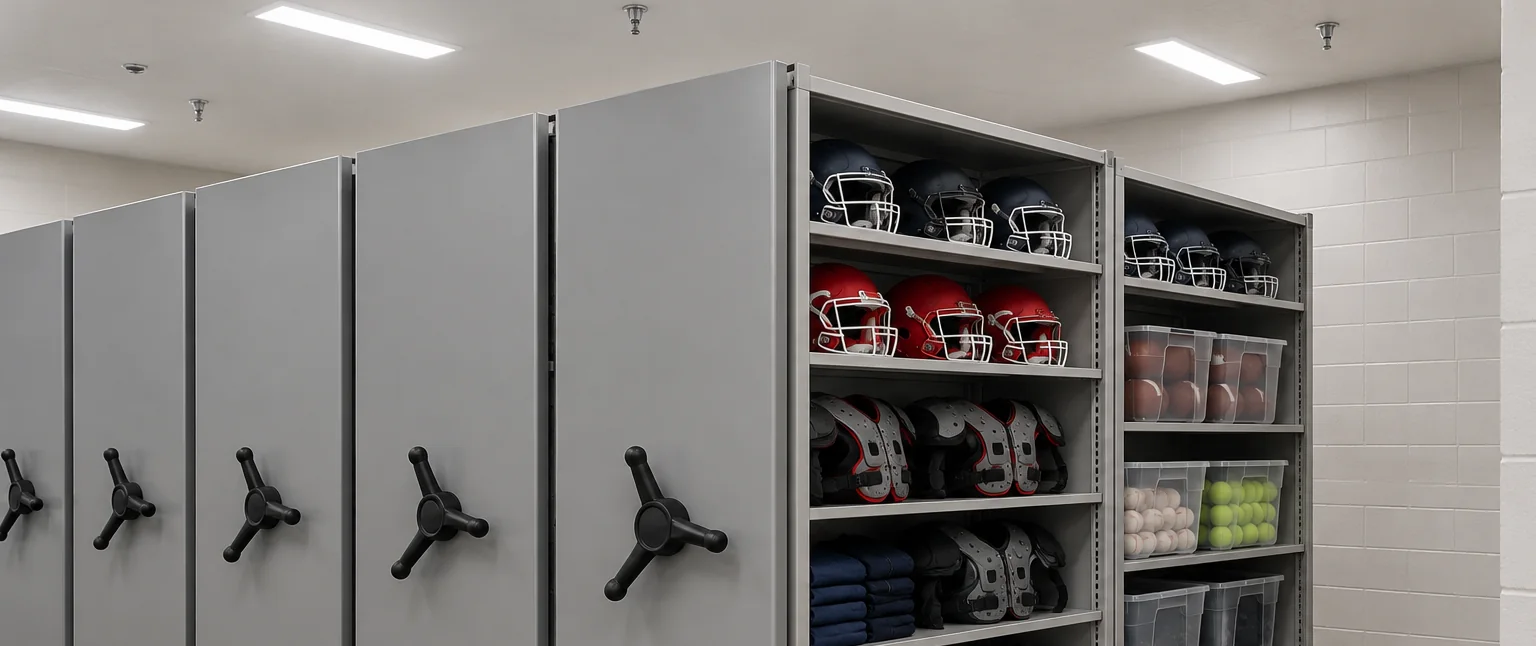
Get the room’s sprinkler layout before you pick shelf height. International Fire Code section 315.3.1 requires storage to stay at least 18 inches below sprinkler deflectors in sprinklered areas, and at least 2 feet below the ceiling where there are no sprinklers. A taller system may look good on paper but can fail inspection if it blocks sprinkler coverage. Confirm the details with your local fire official.
Keep halls, stairs, doors and exits clear, even when a carriage is open for loading. Ask about end-of-travel stops, anti-tip design, carriage locks and aisle safety features. Our guide to mobile shelving safety features explains what each one does.
Make cleaning part of the design
Shared athletic gear can spread skin infections. The CDC’s MRSA prevention guidance for athletic facilities tells coaches and athletic directors to clean shared equipment routinely. Plan shelf spacing so staff can remove, inspect and disinfect helmets, pads, mats and uniforms without making a pile on the floor, and so damp gear can dry.
Safety check: Test the system under a real load before the room goes back into use. Open every carriage, test the controls and locks, confirm that paths and exits stay clear, and review emergency access.
A seismic and safety review matters most in older gyms, converted rooms, and spaces where heavy gear raises the stakes of a shift or tip-over. The densest plan is only a good plan if it stays stable, accessible, cleanable and easy to use.
Utah Example: Weber State University Athletics Storage

Weber State University’s North End Zone Building at Stewart Stadium in Ogden needed space-efficient storage for athletics equipment as part of new construction. Material Handling USA supplied a mechanical mobile shelving system with five shelf levels per section and laminate end panels.
Because the room was built new, a wood sub-floor was built to recess the floor rail flush with the finished floor, so the room has no ramp. The work was coordinated through the general contractor, Big-D Construction, and delivery and installation took about six weeks. Read the full Weber State athletics mobile shelving case study.
The lesson for other Utah schools: if a new gym, stadium or field house is on the drawings, plan the storage room early. A recessed rail is much easier to build in during construction than to add to an existing slab later. For an existing room, a small ramp at each rail is the usual approach. We also serve the area through our Ogden mobile shelving team.
Installation and Procurement Steps
Installation takes more than dropping shelves at the door. The team has to confirm floor condition, rail mounting, clearances, door access and where building services run. Maintenance staff should also flag any work that must happen before installers arrive.
Lead times depend on the system size, finishes, accessories and drive type, so ask for a written schedule with the quote. Plan delivery around the school calendar and the window when the equipment room can be out of service, such as summer or a season break.
- Inventory the room. List gear groups, sizes, weights, how often each is used and how it is cleaned.
- Measure the site. Record room size, openings, floor transitions, sprinkler locations and power.
- Request a layout. Send the floor plan and inventory list so the designer can test aisles, shelf placement and clearances. Our free floor plan review is a simple way to start.
- Review the quote. Confirm configuration, loaded capacity, drive type, controls, anchorage, delivery, installation and handover testing.
- Schedule the work. Line up delivery and installation with an off-season, break or other approved access window.
Material Handling USA offers free layouts and designs with no obligation, plus free quotes for school storage projects. Ask for the design before you commit to a configuration. Early planning helps you hit the install window instead of fighting a season that is already underway. For budget planning, see our guide to Aurora mobile shelving cost per square foot.
Decision Guide
Use this guide while the room and budget are still taking shape.
- Small room with light gear: Consider manual or mechanical-assist mobile shelving, adjustable shelves, bins and a dedicated spot for long gear.
- Heavy or mixed gear: Favor mechanical-assist, stronger shelves and a layout that separates dense cases from soft goods.
- Frequent access or accessibility needs: Review powered movement, reachable shelf heights, clear floor space and control placement.
- High-value or restricted gear: Combine a locked room with lockable doors on carriage sections. Athletic facility guidance supports layered security through locked doors, controlled key access and adult visibility (athletic facility planning guidance).
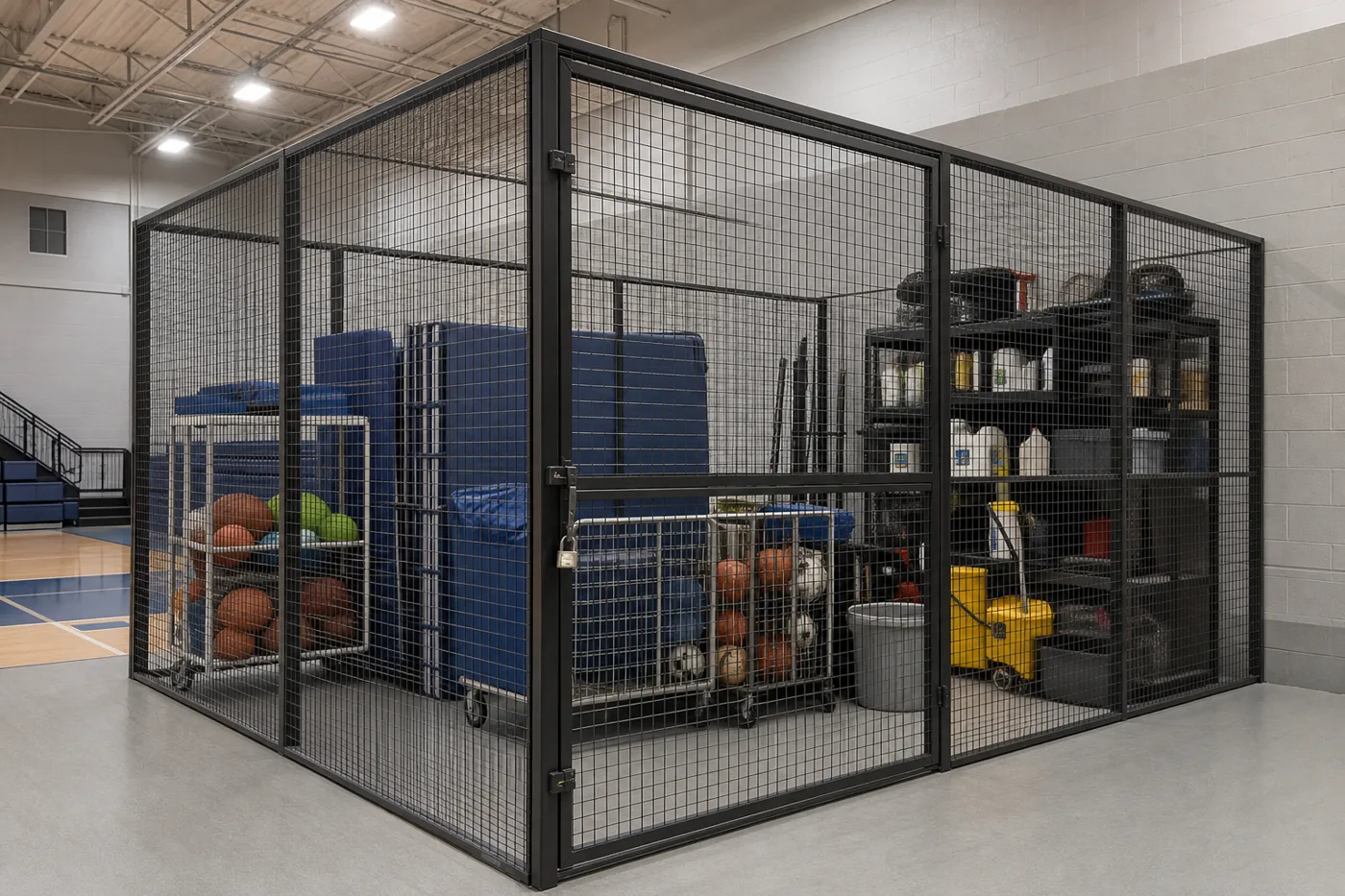
- Mats, carts and wheeled trunks: Keep them off the shelving. A wire security cage or a vertical sports equipment storage lift may fit better.
- Older or altered building: Ask for seismic, anchoring, floor, sprinkler and installation reviews before you approve the final design.
Schools often find the same planning helps other rooms too. See how mobile shelving works for theater costume and prop storage and in a Utah school records room.
Frequently Asked Questions
Is mobile shelving a good fit for a school athletic equipment room?
Yes, for most rooms. It packs helmets, pads, uniforms, balls and cases into fewer aisles. It works best when daily-use gear stays in an open zone near the door and the mobile carriages hold seasonal, reserve and high-value equipment.
Should a school choose manual, mechanical-assist or powered mobile shelving?
Manual fits short, light ranges that are opened now and then. Mechanical-assist uses a geared handwheel and is the common choice for loaded athletic rooms. Powered fits long or heavy ranges, very frequent access, or users who need push-button operation.
Does mobile shelving in a Utah school need a seismic review?
Yes. The Utah State Board of Education facilities manual says earthquake hazard mitigation must meet the IBC rules for nonstructural components, and it names items stored on shelves. Have the design team review rails, carriages, anchorage, loaded height and contents.
How far below the fire sprinklers should shelving stop?
The International Fire Code requires storage to stay at least 18 inches below sprinkler deflectors in sprinklered areas, and at least 2 feet below the ceiling where there are no sprinklers. Check the local fire official’s requirements before you set shelf height.
What accessibility rules apply to athletic storage?
Under the 2010 ADA Standards, at least one of each type of storage element must sit within the 15 to 48 inch reach range. Controls must work with one hand, without tight grasping or wrist twisting, and with no more than 5 pounds of force.
Can mobile shelving hold long or bulky items like bats, sticks and mats?
Some of it. Bats, sticks and poles can go in vertical dividers or bins on a carriage. Mats, sleds, carts and large trunks usually belong in an open floor zone, a wire cage, or a vertical lift built for wheeled trunks.
How should helmets, pads and uniforms be stored for cleaning?
Give each shelf enough height to lift gear out without unloading the bay. Use open or wire shelving where gear needs to air dry. Utah school rules require athletic equipment to be kept clean, safe and in good repair, and the CDC advises routine cleaning of shared equipment.
What should a school ask for in a mobile shelving quote?
Ask for a scaled layout, shelf and carriage sizes, loaded capacity, aisle widths, drive type, safety devices, anchorage and seismic scope, floor or ramp treatment, delivery, installation, training and service terms.
Plan Your Athletic Storage Room
The right athletic equipment storage mobile shelving for a Utah school balances density with access, cleaning, sprinkler clearance, seismic safety and the way your coaches actually work. A careful layout helps you avoid paying for capacity staff cannot use, and it brings athletics, maintenance, safety and purchasing together early.
Start with the free Mobile Shelving Layout Planner, request a free layout and quote, or call (800) 326-4403 to talk through your room with Material Handling USA. You can also email Sales@MH-USA.com. See all our mobile shelving services in Utah.
Design it yourself, then get a quote
Use our free online design tools to plan the storage this article describes, then send the result to our team for pricing:
- Mobile Shelving Layout Planner for the high-density equipment storage
- Shelving designer for the fixed, daily-use gear zone
- Security cage designer for mats, carts and bulky gear