
Lifting and Material Transport Equipment
Lifting and material transport equipment should be selected around the complete handling task: what moves, where it starts, where it finishes and how people interact with it. Material Handling USA helps you compare pallet trucks, carts, positioning equipment, conveyors and lifting systems. Define the load and route first, then evaluate the equipment that can perform the work within its documented limits.

Define the load and the complete handling task
Load
Weight, dimensions and support.
Route
Starting point through final placement.
Cycle
Frequency, peaks and exceptions.
Begin with the object being handled, including its pallet, container, fixture or attachment. Record weight, dimensions, center-of-gravity information where relevant and the condition of the packaging. Include the largest and most difficult loads, not only the average item. A handling method that works for most products may still need a separate process for exceptions.
Describe the starting and finishing positions. Moving a pallet across a floor is different from placing it on a raised platform or presenting its contents at a workstation. Explain whether the load must be lifted, tilted, rotated, weighed or held in place. These functions should be identified before choosing an equipment category.
Observe the work as performed
Watch several complete cycles and record the actions that take time or require awkward handling. Include preparation, empty returns and cleanup. Staff may have developed workarounds that are absent from the written procedure. Understanding those workarounds helps identify the actual constraint rather than purchasing equipment for an idealized version of the task.
- Record load weight and dimensions with all supporting materials included.
- Identify the required travel distance and change in elevation.
- Note handling frequency, peak periods and available operating space.
- Describe the people, equipment and processes sharing the route.
Define the intended improvement in practical terms. It might be presenting parts at a better working height, reducing repeated carrying or moving pallets through a defined route. Avoid starting with a general promise to improve productivity. A specific objective makes it easier to compare alternatives and verify whether the selected equipment achieves the intended result.
Distinguish transport, positioning and elevated lifting

Different equipment categories solve different parts of the handling problem. Transport equipment moves a supported load between locations. Positioning equipment changes the load's working height or orientation. Elevated lifting systems raise or suspend loads within a defined operating arrangement. A project may need more than one function, but each should be evaluated explicitly.
Compare the required movement
| Required task | Equipment direction to investigate | Key selection question |
|---|---|---|
| Move goods across a floor | Cart, platform truck or pallet truck | Load support and route suitability |
| Present work at a useful height | Lift table or positioner | Capacity, travel and transfer method |
| Move repeat flows between stations | Conveyor system | Product behavior and process interfaces |
| Raise or suspend a load | Appropriate lifting system | Complete engineered arrangement and rated components |
Do not assume that equipment suitable for one movement can perform another. A low-lift pallet truck is not a rack-stacking device. A crane scale measures a load within a lifting arrangement; it does not by itself provide the lifting function. A spill deck provides containment and should not be described as general transport equipment without a product-specific basis.
Keep personnel access separate
Ladders, work platforms and personnel lifts have a different purpose from equipment used to move goods. Their selection depends on the task and applicable requirements for people working at height. Do not substitute a material-handling device for personnel access or assume a platform is approved for lifting people because it can support their weight.
When the task calls for a battery powered scissor lift, our guide on whether you can use a scissor lift while charging, battery runtime and charger power requirements covers the planning questions that come up before the lift arrives.
Use the supplier's documentation to establish the intended use of each product. If the task combines several functions, describe the interfaces and ask for a coordinated solution. Adding an accessory without reviewing the complete assembly can change the assumptions that made the original equipment suitable.
Choose carts and pallet trucks around the route

Carts and pallet trucks can support routine movement, but the route and load matter as much as nominal capacity. Check doors, corners, floor joints and staging locations. Include the space needed to turn and place the load. A product that fits through a doorway may still be difficult to maneuver once the load and operator are included.
Review wheels, loads and handling
Describe the floor surface, debris exposure and any moisture or temperature conditions. Ask the supplier to confirm the appropriate wheel and equipment arrangement for the application. Consider how the load is secured and whether its size restricts visibility. Keep loads within the manufacturer's instructions and the facility's operating procedures.
For pallet trucks, check the actual pallet entry and bottom-board arrangement. Include damaged or unusual pallets in the discussion so the operation can define an acceptance process. A common pallet size does not guarantee compatibility with every fork and wheel configuration. The load must remain suitably supported throughout entry, lifting and travel.
Compare manual and powered movement
Use travel distance, frequency, load and working conditions to evaluate whether manual or powered equipment is appropriate. Powered travel introduces battery, charging, training and maintenance requirements that belong in the project. Manual equipment still needs a suitable handling assessment and a route that staff can use without unreasonable effort.
For standard products, browse the verified Carts and Trucks store category, then check the exact item's specifications before ordering. For temperature-controlled pallet movement, review the electric pallet truck for cold rooms. A specialized environment needs an application-specific check rather than substitution from a general product category.
Evaluate lift tables and work positioning equipment
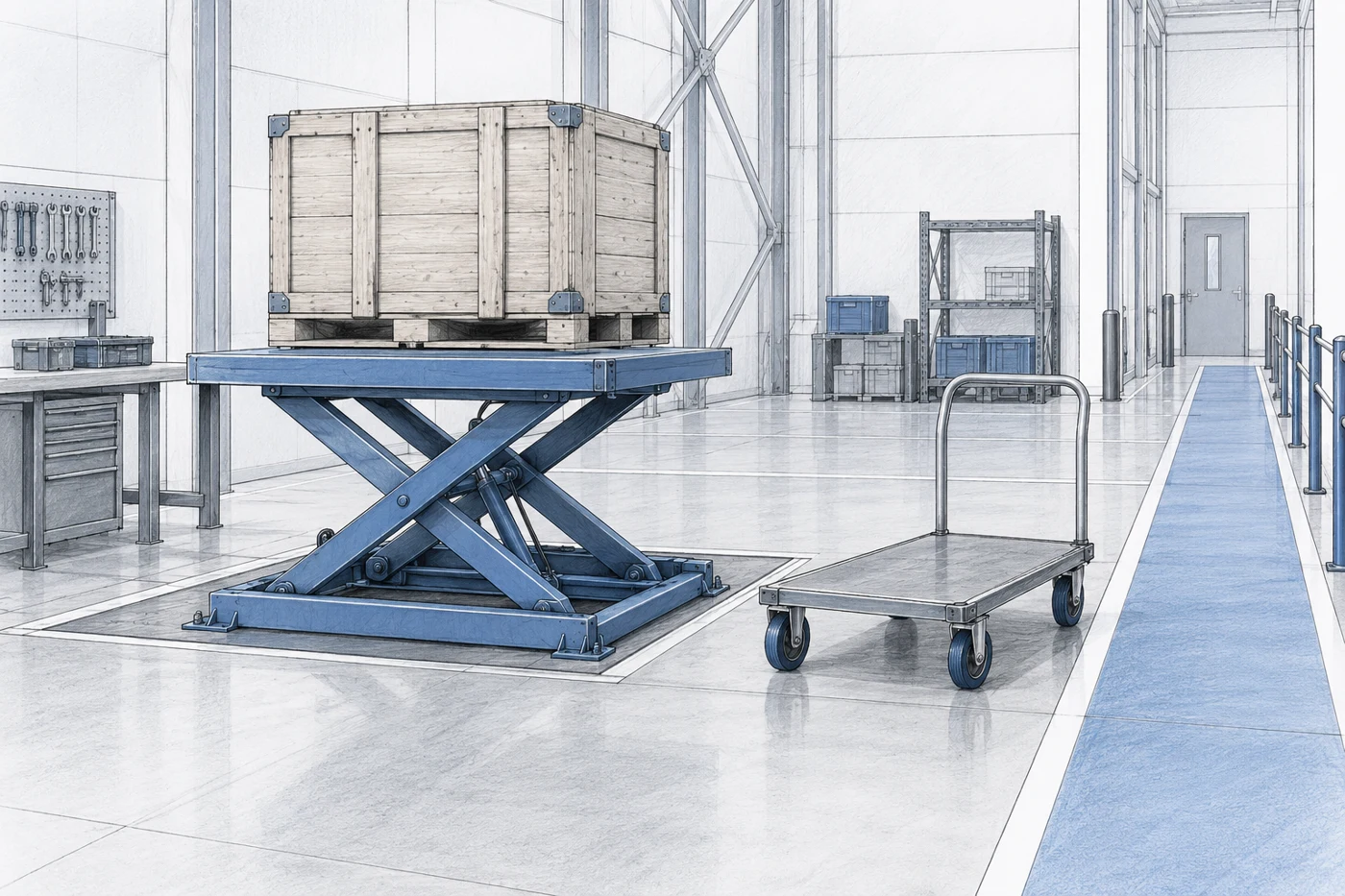
Positioning equipment can bring a load to a more useful working height or orientation. The selection should begin with the transfer process: how the load gets onto the equipment, what happens while it is there and how it leaves. A platform that reaches the desired height may still be unsuitable if the load cannot be transferred safely at either end.
Define the working envelope
Record the required lower and upper positions, platform size and load distribution. Identify whether the load is placed centrally, reaches beyond the platform or changes during the task. Include fixtures and accessories in the load information. Ask the supplier to confirm the proposed use rather than treating a nominal capacity as permission for every loading pattern.
Consider the operator's reach and the position of tools, parts and controls. Raising a load can improve one part of the task while creating another awkward movement if the workstation is not planned as a whole. Observe the full cycle and involve the people who perform it. A useful layout supports access to the work without requiring improvised standing surfaces or excessive reaching.
Review interfaces and maintenance
Check how carts, pallet trucks or conveyors approach the positioner. Identify gaps, changes in height and locations where hands or feet could be exposed during movement. Have the responsible supplier and workplace safety team review the arrangement, including guarding and controls appropriate to the actual application.
Keep inspection and service access available. Follow the manufacturer instructions for maintenance and any required isolation or support procedures. Never treat an elevated platform as a permanently supported work surface during service without the prescribed protections. The installation should make correct maintenance practical rather than forcing technicians to improvise access around nearby storage.
Assess conveyors as part of the process

A conveyor moves products between defined points, but successful selection depends on the processes at those points. Record product dimensions, weight, base condition and orientation. Include soft packages, irregular containers and the smallest items as well as uniform cartons. Different products can behave very differently on the same conveying surface.
Define the interfaces
Describe how products enter, accumulate and leave the conveyor. Identify upstream and downstream equipment, manual workstations and the consequences of a stop. A conveyor that moves faster than the receiving process can handle may simply relocate congestion. Compare the required flow through the complete line rather than specifying speed in isolation.
Ask how product changes affect guides, transfers and controls. If the facility handles several package sizes, define how changeovers occur and who performs them. Include rejected or damaged goods and a practical method for resolving jams under the applicable procedures. Exceptions are part of the design, not unusual events to ignore during selection.
Review the surrounding work area
Conveyors can change pedestrian routes, maintenance access and the way staff reach equipment. Include crossings, workstations and storage on the layout. Coordinate guarding, controls and emergency provisions with the responsible system designer and workplace team. A product photograph does not establish that the complete installation is appropriate for the site.
For related protection questions, review conveyor guard planning. Keep the conveyor and its protective measures in the same project discussion. Maintenance, cleaning and recovery access should remain practical while the equipment is used according to its documented operating procedures. The objective is a manageable flow of goods, with clear responsibilities when the normal process is interrupted.
Plan cranes, hoists and suspended-load applications
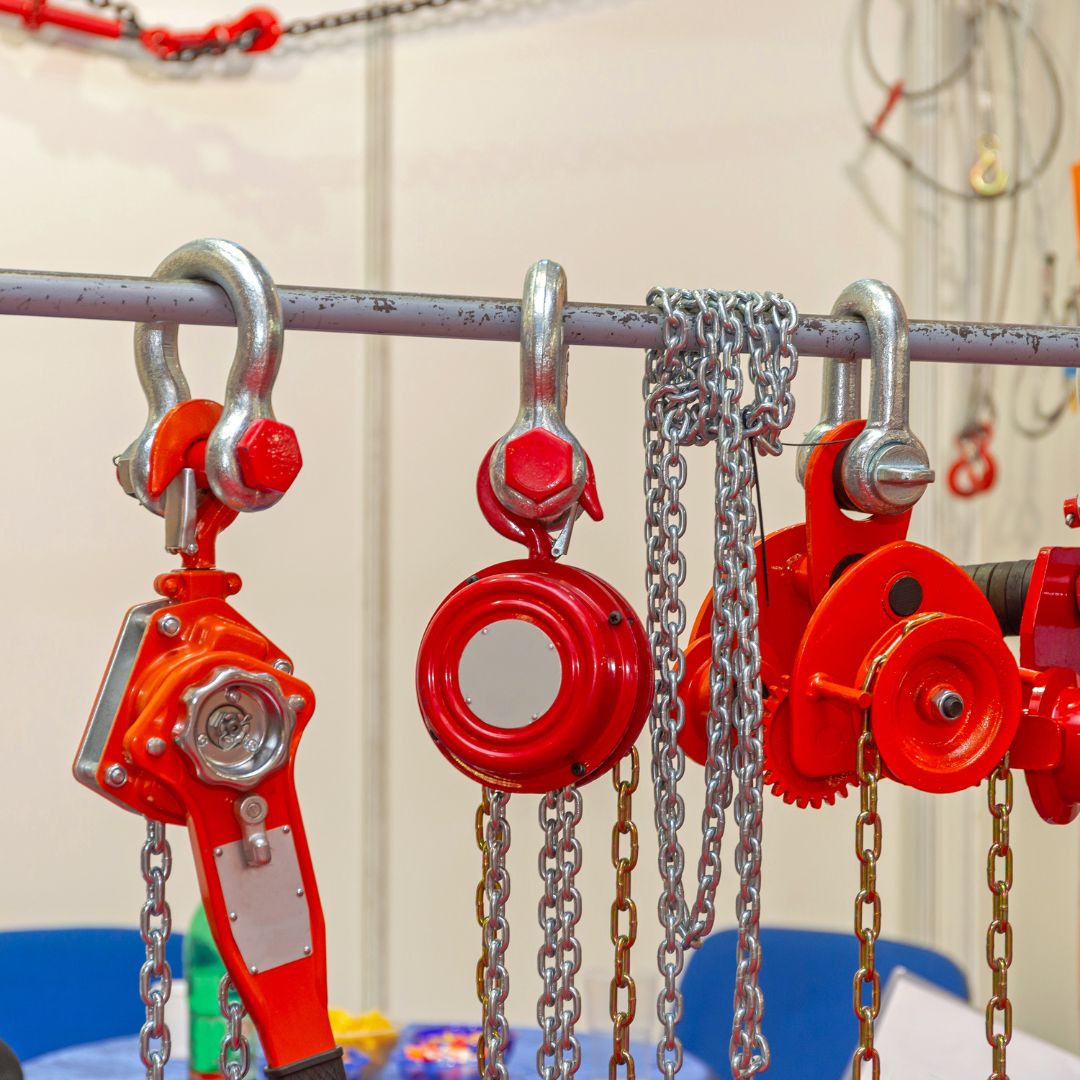
Suspended-load handling requires a complete review of the lifting arrangement. The load, supporting structure, hoist, attachments and operating area all matter. Do not choose a hoist by capacity alone or assume that an available beam is suitable for supporting it. The responsible qualified professionals should establish the requirements for the actual installation and use.
Describe the load path
Identify where the load is picked up, how high it must rise and where it is placed. Include the travel envelope and nearby obstructions. Provide information about the load's lifting points and any uncertainty in its balance. A clear description allows the supplier to identify what must be engineered or otherwise confirmed before equipment is selected.
If weighing is needed, treat the scale as a component of the lifting arrangement. Confirm compatibility, rated use and the effect on available headroom through the responsible supplier. Do not assume a scale, hook or attachment is suitable merely because its marked capacity exceeds the load weight. The complete assembly and use conditions determine suitability.
Establish operating and inspection ownership
- Identify who is authorized and trained to operate the equipment.
- Define inspection and maintenance responsibilities using the applicable instructions.
- Keep the operating area and load path within the approved arrangement.
- Establish how defects and changes in the load or task are escalated.
Avoid improvised lifting points or substitutions in a rated assembly. If the load changes, return to the selection review. A system chosen for a regular production part may not be appropriate for a different machine component or maintenance task. The project record should preserve the assumptions and documentation needed to make that review possible.
Compare safety, service and ownership requirements
Instructions
Use the exact model documentation.
People
Assign training and inspection ownership.
Support
Plan service and downtime arrangements.
Equipment becomes useful through a combination of suitable selection, trained use and dependable maintenance. Review those requirements before purchasing. The same handling task may be performed by different equipment, but the training, power, service and inspection needs can differ significantly. Include those differences in the comparison.
Use applicable guidance and manufacturer instructions
OSHA's powered industrial truck guidance addresses operator training and pre-shift inspections for covered equipment. The employer should establish the requirements that apply to its workplace and the equipment being used. A vendor's general statement about safety does not replace that responsibility or demonstrate that every possible installation is compliant.
Request the current operating and maintenance information for the exact model. Identify replacement parts, service contacts and the process for taking defective equipment out of use. Keep records that let the next shift understand the equipment's status. A fault report should lead to a clear decision, not leave staff guessing whether the product is available.
Compare the complete cost
Include equipment, freight, unloading, installation, utilities, training and any required professional services. Consider planned maintenance and likely downtime arrangements. If the work is essential, define how the operation continues while the equipment is being serviced. A spare, an alternate route or a different work sequence may need to be part of the plan.
Evaluate benefits using the actual workflow. Reduced handling time may increase capacity, improve consistency or reduce waiting without immediately changing staffing cost. State which outcome the business expects and how it will be measured. Avoid turning a generic efficiency claim into a guaranteed financial result for an application that has not yet been tested.
Prepare a quote brief and verify the completed task
Brief
Describe the difficult loads and routes.
Scope
Compare complete installed requirements.
Verify
Check the full handling task at handover.
A clear quote brief should let the supplier understand the complete movement without relying on assumptions. Include photographs, a layout and representative load information. Describe the starting and ending positions, frequency, route and environment. Identify any task that involves lifting people separately from material handling so the appropriate equipment can be evaluated.
Provide the difficult cases
Include the heaviest load, largest package, tightest turn and busiest operating period. State any temperature, moisture, dust or cleaning conditions. If the available information is incomplete, identify the gap and ask what must be measured. It is better to resolve an unknown load or floor condition than to build a quotation around an optimistic estimate.
Ask proposals to identify the exact model or system, supplied accessories and application assumptions. Compare inclusions for freight, unloading, installation, power and support. Confirm the current delivery schedule and what must be ready at the site. Separate delivery from the date the equipment can be safely placed into normal operation.
Test the complete workflow at handover
Confirm the supplied configuration and documentation, then introduce the equipment through the site's approved process with appropriately trained personnel. Verify representative loads and interfaces within the manufacturer's instructions. Record issues and resolve them with the supplier or responsible professionals before expanding use. Do not equate a powered-on device with a completed handling solution.
Keep the load and route assumptions with the equipment record. Reassess suitability when products, pallets, operating conditions or facility layouts change. Material Handling USA can help compare options from this information, with standard carts available through the store and more involved handling systems reviewed through a project discussion. The aim is equipment that completes the intended task and remains practical to operate and support.
Frequently asked questions
How do I choose the right material-handling equipment?
Define the load, starting and ending positions, movement frequency, route and environment. Then compare equipment intended for that complete task, including its operating and support requirements.
Is capacity the only important specification?
No. Load distribution, dimensions, support, travel, clearances and environmental conditions also matter. Confirm suitability for the actual application using the manufacturer's documentation and appropriate professional review.
Can a pallet truck be used for elevated rack placement?
A low-lift pallet truck is intended for pallet transport, not elevated rack placement. Describe stacking or raised-transfer needs separately so the correct equipment category can be considered.
Does a crane scale lift the load?
The scale measures load within an appropriate lifting arrangement. It does not replace the hoist, supporting structure or other components required for the complete lifting task.
Can material-lifting equipment carry people?
Do not assume so. Personnel access and lifting require equipment specifically intended and approved for that use, together with the applicable operating procedures and requirements.
Where can standard carts and trucks be purchased?
Use the Carts and Trucks link on this page to browse the store, then check the exact product's dimensions, capacity and intended use. Contact Material Handling USA for help with application-specific requirements.
Match Equipment to the Complete Handling Task
Share your application details, photographs and requirements with Material Handling USA to start a focused project discussion.