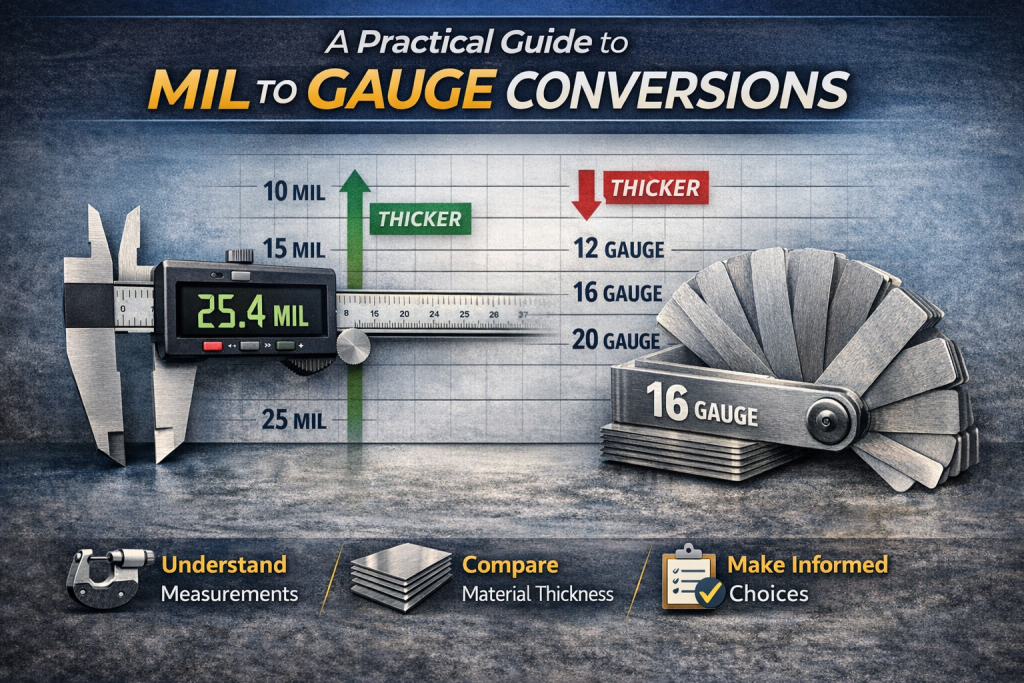
If you’ve ever found yourself staring at a spec sheet for industrial shelving or stretch film, you’ve probably run into two tiny words that cause a lot of confusion: mil and gauge. At first glance, they seem interchangeable. They both measure thickness, right? Yes, but they do it in completely different ways. Mixing them up is a common mistake that can lead to buying the wrong material—a flimsy pallet cover when you needed a heavy-duty one, or shelving that can’t handle your load capacity.
As a manager or buyer, understanding this distinction is crucial for making informed purchasing decisions that impact your budget, safety, and operational efficiency. Let’s clear this up once and for all.
Mil vs. Gauge: What’s the Real Difference?
The most important thing to remember is that these two systems are not the same. One is a straightforward, direct measurement, while the other is a relative scale that changes depending on what you’re measuring.
Confusing them can be a costly error. Imagine ordering 20-gauge steel for a security cage because you assumed it was stronger than 16-gauge. You’d end up with a much weaker enclosure, compromising security and potentially wasting your investment. Understanding the basics is your first line of defense against these kinds of purchasing mistakes.
What Is a Mil?
A mil is as simple as it gets. It’s a direct, linear measurement, just like using a ruler or a tape measure.
One mil is exactly one-thousandth of an inch (0.001″).
That’s it. No tricks or secret formulas. A higher mil number always means a thicker, more substantial material. It’s an intuitive system that makes comparing products easy. If you see a 4-mil poly bag, you know it’s exactly twice as thick and far more puncture-resistant than a 2-mil bag.
Because of its simplicity and precision, the mil system is the go-to for measuring flexible materials like:
- Stretch wrap and industrial films
- Pallet covers and shrink bags
- Heavy-duty poly sheeting and vapor barriers
What Is a Gauge?
This is where things get a little tricky. A gauge is an indirect, non-linear measurement system, and it works backward.
The most critical thing to know about gauge is its inverse relationship: a lower gauge number means a thicker, stronger material.
So, a 12-gauge steel shelf is significantly thicker and more robust than a 20-gauge steel shelf. It’s the opposite of what you might intuitively think, and it’s a classic trap for newcomers.
There’s another catch: the gauge scale isn’t universal. The actual thickness for, say, “14-gauge” is completely different for steel than it is for aluminum. Each material—steel, aluminum, copper wire—has its own standardized gauge chart. This is precisely why you can’t just plug numbers into a “mil to gauge converter” online and expect an accurate result. You must know the material you’re dealing with.
This diagram breaks down the fundamental difference.

As you can see, a mil gives you a hard number you can measure with calipers. A gauge gives you a relative number that you have to look up on a specific material chart to understand its true thickness.
Mil vs Gauge at a Glance
To make it even clearer, here’s a quick side-by-side comparison of the two systems.
| Measurement System | What It Measures | Scale | Common Materials |
|---|---|---|---|
| Mil | Direct thickness in thousandths of an inch. | Linear and direct. Higher mil = thicker. | Plastic films, poly bags, stretch wrap, liners. |
| Gauge | Relative thickness based on a material standard. | Inverse and non-linear. Higher gauge = thinner. | Sheet steel, aluminum, copper wire, security caging. |
This table is a great cheat sheet to keep in mind. If you’re dealing with plastics, you’re almost certainly talking about mils. If it’s metal or wire, it’s probably gauge.
Converting Steel Thickness for Racking and Shelving
When you’re outfitting a warehouse with pallet racking, industrial shelving, or security cages, the conversation quickly moves from abstract plans to physical steel. And in this world, the only measurement that really matters is the Manufacturer’s Standard Gauge for steel. Getting this right is fundamental to the safety, durability, and load-bearing capacity of your entire operation.
The first thing to remember is the inverse nature of the gauge system. A lower gauge number means thicker, stronger steel. It’s a bit counterintuitive, but it’s the law of the land. This means a 12-gauge steel upright is significantly beefier and more robust than a 16-gauge one. Making the wrong call here can lead to dangerous structural failures or paying a premium for over-engineered steel you simply don’t need.

From Gauge to Precise Measurement
To make smart, safe decisions, you have to translate those gauge numbers into measurements you can actually visualize. While the term ‘mil’ is usually reserved for thin materials like plastic film, converting steel gauge to mils gives us a common language for thickness. It helps you truly appreciate how much of a difference a couple of gauge points can make.
Common Steel Gauge to Mil Conversion Chart
Here’s a quick reference for the most common steel gauges you’ll encounter in material handling equipment. We’ve laid out the conversions to both inches and mils to give you a clear picture of what you’re working with.
| Steel Gauge | Thickness (Inches) | Thickness (Mils) |
|---|---|---|
| 10 Gauge | 0.1345″ | 134.5 mil |
| 12 Gauge | 0.1046″ | 104.6 mil |
| 14 Gauge | 0.0747″ | 74.7 mil |
| 16 Gauge | 0.0598″ | 59.8 mil |
| 18 Gauge | 0.0478″ | 47.8 mil |
| 20 Gauge | 0.0359″ | 35.9 mil |
A quick glance at the chart shows just how dramatic the difference is. Moving from 16-gauge to 14-gauge steel adds nearly 15 mils of thickness. That’s a significant jump in material and strength, which is why a solid grasp of these numbers is non-negotiable when you’re buying equipment where performance is defined by precise specs.
Applying This Knowledge in the Real World
Let’s ground this in a practical scenario. You’re tasked with selecting pallet racking for a new warehouse section, and the products being stored are heavy. Capacity is your top priority.
Scenario: You have to choose between 14-gauge and 16-gauge steel for your pallet rack uprights. The 16-gauge option is cheaper, but the 14-gauge is rated for a higher load.
A quick look at our chart tells you that 14-gauge steel is 0.0747 inches thick, whereas 16-gauge is a thinner 0.0598 inches. That small difference of 0.015 inches—or 15 mils—is what determines the structural integrity of the entire rack system. For a deeper dive into how these choices impact your setup, check out our guide to pallet rack specifications and design.
Choosing the thinner 16-gauge steel to save a few dollars upfront could result in a lower weight capacity, inviting serious risks like beam deflection or system failure under load. For any heavy-duty application, the thicker 14-gauge steel isn’t just a preference; it’s the responsible choice for ensuring long-term safety and performance.
Getting this right from the start is crucial. Our team can put together a free quote and layout design to make sure you get the right gauge for your specific loads. Proper planning helps you get installed faster and avoid the costly operational headaches that come from using underspecified equipment.
Decoding Wire Gauge for Cages and Partitions
When you’re talking about materials for wire decking, security cages, or server partitions, the conversation shifts from sheet steel standards to American Wire Gauge (AWG). It might be a different name, but the golden rule is exactly the same as with steel gauge: it’s an inverse scale.
Simply put, a smaller AWG number means you’re getting a thicker, stronger, and more secure wire. This is a critical detail to get right, as your choice directly impacts how durable and secure the final product will be.

Connecting Gauge to Real-World Security
Understanding the relationship between mil and gauge for wire isn’t really about direct conversions. It’s about appreciating what that difference in thickness means for functional strength. The jump from a 10-gauge to an 8-gauge wire might not sound like much on paper, but in a security application, it’s a world of difference.
While professionals in the electrical field rely on tools like Exayard electrical estimating software for precise calculations, our focus in material handling is all about physical resilience.
A thicker wire is inherently more difficult to cut, bend, or compromise. This makes a lower gauge wire mesh a much more effective deterrent against theft or unauthorized access.
Let’s look at two of the most common options to see how this plays out in the real world.
Practical Comparison: 8-Gauge vs. 10-Gauge
Imagine you’re tasked with building a secure enclosure for high-value inventory. You’ll likely be choosing between two primary options for the wire mesh:
- 10-Gauge Wire: This is a solid, standard choice for general-purpose partitions and basic storage lockers. It provides a reliable barrier for separating areas and offers a good baseline of security.
- 8-Gauge Wire: A true heavy-duty option that is noticeably thicker and more robust. This is the gauge you specify when security is the top priority, like for building evidence cages or protecting sensitive data equipment.
The 8-gauge wire offers substantially more resistance to bolt cutters and brute force. To see how these materials are integrated into complete systems, check out our guide to wire partitions. Choosing the right gauge from the start ensures your security solution can handle the real-world challenges it’s going to face.
Investing in the right spec upfront is key. Opting for a heavier gauge wire in a high-security area provides lasting peace of mind and saves you from costly upgrades down the road. With current material availability, planning ahead can also speed up your project timelines. Call (800) 326-4403 for a free quote to see how we can match your security needs with the right materials.
Using Mil Thickness for Packaging and Shipping
After wrestling with the backward logic of steel and wire gauge, you’ll find the world of packaging to be a breath of fresh air. Here, thickness is measured in a much more straightforward way: mils. When you’re talking about flexible materials like stretch wrap, pallet covers, and poly bags, the system is wonderfully simple.
A higher mil number always means a thicker, stronger, and more puncture-resistant product. There are no inverse scales or special charts. A 4 mil pallet cover is exactly twice as thick as a 2 mil one, making it easy to compare your options and choose the right material for the job.
Matching Mil to Your Application
The key is matching the mil thickness to the task at hand. You don’t want to overspend on an ultra-thick bag for light-duty storage, but skimping on a thin film for heavy, sharp objects is asking for damaged products and costly messes. Getting a feel for what each thickness is designed for helps you strike the perfect balance between performance and cost.
Let’s break down a few common scenarios.
Practical Examples for Common Packaging
To make this crystal clear, here are some real-world examples of how to pick the right mil thickness for your packaging supplies.
-
1 Mil Thickness: This is your lightweight champion. It’s perfect for protecting products from dust, dirt, and moisture inside your warehouse. A 1 mil pallet cover is ideal for items already secured on a pallet that just need a basic protective layer during short-term storage.
-
2-3 Mil Thickness: Here’s your versatile, medium-duty workhorse. A 2 mil poly bag offers solid puncture resistance for things like parts, hardware, or boxed goods. Stepping up to a 3 mil shrink bag gives you a stronger hold, making it great for bundling items or securing pallets with fairly heavy, uniform loads.
-
4 Mil+ Thickness: Now we’re in heavy-duty territory. A 4 mil pallet cover is built for tough jobs, like outdoor storage or protecting irregularly shaped loads that have sharp corners. This thickness provides excellent resistance to tears and punctures. For a deeper dive into all the options, check out our guide to flat poly bags.
The key takeaway is simple: mil thickness directly relates to puncture resistance and how well the film will contain your load. Understanding this helps you avoid overspending on packaging you don’t need while ensuring your products are always properly protected.
How to Choose the Right Material Thickness
Knowing the difference between mil and gauge is one thing, but actually putting that knowledge to work is where it really counts. This isn’t just about formulas; it’s about making smart purchasing decisions that directly impact safety, efficiency, and your bottom line.
Let’s bridge that gap between the spec sheet and your facility with a few common scenarios to help turn theory into a practical framework for making the right call every time.

Making the Call in Real-World Scenarios
Let’s apply these concepts to typical material handling needs. Each choice you make is a trade-off between cost, durability, and function, so getting it right matters.
-
When do you need 14-gauge steel for shelving?
If your facility is storing heavy, dense items—think tooling, machine parts, or full liquid containers—then 14-gauge is usually your starting point. That extra thickness provides the critical load capacity and rigidity to prevent dangerous shelf bowing. Trying to save money with a thinner 16 or 18-gauge shelf in this situation isn’t just a bad idea; it’s a serious safety risk. -
When is 10-gauge wire mesh essential for security?
For basic area separation or storing low-risk items, a lighter gauge might be fine. But when you’re securing high-value inventory, pharmaceuticals, or building an evidence enclosure, a lower gauge wire like 8-gauge or 10-gauge is the standard. Its thickness makes it far more resistant to cutting, prying, or tampering. -
When is 80-gauge (0.8 mil) stretch wrap the right choice?
This thickness is your go-to for securing heavy or irregular pallet loads. An 80-gauge film gives you excellent puncture resistance and load containment, ensuring pallets stay stable and secure during transit. For lighter, more uniform loads, a 60-gauge (0.6 mil) film could be a more cost-effective option.
This idea of matching material construction to its job isn’t limited to industrial settings. It’s just as critical in everyday items, as a practical guide to paper coffee cups points out by showing how different wall thicknesses impact performance and user experience.
A Practical Checklist for Buyers
Before you sign off on any purchase order, run through these key questions. It’s a simple gut check that ensures you’ve covered all your bases and are picking a material that will get the job done right the first time.
Decision Checklist:
- Load Capacity: What’s the absolute maximum weight this material needs to support? Always spec a gauge that’s rated well above your average load.
- Security Risks: How valuable or sensitive are the items being stored? Higher risks demand a lower gauge (thicker) material.
- Environmental Conditions: Will it be used outdoors or in a corrosive environment? Don’t just think about thickness; consider the finish, like galvanized versus painted steel.
- Frequency of Use: Is this for long-term, static storage or a high-traffic area? Durability is paramount for equipment that’s accessed frequently.
- Budget vs. Long-Term Value: Will a lower upfront cost compromise safety or force you to replace it sooner? Think total cost of ownership.
Making the right choice now prevents costly replacements, operational headaches, and dangerous failures down the road. It’s about investing in a solution that’s built for the job it needs to do.
We’re Here to Help You Get It Right
Making the right call on material thickness is the bedrock of a successful project. As we’ve seen, ‘mil’ gives you a straightforward thickness measurement, while ‘gauge’ is that tricky, material-specific, inverse scale. Getting this distinction right is the first step to sourcing equipment that’s both durable and cost-effective for your facility.
Nailing down your material needs today prevents expensive headaches and project delays tomorrow. When you specify the correct gauge for your shelving or the right mil thickness for your packaging film from the very beginning, you sidestep the logistical issues and surprise costs of returns and replacements. Businesses that finalize their plans sooner often benefit from faster installation timelines and avoid potential delays caused by supply chain fluctuations.
Get Your Project Started on the Right Foot
Let our experts take the guesswork out of these specifications for you. We offer free, no-obligation design and layout services to make sure every single component is a perfect match for your application, from load capacity to security needs. By tapping into our large inventory and planning ahead, you’re setting yourself up for a much faster project completion.
Choosing the correct material thickness isn’t just about checking a box on a spec sheet; it’s about investing in the long-term safety and efficiency of your entire operation. Our team is here to bring clarity and support you at every turn.
Don’t let confusing terminology derail your project. Connect with us, and let’s build a plan that puts quality and performance first.
You can Request a Quote online or give our specialists a call at (800) 326-4403 for a free consultation. Our team is ready to help you find the perfect solution with our competitive pricing and the fastest shipping in the industry.
Common Questions About Mil and Gauge
To wrap things up, let’s tackle a few questions that often come up when discussing mils and gauges. This quick rundown should clear up any lingering confusion and help you feel confident when you’re specifying your next project.
What’s the Difference Between Steel and Aluminum Gauge?
This is probably the most critical point to remember: different metals use entirely different gauge systems. The Manufacturer’s Standard Gauge for steel is not the same as the Brown & Sharpe (or American Wire Gauge) system used for aluminum and other non-ferrous metals. It’s an easy but costly mistake to make.
For example, if you order 10-gauge steel, you’ll get a sheet that’s 0.1345 inches thick. But if you order 10-gauge aluminum, you’re getting a much thinner sheet at just 0.1019 inches. Always double-check that you’re using the right chart for the specific material you need.
Why Is Wire Mesh Sold by Gauge Instead of Mil?
While you could technically measure the diameter of a single wire in mils, the entire industry—from manufacturers to suppliers—operates on the American Wire Gauge (AWG) system for wire products. It’s the established language everyone speaks.
Sticking to this standard eliminates confusion. When you specify an 8-gauge wire mesh for a security cage, everyone involved knows exactly what structural and security performance to expect. Using the correct industry terminology ensures clarity, consistency, and that you get precisely what you ordered.
How Does Gauge Affect the Price of Equipment?
It’s a direct relationship: a lower gauge number means thicker, heavier material, which means more raw steel was used to make it. Naturally, that increases the product’s price.
But it’s important to look beyond the initial price tag. That higher upfront cost often delivers a much better long-term return. Thicker steel provides significantly higher load capacities and far greater durability against the daily wear and tear of a busy warehouse. Investing in the right gauge for your application is an investment in safety, longevity, and operational reliability, helping you avoid premature replacements and costly downtime.
At Material Handling USA, our team lives and breathes these specifications. We’re here to help you navigate the details and make sure you get the right materials for your job.
Contact Us or give us a call at (800) 326-4403 for a free, no-obligation layout and quote.